The Scientific Examination of Athletic Taping: Does Kinesio Tape Really Work? A Coach Helps You Distinguish Claims from Evidence
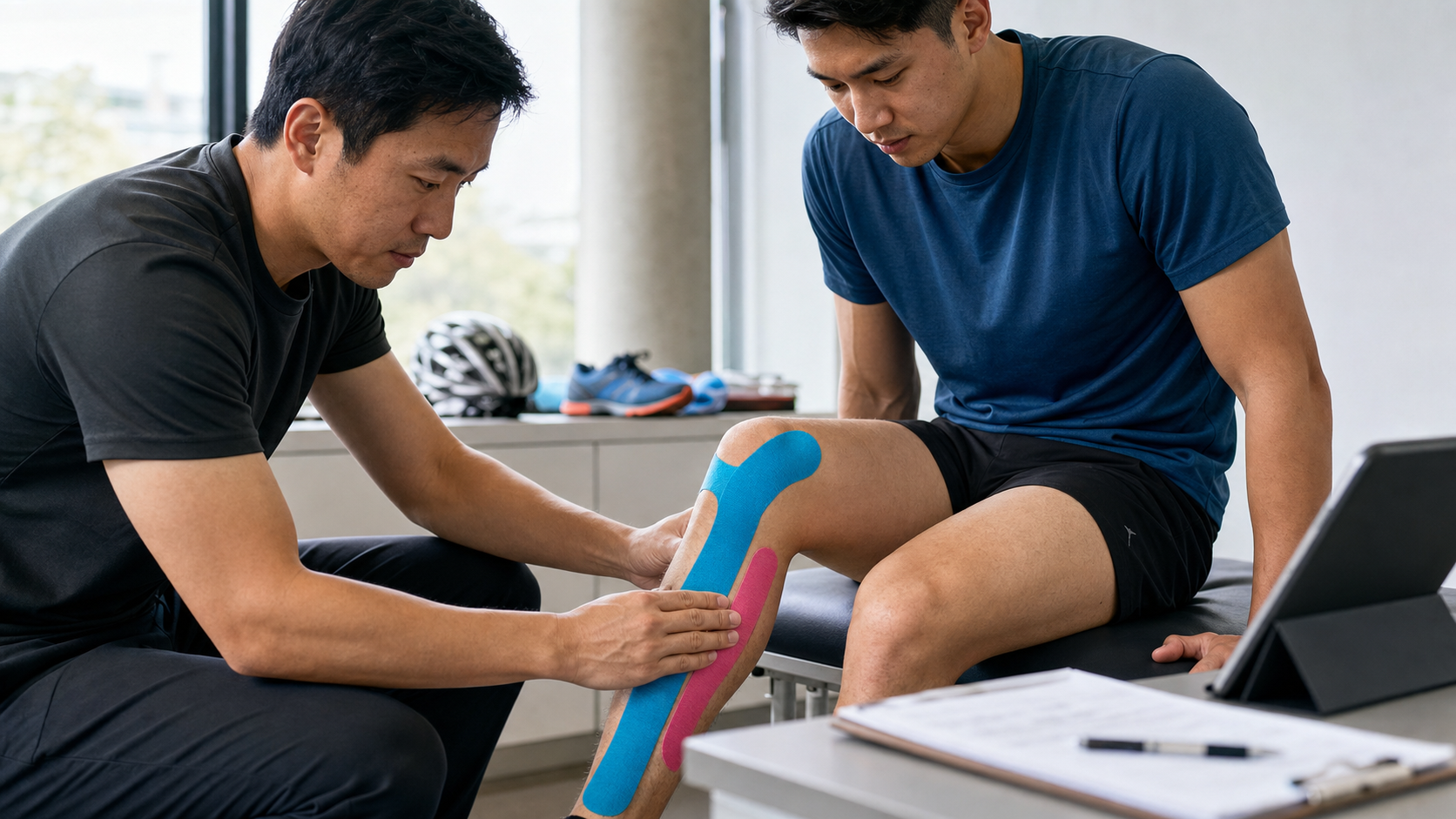
It Starts with a Pre-Race Taping Question
A few years ago, before a triathlon in Taipei, I ran into an amateur athlete in the transition area. His calves, lateral knees, and lower back were covered in blue, pink, and fluorescent green kinesiology tape, applied like works of art. I casually asked him, “What do you think these tapes are doing for you?” He answered honestly, “I don’t really know. I see other athletes wearing them, it feels professional, and I feel more at ease mentally after putting them on.”
That phrase, “I feel more at ease mentally,” actually touches on the most genuine aspect of kinesiology tape. Over the past decade-plus, I’ve coached athletes at various levels and general fitness enthusiasts, and I’ve continuously tracked literature in sports physiology, sports medicine, and rehabilitation. Kinesiology tape (often shortened to kinesio tape or KT) is one of the pieces of equipment I get asked about most, and the question is always the same: “Coach, does this actually work?”
In this article, I want to use my perspective as a coach and sports science consultant to break down kinesiology tape for you: what manufacturers claim it does, what the evidence-based research actually finds, and under what circumstances it’s reasonable to use it. I’m not going to tell you to throw all your tape away, and I’m not endorsing any brand. What I want to do is help you separate “marketing language” from “scientific evidence,” so that every dollar you spend and every strip you apply goes where it belongs.
Let me give the conclusion first for those in a hurry: Kinesiology tape is neither a miracle product nor purely a placebo tax on the gullible. In certain situations (pain in specific areas, proprioceptive reminders, psychological aspects), it may offer modest benefits. But for the claims most often used in marketing—“enhancing strength, improving athletic performance, preventing injury”—the empirical evidence is quite weak. Understanding this line will keep you from having the wrong expectations, while also preventing you from dismissing it entirely.
What Does Kinesiology Tape Actually Claim to Do?
To test whether something works, you first need to understand what it “claims” to achieve. Kinesiology taping originated in Japan in the 1970s. The original design concept was to mimic the elasticity and thickness of human skin, using a stretchy, extensible cotton tape applied to the skin’s surface, allegedly creating a cascade of effects through “lifting the skin.”
The mechanisms commonly claimed by products and teaching systems generally fall into the following categories:
Overview of Common Claimed Mechanisms
| Claimed Mechanism | Manufacturer/Teaching System’s Claim | My Practical Assessment |
|---|---|---|
| Lifting skin, increasing subdermal space | Tape recoil slightly lifts the skin, increasing the space between skin and fascia, promoting lymphatic and blood circulation, reducing swelling | The mechanism makes theoretical sense, but the actual displacement in the human body is extremely small, with limited clinical significance |
| Promoting lymphatic circulation, reducing swelling | Specific “fan” application patterns can drain tissue fluid, accelerating bruise and edema resolution | Swelling reduction is an area with relatively more room for discussion, but it’s still not conclusive |
| Stimulating skin sensory receptors, reducing pain | Through extensive tactile and proprioceptive input, overrides pain signals per “gate control theory” | This is what I believe is the most plausible explanation for subjective pain reduction |
| Enhancing weak muscles, inhibiting over-tight muscles | Taping along the muscle direction can “facilitate” muscle output; taping in the opposite direction can “relax” the muscle | This is the part marketing loves most, but where evidence is weakest |
| Providing joint support, preventing injury | Tape provides mild support and proprioceptive feedback, reducing sprain risk | Elastic tape provides far less support than rigid taping or braces |
| Enhancing athletic performance | Increasing muscle strength output, jump height, power | Evidence almost entirely does not support this; this is the claim most deserving of a question mark |
You’ll notice these claims range from “circulation” and “sensation” all the way to “strength,” “performance,” and “injury prevention”—an extremely broad scope. A thin piece of elastic cotton has been assigned functions spanning nearly every field of physiology. When a product claims to do everything, that’s usually when we should become more alert.
First, Understand: Kinesiology Tape Is Not the Same as “White Tape” or “Rigid Tape”
Many people lump together all the different tapes seen in sports, but their design purposes are worlds apart. Confusing them easily leads to wrong expectations for kinesiology tape. Let me clearly distinguish the three major categories of taping for you:
| Tape Type | Material Properties | Primary Use | Support Level | Common Misconception |
|---|---|---|---|---|
| Kinesiology tape (elastic tape) | Elastic, extensible, mimics skin thickness | Sensory input, adjunct pain relief, postural reminders, mild swelling reduction | Low | Mistakenly believed to fixate joints like a brace |
| Rigid athletic tape (white tape/non-elastic) | Almost no elasticity, high rigidity | Restricting joint movement, fixation, acute-phase protection | High | Mistakenly believed suitable for long-duration training wear |
| Elastic bandage | Moderate elasticity, wrap-around style | Compression, swelling reduction, temporary fixation | Medium | Mistakenly believed the tighter the wrap, the better |
The key takeaway from this table: when you need “joint fixation or movement restriction” support, kinesiology tape is not the right tool. After an acute ankle sprain where you need to restrict joint movement, or in situations requiring rigid protection, rigid white tape or a brace is the main solution. Kinesiology tape’s role has always leaned more toward “sensory-level assistance” rather than “mechanical-level fixation.” Many people are disappointed because they initially used it for something it was never designed to do.
What Does the Evidence-Based Research Actually Find?
In recent years, a substantial body of randomized controlled trials (RCTs) and systematic reviews (high-level evidence that integrates multiple studies) on kinesiology tape has accumulated. Let me organize the key points into several areas, describing them in terms of “trends” rather than falsely precise numbers, because study quality, body parts, and taping methods vary widely—forcing a single unified number would actually be misleading.
One: Pain—May Help a Little, but Often Below Clinical Significance
This is the area where kinesiology tape is relatively “most promising.” Systematic reviews and meta-analyses on musculoskeletal injuries indicate that kinesiology tape may have the potential to reduce pain, but in many cases, the reduction doesn’t reach a clinically meaningful level (that is, statistically you can see a difference, but the actual improvement patients feel may be minimal).
In certain specific situations, the evidence is somewhat more positive. For example, meta-analyses on patellofemoral pain syndrome (anterior knee pain, common in runners and cyclists) observed significant reductions in pain measures with taping. However, for conditions like rotator cuff (shoulder) injuries and acute ankle sprains, study conclusions remain quite divergent, with no consensus yet formed.
My clinical interpretation is: kinesiology tape most likely modulates pain through “extensive tactile and proprioceptive input” (similar to the gate control theory concept), rather than actually “repairing” tissue. This is why many athletes feel “pain drops a bit, I’m more willing to move” after application—this subjective improvement is real, but its source is closer to the sensory nerve level than the structural level.
Here, I’d like to add a key concept: “statistically significant” does not equal “clinically significant.” Research commonly uses a tool called the “Visual Analogue Scale (VAS)” for pain, where subjects mark their pain on a scale from 0 to 10. Statistically, two groups might differ by 0.5 or 1 point, reaching “statistical significance.” But the academic community generally considers that pain scale scores need to drop to a certain threshold (usually around the 2-point magnitude) before patients truly “feel the improvement.” Many positive kinesiology tape studies land right in the awkward zone of “there’s a numerical difference, but it may be below the patient-perceptible threshold.” This is why you see both “it works” and “it doesn’t work” conclusions—they may be describing the same phenomenon, just with different interpretation standards.
Two: Strength and Athletic Performance—Very Weak Evidence
This is where I most want to pump the brakes for everyone. Marketing loves to say “tape will make you stronger, jump higher, ride faster,” but this is precisely the part least supported by evidence.
Multiple randomized controlled trials on healthy individuals have found that using kinesiology tape does not alter muscle strength, nor does it increase joint range of motion. Meta-analyses on lower limb strength, single-leg hop tests, and vertical jump performance also show no significant differences between the taping group and controls in hop distance, vertical jump height, or vertical jump power.
In other words, if you’re a healthy cyclist or runner hoping that a few strips of tape will squeeze out extra watts, improve your heart rate, or make your pacing faster—this expectation has almost no scientific basis. The money you save would have a much higher return on investment if spent on regular interval training, catching up on sleep, or fine-tuning your nutrition strategy.
Three: Delayed Onset Muscle Soreness (DOMS) and Swelling Reduction—Room for Discussion, but Don’t Be Overly Optimistic
Regarding delayed onset muscle soreness (that heavy-leg feeling a day or two after heavy lifting or long distances), some studies have explored whether tape can accelerate recovery or reduce soreness, with mixed results. As for swelling reduction and lymphatic drainage, the theoretical mechanisms sound nice, but the actual clinical evidence strength isn’t enough for me to guarantee it.
Here’s how I’d summarize the state of research:
Summary Table of Evidence Strength
| Application Area | Evidence Direction | Evidence Strength | Coach’s Recommendation |
|---|---|---|---|
| Pain relief for specific areas (e.g., anterior knee pain) | Possibly modestly effective | Moderate-to-weak, divergent conclusions | Can be used as an adjunct; don’t make it the sole treatment |
| Subjective “more willing to move, more at ease” | Tends positive (including psychological effects) | Primarily subjective | Use it reasonably and acknowledge it openly |
| Increasing strength/power | Almost ineffective | Clearly leans toward ineffective | Don’t spend money for this |
| Enhancing athletic performance/pacing | Almost ineffective | Clearly leans toward ineffective | Don’t hold expectations |
| Swelling reduction, lymphatic drainage | Possibly directional | Weak, needs more research | Can try, but don’t be overly optimistic |
| Preventing sports injuries | Insufficient evidence | Weak | Don’t use it to replace foundational training and braces |
Looking at this table, you can probably understand why I said at the start that it’s “neither a miracle product nor purely a tax on the gullible.” It sits in a gray zone: used with the right expectations, it’s a reasonable adjunct tool; used with the wrong expectations, it’s an illusion amplified by marketing.
The Placebo Effect: Not a Flaw, but Something to Honestly Acknowledge
I want to spend a bit more time on the “placebo effect” here, because many people feel offended when they hear those four words, as if it’s calling them foolish. That’s not the case at all.
In sports, psychological state is inherently part of performance. When that triathlete said “I feel more at ease mentally after putting them on,” his sympathetic nervous system, his trust in his own body, and his willingness to push hard could all change as a result. If that “sense of ease” made him more willing to push in the final 5 kilometers, then the tape had indirect value for him.
Research struggles to completely separate the “physiological effects” of kinesiology tape from its “psychological effects,” because the tape is visible, tangible, and colorful—it’s difficult to design a “sham tape” control group where subjects can’t tell whether they’re taped or not. This is an inherent difficulty in this field of research.
My stance is: as long as you clearly understand that part of it is psychological, and you don’t neglect truly important training and rehabilitation because of it, then using that sense of ease is nothing to be ashamed of. Athletes need rituals and the psychological cue of “I’m ready.” The problem isn’t the tape itself; it’s whether you’ve mistakenly treated it as a shortcut that replaces training.
It’s worth noting that the placebo effect has a particularly strong impact on “subjective perception” metrics (pain, fatigue, confidence), while its impact on “objective measurement” metrics (actual power output, jump height, maximal muscle force) is much smaller. This aligns perfectly with the research conclusions above: kinesiology tape is more likely to show positive signals on “subjective pain,” but has almost no effect on “objective strength and performance.” This isn’t a coincidence; it reasonably reflects that its level of action leans more toward sensation and psychology, rather than actually changing how much force a muscle can produce. Understanding this allows you to position its effects reasonably—neither overinflated nor completely dismissed.
The Wrong Ways I’ve Seen Athletes Use Tape Over the Years
Having coached athletes for so long, I’ve seen too many cases of “taping that’s equivalent to not taping” or even “taping that gets in the way.” Here are the most common mistakes and corrections:
Common Mistakes and Corrections
| Common Mistake | Why It’s a Problem | Corrective Action |
|---|---|---|
| Using kinesio tape as a brace, replacing needed support | Elastic tape lacks sufficient support; acute sprains need stability and medical evaluation | For obvious instability, swelling, or inability to bear weight, see a doctor or physical therapist first |
| Applying to unclean skin with sweat and oil | Poor adhesion, easy to peel off, may cause skin issues | Clean, dry, and remove oil and sweat before application |
| Pulling too tight, excessive tension | In Taiwan’s humid, hot environment, more likely to cause blisters, skin tears, itching, and rashes | Most applications only need light-to-moderate tension; anchors at both ends should have no tension |
| Removing too roughly | Tearing against or with the grain carelessly can pull skin and leave red marks | Remove slowly along the direction of hair growth, keeping the tape flat against the skin, or wet it first |
| Continuing to use despite adhesive allergy | Redness, itching, or rashes are the skin protesting | Remove immediately; with Taiwan’s hot, sweaty weather, sensitive skin should be tested on a small area first |
| Expecting it to “heal” the injury | Treating an adjunct tool as the treatment itself, delaying proper care | Tape is an adjunct; real injuries require rehabilitation and medical care |
A special reminder for friends in Taiwan: our summers are humid and hot. During long outdoor rides or runs, sweat gets trapped under the tape, making skin issues (itching, rashes, blisters, hyperpigmentation) more common than in dry, cold regions. If you have sensitive skin, do a small test patch on your inner forearm for a few hours before applying large areas all at once.
So When “Can” You Actually Use Kinesiology Tape?
Putting all the evidence together, here’s a framework for reasonable use. Use it, but use it where the evidence is relatively solid and side effects are low:
- As one adjunct for pain management: For example, chronic, non-acute anterior knee pain or lower back tightness. Provided you already have appropriate training and rehabilitation in place, tape may help you “feel more willing to move, move with less pain,” allowing you to complete the movements you need to do.
- As a proprioceptive reminder: Some people’s posture tends to drift (e.g., shoulders hiking up excessively while riding, anterior pelvic tilt while running). The skin-pulling sensation from the tape can serve as a “cue signal,” making it easier for you to notice and correct your posture.
- As part of a psychological ritual: Honestly acknowledging it has a psychological component, giving yourself a bit of confidence on race day—that’s fine.
- As an attempt at mild swelling reduction: For old bruises or mild edema, trying the fan taping method is low-risk, so you can try it, but don’t make it your only approach.
In the following situations, however, please don’t expect kinesiology tape to help, or don’t use it to replace what should be done:
- Wanting it to increase strength, power, or athletic performance—no evidence base.
- Wanting it to replace a brace or rigid taping for obvious joint instability—insufficient support.
- Treating it as the primary treatment after injury—real injuries need professional evaluation and rehabilitation.
- Experiencing persistent swelling, severe pain, inability to move a joint normally, or suspected fracture or ligament tear—this is a signal to seek medical care, not a signal for tape.
Breaking It Down by Sport: How Cyclists, Runners, and Triathletes Should View Kinesio Tape
Since many readers of this article are endurance athletes, let me break down common scenarios to give you a clearer picture.
Cycling: Fixed Position, Problems Often Lie in “Fit,” Not “Tape”
Cycling’s biggest characteristic is maintaining a fixed position for long periods, with the knee repeating the same pedaling motion thousands of times. Common anterior knee pain, iliotibial band (the band from the outer thigh to the outer knee) discomfort, and lower back or posterior neck tightness are mostly related to “fitting” issues: cleat position, saddle height and fore-aft, handlebar reach, and cadence habits.
I’ll be blunt: tape can barely solve the root of these problems. I’ve seen too many people tape their knees the moment they hurt, wrapping them like mummies, without ever adjusting their saddle. The logical sequence is to first check bike fit and posture, plus necessary strength training. Tape is at most a transitional aid to help you “move without as much pain” during the adjustment period. On long events (like around Hualien-Taitung or Wuling climbs), if you have a chronic minor pain somewhere, taping as a psychological and postural reminder is fine, but don’t treat it as a free pass for unresolved fit issues.
Running and Marathons: More Room for Proprioceptive Reminders
Running involves repeated impact, with the body absorbing several times its body weight on each landing. Here, kinesio tape’s “proprioceptive reminder” role has relatively more applicability—for example, some runners have arch collapse or knee valgus. The skin-pulling sensation from the tape can give you a “hey, watch your form” cue in the latter half of a long run when fatigue sets in and form starts to break down. But again, this is adjunctive; what you really need to train is gluteal and core strength, running form, and foot-strike habits. Taiwan has many running events and hot, humid summers; tape tends to peel at the edges and fall off with heavy sweating, so don’t rely on it to carry you through the entire race.
Triathlon: Pay Special Attention to the Swim Leg
Triathletes often want to use kinesio tape to support a certain area through transitions, but I need to remind you: prolonged water exposure during the swim leg accelerates tape detachment, and it may also curl up in the water, creating drag or rubbing against the skin. If you really want to tape, it’s more practical to apply it for the bike and run legs; avoid taping for the swim leg whenever possible.
Actionable Advice for Readers at Different Levels
Everyone is at a different stage, so I’ve split the advice into three types of readers. Find where you fit.
One: Beginners New to Sport
If you’re just starting cycling, running, or going to the gym, my advice is simple: don’t rush to buy kinesio tape. Your biggest source of progress at this stage isn’t tape; it’s building training volume “consistently, progressively, and without injury.” Spending your budget on proper shoes, correct saddle height, and basic warm-up/cool-down routines will yield far greater benefits than any tape.
If a specific area is subtly aching, the first step isn’t tape—it’s reducing training intensity, observing for a few days, and seeking medical care if necessary. Taiwan’s National Health Insurance makes it easy to see a doctor; rehabilitation, orthopedics, and sports medicine clinics are readily accessible. Don’t let a minor ache turn into a major injury.
Two: Advanced Endurance Enthusiasts
You may already have a regular training rhythm and are pursuing pace, power, or finish times. For you, kinesio tape can be “one small tool in the toolbox,” but it needs to be placed correctly:
- Use it to help manage known chronic minor pains, allowing you to keep training rather than pushing through until things worsen.
- Use it as a postural reminder, especially for areas prone to drifting during long distances.
- Don’t include it in your “performance enhancement” strategy—your performance comes from periodized training, nutrition, sleep, and recovery, not those few strips.
Three: Athletes with Old Injuries or Chronic Issues
If you have recurring old injuries (e.g., chronic anterior knee pain, lower back pain), kinesio tape can be an adjunct in your rehabilitation plan, but the core must be progressive strength training and movement correction under professional guidance. Please get evaluated by a physical therapist or sports medicine physician, and let the tape complement the overall plan rather than randomly taping yourself based on internet videos. Especially if you also have chronic conditions like diabetes, hypertension, or heart disease, exercise prescriptions and injury management need individualized assessment. Drug-exercise interactions, skin sensation, and healing status may all differ—be sure to discuss with your medical team and don’t make judgments on your own.
A Real Case Study: Get the Expectations Right, and the Tool Becomes Useful
Let me share a case scenario I coached (the scenario is for illustration; data is not falsely precise). A male office worker in his forties with a weekly cycling habit had a long-term issue of mild pain on the outside of his right knee after long climbs. At one point, he became heavily dependent on kinesio tape, feeling “if I don’t tape, I don’t dare ride.”
The first thing I did wasn’t discussing taping methods; it was helping him clarify: where is this pain coming from? After adjusting his saddle height and setback, adding progressive strength training for the gluteus medius and quadriceps, and asking him to avoid grinding at too-low cadence on long climbs, his knee pain improved significantly. Kinesio tape receded to an adjunct role in this process—he occasionally taped for long rides as a reminder and psychological comfort, but it was no longer “can’t ride without it.”
The point of this case isn’t the tape; it’s the sequence. Once we addressed the root issues (muscle weakness, posture and cadence, equipment fit), the tape returned to its proper place: a low-side-effect, optional, occasionally useful little tool. This is the mindset I hope every reader remembers—solve the root cause first, then talk about adjuncts.
I later turned this “root first, adjunct second” approach into a simple decision flowchart for my athletes:
| Your Situation | First Step to Take | Role of Kinesio Tape |
|---|---|---|
| Acute injury (severe pain, swelling, unable to bear weight) | Stop immediately, seek medical evaluation if necessary | Not the main player; don’t rush to tape |
| Recurring chronic minor pain | Find the root cause (fit, strength, posture), see a physical therapist if needed | Transitional adjunct during rehabilitation |
| Posture tends to break down when fatigued | Train core and target muscle groups, improve movement patterns | Can serve as a proprioceptive reminder |
| Want peace of mind on race day | Train well in daily practice, plan race strategy | Psychological ritual; use it openly |
| Want to get stronger, faster | Periodized training, nutrition, sleep, recovery | No role for it here |
This table actually applies to any sports adjunct tool, not just kinesio tape. Keep it in mind, and you won’t put the cart before the horse.
How to Judge Whether an Equipment Claim Is Credible
Kinesiology tape is just one of many sports products “claimed to enhance performance or accelerate recovery.” There are also various massage guns, compression boots, energy bracelets, and negative-ion patches. I teach my athletes a simple set of self-questions to filter these claims:
- Does the claimed mechanism make physical and physiological sense? A thin cotton strip “significantly increasing muscle strength”—just thinking about it should raise doubt.
- Is there independent, non-manufacturer-funded research? Materials produced by the company itself or influencer unboxings don’t count.
- Is the evidence subjective perception or objective measurement? “It feels comfortable when I use it” and “measured power output increased” are two different things.
- What are the side effects and costs? Low-side-effect, low-cost items (like kinesio tape) carry little risk even if effectiveness is limited, so using them as adjuncts is fine; high-cost items with risks require stricter scrutiny.
- Is it replacing something truly important? If any piece of equipment makes you think you can sleep less, train less, or rehab less, then its harm outweighs its benefit.
Applying these five questions to kinesiology tape: the mechanism makes some sense but has limited effect; independent research conclusions are divergent; objective performance data is almost unsupported; but side effects are low and cost is low. So the conclusion is—fine as a low-cost, low-risk adjunct; not as a lifeline.
Frequently Asked Questions (FAQ)
Q: Do different tape colors have different effects?
A: No physiological difference. Color is marketing and aesthetics; blue isn’t more anti-inflammatory, and pink isn’t more relaxing. Just pick a color you like.
Q: Does tighter application mean more effective?
A: No. Most applications only need light-to-moderate tension, and anchors at both ends typically have no tension. Pulling too tight in Taiwan’s humid, hot environment actually increases the risk of blisters and skin damage.
Q: Can I shower or swim with it on?
A: Most tapes can handle brief water exposure, but prolonged soaking and repeated friction accelerate detachment and skin maceration. If you feel itching or discomfort after heavy sweating during exercise, it’s time to remove it.
Q: How long should I keep it on before changing?
A: General recommendations suggest changing within a few days, but in practice, use “starting to peel, itching, or discomfort” as the signal to change or remove. In Taiwan’s summer with heavy sweating, it usually won’t last the maximum time stated by the manufacturer.
Q: Can children, pregnant women, or people with chronic conditions use it?
A: These groups may have different skin sensitivity, circulation, and healing status. It’s recommended to consult a doctor or physical therapist first, and avoid large-area self-application.
Q: If the pain is still there after taping, is my application method wrong?
A: It could also be that the tape was never meant to solve your problem in the first place. For persistent pain, swelling, or joint instability, seek medical care rather than endlessly changing taping methods.
Q: Pro athletes all use it, so it must be effective, right?
A: This is a common misconception. Many things pro athletes do stem from sponsorship contracts, team habits, psychological rituals, or personal preference—not necessarily “validated by rigorous scientific evidence.” Following along just because you see elite athletes taping is mistaking “observed correlation” for “causation.” They’re great because of their training, not because of the tape.
Q: Does taping with or against the muscle direction make a big difference?
A: Teaching systems emphasize direction (so-called “facilitation” or “inhibition” methods), but empirical research provides limited support for “different directions causing significant differences in strength.” Instead of obsessing over direction, put your effort into comfortable application, avoiding excessive tension, and preventing skin irritation.
Q: With a limited budget, should I buy kinesio tape or a brace first?
A: It depends on your needs. For “sensory reminders and adjunct pain relief,” choose kinesio tape; for “clear joint support and protection,” a brace or rigid taping is the right direction. The two have different roles; don’t substitute one for the other.
Q: Is it normal for the skin to be red after removing the tape?
A: Mild, temporary red marks or tape impressions usually fade on their own. But if there’s obvious itching, rashes, blisters, or redness and swelling that doesn’t subside, it means you may be sensitive to the adhesive or the tension was too high. Adjust next time or switch to a hypoallergenic version; if severe, stop using it. In Taiwan’s humid, hot climate, these skin reactions are more common than in dry, cold regions.
Conclusion: Separate Claims from Evidence—You Are the Master of Your Own Body
Let’s return to that triathlete covered in tape from the beginning. I later told him, “You can tape, but you need to know what it’s doing for you and what it isn’t.” He nodded. When I saw him the next year, he had far less tape, but his training discipline was much more solid, and his results had improved. That’s the change I most want to see.
Kinesiology tape is neither a scam nor a miracle cure. The evidence-based research tells us: it may have small, worthwhile value as an adjunct for pain in specific areas, proprioceptive reminders, and psychological reassurance; but for the most hyped claims of enhancing strength, improving performance, and preventing injury, the evidence is quite weak.
As a coach, what I hope you take away isn’t a binary answer of “should I or shouldn’t I use kinesio tape,” but a thinking habit: when faced with any sports equipment or method, first ask what it claims, how far the evidence supports it, what the side effects are, and whether my expectations are reasonable. Once you develop this habit, neither kinesio tape nor any expensive recovery gadget can fool you. What truly makes you stronger is always the unglamorous but effective fundamentals—consistent training, adequate sleep, proper nutrition, and progressive overload.
Tape can stick to your skin, but what determines how far you ride or how fast you run is always the body underneath that skin—the one you’ve trained seriously.
This article is educational content and does not replace individual diagnosis or treatment advice from physicians, physical therapists, or nutritionists. If you have persistent pain, swelling, joint instability, or suspected fractures or ligament injuries, please seek medical evaluation as soon as possible.
References
- Effect of kinesiology taping on pain in individuals with musculoskeletal injuries: systematic review and meta-analysis(PubMed): https://pubmed.ncbi.nlm.nih.gov/24875972/
- The effect of kinesiology tape on pain reduction in patellofemoral pain syndrome: a systematic review and meta-analysis of randomized controlled trials(Journal of Osteopathic Medicine): https://jom.osteopathic.org/abstract/the-effect-of-kinesiology-tape-on-pain-reduction-in-patellofemoral-pain-syndrome-a-systematic-review-and-meta-analysis-of-randomized-controlled-trials/
- The efficacy of kinesiology tape for rotator cuff injuries: a meta-analysis of randomized trials(Frontiers in Medicine): https://www.frontiersin.org/journals/medicine/articles/10.3389/fmed.2025.1695350/full
- The Effects of Kinesio Tape on Acute Ankle Sprain: A Systematic Review(NCBI PMC): https://www.ncbi.nlm.nih.gov/pmc/articles/PMC11900455/
- Effects of Kinesio tape on lower limb muscle strength, hop test, and vertical jump performances: a meta-analysis(NCBI PMC): https://www.ncbi.nlm.nih.gov/pmc/articles/PMC6518687/
- Kinesio Taping effects with different directions and tensions on strength and range of movement of the knee: a randomized controlled trial(PubMed): https://pubmed.ncbi.nlm.nih.gov/29728298/
Related Reading
- The Correct Use of Athletic Taping and Braces: A Coach’s Practical Guide to Purpose, Evidence, and Dependency Risks
- The Evidence Pyramid for Sports Supplements: What Actually Works, What’s Just a Trend, and How to Read Research
- The Role of the Placebo Effect in Sports Science: How to Use “Belief” to Strengthen Your Training
- The Complete Guide to Sports Massage and Soft Tissue Therapy: How to Balance Benefits, Timing, Professional Care, and Self-Care
大家都在開箱的...單車用藍芽對講耳機真的有幫助嗎? SENA BiKom 20 長距離旅遊 & 海鷗繞圈賽 實際體驗心得 / 公路車 / CT Yeh
9 個月前
#公路車 #Fitting 靠人工智慧APP 幫你調整單車
6 年前
單車元宇宙新霸主?TrainingPeaks Virtual 實測 / Zwift 完美平替? 還是超越?/ 有台灣國旗!前身 indieVelo / 公路車 / CT Yeh
1 年前
一個測試有沒有認真練車的方法😂 #公路車
10 個月前
3D 列印車褲墊 / 舒適改善? / 無痕 x 分區壓縮 / ATK & Decider系列 / JE22黑科技 / #公路車 #CTYEH
11 個月前
2022台北國際自行車展 訓練台 試騎心得大全 差點腿軟走出! 元宇宙武嶺!| Garmin Tacx Oreka Xpedo Wahoo | 公路車 | CT Yeh
4 年前
風櫃嘴! 現實與虛擬騎乘 會有誤差嗎? 背著iPad邊騎一趟風櫃嘴實際測試一次 | 公路車 | CT Yeh
3 年前
拍單車比賽能賺多少?一日Phomi攝影師實境測試| #公路車 | CT Yeh | 用科學分析賺錢!
3 年前