The Interference Effect of Concurrent Training: When Strength and Endurance Fight Inside Your Body
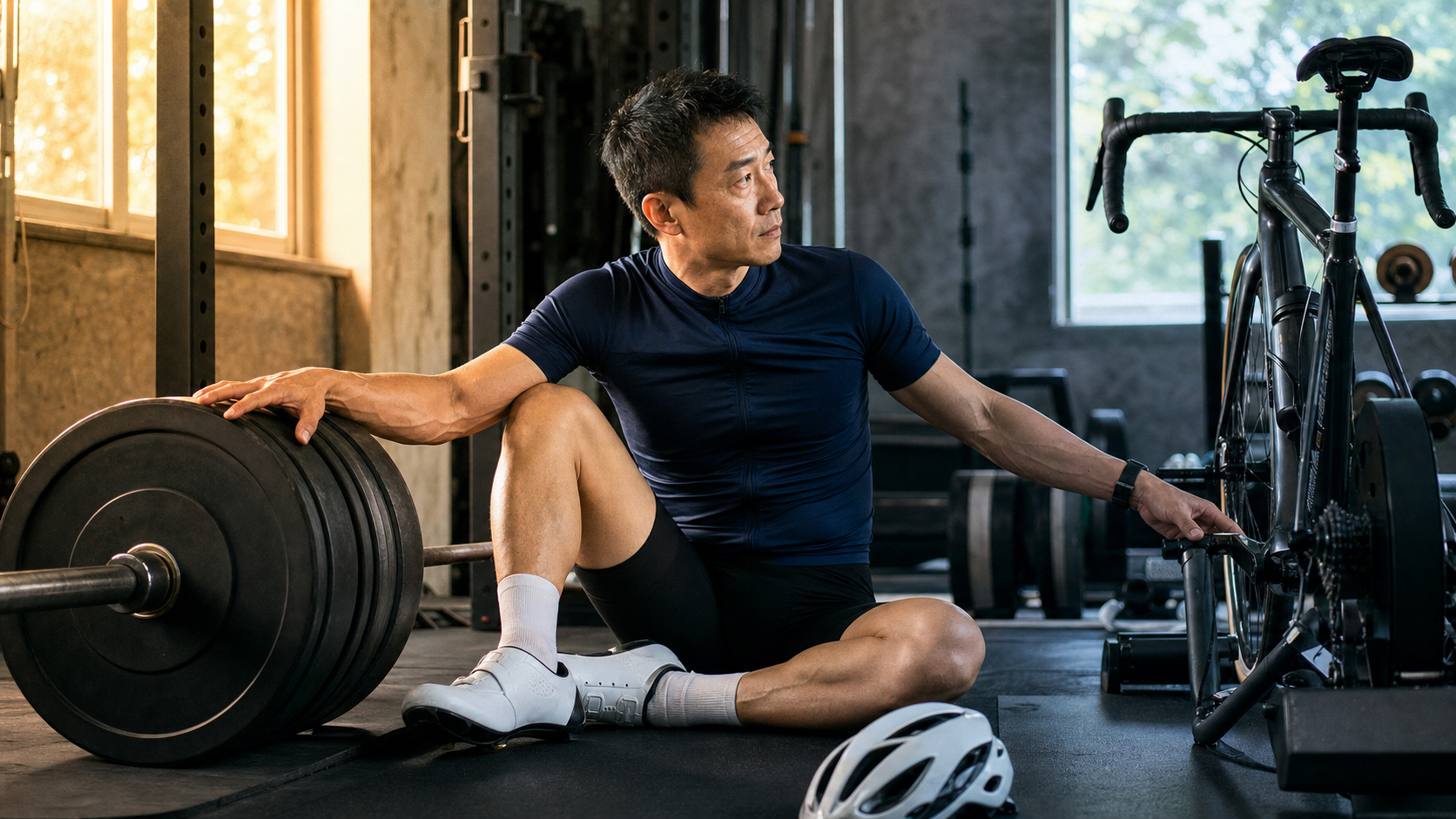
Starting with a Stuck Trail Rider
A few years ago, a student—let’s call him A-Kai—came to me looking confused. He was in his early forties, riding Wuling on weekends and the riverside bike paths on weekdays. Meanwhile, he’d also taken his gym coach’s advice and started doing squats and deadlifts to build climbing power. Six months later, his climbing power had barely improved, his squat weight was stuck at an awkward number, and even his sprinting explosiveness—that “stomp the pedal into the ground” pop—had gotten worse. He asked me: “Coach, I’m training hard at everything, so why does it feel like each one is holding the others back?”
I only replied: “You’re not lacking effort—you’ve got two types of training fighting each other inside your body.”
What A-Kai ran into is an old topic that sports science has been debating for over forty years and still argues about today—the concurrent training interference effect. Simply put, when you pursue both strength (or hypertrophy) and endurance goals at the same time, your body’s adaptation mechanisms pull against each other, and the growth of one—usually strength, especially explosive power—gets shortchanged.
In this article, I want to walk you through the whole picture from the ground up: where exactly the interference happens, what that molecular “tug-of-war” looks like, how to schedule your sessions practically so you don’t end up losing on both fronts, and how Taiwanese riders can put this into practice in our own climate, terrain, and eating-out environment. It’s a long read, but I promise every section has something you can take home and use.
What Is the Interference Effect? Shrink the Fear Down to the Right Size
Let me start with some good news, so you don’t read the headline and immediately cut out all your weight training.
Several large-scale systematic reviews and meta-analyses in recent years have actually reached a relatively reassuring conclusion: for “maximal strength” and “overall muscle hypertrophy,” doing aerobic and strength training concurrently does not show significant interference compared to strength training alone. This conclusion holds fairly consistently across different aerobic modalities (cycling vs. running), different training frequencies, different training statuses (beginners vs. experienced), different age groups, and different scheduling approaches (same session, same day, different days).
In other words, if your goal is just “squat heavier and get a bit more leg mass,” and you’re also riding a few times a week, you really don’t need to lose sleep over the interference effect.
Now for the bad news? The interference isn’t nonexistent—it’s concentrated on specific adaptations:
- Explosive/power-type performance (e.g., sprinting, jump height, short-duration maximal power) is the most vulnerable. Studies have observed that when strength and endurance are performed back-to-back in the same session, explosive power gains can be reduced by up to nearly 30%.
- Hypertrophy at the muscle fiber level (especially when looking at type I and type II fibers combined) shows a “slight” reduction, though it may not be visible in overall muscle mass measurements.
So the right mindset isn’t “cardio will kill my muscles,” but rather:
The interference effect is a selective, manageable phenomenon. It mainly steals your explosive power and some fiber-level details—and those happen to be exactly what riders who care about sprinting, out-of-the-saddle efforts, and cornering acceleration value most.
Once we shrink the fear down to the right size, we can rationally discuss the molecular mechanisms and scheduling.
The Molecular Tug-of-War: AMPK vs. mTOR
This is the core concept of the entire article, and I’ll explain it in a way you can feel on the bike.
Inside your muscle cells, there are two major “signaling pathways,” each responsible for a different direction of adaptation:
The Strength Team: The mTOR Pathway
When you do heavy, high mechanical-tension movements (squats, deadlifts, sprinting out of the saddle), your cells activate a pathway called Akt/mTOR/p70S6K1. You can think of mTOR as the “Minister of Construction”—once activated, it orders the cell to synthesize more muscle protein, making muscle fibers thicker and stronger. And it works persistently: after one high-quality strength stimulus, this pathway’s activity can last for a considerable time (animal and human studies have observed mTORC1 activity persisting on the order of a dozen-plus hours after strength training).
The Endurance Team: The AMPK Pathway
When you do long-duration, energy-hungry aerobic work (long rides, long climbs, intervals), your cells’ energy (ATP) gets heavily depleted, which activates a pathway called AMPK–PGC-1α. Think of AMPK as the “Energy Auditor”—when it detects the cell is running low on fuel, it hits the brakes, pauses energy-consuming construction projects, and simultaneously kicks off mitochondrial biogenesis (making you better at producing energy and more durable in the future).
Why Do They Fight?
The key point: AMPK, activated by endurance work, suppresses mTOR, which is responsible for building.
Physiologically, this makes perfect sense. A cell won’t be doing major construction while its energy is flashing red—saving power comes first. The problem is, when you’ve just finished a brutal long climb and AMPK is running high, and you immediately follow it with strength training to build muscle, the mTOR signal that should be strongly activated gets suppressed by AMPK, diluting the strength/hypertrophy adaptation signal.
Here’s a time window that’s absolutely critical for scheduling:
| Signaling Pathway | Stimulated By | Approximate Duration of Activity (order of magnitude) | Implication for Scheduling |
|---|---|---|---|
| AMPK (endurance/brakes) | High-intensity, long-duration aerobic | Rises quickly after high-intensity aerobic; takes several hours to return to baseline (studies mention at least a 3-hour order of magnitude) | This is the “culprit time window” for interference |
| mTOR (strength/construction) | Heavy, high-tension strength work | Can persist for a dozen-plus hours after strength training | The strength window is longer and less afraid of being briefly suppressed |
Once you understand this table, you understand the soul of the entire scheduling strategy: we want to avoid squeezing the strength stimulus that needs full mTOR output into those few hours when AMPK is still running high. That’s the molecular basis of the “3-hour rule” I’ll cover next.
(Reminder: these numbers are all “orders of magnitude” and “ranges” mentioned in the research literature; individual variation is large, so don’t treat them as precise seconds on a stopwatch.)
The 3-Hour Rule: The Simplest and Most Effective Move
If you can only remember one thing from this entire article, remember this.
Research has observed a fairly consistent phenomenon: when strength and endurance are packed into the same session with a very short gap (e.g., within 20 minutes of each other), interference (especially on explosive power) is most pronounced; but as long as you separate them by at least 3 hours, the interference largely disappears.
The reasoning is that tug-of-war from earlier—give AMPK enough time to exit and return to baseline, then let mTOR go to work, and the two pathways won’t collide head-on at the same time.
For Taiwanese office-worker riders, this is actually easy to execute:
- Do your aerobic work on the morning commute or morning ride, then do strength training after work in the evening. There’s an entire workday in between, far exceeding 3 hours.
- Or just put them on different days. The interference effect is barely an issue with a “different days” arrangement.
What if you really can’t avoid doing them in the same session? Then we move to the next key point: order.
Three Scheduling Strategies: Separate Days, Separate Times, or Same Session?
Let me organize the practical approaches into three tiers, from most ideal to most improvised:
Strategy A: Separate Days (Gold Standard)
Putting strength days and endurance days on different days is the approach with the least interference. It suits people who can afford to train 4+ days a week and care deeply about explosive power and strength details.
Strategy B: Same Day, Split Morning/Evening (Silver Standard, Most Practical)
Use the 3-hour rule—one type in the morning, one in the evening. For the vast majority of Taiwanese commuting riders, this is the highest value-for-effort option: no need to add more training days, and you dodge the interference window.
Strategy C: Same Session, Back-to-Back (The Compromise Option, Order Matters)
When you really have to squeeze both into the same session, order becomes crucial. Research on “order” is actually a bit nuanced; let me condense it into three points for you:
- For long-term outcomes in lower-body dynamic maximal strength, the evidence leans toward “strength first, endurance second.”
- However, for muscle hypertrophy and lower-body static strength, there’s no clear winner regarding order.
- Power is the most fragile—regardless of order, if you cram it into the same session with too little rest between, power output tends to take a hit.
So, when training in the same session, if your priority is building strength, lifting first, then doing cardio is usually the safer default. Because you want to deliver high-quality strength stimuli while your muscles are still fresh and haven’t been depleted by aerobic work.
Here’s a quick decision-making table:
| Your Primary Goal | Recommended Scheduling | Order Within Same Session | Notes |
|---|---|---|---|
| Pure long-distance endurance (don’t care much about strength) | Cardio-focused, strength as accessory | Cardio first | Interference is hardly an issue for you |
| Climbing power + a bit of strength | Split AM/PM or separate days | Strength first | Most important to respect the 3-hour rule |
| Sprint/Power (time trials, criteriums) | Separate days whenever possible, dedicate a power day | Power/Strength first | Power suffers most from being crammed |
| Pure strength/Hypertrophy | Strength-focused, low-volume low-intensity cardio | Strength first | Choose low-impact, low-volume cardio |
| General health + physique | Train however is convenient | Doesn’t matter | Don’t overthink it; consistency is key |
A Weekly Schedule Example You Can Copy
After all that theory, here’s something you can put into practice directly. Below is a weekly example I’d give to a mid-level rider like A-Kai who wants to “balance climbing power and endurance, and can train 5 days a week.” I’ll use relative intensity descriptions (Easy/Moderate/High) so you can plug them into your own power or heart rate zones.
| Day | Morning | Evening | Interference Management Focus |
|---|---|---|---|
| Monday | Rest or easy commute ride | Lower-body strength (squats, deadlifts, single-leg series) | Dedicated strength day, let mTOR fire at full capacity |
| Tuesday | High-intensity interval ride (climbing or trainer) | Rest/Stretching & foam rolling | High-intensity endurance day, keep away from strength stimuli |
| Wednesday | Easy recovery ride | Upper-body + core strength | Upper-body strength doesn’t compete much with leg endurance pathways |
| Thursday | Rest | Power/Sprint specific work (short, sharp, ample rest) | Power scheduled alone, freshest state possible |
| Friday | Long endurance ride (moderate intensity) | Rest | Long ride as the main aerobic volume before the weekend |
| Saturday | Long climb or group ride | — | Primary aerobic stimulus day |
| Sunday | Complete rest | — | Recovery is part of adaptation, not laziness |
Here’s the reasoning behind the design, so you understand it:
- Thursday’s power day is always scheduled alone. Because power is the most vulnerable quality under the interference effect, I won’t let it share a session with any significant aerobic work.
- Monday and Wednesday strength sessions are in the evening, with at most an easy ride in the morning. This applies the 3-hour rule—the low-volume easy morning ride won’t keep AMPK elevated enough to suppress mTOR by evening.
- Truly high-intensity aerobic work (Tuesday) is deliberately separated from strength days. High-intensity cardio is the main engine for AMPK, so those sessions need the most distance from strength training.
If you can only train 3 days a week, compress strength into two full-body sessions and keep one or two key endurance sessions. Everything else stays the same: avoid putting high-intensity cardio and heavy strength in the same session, and don’t schedule them too close together.
Going Deeper: Why Is “Power” the Most Vulnerable?
Many people ask me: since maximal strength and overall hypertrophy aren’t significantly interfered with, why is power so fragile? This deserves a bit more explanation, because understanding it will make you willing to “give power its own slot.”
Power isn’t just about “how big your muscles are or how strong you are”—it’s about the nervous system’s ability to recruit a large number of fast-twitch muscle fibers in a very short time and have them fire in sync. It’s a quality highly dependent on neuromuscular “coordination and timing.” And the fatigue from endurance training—whether central nervous system fatigue or metabolic fatigue in the muscles themselves—tends to blunt this ability to send “clean, fast, high-frequency” signals.
Here’s an analogy: maximal strength is like “how heavy a door you can push.” Even if the door is a bit stuck and your arms are sore, you can still push it with more effort. But power is like “how quickly you can fling the door open.” If your arm is even slightly sluggish or your neural signals are a bit delayed, the quality of that “fling” drops immediately. That’s why power performance tends to collapse when you’ve done a lot of aerobic work first in the same session, leaving your muscles and nervous system fatigued.
For cyclists, this is very practical. The sprint on the last lap of a criterium, that surge to bridge a gap, that one pedal stroke to get going on a steep climb—these are all power. If your training chronically lets endurance fatigue contaminate your power sessions, you’ll find that “your legs are big and your squat is heavy, but you just can’t summon that explosive effort when it counts.” That was exactly A-Kai’s original complaint.
So my iron rule for competitive riders is: Power sessions either get their own day, or they’re scheduled when your body is freshest—never as an afterthought to an endurance session.
Periodization: Making “Time” Your Third Dimension
The scheduling we’ve discussed so far is mostly about arranging time “within a day” or “within a week.” But what truly separates advanced athletes from the average person is larger-scale time planning—periodization.
A big part of why the interference effect causes anxiety is that we’re greedy, wanting to push strength, hypertrophy, endurance, and power all to their peak “in the same period.” But the body has limited resources; trying to max everything at once often results in mediocrity across the board. The wisdom of periodization is: acknowledge that you can’t maximize everything simultaneously, so use time to queue up your goals.
Take a rider aiming to challenge Wuling Pass in the fall while maintaining a base of strength. Here’s how I’d typically phase it:
| Phase | Approximate Duration | Focus | Strength Arrangement | Endurance Arrangement |
|---|---|---|---|---|
| Base Phase | Several weeks to 1-2 months | Foundation building, strength work | Higher emphasis, pursuing maximal strength | Low-to-moderate intensity, building aerobic base |
| Build Phase | Several weeks | Specific endurance improvement | Reduced to “maintenance” level, lower volume | Increasing specific intensity and climbing volume |
| Pre-Race Phase | Several weeks before race | Taper fatigue, preserve power | Minimal, only maintaining power and neural freshness | Tapering volume, retaining intensity |
| Race Season/Recovery | Depends on race calendar | Performance and repair | Very minimal maintenance | Adjusted to race schedule |
The point of this table isn’t for you to copy the exact week counts (that depends on your target event and current situation), but to grasp the core principle:
When a certain ability is “the protagonist of this phase,” give it the most training resources and the best recovery; other abilities step back to “maintenance” mode. The interference effect is almost a non-issue at maintenance-level training volumes.
This is also why professional athletes can possess both remarkable endurance and respectable strength—they aren’t pushing both up simultaneously; they use the entire season to let each take turns being the protagonist and being maintained.
Beyond Scheduling: What Other Levers Can Reduce Interference?
Scheduling is the biggest lever, but not the only one. The following factors can also help you minimize interference further.
The “Type” and “Intensity” of Cardio
- Cycling vs. Running: Good news for cyclists—cycling is low-impact and the movement pattern matches your sport. Compared to high-impact running, it typically causes less muscle damage and recovery burden, so it interferes less with strength training. This is why many strength coaches recommend “if you’re going to do cardio, spinning or outdoor riding is a solid choice.”
- Intensity: What really floors the AMPK pedal is high-intensity, long-duration cardio. So on days when you also have an important strength session scheduled, keep the cardio easy and short, saving your firepower for the strength work.
Total Training Load Management
Interference is often not the fault of “doing cardio” itself, but rather the combined result of excessive total volume and insufficient recovery. When you try to go all-out on everything and don’t recover enough, your body naturally can’t keep up. Learning to periodize—emphasizing endurance in some phases and strength in others—yields far better long-term results than grinding hard at everything every day.
Sleep and Recovery
This point deserves special attention from Taiwanese riders. Many people work during the day, train in the evening, and do long rides on weekends, accumulating a chronic sleep deficit year-round. Insufficient recovery amplifies the negative perception of the interference effect—you’ll feel like “everything is regressing,” when in many cases your body simply hasn’t had enough sleep or repair time. Sleep is the most powerful—and free—anabolic tool available. Don’t waste it.
Nutrition: Not the Main Character, But It Can Help You Recover Some Ground
Nutrition cannot magically eliminate interference at the molecular level, but sufficient energy and protein ensure that the construction crew (the mTOR team) at least has raw materials to work with. The following are range-based references for the average adult rider, not prescriptions:
| Item | General Range Reference | Plain-Language Explanation for Riders |
|---|---|---|
| Daily protein | Approximately 1.6–2.2 g per kg body weight | Aim toward the upper end if you want to preserve muscle and strength; a 70 kg rider would land around 110–150 g per day |
| Protein per serving | Approximately 20–40 g | Distribute evenly between post-training and regular meals—better utilized than loading it all into one meal |
| Training-day carbohydrates | Adjust based on training load; add more on long-ride days | When carbs are insufficient, AMPK tends to be more elevated, adding insult to injury; don’t blindly go low-carb during high-volume training |
| Total calories | At least avoid prolonged deficits | Building muscle and endurance simultaneously while in a long-term calorie deficit is very difficult |
A few practical tips for Taiwanese scenarios:
- Convenience-store and restaurant eaters often fall short on protein. The main protein source in a typical bento box often provides less than 20 g. You can make up the difference with unsweetened soy milk, tea eggs, chicken breast, tuna, dairy products, or a serving of whey—especially the meal after a strength day.
- On hot, humid long rides, don’t just focus on hydration and forget carbs and electrolytes. Climbing Wuling or riding the Beihang in Taiwan’s summer often means three to four hours of heavy sweating; when energy and electrolytes drop too much, your body’s stress signals (including the AMPK pathway) become more active, and recovery slows down.
- Caffeine at approximately 3–6 mg per kg body weight is a common pre-exercise reference range, but it’s an aid, not a magic bullet that can offset poor training programming.
Common Mistakes and Correction Checklist
These are the pitfalls I’ve repeatedly seen in my athletes over the years—see if any apply to you:
Mistake 1: Stacking the Hardest Cardio and Heaviest Strength Work in the Same Session, Back-to-Back
This is the most typical interference generator, especially when you also tack power training on at the end.
Fix: At minimum, switch to strength before cardio; ideally, separate them by morning/evening (the 3-hour rule) or by different days.
Mistake 2: Thinking “Cardio Eats Muscle,” So You Cut Out All Cardio
This is overcorrection. For overall strength and hypertrophy, moderate amounts of cardio do not significantly interfere—and they actually benefit cardiovascular health and recovery.
Fix: Don’t cut out cardio; instead, manage the timing, type, and intensity of cardio.
Mistake 3: Scheduling Power Sessions at the End of the Most Fatiguing Day of the Week
Power requires a fresh neuromuscular state, yet you’re placing it at your fatigue peak.
Fix: Schedule power/sprint sessions on relatively well-rested days, and keep the work “short, sharp, with ample rest between sets”—don’t train to failure.
Mistake 4: Going All-Out Every Day While Ignoring Recovery and Sleep
Overtraining volume can make you mistake the problem for the interference effect, when it’s actually recovery bankruptcy.
Fix: Introduce periodization, schedule clear deload weeks and rest days, and fix your sleep before chasing progress.
Mistake 5: High Training Volume Combined with Chronic Low-Carb and Insufficient Protein
Energy deficiency makes the braking pathways more active and leaves the building pathways without raw materials.
Fix: Eat enough carbs and protein on training days; don’t force a calorie deficit during high-volume periods.
Actionable Advice for Riders at Different Levels
If You’re a Beginner (Riding Less Than a Year, Just Starting Strength Training)
The good news is that in the beginner phase, your body is highly responsive to almost any stimulus, and the interference effect has very little practical impact on you. At this stage, don’t overthink the details of programming. Focus on: learning proper technique, showing up consistently, and progressing gradually. Just remember one big principle—do the strength work that requires skill and force first in the same session, then go ride—and that’s enough.
If You’re an Intermediate (Have a Training Base, Want to Balance Strength and Climbing)
You’ve reached the stage where programming choices start to matter. Take the 3-hour rule seriously, separate high-intensity cardio days from heavy strength days, and schedule power sessions on their own. Start viewing training through the lens of “blocks”: this month emphasizes endurance base, next month emphasizes strength—this is far more efficient than trying to do everything every day.
If You’re a Competitive Rider or Someone Who Cares Deeply About Power
You’re the group that most needs to take the interference effect seriously. The principles are clear:
- Power/sprint sessions should almost never share a session with high-volume cardio; ideally, put them on separate days.
- As the season approaches, let endurance volume drop to maintenance levels and concentrate neuromuscular firepower on power and speed.
- Give yourself full recovery between every high-quality session; better to do less and do it well than to do everything half-heartedly.
If You Just Want to Be Healthy, Look Good, and Ride a Bit Farther
Relax. For you, “whether you exercise regularly” matters far more than “whether your programming is perfect.” Train in whatever way is most convenient, and long-term consistency is what truly counts. Details at the level of the interference effect can wait until the day you actually decide to chase a specific performance goal.
Middle-Aged, Older, and Riders with Chronic Conditions: Value Strength Even More, and Be Even More Conservative
A large portion of Taiwan’s cycling population is over forty, and I especially want to address this group.
As we age, muscle mass and strength naturally decline (increasing the risk of sarcopenia), and strength training is one of the most effective tools to combat this. So for middle-aged and older riders, the question of “does cardio interfere with strength” should actually make you take it more seriously—because you can afford to lose strength even less.
A few principles for middle-aged and older riders:
- Don’t give up strength training out of fear of interference. On the contrary, cherish every high-quality strength stimulus and protect it through smart scheduling (the 3-hour rule, separate days).
- Recovery needs are higher. As you age, recovery typically slows down, so be more generous with rest days and deload weeks in your periodization—don’t force the training density of your younger years.
- Protein intake matters even more. Older adults have a blunted anabolic response to protein, so pushing daily protein toward the 1.6 g per kg range and distributing it evenly across meals is especially important for maintaining muscle.
If you have cardiovascular disease, diabetes, hypertension, or other chronic conditions, I need to say this in the most cautious tone possible: before starting or significantly changing your training, be sure to consult your physician. Taiwan’s National Health Insurance makes medical access convenient—use it. Have your doctor assess your cardiovascular and metabolic status, and if necessary, undergo an exercise ECG or related tests. High-intensity intervals place stress on blood pressure and the heart; whether you can do them, and to what extent, should be determined by a qualified medical professional based on your individual situation—not by blindly following any training plan found online (including this article). This article discusses general principles and is not medical advice tailored to you personally.
Frequently Asked Questions (FAQ)
These are the questions trainees most often ask me after class, compiled here for you in one place.
Q1: I want to train strength and ride long distances at the same time. Am I doomed to be mediocre at both?
No. With proper scheduling, there is almost no significant interference for maximal strength and overall muscle hypertrophy. What truly needs careful protection is explosive power and some fiber-level details. Separate high-intensity aerobic work from heavy strength training in time, and you can absolutely have both.
Q2: Then should I just skip all cardio and focus purely on strength?
Not recommended. Cardio benefits cardiovascular health, weight management, and recovery—and since you’re a cyclist, endurance is your main discipline anyway. The question has never been “should I do cardio or not,” but rather “how should I schedule cardio.”
Q3: If I can only do one type of training in a session, which comes first?
If your current focus is strength, the safer default is “strength first, cardio second.” If your current focus is endurance performance and strength is just supplementary, doing cardio first is fine. As for explosive power, try to avoid pairing it with large volumes of cardio in the same session.
Q4: Does cycling vs. running as cardio interfere with strength differently?
It’s generally believed that cycling (low-impact, with a movement pattern consistent with your sport) interferes with strength training relatively mildly, while running tends to carry a higher burden of muscle damage and recovery demands. For cyclists, using cycling as the primary cardio is a natural choice anyway.
Q5: I can only train three times a week. What’s the best schedule?
Make strength two full-body sessions, keep one to two key endurance sessions, and try to avoid having high-intensity cardio days and heavy strength days adjacent to each other or in the same session. The core principle of the three-day version is the same as the five-day version: protect the time window for strength and explosive power.
Q6: Can supplements offset the interference?
No supplement can replace proper training scheduling. Adequate energy, protein, and sleep are the foundation; supplements are at best a marginal aid. Don’t put the cart before the horse.
Second Case Study: A Working Mom Trying to Do It All
Let me share another example that’s very different from A-Kai’s. Xiao-Wen is a 45-year-old working professional. On weekdays she’s busy with work and family, and on weekends she enjoys riding along riverside paths and mountain roads. She also started going to the gym to “maintain muscle and not keep getting weaker.” Her struggle isn’t about competitive performance—it’s about “never having enough time and always being exhausted to the point of questioning life.”
Her initial approach was: Saturday morning, ride two to three hours in the hills, come home for a meal, then head to the gym in the afternoon for leg strength training—a classic case of “same day, a few hours apart, but both sides are high volume.” The result was that she was completely wiped out all day Sunday, felt like a zombie at work on Monday, and her strength wasn’t improving much either.
The adjustments I helped her make were actually quite simple:
- Moved leg strength training from “the afternoon of the long ride day” to an evening during the week, completely separating it from the long ride.
- After weekend long rides, she only did light stretching and foam rolling, designating that day as an “aerobic stimulus day” instead of forcing in heavy weights.
- Reminded her to fully replenish carbs and protein in the meal after the long ride (she used to just grab a coffee and keep going).
After the changes, she told me: “It’s not that I got stronger—it’s that I finally stopped draining myself dry every single time.” After moving strength training to a separate day, the quality of her leg sessions noticeably improved, her weekend long rides felt easier, and most importantly—she could stay consistent.
Xiao-Wen’s story is meant to show you: for non-competitors, the biggest benefit of managing the interference effect often isn’t “performance breakthroughs,” but rather making training sustainable and no longer burning yourself out to the point of hating it. For so many working cyclists in Taiwan who are burning the candle at both ends, this is actually the most valuable takeaway.
Conclusion: Not Enemies, but Two Teams That Need Mediation
Back to A-Kai. I helped him restructure his schedule—strength in the evening, high-intensity cardio in the morning or moved to another day, explosive power sessions on a separate day when he felt at his best, while also boosting the protein in his meal prep and making sure he slept well after weekend long rides. Three months later, his climbing power was back on an upward trajectory, his squat broke through the plateau he’d been stuck at, and what surprised him most was that the “explosive” feeling when sprinting out of the saddle had returned.
What he did isn’t mysterious—it was simply no longer letting the two types of training collide head-on at the same point in time.
Strength and endurance were never natural enemies. They are two specialized teams within your body, but on the same field and at the same moment, they can get in each other’s way. Your job isn’t to force one team off the field, but to be a good mediator—using scheduling, timing, recovery, and nutrition to let each perform at its best at the right time. Once you understand the tug-of-war between AMPK and mTOR as a “manageable scheduling problem,” concurrent training transforms from a stumbling block into a dual engine that makes you both strong and durable.
Wishing you smooth training, and see you on the mountain roads.
This article is for educational purposes and does not replace individual diagnosis and treatment advice from physicians, physical therapists, or nutritionists. If you have cardiovascular disease, metabolic conditions (such as diabetes or hypertension), or a history of sports injuries, please consult a qualified medical professional before starting or significantly adjusting your training and diet, and make individualized adjustments based on your personal circumstances.
References
- The Effects of Concurrent Aerobic and Strength Training on Muscle Fiber Hypertrophy: A Systematic Review and Meta-Analysis — https://pmc.ncbi.nlm.nih.gov/articles/PMC9474354/
- Compatibility of Concurrent Aerobic and Strength Training for Skeletal Muscle Size and Function: An Updated Systematic Review and Meta-Analysis — https://link.springer.com/article/10.1007/s40279-021-01587-7
- The Role of Intra-Session Exercise Sequence in the Interference Effect: A Systematic Review with Meta-Analysis — https://www.ncbi.nlm.nih.gov/pmc/articles/PMC5752732/
- The acute effects of strength, endurance and concurrent exercises on the Akt/mTOR/p70S6K1 and AMPK signaling pathway responses in rat skeletal muscle — https://pmc.ncbi.nlm.nih.gov/articles/PMC3854410/
- The effects, mechanisms, and influencing factors of concurrent strength and endurance training with different sequences: a semi-systematic review — https://www.frontiersin.org/journals/sports-and-active-living/articles/10.3389/fspor.2025.1692399/full
Related Reading
- The Interference Effect of Concurrent Strength and Endurance Training and How to Resolve It
- The Interference Effect of Strength and Endurance Training: How to Schedule So You Don’t Fall Short on Either
- The Molecular Mechanisms and Scheduling Solutions for Concurrent Training Interference: AMPK, mTOR, and the “At Least Six Hours” Rule
- The Interference Effect Between Muscle Gain and Endurance: Why the Two Goals Pull Against Each Other and How to Schedule to Balance Both
西進武嶺 免費訓練分析服務 Intervals | 練不夠還是練過頭?你哪一種類型選手?AI模型告訴你! | 備戰神器 | 公路車 訓練 | CT Yeh
4 年前
一個測試有沒有認真練車的方法😂 #公路車
10 個月前
一日北高/長距離團騎 常見問題補充篇 / 組團或跟團的眉角 / 壯車友容易被瘦車友慢性拉爆 / 原來屁股痛可能是這個原因...? / 風場配速法 / 公路車 / CT Yeh
2 年前
一日北高前的西濱集訓 | 跟著11小時軍團 | 300W踩不動的大逆風 | 輪車破風差幾瓦?
6 年前
#公路車 #西進武嶺 配速配瓦實驗 坡度分析 四小時內攻略 建大盃 NeverStop #西進武嶺攻略
6 年前
單車AI教練!全新 ChatGPT4o 幫你分析訓練成果!排武嶺課表,分析騎車姿勢! 太神了! / 公路車 / CT Yeh / feat. 緯緯
2 年前
FTL 與 SYB 車隊專訪 西進武嶺 實用攻略分享! 2小時 如何練?!你不知道的眉角!新手準備武嶺必看 EP1 | 實力派女車友 | 精華版 | 公路車 | CTYeh
4 年前
大禹嶺 到 武嶺牌樓 全程前後實況錄影 | 北進武嶺 | 東進武嶺 | KOM | 訓練台 | 坡度分析 | Taiwan KOM Last 10 km HARD | 公路車
6 年前