Stress and Athletic Performance: A Modern Revision of the Inverted-U Theory—Finding Your Individual Zone of Optimal Functioning
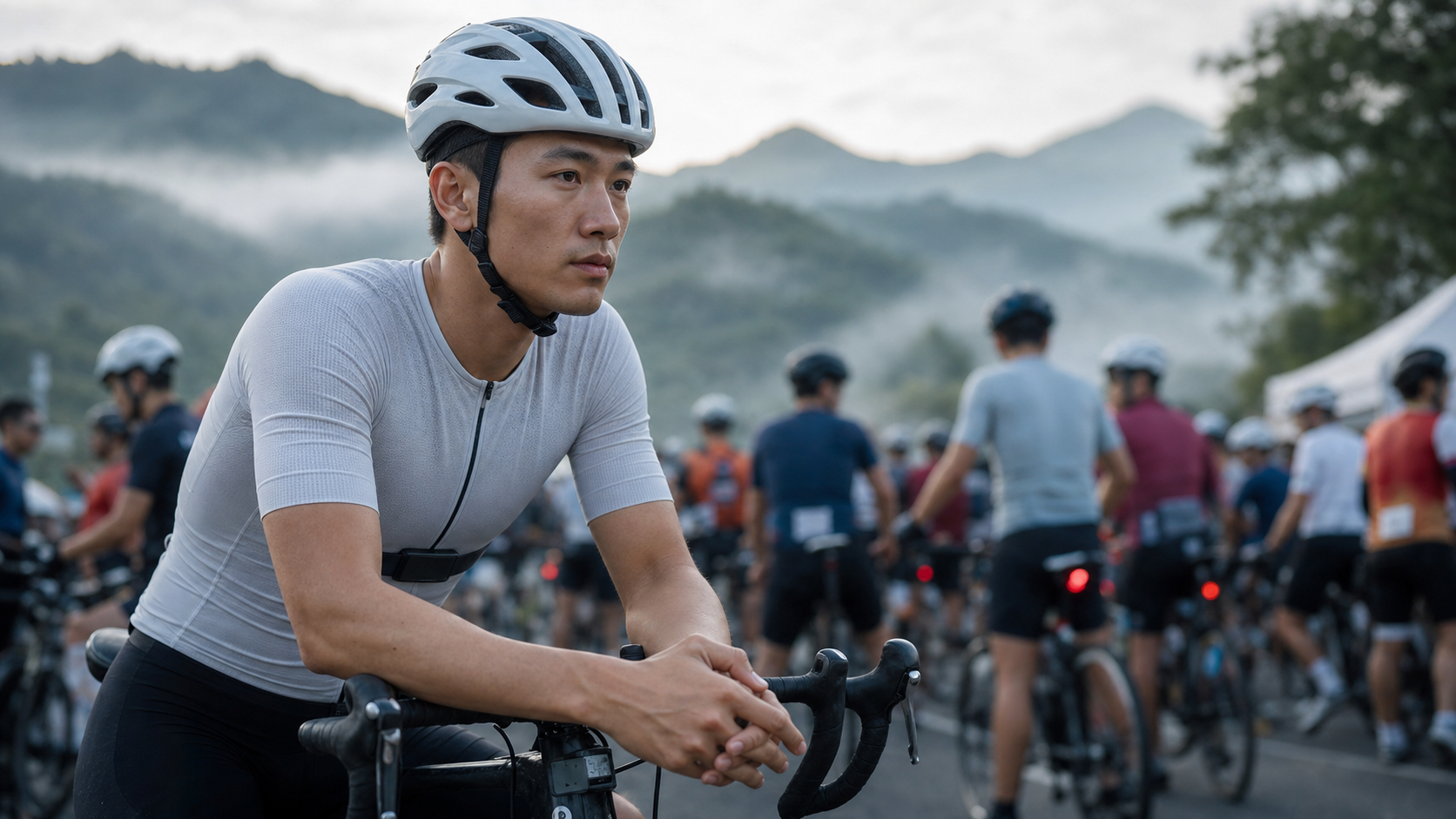
Opening: The Student Whose Hands Shook at the Wuling Start Line
I once coached an amateur cyclist in his early 40s—let’s call him A-Kai. His fitness was beyond question; on the indoor trainer at Yangmingshan, his power was rock-steady, with a 20-minute critical power around 265 watts, which translated to about 72 kilograms of body weight—impressive numbers by any standard. But whenever he entered an actual race, especially a landmark event like the west-route climb up Wuling, he’d start shaking at the start line, his heart rate spiking to more than double his resting rate, and he’d be running to the bathroom nonstop—then, he’d go out too hard in the first 10 kilometers, blow up in the middle, and finish nearly 20 minutes slower than his training predicted.
The first thing he said to me was: “Coach, is my mental toughness just too weak?”
I later spent a lot of time explaining one thing to him: You don’t have weak mental toughness; you just haven’t found the sweet spot on your own “arousal-performance curve,” and you haven’t learned how to pull yourself back from the red zone. What this article wants to discuss is the science behind that curve—from the classic theory of over a hundred years ago, to how modern sports psychology has revised it, and then to concrete methods you can start practicing this very afternoon.
I’ll try to explain it the way I usually do in the classroom, waving my hands in front of a whiteboard with my athletes, rather than reciting from a textbook. Because when it comes to stress, talking theory is easy; what’s truly hard is having a set of usable tools in hand at the moment your heart rate hits 130 and your mind goes blank.
Conceptual Foundation: Starting with the Inverted-U Theory
What Is the Inverted-U Theory
The most classic framework is called the Yerkes-Dodson Law, also known as the “inverted-U theory” that everyone talks about. Its core idea is actually very intuitive:
- When arousal (excitement/tension level) is too low, you feel sluggish, unmotivated, and slow to react—performance suffers.
- When arousal is too high, you’re nervous, stiff, your attention narrows, and your movements break down—performance suffers too.
- In some middle range, you’re both focused and relaxed, your body is warmed up, and your mind is clear—performance is at its best.
Connect those three points, and you get an upside-down U-shaped curve: the horizontal axis is arousal, the vertical axis is performance, and the peak sits in the middle.
This concept has endured for over a century because it captures a real experience: stress is neither better when minimized nor better when maximized. Moderate tension is actually fuel for performance. On a trainer where you’re completely relaxed, you can’t produce the explosive power you get in a race—that’s not an illusion.
First Revision to the Inverted-U Theory: Task Difficulty Shifts the Curve
What many people don’t know is that Yerkes and Dodson’s original observations had a second layer: the peak of the curve shifts depending on task complexity.
- Simple, heavy, strength- or power-based tasks (e.g., a short all-out sprint, lifting a heavy weight, attacking out of the saddle up a short steep climb) require higher arousal levels for optimal performance.
- Complex, fine-motor, judgment- and skill-based tasks (e.g., choosing a line through a downhill corner, positioning in a pack, technical bike handling, race strategy calculations) require lower arousal levels—being too tense will backfire.
This is a highly useful insight for cyclists. In the same race, the arousal level you need for the final 500-meter sprint is completely different from what you need when cornering downhill at 60 km/h. Good athletes aren’t always amped up; they know when to be amped and when to be cool.
The table below summarizes the ideal arousal tendencies for different task types:
| Task Type | Examples (Cycling/Endurance Context) | Ideal Arousal Tendency | Risk of Going Too High |
|---|---|---|---|
| Pure Explosive/Power | Sprint finish, short steep climb out of the saddle, start acceleration | Somewhat high | Almost none, but don’t blow up early |
| Rhythmic Endurance | Steady output on a long climb, time trial | Moderate | Losing pace control in the early stages |
| Technical Control | Downhill cornering, rough roads, pack positioning | Low to moderate | Stiffness, slower judgment, crashes |
| Strategic Decision-Making | When to attack, whether to follow a wheel, timing of refueling | Somewhat low | Narrowed vision, impulsive decisions |
The Problem with the Inverted-U Theory: It’s Too Clean
As elegant as the inverted-U theory is, anyone who has actually coached athletes knows it has two major flaws:
First, the “peak” is different for everyone. Some people are naturally at their best when highly aroused—tell them to calm down and they go soft; others completely fall apart the moment they get tense. Applying the same curve to everyone simply doesn’t work.
Second, real “blowing up” isn’t a smooth decline—it’s a cliff-edge collapse. The inverted-U theory draws a gentle, symmetrical curve, as if you gradually get worse after passing the peak. But A-Kai’s actual experience was different: he didn’t gradually get worse; at some moment, he just “snapped” and completely fell apart, and once that happened, it was very hard to recover within the same race. That cliff-edge feeling can’t be explained by the inverted-U theory alone.
This brings us to two important modern revisions to the inverted-U theory in sports psychology.
Modern Revision One: Hanin’s Individual Zones of Optimal Functioning (IZOF)
Everyone’s Sweet Spot Is Different
Sports psychologist Hanin introduced a very important concept called the Individual Zones of Optimal Functioning (IZOF), often translated into Chinese as “個體最佳激發區” or “個人最佳表現區.”
Its revision to the inverted-U theory is this: there is no one-size-fits-all optimal arousal point; each person has their own unique—and usually quite narrow—range of arousal within which they perform best.
Even more critically, this range isn’t necessarily in the middle. Some athletes have a high optimal zone (they need to be very keyed up), while others have a low one (they need to be very relaxed). So you can’t look at that teammate who blasts heavy metal and slaps his own face before a race and performs well, then copy him—his optimal zone might be on the high end, while yours might be on the low end. Copying him will only push you past your limit.
I think this idea is especially important for amateur cyclists in Taiwan. Our community culture loves to “get hyped together”—before races, everyone at the start line shouts encouragement, slaps each other on the back, and blasts fight songs, creating a very high-energy atmosphere. But if you’re the type who blows up when overexcited, that collective frenzy is poison. You need to learn to politely step away from that hype circle and go do your own thing in a corner.
Hanin’s framework comes from actual observational data on athletes. On the topic of individual differences, you can refer to simplypsychology.org’s summary of the Yerkes-Dodson Law and IZOF and Wikiversity’s explanation of the Zone of Optimal Functioning.
How to Find Your Own Optimal Arousal Zone
This is how I actually work with my athletes, and you can do it yourself. The key is to build a “Performance Log”, pairing your “in-the-moment state” with the “result” for each important workout or race.
Record three dimensions:
- Physiological markers: Heart rate (bpm) before the race or during key segments, whether you have shaky hands, gut reactions, and whether muscles feel tight or loose.
- Psychological feelings: Rate your tension level from 1 to 10 (1=limp, 10=about to explode), then note whether it’s “excited tension” or “fearful tension”—these two feel very different.
- Performance outcome: Whether your power hit the target, whether your pace fell apart, whether technical movements felt smooth, and whether you made any stupid decisions.
After accumulating 5 to 10 entries, you’ll start to see a pattern. For example, when A-Kai’s data was laid out, his best performances all had pre-race self-rated tension between 5 and 6, with heart rate about 40-50% above resting; while every time he blew up, his self-rating was 8 or above, with shaky hands and nonstop trips to the bathroom. His optimal arousal zone emerged that way: leaning toward mid-low, and once it goes past 8, it’s dangerous.
Knowing this is half the solution. Because what he needs to do next isn’t “get pumped up to feel more excited,” but rather actively bring himself down. This is completely opposite to his original instinct that “racing means getting hyped.”
The table below is a simplified self-assessment reference to help you quantify vague feelings:
| Self-rated Tension | Body Signals | Common Performance State | What to Do |
|---|---|---|---|
| 1-3 (Too low) | Yawning, body feeling cold, lacking drive | Slow reactions, can’t warm up | Ramp up: dynamic warm-up, fast-paced music, shouting cues |
| 4-6 (Sweet spot, most people) | Slightly excited, focused, body warm | Focused and relaxed, steady output | Maintain: steady breathing, focus on the present task |
| 7-8 (High alert) | Heart racing, a bit stiff, talking more | Pacing starts to slip, decisions get quicker and more impulsive | Bring down: lengthen exhales, slow movements, pull attention back to the body |
| 9-10 (Red line zone) | Shaky hands, churning stomach, blank mind | Movements break down, decision-making disasters, prone to crashes | Emergency down-regulation: physiological sigh, centering, remove yourself from the stressor |
Modern Revision 2: The Catastrophe Model—Why Things “Snap” and Fall Apart
Cognitive Anxiety Is the Deadly Scissors
The second major revision is called the Catastrophe Model, proposed by Hardy and colleagues. It solves exactly the mystery of A-Kai’s “cliff-edge collapse.”
The catastrophe model splits “arousal” into two things:
- Physiological arousal: The physical stuff—heart rate, breathing, adrenaline.
- Cognitive anxiety: The mental stuff—worry, negative thoughts, “What if I fail,” “Everyone is watching” kinds of thoughts.
The model’s core insight is: When cognitive anxiety is low, rising physiological arousal at most causes a mild decline in performance—it’s reversible and smooth (much like an inverted U). But when cognitive anxiety is high, once physiological arousal crosses a critical threshold, performance doesn’t gradually decline—it collapses off a cliff, and it’s very hard to recover in the moment.
In other words, cognitive anxiety acts like a pair of scissors—it determines whether you “slide down a slope” or “fall off a cliff” after passing the peak. For a summary of this concept, see onboardsportpsychology.com’s explanation of arousal, anxiety, and the catastrophe model.
What This Means for Training
This model gives us a very practical division of labor:
- Physiological arousal is acceptable fuel—even necessary. Your heart racing before a race and a bit of adrenaline is a good thing; don’t try to be completely calm.
- What you really need to manage is cognitive anxiety—those thoughts like “Am I going to blow up?” or “It’ll be embarrassing to lose.” Because that’s what turns reversible nervousness into irreversible collapse.
So the strategy I gave A-Kai wasn’t “don’t be nervous” (the most useless advice possible), but rather: “Let your body be nervous—that’s fine—but we need to shut off the mental chatter.” These two things need to be handled separately; that’s the most important lesson the catastrophe model teaches us.
Practical Methods: A Toolbox for Regulating Arousal Levels
Okay, theory is done—let’s talk about what you can actually use. Regulating arousal levels goes in two directions: down-regulation and up-regulation. Most amateur endurance athletes have the problem of being over-aroused, so I’ll start with down-regulation tools, which is what most people need.
Down-Regulation: Pulling Yourself Back from the Red Line
1. Breathing—Lengthening Your Exhale Is Key
Breathing is the fastest, most reliable, and most accessible regulation tool. The principle is: the sympathetic nervous system (the gas pedal) is more active during inhalation, while the parasympathetic nervous system (the brake) is more active during exhalation. So to calm yourself down, the key isn’t deep breathing—it’s lengthening your exhale so it’s longer than your inhale.
Slow breathing works primarily by enhancing vagal tone and baroreflex function, while also influencing attention and emotional regulation, making it an excellent down-regulation tool before races, during rest, or after events. This is discussed in Frontiers’ study on how breathing frequency modulation affects emotion and motor performance.
A few practical breathing techniques:
- 4-6 Breathing: Inhale for 4 seconds, exhale for 6 seconds. Do this continuously for 1-2 minutes, and you’ll feel your heart rate slow down.
- Physiological sigh: Two quick inhales in a row (fill up, then take a small sip), followed by a long, complete exhale. This is one of the fastest ways to lower arousal; 2-3 reps in an emergency will make a difference.
- Box breathing: Inhale 4, hold 4, exhale 4, hold 4. Good for settling your mind before a race, but during intense competition, “lengthened exhale” flows better.
Practical tip for Taiwan: In the summer, it’s hot and humid—just standing in the start corral leaves you sweating with an elevated heart rate, making breathing regulation even more important. Also, many of Taiwan’s climbing races (Wuling, Fengguizui, Tatajia) start at elevation with altitude differences; with thinner air, your heart rate naturally runs higher. Don’t misread this physiological high heart rate as “I’m anxious” and panic even more.
2. Centering
This is a technique for pulling attention from “mental chatter” back to “the body’s center of gravity.” Here’s how:
- Stand firm, knees slightly bent, and feel your center of gravity settle just below your navel.
- Take one long exhale, imagining the tension sinking down to your feet with the breath.
- Choose a short cue word, such as “steady,” “smooth,” or “light,” and repeat it silently on the exhale.
The point is to give that wandering mind something concrete, singular, and controllable to hold onto, rather than letting it spin on “Am I going to fail?” This directly addresses the need to “shut off cognitive anxiety” from the catastrophe model.
3. Progressive Muscle Relaxation and Self-Talk
If your shoulders, neck, or hands on the handlebars feel stiff before a race, deliberately “tense hard for 3 seconds → fully relax” through a few major muscle groups to teach your body the contrast of relaxation.
For self-talk, rewrite negative sentences into neutral or task-oriented ones:
- ❌ “I’m doomed, I’m definitely going to blow up” → ✅ “Hold the power, segment by segment”
- ❌ “Everyone is stronger than me” → ✅ “Follow my pace, compete against myself”
- ❌ “I can’t fail” → ✅ “Just execute the next action”
Turning It Up: When You’re Too Loose and Can’t Warm Up
A minority of people (or the same person at the end of the season, during a fatigue period, or in an unimportant race) will encounter the problem of under-arousal—lacking motivation, feeling cold, and reacting slowly. This is when you need to turn it up:
- Dynamic warm-up: Add a few short accelerations and jumping jacks to actively raise your heart rate.
- Upbeat music, shouting cues: Use external stimuli to boost arousal.
- Set a small challenge goal: Give the race a reason that matters to you, awakening your focus and energy.
Below is a regulation tool dosage reference table you can use based on your current state:
| Goal Direction | Tool | Recommended Practice/Dosage | Best Timing |
|---|---|---|---|
| Down-regulate (urgent) | Physiological sigh | 2-3 times, each with double inhale + long exhale | When hands are shaking at the start or heart rate is out of control |
| Down-regulate (steady state) | 4-6 breathing | 1-2 minutes, exhale longer than inhale | 10 minutes before the race, before a climb |
| Down-regulate (focus) | Centering + cue word | 20-30 seconds, lower your center of gravity | Before the start, before key decisions |
| Down-regulate (physical) | Progressive relaxation | 3-5 muscle groups, tense for 3 seconds then release | When stiff before a race, gripping the handlebars too hard |
| Up-regulate (arousal) | Dynamic acceleration | 3-4 short accelerations | When body is cold and won’t warm up |
| Up-regulate (emotion) | Fast music/cues | 5-10 minutes before the race | When lacking motivation, season fatigue |
Advanced: Using Heart Rate Variability (HRV) as an Objective Gauge
If you want to be more quantitative, Heart Rate Variability (HRV) is an excellent tool. High HRV typically indicates active parasympathetic nervous system activity, meaning the body is in a more relaxed, recovering state; when tense or anxious, HRV will drop.
There’s a training method called HRV biofeedback, where you watch your HRV change in real-time while using slow breathing to influence it. This adds a learning loop, strengthening your “metacognitive control” over your arousal state. Research shows that this type of slow breathing/HRV feedback can effectively alleviate anxiety symptoms caused by excessive sympathetic activation. Related discussions can be found in the PLOS One study on the effects of a single HRV biofeedback session on performance anxiety.
In practice, many sports watches have simple HRV or stress index features. You don’t need lab-grade precision—just treat it as a trend gauge: if your HRV is noticeably low and stress index is high before a race, spend more time on breathing regulation instead of rushing to the start line.
Common Mistakes and Corrections
In all my years coaching athletes, the mistakes I’ve seen can almost all be categorized into the following types. Check if any of these apply to you.
Mistake 1: Thinking “The Calmer, The Better” or “The More Pumped, The Better”
This is the most fundamental misunderstanding. The goal isn’t to eliminate stress, but to regulate arousal into your own sweet spot. Some people desperately try to become completely relaxed, only to end up flat and unable to warm up; others desperately try to get hyped, only to blow past their limit. First, figure out whether your optimal arousal zone runs high or low, then decide your direction.
Mistake 2: Only Managing the Body, Not the Mind (or Vice Versa)
Remember the division of labor in the catastrophe model: Physiological arousal is the fuel; cognitive anxiety is the deadly scissors. Many people frantically try to relax before a race to push their heart rate down, but the “will I fail” loop in their head never stops. The result is a relaxed body with an exploding mind—still a collapse. You need to handle both sides separately.
Mistake 3: Misjudging Physiologically High Heart Rate as Anxiety
As mentioned earlier, start lines in Taiwan’s climbing races are often in environments with large elevation changes, heat, and humidity, so your heart rate naturally runs high. Some people panic even more when they see their heart rate spike, creating a vicious cycle. First ask yourself: is this high heart rate caused by the environment and warm-up (normal), or by mental chatter (needs addressing)? Distinguish between the two—don’t scare yourself.
Mistake 4: Only Thinking About Regulation Right Before the Race
Breathing techniques, centering, and self-talk are all skills, and skills need practice. You can’t expect to use an untrained tool for the first time in the most stressful moment of your life. These need to be practiced until they’re second nature in regular training, even daily life, so they become reflexes you can call upon on race day. I require my athletes to deliberately practice breathing and cue words during high-intensity intervals on the trainer and in the most painful sections of climbs, so their bodies remember.
Mistake 5: Comparing Your Arousal State to Others
Everyone’s IZOF is different. The guy next to you chugging coffee and slapping his face before the race might genuinely need that, but copying him will only push you over the edge. Focus on your own log, your own sweet spot.
Actionable Advice for Readers of Different Levels
If You’re a Beginner New to Racing
- Don’t chase results first; collect data first. Use your first 3 to 5 races to build a performance log, recording your pre-race tension self-assessment and results, to find where your optimal arousal zone roughly lies.
- Practice just one technique: extended exhale breathing. Inhale for 4 seconds, exhale for 6 seconds. This one has the highest cost-performance ratio—practice it until it’s smooth.
- Keep your pre-race routine simple: a fixed warm-up sequence, a fixed song, a fixed cue word. The routine itself can stabilize arousal.
If You’re an Experienced Advanced Athlete
- Match tools to race segments. Use centering to lower arousal before downhill corners, use short accelerations to raise arousal before the sprint finish—actively regulate according to the difficulty of different tasks.
- Introduce HRV trend monitoring, using it as an objective gauge before races to decide how much time to spend on down-regulation.
- Deliberately create stressful situations in training (e.g., signing up for a race that makes you nervous, or setting a public performance goal) to practice using tools under pressure, rather than only training in your comfort zone.
If You’re a Coach or Team Leader
- Don’t shout the same thing to the whole team. “Everyone relax” is poison for those who need up-regulation; “Everyone get hyped” is a disaster for those prone to over-arousal. Know each person’s IZOF.
- Teach athletes to distinguish physiological arousal from cognitive anxiety, focusing regulation on shutting down cognitive anxiety rather than suppressing all nervousness.
- Schedule mental regulation into the training plan—it needs practice and periodization just like physical training, not a last-minute cram before race day.
A Ready-to-Use Pre-Race Regulation Plan
Below is the 90-minute pre-race template I give to most endurance athletes who tend to get nervous. You can fine-tune it according to your own IZOF (if you’re the low-arousal type, do more down-regulation; if you’re the high-arousal type, you can skip some of the relaxation):
| Time Before Race | Content | Purpose |
|---|---|---|
| 90 minutes out | Finish fueling, get dressed, check equipment | Eliminate “task-related anxiety”—don’t let small details pile up into stress |
| 60 minutes out | Start dynamic warm-up, gradually bring heart rate up | Physiological arousal, warm the body up |
| 30 minutes out | Check HRV/stress trends, decide whether to dial intensity down | Objectively assess current state |
| 15 minutes out | 4-6 breaths for 1-2 minutes + progressive relaxation | Bring excessive physiological arousal back into the sweet spot |
| 5 minutes out | Centering + cue word + positive task-oriented self-talk | Shut down cognitive anxiety, focus on the task at hand |
| At the start | One long exhale, silently repeat the cue word | Start in the sweet-spot state, don’t go out too hot in the opening |
A-Kai eventually relied on this routine, along with his own performance journal, to steadily bring his pre-race self-assessment from routinely breaking 8 down to a stable 5 to 6. His Wuling results not only returned to his training-predicted values, but actually improved. What impressed me most, though, wasn’t the result—it was what he told me afterward: “Coach, it turns out I don’t have weak mental toughness. I just didn’t know where the switch was.”
I’d like to add a contrasting case here, because not everyone is the “low-arousal type” like A-Kai. Another athlete I coached was a female triathlete—let’s call her Xiao-Wen. Her problem was the exact opposite: she was too good at relaxing. Looking at her training journal, her best races all had pre-race self-assessments around 7, with noticeably elevated heart rate, lots of talking, and a bit of excitement; in her mediocre races, she was “too calm” beforehand, scoring only 3 to 4—and as a result, she’d be half a beat slow off the swim start and spend the whole race chasing. Her optimal arousal zone was on the high side, so her homework was the complete opposite of A-Kai’s—not down-regulation, but actively arousing herself: listening to up-tempo music before the race, adding a few short accelerations, and setting a goal she genuinely cared about.
I’m putting the two of them together to emphasize the spirit of IZOF: the same piece of “just relax” advice is medicine for A-Kai but poison for Xiao-Wen. That’s also why I keep stressing that you need to use your own journal to find your own sweet spot, rather than copying someone else’s approach.
FAQ
Q: Does drinking coffee affect arousal levels?
A: Yes. Caffeine raises physiological arousal and heart rate. If you’re the easily-overaroused low-arousal type, heavy caffeine intake before a race can push you over the edge; if you need to ramp up, moderate caffeine may help. Dosage varies from person to person—always test it in training first, never try it for the first time on race day.
Q: I get nervous and keep running to the bathroom. Is this normal?
A: Pre-race gastrointestinal reactions are a common manifestation of sympathetic nervous system activation—many elite athletes have them too. It’s usually a normal physiological response, and down-regulation breathing can relieve part of it. However, if it happens frequently enough to affect daily life, or is accompanied by other GI symptoms, it’s worth seeing a doctor rather than toughing it out as a purely psychological issue.
Q: Are these techniques only useful for racing?
A: No. Work presentations, exams, any situation where you need to perform under pressure—the inverted-U theory and these regulation tools all apply. Practice them until they become daily habits, and they’ll be there when you need them on race day.
Q: I tried the breathing technique and I’m still nervous. What now?
A: Skills take time to develop—don’t expect magic on the first try. If persistent, chronic race anxiety is seriously affecting your performance and mood, or if you’re experiencing insomnia, panic attacks, or similar symptoms, this may go beyond ordinary performance anxiety, and I’d recommend seeking help from a sport psychology professional or medical provider.
Q: Taiwan summers are hot and humid, which makes perceived stress higher. Does this make me more likely to blow up?
A: It can have an impact. High heat and humidity are themselves a physiological stressor—they elevate your baseline heart rate, accelerate dehydration, and push you into the discomfort zone sooner. These physical signals are easily misread by the brain as “I’m not doing well, I’m about to blow up,” which in turn raises cognitive anxiety. Practically, there are two things you can do: first, hydrate with electrolytes before the race and warm up in the shade to keep controllable physiological stress as low as possible; second, pre-warn yourself mentally that “today my heart rate will run high and it will feel heavy—that’s the weather, not me failing,” so you don’t misattribute environmental factors to anxiety. Many of Taiwan’s summer races and early-morning events need to factor in this variable.
Q: I eat out a lot and have an irregular routine. Does that affect my arousal regulation?
A: Indirectly, yes. Chronic sleep deprivation, excessive caffeine and sugary drink intake, and irregular routines all push your autonomic nervous system’s baseline toward sympathetic dominance—meaning you’re “already more prone to tension with lower HRV.” This isn’t something a few minutes of breathing before the race can fully fix. Eating out is convenient in Taiwan, but it also makes it easy to consume too much caffeine and refined sugar. I’d suggest treating sleep, a consistent routine, and avoiding excessive caffeine before races as the “infrastructure” of arousal regulation—take care of the basics day to day, and your pre-race tools will actually work.
Conclusion: Stress Isn’t the Enemy—It’s a Gauge That Needs Calibration
Back to the original question. Stress has never been about “the less, the better,” nor “the more, the better.” It’s more like a gauge that needs calibration—your job isn’t to zero it out, but to tune it to the sweet spot on your own inverted-U curve.
The classic inverted-U theory tells us the sweet spot exists; Hanin’s Individual Zone of Optimal Functioning tells us everyone’s sweet spot is different—and that you have to collect your own data to find it; the catastrophe model tells us the real thing to manage is cognitive anxiety, because it determines whether you slide down the slope or fall off the cliff. And the tools—breathing, centering, self-talk, HRV feedback—are the dials you actually have in your hands to operate that gauge.
Next time you’re standing at the start line with sweaty palms and a racing heart, I hope what comes to mind isn’t “I have weak mental toughness,” but rather: “I know where my sweet spot is, and I know which direction to adjust right now.” In that moment, stress stops being your enemy and becomes your fuel.
This article is for educational purposes and does not replace individual diagnosis or treatment advice from a physician, physical therapist, or nutritionist. If you have cardiovascular disease, an anxiety disorder, or other health conditions, please consult qualified medical professionals and seek individualized assessment before implementing exercise- or psychological-regulation-related practices.
References
- Yerkes-Dodson Law of Arousal and Performance — Simply Psychology
- Zone of Optimal Functioning Hypothesis — Wikiversity
- Arousal and Anxiety in Sport Psychology — Onboard Sport Psychology
- Emotions and ensuing motor performance are altered by regulating breathing frequency — Frontiers in Psychology
- Single-Session Biofeedback Training on Performance Anxiety and HRV — PLOS One
Related Reading
- Mental Preparation Before a Race: Techniques to Turn Nervousness into an Advantage
- Pre-Race Anxiety Management: How to Convert Nervousness into Race Momentum
- Race Anxiety Management: From Pre-Race Insomnia to Shaking at the Start Line—A Triathlon Coach’s Field Notes
- Pre-Race Anxiety: The Mental Technique of Reinterpreting Physiological Arousal as Combat Readiness
西進武嶺 免費訓練分析服務 Intervals | 練不夠還是練過頭?你哪一種類型選手?AI模型告訴你! | 備戰神器 | 公路車 訓練 | CT Yeh
4 年前
西進武嶺 自製新版AI配速表產生器 x 賽前攻略 抱佛腳! 沒有功率計也可以產生配速表嗎?有什麼其他眉角賽前要注意的呢? | 西進武嶺 / 東進武嶺 KOM 攻略 | 公路車 | CT Yeh
4 年前
#公路車 #Vo2Max #最大攝氧量 測驗 體驗 | 心肺測試
6 年前
FTL 與 SYB 車隊專訪 西進武嶺 實用攻略分享! 2小時 如何練?!你不知道的眉角!新手準備武嶺必看 EP1 | 實力派女車友 | 精華版 | 公路車 | CTYeh
4 年前
#公路車 #西進武嶺 配速配瓦實驗 坡度分析 四小時內攻略 建大盃 NeverStop #西進武嶺攻略
6 年前
大禹嶺 到 武嶺牌樓 全程前後實況錄影 | 北進武嶺 | 東進武嶺 | KOM | 訓練台 | 坡度分析 | Taiwan KOM Last 10 km HARD | 公路車
6 年前
一個測試有沒有認真練車的方法😂 #公路車
10 個月前
單車AI教練!全新 ChatGPT4o 幫你分析訓練成果!排武嶺課表,分析騎車姿勢! 太神了! / 公路車 / CT Yeh / feat. 緯緯
2 年前