The Science of Fitness Testing: How to Assess Physical Condition, Choose the Right Venue, and Track Progress
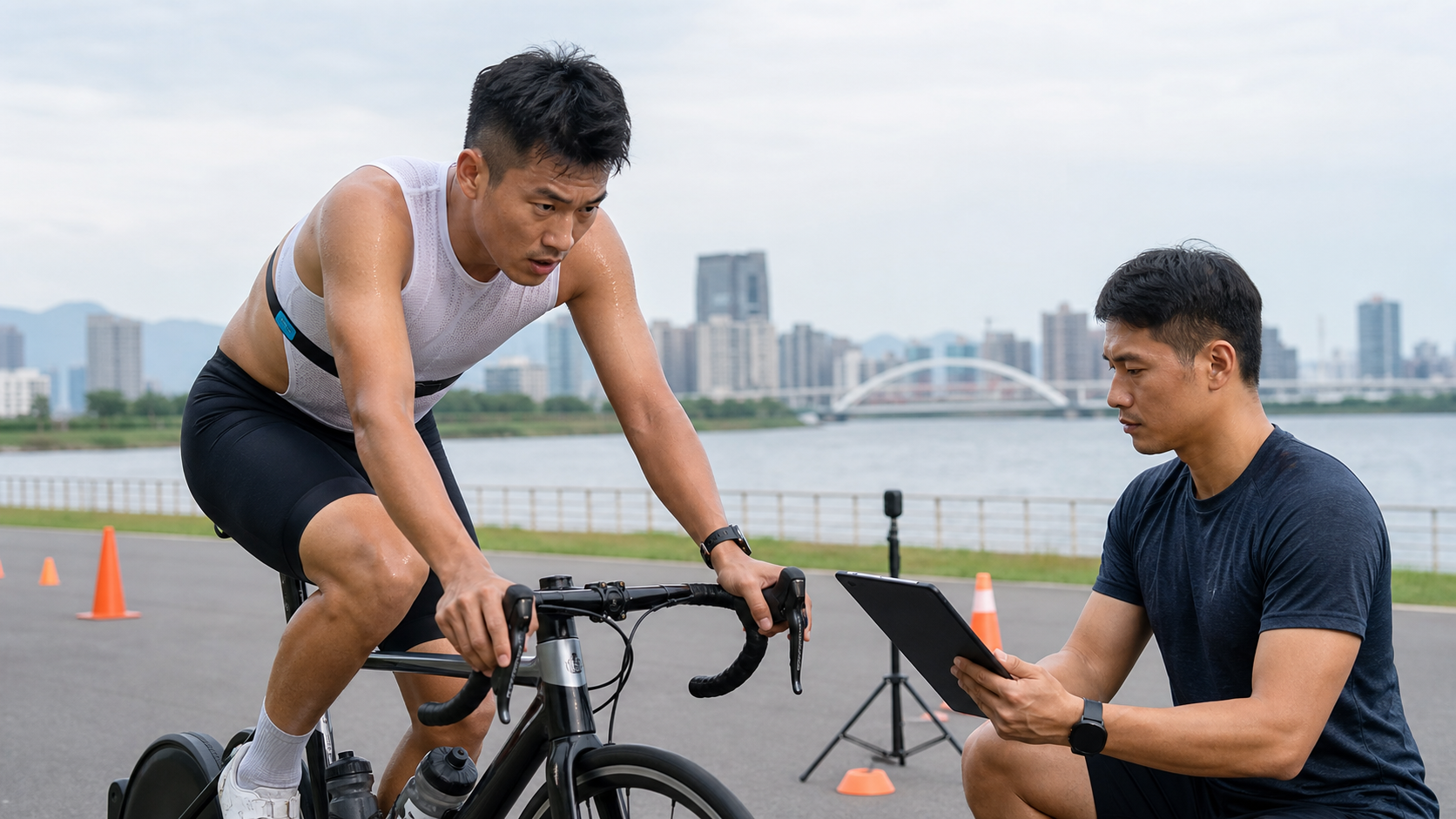
Opening: A Case of “Feeling Tired but Not Improving”
A few years ago, a corporate employee in his early forties came to me as a client. He considered himself diligent, cycling and running a combined six to eight hours a week, yet after six months, his times in major hill-climb races had barely budged. He pulled up his phone app to show me: “Coach, I ride until I’m nearly throwing up every time, and my heart rate gets really high. Why am I not improving?”
I asked him a question: “Do you know roughly how many watts your lactate threshold is, and what heart rate in bpm? Do you know what range your VO2max falls into?” He was stumped. He had trained for six months but had never actually measured his fitness—he was just training based on “feeling tired.”
That’s why I wanted to write this article. In my fifteen years working with athletes of all levels and general fitness enthusiasts, fitness assessment is the most underestimated and most easily botched aspect. Many people think assessing fitness just means “checking your heart rate and looking at a watch number,” but a truly scientifically meaningful test involves validity, reliability, venue selection, and whether it can be tracked long-term. In this article, I’ll do my best to clarify these concepts and give you methods that actually work in Taiwan’s environment (eating out, humid heat, common riverside paths and tracks, and National Health Insurance resources).
Let me start with something I often tell my clients: Without measurement, there is no management. If you don’t even know where your starting point is, how can you know whether you’re improving?
Conceptual Foundation: What Makes a “Good” Fitness Test?
Before discussing various tests, we must establish two core concepts; otherwise, you’ll be drowned in the numbers from all the apps and devices on the market.
Validity: Does This Test Really Measure What You Think It Measures?
Validity is about “accuracy”—whether the number a test produces truly represents the fitness component you want to assess. For example, VO2max is the gold standard for assessing cardiorespiratory fitness, and the most rigorous approach is a cardiopulmonary exercise test (CPET) in a lab with breath-by-breath respiratory gas analysis to measure your oxygen uptake. That’s the highest-validity approach.
But here’s the catch: CPET requires expensive equipment, trained personnel, and a dedicated facility—most people simply can’t access it. So various submaximal alternative tests have been developed, which “estimate” VO2max from your heart rate response at a fixed intensity. These estimation methods have lower validity, carry systematic error, and their accuracy depends heavily on the characteristics of the population being tested. Research shows that some classic submaximal tests (such as the Åstrand–Ryhming and YMCA step tests) have relatively better agreement with CPET, but the mean absolute error of the estimates can still reach ten to twenty percent.
Key point: The more convenient the test, the lower its validity usually is. This is an inevitable trade-off. Your goal isn’t to chase “maximum accuracy” but to choose a test that is “accurate enough for your purpose and can be reliably repeated.”
Reliability: If the Same You Takes the Test Twice, Will the Results Match?
Reliability is about “stability”—if the same person’s fitness hasn’t changed, will repeated tests produce similar results? With a test that has poor reliability, if your heart rate reads 150 one time and 165 the next week, you can’t tell whether your fitness changed or the test itself is jumping around.
For long-term tracking, reliability often matters more than validity. Why? Because what you usually care about isn’t “whether the absolute number is accurate” but “whether I’ve improved over these three months.” As long as the testing method is stable and conditions are consistent each time, you can still see the trend even if the absolute values are slightly off. This is why I always emphasize: tests must be standardized—same warm-up, same venue, same time of day, and as much as possible, similar weather and sleep status.
Common Fitness Components and Corresponding Tests
Fitness isn’t a single number. I usually break down the components that general fitness enthusiasts care about into several categories, each with a different testing logic. The table below is what I commonly use with my clients.
| Fitness Component | Representative Metric | Lab Gold Standard | Feasible Field Test | Validity / Notes |
|---|---|---|---|---|
| Aerobic Endurance (Cardiorespiratory) | VO2max, Lactate Threshold | CPET gas analysis, blood lactate sampling | 12-minute run (Cooper), 20-minute FTP, incremental treadmill/ergometer test | Field tests are estimates; require standardization |
| Anaerobic / Power | Peak Power, Anaerobic Capacity | Wingate ergometer test | Standing long jump, 30-meter sprint, short hill sprint | Good reliability; validity depends on the movement |
| Muscular Strength | 1RM or estimated 1RM | Direct 1RM measurement | Multiple-repetition 1RM estimation (e.g., RPE method) | Estimation is safer for beginners |
| Muscular Endurance | Repetition count | — | Push-ups, timed plank hold | Simple, high reliability |
| Flexibility | Joint Range of Motion | Goniometer | Sit-and-reach test | Only reflects specific body areas |
| Body Composition | Body fat percentage, muscle mass | DXA dual-energy X-ray | Bioelectrical impedance (InBody-type), waist circumference | Bioelectrical impedance is heavily affected by hydration |
Looking at this table, you’ll notice one thing: for almost every component, there are two options—“expensive but accurate” and “cheap but requires caution.” Your job is to make smart trade-offs based on your goals and resources.
Practical Method One: Choosing an Aerobic Endurance Test
This is what most endurance enthusiasts care about most, so I’ll spend a bit more time on it.
Cycling: The 20-Minute FTP Test
FTP (Functional Threshold Power) is the most popular field test in the cycling world. The standard protocol is: after warming up, do an all-out 20-minute time trial, take the average power of those 20 minutes, and multiply it by 0.95 to get your FTP. This 0.95 conversion comes from the method proposed by Coggan and Allen, designed to correct for the fatigue difference between a 20-minute all-out effort and a 60-minute all-out effort.
But I always remind my clients of an easily overlooked fact: this 0.95 is only an approximation. Individual variation means your true FTP could fall anywhere between 92% and 97% of your 20-minute average power. Some people have strong anaerobic capacity and can push especially hard for 20 minutes, so using 0.95 may overestimate; others are endurance-oriented and drop less between 20 and 60 minutes, so 0.95 may slightly underestimate. So I tell my clients: The FTP number itself isn’t gospel; it’s a reference point for long-term tracking. As long as you use the same protocol each time, the trend is meaningful.
The advantage of the FTP test is its high reliability—a power meter isn’t affected by wind or mood; as long as the protocol is fixed, repeatability is excellent. That’s also why I prefer using power rather than heart rate alone to assess cycling fitness.
Running: The 12-Minute Cooper Test and Field Testing
The classic field test for runners is the Cooper 12-minute run: run as far as you can in 12 minutes on a track, then use a formula to estimate VO2max. Its advantage is the extremely low barrier—a 400-meter track is all you need, and any school track or riverside park in Taiwan works. Its downside is that it depends heavily on pacing ability and mental toughness; beginners often start too fast and blow up, leading to underestimation.
In practice, I prefer an incremental protocol: on a treadmill or a standard course, start at an easy pace, increase speed or incline every few minutes until exhaustion, and record the highest stage you can reach. This type of test depends less on pacing ability and has decent reliability.
Submaximal Tests: Who Are They For?
If you’re a complete beginner, an older adult, or someone with cardiovascular concerns, I don’t recommend starting with an all-out maximal-intensity test. This is where submaximal tests (such as the YMCA step test or submaximal ergometer protocols) come in—you don’t have to push to exhaustion; you just work at a moderate intensity, record your heart rate response, and estimate VO2max. Validity is lower, but safety is much higher, and it’s sufficient for tracking broad trends.
A practical principle: The closer a test gets to exhaustion, the higher its validity usually is, but the higher the risk and barrier. When choosing tests for yourself or your clients, safety always comes before precision.
Lactate Threshold and the “Talk Test”: Finding the Line Without Blood Draws
Many clients hear “lactate threshold” and think it’s esoteric, assuming blood draws are mandatory. In the lab, it’s true that threshold is found through repeated blood sampling during exercise and plotting a lactate curve—high validity, but impractical for most people. The good news is that you have a very simple alternative.
The classic one is the talk test. When you’re exercising at an intensity where you “can still speak full sentences but don’t really feel like chatting,” you’re roughly near the aerobic threshold; when you “can only get out a few words and your speech is interrupted by breathing,” you’re near the upper edge of the lactate threshold. This method’s validity certainly can’t match blood sampling, but its reliability is surprisingly good, and it costs nothing and requires no equipment. When I help beginners find their easy-run pace, I almost always start with the talk test.
Another practical anchor is the ventilatory threshold. When you notice your breathing suddenly shifts from “smooth and steady” to “breath after breath, noticeably deeper and faster,” that turning point is usually near the threshold. Learning to feel this shift connects you more closely to your body’s true state than staring at a heart rate monitor—because heart rate is affected by sleep, caffeine, and temperature, but your breathing sensation is relatively honest.
Heart Rate Zones: Useful, but Don’t Treat Them as the Only Truth
Heart rate is the most widespread testing and training tool because it’s cheap and intuitive. But I want to clarify its role: Heart rate is a “response,” not an “output.” At the same 180 watts, if you slept poorly or it’s hot out, your heart rate might spike to 165; well-rested and cool, it might be 150. So heart rate is suitable as a “monitoring” tool, but you need to be very careful using it as an “absolute performance metric.”
Below is a heart rate zone reference I often give clients. Note that this uses a rough “percentage of max heart rate” breakdown; actual numbers should be converted using your own measured max heart rate or threshold heart rate—don’t just apply the crude “220 minus age” formula—that formula’s individual error can be as large as plus or minus ten-plus bpm.
| Zone | Approx. % of Max HR | Subjective Feeling | Training Purpose |
|---|---|---|---|
| Z1 Recovery | ~50–60% | Very easy, can chat comfortably | Recovery, warm-up, flush out |
| Z2 Aerobic Base | ~60–70% | Easy, can speak full sentences | Foundation building, fat utilization, endurance |
| Z3 Tempo | ~70–80% | Somewhat breathless, speech breaks up | Advanced aerobic endurance |
| Z4 Threshold | ~80–90% | Very breathless, only a few words at a time | Raising lactate threshold |
| Z5 Maximal | ~90–100% | Barely able to speak | VO2max, anaerobic capacity |
The greatest value of this table isn’t the precise percentages; it’s helping you align “subjective feeling” with “objective numbers.” Once you learn to calibrate numbers with sensation, even on a day without a heart rate strap, you can judge which zone you’re in by feel.
RPE: The Most Underrated Yet Most Durable Tool
If I had to recommend one “zero-cost, cross-sport, lifelong” assessment tool, it would be RPE (Rating of Perceived Exertion). It simply asks you to rate your current level of effort. The version I use most is the simplified 1-to-10 scale:
| RPE Score | Feeling Description | Approximate Correspondence |
|---|---|---|
| 1–2 | Barely moving, very easy | Walking, cool-down |
| 3–4 | Easy, can sustain for a long time | Z2 aerobic easy run |
| 5–6 | Moderate, starting to breathe harder | Tempo run, steady cruising |
| 7–8 | Hard, requires focus to maintain | Threshold intensity |
| 9 | Very hard, can’t sustain much longer | Near exhaustion |
| 10 | Maximal effort, can’t do any more | Sprint, final push of a test |
RPE’s power lies in the fact that it integrates all physiological and psychological signals—heart rate, breathing, muscle soreness, mental state—all condensed into a single number. Both research and practice show that well-trained individuals using RPE to gauge intensity correlate quite well with objective metrics. I ask my clients to jot down an RPE after each session; over time, that becomes a free fatigue and load tracking log.
Practical Method Two: A Quarterly Testing Plan You Can Execute
Principles alone aren’t enough, so here’s a quarterly testing schedule I actually give to general fitness enthusiasts. It’s not the only solution, but you can adapt it directly.
| Week | Test Item | Purpose | Standardization Focus |
|---|---|---|---|
| Week 0 (Baseline) | 20-min FTP or 12-min run + body weight + waist circumference | Establish starting point | Record sleep, temperature, warm-up routine for that day |
| Week 0 | Timed plank hold + push-up repetitions | Core and upper-body muscular endurance baseline | Fix movement standards (e.g., push-ups down to 90 degrees) |
| Week 4 | Subjective feeling records (training load, fatigue) | Process monitoring, no formal testing | Track with RPE and sleep quality |
| Week 8 | Repeat Week 0 aerobic test | Mid-term check | Keep conditions as close to baseline as possible |
| Week 12 | Full retest (aerobic + strength + body composition) | Quarterly summary | Same venue, same time, same protocol |
There are a few details in this plan I always emphasize:
- Baseline is the most important thing. Without a Week 0 baseline, all subsequent numbers lose their comparative meaning.
- Don’t do exhaustion tests every week. A maximal-intensity test is itself a huge load; doing it too frequently disrupts training and increases injury risk. I typically schedule a formal retest every four to eight weeks.
- Use subjective metrics for monitoring in between. Soft indicators like RPE (perceived exertion), morning heart rate, and sleep quality aren’t “tests” per se, but they’re extremely useful for catching fatigue and overtraining.
Taiwan-Specific Context: Factors That Will Contaminate Your Test Results
This section is what I find most practical and least discussed. Taiwan’s environment has several characteristics that will genuinely pollute your test data.
Humid Heat Will Inflate Your Heart Rate
Taiwan’s summers routinely exceed 32°C with 70–80% humidity. In such conditions, your body needs extra cooling, and your heart rate will run higher than at the same intensity in cooler weather. If you do your baseline in June and retest in October, even if your fitness truly improved, the numbers could be masked by temperature changes.
My advice: Try to retest in similar seasons, at similar temperatures and times of day. If that’s not possible, factor the weather into your interpretation—don’t conclude you’ve regressed just because your heart rate is higher. Early morning is the relatively cooler time of day in Taiwan and is when I often schedule tests.
Nutrition and Hydration for People Who Eat Out
Eating out is common in Taiwan, and many people’s pre-test meal is a greasy, salty bento or noodles. Pre-test diet, caffeine, and hydration status all affect performance and heart rate. I ask my clients to keep the meal 2–3 hours before a formal test as consistent as possible and to avoid trying a new energy gel or drink for the first time on test day. Test day is not the day to experiment.
Venue Selection: Riverside Paths, Tracks, and Gyms
The most accessible testing venues in Taiwan’s urban areas are riverside cycling paths and school/park tracks. Both are fine, but note the following:
- For FTP testing on a riverside path, choose a flat section with no traffic lights and no pedestrian crossings; otherwise, forced braking or dodging people will fragment your power data. Wind direction also matters—headwinds and tailwinds significantly affect pacing-based tests.
- A track is ideal for the 12-minute run because the distance is precise and the surface is even. Avoid the crowded evening rush.
- Gym InBody-type bioelectrical impedance devices for body composition are convenient but heavily affected by hydration—drinking more or less on the same day, right after exercise, or fasted will all shift the numbers. For tracking, measure at the same time and under the same conditions each time.
Medical and Health Checkup Resources
Taiwan’s National Health Insurance and health checkup environment are relatively accessible. If you’re older, have a family history of cardiovascular disease, or have experienced symptoms like chest tightness, dizziness, or palpitations during exercise, I strongly recommend consulting a physician and getting a basic cardiac evaluation before starting high-intensity testing. Some large hospitals and sports medicine centers also offer formal exercise cardiopulmonary testing like CPET; if you’re a serious endurance athlete, getting one formal assessment is a worthwhile investment.
A Deeper Look at Body Composition: Why Your Scale Is Lying to You
Body composition is the most misleading area, so I’m pulling it out for special attention. Many clients treat “body weight” as the only metric—losing two kilograms makes them happy, gaining one makes them anxious. But body weight is a very crude number: it lumps together muscle, fat, water, bone, and even the food in your digestive tract.
I’ve encountered many cases like this: a client does regular strength training for three months, body weight barely changes or even creeps up slightly, and they conclude “it’s not working.” But a body composition measurement shows muscle mass up and body fat percentage down, with a visibly better physique. The scale didn’t move because they gained muscle and lost fat, and the two roughly canceled out. If they only looked at the scale, they’d make a completely wrong judgment.
Trade-offs Among Body Composition Measurement Methods
The lab gold standard is DXA (dual-energy X-ray absorptiometry), which can relatively accurately distinguish fat, muscle, and bone, but it requires a medical or research facility with the equipment, involves radiation (though very low), and costs money. The most common method for most people is the gym’s bioelectrical impedance analysis (BIA, the InBody-type machines). It’s convenient and fast, but there’s a big catch: it works by sending a weak electrical current through the body and estimating based on impedance, and hydration heavily affects the results.
This means: right after drinking water, right after a sweaty workout, right after a meal, or at different phases of the menstrual cycle, your measured body fat percentage will jump. I’ve seen the same person’s InBody body fat percentage differ by three to four percentage points between a morning fasted reading and an evening post-meal reading. So for BIA, my iron rule is—only compare numbers taken under “identical conditions”: fixed time of day (e.g., morning after waking and using the bathroom, fasted), fixed hydration status. Only then does the trend mean anything.
The most down-to-earth and most underrated tool is actually a waist circumference tape measure. Waist circumference reflects visceral fat, which correlates well with metabolic health, and it’s zero-cost with high reliability. I often tell clients who just want to “be healthier, not chase performance”: rather than obsessing over the fluctuating InBody body fat number, measure your waist circumference once a month—that line’s trajectory is far more honest.
| Method | Accuracy | Convenience | Cost | Biggest Pitfall |
|---|---|---|---|---|
| DXA dual-energy X-ray | High | Low | High | Requires specific facility, trace radiation |
| Bioelectrical impedance BIA | Medium | High | Medium | Numbers jump when hydration changes |
| Skinfold calipers | Medium | Medium | Low | Highly dependent on tester skill |
| Waist circumference tape | Medium (reflects visceral fat) | High | Very low | Only measures one area |
| Body weight scale | Low (can’t distinguish components) | High | Very low | Conflates muscle, fat, and water |
Common Mistakes and Corrections
In all my years coaching, the same testing mistakes keep recurring. I’ve listed them below—check whether any apply to you.
Mistake One: Comparing Without a Baseline
This is the most common. Many people train for three months before thinking about testing, then have no “before” numbers to compare against and can only stare blankly. Fix: The first day of any training plan is your test day. Measure first, then train.
Mistake Two: Different Conditions Every Time
This time on a treadmill, next time on a riverside path; this time fasted in the morning, next time after dinner in the evening; this time cool, next time scorching. If conditions keep changing, the data isn’t comparable. Fix: Write your testing protocol into a fixed SOP and follow it every time. Warm-up duration, intensity, venue, time of day—all fixed.
Mistake Three: Treating Single-Test Fluctuation as a Trend
Performance fluctuates daily—poor sleep, work stress, or a hard session the day before can all discount a given day’s test. Panicking over a single drop is unnecessary. Fix: Look at the trend line, not single points. You need at least two or three readings in the same direction before concluding a real change.
Mistake Four: Only Testing Aerobic Fitness, Ignoring Strength and Body Composition
Many endurance enthusiasts fixate on VO2max and FTP while completely ignoring strength. But strength loss (especially after middle age) directly affects athletic performance and injury risk. Fix: Do at least one simple strength and muscular endurance test per quarter—even just a timed plank and a few sets of estimated 1RM.
Mistake Five: Not Pushing Hard Enough, or Pushing Too Hard, During Tests
The trickiest part of field tests is that they depend heavily on willpower. Being too conservative underestimates your fitness; being overly amped can cause injury or distorted data. Fix: Practice “test technique.” Pacing-based tests (like FTP or the 12-minute run) are themselves a skill; it’s normal for the first few attempts to be off. Once you’ve done a few rounds and found your rhythm, results will stabilize.
How to Read Test Numbers as Meaningful Trends
How you interpret the numbers after testing is just as important as how you test. I’ve seen too many people work hard to collect a pile of numbers, then make interpretation errors that create needless anxiety or complacency. Here are a few principles I actually use when reviewing data with clients.
First, always ask, “Is this change beyond the noise?” Every test has an inherent error range. An FTP difference of a watt or two, or a body fat percentage shift of one point, is likely just that day’s state or machine error, not a real change. I use a rough threshold—the change needs to be clearly larger than the test’s own fluctuation before treating it as a real signal.
Second, put the numbers back into context. Suppose a client’s 20-minute FTP test comes in 5 watts lower than last time. Don’t rush to call it a regression. Check the records: was it especially hot that day? Was sleep poor? Did they race the day before? Many “regressions,” when unpacked, turn out to be worse test conditions, not worse fitness.
Third, cross-check multiple indicators. A single number can easily deceive, but if FTP, morning heart rate, RPE, and subjective feel all point in the same direction, the signal is far more trustworthy. One of my favorite positive signals is: at the same pace, heart rate is lower and RPE feels easier—that’s almost certainly real aerobic improvement, more convincing than any single test.
Fourth, allow for plateaus. Progress isn’t linear. Especially after training for a while, numbers stalling is completely normal and doesn’t mean you’re doing something wrong. That’s the time to examine whether your training needs variation or recovery is insufficient—not to doubt yourself or pile on more volume. A plateau is normal, not failure.
Actionable Advice for Readers at Different Levels
Finally, let me distill everything above into concrete actions for three types of people. Find the one that fits you best and start there.
If You’re a Beginner
Don’t touch any exhaustion tests yet. Your focus right now is establishing a simple, repeatable baseline:
- Measure body weight and waist circumference, and take a photo of your posture.
- Do a safe submaximal test, such as walking or jogging a fixed distance at a moderate pace, recording heart rate and time.
- Test how long you can hold a plank and how many push-ups you can do.
- Write these numbers down, then retest in eight to twelve weeks using exactly the same method.
You don’t need precision instruments—just a watch, a tape measure, and a track. Consistency and consistency beat expensive and precise.
If You’re an Advanced Athlete
You already have a training foundation, so you can start using higher-validity tests:
- Cyclists: get a power meter and do regular 20-minute FTP tests (remember, 0.95 is just a reference).
- Runners: do the 12-minute Cooper test or an incremental protocol to estimate VO2max and establish training pace zones.
- Put aerobic, strength, and body composition tests into a quarterly testing schedule, with one full retest per quarter.
- Use soft metrics like morning heart rate, RPE, and sleep to monitor fatigue between formal tests.
If You’re an Older Adult or Have Health Concerns
Safety first, and the order can’t be reversed:
- Get a medical evaluation first, especially if you have a history of cardiovascular disease, hypertension, diabetes, or have experienced discomfort during exercise—consult a physician before anything else.
- Choose submaximal, non-exhaustive tests; avoid all-out sprints.
- Have someone accompany you during testing, and do it in a familiar, safe environment.
- Focus tracking on “functional” indicators—such as whether climbing a few flights of stairs leaves you breathless, how long you can walk before getting tired, or how easy it is to get up from a chair. These matter far more to quality of life than a VO2max number.
FAQ
These are the questions I get asked repeatedly by clients, compiled here for you.
Q1: How accurate is the VO2max estimated by smartwatches?
A watch’s VO2max is estimated from your running speed and heart rate response, not directly measured. Its validity is moderate—fine for capturing “broad directional trends,” but don’t treat it as a lab-grade number. More importantly: for the watch to be accurate, heart rate measurement must be accurate first. Optical wrist-based heart rate tends to drift at high intensity, in cold weather, or when the wrist is sweaty. If you’re serious about tracking, a chest strap heart rate monitor will be far more reliable. Treat the watch’s VO2max as a “reference trend line” and don’t obsess over its absolute value day to day.
Q2: How often should I test?
For formal maximal aerobic tests, I usually recommend once every four to eight weeks. Testing too frequently not only disrupts training and increases injury risk, but fitness doesn’t change week to week anyway—testing too often just drowns you in noise. Body composition once a month and waist circumference once a month is plenty. As for soft metrics like RPE, morning heart rate, and sleep, record them daily—they’re monitoring, not testing, with low cost and immediate reflection of fatigue.
Q3: Can I train normally the day before a test?
Try not to. The day before a formal test, I ask my clients to do an easy recovery session or rest entirely, so the body is in a relatively fresh state. If you did a hard workout the day before and show up carrying that fatigue, your numbers will be underestimated, and you’ll mistakenly think you’ve regressed. If you’re going to test, give your body a fair chance.
Q4: Is there anything women should pay special attention to in testing?
The key factor is that the menstrual cycle affects body temperature, fluid retention, and subjective feelings, which in turn affect heart rate, body weight, and body composition readings. This doesn’t mean you can’t test during the cycle, but you should factor it into interpretation. For rigorous trend tracking, try to retest at similar phases of the cycle—don’t compare luteal-phase water-retention weight against follicular-phase numbers. If this is a concern, an OB-GYN or sports nutrition professional can offer more individualized advice.
Q5: My test numbers are terrible. Does that mean I’m useless?
Absolutely not. The level of your baseline number doesn’t matter; what matters is that it gives you a starting point. I’ve coached clients with very low starting points who, because the direction was right and tracking was solid, made more impressive improvements than those who started strong. The purpose of testing is never to judge you as a person; it’s to navigate your effort. When you see an unflattering number, the right response is, “Great—now I know where to start.”
Conclusion: Numbers Are Here to Serve You, Not to Scare You
Let’s return to that client who “felt tired but wasn’t improving.” The first thing we did was spend a weekend establishing a complete baseline: FTP, incremental run test, body composition, and several strength measures. With a starting point in place, his training finally shifted from “grinding by feel” to “adjusting by data.” Three months later, at the retest, the FTP improvement was written there in black and white, and he was surprised himself—turns out the past six months weren’t a lack of effort, but effort without direction.
The essence of fitness assessment isn’t to create anxiety; it’s to give your effort a coordinate system. With coordinates, you know where to go, how far you’ve come, and whether you’ve arrived. Choose the right test, standardize the conditions, and patiently track the trend—do these three things well, and every drop of your sweat will mean something.
Testing isn’t the finish line; it’s a way of having a conversation with your own body. It doesn’t require expensive equipment, and it doesn’t require you to become a sports science expert—just a watch, a tape measure, a track, and a heart willing to record honestly. Start measuring—from today, from the person you are right now.
This article is educational content and cannot replace individual diagnosis and treatment advice from a physician, physical therapist, or nutritionist. If you have cardiovascular disease, hypertension, diabetes, or other chronic conditions, or have experienced symptoms such as chest tightness, palpitations, or dizziness during exercise, please consult your physician and undergo individualized assessment before starting any high-intensity fitness testing.
References
- Direct Versus Indirect Submaximal VO2max Assessment: https://www.mdpi.com/2411-5142/10/4/431
- Cardiorespiratory fitness assessment using risk-stratified exercise testing: https://pmc.ncbi.nlm.nih.gov/articles/PMC8319417/
- Relationship Between the Critical Power Test and a 20-min Functional Threshold Power Test: https://www.ncbi.nlm.nih.gov/pmc/articles/PMC7862708/
- FTP Tests: How to perform 20-Minute, 8-Minute, and Ramp Tests: https://trainright.com/ftp-tests-how-to-perform-20-minute-8-minute-and-ramp-tests/
Related Reading
- Athlete Blood Test Nutrition Guide: What to Test, How to Read It, and How to Track
- Athlete Posture Assessment and Correction: From a Misaligned Body, Reclaim the Power to Breathe
- Exercise and Stress Management: A Coach’s Guide to Using Physiological Mechanisms and Daily Exercise Prescriptions to Ride Stress Back into a Controllable Range
- Recognizing and Recovering from Exercise Burnout: A Coach’s Guide to Reading Your Body’s Distress Signals
西進武嶺 免費訓練分析服務 Intervals | 練不夠還是練過頭?你哪一種類型選手?AI模型告訴你! | 備戰神器 | 公路車 訓練 | CT Yeh
4 年前
#公路車 #Vo2Max #最大攝氧量 測驗 體驗 | 心肺測試
6 年前
CT 喇低賽) 單車 比賽總是沒照片? 攝影師的觀點大公開 姿勢就是力量! 請加速1.25倍收看
7 年前
單車AI教練!全新 ChatGPT4o 幫你分析訓練成果!排武嶺課表,分析騎車姿勢! 太神了! / 公路車 / CT Yeh / feat. 緯緯
2 年前
一個測試有沒有認真練車的方法😂 #公路車
10 個月前
#公路車 #Fitting 靠人工智慧APP 幫你調整單車
6 年前
實景訓練台) 彰化經典百K 高強度喵團 90分鐘 跟著一起練功 2019 Indoor workout Changhua Classic 100 Taiwan
7 年前
2018 田中馬拉松 全程健跑 VR 360 環景錄影 體驗現場狂野加油氣氛! Insta 360
7 年前