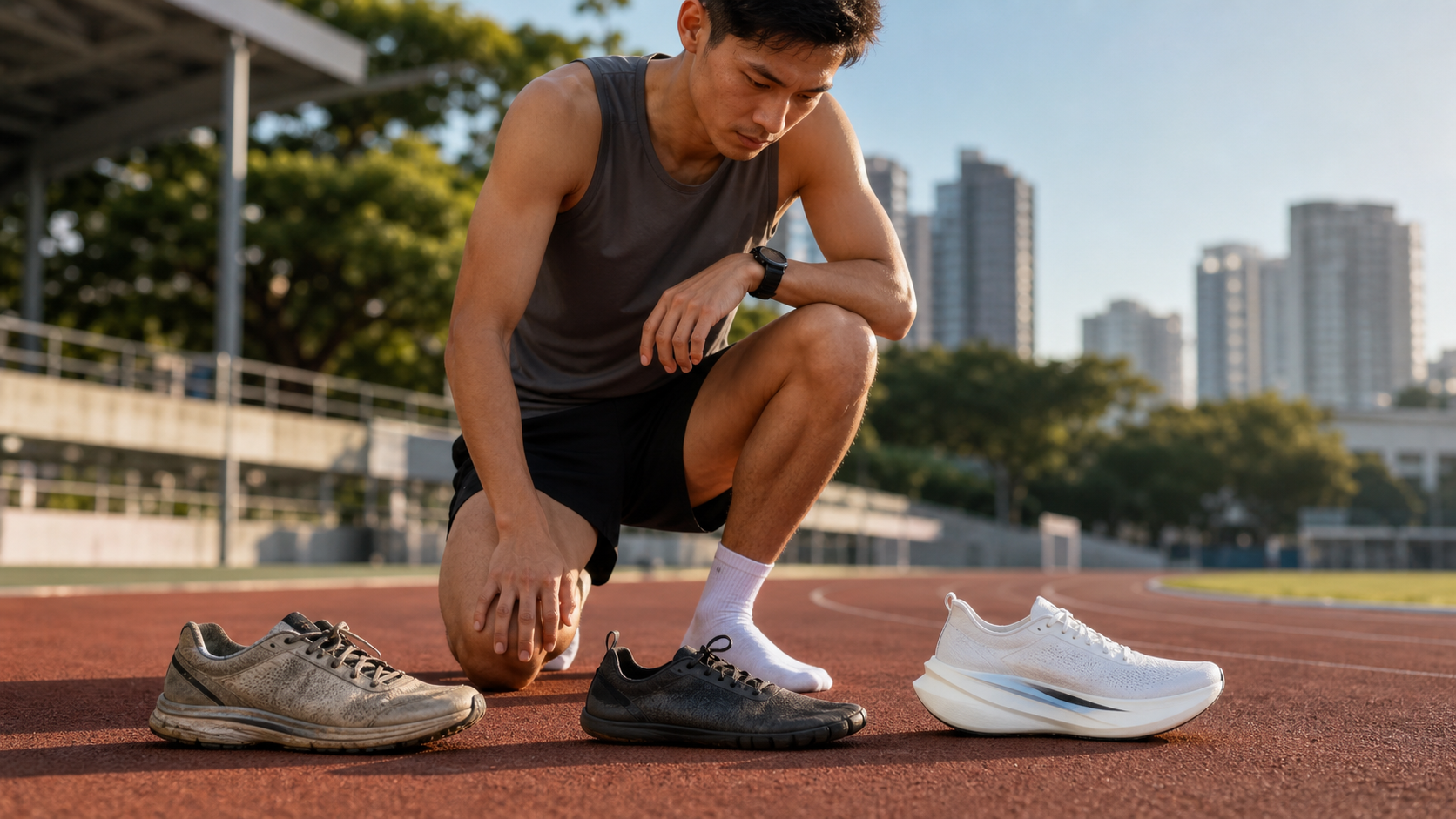
Starting with an Old Pair Worn Down to the Sole
A few years ago, a student working at Hsinchu Science Park came to me for the first time, carrying a pair of running shoes whose soles were worn down like bald tires. He asked me very seriously, “Coach, should I buy a pair of carbon-plated shoes so I can break four hours in a marathon?”
I looked at his shoes, then at the obvious excessive ground contact time and low cadence in his running form video, and said with a smile, “What you need right now isn’t a carbon plate—it’s a pair of training shoes that can still protect you, and a sensible training plan.”
I’ve encountered this exact scenario no fewer than dozens of times over the years. The progress in running shoe technology over the past two decades has been more dramatic than the previous fifty years combined—barefoot running once swept the globe, minimalist shoes had their moment in the sun and then faded, and then super-thick midsoles with carbon-plated racing shoes burst onto the scene, pushing marathon world records ever lower. Just the terms “cushioning,” “energy return,” “carbon plate,” and “energy feedback” alone are enough to leave anyone standing dizzy in front of a shoe wall.
In this article, I want to peel back the science behind running shoes layer by layer from the perspective of coaching students: what exactly are shoes doing for you, are cushioning and energy return the same thing, do carbon plates really work, and how should you scientifically choose shoes based on your foot type, mileage, and goals? I won’t give you a one-size-fits-all answer like “this shoe is the best,” because that simply doesn’t exist. What I want to give you is a framework for judgment, so that next time you stand in front of a shoe wall, you can make the right decision yourself.
Let me start with an important premise: Shoes are tools, not a cure. A good pair of shoes can lower your injury risk, make your runs more comfortable, and squeeze out a little extra performance on race day; but they won’t replace training, and they can’t heal injuries caused by overtraining or imbalanced running form. Understanding this will keep you from putting your money and expectations in the wrong place, and from being led around by marketing talk in front of the shoe wall.
Foundational Concepts: What a Running Shoe Actually Does
With every step you land, your body absorbs roughly 2 to 3 times your body weight in impact force—even more when running faster or downhill. Take a 70-kilogram runner as an example: over a full marathon, your feet hit the ground somewhere between 30,000 and 40,000 times. That’s an enormous cumulative load. The core mission of a running shoe is to help you handle three things in this repetitive “landing–propulsion” cycle.
One: Cushioning—Managing Impact, but Softer Isn’t Always Better
Cushioning is the function everyone thinks of first. The midsole material compresses at the moment of landing, absorbing part of the impact and reducing the peak forces transmitted to your knees, shins, and the soles of your feet. This is especially important for runners with high mileage, heavier body weight, or a history of joint discomfort.
But here’s a common misconception: soft ≠ well protected. If the midsole is too soft, your foot actually has to work harder to stabilize on landing, muscles fatigue more quickly, and over long distances the strain on your calves and arches may increase rather than decrease. The key to cushioning is “appropriate”—enough to shave off dangerous impact peaks, but not so soft that you lose ground feedback and stability. The analogy I often use is: jump on a hardwood floor and your joints will complain; but jump on an ultra-soft spring mattress and you’ll find every landing takes more effort just to “find your balance.” Cushioning needs to land in the sweet spot between these two extremes—and everyone’s sweet spot is different. Body weight, mileage, running form, and terrain all shift that point. That’s why a shoe that others rave about may not feel comfortable on your feet.
Two: Energy Return—Giving Back Part of the Force You Push Down
This is the biggest technological breakthrough of the last decade. Traditional EVA foam midsoles absorb impact when compressed, but they also “eat up” a fair amount of energy. The new generation of foam materials (such as midsoles made from PEBA, TPEE, and other base materials by various brands) don’t just cushion—they also return a portion of the stored elastic energy to you as you push off the ground, like stepping on a springy mat. That’s the core of “energy return.”
Let me clarify one concept here: cushioning and energy return are not the same thing. Cushioning is about “absorption,” while energy return is about “giving back.” The ideal racing midsole is a material that can both absorb dangerous impacts and efficiently return energy.
Three: Propulsion and Gait Guidance—Carbon Plates and Geometry Come In
The third task is guiding your foot to roll forward and aiding propulsion. The carbon fiber plate (carbon plate) and the midsole’s “rocker” geometry were designed precisely for this. The carbon plate itself doesn’t generate energy out of thin air—it acts more like a lever and rigid structure, reducing energy lost when your toe joints bend, and working together with the rocker curve of the thick midsole to make each step’s roll smoother and more efficient.
So the “magic” of a modern racing shoe is actually a combination of three elements working together: high-rebound midsole + carbon plate + rocker geometry—not the carbon plate going it alone. Some students ask me, “So if I stuff a carbon plate into a regular training shoe, will I get faster too?” The answer is almost certainly no—it might even make running harder. The carbon plate needs a thick, highly resilient midsole beneath it to serve as a “fulcrum.” Without that high-rebound foam layer, the carbon plate just makes the shoe stiffer and harder to bend, losing the rolling and efficiency benefits it’s supposed to provide. These three things form a system; look at any one of them in isolation and you’ll misjudge its value.
A Role Often Overlooked: The Foot Itself
I also want to add a fourth, “invisible” player—your own foot. No matter how premium the shoe, it’s only an external aid. What truly absorbs impact and generates propulsion is your arch, Achilles tendon, calves, and gluteal muscles. That’s why I often tell my students it’s more accurate to think of running shoes as an “amplifier.” Your running form and strength are the signal source; the shoe amplifies it—if the signal is good, what comes out is beautiful; if the signal itself has problems, no matter how expensive the shoe, it just amplifies the problems along with it. This concept will run through the entire article.
A Brief History of Shoe Evolution: The Pendulum from Barefoot to Carbon Plates
To understand today’s running shoes, you first need to see how the pendulum has swung to get here. This history is very much like a pendulum swinging back and forth.
The Era of Minimalism and Barefoot
More than a decade ago, a wave of “barefoot running” and “minimalist shoes” swept through the running community. The core claim was: humans evolved as barefoot runners, and excessive cushioning and high heel-to-toe drop actually weakened foot muscles and encouraged injury-prone heel striking. Minimalist shoes had almost no cushioning and a heel-to-toe drop approaching zero, with the goal of letting the foot “return to nature.”
This movement taught the running world one important lesson: foot and calf strength, and running form itself, matter greatly—you can’t outsource everything to your shoes. But it also brought a wave of injuries—many people switched directly from thick-soled shoes to minimalist ones without progressing gradually, while maintaining their original high mileage. Their calves and soles couldn’t handle the sudden change in load, leading to plantar fascia, Achilles tendon, and metatarsal problems.
The Pendulum Swings Back: Maximum Cushioning
After the barefoot craze cooled down, the pendulum swung to the other end—ultra-thick midsoles and maximum-cushioning shoes became popular. The pitch was protection, comfort, and letting high-mileage runners train daily without wearing out their joints. This wave cemented the market sentiment that “thick equals good,” and also paved the way for the carbon-plated racing shoes that followed: because to accommodate a carbon plate and make the rocker effect work, the midsole needs a certain thickness to begin with.
The Carbon-Plated Racing Shoe Explosion
Then came the carbon-plated racing shoe era we’re all familiar with now. The combination of high-rebound foam + carbon plate + rocker has been shown by numerous studies and real-world racing to improve running economy (meaning using less oxygen and less effort at the same pace), and world-class marathon times have been dramatically rewritten in recent years.
This technology became so powerful that governing bodies had to step in. World Athletics has set limits on midsole stack height and regulations on the number of carbon plates for road racing shoes permitted in official competition, aiming to strike a balance between encouraging innovation and maintaining fairness. That’s why you now see a distinction between “rule-compliant” and “training-only ultra-thick” models.
Coach’s note: Regulation details and figures are adjusted by each governing body with each version. If you’re entering an officially certified race, always defer to the organizer and that edition’s published rules—don’t rely on memory.
Breaking Down the Key Materials and Structures
The table below explains several core running shoe terms in plain language—this is the diagram I most often draw on the whiteboard when working with my athletes.
| Term | Plain-Language Explanation | What It Means for You |
|---|---|---|
| Midsole | The foam material sandwiched in the sole; the main player in cushioning and rebound | Determines the shoe’s softness/firmness, rebound feel, and lifespan |
| Stack height | Total thickness of the midsole from under your foot to the ground | Thicker usually means more cushioning, but also higher and less stable |
| Drop | The height difference between the heel and the forefoot | Affects landing pattern and load on the calves/Achilles tendon |
| Energy return | The percentage of elastic energy the midsole gives back | Affects the “effortless feel”—higher isn’t necessarily better for everyone |
| Carbon plate | A carbon fiber plate embedded in the midsole | Increases stiffness and propulsion leverage; only works with a thick midsole |
| Rocker | The curved shape of the midsole that curves up at the front and back | Helps the foot roll forward and reduces push-off resistance |
| Last / toe box | The width and space of the forefoot area | Taiwanese feet tend to be wider on average, so this row is crucial |
Midsole Materials: More Expensive and More Rebound Doesn’t Automatically Mean It Fits You
Newer high-rebound midsoles do save energy, but they also tend to be softer and less stable, demanding more from your running form control and ankle stability. I’ve worked with beginners whose core and ankle stability weren’t solid yet—they rushed into the most premium soft-and-bouncy racing shoes for long runs, and ended up with more calf and plantar soreness. Rebound is meant for feet that have the strength to handle it.
Drop: No Standard Answer, Only What Your Body Adapts To
A higher drop (e.g., more traditional designs) tends to place less load on the Achilles tendon and calves and is friendlier to heel strikers; a low or near-zero drop puts more strain on the calves and Achilles, but also encourages a more midfoot/forefoot landing. Neither is “absolutely correct”—what matters is what your body is currently adapted to, and whether you want to make a change. If you’re switching to a shoe with a significantly different drop, you must progress gradually. Here’s a real example: an athlete who had long worn high-drop shoes and landed on his heel suddenly switched to a near-zero-drop shoe. His calves and Achilles were forced to take on far more stretching load than before, and the first week or two were especially tight and sore. That doesn’t mean the new shoe is bad—it means his body is relearning. Give it time, cut mileage, build up slowly, and most people can make the transition; but pushing through at the same volume is asking for injury.
Three Case Studies: Understanding “Same Shoe, Different Outcomes”
No matter how much theory I explain, nothing beats real scenarios. The details of the three cases below have been adjusted (for privacy and contextual presentation), but they reflect situations I repeatedly encounter with my athletes.
Case A: The Office Worker Who Rushed Into Carbon Plates
A man in his thirties running about 20 to 25 km per week, targeting a sub-4-hour marathon. After reading online reviews, he switched all his daily training to a top-tier carbon-plated racing shoe, reasoning that “if it saves energy, wearing it every day must mean faster progress.” Three weeks later, his Achilles and calves started feeling tight and sore. The problem: the high-drop rocker design and soft, bouncy midsole of the carbon shoe changed his landing and push-off rhythm, but his calf muscles hadn’t adapted to this new loading pattern—wearing it daily meant loading his calves every single day. The fix: put the carbon shoe away and wear it only for the one key workout per week; return to a cushioned, stable trainer for daily runs. Symptoms eased noticeably within two weeks.
Case B: The Running Newbie Injured by Minimalist Shoes
A woman in her twenties who had been running for just six months was drawn to the “barefoot natural running” philosophy and bought a near-zero-drop minimalist shoe outright, while keeping her usual schedule of four runs per week at 8 km each. After about a month, she developed the classic sharp pain on the first step in the morning. The fix: first, return to her original cushioned shoes to let the symptoms settle, and I recommended she see a doctor to rule out other issues; if she still wants to try low-drop shoes later, limit them to one or two short runs per week, build ankle strength gradually, and transition by “adding on” rather than “all at once.”
Case C: The Veteran Runner Who Ignored Shoe Replacement
A man in his fifties with over a decade of running experience, with stable form and training, complained of a nagging ache on the outside of his knee. A quick check of his shoe mileage—the same pair had been worn for over 1,000 km, and the midsole was long since dead. The fix: replace with a new pair of the same model, log the mileage, set a replacement reminder at around 700 km, and the discomfort faded within a few weeks. I especially want to highlight this case: even veterans fall into traps, and often it’s the most basic one—“should have replaced them but didn’t.”
Practical Approach: A Complete Scientific Shoe-Selection Process
Now that the theory is covered, let’s get to the most practical part—how to choose. I’ve organized the shoe-selection process I use with my athletes into actionable steps.
Step 1: Define the Purpose First, Then Look at the Shoe
The most common mistake runners make is “seeing a cool-looking shoe first, then trying to convince themselves they need it.” The correct order is the opposite: define the purpose first, then find the shoe that fits. For the average runner, an ideal shoe rotation has two to three distinct roles.
| Shoe Role | Primary Use | General Characteristics | Suitable Scenarios (Taiwan Context) |
|---|---|---|---|
| Trainer / daily shoe | Daily aerobic runs, easy runs, recovery runs | Generous cushioning, durable, stable | Riverside path jogging, campus loop LSD |
| Tempo / speed shoe | Tempo runs, intervals, threshold work | Lighter, good rebound, still supportive | Track intervals, pace practice |
| Racing / competition shoe | Key races, test days | Lightest, carbon plate, high rebound | Marathon/half-marathon race day |
For beginners, one good trainer will serve you well for a long time; once your weekly mileage is consistent and you start adding speed workouts, consider adding a speed shoe; save the carbon racing shoe for last, when you have a clear race goal and enough training foundation.
Step 2: Know Your Own Feet
Before choosing a shoe, spend ten minutes getting to know your feet. These are the most critical aspects:
- Foot width: Taiwanese feet tend to be wider on average, and many people mistake a narrow last for a sizing issue. When the forefoot is squeezed, long runs often lead to black toenails and bunion discomfort. Better to have a roomier toe box than a cramped one.
- Arch height and stability: People with collapsed arches (overpronation) or high arches that supinate have different support needs. You don’t have to guess—your old shoes’ wear patterns will tell you.
- Old shoe wear patterns: Flip over your most-worn pair and look at the outsole. Even wear usually means a relatively neutral gait; if the outer heel is worn down significantly, or the inner side is collapsing noticeably, use that as a reference for support needs.
- Injury history: If you’ve had plantar fasciitis, Achilles issues, shin splints (medial tibial stress syndrome), or knee discomfort, be more conservative with cushioning and drop choices, and consult a physical therapist or sports medicine specialist if needed.
Step 3: The Science of Trying Shoes On
Don’t just stand up and take a couple of steps when trying on shoes. Here’s what I ask my athletes to do:
- Try them on in the afternoon or after a run: Your feet swell slightly over the course of the day, and that size is closer to what your feet will be like in the later stages of a long run.
- Wear the socks you’ll actually run in: Thickness makes a big difference.
- Leave room at the front: From your longest toe to the tip of the shoe, leave about one thumbnail’s width (roughly 0.5 to 1 cm), because your foot slides forward on downhills and over long distances.
- Jog a little in the store: If the store allows it, do a short run to feel the landing and rolling motion—standing still won’t tell you anything about the rocker or rebound.
- Try both feet: Most people have slight size differences between feet; go with the larger one.
Step 4: Mileage Management and Replacement
Midsole foam “fatigues” with mileage, and rebound and cushioning gradually decline. The lifespan of a typical trainer generally falls in the 600 to 800 km range (varying by body weight, gait, and surface); the high-rebound midsoles of carbon racing shoes are usually more “delicate,” with a noticeably shorter effective lifespan, which is why many people only wear them for key workouts and races.
Practical tip: log the mileage for each pair of shoes in your running watch or app. When you notice that the same pace feels harder, or you start feeling unexplained soreness on landing, that’s often the signal that the midsole is ready for retirement.
Weekly Shoe Rotation Example
Many students ask me: “Do I really need multiple pairs of shoes to rotate?” It’s not mandatory, but shoe rotation does offer two benefits: first, different shoes stimulate slightly different muscle groups, spreading out the repetitive load on any single area; second, it gives the midsole time to “bounce back and recover,” extending its lifespan. Below is a reference example for an advanced runner (beginners don’t need to copy this—starting with one pair of training shoes is fine).
| Day | Workout | Suggested Shoe Role |
|---|---|---|
| Monday | Recovery jog | Training/everyday shoe (the most cushioned pair) |
| Tuesday | Intervals/Speed | Tempo/speed shoe |
| Wednesday | Easy aerobic | Training/everyday shoe |
| Thursday | Tempo run | Tempo/speed shoe |
| Friday | Rest or cross-training | — (rest) |
| Saturday | Long slow distance (LSD) | Training/everyday shoe (stable cushioning) |
| Sunday | Easy run or rest | Training/everyday shoe |
Note: carbon-plated racing shoes barely appear in daily training. They’re more like racing tires on a race car—prepared for that one day, not for daily commuting. If you want to get familiar with them before race day, one or two short runs to adapt is enough. Don’t burn through the precious midsole lifespan on ordinary days.
Common Mistakes and Fixes
These are the pitfalls I’ve seen over and over through the years—traps nearly every runner might fall into.
Mistake 1: Thinking carbon-plated shoes can replace training
This is the misconception of that Hsinchu science-park student mentioned earlier. Carbon-plated shoes improve “running economy”—squeezing a bit more efficiency out of your existing ability. The improvement varies from person to person, and it depends on you already having sufficient aerobic fitness and strength. Without that foundation, these shoes can help you only marginally, and you might even get injured more easily because you can’t handle their soft, bouncy feel. Fix: build your training and foundation first. The shoe is the last piece of the puzzle, not the first.
Mistake 2: Switching shoes too aggressively
Jumping straight from high-cushion, high-drop shoes to minimalist zero-drop shoes, or vice versa; or switching to three brand-new shoe models at once. Your body needs an adaptation period for shoe changes. Fix: change only one variable at a time. Start new shoes with short distances and slow paces, watch for any abnormal signals in your calves, Achilles tendon, or plantar fascia for a week or two, then gradually increase volume.
Mistake 3: Only looking at cushioning, ignoring fit
No matter how impressive the midsole, it’s useless if it doesn’t fit your foot. Black toenails and discomfort in the big toe and pinky toe caused by too-narrow toe boxes are extremely common problems among Taiwanese runners. Fix: fit (especially forefoot width) takes priority over any tech buzzword. Wide-footed people should actively seek out wide versions.
Mistake 4: Not replacing shoes until the “foundation is hollowed out”
Midsole breakdown is gradual—you won’t suddenly notice it one day. Many people’s knee or plantar discomfort actually comes from a pair of shoes that should have been retired three months ago. Fix: track your mileage, watch for “feeling more effort at the same pace” and new aches and pains, and err on the side of replacing shoes earlier.
Mistake 5: Treating someone else’s miracle shoe as your own
Shoe reviews and friend recommendations have reference value, but everyone’s foot shape, running form, weight, and injury history are different. The same shoe can help one person set a PB and give another person knee pain. Fix: treat reviews as a “candidate list,” but let your feet and the try-on experience make the final decision.
Trade-offs Between Different Shoe Types at a Glance
Let’s condense the concepts above into a “trade-off table” to help you quickly orient yourself in front of the shoe wall. No column wins across the board—the key is matching your purpose.
| Shoe Type | Strengths | Costs/Risks | Best For |
|---|---|---|---|
| Minimalist/low-drop shoes | Strong ground feedback, encourages foot strength | Little cushioning, needs long adaptation, injury-prone if switched too fast | Those who are patient and gradual, want to strengthen ankles/feet |
| Neutral training shoes | Balanced, durable, easy to use | No special “speed” boost | The daily workhorse for almost all runners |
| Support/stability shoes | Helps control overpronation | Excessive support can restrict running form | Those with obvious inward collapse on old shoes |
| Max-cushion thick-soled shoes | Protects joints, friendly for high mileage | Heavier, taller, slightly less stable | High-mileage runners, heavier runners, recovery runs |
| Carbon-plated racing shoes | Improves economy, race-day boost | Expensive, short lifespan, requires ability to handle | Those with a foundation and a clear race goal |
I often remind my students: this table has no “strongest column,” only “the column that best fits you right now.” The same person may fall into completely different columns during the beginner phase, advanced phase, and race-prep phase—that’s completely normal, and it’s exactly why your shoe rotation should evolve as you grow.
Care and Longevity: Getting the Most Out of Good Shoes
You’ve spent money on shoes—how do you make them last longer while maintaining their protection? A few practical habits:
- Give the midsole time to rebound: Wearing the same pair for high mileage day after day doesn’t give the midsole time to recover. If you can rotate between two pairs, you’re letting each pair catch its breath.
- Clean properly and dry in the shade: Taiwan is humid. Don’t just toss wet shoes in a corner after a run. Remove the insoles, stuff newspaper inside to absorb moisture, and air-dry in the shade—avoid direct sunlight or machine drying, as high heat accelerates midsole foam aging.
- Don’t treat them like slippers: Forcing your feet into unlaced shoes and crushing the heel counter destroys the upper’s structure and stability.
- Trail is trail, road is road: Taking road shoes onto gravel and dirt wears down the outsole quickly and provides insufficient grip—and vice versa.
- Don’t let one pair do too many jobs: Using your race-day shoes for daily errands and dog walks is like driving city streets on racing tires.
Additional Considerations for the Taiwan Context
Running in Taiwan, there are several local factors worth factoring into your shoe choices.
- Hot, humid climate: Taiwan summers are hot and humid, so upper breathability and drainage matter. Monsoon season and afternoon thunderstorms often leave riverside paths slippery, and wet shoes on long runs make blisters more likely. Sock material and upper dryness directly affect how things feel.
- Diverse common surfaces: From riverside paths and school tracks (PU surfaces) to mountain trails, the terrain varies greatly. If you often run trails or gravel paths, grip (outsole tread pattern, rubber compound) and protection matter more than simply chasing energy return.
- Eating out and weight management: This seems unrelated to shoes, but it actually is. Body weight amplifies impact forces—heavier runners need more cushioning and go through shoes faster. A balanced diet and keeping your weight in a reasonable range protect your joints just as much as any pair of shoes.
- Healthcare accessibility: Taiwan’s National Health Insurance is convenient. If you have recurring pain in the same spot (e.g., Achilles pain after running, sharp pain on the first step in the morning from plantar fasciitis, medial tibial tenderness), don’t just try to fix it by buying new shoes. Seek medical attention early—a rehab or sports medicine specialist’s assessment is often more fundamental than buying another pair.
Actionable Advice for Readers of Different Levels
Finally, here is a table of recommendations organized by your current stage. Find where you fit and follow accordingly.
| Your Stage | Shoe Selection Focus | What to Do | What to Hold Off On |
|---|---|---|---|
| Beginner (just started running, low weekly mileage) | Fit, cushioning, durability | Start with one good pair of neutral training shoes; choose wide-fit versions if you have wide feet | Don’t rush into carbon-plated shoes; don’t chase minimalist zero-drop designs |
| Intermediate (stable weekly mileage, has speed workouts) | Add a pair of speed shoes for specific purposes | Use training shoes for volume, speed shoes for quality sessions; start tracking mileage and rotating shoes | Don’t burn through speed shoes as daily trainers |
| Racing with a goal (has a clear PB ambition) | Get a pair of racing shoes for race day | Do short pre-race runs in carbon-plated shoes to adapt; wear them only for key workouts | Don’t wear carbon-plated shoes every day; don’t wear them for the first time on race day |
| Has injury history/joint discomfort | Conservative, stable, individualized | Choose cushioned, stable models; transition gradually; seek medical evaluation if needed | Don’t force yourself into soft, bouncy, unstable shoes just for performance |
A few universal golden rules worth taping to your shoe rack:
- Fit trumps any tech buzzword. A “super shoe” that doesn’t fit your foot isn’t a super shoe for you.
- Change only one variable at a time. Don’t switch shoes, mileage, and training plans all at once.
- Shoes are tools; training is the main event. Don’t pin your performance expectations on a pair of shoes.
- Listen to your body’s signals. New aches and “feeling more effort at the same pace” are cues to re-examine your shoes or recovery.
- Track mileage and replace shoes on schedule. A worn-out midsole is a silent source of injury.
If you only remember one sentence, let it be this: Don’t let “buying shoes” become an excuse to avoid “training.” I’ve seen too many people pour the effort that should go into their training plan, strength work, and recovery into the fantasy of “the next super shoe.” Shoes can genuinely help you—but they help those who have already done the necessary work and just need that final push. Prepare yourself first, and then the shoes will have something to amplify.
FAQ
Q: Will carbon-plated shoes really make me faster?
A: For runners with an existing base, they can improve running economy and offer some benefit on race day, but the magnitude varies by individual, and not everyone adapts to that soft, stiff, bouncy feel. They won’t replace training, and they don’t guarantee a PB.
Q: Do I have to buy multiple pairs of shoes to rotate?
A: No. One good pair of training shoes is enough to start. Rotation is a practice for advanced runners to extend shoe life and distribute load—it’s not an obligation.
Q: How often should I replace my shoes?
A: Training shoes generally last in the 600 to 800 km range, depending on body weight, running form, and surface; carbon-plated racing shoes typically last less. Use “more effort at the same pace” and new aches as supplementary signals.
Q: I have wide feet—am I doomed to struggle finding shoes?
A: No. Actively look for versions labeled wide, and try them on in the afternoon, with the actual socks you run in, leaving some room at the toe. Most people can find a fitting option.
Q: Can I actually wear barefoot/minimalist shoes?
A: Yes, but you need to let your foot and calf strength adapt very gradually, and significantly reduce your initial mileage. Switching abruptly while keeping the same mileage is a major cause of injury. Those with an injury history should be especially cautious and consult a professional first.
Q: Do I need “stability shoes” or “neutral shoes”?
A: First, look at the wear pattern on your old shoes and your running form. If the medial side is clearly collapsed or you show signs of overpronation, a support/stability model may suit you; if the wear is relatively even, neutral shoes are usually enough. Excessive support can actually interfere with your natural gait—more support isn’t always better. If you’re unsure, having an experienced store staff member or physical therapist assess you is more accurate than guessing on your own.
Q: Do I need different shoes for the treadmill versus asphalt?
A: General road running shoes work for both. Treadmill surfaces are more forgiving with slightly lower impact; if you train heavily on a treadmill, midsole wear is usually slower, but don’t neglect mileage tracking. The real difference is on “trails with gravel and rocks”—that’s when you need dedicated trail shoes.
Q: Will carbon-plated shoes make me more prone to injury?
A: Not inherently, but they change the mechanics of landing and push-off, redistributing load (for example, altering the stress patterns on the calves and Achilles tendon). Without an adaptation period and jumping straight into high daily mileage, they can indeed trigger discomfort. The key is gradual progression and moderate use—not that the shoe itself is “toxic.”
Advanced Concept: How Carbon Plates Actually Save You Energy
Here’s one more section for readers who want to go deeper. The sports science community generally attributes carbon plates’ improvement of running economy to several mutually reinforcing effects, and conclusions vary across studies depending on the shoe, runner, and pace. So I’ll only discuss the “direction,” not give you false-precision percentages:
- Reducing energy loss at the toe joints: When you push off, the metatarsophalangeal joint (the joint at the base of the big toe) flexes and absorbs some energy. The carbon plate increases the shoe’s longitudinal stiffness, acting like a splint to reduce this flexion, allowing more energy to go into forward motion.
- Working with rocker geometry to accelerate rolling: The rigid plate combined with the curved, upturned rocker profile lets the foot roll over smoothly like a seesaw, shortening the effortful phase of ground contact and push-off.
- Pairing with a high-rebound midsole to return energy: The carbon plate itself doesn’t store energy—the true rebound comes from the midsole foam; the plate’s role is more like “channeling” the midsole’s rebound in the right direction, making the whole system more efficient.
To emphasize again: these effects are systemic—each is necessary—and highly individual. Some runners feel “pushed along” in carbon-plated shoes, while others find them unstable, awkward, or even more tiring—all of which is normal, because everyone’s running form, weight, footstrike, and adaptation level differ. That’s why I never tell my athletes “these shoes will definitely make you faster,” but rather “this type of shoe is worth trying once you have a base—let your body verify whether it suits you.” Science gives us direction and a framework; the final answer is written on your own feet.
Conclusion: Put Shoes Back in Their Proper Place
Back to the Hsinchu Science Park runner from the opening. In the end, he didn’t buy carbon-plated shoes first. Instead, he got a pair of well-fitting, cushioned, stable training shoes and gradually built up his cadence and aerobic base following the training plan. Six months later, he wore racing shoes at a full marathon and smoothly finished under four hours. He told me with a smile: “Turns out those carbon-plated shoes were the last thing I needed, not the first.”
That’s the message I want to leave you with. The progress in running shoe technology over the past two decades is remarkable—cushioning, energy return, carbon plates—each genuinely has its value. But they are all tools—they shine only when placed on a proper training foundation. Understanding the science isn’t about chasing the most expensive or newest pair; it’s about being able to make the best choice for who you are right now when you stand in front of that shoe wall.
Once your shoes are right, the rest of the road is still yours to run, step by step. And that’s what makes running so fascinating and so honest—it never demands less effort from you just because you’re wearing more expensive shoes.
This article is educational content and does not replace individual diagnosis or treatment advice from a physician, physical therapist, or nutritionist. If you have recurring pain, a history of injury, or chronic conditions (such as diabetes, hypertension, heart disease, etc.), please consult a medical professional and have your individual situation assessed before starting or adjusting a running program.
References
In writing this article, we attempted to verify information related to running economy and competition shoe regulations. However, at the time of verification, we could not obtain reliable sources with URLs to cite. Therefore, all data and regulations mentioned in this article are stated as ranges and general principles, and readers are reminded to defer to the latest official announcements from governing sports bodies and race organizers, avoiding the citation of unverified specific figures.
Related Reading
- What Exactly Makes Carbon-Plated Shoes Fast? A Complete Breakdown of Energy Return Mechanisms, Target Users, and Potential Risks
- The Science of Running Shoe Selection: How to Choose Between Carbon-Plated, Stability, and Cushioned Shoes
- The Science of Carbon-Plated Running Shoes: An In-Depth Analysis of Rebound Energy Return and Running Economy
- The Science and Selection of Carbon-Plated Running Shoes: Which Runners Are Speed Shoes For
#公路車 #Fitting 靠人工智慧APP 幫你調整單車
6 年前
大家都在開箱的...單車用藍芽對講耳機真的有幫助嗎? SENA BiKom 20 長距離旅遊 & 海鷗繞圈賽 實際體驗心得 / 公路車 / CT Yeh
9 個月前
Unaas X50 全碳纖幅條輪 數據實測對比PK | Lun Hyper 的高階版 | 板輪爬坡也可以很厲害? ! 武嶺2小時大師一起親測! CP值超高 | 公路車 | CT Yeh
4 年前
單車 一日北高 ( 雙城 ) 肥宅雙人瘋狂行 紀錄片 REACTO
10 年前
3D 列印車褲墊 / 舒適改善? / 無痕 x 分區壓縮 / ATK & Decider系列 / JE22黑科技 / #公路車 #CTYEH
11 個月前
一日北高常見問題大集合 | 攻略 | 路線 | 訓練 | 補給 | 自行車 單車 | 一日雙城 | 雙塔 | TWB北高360 | 屁股痛
6 年前
Nepest NOVA 碳條輪組:輕量、空力、舒適一次滿足!/ 公路車 / CT Yeh
7 個月前
單車AI教練!全新 ChatGPT4o 幫你分析訓練成果!排武嶺課表,分析騎車姿勢! 太神了! / 公路車 / CT Yeh / feat. 緯緯
2 年前