The Evidence Pyramid of Sports Supplements: Which Ones Actually Work, Which Are Just Trends, and How to Read the Research
“Coach, Should I Actually Take This?”
In the fifteen years I’ve spent coaching athletes and everyday cyclists and runners, if I had to pick the question I’ve been asked the most, it would absolutely be this one: “Coach, should I actually take this?”
Usually, as they ask, they’re already pulling a jar out of their bag—covered in English text, printed with muscle outlines, and touting claims of “explosive power,” “fat burning,” and “endurance limits.” Once, a student named Xiao Chen, who was preparing to climb Wuling, laid seven jars on the table at once, which together would cost him nearly NT$6,000 a month. He asked me very seriously, “Is this combination right?” I took a look, and only two of them would I recommend he keep. The other five, I told him to return. He was a bit taken aback: “But everyone online is taking them.”
That’s the core of what I want to talk to you about today: “Everyone’s taking it” and “there’s evidence to support it” are two different things. The supplement market generates hundreds of millions in annual revenue, and marketing budgets far exceed research budgets. So what gets pushed to us every day isn’t often the most effective thing—it’s the thing that sells best.
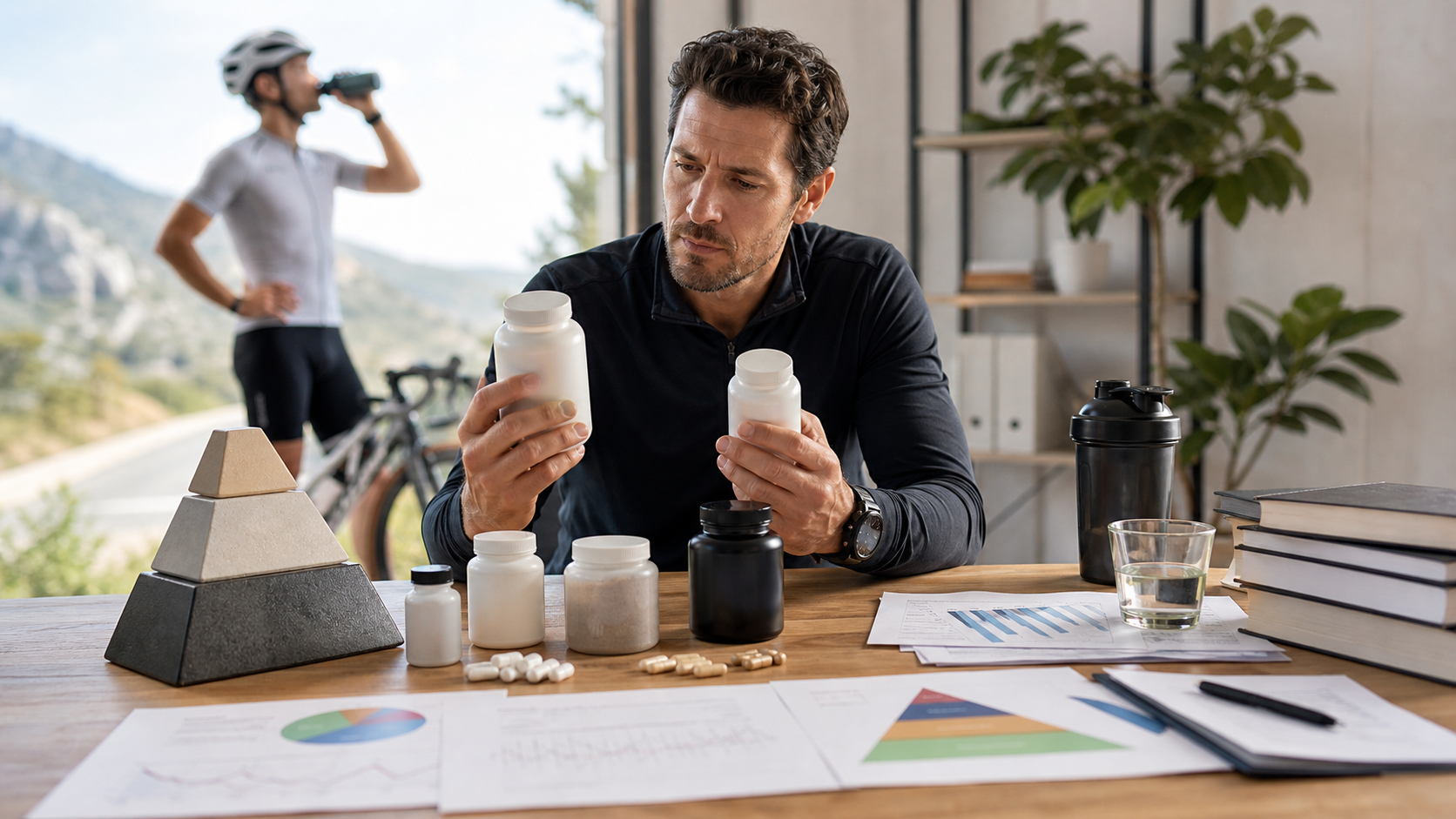
I’m not telling you to take nothing, nor am I telling you to treat all supplements as a tax on the gullible. Instead, I want you to learn one thing: view supplements through a “pyramid of evidence.” At the base of the pyramid are things that are solid, repeatable, and validated by multiple studies; the higher you go, the thinner the evidence and the greater the controversy; and at the very top, many are just beautifully packaged hope. Once you learn this framework, you’ll be able to make your own judgments when you’re standing in front of the shelf, instead of being led around by the adjectives on the label.
This article will be divided into several parts: first, we’ll establish the concept of the “pyramid of evidence,” then I’ll give you a list of supplements that genuinely work, a list of ones that are trendy but lack solid evidence, then teach you how to read a study yourself, and finally offer concrete action recommendations for readers at different levels. It’s on the longer side, but I promise that after reading it, you’ll save yourself a lot of wasted money.
1. Laying the Foundation First: What Is the “Pyramid of Evidence”?
In sports science, not all “evidence” carries the same weight. The same statement—“this supplement works”—could be backed by a rigorous meta-analysis, or it could just be some influencer who felt a difference after taking it themselves. We have to learn to tell the difference between these two, which are worlds apart.
The Hierarchy of Evidence (From Weakest to Strongest)
| Level | Type of Evidence | Credibility | Plain-Language Explanation |
|---|---|---|---|
| Bottom (Weakest) | Personal anecdotes, testimonials, sponsored posts | Extremely low | “My friend took it and got way stronger”—but you don’t know what else they did |
| Lower | Animal studies, cell studies | Low | Working in mice doesn’t mean it works in humans |
| Moderate | Single small human trial | Low to moderate | Small sample size; could just be luck |
| Higher | Randomized controlled trials (RCTs) | Moderate to high | Has a control group and random assignment, better at ruling out bias |
| Highest | Systematic reviews + meta-analyses | High | Combines multiple RCTs; the conclusions are most stable |
This table is the key to interpreting every supplement claim. When you see an attractive claim, first ask yourself: which level does this statement stand on? If it’s just a testimonial video, then its evidentiary weight is actually about the same as “my grandma says eating this is very nourishing.”
Why Is “I Felt a Difference” So Unreliable?
Many students push back: “But I really did feel stronger after taking it!” I completely understand that feeling, but you need to know three things:
- The placebo effect is very strong. The mere thought of “I took something good” is enough to make someone ride harder. In studies, without a placebo control, you simply can’t tell whether the supplement worked or it was psychological.
- People who take only one supplement at a time almost don’t exist. Around the time you start taking a supplement, you’re also usually sleeping better, training more seriously, and feeling more positive mentally. The credit might not belong to that jar.
- People automatically remember successes and forget failures. On a good day, you credit the supplement; on a bad day, you blame the weather. This is called confirmation bias.
That’s why, in sports science, we place so much weight on randomized, double-blind, placebo-controlled designs. It’s also why the things I recommend below are all things that can pass this kind of strict scrutiny.
A Real Case: How I Helped a Student “Test” a Supplement
A few years ago, there was a runner named A-Kai who firmly believed that a popular pre-workout made him run faster. I didn’t directly dismiss him; instead, I played a little game with him. I prepared two packets of powder that looked identical—one was his beloved product, and the other was just plain maltodextrin with a bit of caffeine added. I also labeled them with codes in advance so he wouldn’t know which was which (that’s called a blind test). Over eight consecutive training sessions, I randomly gave him one of the packets and recorded his pace and subjective fatigue.
The results were interesting: on the sessions where he thought he’d “gotten the good stuff,” his performance was indeed slightly better—but the actual results between the two packets were almost identical. In other words, what made him run faster wasn’t the expensive formula, but the psychological state of “I’m prepared today” plus that little bit of caffeine. After he saw the data, he quietly gave away the remaining half of his jar.
The point of this little story is: your subjective feelings really are easily fooled. This is exactly why rigorous research insists on placebo controls and double-blinding. The next time you “feel like a certain jar really works,” think of A-Kai.
2. The Base of the Pyramid: A List of Supplements That Genuinely Work
Alright, framework done—now let’s get practical. The following are the sports supplements with the most solid evidence currently available. The Australian Institute of Sport (AIS) supplement classification framework, widely cited internationally, places all of them in the strongest evidence category, Group A, meaning “there is sufficient scientific evidence to support their use according to evidence-based protocols in specific situations.” These include caffeine, creatine, beta-alanine, nitrate (beetroot juice), and sodium bicarbonate, among others.
I won’t cram every Group A item down your throat; instead, I’ll pick the ones that are most practical and offer the best value for money for everyday cyclists and runners in Taiwan, and go into detail on those.
1. Caffeine—The Most Cost-Effective Jar
If I could only recommend one thing, it would be caffeine. It’s cheap, easy to get (a cup of convenience-store American coffee will do), and the evidence is very consistent.
Meta-analyses show that a moderate dose of caffeine (about 3 to 6 mg per kilogram of body weight) produces a small but clear improvement in endurance performance, with time-trial completion times improving by roughly 2%, and average power improving by a similar margin. For a long ride lasting two or three hours, 2% is no small number.
Practical dosage reference:
| Body Weight | 3 mg/kg (Conservative) | 6 mg/kg (Standard) | Roughly Equivalent To |
|---|---|---|---|
| 55 kg | ~165 mg | ~330 mg | 1–2 cups of American coffee |
| 65 kg | ~195 mg | ~390 mg | 1.5–2 cups of American coffee |
| 75 kg | ~225 mg | ~450 mg | 2 cups of American coffee |
Interestingly, research has found that a low dose of 3 mg/kg produces roughly the same effect as 6 mg/kg. In other words, if you’re sensitive to caffeine and get heart palpitations or shaky hands from it, just use the low dose—no need to force yourself up to a high one.
In practice, I usually have students take it about 60 minutes before exercise. For cyclists in Taiwan, it’s convenient—just grab an American coffee at a convenience store before heading out, or use caffeine tablets. But two reminders: first, be careful about afternoon or evening training affecting your sleep—caffeine has a half-life of about 5 hours, so if you take it at 7 PM, half of it is still in your body at midnight; second, don’t try it for the first time on race day—gastrointestinal reactions vary from person to person, so you absolutely must test it during regular training first.
2. Creatine Monohydrate — Not Just for Weightlifters
Many endurance athletes assume creatine is only relevant to lifting weights in the gym, but that’s not the case. Creatine is one of the most thoroughly researched and safest supplements available, and it benefits high-intensity, repeated sprint efforts (e.g., climbing out of the saddle, sprint finishes, interval training), as well as muscle mass and post-training recovery.
The position stand from the International Society of Sports Nutrition (ISSN) provides clear protocols:
- Loading protocol: Approximately 0.3 g per kilogram of body weight, taken in divided doses for 5 to 7 consecutive days (roughly 20 g per day split into 4 doses), followed by a maintenance dose of 3 to 5 g per day.
- Slow protocol: Simply take 3 to 5 g per day without a loading phase; muscle creatine stores will become saturated after about 3 to 4 weeks.
Both methods ultimately achieve the same level of muscle saturation — the only difference is how quickly. The slow protocol is gentler on the stomach, and when working with the general population, I usually recommend simply taking 3 to 5 g per day — it’s convenient and comfortable. Taking it consistently every day, long-term, is what makes creatine effective — not when you take it.
When purchasing, just look for “creatine monohydrate” — this is the most extensively validated form. The various flashy “next-generation” or “better absorption” versions on the market are mostly just more expensive, without stronger evidence to back them up.
3. Carbohydrates — The True Star of Long-Distance Efforts
This one is often overlooked, but for rides or runs lasting over 90 minutes, timely carbohydrate intake matters far more than any fancy supplement. Your muscle glycogen stores are limited and won’t carry you through an entire Wuling climb or a full marathon. Failing to fuel mid-effort means hitting the wall.
General guidelines (ranges provided, not false precision):
- 1 to 2.5 hours of exercise: Approximately 30 to 60 g of carbohydrates per hour.
- Over 2.5 to 3 hours of exercise: Can increase to 60 to 90 g per hour, but this requires a mixed source of glucose and fructose, and you need to train your gut to handle it beforehand.
Taiwanese cyclists are fortunate — aid stations and convenience stores are densely packed, making energy gels, bananas, onigiri, and sports drinks all great options. But the same point must be emphasized: train your gut. I’ve seen too many people try to down a bunch of gels on race day only to have their stomachs revolt. Practice eating during your regular long rides.
4. Electrolytes (Especially Sodium) — Essential for Taiwan Summers
Strictly speaking, electrolytes aren’t “ergogenic” supplements; they’re about maintaining normal function. But in Taiwan’s hot, humid environment, their importance is greatly amplified. Riding the West Coast or riverside paths at noon in summer, you can lose one to two liters of sweat per hour along with a large amount of sodium. Replacing it with plain water alone can actually cause problems.
Sweat rate and sweat sodium concentration vary enormously between individuals, so I won’t give you a falsely precise number. The principle is: when sweating heavily for long periods, your water needs sodium (sports drinks or electrolyte tablets work), rather than chugging plain water. If you’ve ever experienced severe cramping or dizziness after a long ride, this deserves even more attention.
Here I want to highlight a dangerous myth in Taiwan summers: “Drinking more water is always right” is wrong. When you sweat heavily for a long time but only replace fluids with pure water without sodium, your blood sodium concentration gets diluted, which in severe cases can lead to “hyponatremia.” Symptoms include nausea, headache, confusion, and in extreme cases, it can be life-threatening. So for long summer rides, upgrade “hydration” to “hydration plus sodium.” If you experience persistent headache, nausea, or mental fog during a ride or run, that’s your body’s warning sign — stop, rest in the shade, seek medical attention if necessary, and don’t push through.
Bottom-Layer Supplement Quick Reference (For Fast Review)
| Supplement | Main Benefits | Recommended Dose | When to Use | Taiwan Context Notes |
|---|---|---|---|---|
| Caffeine | Improves endurance performance by ~2% | 3–6 mg/kg | ~60 minutes before exercise | Convenience store Americano works fine; watch sleep if training in the evening |
| Creatine | High-intensity efforts, sprinting, recovery, muscle mass | 3–5 g daily | Take consistently every day | Just look for creatine monohydrate; skip the fancy versions |
| Carbohydrates | Prevents hitting the wall on long distances | 30–90 g per hour | Exercise over 90 minutes | Bananas, onigiri, energy gels all work |
| Electrolytes (Sodium) | Maintains fluid balance, prevents cramping | Supplement during heavy sweating | Long-duration, high-heat exercise | Essential in hot, humid conditions; don’t just drink plain water |
I suggest screenshotting this table. It covers over 90% of the supplement needs for the average Taiwanese cyclist or runner. Honestly, most people who get these four right are already ahead of the majority who blindly consume all sorts of things.
3. The Middle Layer of the Pyramid: Consider Only Conditionally
Things in this layer aren’t ineffective — it’s just that their effects are more limited, and they’re only worth it for specific populations or situations. Most people don’t need to rush to spend money on them.
- Beta-Alanine: Helps with high-intensity efforts lasting 1 to 4 minutes (e.g., track racing, short climb surges). It requires several weeks of continuous supplementation to work, and the side effect is a tingling sensation on the skin. For those doing purely long, steady rides, its priority is low.
- Nitrate / Beetroot Juice: Helps reduce oxygen cost during exercise and improve economy. The evidence is decent, but individual responses vary greatly, and the effect diminishes the more trained you are. You can try it, but don’t expect miracles.
- Sodium Bicarbonate (Baking Soda): Helps with high-intensity efforts where lactate accumulation is significant, but the risk of gastrointestinal distress (bloating, diarrhea) is high. It requires careful dose testing and isn’t something to take casually.
The common principle for this layer is: get your training, sleep, diet, and foundational fueling right first; only then consider these if you have capacity to spare. I’ve seen too many people with a mess of fundamentals obsessing over these marginal supplements — putting the cart before the horse.
Middle-Layer Supplement Detail Comparison
| Supplement | Suitable Disciplines | Approximate Usage | Main Drawbacks / Cautions |
|---|---|---|---|
| Beta-Alanine | 1–4 minute high-intensity efforts (track racing, short climb surges) | Requires several weeks of continuous supplementation to accumulate | Skin tingling; minimal benefit for long, steady riding |
| Nitrate / Beetroot Juice | Low-to-moderate intensity endurance, economy | Several hours before competition or over consecutive days | Large individual variability; reduced effect in trained athletes |
| Sodium Bicarbonate | High-intensity efforts with significant lactate accumulation | Before competition; requires individual dose testing | High risk of GI distress; needs caution |
I want to emphasize the point that the more trained you are, the smaller the marginal benefit. Most studies on these middle-layer supplements use subjects who are recreational or amateur athletes. The closer you are to your physiological limits and the more solid your fundamentals, the less room these supplements have to squeeze out additional gains. Conversely, if you haven’t even established consistent training, these supplements will barely help — because your real room for growth lies in the training itself, not in a bottle.
A Middle-Layer Case Study: The Expectation Gap with Beetroot Juice
A triathlete student named Xiao Ling was chasing a PB (personal best). After seeing foreign athletes share their experiences with beetroot juice, she excitedly asked me if she could improve with it. I didn’t pour cold water on her, but I honestly told her: “The evidence supports that it might help a little, but the magnitude varies by individual — and right now you’re averaging less than six hours of sleep per week. That’s what you should address first.”
She was skeptical, but she first spent a month getting her sleep back up to seven hours and adjusting her training rhythm — and her performance improved noticeably without drinking any beetroot juice. Later, she did add beetroot juice and felt a subjective difference, but that difference was nowhere near the change brought by better sleep. I often use this case to remind my students: don’t treat the supporting cast as the lead role.
4. The Tip of the Pyramid: Popular but Unproven Supplements
Now for the most practical part. These are the types I most often ask my athletes to return or stop buying. Their common thread: marketing hype far outweighs scientific evidence.
| Common Claim | Product Type | My Assessment |
|---|---|---|
| “Boosts fat burning, easy weight loss” | Various fat burners, L-carnitine weight-loss formulas | Very limited help for fat loss in most people; fat loss mainly comes from a calorie deficit |
| “Detoxifies, cleanses the body” | Detox teas, enzyme drinks | Your liver and kidneys already detox; they don’t need the help |
| “Boosts immunity, prevents colds” | High-dose single vitamins | For those with a balanced diet, extra supplementation has limited benefit |
| “One bottle replaces many, all-in-one formula” | Pre-workouts with many mixed ingredients | Each ingredient is often under-dosed; it’s just expensive packaging for caffeine |
| “Natural, ancient, ancestral formula” | Various herbs of unknown origin | “Natural” doesn’t mean effective, nor does it mean safe |
Why Are These So Popular?
A few psychological traps worth recognizing:
- The comfort of “doing something.” Buying a supplement is easier than getting enough sleep or training seriously. Human nature prefers simple solutions.
- A long ingredient list = impressive? Quite the opposite. When a bunch of ingredients are crammed into one bottle, each one is often dosed too low to have any effect. This is called “under-dosing.” Rather than ten ingredients in one bottle, it’s better to take one ingredient at an effective dose.
- The “natural” halo. Many people assume natural means harmless, but natural things can still have side effects and interact with medications—and “natural” absolutely does not guarantee “effective.”
A Serious Warning About “Unknown Origins”
Some products touting quick results may illegally contain undeclared ingredients (for example, certain fat-loss products have been found to contain stimulants or diuretics). This isn’t just a waste of money—it’s genuinely harmful to your health. If you’re a competitive athlete, you could even inadvertently test positive for a banned substance and face suspension.
Buying principle: transparent ingredients, clear labeling, traceable sources, reasonable dosages. If a product fails any of these four, don’t buy it.
5. Learn to Read Research Yourself: Stop Being Led by Marketing
This section is the most important skill in the entire article. Once you learn it, you won’t need to ask me every time—you’ll be able to judge for yourself.
When You Read a Supplement Claim, Ask Yourself These Seven Questions
- Is this a study on humans, or on mice/cells? Animal and cell experiments are only a starting point; they can’t be directly extrapolated to humans.
- Is there a placebo control group? Without a control, you can’t tell whether the effect comes from the supplement or the placebo effect.
- Is it randomized and double-blind? This greatly reduces bias.
- Is the sample size large enough? Studies with only a dozen or so participants should be interpreted cautiously.
- How large is the effect? Does it have practical significance? “Statistically significant” doesn’t equal “actually useful.” A 0.1% improvement can be significant yet imperceptible.
- Who funded the study? If the research was fully funded by the product’s manufacturer, be more wary of the conclusions.
- Is it a single study, or is there meta-analytic support? Single studies can contradict each other; conclusions that pool multiple studies are the most robust.
A Few Common “Marketing Translation” Phrases
- “Clinically proven”—proven what? On whom? How many people? Often deliberately vague.
- “Studies show”—which study? Animal or human? Many times it’s cherry-picking.
- “Up to 300% improvement”—300% of what? What’s the baseline? Huge percentages often come from tiny baselines.
- “Patented formula”—a patent protects the “combination of ingredients,” which has nothing to do with whether it “works.”
Remember this: the more categorical and miracle-promising a claim is, the more it deserves skepticism. Real, solid science speaks conservatively, with caveats and ranges.
The Difference Between “Statistically Significant” and “Practically Useful”
This is the concept I most want to help you grasp, because it’s where the most people get fooled.
A study says a supplement “reached statistical significance (p < 0.05).” Sounds impressive, but all it really means is: “This result is unlikely to be pure coincidence.” It tells you absolutely nothing about how large the effect is.
Here’s an exaggerated but illustrative example: suppose a study has 1,000 people take a supplement and finds their time-trial average improved by 0.3 seconds, and it’s statistically significant. For a two-hour ride, 0.3 seconds is essentially meaningless—but the manufacturer can legitimately print “clinically proven to enhance performance” on the label.
So besides asking “does it work,” you should also ask “how large is the effect size? Does it matter for my actual race?” A good study will tell you the percentage improvement and confidence intervals, not just throw out the word “significant.” When a claim only emphasizes “significant” but never mentions the magnitude, your alarm bells should go off.
Don’t Forget “Publication Bias”
There’s another trap that’s often overlooked: studies with positive results are more likely to be published in journals, while studies with null results often get shoved in a drawer. This is called publication bias. In other words, the “evidence” you see online has already been filtered, skewed toward the “effective” side. This is exactly why meta-analyses (which include both published and unpublished studies whenever possible) are far more reliable than looking at one or two “effective” studies in isolation.
6. Common Mistakes and Corrections
In my years of coaching athletes, I’ve seen almost every mistake fall into the categories below. See if any of them apply to you.
Mistake 1: Thinking About Supplements Before Training
Symptom: Training plan is a mess, you stay up late often, and you eat whatever for all three meals—yet you spend big money researching which supplement to buy.
Correction: Supplements are “supplementary”—they’re the top of the pyramid, not the foundation. The foundation is training, sleep, and proper meals. If these three aren’t in order, supplements won’t help you much. I often tell my athletes: “If you can’t even eat proper meals, don’t think about that bottle yet.”
Mistake 2: Starting Five Supplements at Once
Symptom: Buying an entire stack and starting them all at the same time.
Correction: This way you’ll never know which one works and which one upsets your stomach. Add only one at a time, and observe for two to three weeks before deciding. This is like running an experiment—you need to control the variables.
Mistake 3: Trying New Fuel for the First Time on Race Day
Symptom: You never eat energy gels in training, then bring six on race day to go all out.
Correction: “Nothing new on race day” is an iron rule. Your fueling strategy, caffeine dosage, and energy gel brand should all be tested during regular long training sessions to train your gut. On race day, just replicate the version that worked in practice.
Mistake 4: Treating Supplements as Meals
Symptom: Replacing proper meals with protein powder and energy bars.
Correction: Real food provides nutrients, fiber, satiety, and micronutrients that processed supplements can’t match. Supplements fill the gap when real food isn’t practical or convenient (like finishing a workout and rushing to work)—they don’t replace the dinner table.
Mistake 5: Ignoring Interactions with Chronic Conditions and Medications
Symptom: You’re on medication for chronic conditions (such as high blood pressure, diabetes, or heart-related drugs), yet you self-prescribe large amounts of various supplements without consulting a medical professional.
Correction: I want to be especially serious about this one. Certain supplements can affect blood pressure, blood sugar, heart rate, or interact with medications. If you have a chronic disease or are taking medication, you should consult your physician or pharmacist before taking any supplement—including seemingly harmless ones like caffeine or baking soda. Taiwan’s National Health Insurance makes it easy to see a doctor; spending five extra minutes to ask is far better than dealing with problems later. This isn’t something I can decide for you in an article—it requires individualized assessment.
7. Actionable Advice for Readers at Different Levels
Finally, let’s distill the concepts above into a checklist you can follow directly. Find the section that fits you best.
If You’re a Beginner: “Weekend Rider / Just Started Running”
You basically need no supplements at all. Put your money and energy here instead:
- Sleep enough, eat proper meals, and train consistently.
- On long rides and runs, remember to hydrate, take in carbs, and add electrolytes in hot weather.
- If you really want to try one thing, start with a cup of coffee before exercise—it’s the cheapest and has the best evidence.
- Everything else? Don’t touch it for now.
If You’re an Advanced Athlete with Structured Training, Looking to Break Through
Here’s a suggested priority order:
- Master your fueling strategy (carb and electrolyte intake during training—this matters more than supplements).
- Caffeine—use before key races or crucial training sessions, at a dose of 3–6 mg/kg, and test it during training first.
- Creatine—3–5 grams daily, taken consistently long-term, helps with sprinting, climbing, and recovery.
- If you still have capacity, then look into whether β-alanine or nitrates suit your discipline.
If You’re a Competitor Who Races and Wants to Squeeze Out Every Last Drop
- Assuming all of the above is already in place, you can fine-tune things more individually and consider mid-tier supplements.
- Be very mindful of doping risks—choose products with third-party testing and transparent ingredient labels.
- If your organization has team doctors or nutritionists, make good use of them; individualized professional assessment beats any generic article.
A Universal Four-Step Self-Check
Before buying any new supplement, run through these four steps:
- Which tier of the pyramid does it sit on? Only the base tier deserves serious consideration.
- Is the evidence from human RCTs/meta-analyses, or from testimonials and animal studies?
- Is the dose adequate? Is the ingredient list transparent? Is the source traceable?
- Have I already nailed my training, sleep, meals, and basic fueling?
Only if you pass all four checks should you open your wallet.
8. FAQs—Questions My Students Ask Me Most Often
These are the questions I’ve been asked a thousand times over the years, but they’re genuinely useful. Here they are, all organized for you.
Q1: I don’t drink coffee. Can I take caffeine pills instead? Will the effect be the same?
Yes. Research shows that as long as the total dose is sufficient, caffeine works about the same whether it comes from coffee, pills, gum, or energy gels. The advantage of pills is precise dosing—you can accurately calculate 3–6 mg/kg. One word of caution though: it’s easier to accidentally take too much with pills, so still calculate based on body weight and don’t pop extra just because it’s convenient.
Q2: Does creatine damage the kidneys?
For healthy people with normal kidney function, long-term, consistent use of creatine monohydrate at the generally recommended dose is a supplement with solid research backing and a good safety profile. But if you have kidney disease, a relevant family history, or are taking medication that affects kidney function, you must consult a doctor first and not self-supplement. This echoes what I always emphasize: anyone with underlying conditions needs individualized assessment for any supplement.
Q3: Do I need a “pre-workout” supplement?
The core active ingredient in most commercial pre-workouts is actually just caffeine (sometimes with a bit of β-alanine to create a tingling sensation that makes you “think it’s working”). You can get the same caffeine for a fraction of the cost. If you enjoy the ritual and can afford it, there’s no harm—but don’t think that tub holds some magic; most of the time it’s just overpriced caffeine in fancy packaging.
Q4: Can taking BCAAs (branched-chain amino acids) really reduce muscle loss?
For people who already get adequate daily protein intake, the marginal benefit of additional BCAAs is quite limited. Instead of spending money on BCAAs, it’s better to eat enough protein in your regular meals (for example, a palm-sized portion of eggs, meat, beans, or fish at each meal). The complete proteins from real food generally outperform supplementing a few isolated amino acids.
Q5: It’s hard for people who eat out all the time to “eat proper meals”—does that make supplements more important?
This is a very Taiwanese, very practical question. My take is this: for people who eat out often, the priority should be choosing better options when eating out, not using supplements to patch holes in a leaky boat. Swapping in an extra serving of blanched vegetables with your bento, choosing whole-food protein (braised chicken leg over fried options), adding a piece of fruit or unsweetened soy milk—these adjustments deliver far more benefit than a pile of supplements. Supplements can fill the gaps when you genuinely don’t have time to eat (like rushing from work to a ride), but they shouldn’t become an excuse to avoid eating properly.
Q6: Should I take a multivitamin every day?
For people with a generally balanced diet, the added benefit of taking a daily multivitamin is limited. It’s more suited to specific situations (such as severely unbalanced diets, certain populations, or deficiencies confirmed by medical evaluation) rather than something to pop as “insurance.” If you suspect you’re deficient in something, seeing a doctor in Taiwan is easy—get a blood test and supplement accordingly. That’s more precise and more cost-effective than blindly taking a full-spectrum cocktail.
Conclusion: Build the Foundation Solid, and the Apex Means Something
Let’s return to the student Xiao Chen from the beginning, who had seven bottles on his desk. He ended up returning five of them, keeping only caffeine and creatine, and used the money he saved to buy a pair of properly fitting cycling shoes and sign up for a structured training camp. Three months later, he not only rode up Wuling, but his time was better than he’d expected. He told me with a smile: “I used to spend the foundation money on roof decorations.”
I love that line, and I’m passing it on to you. At the pyramid of athletic performance, the base is always training, sleep, and nutrition; supplements are just a small ornament at the apex. Build the base solid, and the apex means something; if the base is hollow, no amount of expensive decoration can hold it up.
I hope this article gives you not just a list of “what to take and what to avoid,” but a set of skills to judge for yourself and not be led around by marketing. Next time you’re standing in front of a shelf, or scrolling past a tempting sponsored post, I hope you can smile, and then ask yourself those seven questions.
Wishing you happy riding, healthy running, and that every dollar you spend goes to something that truly matters.
This article is educational content and does not replace individual diagnosis or treatment advice from a physician, physical therapist, or nutritionist. If you have a chronic condition (such as diabetes, hypertension, or heart disease) or are taking medication, please consult your doctor or pharmacist for an individualized assessment before taking any supplement.
References
- Australian Institute of Sport — Sports Supplement Framework (ABCD classification system): https://www.gomotionapp.com/usanybgcnwm/UserFiles/Image/QuickUpload/ais-supplement-framework_026372.pdf
- The Effect of Acute Caffeine Ingestion on Endurance Performance: A Systematic Review and Meta-Analysis (Sports Medicine): https://link.springer.com/article/10.1007/s40279-018-0967-4
- Effects of Caffeine Intake on Endurance Running Performance and Time to Exhaustion: A Systematic Review and Meta-Analysis (PMC): https://pmc.ncbi.nlm.nih.gov/articles/PMC9824573/
- New ISSN Position Stand on Creatine Supplementation (Exercise & Sport Nutrition Lab): https://exerciseandsportnutritionlab.com/new-issn-position-stand-on-creatine-supplementation/
Related Reading
- Evidence Grading for Sports Supplements: What’s Supported, What’s Nearly Useless, and How to Avoid Marketing Traps
- Should Athletes Take Supplements: A Decision Framework to Stop Wasting Money
- Sports Nutrition Myth-Busting Collection: Claims Circulating in Gyms and Cycling Groups That Don’t Hold Up to Science
- Caffeine Supplementation Guide: How to Get Dose, Timing, and Sources Right? A Coach Walks You Through Drinking It Correctly
大家都在開箱的...單車用藍芽對講耳機真的有幫助嗎? SENA BiKom 20 長距離旅遊 & 海鷗繞圈賽 實際體驗心得 / 公路車 / CT Yeh
9 個月前
CT暗黑廚房) 車友必備 宇宙無敵鮮蚵湯 幫助訓練恢復 天然食補 好市多 超肥鮮蚵 破PR
7 年前
一個測試有沒有認真練車的方法😂 #公路車
10 個月前
2021 96聯賽 桃園市長盃 4K多視角實況 當天選手瓦數/推力比/均速/時間 即時數據分析 | 公路車 | CT Yeh
5 年前
風櫃嘴! 現實與虛擬騎乘 會有誤差嗎? 背著iPad邊騎一趟風櫃嘴實際測試一次 | 公路車 | CT Yeh
3 年前
一日北高前的高裝檢 | 北高 360 | 挑戰11小時的裝備 | 一日雙塔 | 補給
6 年前
單車 重低音 藍芽喇叭 音質實測 SoundBot SB525 Real Sound Test
8 年前
單車AI教練!全新 ChatGPT4o 幫你分析訓練成果!排武嶺課表,分析騎車姿勢! 太神了! / 公路車 / CT Yeh / feat. 緯緯
2 年前