The Role of the Placebo Effect in Sports Science: How to Use "Belief" to Make Your Training Stronger
It Starts with a Fake Capsule
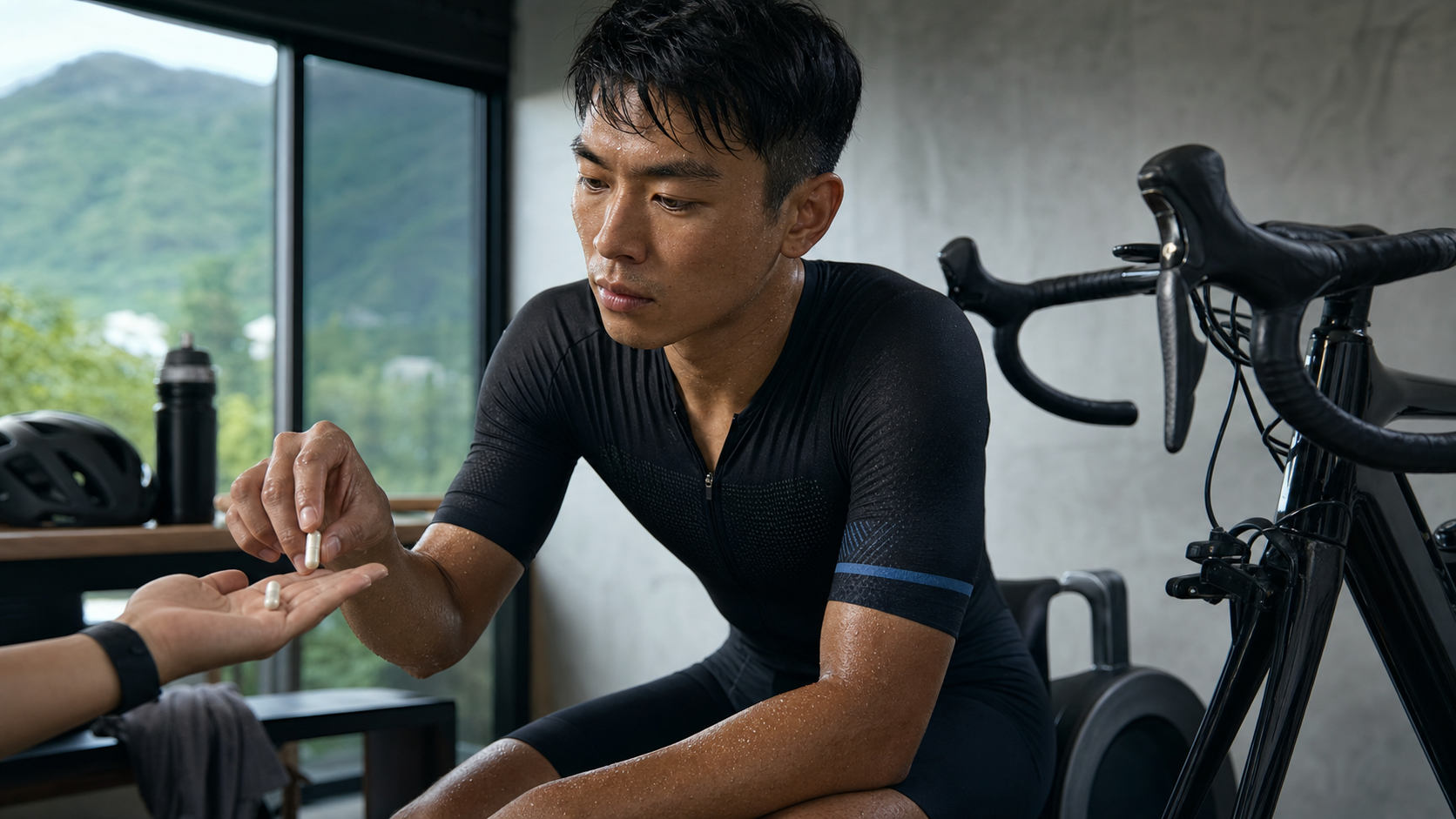
A few years ago, I coached a time trialist—let’s call him A-Zhe. Before one race, during the pre-race fueling, I handed him a capsule and said, “This is a high-dose caffeine blend I specially formulated. Today your legs are going to feel especially powerful.” That capsule was actually just maltodextrin—no active ingredient whatsoever. He went out and set a personal best in that 40 km individual time trial, and when he came back he told me, “Coach, that stuff is legit. I didn’t lose any speed in the second half.”
I hesitated for a moment about whether to let him in on the secret. In the end, I chose to be honest and told him the truth—it was a placebo. He froze for a second, then asked a question that stuck with me: “So then, what made me stronger—the capsule, or me?”
That question is exactly what this article wants to explore with you. The placebo effect in sports science isn’t just a fun anecdote for casual conversation—it’s a real variable that can be quantified, studied, and even “legitimately harnessed.” In my 15 years of coaching athletes, the more I’ve worked, the more convinced I’ve become of one thing: a huge chunk of training results happen in the brain, before it ever reaches the legs.
In this article, I’ll walk you through three angles: just how powerful the placebo really is, how we can openly and honestly leverage it in self-directed training, and how rigorous research separates this force from the noise. Along the way, I’ll weave in real situations from coaching my athletes, a few tables you can use directly, and the pitfalls that people in Taiwan are especially prone to stepping into.
What Is the Placebo Effect? Let’s Clear Up the Concept First
A lot of people frown the moment they hear “placebo,” thinking it’s “fake,” “deceptive,” or “just psychological.” That’s the biggest misconception. The placebo effect refers to this: when a person believes an intervention (a capsule, a drink, a patch, a massage, words) will produce an effect, the body shows measurable changes even if the intervention itself has no physiological activity.
Note that key word—“measurable.” This isn’t just feeling good about yourself; it shows up concretely in the watts on a power meter, the bpm of your heart rate, and the seconds on the clock.
The Physiological Mechanisms Behind the Placebo Effect
“Psychological” sounds vague, but it has very real physiological pathways. Here are several mechanisms generally accepted in exercise physiology today (I’ll describe them in general terms to avoid pinning down exact numbers):
- Recalibration of central fatigue: The limit of endurance exercise is largely the result of the brain “hitting the brakes” to protect the body, rather than the muscles truly being spent. When you believe you’ve taken a powerful supplement, the brain is willing to ease off that safety brake a little, letting you tap into reserves you normally hold back.
- Expectation and reward circuitry: The brain’s dopamine system activates in response to the expectation of “I’m about to perform better,” which in turn influences motivation and pain perception.
- Modulation of pain and perceived exertion (RPE): A placebo often doesn’t make you stronger—it makes the same effort “feel less painful.” When your Rating of Perceived Exertion drops, you naturally keep pushing.
- Release of endogenous substances: The release of endogenous compounds, including endorphins, is linked to expectation.
String these four together, and you’ll see the essence of the placebo effect is this: it changes “how the brain interprets bodily signals,” rather than conjuring energy out of thin air. That’s also why it has limits—a placebo won’t get someone who’s never trained up Wuling, but it might help a well-trained athlete squeeze out that crucial few percent.
The Relationship Between Placebo, Expectation, and Actual Performance
I often draw a simple mental map for my athletes to explain this. Your “true physiological ceiling” is fixed—it’s determined by the VO₂max, lactate threshold, and muscle fiber composition you’ve built up over years of training. But in any given race, you rarely actually touch that ceiling, because the brain’s protective mechanism stops you early, keeping a safety margin in reserve.
What the placebo does is release a little of that “reserve the brain holds back, the part you don’t normally use.” To use an analogy: your engine’s tachometer can actually reach the redline, but the factory locked a portion of the rev limit for protection; the placebo is like temporarily nudging that limiter up a notch, letting you access horsepower you normally can’t touch. It doesn’t swap in a bigger engine—it just gets you closer to the limit you already had.
This concept matters because it explains both what the placebo “can” and “cannot” do:
- Can: Help well-trained athletes, who are heavily protected by their brain, tap into that crucial few percent more.
- Cannot: Drag someone who hasn’t built the corresponding fitness beyond a capacity that simply doesn’t exist.
So the closer you are to your true limit, and the better you are at approaching it, the more “operating room” the placebo has. That’s also why many studies find the placebo effect is actually more pronounced in well-trained individuals—their “engine” is big enough; it’s just a matter of whether the limiter is willing to let go.
How Powerful Is the Placebo Effect, Really? What the Research Says
Here I need to be very careful in citing research I’ve actually verified, because giving you fake numbers would do you a disservice.
The Classic Caffeine Fake-Capsule Experiment
One study published in a sports medicine journal used a clever “deception design” to isolate the placebo effect. The researchers had trained male cyclists perform a 10 km time trial and told them they would randomly receive a placebo, a moderate dose of caffeine, or a high dose of caffeine. But in reality—every single time, they were given a placebo.
The results were striking: when the cyclists “believed they had taken caffeine,” their power output increased by roughly 2% compared to baseline. 2% doesn’t sound like much, but for an already well-trained athlete with limited room for improvement, 2% of power could be the difference between standing on the podium and going home empty-handed. The study also included interviews, and the cyclists genuinely “subjectively felt” the effect, even though it was just maltodextrin. (Source listed in the references at the end.)
However, the same line of research also highlights an important limitation: for people who habitually consume caffeine, the deception doesn’t always work. I’ll come back to this later, because it’s especially relevant for people in Taiwan who love their bubble tea and coffee.
What Systematic Reviews and Meta-Analyses Say
Zooming out, recent systematic reviews have pooled studies from across the literature to estimate the “effect size” of the placebo effect (effect size—a statistical measure of the magnitude of a difference, Cohen’s d):
| Research Synthesis | Scope Covered | Placebo Effect Size (Approximate) | Plain-Language Interpretation |
|---|---|---|---|
| Earlier meta-analysis of exercise placebos | Over a dozen studies | d ≈ 0.3–0.4 | Small to moderate effect |
| 2019 systematic review | 32 studies, over 1,500 people | d ≈ 0.36 | Small to moderate effect |
| 2024 updated systematic review | Larger pooled analysis | Aggregate d ≈ 0.67 | Moderate to large |
How should you read these numbers? An effect size of about d = 0.3 is “small to moderate,” around 0.5 counts as “moderate,” and anything above 0.8 is considered “large.” In other words, the placebo effect is absolutely not negligible noise—in most studies, it lands at a level where you can genuinely see it. The 2024 update even observed that placebo effects were especially pronounced for nutritional interventions, while “open-label placebos” (where you’re honestly told it’s a placebo) had much smaller effects. (Sources listed in the references at the end.)
This leads to a practical takeaway, and the core message I most want to convey here: since it works, we should learn to use it well—within legal bounds and in the spirit of fair sport.
A Real-Life Scenario: Two Riders, “The Same Bottle”
Let me use a real situation with my riders to make the numbers concrete. During one team training session, I prepared the same sports drink and gave it to two riders of similar ability, Xiao-Mei and Xiao-K. When I handed it to Xiao-Mei, I casually said, “This one’s nothing special, just for hydration.” When I gave it to Xiao-K, I said seriously, “This is a special mix I put together—I adjusted the electrolyte ratio. You’ll feel more stable in the later part.”
That day’s workout was 5 repeated sprints on a fixed climb. The results were fascinating: Xiao-K’s average power on the last three reps held up noticeably better than his earlier ones, while Xiao-Mei followed her usual pattern and faded more in the later reps. They drank the exact same bottle—the only difference was the “description” I attached to it.
I later brought this up with both of them. The point wasn’t to prove how manipulative I could be, but to let them experience it firsthand: the “meaning” you assign to a feed, a workout, or a race genuinely shows up in your power numbers. Xiao-K wasn’t deceived by me; his brain, because of that expectation of “I got something good,” was willing to release a little more reserve. This is exactly what we’re about to learn to do for ourselves—you don’t need someone else to give you the narrative; you can give yourself a positive one.
Practical Guide: How to Harness the Placebo Effect in Training
Let me first clarify the ethical boundary. I’m not telling you to deceive your teammates or fake results with banned substances. What we’re talking about is how you can proactively build a favorable psychophysiological environment in your own training and preparation. This is called “ritualization” and “expectation management,” and it’s a completely legitimate application of sports science.
Method 1: Build a Pre-Race Ritual
The human brain loves routine. When you consistently pair a set of actions with “I’m ready, I’ll perform well,” that routine itself eventually triggers that expectation.
Here’s a template for a “pre-race ritual checklist” I often have riders customize. You can copy it or modify it:
| Time Point | Ritual Action | Psychological Anchor Message |
|---|---|---|
| 90 min before | A fixed meal (e.g., white toast with banana) | “Fuel is in place” |
| 40 min before | The same dynamic warm-up routine | “Body is activated” |
| 15 min before | A fixed song + 6 deep breaths | “I’m in the zone” |
| 3 min before start | Touch a spot on the frame / slap your thigh | “Switch is on” |
The key isn’t how scientific the actions are—it’s consistency. Repeat it enough times, and your brain will interpret that sequence as a “precursor to good performance,” automatically releasing that central brake.
Method 2: Use “Meaningful” Nutrition
This one requires balance. Legal supplements (like moderate caffeine, sports drinks, energy gels) have real physiological effects, but your belief in them amplifies those effects. Instead of gulping them down furtively, consume them with a sense of ritual and the positive expectation that “this will make me stronger.” Physiological effect + placebo effect—stacked together.
Here’s a comparison table of common legal supplements, with “real effects + psychological amplification.” The numbers are ranges, not false precision:
| Supplement | Common Usage Range | Real Physiological Effect | How to Pair It Psychologically |
|---|---|---|---|
| Caffeine | ~3–6 mg per kg body weight | Reduces perceived exertion, increases alertness | Take at a fixed time pre-race as a “start-up ritual” |
| Carbohydrates (gels/drinks) | ~30–60 g per hour during prolonged exercise | Maintains blood sugar, delays bonking | Tell yourself “fuel’s in place” when feeding |
| Carbohydrate rinse | High-intensity, short duration; swish and spit | Oral sensors activate the central nervous system | Use as a “final wake-up before high intensity” |
| Beetroot juice | Several hours pre-race | Nitrate pathway, theoretically aids endurance | Ritualize intake to reinforce positive expectation |
Note: the carb rinse trick is fascinating—it’s almost the perfect middle ground between placebo and real physiology—you don’t even swallow the sugar; just the sweetness detected in your mouth gives your central nervous system a bit of “throttle.” This also proves how much weight the brain carries in endurance performance.
Method 3: Positive Language and Self-Talk
The nocebo effect (detailed in the next section) tells us that negative suggestions drag down performance. Conversely, deliberately managing what you say to yourself is giving yourself positive suggestions.
When I work with riders, I teach a simple self-talk replacement framework:
- Change “I’m about to die on this climb” → “My engine is warming up”
- Change “I feel terrible today” → “Today is a day to build mental toughness”
- Change “The wind is too strong, I can’t move” → “Others have it worse in this weather—I’m banking time”
This isn’t just delusional positive thinking; it’s genuinely shifting your interpretation of perceived exertion in a favorable direction.
Method 4: Designing “Achievability” with Segments and Milestones
I particularly like this one because it combines the psychology of the placebo with pacing strategy. Long distances are intimidating because the brain gets tired just thinking “80 km to go.” Instead of letting the brain face a total that’s so vast it feels hopeless, break it into smaller goals with a visible “finish line.”
I usually have riders do this:
- Split the whole ride into 3–5 mental segments, each with a concrete “arrival marker” (an intersection, a bridge, an aid station).
- Mentally check off each segment as you complete it, giving yourself the positive feedback of “I nailed another one.”
- Never think about the remaining total mid-segment—only focus on “get to the next marker.”
The principle here is the same as the placebo—you’re manipulating the brain’s perception of “task difficulty.” When every segment “feels doable,” the brain won’t prematurely engage that protective brake. Many riders report that just switching to this mental framework turned long-distance finishes from “hell” into “knocking out one segment at a time,” with much steadier pacing.
Method 5: The “Race Kit Effect” of Environment and Gear
Have you ever had the experience of “automatically entering the zone” when you put on your race kit? That’s also part of the placebo family—sometimes referred to in psychology as an extension of “enclothed cognition”—the symbolic meaning you assign to a piece of gear feeds back into your performance and mindset.
This isn’t about superstition; it’s a reminder that you can deliberately design these positive associations. For example:
- Designate a specific pair of shoes or a specific kit as your “race-day-only” gear for personal-best attempts.
- Save a route where you ride well and have good memories for days when you need to build confidence.
- Deliberately train in “worse conditions” during practice (bad weather, older gear), so that on race day—with good gear and good weather—the contrast itself becomes a positive placebo.
This tactic is especially useful for riders still building their mental foundation—it’s like pre-storing a batch of “performance anchors” for them.
The Nocebo Effect: The Hidden Ditch That’s Easy to Overlook
If the placebo is a tailwind, the nocebo is a headwind—and it’s often more damaging. Nocebo refers to performance decline or symptom onset caused by negative expectations.
I’ve seen too many riders fall into this trap. Here are the most common examples from the local scene in Taiwan:
- Staring at the watch before the start, checking the temperature: “It’s 34°C today, I’ll definitely get heatstroke”—and then mentally collapsing before even getting hot, with pacing falling apart.
- Seeing an opponent’s gear is more expensive: “His bike is so much better, how can I chase him”—self-limiting before the race even starts.
- Sleeping poorly the night before and muttering all morning, “I’m doomed today, I didn’t sleep enough”—blowing one ordinary night of poor sleep into a disaster.
These are all the nocebo at work. Negative expectations genuinely drop your power and spike your perceived exertion.
Practical Ways to Break the Nocebo Effect
| Common Negative Trigger | Nocebo Trap | Replacement Strategy |
|---|---|---|
| Hot weather | “I’ll definitely overheat and slow down” | “I’ll hydrate early and start easy—I have a plan” |
| Poor sleep | “Today is going to be terrible” | “Research shows one night of poor sleep has limited impact on endurance—just get moving first” |
| Inferior equipment | “I can’t win” | “The engine (my body) is what matters; equipment is just a supporting role” |
| Slight body soreness | “I’m going to get injured” | “This is a normal training response—warm up and observe first” |
A special note on physical discomfort: breaking the nocebo effect does not mean ignoring real warning signs. Chest tightness, abnormal heart palpitations, unilateral limb weakness, or sharp joint pain—these are not things you can “think away” with positive thinking. See a doctor when needed. Psychological techniques address “overly negative interpretations of normal training responses,” not the suppression of genuine danger signals. This line must be clearly drawn.
Research Control Section: How Scientists Isolate the Placebo Effect
Now that we’ve covered the practical applications, let’s look at how rigorous research deals with placebos. This is useful for you too—when you see a supplement ad claiming “clinically proven to improve performance by 15%,” you’ll know exactly what questions to ask.
Why Do We Need a Placebo Control Group?
If a study simply “gives everyone a supplement and checks whether they got stronger,” it’s impossible to distinguish whether the improvement came from the supplement actually working or from participants believing it works. The placebo control group exists to subtract “the contribution of belief” from “the contribution of the ingredient.” True ingredient effect = supplement group’s improvement − placebo group’s improvement.
Key Research Design Tools
| Design Tool | What It Does | Why It Matters |
|---|---|---|
| Double-blind | Neither participants nor administrators know who got the real treatment | Prevents administrators from unintentionally leaking clues and prevents participants from guessing |
| Randomization | Randomly assigns who goes into which group | Ensures both groups are comparable at baseline, so differences can be attributed to the intervention |
| Crossover design | The same person experiences all conditions in sequence | Each person serves as their own control, reducing interference from individual differences |
| Deception design | Deliberately makes participants believe they received an active substance | Specifically used to “measure the size of the placebo effect itself” |
| Open-label placebo | Honestly tells participants it’s a placebo | Tests whether it still works “even when you know it’s fake” |
The caffeine fake-capsule experiment mentioned earlier used a “deception design”—the purpose isn’t to deceive people, but to scientifically isolate the placebo effect as a variable and measure it separately. Meanwhile, a 2024 review found that “open-label placebos” have a much smaller effect, which also tells us: the “authenticity” of belief does make a difference to some extent, but even knowing it’s fake doesn’t mean it’s completely ineffective.
Three Questions for Reading Supplement Ads
Next time you see a product backed by “clinical evidence,” ask yourself:
- Is there a placebo control group? If not, a large portion of the claimed effect may be placebo.
- Is it double-blind? Without double-blinding, results are easily contaminated by expectation.
- Is the sample population similar to me? Results from a handful of elite athletes don’t necessarily apply to an average office worker who rides on weekends.
Master these three questions and you won’t be easily led around by marketing numbers.
Common Mistakes and Corrections
After years of coaching athletes, I’ve compiled the most common mistakes people make when applying (or misapplying) the placebo effect:
Mistake 1: Treating the Placebo as a Cure-All While Neglecting Real Training
The placebo can help you bring out the best of “abilities you’ve already built,” but it cannot conjure fitness you simply don’t have. I’ve seen people obsess over various “mental cues” and “energy bracelets” while neglecting proper training volume—and of course, they stay stuck in place.
Correction: Treat the placebo as an “amplifier,” not an “engine.” The engine is your solid training; the placebo just makes the engine run more smoothly.
Mistake 2: Overusing Habitual Substances, Making Them Ineffective
Remember what we covered earlier—for people habituated to caffeine, the deception effect is diminished. For Taiwanese people, a hand-shaken drink in the morning and a coffee in the afternoon is routine; your body is already numb to caffeine. If you try to rely on a “caffeine placebo” for a boost at the last minute, the effect will be very limited.
Correction: If you want caffeine (whether real or psychological) to work at a key race, consider reducing your daily intake for a period beforehand to make your body sensitive again. This is called “deadaptation,” but do it gradually—quitting cold turkey can cause headaches and poor mental focus.
Mistake 3: Unintentionally Giving Yourself Nocebo
Many people don’t realize they’re giving themselves negative suggestions all day long. You scroll your phone, see a “heat advisory,” and immediately set limits on yourself. Your morning heart rate is 3 beats higher, and you decide today is doomed.
Correction: Build an “information filtering” habit. Data is meant to “adjust strategy,” not to “scare yourself.” If your heart rate is a bit high, ease off the pace and hydrate more—don’t hand down a death sentence.
Mistake 4: Rituals Turning into Superstition and a Source of Anxiety
Rituals are a good thing, but if you get to the point where “I can’t race without doing that routine” or “I panic if I forget one lucky charm,” then it becomes a nocebo trigger instead.
Correction: Rituals should “help you focus,” not “hold you hostage.” Deliberately practice “staying steady even when a step is missing” to keep your rituals flexible.
Actionable Advice for Readers at Different Levels
Everyone starts from a different point, so I’ve divided the advice into three tiers. Find where you fit.
For Beginners New to Sports
- Master the fundamentals first: Consistent training, sleep, and nutrition are the main pillars. The placebo comes later.
- Build a small pre-race ritual: It doesn’t need to be complicated—a fixed song or a fixed warm-up sequence is enough.
- Manage your self-talk: Practice replacing “I can’t” with “I’m improving.” This is a free and effective first step.
- Don’t rush into supplements: A beginner’s body is highly sensitive to training stimuli; you’ll improve just by training properly. Don’t pin your hopes and credit on bottles and pills.
For Intermediate Amateur Enthusiasts
- Systematize your rituals and fueling protocols: Write down your pre-race routine, rehearse it until it’s automatic, and make it a stable psychological anchor.
- Use caffeine strategically: Understand your level of habituation and consider moderate deadaptation before key races.
- Proactively break the nocebo effect: Prepare replacement statements for common negative triggers (weather, equipment, physical sensations) in advance so you won’t panic in the moment.
- Be your own control group: Track your performance under different conditions, and you’ll more objectively know the difference between “actually effective” and “just feels effective.”
For Competitive Athletes and Coaches
- Treat mental preparation as part of the official training plan: Don’t just train the body. Expectation management, perceived exertion regulation, and pre-race rituals should all be systematically trained.
- Leverage team atmosphere: Positive language from coaches and teammates can create a deliberately cultivated collective placebo environment.
- Watch out for nocebo contagion: One person shouting “the wind is huge today, we’re doomed” can drag down the whole team’s morale. Managing team language is as important as managing individual language.
- Stay scientifically honest: Using the placebo effectively doesn’t mean deceiving yourself into ignoring data. Power, heart rate, and training volume still need to be looked at honestly—psychology just helps those numbers reach their full potential.
Three Practical Reminders for the Taiwan Context
Finally, a few reminders specifically tailored to Taiwan’s environment—details that only local athletes will encounter.
First, the double-edged sword of the hot, humid climate. Taiwan’s summers are hot and humid, which easily triggers the “I’m definitely going to get heatstroke” nocebo. Rather than fearing it, prepare thoroughly: hydrate and replenish electrolytes early, start at a slower pace, and choose early morning or evening venues (like riverside bike paths or mountain industrial roads). When you’re well-prepared, your fear of heat naturally drops, and positive expectations return. But don’t push your luck either—true heat injury (dizziness, cessation of sweating, confusion) is a medical emergency. Stop when you should stop, and seek medical care when you should.
Second, the nutrition mindset for those who eat out. In Taiwan, eating out is convenient, so the pre-race meal is easily thrown together. In fact, choosing a pre-race meal you “trust” (like convenience store sweet potato with tea eggs, or white toast with banana) is itself a form of ritualized fueling—a win for both physiology and psychology. The key is consistency, predictability, and your belief in it.
Third, make good use of National Health Insurance and professional resources—don’t scare yourself. Taiwan’s accessible healthcare is a huge advantage. If you repeatedly experience chest tightness during exercise, abnormal heart palpitations, or unusual breathlessness, don’t tough it out with “positive thinking,” and don’t self-diagnose online and scare yourself. Go see a doctor and get checked—that’s the most practical approach. Leave the red lights of your body to professional judgment, and you can safely perform in the green-light zone, leveraging that “psychological bonus” of the placebo effect.
A Complete Case Study: A-Zhe’s Three-Month Transformation
As for A-Zhe from the opening, I spent three months systematically integrating the placebo concept into his preparation. Here’s the full account, so you can see how it works in a real case (the training volume and psychological strategies are real; I won’t fabricate specific power numbers, only describe trends).
| Phase | Main Focus | Placebo/Psychological Leverage | Observed Changes |
|---|---|---|---|
| Month 1: Debunking Myths | Honestly discuss the fake capsule; build the understanding that “the engine is you” | Shift the credit from the capsule back to him | Began to believe in his own ability; stopped pinning performance on supplements |
| Month 2: Building Rituals | Establish a fixed pre-race routine, fueling protocol, and warm-up playlist | Ritualization, positive self-talk | Pre-race anxiety noticeably decreased; more stable starts |
| Month 3: Breaking the Nocebo | Run replacement drills targeting his biggest fears: “heat” and “late-race fade” | Information filtering, sense of segment-by-segment achievability | Late-race fade narrowed; set a new personal best in a time trial |
The most critical turning point was actually the first month. When he stopped outsourcing “getting stronger” to a capsule and reclaimed it as “that’s my own ability,” he became more stable. Because the rituals, fueling, and positive self-talk were all built on a healthy self-perception: the placebo is the key I use to unlock my own potential, not a crutch to replace training.
Three months later, A-Zhe told me something else, echoing his opening words: “I never realized I was underestimating myself all along. That fake capsule let me see, for the first time, that I actually can.” That is the best version of using the placebo effect.
FAQ
Over the years of coaching athletes, these are the most frequently asked questions about the placebo effect. I’ve compiled them all here.
Q1: If I know it’s a placebo, does it still work?
Yes, but the effect is usually smaller than when you’re deceived. A 2024 systematic review observed that the effect size of “open-label placebos” (where you’re honestly told it’s a placebo) is much smaller than that of regular placebos. However, “smaller” doesn’t mean “none”—which is why techniques like rituals and positive self-talk, which you know you’re operating yourself, still help.
Q2: Is using the placebo effect cheating or unethical?
Not at all. You’re managing your own rituals, expectations, and self-talk using entirely legal means that contain no banned substances. This is completely different from using performance-enhancing drugs or deceiving opponents. The sports science community generally regards “mental preparation” as a legitimate part of training. The line is this: you’re operating on “your own beliefs,” not “deceiving others” or “banned substances.”
Q3: Is the placebo effect equally strong for everyone?
No. Individual differences are large—some people are especially sensitive to suggestion, while others are more skeptical. This is why research uses large groups of subjects to average out results, while you, personally, need to use logging and observation to figure out which psychological tools work best for “you.” There’s no standard answer, only the combination that suits you.
Q4: Should I always rely on positive suggestion and never face negative feelings?
No. Over-suppressing genuine bodily signals is dangerous. The right approach is “discrimination”: for normal training soreness, perceived exertion, and pre-race nerves, use a positive frame; but for genuine warning signs (chest pain, abnormal palpitations, severe joint pain, dizziness with nausea), be honest, rest when needed, and seek medical care when needed. Psychological techniques are for optimizing performance “within the normal range,” not for covering up red lights.
Q5: Caffeine doesn’t work on me anymore—is it a physical issue?
Most likely it’s not physical, but “habituation.” With long-term regular caffeine intake, your body downregulates sensitivity, so the same dose produces less effect. In Taiwan, where bubble tea and coffee consumption is generally high, it’s easy to be in this desensitized state. If you want caffeine to be more effective at key moments, you can gradually reduce your intake “to adapt” in the period before a race—but don’t quit cold turkey, or you’ll risk headaches and low energy.
Q6: Will the placebo effect eventually “stop working”?
If you treat it as a “shortcut to replace training,” it will eventually disappoint you—because it was never the engine. But if you treat it as “a tool to amplify existing ability” and keep training consistently, it will remain a reliable ally. The key is how you position it.
A Quick-Reference Cheat Sheet
Finally, here’s a condensed cheat sheet you can save and flip through before races:
| Aspect | Do | Don’t |
|---|---|---|
| Training itself | Build training volume solidly, sleep enough, eat right | Rely on psychological suggestion to replace training |
| Pre-race rituals | Fixed, predictable, helps you focus | Turn it into a superstition you collapse without |
| Fueling | Take legal supplements with positive expectations | Rely on substances that have lost effect due to habituation |
| Self-talk | Reframe perceived exertion positively | Keep giving yourself negative suggestions all day |
| Facing warning signs | Honestly seek medical care for real danger signals | Use “positive thinking” to cover up red lights |
| Reading supplement ads | Ask about control groups, double-blind design, sample size | Get led around by “improves X%” numbers |
Conclusion: The One Getting Stronger Is You
Back to A-Zhe’s opening question: “What got stronger—the capsule, or me?”
My answer to him was: “It was you. The capsule just helped you believe that you could do it all along.”
This is the most fascinating and important aspect of the placebo effect in sports science. It’s not a trick—it’s a window that lets us see the enormous influence the brain has on performance. Once you understand it and learn to harness it, you don’t need deception, you don’t need drugs. Simply managing your beliefs and expectations well can squeeze that crucial few percent out of the fitness you’ve worked so hard to build.
And that few percent is often the most beautiful distance between you and yesterday’s you.
So train well, and believe well. These two things have never been in conflict.
This article is educational content and cannot replace individual diagnosis and treatment advice from a physician, physical therapist, or nutritionist. If you have a history of chronic conditions such as cardiovascular disease, diabetes, or hypertension, or if you experience chest tightness, abnormal heart palpitations, dizziness, or other discomfort during exercise, please seek medical attention and receive individualized assessment. Do not self-adjust based solely on this article.
References
- Placebo effects of caffeine on cycling performance (PubMed): https://pubmed.ncbi.nlm.nih.gov/17146324/
- The Placebo and Nocebo effect on sports performance: A systematic review (Hurst et al., European Journal of Sport Science, 2020, Wiley Online Library): https://onlinelibrary.wiley.com/doi/10.1080/17461391.2019.1655098
- Placebo and Nocebo Effects on Sports and Exercise Performance: A Systematic Literature Review Update (MDPI Nutrients, 2024): https://www.mdpi.com/2072-6643/16/13/1975
Related Reading
- The Science of Massage and Foam Rolling: Mechanisms, Effect Sizes, and the Overlooked Placebo Component
- The Benefits of Caffeine for Endurance Performance: Latest Meta-Analysis of 3-6 mg/kg Doses and Individual Differences
- Energy Gels and Bars Fully Explained: Carbohydrate Ratios, Osmolality, Caffeine, and DIY Recipes
- The Sports Science of Caffeine: Mechanisms, Dosing, and Individual Differences—Why the Same Cup of Coffee Makes Some Fly and Others Blow Up
#公路車 #Fitting 靠人工智慧APP 幫你調整單車
6 年前
西進武嶺 免費訓練分析服務 Intervals | 練不夠還是練過頭?你哪一種類型選手?AI模型告訴你! | 備戰神器 | 公路車 訓練 | CT Yeh
4 年前
西進武嶺 自製新版AI配速表產生器 x 賽前攻略 抱佛腳! 沒有功率計也可以產生配速表嗎?有什麼其他眉角賽前要注意的呢? | 西進武嶺 / 東進武嶺 KOM 攻略 | 公路車 | CT Yeh
4 年前
一個測試有沒有認真練車的方法😂 #公路車
10 個月前
單車AI教練!全新 ChatGPT4o 幫你分析訓練成果!排武嶺課表,分析騎車姿勢! 太神了! / 公路車 / CT Yeh / feat. 緯緯
2 年前
大家都在開箱的...單車用藍芽對講耳機真的有幫助嗎? SENA BiKom 20 長距離旅遊 & 海鷗繞圈賽 實際體驗心得 / 公路車 / CT Yeh
9 個月前
iPhone內建一秒變長腿🤣 車友必備#cycling
2 年前
如果Pogačar騎西進武嶺可以多快?會破2嗎?各種情況深度推估探討 / 公路車 / CT Yeh
2 年前