Complete Guide to Hydration Strategy: Build Your Personalized Hydration Plan with a Custom Sweat Rate Test
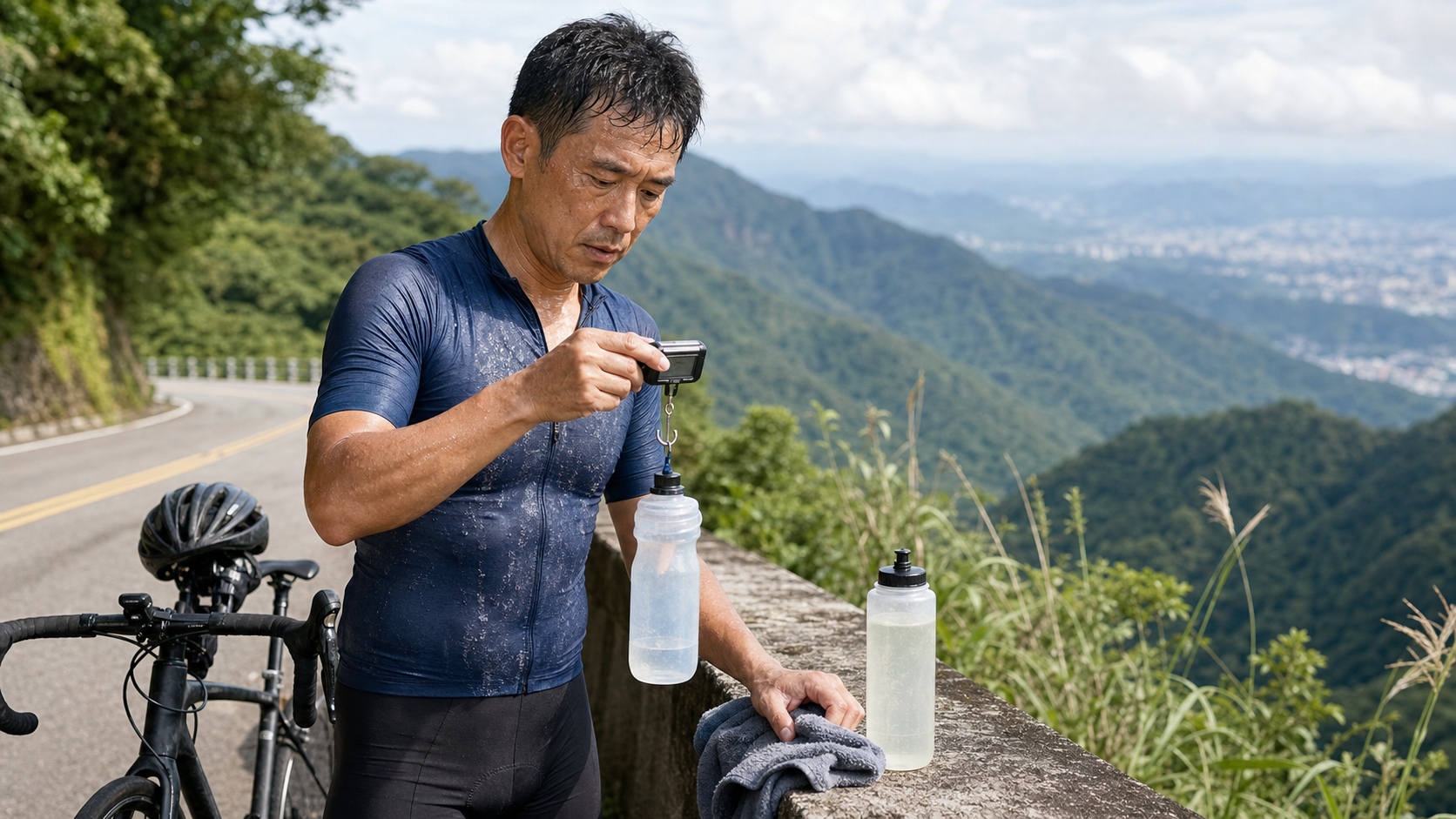
Opening: The Student Who Cramped Up and Collapsed on Yangjin Highway
In my over a decade of sports science consulting, I’ve encountered all kinds of hydration disasters, but there’s one case I remember vividly to this day.
He was a male student in his early forties; let’s call him A-Kai. He trained seriously, had decent power—could push over 300 watts for five minutes—weighed about 72 kilograms, and was your typical dedicated weekend-warrior cyclist. One summer, he signed up for a group ride starting from Shilin, climbing Yangjin Highway, and looping back—about 90-plus kilometers in total. Before setting off, he proudly told me, “Coach, this time I’m fully prepared. I’ve brought three bottles of water, so there’s no way I’ll get dehydrated.”
So what happened? Halfway through the ride, on a steep slope near Xiaoyoukeng, his entire inner thigh cramped up. The pain was so bad he had to stop by the roadside, and in the end, his teammates had to call a support vehicle to get him down the mountain. He asked me, utterly confused, “I drank tons of water, so why did I still cramp? Others drank less than me and were perfectly fine?”
This question is actually the core of today’s article. A-Kai’s problem wasn’t that he drank too little; it was that he drank the wrong thing and used the wrong strategy. He was a classic “salty sweater”—sweating profusely and losing a lot of sodium, yet only replacing it with plain water, which further diluted the sodium he had left. What he lacked was never water; it was the balance of sodium and overall electrolytes. On top of that, he had never figured out how much sweat he actually lost per hour.
After that incident, I had him do something very basic that many people never do in their entire lives: a personalized sweat rate test. After completing it, his cramping issues virtually disappeared, and his performance on long rides became much more stable. In this article, I’m going to walk you through the complete process I used with A-Kai back then, and with the hundreds of students I’ve guided since, step by step.
This will be a long, practical read, because hydration simply can’t be dismissed with slogans like “drink eight glasses of water a day.” Grab a digital scale, and let’s get started.
Foundational Concepts: Why “One-Size-Fits-All Hydration” Is Wrong
Let’s start with a harsh but important fact: There’s no standard answer for hydration because everyone’s body is different.
In the past, many people believed in “universal formulas,” like “drink 500 milliliters per hour” or “take two sips every 15 minutes.” The problem with this advice is that it assumes everyone’s sweat rate is roughly the same—but the reality is the complete opposite. According to sports science literature, sweat rates among different athletes can vary enormously. Some people lose only 0.5 liters per hour, while others can lose over 2 liters per hour—a difference of more than fourfold. If you hydrate based on someone else’s numbers, you’ll either over-hydrate or under-hydrate.
What Exactly Is Lost in Sweat
Sweat isn’t pure water. It’s primarily water, but it also carries away electrolytes, the most critical of which is sodium, followed by chloride, potassium, magnesium, calcium, and others. Sodium is the most important because it’s the primary regulator of osmotic pressure in extracellular fluid, directly linked to muscle contraction, nerve transmission, and the distribution of water in the body.
Here’s a key piece of data many people don’t know: Sodium concentration in sweat varies enormously from person to person. According to sports science literature reviews, sodium concentration in athletes’ sweat can be as low as about 200 milligrams per liter, or as high as over 2,000 milligrams per liter—an enormous range. People generally classified as “average” fall around 500 to 1,000 milligrams per liter, while so-called “salty sweaters” can reach 1,500 to 2,500 milligrams per liter.
What does this mean? Two people with the same weight and the same sweat rate—one can drink plain water and be fine, while the other drinks plain water and ends up cramping and dizzy—because the latter’s sweat is much saltier, losing three to five times more sodium than the former. This is why “one-size-fits-all hydration” is destined to fail a portion of the population.
How to Tell If You’re a Salty Sweater
Before doing formal measurements, there are several practical observational indicators that can give you a rough idea of which category you fall into:
- After exercise, do you see white salt crystals on your clothes, hat, or jersey shoulder straps once they’ve dried? The more visible the crystals, the saltier your sweat typically is.
- Does sweat sting particularly badly when it gets in your eyes? Does it taste distinctly salty when it runs into your mouth?
- Do you tend to cramp easily after prolonged exercise, especially in your calves or inner thighs?
- In hot weather, do you easily feel dizzy, weak, or experience a cliff-like drop in performance?
These are subjective indicators and can’t replace actual measurement, but they can give you a preliminary sense. A-Kai hit almost every single one back then—a textbook salty sweater.
How Severe Does Dehydration Have to Be Before It’s a Problem?
A widely cited principle in sports science is: During exercise, weight loss caused by fluid loss should ideally not exceed 2% of body weight. For a 70-kilogram person, 2% equals 1.4 kilograms. Beyond that threshold, endurance performance, thermoregulation, and focus all begin to decline noticeably.
But here, I want to emphasize the risk in the other direction—drinking more isn’t always better. Some people, afraid of dehydration, chug plain water excessively, diluting their blood sodium to dangerously low levels. This causes a condition called hyponatremia, which in severe cases can lead to nausea, confusion, seizures, and even be life-threatening. The goal of sports hydration has never been to “replace every drop of sweat,” but rather to keep weight loss within 2% while avoiding severe sodium imbalance. It’s a balancing act, not a one-way “more is better” metric.
Practical Method: Measuring Your Sweat Rate Yourself
Alright, enough theory—let’s get hands-on. The principle behind the sweat rate test is actually very simple: Weigh yourself before and after exercise, subtract what you drank, add back what you urinated, and the remaining weight change is your sweat loss. Since one liter of sweat weighs approximately one kilogram, the conversion is very intuitive.
What You’ll Need
| Equipment | Specification Recommendations | Notes |
|---|---|---|
| Digital scale | Accuracy to at least 0.1 kg, ideally 0.05 kg | This is the key to the entire test’s accuracy; a home digital scale works fine |
| Timing device | Watch, stopwatch, or sports app | To accurately record exercise duration |
| Water bottle | Graduated or pre-weighed | To record how much you drink |
| Towel | Regular sports towel | To dry off sweat before weighing |
| Paper/pen or phone notes | — | To record all numbers |
Standard Test Protocol (Step by Step)
Step 1: Pre-test preparation. Choose a day that represents your typical training intensity, preferably on an indoor trainer or in a stable environment for better control of variables. Hydrate normally beforehand so your body is in a normal hydration state.
Step 2: Measure “pre-exercise weight.” This step is where the test is most prone to error and has the biggest impact on accuracy. The ideal approach is to minimize clothing, dry off sweat, and use the restroom before weighing. Professional labs even use nude weight; at home, at least wear light, dry clothing and keep conditions consistent each time. Record the number, e.g., 72.0 kg.
Step 3: Train normally for 60 to 90 minutes. If the duration is too short, the margin of error becomes proportionally larger, so aim for at least one hour. If you drink water during this time, be sure to record how many milliliters you consumed; if you use the restroom, note it too (or try to take care of it before the test). Intensity should closely match your usual riding or running state.
Step 4: Measure “post-exercise weight.” Immediately after finishing, thoroughly dry off sweat, remove soaked clothing, and weigh yourself under the same conditions as before exercise. Let’s say you measure 70.8 kg.
Step 5: Apply the formula to calculate sweat rate.
Sweat volume (liters) = (Pre-exercise weight − Post-exercise weight) + Water consumed during exercise − Urine volume during exercise
Sweat rate (liters/hour) = Sweat volume ÷ Exercise duration in hours
Walk Through the Calculation: A-Kai’s Actual Numbers
Using A-Kai’s real measurements from his trainer session back then as a demonstration (these are case-specific measurements, for demonstration only—use your own):
| Item | Value |
|---|---|
| Pre-exercise weight | 72.0 kg |
| Post-exercise weight | 70.8 kg |
| Weight difference | 1.2 kg (= 1.2 liters of sweat) |
| Water consumed during exercise | 0.75 liters |
| Urine volume during exercise | 0 (took care of it before the test) |
| Exercise duration | 1.5 hours |
Calculation: Sweat volume = 1.2 + 0.75 − 0 = 1.95 liters
Sweat rate = 1.95 ÷ 1.5 = approximately 1.3 liters per hour
See that? A-Kai was losing 1.3 liters of sweat per hour. Back then, he brought three 750-milliliter bottles—2.25 liters total—for a 90-plus-kilometer ride lasting over three hours. Just looking at his sweat rate, it’s obvious his water supply was severely inadequate, not to mention he was drinking plain water with zero sodium replacement. No wonder things went wrong.
Adding “Sodium” as a Variable: Estimating Your Sodium Loss
Your sweat rate tells you “how much water to replace,” but to know “how strong your electrolyte drink should be,” you also need to know your sweat sodium concentration.
The most accurate method is professional sweat analysis (some sports labs or specific manufacturers offer patch-based testing), which directly tells you how many milligrams of sodium are in each liter of your sweat. But if you don’t have access to that, you can use the “subjective saltiness classification” mentioned earlier for a rough estimate, combined with the following reference table:
| Sweat Saltiness Type | Observational Characteristics | Estimated Sweat Sodium Concentration (per liter) | Estimated Sodium Loss per Liter of Sweat |
|---|---|---|---|
| Light sweater | Sweat isn’t very salty; salt crystals rarely seen | Approximately 200–500 mg | Lower |
| Average | Sweat is slightly salty; light salt residue occasionally seen | Approximately 500–1,000 mg | Moderate |
| Salty sweater | Sweat is very salty; obvious white crystals on clothes/hats; prone to cramping | Approximately 1,500–2,500 mg | High |
Multiply “sweat rate” by “sweat sodium concentration” to roughly estimate how much sodium you lose per hour. Using A-Kai as an example: he’s a salty sweater, so we’ll estimate about 1,800 mg of sodium per liter with a sweat rate of 1.3 liters/hour, meaning he was losing approximately 2,300 mg of sodium per hour. That’s a substantial amount—no wonder plain water was completely insufficient for him.
Turning the Numbers into a Hydration Plan
Once you’ve measured your sweat rate and sodium loss, you can build your personalized hydration plan. There are three core principles:
- Aim to keep weight loss within 2% of body weight—you don’t need to replace 100% of what you lose, and you shouldn’t chug excessively to try to break even.
- For salty sweaters or prolonged exercise, your drink must contain sodium. Research indicates that adding moderate sodium to sports drinks (roughly in the 400 to 500 mg per liter range) helps promote water absorption, especially when combined with carbohydrates. Most commercial sports drinks fall in this range; salty sweaters may also need to supplement with salt tablets.
- Layer your approach based on exercise duration: For exercise under an hour, water is usually sufficient; only when exceeding an hour, especially in high heat with heavy sweating, do you need to seriously address electrolytes and carbohydrates.
Here’s the tiered hydration framework I often give my students:
| Exercise Duration | Hydration Focus | Recommended Approach |
|---|---|---|
| Less than 60 minutes | Primarily water | Drink according to thirst; generally no special electrolyte needs |
| 60–90 minutes | Water + start adding sodium | Begin using sodium-containing sports drinks; adjust amount based on sweat rate |
| 90 minutes–3 hours | Water + sodium + carbohydrates | Sodium-containing drinks paired with carbohydrate intake; salty sweaters add salt tablets |
| Over 3 hours | Full electrolytes + energy | Systematic water, sodium, and carbohydrate replacement; fixed amounts at fixed intervals each hour |
Common Mistakes and Corrections
Over the years, about 80% of the hydration mistakes I’ve seen fall into the following categories. See if any of these hit home.
Mistake 1: Using “Thirst” as the Only Indicator, or Completely Ignoring It
These are actually two extremes. One group waits until they’re thirsty to drink, which during prolonged exercise often means they’re already far behind. The other group completely ignores thirst and chugs on a fixed schedule, risking blood sodium dilution.
Correction: For the general exercising population and most amateur cyclists, “thirst” is actually a fairly reliable physiological signal and can serve as the primary guide, paired with your measured sweat rate as an upper-limit reference. In other words—drink when thirsty, but don’t drink more than what you’ve lost. Don’t over-hydrate out of fear of dehydration.
Mistake 2: Replacing Only Water, Not Sodium (A-Kai’s Original Error)
This is the most fatal mistake for salty sweaters. During prolonged, heavy sweating, drinking only plain water drives blood sodium lower and lower—mild cases cause cramping, bloating, and weakness; severe cases lead to hyponatremia.
Correction: When exercising for over an hour with heavy sweating, your drink needs sodium. Salty sweaters especially need this, and may require salt tablets to make up the difference. Remember: Cramping isn’t necessarily dehydration—often it’s sodium deficiency.
Mistake 3: Thinking One Test Is Enough Forever
Your sweat rate isn’t a fixed value. It changes with temperature, humidity, exercise intensity, and heat acclimatization. The 1.0 liter/hour you measured on the trainer in winter could spike to over 1.8 liters/hour on Taiwan’s July asphalt.
Correction: Test yourself in different seasons and at different intensities several times to establish a “sweat rate range” rather than clinging to a single number. At minimum, have a “cool weather version” and a “scorching heat version.”
Mistake 4: Neglecting Post-Exercise Hydration and Sodium Replacement
Many people, the moment exercise ends, are only focused on scrolling their phones and taking photos for social media, forgetting that their body is still in a dehydrated, sodium-depleted state.
Correction: If your weight drops more than 2% after exercise, replenish fluids gradually and in portions over the next few hours, paired with sodium-containing foods or drinks (Taiwanese daily eating out actually provides plenty of sodium—a bowl of noodle soup or a bento box often restores a good amount). Chugging too much at once means your body can’t retain it, and you’ll just keep running to the bathroom.
Mistake 5: Using Sugary Commercial Drinks as Your Primary Hydration Source
Some people use high-sugar beverages as sports fuel. When sugar concentration is too high, it actually delays gastric emptying, causing gastrointestinal discomfort and bloating.
Correction: During exercise, carbohydrate concentration in drinks shouldn’t be too high (generally, a range of about 6–8% is better absorbed). Overly sweet bubble tea or cola isn’t ideal mid-exercise fuel—save those for after your workout.
Taiwan-Specific Practical Application: Factoring in the Climate Variable
Taiwan’s hydration strategy has one unavoidable major obstacle—heat and humidity.
Taiwanese summers routinely exceed 32°C, with humidity often spiking to 70% or 80%. High humidity makes it harder for sweat to evaporate, so the body has to produce even more sweat to cool down. As a result, at the same exercise intensity, you sweat far more in Taiwan than in drier climates. This is why many cyclists are fine riding abroad, but when they return to Taiwan and ride Yangmingshan, Fengguizui, or Beiyi in summer, they’re especially prone to problems.
Practical Advice for Common Taiwanese Scenarios
- Summer climbing routes (Yangjin, Fengguizui, Beiyi, early Wuling sections): Sweat rates are typically 30% to 50% higher than in winter. Budget more water and electrolytes between aid stations, and salty sweaters absolutely must carry salt tablets.
- Start early in the morning to avoid peak heat: This is one of the most practical strategies for Taiwanese summers. Scheduling long rides or runs for 5 or 6 a.m. significantly reduces sweat rate and heatstroke risk.
- Take advantage of convenience store density: Taiwan’s convenience store density is a hydration lifesaver. On long routes, you can plan stops at stores along the way rather than carrying all your water at once—but be sure to check for gaps in mountainous sections.
- Getting sodium from regular food is actually easy: Taiwanese noodle soups, bento boxes, and oden all have decent sodium content. After exercise, eating a normal meal often replenishes your sodium without needing to aggressively pop salt tablets.
Heat Acclimatization: Making Your Body More Resilient
Here’s some good news: your body adapts. Training consistently in hot environments for one to two weeks triggers “heat acclimatization,” which causes you to start sweating earlier, produce more dilute sweat (losing less sodium), and regulate temperature more efficiently. This is why the beginning of summer feels especially brutal, but things smooth out once you push through. So in early summer, keep intensity and distance conservative to give your body time to adapt.
Actionable Advice for Readers at Different Levels
If You’re a Beginner Just Starting to Exercise
Don’t let the numbers scare you. For now, just remember three things:
- When exercising for over an hour with heavy sweating, what you consume needs sodium (an electrolyte-containing sports drink works).
- Drink when thirsty, but don’t chug.
- Pick a day, use your home scale, and do a simple pre- and post-exercise weigh-in to feel “so this is how much I sweat in an hour.” That single experience is worth more than reading ten articles.
If You’re an Intermediate Athlete with Some Foundation
Seriously complete a full sweat rate test—ideally once in cool conditions and once in hot conditions—to establish your sweat rate range. Combine it with the subjective saltiness classification to build your own tiered hydration table, then test and fine-tune it during your next long event. You’ll notice a clear improvement in performance stability.
If You’re an Advanced Athlete Chasing Performance
Beyond self-testing your sweat rate, it’s worth considering a professional sweat sodium concentration analysis to refine your hydration and sodium replacement to near-laboratory precision. For your target race’s expected climate, intensity, and duration, do “fueling rehearsals”—practice your race-day fueling rhythm multiple times during training so you don’t fumble on race day.
Quick-Reference Action Table for All Three Levels
| Level | Primary Action | Advanced Action |
|---|---|---|
| Beginner | Remember “long + hot = add sodium” + drink when thirsty | Do one simple pre/post weigh-in |
| Intermediate | Complete full sweat rate test (cool/hot, once each) | Build a personal tiered hydration table and fine-tune through testing |
| Advanced | Professional sweat sodium analysis | Do fueling rehearsals for your target race |
Advanced Supplement: A Second Case Study and Finer Practical Details
Talking only about A-Kai, a salty sweater, isn’t enough. I want to share a case of the opposite type to show you just how much “personalization” matters.
Case Study 2: Xiao-Wen, Who Got Bloated No Matter How She Hydrated
Xiao-Wen was a serious female long-distance runner, weighing about 54 kilograms, with a cautious personality. Her problem was the exact opposite of A-Kai’s—she was so afraid of dehydration that she chugged a big cup at every aid station during long runs. As a result, her stomach always felt bloated like a balloon, she’d feel nauseous in the later stages, and once she even finished with swollen fingers and slight dizziness.
I had her do a sweat rate test, and in cool conditions, she only lost about 0.6 liters of sweat per hour—a low sweat rate with relatively light salt content. In other words, the amount of water she was consuming far exceeded what she was losing. Her swollen fingers, nausea, and dizziness were actually warning signs of mild overhydration and diluted blood sodium—a completely different problem from A-Kai’s sodium deficiency.
The adjustment was simple: reduce her fluid intake to match her actual sweat rate, switch to “drink when thirsty, small amounts each time,” and add a bit of sodium during longer sessions. Her bloating and nausea virtually disappeared, and her running felt lighter.
A-Kai drank too little without sodium; Xiao-Wen drank too much. If both had followed the same “standard hydration advice” from the internet, one of them would have kept having problems. That’s the value of personalized testing.
Why Women and Smaller-Framed People Need Extra Attention
For smaller, lighter individuals, drinking the same bottle of sports drink has a more pronounced dilution effect on their body’s electrolytes than for larger people. Additionally, since women’s average body weight and total fluid volume are typically lower, in ultra-endurance events, blindly following “what everyone else drinks” makes it relatively easier to tip into overhydration and low blood sodium. This is why sports medicine has increasingly emphasized: hydration strategies must be tailored to individual body weight and sweat rate, not copied from others.
The “Timing” of Hydration Is Just as Important as the “Amount”
Many people only think about “how much to drink” but overlook “when to drink.” Here are some practical finer points:
- Pre-exercise hydration: Get your body to a normal hydration state one to two hours before departure, rather than chugging at the starting line. Last-minute chugging will only make you constantly need the bathroom.
- Small amounts, frequent intervals during exercise: Rather than waiting until you’re desperately thirsty and gulping a huge mouthful, take small sips at regular intervals. Your stomach will be more comfortable, and absorption is more stable.
- The golden replenishment window after exercise: Don’t chug it all at once when you finish. Split it into several portions, paired with sodium-containing foods, to let your body gradually retain the fluid.
A Four-Week “Hydration Practice” Cycle
Hydration is a trainable skill. Many people train hard before a race but never seriously practice their fueling, and then their stomach rebels on race day. I usually recommend that students schedule a hydration practice period before a target race:
| Week | Practice Focus | Specific Actions |
|---|---|---|
| Week 1 | Establish baseline | Do a sweat rate test in cool conditions; record the numbers |
| Week 2 | Hot environment calibration | Test again during a time slot close to race climate; compare differences |
| Week 3 | Fueling rhythm rehearsal | During long training sessions, execute your target hydration/sodium rhythm and observe gastrointestinal response |
| Week 4 | Fine-tune and finalize | Adjust drink concentration and fueling intervals based on previous weeks’ feedback; finalize the race plan |
Go through this cycle once, and on race day you won’t panic about “how much to drink, what to drink, or when to drink”—because you’ve already practiced it many times.
Urine Color: A Free and Useful Daily Indicator
Besides weighing yourself, there’s a zero-cost daily hydration indicator—urine color. Generally, pale yellow (like diluted lemon juice) usually indicates good hydration status; dark yellow or amber suggests possible insufficient fluid intake. Of course, it can be affected by vitamins, food, and medication, so it’s not absolutely precise, but it’s a convenient reference for a quick daily self-check every morning. This is especially useful for office-worker athletes in Taiwan who can easily become chronically dehydrated in summer without realizing it.
FAQ: Questions Students Ask Most Often
Q1: Does cramping always mean dehydration or sodium deficiency?
Not necessarily. The causes of exercise-associated muscle cramps are actually complex. Besides dehydration and electrolyte imbalance, they’re also related to muscle fatigue, neuromuscular control, and insufficient training. Sodium and fluid replacement helps a lot for “salty sweaters who sweat for long periods,” but if you’re replenishing adequately and still cramping frequently, you should also examine your training load and strength, and seek professional evaluation if needed.
Q2: Do I have to buy expensive electrolyte products?
Not necessarily. Common commercial sports drinks generally contain moderate sodium, which is sufficient for most people. Only salty sweaters or those doing ultra-long exercise really need additional salt tablets. Rather than spending money on products, spend time first figuring out your sweat rate and sweat saltiness type.
Q3: If I drink until I’m no longer thirsty, does that mean I’ve had enough?
For most amateur athletes, thirst is a reliable reference signal. However, in ultra-long events, extreme heat, or high-intensity races, the thirst signal can lag behind. In those cases, you need your pre-measured sweat rate to help guide your fueling rhythm.
Q4: I have high blood pressure / heart disease / diabetes. Will sodium supplementation be a problem?
This is a very important question that must be individualized. For people with chronic conditions (such as high blood pressure, heart disease, kidney disease, or diabetes), sodium intake, exercise intensity, and hydration strategies should all be professionally evaluated—you can’t directly apply the general principles in this article. Be sure to discuss this with your physician or dietitian and adjust according to your health status. Taiwan has a robust national health insurance system and sports medicine resources—make good use of them, and don’t just push through on your own based on feel.
Q5: Can I chug a large amount of water right after exercise?
It’s not recommended to drink too much too quickly. After exercise, your body has lost fluids, and it’s best to replenish gradually in portions, paired with sodium-containing foods or drinks. This way your body retains it better, and you’re less likely to keep running to the bathroom or experience discomfort.
Debunking Common Hydration Myths
Finally, let’s dismantle a few claims that circulate widely in the sports world but don’t hold up.
Myth 1: “The More You Sweat During Exercise, the More Effective the Training”
Sweat volume primarily reflects your thermoregulation and the ambient temperature/humidity, not training effectiveness. The same workout done in an air-conditioned room versus under the blazing sun will produce wildly different sweat volumes, but the training stimulus may be similar. Sweating a lot just means your body is working hard to cool down—don’t use it as a measure of training quality.
Myth 2: “Chugging Water Before Exercise Can Prevent Dehydration”
When you rapidly consume large amounts of water, your body can’t absorb and store it in time—the excess is simply excreted as urine. It might also make you constantly look for bathrooms during your event, and could even dilute blood sodium. The correct approach is to adjust your hydration status early, in portions, and in appropriate amounts—not to cram at the last minute.
Myth 3: “The More Salt Tablets You Take, the Less Likely You’ll Cramp”
Salt tablets are indeed helpful for salty sweaters who sweat for long periods, but more isn’t always better. Excess sodium supplementation can also cause gastrointestinal discomfort and can’t infinitely prevent cramping—remember, cramping is also linked to muscle fatigue and insufficient training. Salt tablet dosage should match your estimated sodium loss, not be a “the more, the merrier” approach.
Myth 4: “Plain Water Is the Healthiest, So Drink Only Plain Water During Exercise”
In daily life, plain water is perfectly fine, of course. But in prolonged, heavy-sweating exercise scenarios, drinking only plain water can actually cause electrolyte imbalance. In those situations, a sodium-containing sports drink is the right tool. Tools have no absolute good or bad—it depends on the context.
Hydration Adjustments for Different Sports and Situations
The principle of the sweat rate test applies across all sports, but there are practical differences worth noting.
Cycling vs. Running vs. Swimming
| Sport Type | Hydration Characteristics | Practical Reminders |
|---|---|---|
| Cycling | Bike frame can carry bottles; easy to drink anytime; downhill wind can make you underestimate sweat loss | High-heat climbing sections are where dehydration is most likely; don’t drink less just because the wind makes it feel cool |
| Running | Relies on aid stations or carrying your own; fewer fueling opportunities | Plan aid points in advance; consider a waist pack or hydration vest for long distances |
| Swimming/Triathlon | Hard to notice sweating in water; still dehydrates | Don’t assume being in water means you won’t dehydrate; plan fueling just the same |
Swimming is especially easy to overlook. Many people think being in the water means no dehydration, but in warm water or during intense swimming, you still sweat and still lose fluids—you just can’t feel it. Triathletes especially need to plan hydration holistically across the swim, bike, and run segments.
The Hidden Trap of Indoor Trainers
Many Taiwanese cyclists switch to indoor trainers in summer, but indoors, without the natural wind of riding, heat dissipation is much less efficient, and sweat rates are often higher than outdoor efforts at the same intensity. If you don’t have a fan or air conditioning, riding for an hour in a stuffy room can produce shocking amounts of sweat. For indoor training, be sure to have a fan and plenty of water ready. This is also a great setting for doing your sweat rate test—the environment is stable and data is easier to control.
Special Reminders for Older Athletes and Those with Chronic Conditions
Older athletes may have a blunted sense of thirst, and some have chronic conditions or take medications that affect fluid and electrolyte balance (such as certain blood pressure medications or diuretics). Their hydration strategies require even more caution and individualization. This group absolutely cannot copy younger people’s fluid volumes or salt tablet dosages—they must first discuss with their physician and dietitian. Taiwan’s national health insurance and access to family medicine, cardiology, and nephrology resources are very convenient. Getting an evaluation before exercising is far more worthwhile than dealing with problems after an incident. This isn’t meant to scare you, but to help you enjoy exercise safely and sustainably.
Conclusion: Turning Hydration from “Mysticism” into “Data”
Back to A-Kai’s story. After completing the sweat rate test and understanding that he was a salty sweater, he began following a personalized hydration and sodium plan—fixed amounts of sodium-containing drinks per hour on long rides, salt tablets for salty-sweat situations, and fluid volumes matched to his sweat rate rather than guesswork. Since then, his cramping has virtually disappeared. What makes him happiest is that the final 30 kilometers of long rides no longer feel like “losing speed and questioning life,” but rather holding power and riding all the way home.
When it comes down to it, hydration isn’t magic—it’s just whether you’ve taken the time to understand your own body. A digital scale, a towel, and one serious test can turn a lifetime of “mystical hydration” into “data-driven hydration.” In my opinion, this is the highest-return lesson any serious athlete can learn.
Pick a day and try it. Your body deserves a hydration plan that’s uniquely yours.
This article is educational content and cannot replace individual diagnosis and treatment advice from a physician, physical therapist, or dietitian. If you have a chronic condition, are taking medication, or have experienced severe discomfort during exercise, please consult a qualified medical professional first and adjust your hydration and sodium strategies according to your personal situation.
References
- Precision Hydration — How to measure your sweat rate: https://www.precisionhydration.com/performance-advice/hydration/how-to-measure-your-sweat-rate/
- American College of Sports Medicine position stand — Exercise and fluid replacement (PubMed): https://pubmed.ncbi.nlm.nih.gov/17277604/
- Sweating Rate and Sweat Sodium Concentration in Athletes: A Review of Methodology and Intra/Interindividual Variability (PMC): https://pmc.ncbi.nlm.nih.gov/articles/PMC5371639/
- Normative data for sweating rate, sweat sodium concentration, and sweat sodium loss in athletes (Taylor & Francis): https://www.tandfonline.com/doi/full/10.1080/02640414.2019.1633159
- Gatorade Sports Science Institute — Sodium Ingestion, Thirst And Drinking During Endurance Exercise: https://www.gssiweb.org/sports-science-exchange/article/sse-122-sodium-ingestion-thirst-and-drinking-during-endurance-exercise
Related Reading
- Recognizing and Managing Exercise Dehydration: A Complete Guide to Severity Levels, Symptoms, and Hydration Strategies
- The Science of Exercise and Electrolyte Balance: The Roles of Sodium, Potassium, Magnesium, and Calcium, Loss, and Individualized Supplementation Strategies
- Fluid and Electrolyte Strategies: Starting with a Sweat Rate Test
- Hydration and Electrolytes for Long-Distance Riding: Dehydration, Hyponatremia, and Personalized Hydration Rates
雨戰! 西進武嶺員工旅遊 加料 各路段大數據分析 | 同事端出5公斤的公路車來挑戰!? EP1
4 年前
CT暗黑廚房) 車友必備 宇宙無敵鮮蚵湯 幫助訓練恢復 天然食補 好市多 超肥鮮蚵 破PR
7 年前
Never Stop 西進武嶺 前後雙機 完整全程錄影 訓練台 實境
8 年前
水金九不厭五分 10度寒流冷到不願停!feat. 卡卡 / 公路車 / CT Yeh
6 個月前
西進武嶺 免費訓練分析服務 Intervals | 練不夠還是練過頭?你哪一種類型選手?AI模型告訴你! | 備戰神器 | 公路車 訓練 | CT Yeh
4 年前
單車 一日北高 ( 雙城 ) 肥宅雙人瘋狂行 紀錄片 REACTO
10 年前
一日北高/長距離團騎 常見問題補充篇 / 組團或跟團的眉角 / 壯車友容易被瘦車友慢性拉爆 / 原來屁股痛可能是這個原因...? / 風場配速法 / 公路車 / CT Yeh
2 年前
CT 喇低賽) 武嶺牽車 才是王道 西進牽車四小時內秘訣 攝手位置 如何判斷 防抽筋小秘訣
7 年前