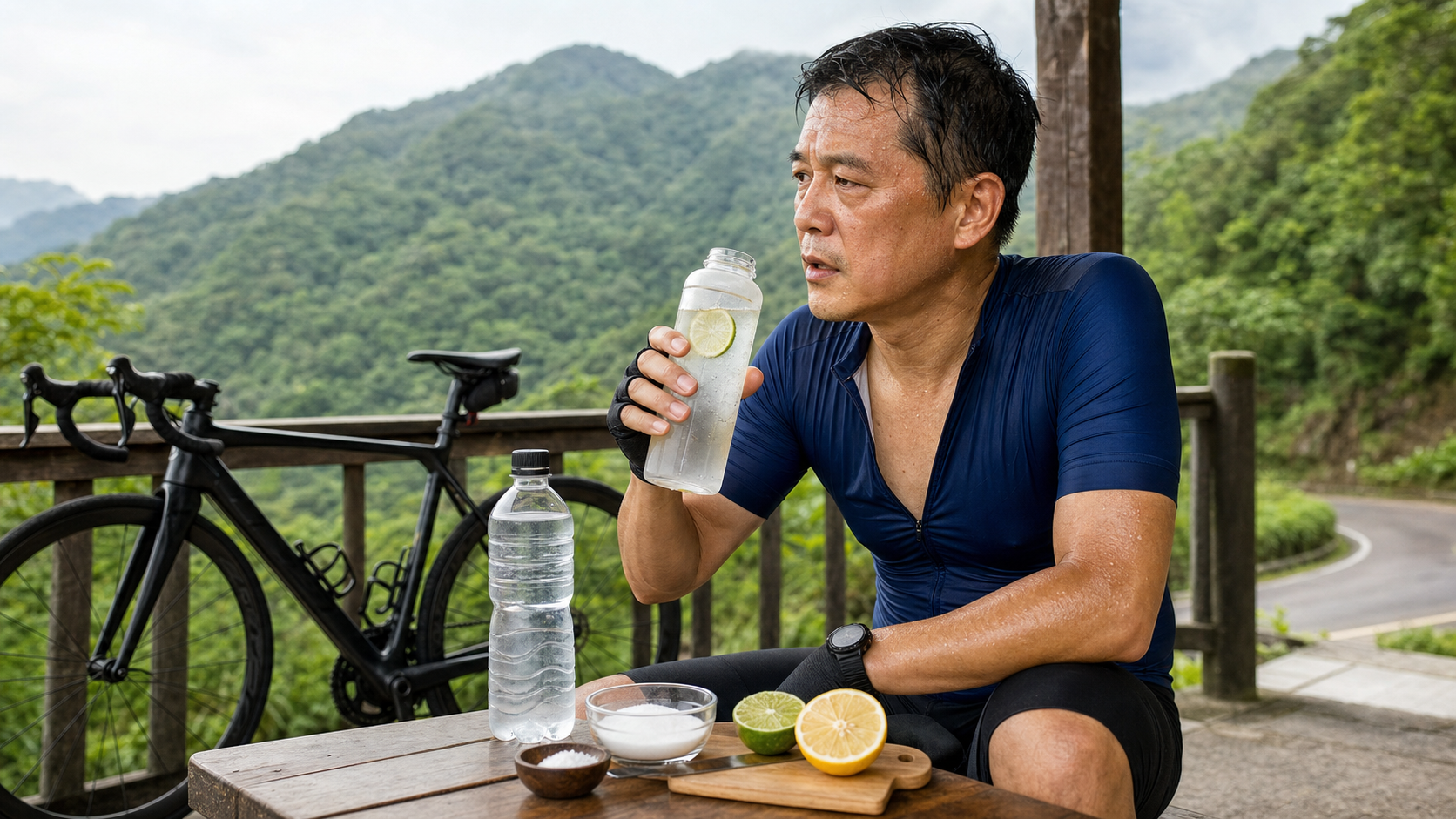
Starting with a Student Who Got Heatstroke on the Yangjin P-Style Mountain Ride
In my fifteenth year of coaching, one image remains crystal clear. A student in his early forties, let’s call him A-Hong, went to challenge the Yangjin P-Style Mountain ride on a July weekend. Before setting off, he downed a large bottle of plain water, thinking he was “well-hydrated.” But halfway up the mountain, he started feeling dizzy, got calf cramps, felt nauseous, and collapsed in a pavilion. When he messaged me, his first words were: “Coach, I drank so much water, why is this happening?”
Looking at his photos and description, I had a pretty good idea. Taiwan’s humid summer heat, combined with two to three hours of high-intensity climbing, meant he had lost not just water, but a huge amount of sodium and other electrolytes. And all he had replenished was plain water, which further diluted his already declining blood sodium concentration. In exercise physiology, this has a name: exercise-associated hyponatremia, and in severe cases, it can be fatal.
After this incident, A-Hong asked me a great question: “So can I just grab any sports drink from the store?” — That question is exactly what this article aims to answer thoroughly. Sports drinks line the shelves of Taiwan’s convenience stores in dazzling variety. Some people treat them as a miracle cure, insisting on drinking them for any exercise; others dismiss them as a “stupidity tax,” thinking they’re just salted sugar water. The truth is: they are neither a panacea nor a stupidity tax, but a tool with clear usage timing that requires reading the ingredients to use correctly.
This article will start with the core scientific concepts — osmolality and carbohydrate concentration — help you decipher the labels on the shelf, teach you when to drink and when plain water is enough, and finally give you a DIY recipe I actually give my students. The goal is simple: next time you exercise, you’ll be replenishing the right things, not just going by feel.
Foundational Concepts: What the Body Actually Loses During Exercise
To understand sports drinks, you first need to understand what the body “leaks” during exercise. When you sweat, the primary component is, of course, water, but it also carries away electrolytes, the most critical being sodium, followed by chloride, potassium, magnesium, calcium, and others.
Sodium: Loss Varies Greatly from Person to Person, More Than You’d Think
Many people assume everyone loses roughly the same amount of sodium through sweat. That’s not the case. According to sports science literature, sweat sodium concentration varies enormously between individuals — some people lose only about 200 milligrams of sodium per liter of sweat, while others can lose up to 1500 or even 2000 milligrams. Using common academic classifications, sweat sodium concentration generally falls into three levels: low (below 30 millimoles per liter), moderate (30 to 50 millimoles per liter), and high (above 50 millimoles per liter).
This individual variation is very obvious in practice. Among the students I’ve coached, some finish exercise with a white layer of salt frost on their clothes and crystals on their hat brims — these are classic “salty sweaters.” Others sweat just as much, yet their clothes dry with no trace at all. If these two types of people used the same replenishment strategy, one of them would definitely have problems.
Carbohydrates: Not Just for Flavor
The sugar in sports drinks isn’t just for taste (though that’s one reason). During moderate-to-high intensity, prolonged exercise, the body primarily relies on glycogen for energy, and glycogen stores are limited, starting to run low after about 60 to 90 minutes of continuous exercise. If there’s no external carbohydrate supply at that point, your pace drops, your mind gets foggy, and you hit the so-called “bonk.” The carbohydrates in sports drinks are the fuel continuously fed to your muscles during exercise.
But here’s the key: more sugar isn’t better. Adding too much actually slows gastric emptying, causes gastrointestinal discomfort, and can even dehydrate you further. This brings us to the most core concept of this entire article — osmolality.
Core Science: The Golden Zone of Osmolality and Carbohydrate Concentration
What Is Osmolality and Why Does It Determine Everything
Osmolality, simply put, is the concentration of dissolved particles in a liquid. Our blood plasma osmolality is approximately in the range of 280 to 300 milliosmoles per kilogram (mOsm/kg). The osmolality of a sports drink relative to blood plasma determines how quickly it’s absorbed in the gastrointestinal tract, and it’s generally divided into three categories:
- Hypotonic: Osmolality lower than blood plasma. Water absorption is fastest, suitable for situations where you simply want rapid rehydration.
- Isotonic: Osmolality similar to blood plasma. Balances water replenishment and energy supply; this is the setting for most commercial sports drinks.
- Hypertonic: Osmolality higher than blood plasma. Most fruit juices, sugary sodas, and colas fall into this category; drinking them during exercise actually delays gastric emptying.
Here’s a very important and often misunderstood concept: when a hypertonic drink enters the intestine, the body, in order to dilute it to the same concentration as bodily fluids, actually “pulls” water from the blood into the intestine, making you more dehydrated in the short term and more prone to bloating and diarrhea. So chugging cola or concentrated fruit juice during exercise is a very common mistake.
The Golden Zone of Carbohydrate Concentration: 6% to 8%
So what’s the right way to formulate it? According to sports nutrition research literature, the ideal drink during exercise has a carbohydrate concentration of approximately 4% to 8%, with 6% to 8% considered the sweet spot that balances “energy supply” with “not slowing gastric emptying.”
A 6% carbohydrate concentration means 6 grams of carbohydrates per 100 milliliters of drink (which translates to 60 grams per liter). Research indicates that a mixed-carbohydrate drink at around 6% is typically isotonic, with good gastric emptying efficiency and adequate energy supply.
But the research also highlights a detail: when carbohydrate concentration reaches the 8% upper limit, the situation differs from 6%. Some studies have found that repeatedly consuming drinks with an 8% carbohydrate concentration during exercise significantly reduces the gastric emptying rate, whereas lower concentrations don’t have this problem. This is also why it’s generally recommended to avoid drinks with an osmolality exceeding 500 milliosmoles per kilogram during exercise. In plain terms: when drinking during exercise, it’s better to err on the side of more dilute, not more concentrated. If the concentration is too high, your gut goes on strike before the energy you’ve consumed is even absorbed.
The table below summarizes the differences among the three types of drinks for easy reference:
| Type | Osmolality (relative to plasma) | Carbohydrate Concentration | Primary Use | Common Examples in Taiwan |
|---|---|---|---|---|
| Hypotonic | Lower | Approx. 2-4% | Primarily rapid rehydration | Diluted sports drinks, water with electrolyte tablets |
| Isotonic | Similar | Approx. 6-8% | Rehydration plus energy | Most commercial sports drinks |
| Hypertonic | Higher | 10% and above | Post-exercise or not suitable during exercise | Fruit juice, cola, sugary sodas |
Sodium: Not Just for Saltiness
The sodium in sports drinks, besides replacing the sodium lost through sweat, has another function many people don’t know about: helping water and glucose be absorbed together in the intestine. There’s a “sodium-glucose cotransport mechanism” in the gut — simply put, sodium and glucose are absorbed hand-in-hand, bringing water along with them. So in a good sports drink, the ratio of sugar to sodium is meaningful, not random.
According to the literature, the ideal sodium content for a sports drink is approximately 400 to 1100 milligrams per liter (roughly 20 to 40 millimoles per liter). In hot, humid environments or during ultra-long exercise, it’s recommended to aim for the upper end of this range.
Why Drinks with “Multiple Transportable Carbohydrates” Are Absorbed Better
Let me add one more advanced but practical concept here. You might have seen “glucose + fructose” or “multiple transportable carbohydrates” on some sports drinks or energy gels. This isn’t marketing hype; there’s a physiological basis behind it.
The intestine absorbs glucose and fructose through different transport channels. Relying solely on glucose as a carbohydrate source has an upper limit on absorption rate. But if you provide both glucose and fructose, both channels are open simultaneously, allowing a higher total amount of carbohydrate to be absorbed per unit of time. This is particularly beneficial for ultra-long events that require massive carbohydrate intake, like ultramarathons or long-distance cycling. That’s why many professional endurance supplements are deliberately formulated as glucose-fructose blends.
For the average exerciser, you don’t need to obsess over this. But if you’re tackling distances over 4 hours that require substantial carbohydrate intake, choosing products that tout multiple transportable carbohydrates, or using a DIY blend of table sugar (sucrose is itself glucose + fructose) with a bit of honey, will be better absorbed and less likely to cause gastrointestinal distress than pure glucose powder.
Practical Methods: When to Drink, How to Choose, How to Mix Your Own
Now that the concepts are covered, let’s get to the most practical part. I’ll break it down into three questions: whether to drink, how to choose, and how to make your own.
Step 1: Determine Whether You “Need” a Sports Drink for This Session
This is the most frequently skipped, yet most important step. Not all exercise requires a sports drink. The simple criteria I give my students are based on three variables: “intensity × duration × environment”:
| Scenario | Recommended Replenishment | Explanation |
|---|---|---|
| Exercise <60 minutes, cool environment, low-to-moderate intensity | Plain water is enough | In this case, a sports drink just adds extra sugar and calories |
| Exercise 60-90 minutes, moderate intensity | Primarily plain water, supplement some electrolytes as needed | Time to start paying attention to sodium loss |
| Exercise >90 minutes, or heavy sweating | Sports drink/electrolyte replenishment | Both carbohydrates and sodium need external supplementation |
| Taiwan’s humid summer heat, climbing, salty sweaters | Sports drink leaning toward higher sodium content | Highest risk group for hyponatremia |
For example, if you’re just going for a 40-minute easy jog along the riverside in the evening and it’s not hot, all you need is a bottle of plain water; a sports drink would just be unnecessary sugar and calories. But if you’re riding up Fengguizui at noon in July for over two hours, your replenishment strategy is a completely different story.
A “Sweat Rate” Self-Test You Can Do at Home
If you want to know more precisely how much water you need to replenish, there’s a very simple method that requires no equipment: weigh yourself before and after exercise (wear as little as possible, dry off the sweat). Suppose you exercise for 1 hour, your weight drops by 0.8 kilograms, and you drank 0.3 liters of water during that time. Then you lost approximately 0.8 + 0.3 = 1.1 liters of sweat in that hour. That’s your approximate “sweat rate.”
What’s the use of knowing your sweat rate? It helps you estimate how much you need to replenish for longer exercise. Using this example, if you plan to ride for 3 hours, theoretically you’d lose about 3 liters, so you’d know you can’t just bring a single 600-milliliter bottle of water. Of course, this is just an estimate; the actual number will vary with weather and intensity, but it’s incredibly helpful for planning long-distance replenishment. Doing this test in a Taiwanese summer often shocks people — sweat rates are usually much higher than you’d imagine.
Step 2: Reading the Ingredient Labels on the Shelf
Standing in front of the convenience store cooler, how do you quickly judge whether a sports drink is suitable? I teach my students to look at three numbers, which you can calculate from the nutrition label on the back:
- Calculate carbohydrate concentration: Look at “carbohydrates” per 100 milliliters in grams. Falling between 6 and 8 grams (6% to 8%) is the ideal value for during exercise. If it’s labeled per serving or per bottle, remember to convert back to per 100 milliliters.
- Check sodium content: Look at sodium per 100 milliliters. An ideal sports drink has approximately 40 to 110 milligrams of sodium per 100 milliliters. If it’s too low (some products marketed as “light” or “refreshing” have extremely low sodium), the electrolyte replenishment effect is limited.
- Check for extras: High caffeine, lots of artificial additives, or carbohydrate concentrations soaring above 10% are not ideal for during exercise.
Here’s a reminder specific to Taiwan: many people use “energy drinks” or “stimulant drinks” as sports drinks, but these two are completely different things. Stimulant drinks usually have very high sugar content (hypertonic) and high caffeine, which easily causes gastrointestinal discomfort during exercise. Don’t confuse sports drinks with energy drinks.
Step 3: DIY — The Most Cost-Effective and Most Customizable Option
Commercial sports drinks are convenient, but they have two drawbacks: first, the sugar concentration and sodium ratio are set by the manufacturer and may not fit your needs; second, over the long term, they add up as an expense. I highly recommend my students learn to mix their own, especially those who do regular long training sessions.
Here’s the basic recipe I actually give my students. All ingredients are available at any supermarket in Taiwan. This recipe produces a roughly isotonic drink with a carbohydrate concentration around 6%:
| Ingredient | Amount (for 1 liter) | Function |
|---|---|---|
| Water or cold boiled water | 1000 milliliters | Base |
| Sugar or honey | Approx. 50-60 grams (about 4-5 tablespoons) | Provides carbohydrates, ~6% concentration |
| Table salt | Approx. 1/4 teaspoon (about 1-1.5 grams) | Provides sodium, ~400-600 milligrams |
| Freshly squeezed lemon or orange juice | Approx. 100-150 milliliters | Flavor, small amounts of potassium and vitamin C |
Mixing tips:
- For the salt: 1/4 teaspoon of table salt contains approximately 400 to 600 milligrams of sodium. If you’re one of the “salty sweaters” mentioned earlier, or exercising for long periods in very hot conditions, you can increase it to closer to 1/2 teaspoon, but it’s recommended to increase gradually and adjust based on how you feel, not all at once to avoid it being too salty.
- If you want to more precisely supplement potassium, you can use a small amount of “low-sodium salt” (which contains potassium) as a salt substitute, but people with heart or kidney conditions should not add potassium on their own — I’ll emphasize this again in the compliance section later.
- If it’s too sweet or your exercise session isn’t that long, you can reduce the sugar to 30 to 40 grams to make a more hypotonic, hydration-focused version.
- If you like carbonation, I don’t recommend adding sparkling water; it tends to cause bloating during exercise.
The advantage of this DIY recipe is that you have complete control over concentration and saltiness, allowing you to fine-tune based on the day’s weather and exercise duration. When I lead long-distance training, my water bottles often contain this homemade version.
Before, During, and After Exercise: Different Drinking Strategies
Many people think a sports drink is just for “during exercise,” but the replenishment logic for the pre-exercise, during-exercise, and post-exercise phases is different, and the formula can be adjusted accordingly.
Before exercise (from warm-up to 1 hour before start): The focus of this phase is to “fill up” the body’s water and glycogen. If you have a long-distance challenge the next day, eat and hydrate normally the day before. On the day itself, 1 to 2 hours before departure, you can drink about 300 to 500 milliliters of an isotonic drink or plain water. You don’t need it too concentrated here; the key is to give the water time to be absorbed and excess to be eliminated, rather than chugging right before you start. I often remind my students: light yellow urine before departure and using the restroom before heading out is a simple self-check.
During exercise: This is the golden zone discussed earlier — isotonic, 6% to 8% carbohydrates, adequate sodium, small amounts frequently. The longer the duration and the hotter the environment, the more you need to replenish regularly and lean toward the upper end of sodium intake.
After exercise (recovery phase): The goal here shifts from “maintaining performance” to “accelerating recovery,” and what you replenish can differ from during exercise. The focus of recovery is to replace lost fluids and electrolytes and to supplement carbohydrates to help rebuild glycogen. At this point, you can actually drink something slightly more concentrated than during exercise, and even pair it with some protein (like low-fat milk or soy milk) to aid muscle repair. Hypertonic drinks like fruit juice or chocolate milk, which aren’t recommended during exercise, are actually good choices during the recovery phase.
The table below summarizes the replenishment focus for the three phases:
| Phase | Primary Goal | Recommended Concentration | Local Examples in Taiwan |
|---|---|---|---|
| Before exercise | Fill up water and glycogen | Isotonic or plain water | Drink 300-500 milliliters 1-2 hours before departure |
| During exercise | Maintain water, electrolytes, energy | Isotonic, 6-8% carbohydrates | DIY recipe or commercial sports drinks, small amounts frequently |
| After exercise | Accelerate recovery, replenish glycogen and protein | Can be slightly more concentrated, add protein | Chocolate milk, soy milk with banana, fruit juice |
A Real Case Study: Adjusting Replenishment for a Salty Sweater
Let me give another student example to show you what “individualization” looks like in practice. A female student training for full marathons, let’s call her Xiao-Min, weighs about 52 kilograms. After every long run, her clothes are covered in a white layer of salt frost, and the skin around her temples feels prickly — a very typical salty sweater. She initially used the most common commercial sports drink but still frequently cramped up after the 30-kilometer mark.
The adjustments I made were actually quite simple: First, I increased the sodium in her replenishment, bumping the salt in the DIY recipe from 1/4 teaspoon to nearly 1/2 teaspoon. Second, I set a fixed replenishment rhythm — she had to take a sip every 20 minutes, whether she was thirsty or not. Third, I reminded her that she could eat slightly saltier meals the night before the race and at breakfast on race day (which is reasonable for salty sweaters). After these adjustments, her cramping in the latter half of races improved significantly.
The point of this case isn’t that “adding salt is always the answer,” but that replenishment strategy must correspond to your individual sweating characteristics. The same recipe that’s just right for Xiao-Min might be too salty for someone with very dilute sweat. That’s why I always emphasize observing your own sweat and adjusting gradually, rather than copying someone else’s formula.
Common Mistakes and Corrections
In all my years of coaching, the same mistakes keep recurring. I’ve listed the most common ones below, along with corrections:
Mistake 1: Chugging Sports Drinks During Short, Easy Exercise
Many people have developed the reflex of “exercise = sports drink.” But if you’re just taking a walk or an easy 40-minute ride, drinking a sports drink only adds unnecessary sugar and calorie intake. Some people see no results from fat loss because the calories burned during exercise are offset by a sports drink.
Correction: For short-duration, low-intensity exercise in cool environments, plain water is fine. Save sports drinks for the long-duration, high-intensity, heavy-sweating situations that truly need them.
Mistake 2: Replenishing Only Water Without Sodium — Actually More Dangerous
This is A-Hong’s situation from the beginning. Continuously chugging plain water during prolonged, heavy sweating dilutes your blood sodium concentration lower and lower, potentially triggering exercise-associated hyponatremia. Symptoms include dizziness, nausea, confusion, and in severe cases, seizures and even life-threatening conditions. This has happened to finishers of marathons, long-distance cycling events, and triathlons.
Correction: For exercise lasting over 90 minutes with heavy sweating, you must replenish sodium — you can’t just drink plain water. This is one of the core reasons sports drinks exist.
Mistake 3: Chugging High-Concentration Fruit Juice or Cola During Exercise
It’s only natural to think “I’m tired, let me get some sweet energy,” but fruit juice and cola are mostly hypertonic drinks. Chugging them during exercise delays gastric emptying, causes bloating and diarrhea, and can even dehydrate you further.
Correction: If you really want to drink them, dilute them with at least half water during exercise. Drinking them undiluted during the recovery phase after exercise is fine.
Mistake 4: Drinking Too Much at Once, Too Quickly
Even if the drink is perfectly formulated, downing 500 milliliters in one go means your stomach can’t absorb it all, and you’ll just feel nauseous when you move around.
Correction: Small amounts, frequently. During exercise, take a small sip (about 150 to 250 milliliters) every 15 to 20 minutes, giving your stomach time to empty and absorb. This is far better than chugging only when thirsty.
Mistake 5: Treating Sports Drinks as Everyday Beverages
Sports drinks are designed for “during exercise.” Drinking them like water when you’re not exercising means consuming a bunch of extra sugar and sodium every day, which isn’t good for your weight or blood pressure.
Correction: When you’re not exercising, water is the best beverage. Let sports drinks return to their professional purpose.
Mistake 6: Relying on “Thirst” as the Only Cue to Hydrate
Thirst is actually a “lagging indicator” — by the time you feel thirsty, your body is often already mildly dehydrated. Especially during high-intensity exercise or when you’re focused, thirst signals are often ignored. Waiting until you’re clearly thirsty to drink throws off your rhythm.
Correction: Replenish regularly and proactively, don’t wait until you’re thirsty. For long exercise sessions, set a timer reminder to take a sip every 15 to 20 minutes. However, I should also note: this doesn’t mean “drink as much as possible.” Over-hydrating also carries a risk of hyponatremia. The principle is regular and moderate.
Mistake 7: Being Seduced by Zero-Sugar, “No Burden” Sports Drinks
Some people, afraid of gaining weight, specifically choose zero-sugar or very low-sugar sports drinks. This is fine for “short sessions where you just want water and electrolytes,” but if you’re doing long-duration, high-intensity exercise, a zero-sugar drink lacks the energy source you need most during exercise, making you more likely to bonk.
Correction: Distinguish your needs. If you need energy, don’t choose zero-sugar. Only if you’re just replenishing water and sodium does a zero-sugar or low-sugar version make sense.
Frequently Asked Questions (FAQ)
Over the years of coaching, the questions I get about sports drinks are pretty much the same few, so I’ve compiled them into an FAQ:
Q1: Can coconut water be used as a sports drink?
Coconut water is high in potassium and low in sodium, with a slightly higher osmolality. It’s a decent natural choice for “post-exercise rehydration and potassium replenishment,” but for situations involving prolonged heavy sweating where you need sodium, coconut water alone doesn’t provide enough. It’s recommended to supplement sodium separately or pair it with a sodium-containing drink.
Q2: What’s the difference between electrolyte tablets (effervescent tablets) and sports drinks?
The biggest advantage of electrolyte tablets is that they’re “portable and concentration-controllable” — you can decide how much water to dissolve them in and how salty you want it. The downside is that most electrolyte tablets are low in carbohydrates (sugar); they mainly replenish electrolytes rather than energy. For long-duration, high-intensity exercise, you may need to supplement carbohydrates separately (energy gels, bananas, etc.).
Q3: Is it better to drink sports drinks cold or at room temperature?
In Taiwan’s summer, a moderately chilled drink (not painfully cold) is not only easier to consume but also helps lower core body temperature and improve performance in hot environments, so it’s worth using. However, people with sensitive stomachs may feel uncomfortable if they chug large amounts of ice-cold liquid at once, so the principle of small amounts frequently still applies.
Q4: Can I dilute a commercial sports drink with water to make a hypotonic drink?
Absolutely, and it’s a very practical trick. Most commercial sports drinks are formulated as isotonic; diluting them with water (e.g., 1:1) turns them into a more hypotonic, hydration-focused version, suitable for hot weather but lower-intensity sessions. The downside is that the sodium gets diluted too, so if you’re a salty sweater or doing ultra-long exercise, you may need to add a bit of salt or electrolytes after diluting.
Q5: For an average person’s daily exercise, is it really necessary to research all this detail?
Honestly, if most of your exercise is under 60 minutes and not in extreme heat, all you need to remember is “plain water as the main source, and don’t treat sports drinks as everyday beverages.” The details in this article are mainly for people doing long-duration, high-intensity exercise, or challenging long distances in Taiwan’s humid heat. The complexity of the tool should match your needs; you don’t need to prepare like you’re racing an Ironman for a 60-minute jog.
Actionable Advice for Readers at Different Levels
Everyone’s exercise patterns are different, so replenishment strategies should be too. Here’s specific advice for three common groups.
For Beginners / General Health-Conscious Individuals
If most of your exercise is 30 to 60 minutes of jogging, spinning, or gym weight training, and the weather isn’t too hot:
- Plain water should be your mainstay; you don’t need a sports drink every time.
- If you want some electrolytes, diluting a commercial sports drink with half water is actually more suitable for light exercisers.
- Don’t treat sports drinks as your fat-loss partner; they contain calories. A 600-milliliter commercial sports drink often has over 100 calories, roughly equivalent to what you burn in 30 minutes of jogging — drinking one cancels out your run.
- A note for people who eat out often in Taiwan: your daily sodium intake from regular meals is already on the high side (bento boxes, noodles, and soups all contain plenty of salt). If your exercise volume is low, you probably don’t need extra sodium from sports drinks.
For Advanced Athletes with Regular Training
If you have regular long-distance rides, long runs, or participate in amateur races every week:
- Learn the DIY recipe above and adjust the concentration and saltiness based on weather and training duration.
- Practice the “small amounts, frequently” replenishment rhythm until it becomes muscle memory.
- Observe whether you’re a “salty sweater” — check for salt frost on your clothes or crystals on your hat brim after exercise — and adjust your sodium intake accordingly.
- Any replenishment you plan to use in a race must be tested during regular training first. Don’t use something you’ve never tried on race day; your gut is very likely to cause problems.
For Those Tackling Long Distances in Taiwan’s Summer
Taiwan’s humidity and heat are a major challenge for replenishment. At the same exercise intensity, sweat volume and sodium loss in a Taiwanese summer are far higher than in dry, cool environments. If you’re planning to challenge Wuling, the Hualien-Taitung loop, or a full marathon this summer:
- Aim for the upper end of sodium intake; you can increase the salt in the DIY recipe to nearly 1/2 teaspoon, or have electrolyte tablets on hand for quick supplementation.
- Replenish early and regularly; don’t wait until you’re thirsty or cramping, because by then it’s often too late.
- Carry enough supplies with you; replenishment points in Taiwan’s mountainous areas are often far apart (like on the Wuling route).
- If you experience dizziness, nausea, confusion, or worsening cramps, stop exercising immediately, rest in a shaded area, and consume a sodium-containing drink. If symptoms don’t improve or worsen, don’t tough it out. Taiwan’s National Health Insurance makes seeing a doctor very convenient — go to the emergency room if needed. Heatstroke and hyponatremia are both potentially fatal emergencies.
A Decision Flowchart You Can Follow Directly
Finally, let me condense the entire article into a decision flowchart you can use right away. Before your next workout, ask yourself three questions:
- Will this exercise last over 90 minutes, or will I sweat heavily? No → Plain water as the main source. Yes → Move to question 2.
- Do I need energy (carbohydrates) or mainly water and sodium? Need energy (long duration, high intensity) → Choose an isotonic drink with 6-8% carbohydrates or the DIY recipe. Mainly water and sodium (hot weather, lower intensity) → Choose a more hypotonic version with adequate sodium.
- Am I a salty sweater? Yes → Push sodium toward the upper limit. No → The general range is fine.
Internalize these three questions as a habit, and you’ll never stand blankly in front of the convenience store cooler again, nor make the same mistake A-Hong made at the beginning — “replenishing water but becoming more dangerous.”
Commercial vs. DIY: Which Should You Choose?
Finally, let me give you an overall comparison between “buying ready-made” and “mixing your own” so you can decide based on your lifestyle:
| Aspect | Commercial Sports Drinks | DIY Recipe |
|---|---|---|
| Convenience | High, readily available at convenience stores | Requires advance preparation |
| Cost | More expensive over the long term | Ingredients are much cheaper |
| Customization | Concentration and saltiness are fixed | Completely under your control |
| Suitable for | Occasional, short sessions, those who don’t want to prepare | Regular training, salty sweaters, long distances |
| Storage | Drink promptly after opening | Mix fresh on the day, don’t store overnight |
My recommendation: if you exercise occasionally or on a whim, buying ready-made is the easiest. But once you start regular long-duration training, learning to DIY will save you money and truly fit your body’s needs. The two aren’t mutually exclusive; use them flexibly depending on the situation.
Conclusion: Tools Only Have Value When Used Correctly
Let’s return to A-Hong’s original words: “I drank so much water, why is this happening?” — The answer is, he was replenishing the wrong things. The value of a sports drink has never been about being “premium” or “professional,” but about whether you’re replenishing what your body truly needs, at the right time, with the right concentration.
Once you understand the relationship between osmolality, carbohydrate concentration, and sodium, you upgrade from “drinking by feel” to “knowing what you’re drinking.” Whether you’re picking a bottle off the shelf or mixing one in your kitchen, you can make choices that fit your current needs. This is where sports science is truly practical: it’s not knowledge for showing off, but a tool to help you exercise more safely and perform better.
Next time you head out for training, take 30 seconds to ask yourself those three questions. Your body will thank you.
This article is for educational purposes and cannot replace individual diagnosis and treatment advice from a physician, physical therapist, or nutritionist. If you have diabetes, hypertension, heart disease, kidney disease, or other chronic conditions, your strategies for supplementing sugar, sodium, and potassium need individualized assessment. Be sure to consult your medical team first and do not make large adjustments on your own. If you experience unusual discomfort during exercise, stop immediately and seek medical attention as soon as possible.
References
- Fueling During Endurance Exercise: Balancing Intake with Gastrointestinal Tolerances — Practical Gastro: https://practicalgastro.com/2023/10/10/fueling-during-endurance-exercise-balancing-intake-with-gastrointestinal-tolerances/
- Gastric Emptying During Exercise: Influence of Carbohydrate Concentration — NCBI Bookshelf: https://www.ncbi.nlm.nih.gov/books/NBK231135/
- Sodium intake for athletes before, during and after exercise: review and recommendations — Springer Nature: https://link.springer.com/article/10.1186/s44410-025-00011-9
- Compositional Aspects of Beverages Designed to Promote Hydration Before, During, and After Exercise — PMC: https://pmc.ncbi.nlm.nih.gov/articles/PMC10781183/
- Sweating Rate and Sweat Sodium Concentration in Athletes: A Review — hDrop: https://hdroptech.com/sweating-rate-and-sweat-sodium-concentration-in-athletes-a-review-of-methodology-and-intra-interindividual-variability/
Related Reading
- Comparison of Renal Water Retention Efficiency Between Post-Exercise Electrolyte Drinks and Plain Water
- Sports Nutrition Myth-Busting Collection: Claims Circulating in Gyms and Cycling Groups That Don’t Stand Up to Scientific Scrutiny
- Sodium Supplementation for Athletes: Are Salt Tablets Really Necessary? A Coach’s Guide to Understanding Loss Differences, Appropriate Timing, and Overdose Risks
- Water Intoxication and Overhydration in Athletes: The Hidden Killer of Hyponatremia, Teaching You How to Hydrate Correctly
CT暗黑廚房) 車友必備 宇宙無敵鮮蚵湯 幫助訓練恢復 天然食補 好市多 超肥鮮蚵 破PR
7 年前
4K 東眼山 x 水蜜桃冰沙 百人單車約騎! 操完再吃冰 多爽快
7 年前
秘境雪場 日本 八甲田 冰樹探險與滑雪體驗 ft. Q老師 & 運動生活
7 年前
水金九不厭五分 10度寒流冷到不願停!feat. 卡卡 / 公路車 / CT Yeh
6 個月前
西進武嶺 自製新版AI配速表產生器 x 賽前攻略 抱佛腳! 沒有功率計也可以產生配速表嗎?有什麼其他眉角賽前要注意的呢? | 西進武嶺 / 東進武嶺 KOM 攻略 | 公路車 | CT Yeh
4 年前
#公路車 #Fitting 靠人工智慧APP 幫你調整單車
6 年前
西進武嶺 免費訓練分析服務 Intervals | 練不夠還是練過頭?你哪一種類型選手?AI模型告訴你! | 備戰神器 | 公路車 訓練 | CT Yeh
4 年前
洗單車神器 吹水機! 實際洗車用用看 暴力洗鍊條大法 | 公路車 | CT Yeh
4 年前