Whole Grains and Athlete Carbohydrate Quality: Whole vs Refined, GI, and Practical Choices for Sports Performance
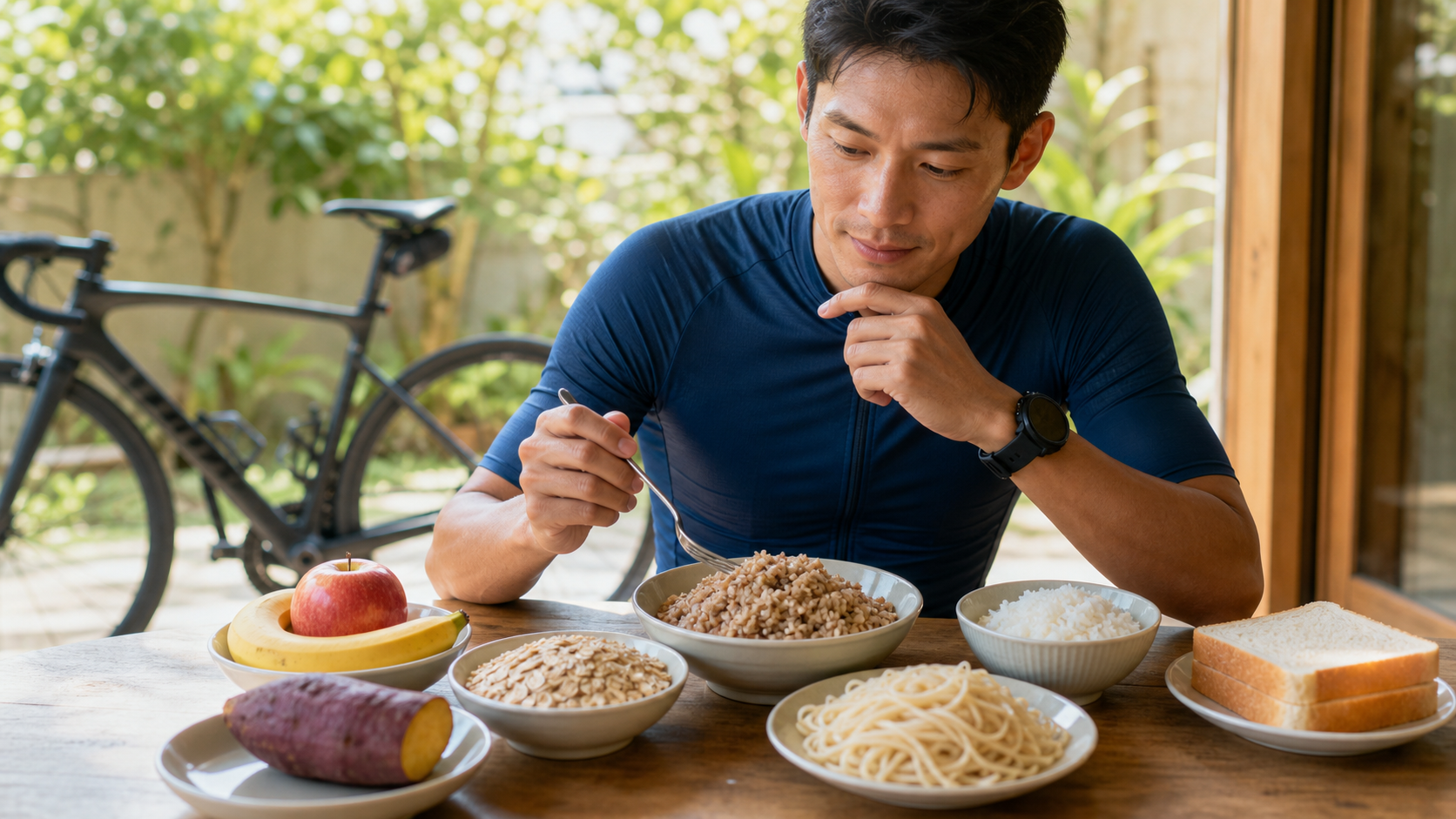
Starting with a Trainee Who “Ate Rice but Kept Fading on the Bike”
I’ve been coaching athletes and recreational exercisers for about fifteen years now. Over that time, one type of issue shows up almost every month: trainees train hard and eat properly, but they still feel “weak in the back half, slow to recover, and mentally foggy.” Recently, an amateur cyclist in his early forties—let’s call him A-Jhe—came to see me. He rode three to four times a week, did a regular weekend climb up Beiyi Highway or Fengguizui, weighed about 72 kg, and had a power threshold around 240 watts. His problem: on long rides, by the third hour, even though he’d taken in fuel earlier, he’d feel completely “deflated,” and after getting home he’d be so ravenous he’d lose control and binge on late-night snacks.
I asked him to photograph a week of his meals for me. The result was interesting: his carbohydrate intake wasn’t low, but it was almost exclusively white rice, white toast, noodles, and white bread with jam before training. In other words, his problem wasn’t the amount of carbs, but the “quality” of those carbs. That’s exactly the topic I want to discuss with you today: whole grains and carbohydrate quality for athletes.
A lot of people hear “carb quality” and assume it’s another lecture about cutting starches, going low-carb, or trying keto. Quite the opposite. For the vast majority of people who exercise—especially endurance athletes—carbs are the primary fuel; you don’t cut them, you just “choose the right ones and time them right.” Whole grains vs refined, high vs low GI, when to eat fast carbs and when to eat slow ones—once you sort out these concepts, you’ll find that training feel, recovery speed, and even your everyday mental state all improve.
In this article, I’ll keep things as plain-spoken and actionable as possible. I’ll start by building the concepts and scientific foundation, then give you concrete practical methods and tables, then point out the most common mistakes I see and how to fix them, and finally offer action steps for readers at different levels. I’ll also factor in Taiwan’s eating-out environment, climate, and healthcare context, because no matter how good a theory is, if it can’t be applied on the ground, it’s just empty talk.
Conceptual Foundation: What Does “Carbohydrate Quality” Mean?
Carbs Aren’t Just About “Quantity,” but Also “Quality”
In the past, sports nutrition discussions focused almost entirely on the “amount” of carbs—how many grams per day, how many grams per kilogram of body weight. That’s certainly important; endurance athletes need roughly 5 to 10 grams of carbs per kilogram of body weight per day (depending on training load), and that framework isn’t wrong. But in recent years, sports science and public health have increasingly emphasized another dimension: carbohydrate quality.
So what determines carb quality? Based on the current research consensus, the positive quality indicators generally include three things: whether it’s a whole plant food, how high the whole-grain content is, and how much dietary fiber it has; the negative indicators are excess added sugar and refined carbs that are overall high-glycemic (high GI). In other words, even though both are “carbs,” a bowl of brown rice and a sugary hand-shaken drink take completely different paths through your body.
Whole Grains vs Refined: The Difference at Three Levels
I often explain the difference between whole grains and refined grains to trainees using “how much of a whole grain kernel gets stripped away.” A complete grain kernel (e.g., brown rice, whole wheat) consists of three parts:
- Bran (outer layer): The main home of dietary fiber, some minerals, and phytochemicals.
- Germ (the seed’s life core): B vitamins, vitamin E, healthy fats, and antioxidants.
- Endosperm (the largest part): Mostly starch—essentially the only thing left after refining.
“Refining” means milling away the bran and germ during processing, leaving only the endosperm. That’s how white rice and white flour come to be. What gets milled away is precisely the fiber, B vitamins, minerals, and a large amount of phytochemicals. Whole grains are high quality not because they’re lower in calories (they’re actually similar), but because they retain the “full package”—fiber, micronutrients, and a slower digestion rate.
Looking at data from the Ministry of Health and Welfare makes it more intuitive: swapping refined starches in your three daily meals for unrefined grains like brown rice adds roughly 7.9 grams of dietary fiber per day—about 30% of the daily recommended intake. Taiwanese adults generally don’t get enough dietary fiber, so this “one swap covers a third of your needs” lever is a pretty good deal.
GI and GL: Don’t Be Held Hostage by a Single Number
When discussing carb quality, the Glycemic Index (GI) is unavoidable. Simply put, GI describes how quickly and how much a food raises blood sugar, with glucose set at 100 as the reference. Whole grains generally have a lower GI; refined starches and sugary drinks have a higher GI.
But I want to flag a key point many people overlook: GI is measured under experimental conditions using “50 grams of available carbohydrate per serving,” which is disconnected from how much you actually eat. So another metric is more practical—Glycemic Load (GL), which factors in “portion size.” For example, watermelon has a fairly high GI, but the amount of carbs in a typical serving isn’t that much, so its actual GL isn’t high.
More importantly, the scientific community actually has reservations about GI’s health value. The World Health Organization (WHO), based on a series of meta-analyses, concluded: increasing dietary fiber and whole-grain intake has sufficient evidence to be recommended for reducing chronic disease risk; but simply lowering GI or GL has weaker evidence. This gives us a very practical takeaway:
Rather than obsessing over the GI number of every food, put your effort into the big picture: “eat more whole grains, eat more fiber, eat less added sugar.” Get the direction right, and GI will naturally move in the right direction.
That’s also why I never tell trainees to memorize GI tables. You won’t remember them anyway, and when you do, you’ll often calculate them wrong. Focusing on the big picture beats chasing precise numbers.
Why Do Whole Grains “Digest Slower”? The Reasoning, Simply Put
Trainees often wonder: both are starch, so why does brown rice “hold you over” longer than white rice? I explain it in a way that doesn’t require a physiology background.
First, fiber itself isn’t easily digested or absorbed in the small intestine; it increases the volume and viscosity of the chyme, slowing gastric emptying and sugar absorption, which flattens the blood sugar curve. Second, the physical structure of the intact kernel is still there—white rice is milled fine and cooked soft, so the starch has a large exposed surface area and digestive enzymes attack it all at once, spiking blood sugar quickly; brown rice retains its outer structure, so enzymes have to “nibble away” slowly, and release is naturally stretched out. Third, whole grains also carry a bit of protein and fat, and these components further slow overall digestion.
Together, these three mechanisms are the source of whole grains’ “slow and steady” energy-supply character. Once you understand this, you’ll see why the same nutrient (carbs), in a different form, can dramatically change how it behaves in your body—and you’ll be more receptive to the core concept of “using them by timing.”
Three Practical Benefits of Whole Grains for Athletes
One: Fuel That “Flows Steadily,” Reducing Late-Stage Collapse
Back to A-Jhe’s case. He ate white bread with jam before training; blood sugar spiked quickly, insulin surged in response, and then blood sugar could actually drop just as fast—some people experience a “I just ate but I have no energy” dilemma about half an hour into exercise. In contrast, whole grains, with more fiber and slower digestion, release glucose more gradually, and fuel supply is more like a steady stream. For long-duration, prolonged endurance activities, this “stable energy supply” character is especially valuable in daily meals and in the meal one to two hours before training.
(An important distinction: this refers to daily meals and the main meal several hours before competition. As for fueling “during” exercise—for example, on the road for rides over 90 minutes—you actually want easily absorbed, fast-acting carbs instead. I’ll cover that specifically later; don’t mix them up.)
Two: Fiber, B Vitamins, and Minerals Supporting Training and Recovery
Athletes have high energy metabolism, so their needs for B vitamins (involved in energy metabolism), magnesium, zinc, and other minerals are naturally higher than the average person’s. Whole grains happen to be an excellent source of these micronutrients. Rather than relying on supplements one pill at a time, I prefer to have trainees build the foundation first with whole foods like whole grains, using supplements as backup rather than the mainstay.
III. The Compound Interest of Gut Health and Long-Term Health
Dietary fiber feeds the gut microbiome, and over the long term, this benefits metabolism, immunity, and even mood. From a research perspective, higher dietary fiber intake is associated with better long-term blood sugar control markers (such as HbA1c), and increased whole grain consumption is linked to smaller blood sugar fluctuations. For the general athletic population, this is an investment that “helps training now and pays compound interest for health in the future.”
In the table below, I’ve organized the differences between whole grains and refined carbohydrates for a quick comparison:
| Aspect | Whole Grains (brown rice, whole wheat, oats, etc.) | Refined Carbohydrates (white rice, white bread, white toast) |
|---|---|---|
| Dietary Fiber | High | Low (bran removed during processing) |
| B Vitamins / Minerals | More completely retained | Largely lost |
| Digestion & Absorption Speed | Slower, steadier | Faster, prone to blood sugar spikes |
| GI Tendency | Mostly low to medium | Mostly medium to high |
| Suitable Timing | Daily meals, several hours before competition | During exercise/racing for quick fuel, post-race rapid recovery window |
| Satiety | More prolonged | Shorter |
| Long-Term Health Association | Better (strong evidence for fiber and whole grains) | Detrimental in excess |
The key to reading this table is the last two columns: whole grains aren’t “always better,” and refined carbohydrates aren’t “absolutely the bad guys.” They are tools for different timing. This is the practical core I’ll teach you next.
Common Whole Grains and Root Vegetables: A Fiber Concept Table
Many trainees ask me: “So exactly how much whole grain should I eat to get enough fiber?” Let me start with a general principle: the Ministry of Health and Welfare’s 8th edition of the Dietary Reference Intakes for Taiwanese recommends adults consume at least 14 grams of dietary fiber per 1,000 kcal. Converted, this generally lands most adults in the 20 to 38 grams per day range. Athletes, who eat more and have higher metabolic rates, typically fall on the higher end of this range.
The table below is a “conceptual” guide to fiber content that I often give my trainees (actual values vary by variety, water content, and cooking method; this gives you a sense of magnitude, not precise lab values, so treat it as a relative comparison):
| Food (general serving concept) | Fiber Level | My Practical Notes |
|---|---|---|
| One bowl of white rice | Very low | Contributes almost no fiber; mainly quick energy |
| One bowl of brown rice | Significantly higher than white rice | The first choice for upgrading your daily staple |
| One medium sweet potato | Medium-high | Available at any Taiwanese convenience store; one of the most convenient whole grain alternatives |
| One serving of oats (about a handful, dry weight) | High | A breakfast staple; strong satiety, steady blood sugar |
| One slice of whole wheat bread | Medium | Better than white bread, but check the ingredients to ensure it’s truly whole wheat |
| One serving of mung beans/red beans (without added sugar) | Medium-high | Often overlooked; these actually count as whole grains and legumes |
Looking at this table, you’ll get an intuitive sense: just swapping one or two servings of refined starch in your daily meals for brown rice, sweet potato, or oats results in a significant fiber gain. This is more cost-effective and natural than buying fiber powder from the pharmacy. One reminder: when you increase fiber, you must also increase your “water” intake, otherwise you might experience constipation or bloating—this is a common pitfall for people in Taiwan who sweat a lot in summer and often forget to drink water.
Practical Approach: Timing Your Carbohydrates
This is the most interesting and most misunderstood part of sports nutrition. The same food, at the right time, is a great teammate; at the wrong time, it’s a bad one. I use a “Carb Timing Quadrant” framework with my trainees, and you can use it too.
Carbohydrate Timing Table: When to Eat Whole Grains, When to Eat Fast Carbs
| Timing | Goal | Recommended Carb Type | Local Taiwanese Examples |
|---|---|---|---|
| Regular daily meals | Steady energy, fiber and micronutrients | Primarily whole grains | Brown rice, multigrain rice, sweet potato, oats, whole wheat steamed buns |
| 1–3 hours before exercise | Fill glycogen stores, avoid drastic blood sugar swings | Low-to-medium GI, easily digestible whole grains/root vegetables | Oatmeal, sweet potato, brown rice onigiri (avoid too much fat or fiber which can cause bloating) |
| 30–60 minutes before exercise (if needed) | Top up with quick, usable energy | Small amount, easily digestible | Banana, white toast, a small amount of sugary sports drink |
| During exercise (>60–90 minutes) | Immediate fuel, maintain blood sugar | Easily absorbed fast carbs | Energy gels, bananas, sports drinks, water yokan (sweet red bean jelly) |
| 0–2 hours after exercise | Quickly replenish glycogen, kickstart recovery | Fast carbs + adequate protein | White rice with eggs, milk + banana, onigiri + soy milk |
| Several hours after exercise | Return to daily quality | Return to whole grains as the base | Brown rice, vegetables, quality protein |
Please pay special attention to two “counter-intuitive” but very important points:
- During and immediately after exercise is the domain of refined/fast carbs. At this point, you want “quick entry”; too much fiber slows absorption and can upset your stomach during intense exercise. Forcing yourself to eat a brown rice onigiri for fiber during a long ride is one of the classic mistakes I’ve seen.
- The meal 1–3 hours before competition can include whole grains, but don’t overdo the fiber. Too much fiber before the start can cause bloating and frequent bathroom trips. Taiwan’s hot, humid summers make the gut more sensitive, so this needs careful management.
Sample Daily Menu: A Training Day for A-Zhe
I reworked a “long-distance cycling day” carbohydrate framework for A-Zhe (not a precise prescription, just an illustrative direction; actual portions should be individualized based on body weight, intensity, and sweat rate):
| Time | Content Direction | Carb Strategy |
|---|---|---|
| Previous night | Normal portion of brown rice or multigrain rice + vegetables + protein | Whole grains as the base, gradually topping up glycogen |
| 2 hours before departure | Oatmeal or sweet potato + a little protein | Low-to-medium GI whole grains for steady energy |
| 30 minutes before departure | Half to one banana | Small amount of fast carbs to top up |
| Every hour during the ride | Alternate energy gels/bananas/sports drinks | Fast carbs to maintain blood sugar |
| Within 1 hour after getting home | White rice with eggs, or milk with banana | Fast carbs to kickstart recovery |
| Dinner that day | Back to brown rice, vegetables, protein | Return to whole grain quality |
After following this framework for about three weeks, A-Zhe reported back: the “bonking” feeling at the third hour had noticeably improved, and the urge to binge-eat late at night had significantly decreased. He summed it up with a phrase I really like: “Turns out I wasn’t eating too little; I was eating in the wrong order.”
Another Case: A Female Runner Afraid to Eat Rice for Fear of Gaining Weight
Let me share another case that contrasts with A-Zhe, because her problem was exactly the opposite. Xiao-Ru (pseudonym) is an office worker in her early thirties who runs three times a week, 5–8 km each time, and occasionally participates in 10 km road races on weekends. Her issue wasn’t fading energy in the latter part of her run, but rather “I exercise regularly, yet my body fat won’t go down, and I often feel dizzy and have shaky hands after running.”
After reviewing her diet log, I immediately spotted the problem: afraid of gaining weight, she barely ate any staple foods, surviving on some bread, fruit, and lots of sugar-free drinks during the day, treating “eating fewer carbs” as her only weight-loss strategy. The result was—severe energy deficiency during training, forcing her body to use protein as fuel. Her muscles weren’t being built, her metabolism actually worsened, and she experienced symptoms resembling hypoglycemia: dizziness and shaky hands.
The adjustment I gave her wasn’t “eat even less,” but rather “improve the quality of your carbs and bring the quantity back up to a reasonable range”: a fixed serving of oatmeal or sweet potato for breakfast, a normal portion of brown rice with adequate protein from the buffet at lunch, and a banana before running. Two months later, her training status stabilized, the dizziness and shaky hands disappeared, and her body fat slowly started to decrease—even though she was eating more than before.
Looking at these two cases together, the core message I want to convey is: any discussion of carbohydrate quality must be built on the premise of ‘sufficient quantity.’ Whole grains are meant to replace refined carbohydrates, not to replace the act of eating. If you cut carbs too low, no amount of quality can save you from the problems caused by energy deficiency. This is especially worth emphasizing in Taiwan, where there are countless claims about “cutting out starch” or “you’ll lose weight if you don’t eat rice,” which have led many active people to starve themselves into health problems.
Local Taiwan Context: How to Get Whole Grains In When You Eat Out
After all the theory, the real battlefield is Taiwan’s bento shops, buffet restaurants, convenience stores, and breakfast shops. I know many people think when they hear “eat more whole grains”: “I eat out every day, where am I supposed to find brown rice?” Don’t worry—I’ve tested this with my clients, and there are plenty of no-cooking ways to upgrade your carbohydrate quality when eating out.
Convenience Store and Breakfast Shop Swap List
| Common Choice | Upgraded Version (Better Quality) | Notes |
|---|---|---|
| White toast | Whole wheat toast, sweet potato | Convenience stores often have sweet potatoes, convenient and cheap |
| White rice onigiri | Brown rice / multi-grain onigiri | Some convenience stores have brown rice onigiri |
| Sugary bread | Granola bars, unsweetened oatmeal | Check the ingredients; don’t be fooled by “multi-grain” marketing |
| Sugary milk tea | Unsweetened soy milk, fresh milk | Cutting added sugar is key to quality |
| Plain congee | Multi-grain congee, sweet potato porridge | Common at breakfast shops |
Buffet restaurants are actually a hidden advantage for Taiwan’s eat-out crowd: many buffets now offer brown rice or multi-grain rice options—just ask and you’ll get it. For bento shops, you can “reduce the white rice and add more vegetables,” making up some of the fiber with veggies.
Taiwan’s Climate and Gut Realities
Taiwan is hot and humid. In summer, you sweat a lot during exercise and blood flow to the gut is relatively reduced. In this situation, “loading up on high-fiber whole grains before a race” can easily cause bloating and frequent bathroom trips. My advice is: on regular days, make whole grains your staple to build a solid foundation; on actual race day or high-intensity training days, choose an easily digestible version for your pre-race meal. This isn’t contradictory—it’s about context. It’s like wearing comfortable shoes on a normal day and racing shoes on race day; the purpose differs.
Fiber and Hydration: A Combination That Needs Special Attention in Taiwan’s Summer
I want to spend a moment on “fiber with water,” because this is the most overlooked yet most problematic issue in Taiwan’s climate. For fiber to work and pass through the digestive tract smoothly, it needs enough water to go with it. Taiwan’s summer easily hits 30+ degrees Celsius and is humid; you sweat a lot during exercise, and many people already don’t hydrate enough. If you then suddenly increase whole-grain fiber, you might end up constipated and bloated, feeling even worse.
In practice, I ask my clients to follow two principles: first, “as you add fiber, remember to add water too,” especially on days when you eat oatmeal or sweet potato for breakfast—don’t slack on hydration during the day; second, “don’t try new high-fiber foods before training in hot weather.” Your gut is more sensitive before races or big training days, so anything new should be tested on a regular day first. These two points seem minor, but they are the root cause I’ve seen most often of “people eating healthy yet ending up with gut discomfort.”
Additionally, heavy sweating in summer also depletes electrolytes. Whole grains and various whole foods naturally contain some minerals (such as potassium and magnesium), which is one reason I lean toward having clients build from whole foods rather than relying solely on single supplements—the benefits of food often come as a “package deal” that’s hard to fully replicate with a single nutrient.
Common Mistakes and Fixes
Having coached so many clients, the mistakes are highly repetitive. Let me cover the most common and most damaging ones.
Mistake 1: Treating “Whole Grains” as “The More the Better, Anytime, Anywhere”
Some clients overcorrect and even insist on whole-grain, high-fiber options for mid-ride fueling, only to end up with a churning stomach halfway through. Fix: Match the timing. During exercise and right after exercise, fast carbs are the right tool; save whole grains for daily meals and meals a few hours before racing.
Mistake 2: Being Misled by “Multi-Grain” or “Whole Grain” Marketing
Many “multi-grain toast” or “whole grain bread” products on the market are still mostly refined flour, just sprinkled with a few grains for decoration—and often loaded with extra sugar and oil. Fix: Learn to read the ingredient list. The earlier an ingredient appears, the higher its content. If the first ingredient is still “wheat flour/flour” rather than “whole wheat,” don’t overestimate its whole-grain content.
Mistake 3: Switching from White Rice to Brown Rice All at Once, and Your Gut Goes on Strike
This is the most common frustration for beginners. People who normally eat very little fiber suddenly eat brown rice and multi-grain at every meal; their gut hasn’t adapted, so they get bloated and uncomfortable, then give up. Fix: Go gradual. Start with “white rice : brown rice = 2:1” to let your gut bacteria and digestive system adapt slowly, then gradually increase the ratio over a few weeks. Also remember to drink plenty of water—fiber needs enough fluid to work properly.
Mistake 4: Focusing Only on Carb Quality, Forgetting Overall Calories and Protein
Some people treat whole grains as a cure-all but forget that athletic performance is the result of “overall nutrition.” No matter how good your carb quality is, if total calories are chronically insufficient and protein intake is inadequate, recovery will still suffer. Fix: View carb quality within the framework of your overall diet; don’t obsess over a single point.
Mistake 5: People with Chronic Conditions Self-Adjusting Without Coordinating with Medical Care
I want to be very serious about this point. For those with diabetes, kidney disease, or other chronic conditions, diet—especially the amounts of carbs, fiber, and protein—needs to be individualized and often interacts with medications and kidney function. Fix: Before making any changes, discuss it with your doctor and dietitian first. Under Taiwan’s National Health Insurance, if you have a chronic condition, you can get individualized advice through hospital or clinic nutrition consultations—this is a resource worth using. This article provides general principles, not a prescription tailored to your personal situation.
Carb Quality Should Also Match Your “Training Cycle”
One more advanced concept for those following a training plan. The “amount” of carbs should naturally fluctuate with training load—more on big training days and long-distance days, less on rest days and taper days. The role of carb “quality” within this framework is: on daily and low-intensity days, rely on whole grains to take care of your foundation and health; on high-intensity and long-duration training/race days, bring out the fast carbs as a tool during and after exercise.
I often use an analogy to help clients understand: whole grains are like your “daily savings,” steadily accumulating and supporting you long-term; fast carbs are like “cash on race day,” taken out when you need immediate liquidity. They don’t conflict—they divide the labor. Layer this periodization concept on top of the “timing quadrant” mentioned earlier, and your mastery of carbs will upgrade from “which food is good” to “what occasion, what amount, what form”—that’s the truly practical skill.
One reminder: everything discussed here is general training nutrition principles. If you’re preparing for a specific race, have weight-class requirements, or have any health conditions, please individualize the actual amounts and strategies, and seek help from a sports dietitian when necessary.
Actionable Advice for Readers at Different Levels
Everyone starts from a different point, so I’ve divided the recommendations into three levels. Just find where you fit.
Beginners / Those Just Starting to Exercise
Just do “one thing” first—don’t try to do everything at once:
- Step one: Swap the white rice in “one meal” a day for brown rice or sweet potato. Once your body adapts after a week, swap a second meal.
- Cut sugary drinks from “every day” to “once or twice a week”—this step often improves carb quality more than switching to brown rice.
- Swap white toast at breakfast shops for whole wheat, or add an egg or a serving of sweet potato.
- Don’t chase perfection; aim to be “a little better than yesterday.”
Intermediate Athletes / Those with a Regular Training Routine
You already have a foundation; the focus is on “timing” and “individualizing amounts”:
- Make whole grains the staple of daily meals to build a solid foundation of fiber and micronutrients.
- Learn to match the occasion: on training/race days, choose an easily digestible pre-race meal, and use fast carbs during and after exercise.
- Start paying attention to whether your “carbohydrate grams per kilogram of body weight” adjusts with training load (more on big training days, less on rest days).
- Track how you feel: identify which pre-race meal leaves you performing at your best, and turn it into your standard SOP.
Coaches / Those Designing Plans for Others
- Teach clients the “big picture” rather than memorizing GI tables: more whole grains, more fiber, less added sugar.
- Use the “timing quadrant” to break things down for clients, so they don’t blindly apply whole grains to every situation.
- Maintain boundaries with clients who have chronic conditions: anything disease-related goes back to the medical side; you handle exercise and the general dietary framework, while diagnosis and prescriptions are left to qualified medical professionals.
- Introduce changes gradually, and accept that clients’ guts need time to adapt—don’t change too much at once.
A Common FAQ Summary
Q: Is brown rice lower in calories than white rice, so eating brown rice can help with weight loss?
A: The calories in both are actually similar. Brown rice’s advantage lies in its fiber, micronutrients, higher satiety, and a more gradual blood sugar response—not in being “particularly low in calories.” Weight loss still depends on overall calorie balance.
Q: Should I eat brown rice or white rice for breakfast on race day?
A: For most people, choosing “easily digestible” foods for the pre-race meal matters more; too much fiber may cause bloating. You can have whole grains but not in excess, or simply choose easily digestible options like sweet potatoes or oatmeal, then return to whole grains after the race.
Q: Are low-carb/keto diets suitable for endurance sports?
A: For most endurance athletes whose goal is performance, carbohydrates are the primary fuel, and I generally do not recommend long-term low-carb diets. If you have specific health considerations and want to try it, be sure to discuss it with your physician and dietitian for an individualized assessment.
Q: I eat out every day. Can I really improve my carbohydrate quality?
A: Yes, you can. Sweet potatoes, whole wheat toast, brown rice/multi-grain rice balls, unsweetened soy milk, and brown rice options at buffet restaurants are all upgrades you can make without cooking. The key is to “choose actively and reduce added sugar.”
Q: Whole grains make me bloated and gassy. Does that mean they’re not suitable for me?
A: This is usually a transitional phase as your gut adapts, especially if you previously ate very little fiber. Slow down, increase gradually, and drink enough water—most people see improvement within a few weeks. If discomfort persists or is accompanied by other gastrointestinal symptoms, seek medical evaluation rather than toughing it out.
Q: Should I completely stop eating white rice?
A: Not at all. White rice (fast carbs) is actually a good tool during exercise and in the recovery window after exercise. The key is “timing” and “overall proportion,” not turning a certain food into a forbidden item. Shift it from “the main character of every meal” to “a tool for specific occasions,” and you’re on the right track.
Q: Are low glycemic index (GI) foods necessarily healthy?
A: Not necessarily. Some highly processed foods high in oil and fat also have a low GI, but they aren’t healthy overall. GI is just one dimension and cannot be used alone to judge whether a food is good or bad. Return to the big picture—more whole grains, more fiber, less added sugar—which is more reliable than fixating on a single GI number.
Learning to Read Labels: Three Steps to Tell If a Product Is Truly Whole Grain
On the shelves of Taiwanese convenience stores and supermarkets, labels like “multi-grain,” “mixed grains,” and “high fiber” are everywhere, but many are marketing gimmicks. Here are three quick checks I teach my athletes:
- Check the ingredient order: Ingredients are listed in descending order by weight. If the first ingredient is “wheat flour/white flour/refined rice,” and whole wheat or brown rice appears later or not at all, the whole grain content is actually limited.
- Check added sugar: Many “healthy-looking” breads and granola bars actually contain quite a bit of sugar and oil. If the “sugar” figure on the nutrition label is high, the quality is questionable.
- Check the fiber number: Nutrition labels usually list dietary fiber. Compare similar products—the one with noticeably higher fiber usually has more substantial whole grain content.
These three checks take less than ten seconds but can help you avoid a host of traps that “look healthy but are actually refined carbs plus sugar.”
Conclusion: Carbohydrate Quality Is a Habit You Can Gradually Build
Looking back at A-Zhe’s story, his transformation didn’t involve any earth-shattering secret—it was simply about “choosing the right carbs and timing them right.” On a daily basis, he focused on whole grains to build a solid foundation of fiber and micronutrients; during and after exercise, he switched to fast carbs as a tool; and for pre-race meals, he balanced digestibility with fueling needs. That was it. His late-race bonks and late-night binge eating both eased as a result.
I often tell my athletes: Carbohydrate quality isn’t an exam; it’s a habit you build. You don’t need to become perfect overnight. You just need to nudge every meal and every choice a little closer to “more whole grains, more fiber, less added sugar.” Over time, your training performance will reward you, and your long-term health will reward you too.
Taiwan’s eating-out environment isn’t as unfriendly as you might think. The sweet potatoes at convenience stores, the brown rice at buffet restaurants, and the whole wheat options at breakfast shops are all there waiting for you to choose them actively. Starting with your next meal today, making one small different choice is the best beginning. What you sustain is what you do well; may we all steadily turn this into a lifelong habit.
This article is for educational purposes and does not replace individual diagnosis or treatment advice from a physician, physical therapist, or dietitian. If you have chronic conditions such as diabetes, hypertension, heart disease, or kidney disease, or if you are taking medication or have special dietary restrictions, please consult your healthcare team for an individualized assessment before making any dietary changes.
References
- Health Promotion Administration, Ministry of Health and Welfare – Daily Dietary Guidelines Handbook: https://www.hpa.gov.tw/Pages/EBook.aspx?nodeid=1208
- Health Promotion Administration, Ministry of Health and Welfare – How Much Whole Grain and Starchy Foods Should You Eat?: https://www.hpa.gov.tw/Pages/Detail.aspx?nodeid=4561&pid=15321
- Ministry of Health and Welfare – Choose Domestic, Eat Varied, Include Whole Grains at Every Meal (Dietary Fiber): https://www.mohw.gov.tw/cp-16-76219-1.html
- Perspective on the health value of carbohydrate-rich foods: glycemic index and load; fiber and whole grains (American Journal of Clinical Nutrition / PMC): https://pmc.ncbi.nlm.nih.gov/articles/PMC11393399/
- Harvard T.H. Chan School of Public Health, The Nutrition Source – Whole Grains: https://nutritionsource.hsph.harvard.edu/what-should-you-eat/whole-grains/
Related Reading
- Nutrition Guide for Vegan Athletes: Practical Strategies for B12, Iron, Calcium, Omega-3, and Protein Quality
- The Science of In-Race Fueling: How Many Carbs Per Hour? A Complete Practical Guide from 60g to 90g
- Blood Sugar Stability for Athletes: A Complete Guide to GI/GL, Meal Timing, and Practical Fueling
- The Science of Satiety for Athletes: Eating Enough Without Overeating
CT暗黑廚房) 車友必備 宇宙無敵鮮蚵湯 幫助訓練恢復 天然食補 好市多 超肥鮮蚵 破PR
7 年前
Unaas X50 全碳纖幅條輪 數據實測對比PK | Lun Hyper 的高階版 | 板輪爬坡也可以很厲害? ! 武嶺2小時大師一起親測! CP值超高 | 公路車 | CT Yeh
4 年前
一日北高/長距離團騎 常見問題補充篇 / 組團或跟團的眉角 / 壯車友容易被瘦車友慢性拉爆 / 原來屁股痛可能是這個原因...? / 風場配速法 / 公路車 / CT Yeh
2 年前
再一組! 全碳幅條 碟煞/無內胎輪組 開箱! 到底好騎嗎? UNAAS X40 | 公路車 | CT Yeh
4 年前
西進武嶺 免費訓練分析服務 Intervals | 練不夠還是練過頭?你哪一種類型選手?AI模型告訴你! | 備戰神器 | 公路車 訓練 | CT Yeh
4 年前
一日北高常見問題大集合 | 攻略 | 路線 | 訓練 | 補給 | 自行車 單車 | 一日雙城 | 雙塔 | TWB北高360 | 屁股痛
6 年前
2021 96聯賽 桃園市長盃 4K多視角實況 當天選手瓦數/推力比/均速/時間 即時數據分析 | 公路車 | CT Yeh
5 年前
CT趣訪 西進武嶺 2小時組 EP2 全村的希望 蔣緯緯! 訓練菜單&技巧公開 |公路車 |CT Yeh
4 年前