Athlete's Meal Prep in Practice: A Complete Guide to Efficiency, Nutritional Balance, Storage, and Variety
Starting with a Student Who Always Ate at the Wrong Time
I once coached a weekend rider named A-Zhe, in his early forties, a tech engineer. He trained three to four times a week and regularly rode the Balaka to Xiaoyoukeng route in Yangming Mountain on weekends. His power numbers weren’t bad—he could hold over 220 watts on long climbs. The problem was “those two hours after training.” He’d often finish a ride, go home to shower, reply to a few work messages, and only then realize he was hungry, ordering fried chicken or braised pork rice delivery on a whim. Three months in, his weight hadn’t dropped, his climbing hadn’t improved, and he frequently complained that his legs felt heavy the next day and he slept poorly.
I asked him to do something very mundane: photograph everything he ate for a week. The result was clear—he wasn’t lacking effort; his nutritional “timing” and “content” were being thrown off by the rhythm of his life. He spent hours on the pedals but never spent twenty minutes preparing the fuel for recovery.
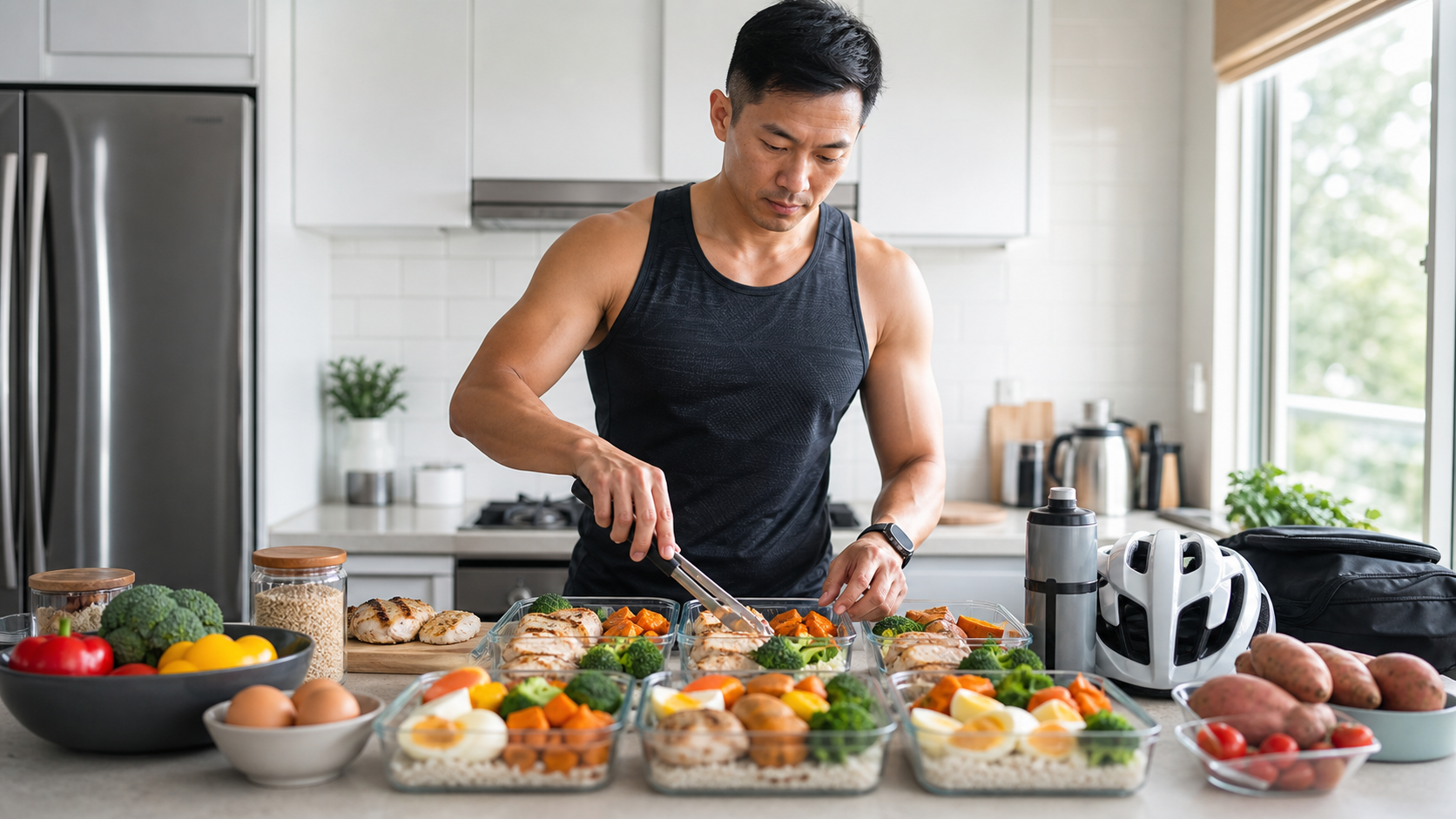
I didn’t give him a complicated nutrition prescription. I only taught him one thing: meal prep. One Sunday afternoon, he spent a little over two hours portioning out the staples, protein, and vegetables he’d need for the week. Six weeks later, he’d lost two kilograms, his average power on long climbs had gone up, and more importantly, he said, “I finally don’t have to stress every day about what to eat.”
In this article, I want to lay out for you the complete meal-prep playbook I’ve accumulated over fifteen years of working with athletes at all levels and general active populations. This isn’t the Instagram-aesthetic glass-jar salad approach—it’s a practical system that can survive Taiwan’s humid, sweltering climate, the temptation of eating out on every corner, and the fragmented schedules of office workers.
Why Do Athletes Especially Need Meal Prep?
Half of Your Training Results Are Decided in the Kitchen
Many people think progress comes from “harder training plans,” but in reality, training merely sends your body a signal that it should get stronger; the actual adaptation happens during recovery, and the raw material for recovery is what you eat. If the training stimulus is sufficient but recovery fuel doesn’t keep up, your body is like a factory that received orders but no inventory—it can only spin its wheels or even regress.
Meal prep solves three core problems:
- Timing: After training, your body is more efficient at utilizing nutrients. Getting carbohydrates and protein in quickly supports glycogen resynthesis and muscle repair. Prepped meals let you eat immediately after a ride or run, rather than scrambling to find food an hour later.
- Composition: Eating out on the fly easily falls into the trap of “high fat, high sodium, insufficient protein, zero vegetables.” Meal prep lets you decide the proportions in advance, handing the choice back from the impulse of the moment of hunger to the planning of a calm mind.
- Consistency: Athletic performance depends on “getting it right day after day.” Eating perfectly occasionally means nothing; being able to execute at 80 percent consistently is what matters. Meal prep turns “eating right” from a daily decision into a once-a-week decision.
Protein Needs: Endurance Athletes Need It Too—and Quite a Lot
There used to be a misconception that protein was a matter for weightlifters and bodybuilders, and that endurance athletes just needed carbohydrates. But the consensus in sports nutrition has shifted in recent years. According to position stands from organizations like the American College of Sports Medicine (ACSM) and the Academy of Nutrition and Dietetics (AND), daily protein recommendations for athletes are approximately 1.2 to 2.0 grams per kilogram of body weight; the International Society of Sports Nutrition (ISSN) cites a range of roughly 1.4 to 2.0 grams per kilogram. During hard training blocks or after major competitions, recommendations even go up to about 1.8 grams per kilogram or more to support muscle repair and maintenance. (Sources listed in the references at the end.)
I want to emphasize here: treat these numbers as a range to reference, not a precise prescription. Individual training volume, body composition, age, and goals all affect requirements, which is why individualized assessment by a dietitian is irreplaceable. But for the average enthusiast, an easy rule of thumb is:
- A rider weighing 60 kilograms with moderate training volume needs roughly 72 to 108 grams of protein per day
- Spread evenly across three to four meals, roughly 20 to 35 grams per meal
This is where the value of meal prep lies—when you weigh and portion things out in advance, that “20 to 35 grams per meal” can actually be executed consistently, rather than going by feel.
Let me also touch on a concept that’s often overlooked: “distribution” of protein is harder to execute than “total amount.” Many people’s daily protein totals aren’t actually bad, but almost all of it is concentrated in one dinner—breakfast is a slice of toast, lunch is a bowl of noodles with soup, and protein is severely lacking. Research generally supports that “spreading protein evenly across meals” is more favorable for stimulating muscle protein synthesis. Meal prep directly solves this distribution problem—when every container already has an adequate amount of protein in it, you naturally flatten the total across the whole day, rather than starving all day and then trying to catch up in one meal at night. This is a very practical physiological benefit of meal prep.
The Science Base of Meal Prep: How to Balance the Three Macronutrients
Before you start chopping vegetables, establish a “plate framework” first. From there, all meal prep is just filling in that framework. I often teach students a simplified one-third plate method so that even people without a nutrition background can get started.
The One-Third Plate Framework
| Section | Proportion of Plate | Primary Role | Common Taiwanese Food Examples |
|---|---|---|---|
| Carbohydrates (staples) | About 1/4 to 1/2 | Training fuel, glycogen replenishment | White rice, brown rice, sweet potato, pumpkin, pasta, oats |
| Protein | About 1/4 | Muscle repair, immune maintenance | Chicken breast, chicken thigh, pork tenderloin, mackerel, salmon, eggs, tofu, edamame |
| Vegetables | About 1/4 to 1/2 | Vitamins, minerals, fiber, satiety | Broccoli, cabbage, spinach, green beans, bell peppers, tomatoes |
| Healthy fats (garnish) | Small amount | Hormones, absorption of fat-soluble vitamins | Olive oil, avocado, nuts, sesame |
The key point is that the proportion of carbohydrates should fluctuate with training volume. This is where many people fail at meal prep—they make every container a “weight-loss bento,” and then on heavy training days they run out of fuel and their performance collapses.
Practical Carbohydrate Ratios Adjusted by Training Day
I ask students to divide their week into three types of days and, when prepping, make two to three versions of containers with different “carbohydrate amounts,” labeled to tell them apart:
| Day Type | Example Training Content | Carbohydrate Strategy | Staple Portion (cooked weight, reference) |
|---|---|---|---|
| High-intensity / long-duration day | Three-hour long ride, interval sessions, race | Increase carbohydrates | White rice / sweet potato about 200 to 300 grams |
| General training day | One-hour easy ride, base aerobic | Moderate carbohydrates | White rice about 150 to 200 grams |
| Rest / low-activity day | Complete rest, long hours at a desk | Reduce carbohydrates, increase vegetables | White rice about 100 to 150 grams, double the vegetables |
This approach is especially practical in Taiwan because our staple-food culture is built around rice and sweet potatoes—easy to get, low cost, and easy to store. Sweet potato in particular is a meal-prep staple I strongly recommend—it holds up well refrigerated or frozen after steaming, can be microwaved at the office, and has decent fiber and potassium content.
Hydration and Electrolytes: The Hidden Challenge of Taiwan’s Climate
One often-overlooked aspect of meal prep is planning for hydration and electrolytes. Taiwan’s summers are hot and humid, and a long ride can result in significant sweat loss. Drinking water without replenishing sodium can actually dilute blood sodium levels, leaving you feeling weaker the more you drink. I’m not advocating that everyone blindly take salt tablets, but while prepping meals, it’s easy to include whole foods and soups rich in sodium and potassium, such as miso soup, vegetable soup, or a glass of water with a pinch of salt and lemon after exercise. The exact fluid intake and sweat sodium concentration vary from person to person. If you’re a heavy sweater or have experienced cramping or dizziness during exercise, I recommend consulting a sports nutritionist for an individual assessment.
I often give my athletes a simple “Hydration and Electrolyte Supplies” reference chart so that long summer training sessions don’t become chaotic:
| Timing | Supply Suggestions | Purpose |
|---|---|---|
| Night before training | Drink water normally, eat a normal sodium-containing diet | Ensure the body is well-hydrated without needing to chug fluids at the last minute |
| During training (over 1 hour) | Bring plenty of water; for prolonged high heat, include electrolyte drinks | Replenish fluids and sodium lost through sweat |
| After training | A glass of water with a pinch of salt and lemon, or a bowl of miso soup | Replace lost sodium and fluids to aid recovery |
| Daily | Miso soup, vegetable soup, seasonal fruits | Steadily consume potassium, sodium, and magnesium from whole foods |
Again, this is a general reference. Actual fluid intake and sodium supplementation depend on your body size, sweat rate, and ambient temperature. Especially if you have high blood pressure or a health condition requiring sodium restriction, sodium intake must be individually assessed by a physician or nutritionist—never increase it on your own.
Training Periodization and Meal Prep: Not Every Week is the Same
A more advanced concept is this: meal prep should breathe with your training cycle. Many people fail at meal prep because they treat it as a “fixed, unchanging formula,” but your body’s fuel requirements vary significantly across different training phases.
I typically simplify the cycle into three modes for my athletes to understand:
Base Phase (Accumulating Training Volume)
During this phase, training volume steadily accumulates. The focus of meal prep is maintaining consistent protein and adequate carbohydrates to support day-in, day-out aerobic training. This is the best time to establish your meal prep system and build the habit, because the routine is regular and changes are minimal.
Intensity Phase / Pre-Competition (Increasing Load)
Training becomes harder, and long-distance sessions increase. At this point, overall calories and carbohydrates should be proactively increased—don’t be afraid to eat more. When prepping, bump up the portion sizes of staple foods on high-carb days, and make sure post-training recovery meals are especially substantial. The worst thing in this phase is clinging to fat loss and training hungry—that’s a breeding ground for performance collapse and increased injury risk.
Taper / Recovery (Reducing Load)
During the pre-race taper or the recovery week after a major event, training volume drops. Overall portions can be moderately reduced, but don’t slash protein, because the body is still repairing itself. This phase is a great time to adjust body weight and clear out the freezer.
This “adjust with the cycle” mindset is the watershed moment where meal prep evolves from “following a schedule” to “smart management.” You don’t need to calculate every single calorie, but you should have a general sense of “should I eat more or pull back this week?”
Practical Method: A Complete Weekly Meal Prep Workflow
This section is the core of the article. I’ve broken down the “Two-Hour Weekend Meal Prep Method” I most often use with athletes into five steps. Follow these, and you can build your own system.
Step 1: Plan First, Then Shop (15 minutes)
Open your calendar, look at next week’s training schedule, and mark which days are high-intensity and which are rest days. Then decide how many meals you’ll prep this week—for beginners, I suggest starting with just “prepping five weekday lunches.” Don’t try to tackle all twenty-one meals across breakfast, lunch, and dinner at once; that’s almost guaranteed to fail.
Write out a shopping list. I usually categorize it like this:
- Protein mains: Choose two to three types to rotate weekly to avoid getting bored. For example, chicken breast, mackerel, and pork tenderloin—one portion each
- Carb staples: Pick two from rice, sweet potatoes, and pumpkin
- Vegetables: Choose three to four types that store well (broccoli, cabbage, and bell peppers hold up better in the fridge than leafy greens)
- Pantry staples: Eggs, tofu, nuts, olive oil, scallions, ginger, garlic
Step 2: Batch Cook with Multiple Burners Going (60 minutes)
The secret to meal prep efficiency is parallel processing—don’t cook one dish at a time. My standard workflow is:
- Start the rice cooker or oven first—steam sweet potatoes and pumpkin in the rice cooker, or roast a whole tray of root vegetables in the oven
- Simultaneously cook a large batch of rice (enough for five to seven meals)
- On the stovetop, use one pot to blanch vegetables (blanch different vegetables in batches in the same water to save water and time)
- Use a skillet or air fryer for the proteins (chicken breast, fish, tenderloin)
With four burners working at once, your staples, proteins, and vegetables are all done within an hour. This is the essence of “efficiency” in the whole system—using one round of cooking and one round of dishwashing to produce a week’s worth of meals.
Step 3: Portion and Label (20 minutes)
Portion the cooked ingredients into containers according to the “plate method” and “training-day carb ratios” mentioned earlier. Here are some practical tips:
- Proteins and vegetables can be portioned out first; it’s better to keep staples slightly separate or in their own containers, since carb portions vary by day
- Label containers with the “prep date” and “recommended use-by date”—this is especially important in Taiwan’s humid environment to avoid forgetting how long things have been stored
- Store sauces separately (like wafu dressing or vinaigrette) in small containers and drizzle them on just before eating to prevent vegetables from releasing water and turning soggy
Step 4: Divide Between Refrigerator and Freezer (10 minutes)
This is the key decision for storage. According to the U.S. Department of Agriculture’s (USDA) Food Safety and Inspection Service recommendations, cooked meats and leftovers should be consumed within 3 to 4 days when refrigerated at or below 4°C (40°F); and food should be refrigerated within two hours of cooking. (Source listed in the references at the end.)
So my division principle is:
- Meals for the first three days: refrigerate directly
- Meals for day four and beyond: freeze them the same day, then transfer to the refrigerator the night before eating to thaw
Taiwan’s hot, humid environment makes food spoil faster, so I ask my athletes to be more conservative with this “3 to 4 day” guideline—when in doubt, freeze.
Step 5: Reheat and Assemble Fresh (5 minutes per day)
Prepped meals don’t mean zero hands-on work. I keep one or two “add-fresh” elements so each day’s meal has some variety and better texture:
- Drizzle with a sauce chosen based on that day’s mood when reheating
- Add a freshly fried egg, a handful of fresh lettuce, or cherry tomatoes
- Sprinkle nuts, white sesame seeds, or nori for extra flavor and healthy fats
This step may seem small, but it’s the key to long-term adherence—people aren’t machines. If you eat the exact same thing five days in a row, most people will want to quit by day three.
Weekly Meal Prep Example: For a Rider with Moderate Training Volume
To make the framework above concrete, here’s a sample template I often give athletes (based on an enthusiast weighing about 65 kg, training three to four times per week; values are rough references, not a precise prescription):
| Day | Training | Staples | Protein | Vegetables | Notes |
|---|---|---|---|---|---|
| Monday | Rest | White rice 120g | Tofu + eggs | Broccoli + tomatoes | Low-carb day, double vegetables |
| Tuesday | Intervals 1 hour | Sweet potato 250g | Chicken breast 150g | Cabbage | Replenish carbs + protein soon after training |
| Wednesday | Easy ride 1 hour | White rice 160g | One piece of mackerel | Spinach | Healthy fats from the fish |
| Thursday | Rest | White rice 120g | Pork tenderloin 120g | Bell peppers + green beans | |
| Friday | Short intervals | Sweet potato 200g | Skinless chicken thigh | Broccoli | |
| Saturday | Long ride 3 hours | White rice 250g + banana | Chicken breast + eggs | Mixed vegetables | High-carb day, largest portions |
| Sunday | Recovery ride | White rice 150g | Tofu + edamame | Cabbage | Also prep for next week |
This table isn’t meant to be copied exactly, but to demonstrate how the three principles—“carbs follow training load, protein is present at every meal, and vegetables appear daily”—are put into practice. Feel free to swap in ingredients you like or can easily find; just keep the framework.
Case Studies: Meal Prep Adjustments for Three Different Individuals
Looking at a sample template isn’t enough—the real skill lies in “adjusting for the individual.” I’ve picked three real scenarios I’ve worked with (the people and situations are reconstructed for teaching purposes, but the data is not fabricated) to show you how the same framework can take on different forms.
Case 1: A Middle-Aged Office Worker Trying to Lose Weight
Mei-ling, 50, wanted to bring her weight down from 68 kg before retirement, swimming twice a week and brisk-walking three times a week. Her issue was, “I get so hungry after work in the evening that I lose control and easily end up eating late-night snacks.” I didn’t tell her to eat less; instead, I helped her redistribute—shifting the focus of meal prep to a high-protein, high-fiber snack before dinner (such as a boiled egg with a small box of blanched edamame) to take the edge off her hunger first, so her actual dinner wouldn’t spiral out of control. Her staple food portions were deliberately kept on the lower side, but vegetables and protein were given in full to maintain satiety. Over two months, her weight dropped steadily, and the key point is that she no longer had the cycle of “starving and then binge-eating out of revenge.” This tells us: meal prep isn’t just about preparing main meals; strategic snacks are often the key to breaking the deadlock.
Case 2: A Busy College Student Triathlete
Hsiao-yu, 20, does triathlons, with heavy training volume but tight on both budget and time. His pain point was, “No kitchen in the dorm, and I often end up eating instant noodles.” Our strategy was completely practical: make good use of the buffet restaurants and convenience stores near campus, and focus meal prep on “filling the gaps”—he keeps ready-to-eat oatmeal, boiled eggs, unsweetened soy milk, bananas, and nuts in the dorm as staples that need no cooking but can boost protein and carbohydrate quality, consumed immediately after training. For main meals, he relies on buffet restaurants, adding two extra portions of protein and vegetables. The key takeaway from this case: not having a kitchen doesn’t mean you can’t meal prep; the key is prepping the right staples to fill the gaps left by eating out.
Case 3: A Mother Runner Returning After Childbirth
Yi-chun, 35, wanted to return to half-marathons after giving birth. Her time is shattered by her child, making it hard even to sit down for a full meal. We designed her meal prep in a “one-hand-eatable, easy-to-interrupt” format: portioned rice balls, cubed sweet potatoes, boiled eggs, and yogurt. She can eat bite by bite in the gaps after feeding her child. Meanwhile, nutritional needs are higher during lactation, so I specifically reminded her to increase overall calories and fluids, and emphasized that nutritional adjustments during lactation are best done with individual assessment by a dietitian, not by blindly applying general weight-loss principles. This case reminds us: the “format” of meal prep should adapt to your lifestyle; not everyone is suited to sitting upright and eating a bento box.
Equipment and Storage: Gear That Makes Meal Prep Easier
For meal prep to be sustainable, having the right tools is crucial. I don’t advocate spending big money, but a few basic pieces of equipment can significantly reduce friction.
| Equipment | Purpose | Buying Considerations |
|---|---|---|
| Glass or heat-resistant food containers | Portioning, reheating in microwave | Choose microwave-safe, well-sealed, with varied sizes (large boxes for main meals, small boxes for sauces) |
| Rice cooker / multi-cooker | Steam multiple staples and proteins in one pot | Every Taiwanese household has a rice cooker; make good use of it to steam rice, sweet potatoes, and eggs simultaneously |
| Air fryer or oven | Batch-process proteins and root vegetables | One large tray at a time, saves time watching the stove |
| Kitchen scale | Weigh staple and protein portions | Turns “20-35 grams of protein per meal” from a slogan into something executable |
| Freezer labels and permanent marker | Mark preparation dates | In Taiwan’s humid and hot environment, date management is key to food safety |
I want to emphasize the kitchen scale in particular. Many people fail at meal prep because they estimate portions “by feel,” resulting in chronically insufficient protein or carb overload without realizing it. Spend a few hundred NT$ on a scale, weigh things for two to three weeks to build the feel, and you’ll naturally be able to estimate by eye without weighing forever. This is a small expense with an extremely high return on investment.
Budget Considerations: Meal Prep Actually Saves Money
Many people think athletes’ “clean eating” is expensive, but in reality, preparing your own meals is usually cheaper than eating out every day. At Taiwan’s price levels, a chicken leg bento from a bento shop easily exceeds NT$100, whereas if you batch-buy chicken legs, rice, and seasonal vegetables yourself, the average cost per meal is often significantly lower—and you can also control the oil and salt yourself.
A few practical principles for saving money:
- Buy seasonal vegetables: In-season produce has the best prices and is also the freshest
- Pick economical protein options: Chicken legs, chicken breast, eggs, tofu, and affordable seasonal fish are all high-value choices
- Make good use of the freezer: Buy bulk packs and portion them for freezing, avoiding the premium and waste of frequent small purchases
- Reduce food waste: Meal prep means you “buy according to plan, eat according to plan,” drastically cutting down on ingredients that rot and get thrown away in the fridge
When you add up the “money saved” and the “daily decision-making time saved,” the total return on meal prep is actually quite substantial.
Frequently Asked Questions (FAQ)
These are the questions I get asked repeatedly when coaching clients, compiled here.
Q: Does refrigerating prepared meals cause significant nutrient loss?
A: Reheating may indeed cause a small loss of heat-sensitive vitamins (such as some vitamin C), but the impact on overall protein, carbohydrates, and minerals is limited. Rather than agonizing over this small loss, it’s more practical to look at it this way—consistently eating a balanced meal far outweighs eating whatever you can grab because you didn’t prep. To make up for vitamins, just add a serving of fresh salad greens or fruit.
Q: Do I really need to eat within the “30-minute golden window” after training?
A: The so-called refueling window isn’t as absolute or urgent as it was once made out to be. For the average enthusiast, getting carbohydrates and protein within one to two hours after training is more than sufficient; your total daily intake and distribution are the bigger picture that matters more. The benefit of meal prep is that it ensures you “don’t go several hours without eating,” and that’s the real point.
Q: Can I eat the same prepared meals for five days straight?
A: From a food safety standpoint, it’s fine as long as it’s stored properly and consumed within the shelf life (remember 3-4 days, or freeze for longer). But psychologically, most people can’t stick with it. I recommend preparing at least two types of protein and two types of staples to rotate, and relying on sauces and toppings added fresh to create variety—this will greatly improve your adherence rate.
Q: I’m vegan / lacto-ovo vegetarian. Does this approach apply to me?
A: It applies completely—just swap the protein sources for tofu, dried tofu, tempeh, edamame, chickpeas, various beans, and (for lacto-ovo vegetarians) eggs. Vegetarians need to pay extra attention to whether the “amount” of protein is sufficient and whether sources are diverse; if necessary, consult a dietitian to confirm your overall intake is adequate.
Q: What if I really can’t prep on a training day?
A: This is exactly why I always emphasize keeping a “eating-out backup plan.” Combinations like buffet restaurants, ready-to-eat chicken breast and salad from convenience stores, or unsweetened soy milk with tea eggs can all hold the line. Meal prep is for the majority of days; it’s not meant to make you feel guilty on chaotic days.
Common Mistakes and Corrections
In my years of coaching, the pitfalls people hit with meal prep are highly repetitive. I’ve compiled the most common ones into a comparison table you can use for self-checking.
| Common Mistake | Why It Causes Problems | My Correction Suggestion |
|---|---|---|
| Making every box a fat-loss meal | Insufficient fuel on heavy training days, performance crashes, poor recovery | Let carbs fluctuate with training volume; prep two portion sizes of staples |
| Prepping all seven days of meals at once | Goal too big, food goes bad, gives up entirely | Beginners should start with five days of lunches; expand after success |
| Adding sauce to vegetables before refrigerating | Water release makes them soggy, poor texture, less appetizing over time | Keep sauce in a separate small box; pour it on only before eating |
| Ignoring shelf life | Taiwan’s humid heat causes spoilage; getting food poisoning interrupts training | Label preparation dates, eat within 3-4 days, freeze the rest |
| Focusing only on protein, forgetting fiber | Gut discomfort, poor satiety, insufficient micronutrients | Every meal should include at least a fist-sized portion of vegetables |
| Monotonous flavors | Bored by day three, mental fatigue | Preserve room for adding sauces and toppings fresh |
| Overheating during reheating | Chicken breast turns dry and tough, losing both nutrition and texture | Reheat in short microwave bursts, or add a little water and steam covered |
Here I’d like to expand specifically on the small issue of “dry, tough chicken breast,” because it has turned away too many people. Many clients say, “I know chicken breast is healthy, but it really tastes bad.” The key actually lies in cooking: don’t overcook the chicken breast—remove it from heat once the center is cooked through and let residual heat finish the job; when reheating, add a little water and steam it covered, which tastes far better than dry microwaving. Alternatively, change your approach—skinless chicken thigh has much more forgiving texture, and it’s also sufficient in protein, making it a friendlier starting point for those who fear dry, tough meat.
Taiwan-Specific Context: Eating Out, Climate, and the Medical Environment
Meal prep in Taiwan has its unique circumstances, and I want to address three points separately, because these are things overseas articles won’t tell you.
Eating Out Is a Double-Edged Sword
Eating out is incredibly convenient in Taiwan, which makes it both a temptation and a fallback. I don’t tell my athletes they “absolutely cannot eat out”—that’s unrealistic and unnecessary. My approach is to use meal prep to secure the most critical recovery meal after training, while treating eating out as flexibility by choosing relatively balanced options. For example, buffet-style自助餐 (weighed self-service at bento shops) is actually a good choice when eating out—you can load up on more protein and vegetables while taking less fried food. Meal prep isn’t about becoming an ascetic; it’s about holding the line on days when you’re too busy to cook.
Humid, Muggy Weather Is the Enemy of Food Storage
I’ve repeatedly emphasized shelf life because of Taiwan’s heat and humidity. Food spoils quickly at room temperature in summer, so the “into the fridge within two hours” rule for meal prep is non-negotiable. Additionally, during the plum rain season and summer, I recommend increasing the proportion of frozen items, and clearing out refrigerated containers within three days. Storage containers also need to be thoroughly washed and dried—residual moisture is a breeding ground for mold.
If You Have Chronic Conditions or Special Circumstances, Personalization Is a Must
If you have diabetes, high blood pressure, heart disease, kidney disease, or are taking related medications, the carbohydrate portions, sodium intake, and total protein in your meal prep all need individualized adjustments—this is beyond what a general article can cover. Taiwan’s National Health Insurance makes seeing a doctor easy, so make good use of that resource—ask your primary care physician or dietitian for advice based on your condition, especially if you need to manage blood sugar, blood pressure, or protein intake. Never blindly apply generic numbers from the internet. When chronic conditions are present, adjustments to exercise and diet must be even more conservative and more individualized.
Actionable Advice for Readers at Different Levels
Finally, here are three different starting paths based on where you are right now. Just find the one that fits you best and start there.
If You’re a Complete Beginner
Don’t try to do everything at once. This week, do just one thing: pick a day, cook a big pot of rice and a portion of chicken thighs or chicken breast, and divide it into three containers for the fridge. That’s it. Let yourself experience the satisfaction of “opening the fridge and having food ready after training” to build positive reinforcement. Add vegetables next week, and differentiate carbohydrate portions in week three. Meal prep is a habit, not a one-off project.
If You Already Have Some Basics
You can start executing the full “two hours on the weekend to prep five days of lunches” workflow and introduce the concept of carbohydrate cycling around training days. Focus on distributing protein so every meal has 20 to 35 grams, and start tracking—not obsessively, but reviewing once a week to see which days went well and which days fell apart, so you can identify the real gaps in your life.
If You’re Advanced / Have Specific Goals
For advanced athletes, meal prep should be tied to your training cycle. During heavy training blocks or pre-competition, proactively raise overall calories and carbohydrates; during deload weeks or weight management phases, pull back moderately. At the same time, treat meal prep as part of data-driven management, looking at it alongside your power, heart rate, body weight, and sleep. If your goal is specific (such as a target power-to-weight ratio for a particular race), I recommend getting a full individualized assessment from a sports dietitian to calibrate the general framework into a plan tailored to you.
Conclusion: Turn “Eating Right” into a Decision You Make Once a Week
Back to A-Zhe from the beginning. He later told me that meal prep didn’t just change his body—it changed his mental load. He no longer worried daily about “what am I going to eat later,” and the willpower he saved let him focus more on training and work.
That’s the most underrated value of meal prep. On the surface, it’s a tool for efficiency and nutrition; at its core, it’s helping you spend your limited self-discipline where it matters most. You can’t rely on willpower to make the right choice at every single meal, but you can spend two hours a week so the coming week doesn’t require willpower at all.
Training sends your body the signal to get stronger, recovery turns that signal into results, and meal prep is the quiet foundation that makes recovery happen consistently. This weekend, pick a day, cook a pot of rice, and just start.
One last reminder I often give my athletes: Don’t chase perfection; chase sustainability. It doesn’t matter if your containers look ugly at first, the menu is monotonous, or you occasionally fall off the wagon and eat out. Meal prep is a craft that gets smoother and faster the more you do it. The key is to get moving and make it part of your life. When “eating right” no longer requires daily willpower, you’ll find that your training progress, how your body feels, and even your focus at work and in life all gradually improve. That’s the most tangible gift a pre-prepared meal can give to someone who takes their training seriously.
This article is educational content and cannot replace individual diagnosis and treatment advice from a physician, physical therapist, or dietitian. If you have chronic conditions or special health circumstances, consult a qualified medical professional before adjusting your diet or training.
References
- Protein intake recommendations for endurance athletes (ACSM/AND/ISSN ranges): Protein for endurance athletes - BaseCamp, How Much Protein Do Athletes Really Need? - Science for Sport
- Cooked food refrigerated storage of 3 to 4 days and the two-hour refrigeration rule: Leftovers and Food Safety - USDA FSIS, How long will cooked food stay safe in the refrigerator? - USDA
Related Reading
- A Sample Weekly Meal Plan for Athletes: A Complete Practical Guide from Weekly Structure to Training Day Adjustments
- Quick Cooking for Athletes: 15-Minute Nutritious Meals—Practical Recipes for Eating Right on a Busy Schedule
- Nutrition Time Management for the Office-Working Athlete: Too Busy to Eat, Still Getting the Most Out of Your Training
- Recovery Day Nutrition for Athletes: What to Eat on Rest Days to Hold On to What You’ve Worked So Hard to Build
CT暗黑廚房) 車友必備 宇宙無敵鮮蚵湯 幫助訓練恢復 天然食補 好市多 超肥鮮蚵 破PR
7 年前
西進武嶺 免費訓練分析服務 Intervals | 練不夠還是練過頭?你哪一種類型選手?AI模型告訴你! | 備戰神器 | 公路車 訓練 | CT Yeh
4 年前
一日北高前的高裝檢 | 北高 360 | 挑戰11小時的裝備 | 一日雙塔 | 補給
6 年前
單車 一日北高 ( 雙城 ) 肥宅雙人瘋狂行 紀錄片 REACTO
10 年前
CT趣訪 西進武嶺 2小時組 EP2 全村的希望 蔣緯緯! 訓練菜單&技巧公開 |公路車 |CT Yeh
4 年前
西進武嶺 自製新版AI配速表產生器 x 賽前攻略 抱佛腳! 沒有功率計也可以產生配速表嗎?有什麼其他眉角賽前要注意的呢? | 西進武嶺 / 東進武嶺 KOM 攻略 | 公路車 | CT Yeh
4 年前
FTL 與 SYB 車隊專訪 西進武嶺 實用攻略分享! 2小時 如何練?!你不知道的眉角!新手準備武嶺必看 EP1 | 實力派女車友 | 精華版 | 公路車 | CTYeh
4 年前
一日北高/長距離團騎 常見問題補充篇 / 組團或跟團的眉角 / 壯車友容易被瘦車友慢性拉爆 / 原來屁股痛可能是這個原因...? / 風場配速法 / 公路車 / CT Yeh
2 年前