Athlete's Snack Strategy: Smart Snacking Between Training Sessions, Turning Snacks into Your Second Training Partner
Opening: The Misunderstood Snack
Over the years coaching athletes, the two extremes I see most often in the rest area at training camps are these. One type of athlete treats “snacks” as a sin—after a two-hour climbing session, they’re starving and their hands are shaking, but they grit their teeth and refuse to eat, only to binge when they get home. The other type treats energy gels like candy, popping two gels for a mere 20-minute commute. Both types eventually come to me with complaints: one says they’re getting more tired the more they train, yet the weight won’t come off; the other says their blood sugar swings wildly and they have no energy for afternoon workouts.
I often tell them this: Snacks themselves aren’t the enemy—using the wrong timing and the wrong types is. For the average office-worker athlete, the day’s three real meals are often fragmented by meetings, commutes, and family life, and training usually gets squeezed into that post-work window that’s “too far from lunch and too early for dinner.” In this situation, smart snacking isn’t indulgence—it’s keeping blood sugar, energy, and recovery on a steady line, so you can actually produce power during that one hour that matters.
In this article, I want to explain “between-training snacking” clearly from a coach’s perspective: the physiology behind it, how to choose healthy snacks, how to time them, and how to make it work in Taiwan’s environment of convenient eating out and hot, humid weather. It’ll be a bit long, but I’ll try to make it feel like we’re chatting face-to-face at a training camp, complete with tables and checklists you can copy directly.
Concepts and Scientific Basis: Why “Snacking” Deserves to Be Taken Seriously
1. Stable Blood Sugar Determines Your Focus and Power During Training
Let’s start with a key point many people overlook: what you ate at your last meal and when you ate it directly affects your state the moment you step onto the trainer or line up at the start. When it’s been more than four to five hours since your last meal, liver glycogen (glucose stored in the liver) is gradually used to maintain blood sugar. By the time you start exercising, your available immediate energy will be low, showing up as “warming up forever but still can’t get going” or “heart rate is higher than usual, but power output won’t climb.”
At this point, a small, well-chosen snack isn’t about filling you up—it’s about pulling blood sugar back into a stable range before it drops, giving you enough immediate fuel for your scheduled workout. This is why I often ask athletes to eat a small, easily digestible carbohydrate 30 to 60 minutes before an important evening session, rather than toughing it out or, conversely, eating a huge meal.
Going further, stable blood sugar doesn’t just affect muscles—it affects the brain. The central nervous system runs almost entirely on glucose. When blood sugar is low, you’ll notice you recover slowly between intervals, your judgment gets dull, and you might even feel inexplicably irritable and want to quit. Many people think “I’m just in a bad mood today and don’t want to train,” but really their body is protesting that the tank is nearly empty. The right snack steadies not just your legs, but also your willpower.
2. Carbohydrate During Exercise Has a “Dose” Concept
Many people think “exercise means you need to fuel with sugar,” but how much you need—and whether you need it at all—depends on the duration and intensity of the session. According to the sports nutrition literature, the general principles are roughly as follows:
- For sessions under 1 hour, extra carbohydrate is usually unnecessary; your body’s existing glycogen stores are sufficient.
- For 1 to 2.5 hours of moderate-to-high-intensity endurance exercise, roughly 30 to 60 grams of carbohydrate per hour is plenty.
- For ultra-endurance sessions over 2.5 to 3 hours, intake can approach 90 grams per hour if your gut can handle it, but this high intake typically requires “multiple transportable carbohydrates” (e.g., a glucose-plus-fructose combination) and several weeks of gut training to tolerate (source listed in the references at the end).
The takeaway for the general athletic population is: you don’t need to stuff fuel in every time you sweat. For weekday gym sessions, commutes, and jogs under an hour, focus on “a good pre-workout snack” and “a post-workout recovery snack”—water or a sports drink during exercise is plenty. What really needs mid-exercise fueling is that weekend long session.
Incidentally, this is also why “over-fueling” is just as much of a problem as “under-fueling.” Downing two energy gels for a one-hour ride is like forcing your blood sugar up when you’ve barely burned anything—the excess sugar doesn’t get used, and you’ll feel even more fatigued when your blood sugar crashes afterward. The concept of dosing means matching your fueling to actual need, not to feelings or habits.
3. Spreading Out Protein Intake: Recovery Cares More About “Timing Distribution” Than You Think
If carbohydrates handle “whether you have power in the moment,” then protein handles “whether you can repair afterward.” A common consensus in sports nutrition is that highly active people need roughly 1.6 to 2.2 grams of protein per kilogram of body weight per day; and to effectively stimulate muscle protein synthesis, a single meal should contain roughly 20 to 40 grams, with daily protein spread across four to five meals—this is more effective than concentrating it all in one dinner (source listed in the references at the end).
This point is especially important for people in Taiwan. Our eating habits often feature low protein at breakfast (a rice ball, a milk tea), average at lunch, and a huge overload at dinner. The result is that the “raw materials” for muscle repair come in fits and starts all day. Snacking is exactly the best tool to fill these gaps—a glass of unsweetened soy milk, a tea egg, a small container of plain yogurt—all of these help flatten your protein intake across the day.
Take a 70 kg athlete as an example: if the goal is 112 to 130 grams of protein per day (about 1.6 to 1.85 g/kg), split across four to five portions, each portion lands around 22 to 32 grams. At that point, “snacking” isn’t an optional treat—it’s a necessary part of hitting the target. You’ll find that if you don’t get protein at breakfast and in the gaps, relying on just lunch and dinner makes it nearly impossible to hit your daily number unless you stuff yourself at every meal—which becomes a burden on digestion and sleep.
Practical Approach: Fitting Snacks into Your Day
The Three Golden Snacking Windows
I usually categorize snacking windows for athletes into three types so they’re easy to remember:
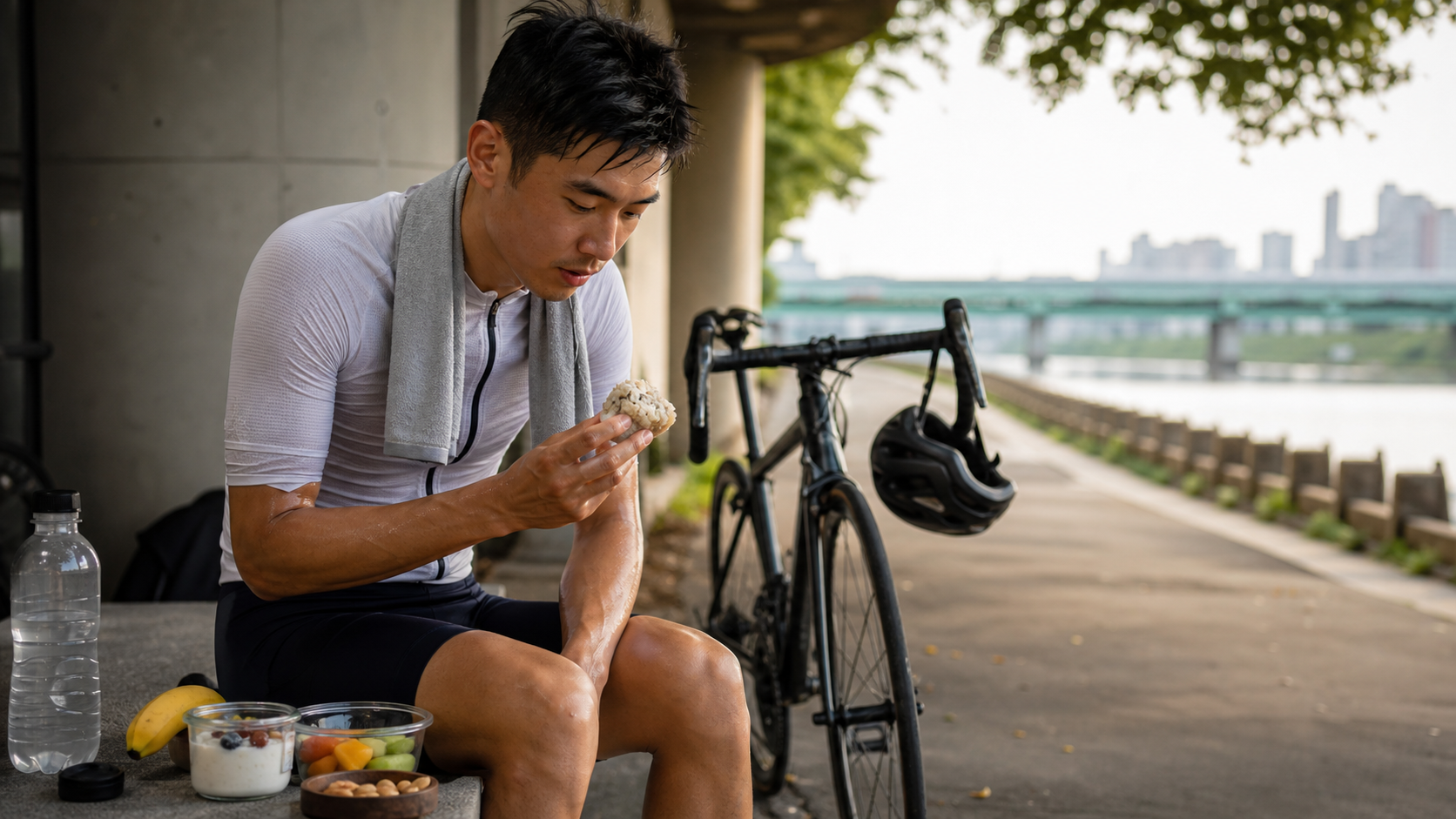
Window 1: The “Ignition Snack” 30–60 Minutes Before Training. The goal is easily digestible carbohydrates as the main focus, with small amounts of protein and fat, to avoid your gut still being busy digesting during exercise. Examples: a banana, a slice of toast with a thin layer of peanut butter, or an onigiri (rice ball).
Window 2: The “Recovery Snack” 30–120 Minutes After Training. The goal is to combine carbohydrates and protein to refill glycogen and provide muscle-repair materials. Classic combos: plain yogurt with fruit, chocolate milk, or a tea egg with sweet potato.
Window 3: The “Gap Snack” Between Meals. The goal is to stabilize blood sugar and prevent overeating at the next meal, focusing on protein and fiber that won’t spike blood sugar. Examples: a small handful of nuts, unsweetened soy milk, boiled eggs, or cherry tomatoes with cheese.
The table below organizes the principles for these three windows so you can directly match them to your own schedule.
| Snacking Window | Primary Goal | Recommended Nutritional Composition | Easy-to-Find Examples in Taiwan | Suggested Portion (General Adult Reference) |
|---|---|---|---|---|
| 30–60 min pre-workout | Ignition, stabilize blood sugar | Easily digestible carbs as main focus, low fat and fiber | Banana, onigiri, toast with thin peanut butter | About 30–50 g carbohydrate |
| 30–120 min post-workout | Refill glycogen, repair muscle | Carbs + protein (about 3:1 to 4:1) | Chocolate milk, yogurt with fruit, sweet potato with tea egg | 40–60 g carbs + 20–30 g protein |
| Between meals | Stabilize blood sugar, prevent overeating | Protein + fiber, low glycemic index | Unsweetened soy milk, nuts, boiled egg, cherry tomatoes with cheese | About 150–250 kcal |
Healthy Snack List: You Can Build a Good Snack at the Convenience Store
Taiwan’s biggest advantage is the incredibly high density of convenience stores and eateries—this is actually a snacking paradise, provided you know how to choose. I’ve organized common options by “training purpose” into the comparison table below, so you won’t hesitate in front of the convenience store fridge anymore.
| Snack Type | Approximate Calories | Protein | Best Timing | Coach’s Notes |
|---|---|---|---|---|
| Banana (1) | About 90–110 kcal | About 1–2 g | Pre-workout ignition | Easy to digest, high in potassium, friendly for cramp-prone athletes |
| Tea egg (1) | About 70–80 kcal | About 6–7 g | Gap, post-workout | Convenient quality protein; note sodium is on the higher side |
| Unsweetened soy milk (1 bottle, ~400 ml) | About 130–160 kcal | About 13–15 g | Gap, post-workout | Plant protein; good choice for lactose-intolerant individuals |
| Plain yogurt (1 small container) | About 80–120 kcal | About 6–10 g | Post-workout, gap | Choose unsweetened versions; add your own fruit |
| Sweet potato (1 medium) | About 120–160 kcal | About 2–3 g | Pre-workout, post-workout | Low-glycemic carbs, plenty of fiber, satisfying |
| Mixed nuts (1 small handful, ~25 g) | About 150–170 kcal | About 4–6 g | Gap | Good fats but calorie-dense; stick to one small handful |
| Chocolate milk (1 bottle) | About 150–200 kcal | About 8–10 g | Post-workout | Classic recovery drink with a good carb-to-protein ratio |
| Cherry tomatoes + cheese (1 serving) | About 120–160 kcal | About 6–8 g | Gap | Low glycemic + protein + fiber; top choice for stable blood sugar |
Please note that the calories and protein in the table are rough estimates of common ranges—different brands and portion sizes vary considerably. Always refer to the nutrition label on the package for actual values. I list ranges rather than precise decimal numbers because, in real life, the banana you grab won’t be exactly 100 grams.
Sample Daily Snacking Schedule
What does putting these principles into practice look like across a real day? Here’s an example based on the routine of an athlete working in tech who rides or runs after work (purely illustrative; values are general estimates):
- 07:00 Breakfast: Whole-wheat toast with egg + unsweetened soy milk (boost breakfast protein; don’t just eat starch).
- 10:00 Gap snack: One tea egg or a small container of plain yogurt.
- 12:30 Lunch: Normal meal—staple + protein + vegetables.
- 17:30 Pre-workout ignition snack: One banana (training starts at 18:30).
- 20:00 Post-workout recovery snack: Chocolate milk or yogurt with fruit to kick-start recovery.
- 20:45 Dinner: Normal dinner—don’t binge just because you finished training.
You’ll notice that snacking isn’t about “eating more”—it’s about redistributing the volume that would otherwise be crammed into one dinner across more efficient time points in the day. Many athletes aiming to lose fat who made this adjustment found their total calories didn’t increase, but training quality improved noticeably and dinner was no longer out of control.
Common Mistakes and Corrections
In all my years coaching, the mistakes I’ve seen around snacking could fill a book. Here are the most common and most impactful ones.
Mistake 1: Treating Sports Drinks and Energy Gels as Everyday Snacks
This is what I stop most often. Energy gels and sports drinks are designed for rapid sugar delivery “during long, high-intensity exercise”—they’re concentrated and fast-absorbing. If you’re just commuting 20 minutes or habitually sipping a sports drink at your desk, you’re pouring a load of fast sugar into your body with no expenditure to match. Your blood sugar rides a roller coaster, and long-term, it’s not kind to your weight or metabolism.
Fix: Save the supplements for real long sessions (high-intensity endurance efforts over one to one and a half hours). For everyday gaps, switch to whole foods with protein and fiber.
Mistake 2: Eating Too Much Fat and Fiber Before Training, Then Your Gut Rebels Mid-Workout
I’ve had athletes eat a big salad with avocado before training “for health,” only to suffer stomach cramps an hour into the ride. High fat and high fiber slow gastric emptying, and during exercise blood flow shifts to the muscles, leaving the gut even less able to digest.
Fix: Make your pre-workout snack primarily easily digestible carbohydrates; save fats and fiber for after training or regular meals. The closer you get to exercise, the simpler, blander, and smaller the food should be.
Mistake 3: Not Refueling After Training, Treating “Fasted Recovery” as a Virtue
Some athletes trying to lose fat deliberately stay hungry after training, thinking it burns more fat. It might be fine short-term, but long-term, forcing your body to recover in a state of “already exhausted and no raw materials” leads to declining performance, weakened immunity, and even disrupted sleep.
Fix: Your post-workout recovery snack doesn’t need to be large, but it should include both carbs and protein. True fat loss comes from controlling total daily calorie intake, not from starving through the recovery window.
Mistake 4: Only Looking at Calories, Not Composition
“This bag of cookies is only 100 calories!”—but those 100 calories are almost entirely refined sugar and oil, and you’re hungry again half an hour later. The value of a snack isn’t just its calorie number; it’s whether it can stabilize you and give you raw materials.
Fix: When choosing a snack, first check “does it have protein? does it have fiber?”—then look at calories. For the same 150 kcal, a small yogurt beats a bag of sandwich cookies by a mile.
Mistake 5: Turning a Snack into a Fourth Full Meal
If a snack’s portion gets out of control and becomes the size of a bento box, it loses its purpose. I’ve seen athletes “snack” on fried chicken and bubble tea, then eat their regular meals on top, blow past their totals, and blame their metabolism.
Fix: Keep gap snacks around 150 to 250 kcal. Post-workout recovery snacks can be a bit higher, but they’re still “a small portion,” not a meal.
Mistake 6: Forgetting to Hydrate, Treating Snacking and Water Intake as Separate
Many people focus on “what to eat” but forget to drink water alongside their snack. Especially in Taiwan’s muggy heat, dehydration can masquerade as “tiredness” or “hunger,” so you eat more without solving the problem.
Fix: Pair your snack with hydration—when you eat that tea egg or banana, take a few sips of water. For long sessions with heavy sweating, consider electrolyte-containing fluids.
Taiwan-Specific Context: Adjusting Snacks for Humid Heat and the Eating-Out Environment
1. Hot and Humid: Snacks Need to Account for Electrolytes and Fluids
Taiwan summers routinely hit 32°C or higher with high humidity, and outdoor riding or running produces enormous sweat loss. In these conditions, snacks for long sessions need to consider sodium and fluids in addition to carbs. This is one of the few situations in Taiwan where “moderate use of sports drinks or electrolyte supplements during exercise” is justified. The judgment principle is simple: if your clothes come back with white salt stains after training, or your weight drops noticeably, you’ve lost a lot—next time, be more aggressive with fluids and electrolytes.
But a reminder: this applies to long, heavy-sweating sessions; it doesn’t mean guzzling sports drinks every day. For everyday gap snacks, plain water plus whole foods is all you need. Also, food spoils quickly in summer heat—snacks you bring out (like rice balls or boiled eggs) need proper handling; don’t leave them sitting too long in a hot car or backpack.
2. Convenient Eating Out Is a Double-Edged Sword
Convenience stores, breakfast shops, and bubble tea stands are everywhere. The upside is plenty of snack options; the downside is hidden sugar and refined starch everywhere. Here are the simple rules I give athletes:
- Bubble tea: If you want it, choose unsweetened or lightly sweetened, and treat it as “an occasional treat” rather than a daily snack; a full-sugar bubble tea often exceeds the entire day’s recommended sugar limit.
- Breakfast shops: Swap milk tea for unsweetened soy milk, and pair pure-starch items (like plain toast or radish cake) with an egg to add protein immediately.
- Convenience stores: Tea eggs, unsweetened soy milk, plain yogurt, sweet potato, bananas, and boiled eggs—these are nearly the universal snack combo. You can put together a good snack on the fly.
3. Medical Conditions: These People Need to Be More Careful with Snacks
I want to slow down and be very clear here. Snacking strategies are general guidelines for “the generally healthy athletic population,” but if you have a chronic condition, your approach must be individualized and should follow professional medical advice:
- Diabetes or blood sugar issues: The type, portion, and timing of carbohydrate snacks can all affect blood sugar control. You must discuss this with your physician or dietitian and adjust based on blood glucose monitoring—don’t apply this article’s general rules on your own.
- Hypertension or cardiovascular disease: Tea eggs and some processed snacks are high in sodium. If you’re managing blood pressure or have relevant history, pay closer attention to sodium when choosing snacks and follow your doctor’s individual recommendations.
- Kidney disease: Protein and electrolyte (potassium, phosphorus) intake needs to be strictly individualized. Foods recommended in this article like nuts, soy milk, and bananas may not be appropriate—please follow your medical team’s instructions.
Taiwan’s National Health Insurance makes it easy to see a doctor. If you have any of these conditions and want to seriously adjust your training and diet, it’s well worth booking an appointment with a metabolism clinic, cardiology clinic, or nutrition consultation so a professional can design a plan for you. This article can give you principles and direction, but it cannot replace the hands that take your pulse.
Three Real-Life Case Studies: How Snacks Saved Training
No matter how much theory I lay out, nothing beats looking at real situations. The following three people are composites of common cases I’ve seen in athletes I’ve coached (illustrative scenarios; values are general estimates). You might well see yourself in one of them.
Case 1: The Office-Worker Cyclist Who Crashes After Work
A 68 kg tech-industry cyclist would finish lunch at noon, then sit in meetings until 7 PM, then head straight to the trainer to do an hour of threshold intervals. He complained that every time he pushed intensity, he got dizzy and his legs gave out—he couldn’t even finish the third interval. Looking at his day, the problem was obvious: seven hours between lunch and training with nothing eaten in between. His blood sugar was already on empty; his body had no fuel for high-intensity work.
I asked him to make one small adjustment: around 16:30, add a “gap snack” (a tea egg plus half a banana), and before getting on the trainer at 18:00, take a few more bites of easily digestible carbs. Two weeks later, he reported that he could finally complete all the intervals, and his power had stabilized. He wasn’t training more—he just went from “toughing it out hungry” to “having fuel to burn.” This is the lesson I demonstrate most often: many people think poor performance is a fitness problem, when it’s actually an energy-timing problem.
Case 2: The Fasted-Training Runner Who Couldn’t Lose Weight
Another athlete, a 55 kg female runner, firmly believed “fasted exercise burns the most fat.” She ran fasted every morning for an hour and deliberately held off eating until noon. She did lose a little weight, but quickly plateaued, and she started catching colds more often, her menstrual cycle became irregular, and her pace regressed instead of improving.
This is a classic warning sign of chronic energy deficiency. I didn’t tell her to eat recklessly; I asked her to do two things: eat a few bites of easily digestible carbs before her morning run (half a banana or a few saltine crackers), and within 30 minutes after training, have a recovery snack with carbs and protein. Three months later, her pace was back up and her colds had noticeably decreased. A serious reminder here: long-term fasted training combined with deliberately undereating may involve the effects of energy deficiency on hormones, immunity, and bone health. If you’re already experiencing menstrual irregularities, recurrent infections, or persistent fatigue, please seek medical attention and have it evaluated by a gynecologist, dietitian, or sports medicine professional—don’t just tough it out on your own.
Case 3: The Long-Climb Cyclist Whose Gut Went on Strike
The third person was an experienced cyclist preparing for the long Wuling climb. His fitness was fine, but on every ride over three hours, the back half brought nausea and an inability to take in fuel; he’d finish on willpower alone. His problem wasn’t fitness—it was an untrained gut. He never fueled on short sessions, but on race day he tried to slam a huge amount of carbs at once, and his gut naturally revolted.
I asked him to pick one or two long sessions per week for six to eight weeks before the event and deliberately practice “fueling while riding,” starting at about 40 grams of carbs per hour and gradually increasing every week or two to let his gut adapt to higher intake. At the same time, he tested different fuels (gels, bananas, rice balls) for tolerance in his stomach. On challenge day, he was finally able to take in fuel steadily with no nausea the whole way. Your gut is like your muscles—it can be trained. And that training only accumulates through your everyday snacks and long-session fueling.
Snacking FAQ
These questions come up in almost every group of athletes I coach. Here they are, all in one place.
Q1: Will eating a snack after evening training make me fat?
This is the most common myth. What determines weight gain or loss is your total daily calorie balance—not “what time you eat.” A reasonable post-workout recovery snack is helping you repair and refill what you burned; it doesn’t automatically turn into fat just because it’s late. What actually makes people gain weight is usually the uncontrolled volume of a post-workout binge, not a glass of chocolate milk.
Q2: I’m just trying to lose fat—do I still need snacks?
Yes, and used well, snacking actually helps fat loss. One of the core values of a gap snack is preventing the next meal from becoming an out-of-control binge because you’re starving. One tea egg (about 70–80 kcal) in exchange for not eating an extra 300 kcal at dinner is a very good trade. Fat loss comes from stable control of your daily total, not from starving.
Q3: Can protein bars and whey protein count as snacks?
Yes—they’re convenient, the protein is clear, and they’re good tools when you’re out and about or don’t feel like preparing something. But I usually ask athletes to prioritize whole foods (eggs, soy milk, yogurt) and treat supplements as “fill-ins” rather than the main event. Whole foods bring fiber, micronutrients, and satiety along with protein—things a processed bar can’t provide. When choosing a protein bar, read the label; some actually contain a fair amount of sugar and fat and are closer to candy in nature.
Q4: Should I train fasted or eat before exercise?
It depends on the length and intensity of the session and your own gut. For low-intensity sessions under an hour, training fasted is usually fine. But for high-intensity evening sessions, or when it’s been more than four or five hours since your last meal, I strongly recommend a pre-workout snack of easily digestible carbs. As for early-morning fasted training: if you tolerate it well and it’s not too long, that’s okay, but don’t combine it long-term with deliberately undereating (see Case 2).
Q5: Can I eat fruit as a snack? Isn’t fruit high in sugar?
Yes, fruit is an excellent snack option. Its sugar comes with fiber, water, and micronutrients—completely different from a piece of refined candy. Bananas are the classic pre-workout ignition choice; apples, guavas, and cherry tomatoes are great for gap snacks. What to watch out for is “juice”—once squeezed, the fiber is destroyed, the sugar is concentrated, and you drink it fast, which is far worse than eating the whole fruit.
Q6: How many times a day can I snack?
There’s no hard number; the key is “does it actually fill a gap?” For most regularly training office workers, one to two snacks a day (one gap snack, one post-workout) is plenty. Snacking is meant to fill the gaps between meals and the needs around training—not to add extra meals. Don’t turn it into an excuse to graze all day.
Actionable Advice for Readers at Different Levels
For Beginners: First Build the “Three Windows” Habit
If you’re just starting to exercise, don’t rush into counting grams. Just do three things:
- Eat an easily digestible carbohydrate 30–60 minutes before training (banana or onigiri).
- Don’t stay hungry after training—have a snack with carbs and protein (yogurt with fruit or chocolate milk).
- If you’re hungry between meals, choose whole foods with protein instead of cookies and candy.
These three habits alone will noticeably improve your training quality and recovery. Once they become automatic, then you can advance to calculating portions.
For Intermediate Athletes: Start Spreading Protein Across the Day
If you’re already training regularly and want to go further, focus on daily protein distribution. Try calculating whether you’re getting around 1.6 to 2 grams of protein per kilogram of body weight per day, and confirm it’s spread across four to five meals rather than concentrated at dinner. Snacking is your main tool for filling the protein gaps at breakfast and in the between-meal windows. At the same time, start doing “gut training” for your long sessions—practice fueling with carbs while moving during long rides and runs so your gut gradually adapts. Don’t wait until race day to try high-volume fueling for the first time.
For Advanced/Race-Oriented Athletes: Treat Snacking as a Quantifiable Training Variable
If you’re preparing for a race, snacking and fueling should be recorded and adjusted just like power and heart rate. For key sessions over two hours, progressively push your hourly carbohydrate intake toward 60 grams or higher (provided your gut can handle it), and use actual training to test the tolerance of different fuels. Log “what time, what I ate, how my body responded” to find your own optimal formula. Remember the old saying: nothing new on race day. Every snacking and fueling strategy should be validated in training first.
A Decision Checklist You Can Stick on the Fridge
Finally, here’s a quick decision checklist I often ask athletes to stick on the fridge or save on their phone. When you’re hungry, pull it out and run through it:
- Am I about to exercise? Yes → choose easily digestible carbs (banana, rice ball); No → go to the next question.
- Have I just finished exercising? Yes → carbs + protein (yogurt with fruit, chocolate milk); No → go to the next question.
- Am I just hungry between meals? Yes → choose something with protein and fiber (tea egg, soy milk, a small handful of nuts, cherry tomatoes with cheese).
- Does this snack have protein or fiber? No → pick something else.
- Is the portion too big? If a gap snack exceeds 250 kcal, think again.
These five questions take less than ten seconds, but they’ll help you avoid ninety percent of snacking landmines.
Advanced Supplement: Prepare Your Snacks Before You Need Them
After coaching for years, I’ve found that the most common reason snacking fails isn’t “not knowing what to eat”—it’s “not having the right thing on hand in the moment.” Your willpower is weakest when you’re hungry. If the only things in your drawer are cookies someone shared and the only thing downstairs is fried food, you’ll cave eight times out of ten. So the real key to making a snacking strategy work is preparing your choices before you’re hungry.
I usually ask athletes to do three simple preparation tasks:
First, build a “standing supply zone.” In your office drawer, gym bag, or car, keep a few non-perishable snacks: small packs of nuts, saltine crackers, energy bars (for long sessions), and a bottle of unsweetened soy milk or protein drink that can sit at room temperature. Make “grabbing the right thing” the default, and you won’t have to fight your willpower against the red-light foods in the fridge every time.
Second, put snacks on your shopping list. Every week at the supermarket or convenience store, stock up on “green-light snacks” like bananas, sweet potatoes, plain yogurt, and boiled eggs. If they’re in the fridge, you won’t grab potato chips as a last resort at home. It sounds trivial, but over a month, the difference is very noticeable.
Third, do a “fueling rehearsal” for long sessions. The night before a long weekend ride or run, prep and portion out what you’ll eat during the session, and plan the rhythm of roughly one serving per hour. Don’t wait until you’re halfway through to scramble for fuel—that’s usually when gut issues or bonking begin.
Here’s the skeleton of the “preparation checklist” I give athletes. You can fill in your own version:
| Location | Recommended Standing Items | Purpose | Restock Frequency |
|---|---|---|---|
| Office drawer | Small packs of nuts, saltine crackers, protein drink | Gap snack, pre-workout ignition | Check once a week |
| Refrigerator | Bananas, plain yogurt, boiled eggs, sweet potato | Daily snacks, post-workout recovery | Restock on every shopping trip |
| Gym bag / car | Energy bars, energy gels, electrolyte supplements | Fueling during long sessions | Replace when used; watch expiration dates |
This “prepare first” mindset is exactly the same logic as planning your training: good performance is never the result of winging it in the moment—it’s the product of planning ahead. Snacking is the same. When you’ve prepared your choices before you need them, you’ve already won half the battle.
Conclusion: Make Snacks Your Second Training Partner
Let’s return to the two athletes from the opening. The one who tough it out hungry learned to eat a banana before training and have a glass of chocolate milk after. Three months later, not only was she no longer shaking during sessions, but her weight was steadily dropping because dinner was no longer a binge. The one who treated gels like candy switched his everyday snacks to tea eggs and soy milk; his blood sugar stopped swinging, and his afternoon training finally had energy.
Their shared takeaway was the same sentence: The problem was never “can I eat snacks or not”—it was “did I eat the right ones.”
Snacking is a very practical, everyday science. It doesn’t require expensive supplements—a convenience store is enough. It doesn’t require complicated calculations—grasp the two principles of “timing” and “composition” and you’ll go far. When you start treating snacks as part of your training plan rather than a source of guilt, you’ll find it’s actually the invisible partner that quietly helps you hold your sessions together and speeds up recovery.
Next time you’re standing in front of the convenience store fridge, don’t hesitate. Grab that tea egg, that unsweetened soy milk, that banana—you’re not indulging; you’re paving the way for your next great performance.
This article is educational content and cannot replace individual diagnosis and treatment advice from a physician, physical therapist, or dietitian.
References
- A Step Towards Personalized Sports Nutrition: Carbohydrate Intake During Exercise (Sports Medicine, Springer; summary of carbohydrate intake during exercise and hourly recommendations): https://link.springer.com/article/10.1007/s40279-014-0148-z
- Dietary Carbohydrate And The Endurance Athlete: Contemporary Perspectives (Gatorade Sports Science Institute; perspectives on carbohydrate intake for endurance athletes): https://www.gssiweb.org/sports-science-exchange/article/dietary-carbohydrate-and-the-endurance-athlete-contemporary-perspectives
- How much protein can the body use in a single meal for muscle-building? Implications for daily protein distribution (single-meal protein and daily distribution): https://pmc.ncbi.nlm.nih.gov/articles/PMC5828430/
Related Reading
- Healthy Snack Choices for Runners: A List of Quality Carbs and Protein Foods for Post-Training Recovery
- Athlete Meal Prep in Practice: A Complete Guide to Efficiency, Nutritional Balance, Storage, and Variety
- Athlete Sugar Intake: Enemy or Fuel? A Coach’s Guide to Understanding Sugar in Daily Life and Exercise
- Nutritional Time Management for the Office-Worker Athlete: Too Busy to Eat, Still Getting Your Training’s Worth
CT暗黑廚房) 車友必備 宇宙無敵鮮蚵湯 幫助訓練恢復 天然食補 好市多 超肥鮮蚵 破PR
7 年前
一日北高/長距離團騎 常見問題補充篇 / 組團或跟團的眉角 / 壯車友容易被瘦車友慢性拉爆 / 原來屁股痛可能是這個原因...? / 風場配速法 / 公路車 / CT Yeh
2 年前
西進武嶺 免費訓練分析服務 Intervals | 練不夠還是練過頭?你哪一種類型選手?AI模型告訴你! | 備戰神器 | 公路車 訓練 | CT Yeh
4 年前
一日北高前的高裝檢 | 北高 360 | 挑戰11小時的裝備 | 一日雙塔 | 補給
6 年前
靠單車減肥35公斤 心得分享與整理
7 年前
FTL 與 SYB 車隊專訪 西進武嶺 實用攻略分享! 2小時 如何練?!你不知道的眉角!新手準備武嶺必看 EP1 | 實力派女車友 | 精華版 | 公路車 | CTYeh
4 年前
CT趣訪 西進武嶺 2小時組 EP2 全村的希望 蔣緯緯! 訓練菜單&技巧公開 |公路車 |CT Yeh
4 年前
4K 東眼山 x 水蜜桃冰沙 百人單車約騎! 操完再吃冰 多爽快
7 年前