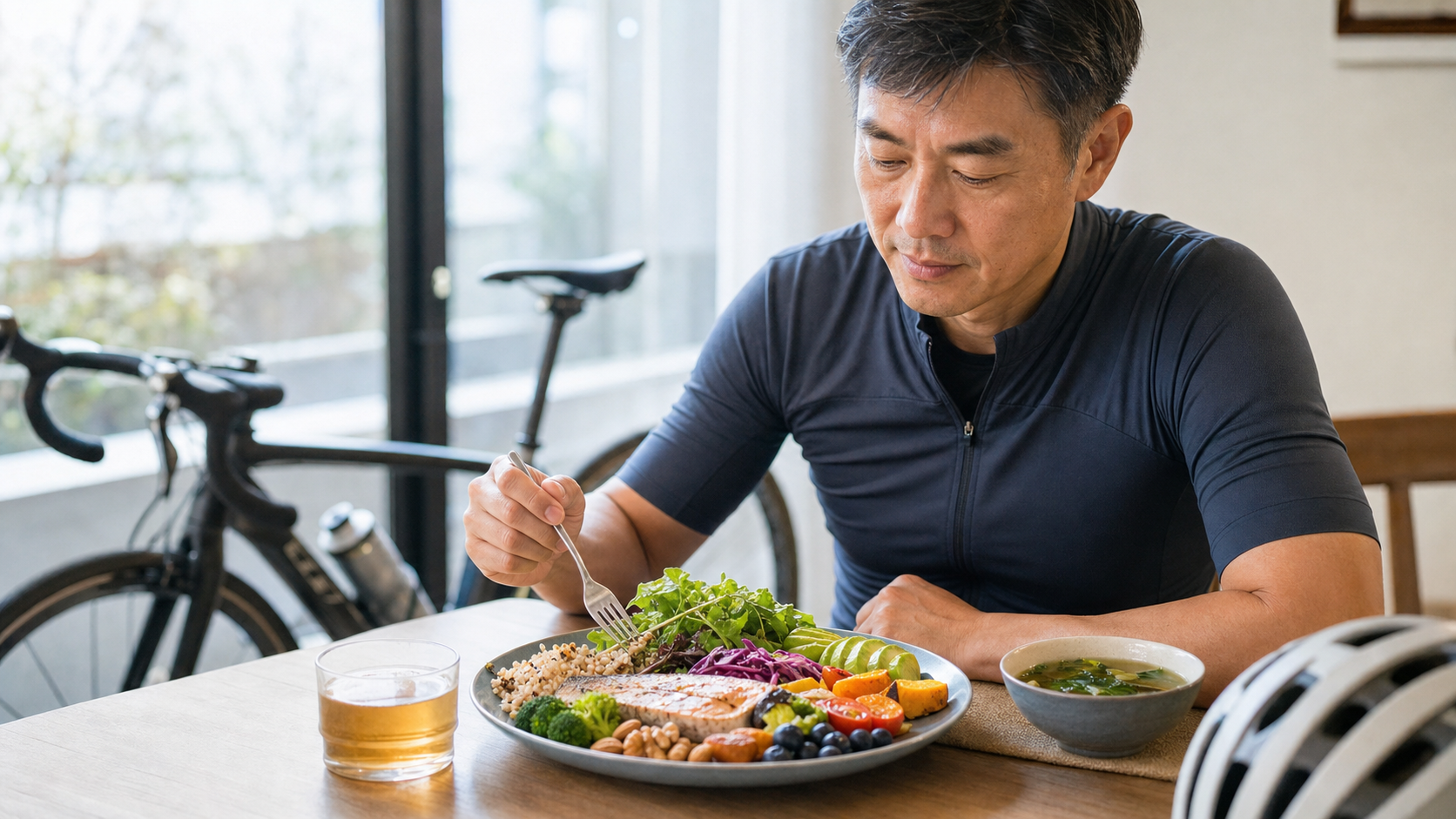
Starting with a Stuck Athlete
A few years ago, I coached an amateur road cyclist in his early forties; let’s call him A-Kai. He trained about 250 to 300 kilometers per week, with a functional threshold power (FTP) around 240 watts—respectable numbers. The problem: every time he did a long climb on the weekend, his legs would be so swollen the next day that even walking downstairs made him wince. His resting heart rate would run 8 to 12 bpm higher than usual, and his sleep tracker’s recovery score was constantly flashing red. At one point, he thought he might be “overtraining” and even went out and bought a more expensive massage gun.
The first thing I asked him to do wasn’t to change his training plan, but to photograph his meals for three days. The result was typical: breakfast was a convenience store rice ball and milk tea, lunch was a buffet with three portions of fried food and a big spoonful of braising sauce over rice, and after evening training he’d often reward himself with a bowl of braised pork rice and sausage. Vegetables were almost limited to the small pile of greens drowning in sauce in his bento box. It wasn’t that he wasn’t trying—it’s just how easily Taiwanese people who eat out fall into this trap. Over six weeks, without significantly changing his training volume, we only adjusted “what the food he ate looked like.” His post-ride swelling noticeably decreased, and his resting heart rate returned to baseline.
What this article wants to talk about is exactly this: an anti-inflammatory diet isn’t some magical supplement; it’s a daily engineering project that raises your recovery ceiling. I’ll start with the science of inflammation, help you see which dietary patterns and key foods actually hold up, and then give you a set of practices you can implement immediately in a Taiwanese context.
Let me be clear about positioning: this article is educational content to help you understand principles and direction, but it cannot replace individual diagnosis and treatment advice from a physician, physical therapist, or dietitian. If you have a chronic disease or are taking medication, please discuss any dietary changes with your healthcare team first.
Conceptual Foundation: Inflammation Isn’t the Enemy—Losing Control Is
Many people hear “inflammation” and want to eliminate all of it, which is a misunderstanding. Exercise itself is a form of controlled damage. When you finish a high-intensity interval session or a long climb, muscle fibers sustain micro-damage, and the body immediately launches a cascade of inflammatory responses: immune cells move in to clear damaged tissue, release signaling molecules, and summon repair materials. This acute inflammation is actually the starting point of training adaptation—without it, you’d never get stronger.
What truly holds athletes back is another state: chronic low-grade inflammation. When training stress, insufficient sleep, psychological stress, and a long-term pro-inflammatory diet pile up together, the body is like a car with the accelerator pressed down but unable to release the inflammatory brake—the inflammatory response never gets to “wrap up.” This background inflammation makes recovery after every workout lag behind, and over time it becomes the kind of “my legs always feel heavy” state A-Kai was in.
How the Body Wraps Up Inflammation
A key shift in sports nutrition research in recent years has been moving from “suppressing inflammation” to “helping inflammation resolve properly.” The body wraps up inflammation using a group of molecules called specialized pro-resolving mediators (SPMs), such as resolvins, protectins, and maresins. The raw materials for these molecules come directly from omega-3 fatty acids (EPA and DHA) in our diet. In other words, the types of fat you eat directly affect your body’s ability to “turn off” inflammation.
This is also why I don’t like athletes chronically popping high doses of pain-relieving anti-inflammatory drugs (NSAIDs) after training. Short-term use in the acute phase has its role, but relying on drugs long-term to crush acute inflammation may also suppress the signals for training adaptation—not worth it. The role of diet is to cultivate the body’s ability to self-regulate inflammation, not to forcibly shut it down.
I often use an analogy with my athletes: acute inflammation is like a construction site. The excavators, workers, and materials all need to be in place for the building to go up; the problem is when “the site never closes.” You don’t want to forbid construction—you want the project to finish on time and the site to be cleaned up. An anti-inflammatory diet plays the role of helping the project wrap up smoothly—providing enough finishing materials (omega-3, antioxidants) while not constantly dumping garbage (excess refined sugar, fried food, processed meat) into the site to increase the cleanup burden. Understanding this, you won’t fall into the mistaken mindset that “the lower the inflammation, the better.”
Anti-Inflammation Can’t Be Separated from “Eating Enough”
There’s another often-overlooked concept: an anti-inflammatory diet must be built on a foundation of adequate total energy and protein. Repairing damaged tissue requires materials, and protein is one of the key materials. If you push total calories too low or don’t eat enough protein in pursuit of “clean eating,” then no amount of antioxidants or good fats can compensate for a repair project lacking raw materials. I’ve seen plenty of people misinterpret “anti-inflammatory” as “eat very little and very bland,” only to end up with worse recovery.
For the general training population, protein intake should roughly be 1.4 to 2.0 grams per kilogram of body weight per day, spread across three to four meals. This range is a guideline; actual amounts vary by training type and individual circumstances. For precise calculations, I recommend consulting a sports dietitian. The key concept is: anti-inflammation and eating enough are two sides of the same coin, not opposites.
Pro-Inflammatory vs. Anti-Inflammatory: A Comparison Table
| Aspect | More Pro-Inflammatory Daily Habits | More Anti-Inflammatory Daily Habits |
|---|---|---|
| Fat sources | Lots of fried food, hydrogenated oils, excess omega-6 | Olive oil, nuts, deep-sea fish (omega-3) |
| Carbohydrate quality | Refined sugar, sugary drinks, large amounts of white bread | Whole grains, root vegetables, legumes, whole-food starches |
| Fruit and vegetable color | Mostly just starches, few fruits and vegetables | Multi-colored fruits and vegetables at every meal (polyphenols, antioxidants) |
| Degree of processing | Frequent sausage, ham, processed meats | Mostly whole foods, occasional processed meat |
| Beverages | Daily sugary hand-shaken drinks | Water, unsweetened tea, moderate coffee |
| Sleep and stress | Chronic sleep deprivation, long-term high stress | 7+ hours of sleep, stress has an outlet |
Please note: this table describes overall tendencies, not a moral judgment of “this bite is allowed, that bite isn’t.” Eating a bowl of braised pork rice occasionally won’t ruin your recovery, but if your plate chronically looks like the left column, the inflammatory brake will get duller and duller.
What Science Says: Two Directions That Hold Up
When I teach athletes about anti-inflammatory diets, I only give directions with “relatively solid evidence” and avoid chasing trends. In the current sports science literature, two lines of evidence are particularly worth knowing for athletic populations.
Direction One: Omega-3 (EPA/DHA) and Recovery
In recent years, several systematic reviews and meta-analyses on exercise-induced muscle damage have pointed out that omega-3 (EPA + DHA) supplementation can moderately reduce several markers of inflammation and muscle damage, including interleukin-6 (IL-6), tumor necrosis factor-alpha (TNF-α), creatine kinase (CK), and subjective ratings of delayed onset muscle soreness (DOMS). Mechanistically, as mentioned earlier, EPA/DHA are metabolized into SPMs, helping inflammation resolve properly while enhancing cellular antioxidant capacity. (Sources listed in the references at the end)
However, there are several very important caveats I always emphasize to athletes:
- The doses showing clearer effects in the literature mostly fall at 2 grams or more of EPA + DHA per day, sustained for at least about 4 to 6 weeks; a few days of short-term use has limited effect.
- These benefits are more easily observed in amateur, recreational athletic populations; in elite athletes whose training and nutrition are already well-optimized, the additional benefit is less pronounced.
- Improvements in biomarkers do not equal direct improvements in athletic performance. Current evidence has no consistent conclusion on whether omega-3 can make you “ride faster,” so don’t expect it as an ergogenic aid.
So my position is clear: get omega-3 from food first (two to three servings of deep-sea fish per week), and treat supplements as a backup, not the main event.
Direction Two: The Mediterranean Dietary Pattern
The second line is overall dietary pattern, and the one with the most accumulated evidence is the Mediterranean diet. Its core isn’t a single superfood but an entire structure: abundant fruits and vegetables, whole grains, legumes, and nuts, olive oil as the primary fat, moderate fish and dairy, and limited red meat and processed foods. Multiple reviews of intervention studies in both athletic and non-athletic populations indicate that this pattern is associated with higher plasma total antioxidant capacity and lower oxidative stress and inflammatory markers.
Particularly worth mentioning are the phenolic compounds in olive oil, such as hydroxytyrosol, oleocanthal, and oleuropein, which have antioxidant and anti-inflammatory properties. The polyphenols and antioxidant vitamins in fruits and vegetables are also thought to help reduce the elevated inflammatory state after exercise. Of course, the literature also reminds us that the direct effects of the Mediterranean diet on athletic “performance” still require more rigorous research—don’t over-mythologize it. But as a long-term foundation for health and recovery, its direction is reliable. (Sources listed in the references at the end)
Putting the two lines together, the conclusion is actually quite plain: eat more whole fruits and vegetables and good fats, have a few servings of deep-sea fish per week, and eat less refined sugar and processed meat. It doesn’t sound sexy at all, but that’s usually what evidence-based things look like.
An Overlooked Piece: The Omega-6 to Omega-3 Ratio
When talking about anti-inflammation, everyone fixates on “eat more omega-3,” but few notice the other half: whether omega-6 intake is too high. Omega-6 itself isn’t bad—it’s an essential fatty acid that the body needs. But modern eating-out culture uses large amounts of refined vegetable oils (salad oil, blended oil) for frying and stir-frying, pushing many people’s omega-6 intake far above omega-3, tilting the overall fat environment toward the pro-inflammatory side.
I don’t ask athletes to calculate some perfect “ratio” precisely—that’s overthinking it. My approach is pragmatic: instead of endlessly adding omega-3, first bring down the excess omega-6. Concretely, that means reducing fried foods, avoiding buffet dishes stir-fried in large amounts of reused oil, switching your primary cooking oil to olive oil, and swapping several meals of protein to deep-sea fish. When you lower the pro-inflammatory end, the same amount of omega-3 works more effectively. This is one of the hidden reasons many people take fish oil without feeling any difference.
How Local Taiwanese Foods Fit In
Many anti-inflammatory articles talk about imported ingredients—blueberries, avocados, salmon—which are often expensive and hard to buy daily. In reality, local Taiwanese ingredients can fully support an anti-inflammatory plate, and they’re cheaper and fresher. I’ve put together a “local substitute table” for my athletes:
| Commonly Recommended Imported Ingredient | Local Taiwanese Substitute | Notes |
|---|---|---|
| Salmon | Mackerel, Pacific saury, horse mackerel | Same family of omega-3-rich blue-backed fish, cheap at the market |
| Blueberries | Mulberries, dragon fruit, grapes, roselle | Sources of dark anthocyanins, more economical in season |
| Kale | Sweet potato leaves, A-choy, spinach, dragon bean sprouts | Dark leafy greens with equally rich antioxidants |
| Avocado | Black sesame, nuts, camellia oil | Local options for good fats and phytochemicals |
| Quinoa | Brown rice, purple rice, sweet potato, taro | Whole-food starches and fiber, easy to find in Taiwan |
The purpose of this table is to break the myth that “an anti-inflammatory diet is expensive and hard.” A trip to the traditional market makes it easier to assemble an anti-inflammatory plate than a trip to an imported supermarket.
Taiwan’s Climate: Heat, Humidity, and the Hidden Cost to Recovery
Taiwan’s summers are hot and humid, which adds extra stress to an athlete’s inflammation and recovery. Training in high temperatures raises core body temperature, causes dehydration, and depletes electrolytes, all of which intensify the body’s stress response and increase the recovery burden. I often see athletes recover noticeably slower after long summer rides or runs than in winter, yet they just blame “poor form.”
Here are a few key points tied to diet:
- Keep up with hydration and electrolytes: Heavy sweating in hot weather means plain water isn’t enough; long-duration exercise requires sodium-containing electrolytes to avoid hyponatremia. This isn’t exclusive to anti-inflammation, but dehydration itself amplifies the stress response.
- Don’t skip recovery meals just because heat kills your appetite: Appetite often drops after summer exercise. Using easy-to-eat options like unsweetened yogurt, soy milk, and fruit to cover the recovery window is a very practical compromise.
- Sleep quality is more easily disrupted by heat in summer: Poor sleep makes inflammation hard to resolve. Turn on the air conditioner and get enough sleep—don’t skimp.
Factoring in the climate, you’ll understand why the same menu and the same training require more careful recovery management in summer.
A-Kai’s Six Weeks: What We Actually Changed
Let me go into more detail on A-Kai’s case, because the devil is in the details. We didn’t give him any expensive supplements; over six weeks we only did four things. First, we swapped his daily sugary hand-shaken drink for unsweetened tea or water. Second, his lunch buffet went from “three portions of fried food” to “one serving of grilled fish or braised chicken leg plus two portions of dark leafy greens and brown rice.” Third, he scheduled three meals a week of blue-backed fish (mainly mackerel and Pacific saury). Fourth, after training he no longer rewarded himself with braised pork rice and sausage; instead, he had a rice ball with unsweetened soy milk, and saved his main meal for later.
None of these changes required him to step into a kitchen—they all fit within his existing eating-out routine. Six weeks later, the swelling the day after long climbs had noticeably decreased, his resting heart rate returned to baseline, and his subjective complaints of “heavy legs” were mostly gone. I want to emphasize: this wasn’t a miracle, nor the credit of any single food—it was the cumulative effect of shifting his overall plate tendency. This is what an anti-inflammatory diet should look like—not relying on a single-point breakthrough, but on overall structure.
Practical Methods: Turning Principles into a Plate
Principles alone are useless; athletes want to know “so what do I actually pick up for lunch today.” Here are the tools I actually use with my athletes.
Key Foods and Approximate Intake Directions (Dosing Table)
The table below organizes common anti-inflammatory food categories, representative foods, and the approximate directions I give to the general training population. All values are ranges because everyone’s body weight, training volume, and gastrointestinal tolerance differ—there shouldn’t be a falsely precise “standard answer.”
| Category | Representative Foods Easy to Find in Taiwan | Approximate Direction | Main Contribution |
|---|---|---|---|
| Deep-sea fish (omega-3) | Mackerel, Pacific saury, salmon, sardines | 2–3 servings per week, about palm-sized each | EPA/DHA, helps resolve inflammation |
| Good fats | Cold-pressed olive oil, avocado, nuts | A small portion at each meal; about a small handful of nuts daily | Monounsaturated fats, polyphenols |
| Dark vegetables | Sweet potato leaves, spinach, broccoli, bell peppers | At least one fist-sized portion per meal | Antioxidants, polyphenols, fiber |
| Berries and dark fruits | Blueberries, mulberries, dragon fruit, grapes | 1–2 servings per day | Anthocyanins, polyphenols |
| Whole grains and root vegetables | Brown rice, oats, sweet potato, pumpkin | Adjust portions based on training volume | Slow carbohydrates, fiber, minerals |
| Spices | Ginger, turmeric (with black pepper), garlic | Moderate amounts in cooking | Anti-inflammatory phytochemicals |
| Legumes | Soybeans, black beans, edamame, chickpeas | Include as one protein source daily | Plant protein, fiber |
How do you use this table? I usually ask athletes to treat it as a shopping and food-picking reminder card, not a daily gram-counting exercise. When you walk into a buffet, scan first for “is there dark vegetables, is there fish, is there whole-food starch”—that’s far more practical than weighing spinach at home.
Recovery Timing: The Key Points of the Post-Training Meal
An anti-inflammatory diet isn’t just about “what you eat,” but also “when you eat.” With recovery as the goal, I remind athletes of two key points:
- Post-training, replenish carbohydrates plus protein: Carbohydrates restore glycogen, and protein provides repair materials. I don’t recommend making this meal so “light and healthy” that calories are insufficient—recovery needs adequate energy, and over-restricting actually leaves the body unable to repair.
- Spread anti-inflammatory elements across the whole day, not crammed into one meal: The effects of polyphenols and omega-3 are background-level; distributing them evenly across three meals makes more sense than one massive dose.
A Sample One-Week Menu (Eating-Out Friendly Version)
Below is the direction I set up for athletes like A-Kai who eat almost all meals out. The focus is executability, not Michelin-level cuisine.
| Meal | Suggested for Weekday Training Days | Easy Substitute Options |
|---|---|---|
| Breakfast | Unsweetened oatmeal with blueberries and nuts, boiled egg | Convenience store sweet potato + tea egg + unsweetened soy milk |
| Lunch | Buffet: brown rice + two portions of dark vegetables + fish or tofu | Bento with grilled fish or braised chicken leg, add some blanched vegetables |
| Post-training | Banana + unsweetened yogurt, or rice ball + soy milk | Convenience store salmon rice ball + unsweetened soy milk |
| Dinner | Steamed fish + broccoli + sweet potato + olive oil-dressed vegetables | Buffet: one fish, two vegetable portions, light sauce |
| Snack | A small handful of nuts, one piece of fruit | Small pack of unseasoned nuts, seasonal fruit |
This menu deliberately leaves a lot of flexibility. Taiwan’s summers are hot and humid, and appetite often drops after long rides or runs. In that case, I’d rather have athletes cover the recovery window with easy-to-eat unsweetened yogurt with fruit or soy milk, then eat a proper meal later, than skip the recovery meal entirely because “I can’t stomach a full meal.”
A Real Buffet Food-Picking Demonstration
Many athletes say, “I understand the principles, but when I stand in front of the buffet, I still don’t know what to pick.” So let me demonstrate the thought process directly. Standing at the food counter, my eyes scan in this order: first find the starch—if there’s brown rice or multigrain rice, choose it; if not, take a smaller portion of white rice. Then find the protein—prioritize grilled fish, steamed fish, braised chicken leg, or tofu; avoid breaded and fried items. Next, grab two portions of dark vegetables—sweet potato leaves, spinach, broccoli, dragon bean sprouts all work; avoid the ones soaking in oily, greasy sauce. Finally, control the sauces—go light on braising liquid and minced meat sauce; this step is often the hidden source of oil and sugar.
See, the whole process involves no special ingredients, no scale, no app—it’s just making anti-inflammatory-leaning choices at the most ordinary Taiwanese buffet. This is what a sustainable anti-inflammatory diet looks like—not forcing you to change your lifestyle, but choosing smarter within your existing life. I often say, a 60-point plate you can sustain for three years beats a 100-point plate you can only maintain for three weeks.
Common Mistakes and Corrections
After all these years, I’ve found that people tend to fall into very similar traps. Here are the most common ones, along with how I correct them.
Mistake One: Treating Supplements as the Main Event While Meals Stay Terrible
This is the most common one: three meals of fried food and braising sauce, then spending big money on fish oil capsules, thinking it cancels everything out. I always make the order clear: food is the foundation, supplements are the roof. If the foundation isn’t solid, no matter how nice the roof is, it won’t help. Should you supplement fish oil? If you genuinely can’t eat two servings of fish a week, you can discuss supplementation with a physician or dietitian—but that’s to fill a “deficiency,” not to offset a whole day of a terrible plate.
Mistake Two: Chugging High-Dose Antioxidant Supplements After Training
This is common among more advanced athletes. Some people hear “antioxidant” and start swallowing high doses of vitamin C and E supplements long-term, even right after finishing a workout. The problem is that the oxidative and inflammatory signals after exercise are part of training adaptation; chronically suppressing them with very high-dose antioxidant supplements may actually interfere with adaptation. My correction: get antioxidants from natural fruits and vegetables as much as possible, and leave supplement dosing and timing to professional assessment—don’t experiment on yourself.
Mistake Three: Using “Anti-Inflammatory” as an Excuse to Diet
Some people go to extremes when they hear “anti-inflammatory,” making their plates so bland that calories are severely insufficient, and they’re proud of it. But low energy availability is itself a stressor that wrecks recovery and disrupts hormones, which is counterproductive to resolving inflammation. The goal of an anti-inflammatory diet is to “swap quality,” not to “mindlessly eat less.” If you train a lot, you still need to eat enough.
Mistake Four: Focusing Only on Food, Ignoring Sleep and Stress
I especially want to emphasize this one. No matter how beautiful your plate is, if you chronically sleep less than 6 hours and have high work stress with no outlet, chronic inflammation won’t come down. Diet, sleep, and stress management are one system. I often tell athletes: if you can only change one thing first, go get enough sleep, then we’ll talk about the anti-inflammatory menu.
Mistake Five: Treating Body Warning Signs as “Still Trainable”
Persistent joint swelling, unexplained fatigue, chronically elevated resting heart rate, and abnormal weight changes sometimes aren’t just “not eating well enough”—they may involve conditions that need medical evaluation. In Taiwan, seeing a doctor is convenient and National Health Insurance access is easy. When it’s time to see a doctor, don’t delay it with dietary tweaks. Diet is maintenance, not a diagnostic tool.
Actionable Advice for Readers at Different Levels
Everyone starts from a different point, so I’ve divided the advice into three tiers. Find where you fit.
Beginners / Just Starting Regular Exercise
Don’t worry about terms like SPMs or polyphenols yet. If you just do three things, you’re already ahead of most people:
- Add one fist-sized portion of dark vegetables to every meal—even grabbing one extra portion of greens at the buffet counts.
- Swap your daily sugary hand-shaken drink for water or unsweetened tea—the benefit of this step is often underestimated.
- Schedule two meals a week with fish—mackerel and Pacific saury are both cheap and easy to find.
These three things are simple enough that they can’t fail. Making them habits matters more than memorizing a bunch of theory.
Intermediate / Amateur Athletes with a Fixed Training Volume
You can start paying attention to “structure”:
- Use the dosing table above as a shopping reminder card to keep your plate leaning toward the anti-inflammatory column long-term.
- Take care of your post-training recovery meal with carbohydrates and protein—don’t leave the recovery window empty.
- If you genuinely can’t eat two servings of fish a week, then discuss with a dietitian whether omega-3 supplementation is needed, and observe changes in how you feel and your resting heart rate in 4- to 6-week blocks.
- Start managing sleep and training load alongside diet, using your watch’s resting heart rate and recovery data as feedback.
Advanced / High Training Volume or Competitive Goals
Your marginal gains come from details:
- During the taper before key races, pay special attention to not crash-dieting just because training volume drops—low energy availability will wreck inflammatory resolution and immunity.
- For high-dose antioxidant supplements or any intervention affecting inflammation, get individual assessment from a sports dietitian or physician—don’t self-administer high doses long-term.
- If you have recurring overuse injuries or abnormal recovery, bring your diet records, training load, and sleep data together to a professional for interpretation rather than just tweaking your menu.
Frequently Asked Questions (FAQ)
Q: Do I have to take fish oil capsules?
A: Not necessarily. If you can eat two to three servings of deep-sea fish a week, you usually don’t need extra supplementation. Capsules are a backup for people who genuinely can’t get enough from food, and I recommend discussing dosage with a professional.
Q: Are turmeric and ginger really effective?
A: They contain anti-inflammatory phytochemicals, and using them in cooking is a great bonus, but don’t treat them as medicine. Treat them as part of your daily diet, not as a “swallow a big spoonful and inflammation disappears” miracle cure.
Q: Can people who eat out really follow an anti-inflammatory diet?
A: Yes, and most of my athletes eat out. The key isn’t cooking at home—it’s choosing smarter within the options you already have: grab an extra portion of greens, pick grilled fish over fried food, swap sugary drinks for water. None of these require a kitchen.
Q: I have a chronic disease (like diabetes or high blood pressure). Is this suitable for me?
A: The direction is mostly compatible, but portions, carbohydrate structure, and sodium control all need to be individualized, especially if you’re on medication. Please discuss with your primary care physician or dietitian first—don’t make major changes on your own.
Q: How long until I feel a difference?
A: Subjective recovery usually changes gradually within a few weeks, but don’t expect results in a week. An anti-inflammatory diet is compound interest, not a quick fix.
Q: Can I drink cold drinks or eat dessert after training?
A: Occasionally, of course—don’t turn diet into a religion. The key is “frequency,” not “a single instance.” If you reward yourself with large amounts of sugary desserts after every training session, you’ll gradually pull your plate toward the pro-inflammatory side; but a small indulgence once or twice a week has limited impact on the overall structure. Focus on the big picture, and you’ll last longer.
Q: How should vegetarians handle omega-3?
A: Plant-based omega-3 (ALA) mainly comes from flaxseed, chia seeds, and walnuts, but the body’s conversion of ALA to EPA/DHA is inefficient. Vegan athletes who are concerned can discuss plant-based EPA/DHA sources like algae oil with a dietitian. In terms of overall pattern, vegetarian diets naturally tend to have more fruits, vegetables, legumes, and whole grains, so the anti-inflammatory foundation is actually not bad.
Q: Do I need to get blood tests to check inflammatory markers?
A: For generally healthy athletic populations, there’s no need to run a bunch of inflammatory marker tests just to adjust your diet. How you feel, resting heart rate, and recovery status are already good feedback. If you have recurring injuries, long-term abnormal fatigue, or chronic disease, let your physician decide what tests are needed—don’t scare yourself by comparing numbers online.
A Warning Signs Table: “Time to See a Doctor, Not Adjust Your Menu”
Finally, here’s a table to help you distinguish when a problem has gone beyond the scope of diet. Diet is maintenance; for the situations below, go directly to a medical professional—don’t keep tweaking your menu and delaying:
| Situation | Could Just Be Insufficient Recovery | Recommended Medical Evaluation |
|---|---|---|
| Muscle soreness | Delayed onset soreness 1–3 days after training | One-sided, persistent, accompanied by swelling and heat |
| Fatigue | Brief tiredness after a heavy training week | Long-term unexplained fatigue, doesn’t recover with rest |
| Resting heart rate | Temporarily elevated after heavy training | Chronically and significantly elevated with accompanying discomfort |
| Joints | Mild tightness after exercise | Recurrent swelling, locking, deformity |
| Weight | Small fluctuations with training volume | Short-term unexplained large gains or losses |
Taiwan makes it easy to see a doctor, and National Health Insurance access is high—take advantage of this environment. Treat diet as one part of long-term maintenance, but don’t use it to replace the medical evaluation you need.
Conclusion: Recovery Is a Long-Term Project Built Through Eating
Back to A-Kai’s story. Six weeks later, he reported that the day after long climbs, he no longer swelled up so badly he was afraid to walk downstairs. His resting heart rate returned to baseline, and training flowed more smoothly. We didn’t add training volume, didn’t change his bike, didn’t buy expensive supplements—we just gradually moved his plate from the left column to the right column.
The core concept I want to leave you with is simple: an anti-inflammatory diet isn’t a short-term treatment; it’s about giving your body the long-term ability to “wrap up inflammation properly.” It relies on unglamorous fundamentals—whole fruits and vegetables, good fats, moderate deep-sea fish, less refined sugar and processed meat—combined with sleep and stress management to be complete. Don’t chase trends, don’t worship single superfoods, and don’t use it as an excuse to diet.
Next time you finish training, instead of just wondering whether to pop an anti-inflammatory pill, first look at what your plate looks like today. Recovery often starts with that plate of food. Start with today’s lunch, today’s hand-shaken drink, today’s post-training bite—one small step at a time, and let your body gradually relearn how to resolve inflammation properly. This path isn’t flashy, and it doesn’t require spending a lot of money, but it will stay with you as you get stronger, and help you ride farther and run longer in better health.
This article is educational content and cannot replace individual diagnosis and treatment advice from a physician, physical therapist, or dietitian. If you have chronic conditions such as diabetes, high blood pressure, or heart disease, or are taking medication, please discuss any dietary changes with your healthcare team and have them individualized.
References
- Omega-3 Fatty Acid Supplementation on Post-Exercise Inflammation, Muscle Damage, Oxidative Response, and Sports Performance—A Systematic Review of RCTs(PMC):https://www.ncbi.nlm.nih.gov/pmc/articles/PMC11243702/
- Effect of omega-3 fatty acids supplementation on inflammatory markers following exercise-induced muscle damage: Systematic review and meta-analysis(ScienceDirect):https://www.sciencedirect.com/science/article/abs/pii/S0985056224000918
- From Fish Oil to Resolution: A Narrative Review on SPM-Enriched Marine Oil for Exercise-Induced Muscle Damage Recovery(PMC):https://www.ncbi.nlm.nih.gov/pmc/articles/PMC12195882/
- Impact of the Mediterranean Diet on Athletic Performance, Muscle Strength, Body Composition, and Antioxidant Markers: A Systematic Review of Intervention Trials(PMC):https://pmc.ncbi.nlm.nih.gov/articles/PMC11509905/
- The Application of Olive-Derived Polyphenols on Exercise-Induced Inflammation: A Scoping Review(PMC):https://www.ncbi.nlm.nih.gov/pmc/articles/PMC11767577/
Related Reading
- An Athlete’s Recovery Day Diet: How to Eat on Rest Days to Preserve the Gains from Hard Training
- Anti-Inflammatory Diet: Nutritional Strategies to Speed Recovery and Reduce Sports Injuries
- An Athlete’s Race Week Nutrition Plan: Glycogen, Gut Health, and Daily Plate Strategies for the Week Before Competition
- Sample One-Week Menu Design for Athletes: A Complete Practical Guide from Weekly Structure to Training Day Adjustments
CT暗黑廚房) 車友必備 宇宙無敵鮮蚵湯 幫助訓練恢復 天然食補 好市多 超肥鮮蚵 破PR
7 年前
西進武嶺 免費訓練分析服務 Intervals | 練不夠還是練過頭?你哪一種類型選手?AI模型告訴你! | 備戰神器 | 公路車 訓練 | CT Yeh
4 年前
西進武嶺 8000名單車友數據分析 PART1 | 從新手到高手數量/瓦數/推力比/FTP推力比/功率計使用率 大解析 | 公路車 | CTYeh
5 年前
FTL 與 SYB 車隊專訪 西進武嶺 實用攻略分享! 2小時 如何練?!你不知道的眉角!新手準備武嶺必看 EP1 | 實力派女車友 | 精華版 | 公路車 | CTYeh
4 年前
一個測試有沒有認真練車的方法😂 #公路車
10 個月前
JJSC南台灣單車走春三日行 DAY 1 / 強度 x 美食 x 節慶體驗 / 公路車 CT Yeh
5 個月前
單車 一日北高 ( 雙城 ) 肥宅雙人瘋狂行 紀錄片 REACTO
10 年前
水金九不厭五分 10度寒流冷到不願停!feat. 卡卡 / 公路車 / CT Yeh
6 個月前