Mediterranean Diet and Athletic Performance: A Sports Science Consultant's Field Notes—Health Benefits, Applicability for Athletes, and a Practical Guide for Taiwan
Opening: Starting with a Student Who “Trained Hard but Recovered Poorly”
A few years ago, I coached an amateur cyclist in his early forties—let’s call him Ah-Ming. He rode over 200 kilometers a week and did his strength training diligently, putting him in the top tier for training volume among his peers. But every time he came to me, he said the same thing: “Coach, no matter how much I sleep, I’m still exhausted. On climbs, I completely fall apart in the latter half. And my family doctor has been on my case about my cholesterol for the past six months.”
I looked at his week of food records, and the answer was written all over them: convenience store rice balls and milk tea for breakfast, a pork chop bento with a sugary drink for lunch, and a bowl of instant noodles as a late-night snack after training. He wasn’t lacking effort—he was treating his body like a high-performance engine running on cheap fuel.
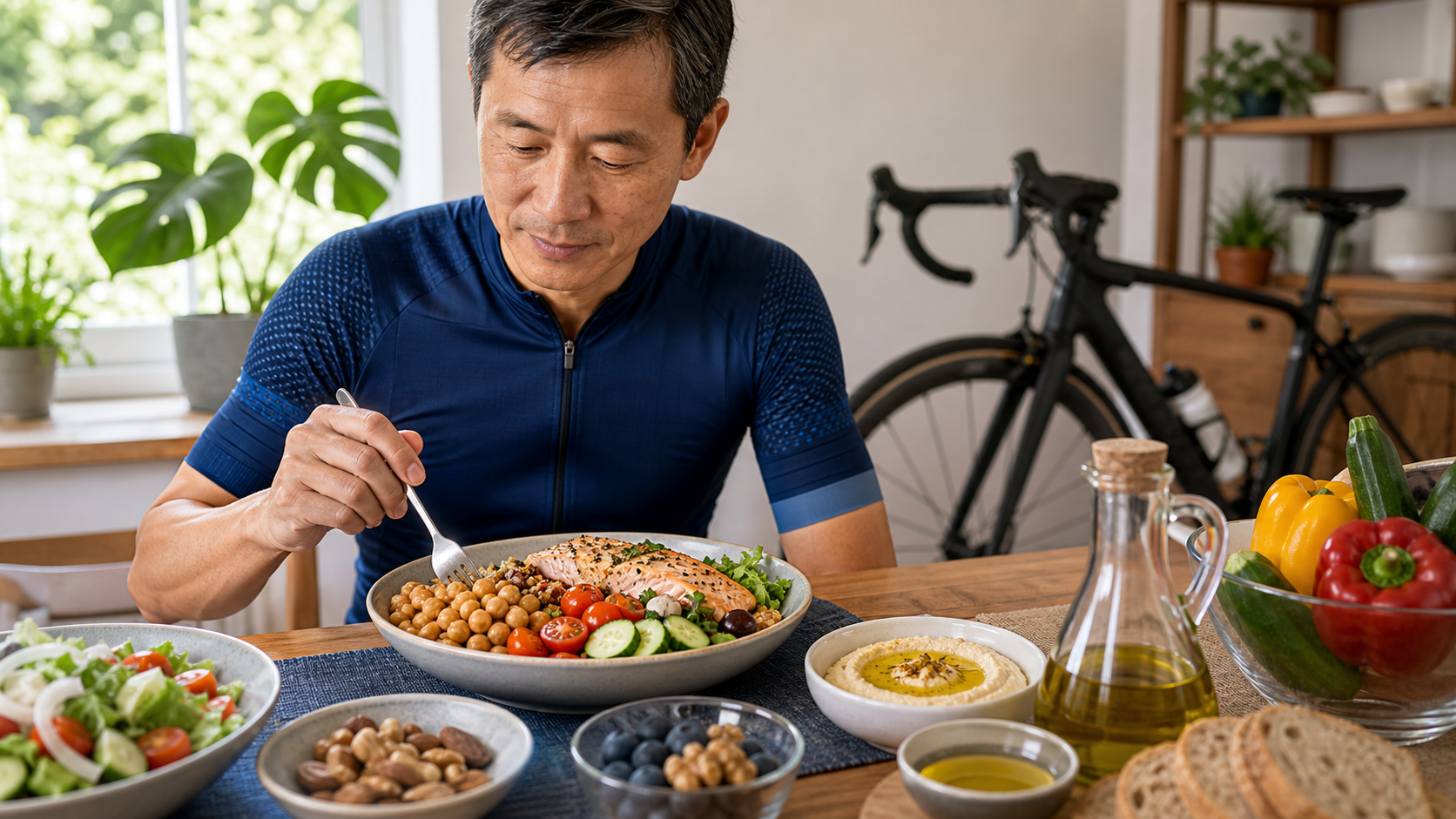
That time, I didn’t give him any supplement lists. The first thing I did was ask him to shift his diet “toward the Mediterranean”—not to fly to Greece the next day, but to move the center of his plate away from refined starches and processed meats, and toward vegetables, whole grains, legumes, nuts, olive oil, and moderate amounts of fish. Three months later, he stopped fading on the latter half of climbs, his sleep quality noticeably improved, and at his follow-up appointment, his doctor nodded approvingly at his lipid numbers.
In this article, I want to lay out that entire framework in full. The Mediterranean diet is not a trend label—it is one of the dietary patterns with the strongest evidence for cardiovascular disease prevention; and for athletes and regular exercisers, it serves both health and performance. More importantly, I’ll show you how to implement it practically in Taiwan, an environment where eating out is incredibly convenient but also incredibly easy to get wrong.
Let me be clear upfront: this article is educational content to help you build understanding and direction. Any decisions involving illness, medication, or individual health conditions should be discussed individually with your physician, dietitian, or physical therapist.
1. What Is the Mediterranean Diet? Debunking Three Misconceptions
When many people hear “Mediterranean diet,” what comes to mind is pasta, pizza, and red wine. That’s an impression skewed by marketing. The true traditional Mediterranean diet refers to the everyday eating patterns of people living around the Mediterranean—such as Crete in Greece and southern Italy—in the mid-twentieth century. Its core characteristics are:
- Abundant and varied vegetables, fruits, legumes, nuts, and seeds
- Whole, minimally processed grains as the staple (rather than refined white bread or white rice)
- Extra virgin olive oil as the primary source of fat
- Fish and seafood consumed moderately and regularly
- Poultry, eggs, and dairy (especially yogurt and cheese) in moderation
- Red meat and processed meats consumed rarely
- Added sugar and highly processed foods kept to a minimum
- Water as the main beverage, with red wine (if consumed at all) only in small amounts with meals
Let me help you debunk the three most common misconceptions:
Misconception 1: The Mediterranean diet means eating lots of pasta. Wrong. Its carbohydrates are primarily “whole, high-fiber, low-glycemic” foods. Pasta is only a supporting player in the traditional diet, and portions are far smaller than Taiwanese people imagine.
Misconception 2: The Mediterranean diet is a low-carb diet. Also wrong. It is actually a moderate-to-high carbohydrate eating pattern that is quite friendly to endurance athletes. The key is the quality of carbohydrates, not the quantity.
Misconception 3: The more olive oil, the better. Olive oil is good, but it is still a calorie-dense fat—one tablespoon (about 15 ml) contains roughly 120 kcal. It’s about “replacing bad fats with good fats,” not “adding unlimited fat.”
2. The Scientific Foundation: Why Is This Diet So Convincing for Health?
As a consultant, my first question about any diet is always: “How strong is the evidence?” In nutritional science, few dietary patterns can point to large-scale, long-term randomized controlled trials (RCTs) with real clinical endpoints (heart attack, stroke, death)—and the Mediterranean diet is one of the most thoroughly evidenced.
Large trials supporting its cardiovascular benefits include the Spanish PREDIMED series of studies. These studies consistently point in one direction: populations following a Mediterranean-style diet perform better in preventing cardiovascular events compared to those on a simple low-fat diet. Harvard’s School of Public Health Nutrition Source has also compiled this evidence trail (see references at the end).
Its health benefits can be understood through several mechanisms:
2-1 Anti-inflammatory and Antioxidant Effects
Vegetables, fruits, olive oil, and nuts are rich in polyphenols and other phytochemicals with antioxidant and anti-inflammatory properties. Chronic low-grade inflammation is common ground for cardiovascular disease, metabolic syndrome, and even the chronicization of some sports injuries. Shifting your diet toward an anti-inflammatory direction is like extinguishing a slow-burning fire inside your body.
2-2 Improved Blood Lipids and Vascular Function
Replacing saturated and trans fats with monounsaturated fats (from olive oil), combined with abundant soluble fiber, helps improve the blood lipid profile. This is why cases like Ah-Ming’s often show gratifying changes in lipid panels at follow-up after switching diets—of course, everyone responds differently, and the numbers should still be interpreted by a physician.
2-3 Gut Microbiota and Short-Chain Fatty Acids
A high-fiber, high-plant-diversity diet feeds a healthier gut microbiota and produces more short-chain fatty acids (SCFAs). In recent years, sports nutrition has placed increasing emphasis on the “gut–athletic performance” axis, and SCFAs are linked to energy metabolism and immune regulation.
2-4 Nitric Oxide and Blood Flow
Vegetables (especially leafy greens, beetroot, and similar) are rich in nitrates, which the body can convert into nitric oxide (NO), supporting vasodilation and blood flow efficiency. This is a tangible plus for oxygen delivery and metabolic waste clearance during exercise. It’s also why the sports science community has shown keen interest in high-nitrate foods like beetroot juice in recent years—it’s not exclusive to the Mediterranean diet, but since the Mediterranean diet “naturally includes a lot of vegetables,” it builds this benefit into daily life.
2-5 Don’t Credit a Single “Superfood”
I want to make one particular point: the power of the Mediterranean diet comes from the overall dietary pattern, not from any single magical ingredient. You often see olive oil, nuts, or berries singled out and hyped as “superfoods,” then sold to you as expensive extract capsules. But research repeatedly shows that the real health benefits come from “a long-term combination of an entire way of eating”—the synergy of vegetables, whole grains, legumes, good fats, fish, and minimal processing is far more reliable than any single supplement. As a consultant, this is the wasted money I most want to save you.
2-6 Quick Reference: Nutritional Roles of Common Foods
To give you a clearer picture, I’ve compiled the main physiological roles of core Mediterranean diet foods in sports physiology. This table isn’t meant to be memorized—it’s so that when you’re at the supermarket or the buffet line, you know “why you should pick this one”:
| Food Category | Representative Foods | Main Nutritional Contributions | Significance for Exercise |
|---|---|---|---|
| Leafy / colorful vegetables | Spinach, broccoli, tomatoes, bell peppers | Nitrates, vitamins, polyphenols, fiber | Blood flow, antioxidant defense, gut health |
| Whole grains | Brown rice, oats, quinoa, whole wheat | Slow-release carbs, B vitamins, fiber | Steady energy supply, glycogen replenishment |
| Legumes | Black beans, chickpeas, edamame, tofu | Plant protein, fiber, iron | Protein source, satiety, recovery |
| Deep-sea fish | Mackerel, salmon, Pacific saury, sardines | Omega-3, high-quality protein, vitamin D | Anti-inflammation, muscle repair |
| Nuts and seeds | Walnuts, almonds, chia seeds | Healthy fats, magnesium, vitamin E | Anti-inflammation, micronutrient support |
| Extra virgin olive oil | — | Monounsaturated fat, polyphenols | Anti-inflammation, cardiovascular protection |
| Fermented dairy | Unsweetened yogurt, kefir | Protein, calcium, probiotics | Gut microbiota, bone health, immunity |
3. Applicability for Athletes: Can the Mediterranean Diet Improve Performance?
This is the part I most want to explain clearly to those of you who train seriously. Let me give you the conclusion first: the direction of the evidence is positive, but don’t treat it as a guaranteed medal-winning miracle.
Recent systematic reviews and intervention studies I’ve verified suggest the Mediterranean diet may offer athletes the following types of benefits:
- Endurance and recovery: A vegetable-rich Mediterranean diet offers higher nitric oxide production potential; consuming it before exercise may support cardiopulmonary parameters, endurance, and high-intensity interval performance.
- Strength and power: Some studies have observed positive associations with metrics such as vertical jump height and grip strength.
- Immunity and recovery: Polyphenols, probiotics, vitamins A/C/D, and adequate carbohydrates jointly support the immune system, potentially helping athletes recover immunologically under high training loads.
- Speed of effect: Some viewpoints suggest that many individual nutrients in the Mediterranean diet can improve exercise performance within days, so the benefits of the overall dietary pattern may arrive faster than expected.
But I must honestly add: current research on “Mediterranean diet and athletic performance” still shows inconsistent conclusions. One paper specifically exploring “why the association is unclear” points out that differences in study design, populations, and adherence measurement methods make results difficult to compare directly (see references at the end). So my professional stance is:
Treat the Mediterranean diet as a foundational health and recovery base, not as a “performance hack” that replaces periodized nutrition, pre-race glycogen loading, or in-race fueling. It makes you more durable, helps you recover faster, and keeps you healthier—and these accumulate into long-term progress.
3-1 An Often Overlooked Key Point: Is Carbohydrate Intake Sufficient?
I’ve seen many people misread “Mediterranean diet” as “eat less starch,” only to hit a wall when training volume increases. For endurance athletes, the Mediterranean diet can—and should—provide adequate carbohydrates. The table below is a rough “daily carbohydrate per kilogram of body weight” range I commonly use in consultations, to give you a sense of direction (actual needs still require individualization):
| Training Scenario | Daily Carbs per kg Body Weight (g/kg) | Notes |
|---|---|---|
| Rest day / low-volume day | 3–5 | Focus on whole grains, legumes, root vegetables |
| Moderate training day (1–2 hours) | 5–7 | Moderate supplementation around training sessions |
| High-volume day (>2 hours endurance) | 7–10 | Deliberately increase grains and fruit portions |
| Pre-race glycogen loading | 8–12 | Short-term strategy, not daily practice |
Take a 65 kg cyclist on a 3-hour high-volume day as an example: carbohydrate needs may fall around 455–650 grams—this is absolutely not something “eating less rice” can achieve. The value of the Mediterranean diet is that you’re fueling with “quality carbohydrates that carry fiber and phytochemicals”—whole grains, fruit, legumes—rather than empty-calorie sugary drinks.
3-2 Anti-inflammation and Injury Recovery: An Often Underrated Value
If you ask me what the most underrated value of the Mediterranean diet is for “serious trainees,” I’d say anti-inflammation. Training itself is a controlled inflammation–repair cycle; moderate inflammation is a signal of progress. But if you’re chronically operating against a background of diet-induced inflammation (lots of refined sugar, trans fats, processed meats), your body’s repair systems are constantly “paying off old debts,” leaving little capacity to properly handle the new stress from training.
I once worked with a runner who had long-term chronic Achilles tendon discomfort. Her physical therapy and eccentric training were all on point, but recovery always lagged. After shifting her diet toward the Mediterranean pattern (significantly increasing deep-sea fish, vegetables, and olive oil, and cutting out daily sugary drinks and fried foods), she reported after a few months that “that tight, stuck feeling in the morning was noticeably reduced.” I’ll be honest: this is a subjective improvement, and multiple factors were likely at play—diet wasn’t the only variable, and the core treatment for tendon issues remains progressive loading and professional rehabilitation. But lowering the inflammatory background does give the body more capacity to repair—this is a reasonable, low-risk strategy.
Important reminder: for any persistent pain, swelling, or functional limitation, please have a physical therapist or sports medicine physician evaluate you. Don’t expect to “fix” structural problems through diet alone. Diet is supportive, not a substitute for treatment.
3-3 Omega-3 and Protein: Two Pieces of the Recovery Puzzle
The Mediterranean diet’s regular consumption of deep-sea fish provides omega-3 fatty acids that help regulate inflammation and support muscle repair. Combined with legumes, eggs, fermented dairy, and moderate poultry, protein sources are quite adequate. Using the common reference ranges for athletic populations:
| Population | Daily Protein per kg Body Weight (g/kg) | Notes |
|---|---|---|
| General healthy adult | 0.8–1.2 | Meets basic needs |
| Regular endurance athlete | 1.2–1.6 | Supports recovery and adaptation |
| Strength / muscle-building trainee | 1.6–2.0 | Better distributed across meals |
| Fat-loss phase (preserving muscle) | 1.6–2.2 | Needs to be higher under caloric deficit |
The Mediterranean diet can fully cover these ranges. The key is “distributing protein evenly across three meals” rather than eating one large piece of meat only at dinner. Taiwanese breakfasts are often protein-deficient (a rice ball and a milk tea on the way out the door)—this is one of the most common gaps I help students fix: add an egg, a cup of unsweetened soy milk, or a serving of yogurt, and recovery quality changes.
3-4 Comparison with Other Popular Diets
Students most often ask: “Coach, what about keto, low-carb, or intermittent fasting?” Let me use a table to capture the key points. Please note this is a general rule for the average exercising population; the suitability of any diet for a specific individual requires individual assessment:
| Diet | Carbohydrate Strategy | General Rule for Endurance Sports | Long-term Sustainability | My One-Line Verdict |
|---|---|---|---|---|
| Mediterranean diet | Moderate-to-high carb, quality-focused | Friendly; supports both fueling and recovery | High | Best foundational choice; easy to execute |
| Ketogenic diet | Very low carb, high fat | High-intensity fueling often limited | Low-to-moderate | Usable for specific purposes, not general |
| General low-carb | Low carb | High-volume training tends to hit a wall | Moderate | Fine short-term for fat loss; be careful with endurance |
| Intermittent fasting | Depends on content | Needs to be paired well with training timing | Moderate | It’s a “timing arrangement,” not “food quality” |
| Highly processed Western diet | Lots of refined sugar | High inflammatory background | — | This is the direction to move away from |
As you can see, the Mediterranean diet’s strength isn’t a single explosive point—it’s “not deducting points on any front and being sustainable long-term.” That’s exactly why it’s suitable as the dietary foundation for most athletic populations.
4. Practical Methods: Bringing the Mediterranean Diet to the Taiwanese Table
Science aside, let’s talk about the most important part—how to do it. Taiwan’s challenges are specific: a high rate of eating out, bentos heavy on starch and light on vegetables, sugary drinks everywhere, and a hot, humid climate that causes heavy sweating and electrolyte loss. Here are the practical strategies I actually use with my students.
4-1 A Taiwan-Style “Mediterranean Plate” Ratio
I don’t like making students obsess over precise calculations. Start with the “plate ratio” to capture the big picture—it’s far easier to sustain long-term than precisely counting calories:
| Plate Section | Proportion | Taiwan Local Examples |
|---|---|---|
| Vegetables (including dark leafy and colorful) | 1/2 | Blanched greens (light sauce), tomatoes, broccoli, mushrooms, cold cucumber salad |
| Whole grains / root starches | 1/4 | Brown rice, multigrain rice, sweet potato, pumpkin, whole wheat noodles |
| Quality protein | 1/4 | Mackerel, salmon, milkfish, tofu, chicken breast, eggs |
| Healthy fats | Moderate, with meals | Olive oil, avocado, a small handful of nuts |
| Beverages | Mostly water | Plain water, unsweetened tea; cut sugary drinks as much as possible |
4-2 Practical Swaps for People Who Eat Out
I know most of you don’t have time to cook every day. Here are concrete ways to “Mediterraneanize” common Taiwanese eating-out options:
- Bento boxes: Swap white rice for brown rice or halve the portion, add an extra serving of blanched vegetables, choose grilled fish or braised skinless chicken leg over fried pork chop, and ask for sauce on the side.
- Breakfast shops: Swap the egg pancake for a tuna version (light on mayo), change your drink from milk tea to unsweetened soy milk or an Americano, and add a serving of lettuce.
- Buffet-style自助餐: This is actually the easiest place in Taiwan to follow the Mediterranean diet—take two or three extra vegetable dishes, choose steamed fish or braised tofu, and switch white rice to multigrain.
- Convenience stores: Sweet potato, unsweetened yogurt, boiled eggs, salad (light dressing), small packs of nuts, and canned mackerel are all great allies.
- Hot pot: Load up on vegetables, mushrooms, seafood, and tofu; choose a clear broth; and use scallion, ginger, garlic, and chili in your dipping sauce instead of satay sauce with egg yolk.
4-3 One-Week Sample Menu (Training-Day Version)
This is a template I designed for a half-marathon runner. You can copy it and adjust to taste:
| Day | Breakfast | Lunch | Dinner (post-training) |
|---|---|---|---|
| Mon | Unsweetened yogurt + nuts + banana | Multigrain rice + grilled mackerel + double serving of blanched vegetables | Tomato tofu vegetable soup + sweet potato |
| Tue | Whole wheat toast + avocado egg | Buffet: brown rice + braised chicken leg + broccoli + mushrooms | Salmon pasta (lots of vegetables, tossed with olive oil) |
| Wed | Unsweetened soy milk + boiled egg + guava | Bento (half rice, add blanched vegetables) | Garlic stir-fried shrimp + quinoa + cold cucumber salad |
| Thu | Oatmeal + nuts + blueberries | Hot pot: clear broth, seafood, lots of vegetables | Milkfish soup + multigrain rice + stir-fried seasonal vegetables |
| Fri | Greek yogurt + chia seeds + fruit | Whole wheat sandwich (tuna, lettuce, tomato) | Grilled chicken breast + roasted vegetables (olive oil) + sweet potato |
Adjust portions according to your body weight and training volume—remember the carbohydrate table from earlier.
4-4 Taiwan’s Climate and Terrain: Using the Mediterranean Diet in Real-Life Conditions
The Mediterranean region is dry and hot; Taiwan is humid and hot. This difference is critical for “execution details.” In Taiwan’s summer, whether you’re on riverside bike paths, riding around the city, or climbing classic routes like Yangmingshan or Fengguizui, your sweat output far exceeds that of dry, cool regions. This brings two practical adjustments:
First, hydration and electrolytes can’t rely on daily diet alone. The Mediterranean diet’s daily sodium content is relatively low—an advantage for blood pressure and cardiovascular health—but for “two to three hours of sweating like rain,” you still need additional electrolytes and carbohydrates during exercise. Don’t mistake “eating light and healthy normally” for “no need to supplement sodium during exercise.”
Second, meals close to training should be easy to digest. In hot, humid conditions, gastrointestinal blood flow allocation is more strained. If you stuff yourself with a high-fiber, high-fat meal before training (the Mediterranean diet is inherently high in fiber), you’re likely to experience GI discomfort. My approach: keep everyday meals as Mediterranean as possible, but deliberately reduce fiber in the meal closest to training (one to two hours before), focusing on easily digestible carbohydrates—for example, white rice or white toast with banana. At that point, don’t agonize over “not being whole-food enough”; performance and GI comfort take priority.
4-5 A Pre-Race Scenario Case Study
Let me use a concrete scenario to clarify the boundary between “everyday Mediterranean” and “race nutrition.” Take a cyclist taking on a classic long-distance climbing race in Taiwan. Normally, I have him use the Mediterranean diet as a foundation—controlling inflammation and maintaining body composition. But in the three days before the race, the strategy shifts:
- 2–3 days before: Gradually increase the carbohydrate ratio (moving toward the high end of the carbohydrate table), while reducing fiber and raw/cold vegetable intake to avoid GI trouble on race day. At this point, brown rice can temporarily switch back to white rice, and vegetables should be cooked into easily digestible forms.
- Night before: Focus on familiar, easily digestible high-carb meals. Don’t try new foods you’ve never eaten before.
- Race morning breakfast: 2–3 hours before the start, eat easily digestible carbs (such as white toast, banana, or congee), avoiding high fat and high fiber.
- During the race: Regularly supplement carbohydrates and electrolytes according to time and intensity. Use energy gels and sports drinks as needed.
- After the race: Return to Mediterranean mode—vegetables, whole grains, quality protein, good fats, and plenty of fluids—to move the body from inflammation back to repair.
See, the Mediterranean diet isn’t about insisting on “all-natural” on race day. It provides a healthy “baseline nutritional background,” and you layer specialized sports nutrition strategies on top during competition. Keep those two things separate, and you won’t make the mistake of “starving yourself and losing speed during a race for the sake of health.”
5. Common Mistakes and Corrections
After years of coaching students, I’ve seen the same pitfalls countless times. Let me flag the landmines for you in advance.
Mistake 1: Treating “Mediterranean” as “Unlimited Olive Oil and Nuts”
These are good fats, but they’re extremely calorie-dense. Nuts should be about a small handful (20–30 grams) per day, and olive oil is for cooking and dressing—not for drinking. Correction: Fat is a supporting player; vegetables and whole grains are the stars.
Mistake 2: Thinking “As Long as I Eat Vegetables, It Counts,” Regardless of Variety
If you eat the same vegetable every day, the range of phytochemicals you get is very limited. Correction: Aim for a “rainbow plate”—rotate through red (tomatoes), orange (pumpkin), green (broccoli), purple (eggplant), and white (mushrooms).
Mistake 3: Cutting Carbs Too Aggressively, Hitting a Training Wall
Misreading the Mediterranean diet as low-carb is the most common mistake among endurance athletes. Correction: Go back to the carbohydrate table. On high-volume days, supplement as needed—with quality carbohydrates.
Mistake 4: Ignoring Taiwan’s Humid-Heat Electrolyte Loss
The Mediterranean diet itself is not high in sodium (which is an advantage for the general population), but in Taiwan’s summer, long-distance training causes heavy sweating. If you only drink plain water without electrolytes, you risk hyponatremia or cramping. Correction: For long-duration, heavy-sweat training, you still need moderate electrolyte and carbohydrate supplementation during exercise—you can’t rely on daily diet alone.
Mistake 5: Trying to Change Everything Overnight
Radical changes almost never last more than two weeks. Correction: Change one meal at a time, one habit at a time. Like Ah-Ming, shifting gradually over three months is what actually lasts.
Mistake 6: Thinking “Mediterranean” Means Buying Imported Goods
Many people immediately rush out to buy expensive imported extra virgin olive oil, imported berries, and imported whole grains—only to find their wallets can’t sustain it, and neither can the habit. Correction: The spirit of the Mediterranean diet is “local, seasonal, minimally processed.” In Taiwan’s context, that means using domestic mackerel, seasonal vegetables, brown rice, sweet potatoes, tofu, and edamame—these are cheap and effective. Buy olive oil that’s decent quality; the point is “replacing your old bad fats,” not chasing top-tier products.
Mistake 7: Focusing Only on Food, Neglecting Sleep and Training
Diet is one piece of the puzzle, not the whole picture. I’ve seen people perfect their diets while staying up late every night and training chaotically, then blaming the diet for not working. Correction: Diet, training, and sleep are multiplicative. If any one of them is zero, the total score is poor. The Mediterranean diet helps you nail the “nutrition” piece, but it can’t save you from chronic sleep deprivation.
6. Actionable Advice for Readers at Different Levels
For Exercise Beginners / People Who Want to Get Healthier
You don’t need to get it all right at once. Start with these three “minimum viable changes”:
- Swap sugary drinks for unsweetened tea or water—this single step has the highest health return.
- Add one extra serving of vegetables to every meal—no calculations needed; just increase the volume first.
- Replace half your white rice with brown rice or sweet potato—upgrade your starch quality first.
Just doing these three things consistently will produce noticeable results in two to three months.
For Advanced Athletes Training Regularly
Your focus is on “using the Mediterranean diet as a foundation, then layering periodized nutrition on top”:
- Use the Mediterranean plate as your daily baseline to ensure an anti-inflammatory and recovery foundation.
- Adjust carbohydrates according to training load (refer to the carbohydrate table); don’t be afraid of whole grains and fruit on high-volume days.
- Plan pre-race, in-race, and post-race fueling separately. Use sports drinks and energy gels when needed—don’t starve yourself during competition because you want to “eat natural.”
- Track subjective recovery, sleep, and training performance over the long term, and use the data to validate your direction of adjustment.
For Readers with Chronic Conditions or Health Concerns
If you have diabetes, hypertension, heart disease, kidney disease, or are taking medication, the Mediterranean diet is generally recognized as a healthy eating pattern in direction, but the details must be individualized. For example, those with impaired kidney function have special considerations for protein, potassium, and phosphorus intake; those taking anticoagulants need to confirm dark leafy vegetable portions (rich in vitamin K) with their physician. Taiwan’s National Health Insurance makes medical access convenient—please consult your physician or dietitian first, and let professionals give individualized advice based on your lab results and medication status. Don’t use internet articles (including this one) as a prescription.
7. Frequently Asked Questions (FAQ)
Q: With a limited budget, is the Mediterranean diet expensive?
A: Not necessarily. Legumes, brown rice, sweet potatoes, seasonal vegetables, eggs, and domestic mackerel are all relatively affordable. What’s genuinely expensive is imported extra virgin olive oil and nuts—but these are used in small amounts, and when spread out, they may not cost more than sugary drinks and late-night snacks.
Q: Do I have to drink red wine?
A: No. In the traditional diet, red wine is consumed in small amounts with meals and is part of a cultural context. From a health and athletic performance perspective, people who don’t already drink have no need to start for this reason—alcohol is a negative for sleep and recovery.
Q: Can vegetarians follow the Mediterranean diet?
A: Absolutely. Swap fish for legumes, tofu, tempeh, and eggs/dairy (if lacto-ovo vegetarian), and make sure to cover vitamin B12, iron, and calcium. A dietitian can help with the details.
Q: How long until I see results?
A: Subjective improvements in energy, digestion, and sleep are often noticeable within two to three weeks. Objective markers like blood lipids and body composition typically take several months and depend on training, with large individual variation.
Q: Can the Mediterranean diet help with fat loss?
A: It helps build better satiety and a better metabolic environment, but the foundation of fat loss remains energy balance. The Mediterranean diet lets you “eat healthily without getting overly hungry”—it’s an excellent framework for fat loss, but it’s not magic that makes you lose weight just by eating it.
Q: I don’t have time to cook and eat out for every meal. Can I still do this?
A: Yes. Taiwan’s buffet restaurants, hot pot places, and convenience stores actually hide a wealth of Mediterranean-friendly options. The key is “how you choose,” not “whether you cook.” Go back to the eating-out swap table in Section 4-2: halve the rice in your bento, add two extra vegetable dishes, choose steamed or grilled over fried for your main, and switch your drink to unsweetened—you’ve already done 80% of the work. You can eat very Mediterranean even eating out for every meal—that’s exactly why it’s sustainable in Taiwan.
Q: Do I have to take fish oil capsules to get omega-3?
A: Not necessarily. If you can regularly eat deep-sea fish (two to three times a week), getting it from food is usually sufficient—this is an advantage of the Mediterranean diet. Fish oil supplements are only worth considering in certain situations (for example, if you rarely eat fish or have specific clinical needs), and the dosage and necessity should be discussed with a physician or dietitian—don’t self-prescribe large amounts.
Q: Is this diet suitable for children and the elderly?
A: The Mediterranean dietary pattern is broadly friendly across age groups and is a direction the whole family can follow together. However, for elderly individuals with chewing, swallowing difficulties, or chronic conditions, the form of vegetables and protein (chopped, cooked soft) and portion sizes need adjustment; growing children also have different calorie and calcium needs. The principles are the same, but adjust the details to individual circumstances and consult professionals when necessary.
8. Making It a Lifelong Habit
Back to Ah-Ming’s story. He later told me that the biggest change wasn’t any particular number—it was that “he no longer felt like eating healthy was a punishment.” When he realized that adding two extra vegetable dishes at the buffet or halving the rice in his bento was all it took to follow the Mediterranean diet, it went from “white-knuckling through willpower” to “a routine thing you just do.”
This is the core idea I want to leave you with: the Mediterranean diet is powerful not just because of its evidence, but because it’s sustainable. It’s not extreme, it doesn’t forbid things, it doesn’t require you to weigh and count calories every day—yet it compounds over the long term for both health and athletic performance. For those of you who train seriously, the best diet is always the one you can eat for a lifetime.
Starting with your next meal, shift a little bit toward the Mediterranean. Three months from now, let your body tell you the answer.
Finally, here’s a closing reminder I often give my students: dietary adjustment isn’t an exam. There’s no “get it all right at once” standard answer, and no such thing as “one off-plan meal ruins everything.” Today, if you added an extra serving of broccoli at the buffet or swapped your milk tea for unsweetened tea, that was a successful Mediterranean-style choice. Treat every meal as a chance to start over. As long as the cumulative direction is right, the long-term compounding will happen naturally. What actually carries you to the finish line is never one perfect week—it’s years of “mostly getting it right.” That’s why I’ve always believed: for those of you who train seriously and want to live long and healthy, the Mediterranean diet deserves to be a lifelong foundational habit.
Disclaimer: This article is educational content and cannot replace individual diagnosis and treatment advice from a physician, physical therapist, or dietitian. If you have a chronic condition, are taking medication, or have special health circumstances, please consult a professional before adjusting your diet or training.
References
- Harvard T.H. Chan School of Public Health, The Nutrition Source — PREDIMED Study Retraction and Republication: https://nutritionsource.hsph.harvard.edu/2018/06/22/predimed-retraction-republication/
- The Mediterranean diet and cardiovascular disease (NCBI): https://www.ncbi.nlm.nih.gov/pmc/articles/PMC12713640/
- Why Is the Association Between Mediterranean Diet and Physical Performance in Athletes Inconclusive? Implications for Future Studies (PMC): https://pmc.ncbi.nlm.nih.gov/articles/PMC11755438/
- Impact of the Mediterranean Diet on Athletic Performance, Muscle Strength, Body Composition, and Antioxidant Markers (PMC): https://pmc.ncbi.nlm.nih.gov/articles/PMC11509905/
Related Reading
- Anti-Inflammatory Diets for Athletes: A Recovery Project That Starts with a Plate of Vegetables
- Diet for Hypertension and Exercise: A Practical Guide to the DASH Diet, Sodium-Potassium Balance, and Exercise Synergy
- Diet Periodization for Athletes: Aligning with Training Phases for a Triple Win in Performance, Body Weight, and Recovery
- Race-Week Nutrition Planning for Athletes: Glycogen, Gut Health, and Daily Plate Strategies for the Week Before Competition
CT暗黑廚房) 車友必備 宇宙無敵鮮蚵湯 幫助訓練恢復 天然食補 好市多 超肥鮮蚵 破PR
7 年前
靠單車減肥35公斤 心得分享與整理
7 年前
一個測試有沒有認真練車的方法😂 #公路車
10 個月前
西進武嶺 免費訓練分析服務 Intervals | 練不夠還是練過頭?你哪一種類型選手?AI模型告訴你! | 備戰神器 | 公路車 訓練 | CT Yeh
4 年前
風櫃嘴 | 全台最多大砲的單車路線 | 尋寶網攝影師告訴你怎麼擺拍起來才好看 | 熱門攝影地點巡禮
6 年前
單車 一日北高 ( 雙城 ) 肥宅雙人瘋狂行 紀錄片 REACTO
10 年前
水金九不厭五分 10度寒流冷到不願停!feat. 卡卡 / 公路車 / CT Yeh
6 個月前
16/02/16 - 夜訪中社路 緩慢進步中
10 年前