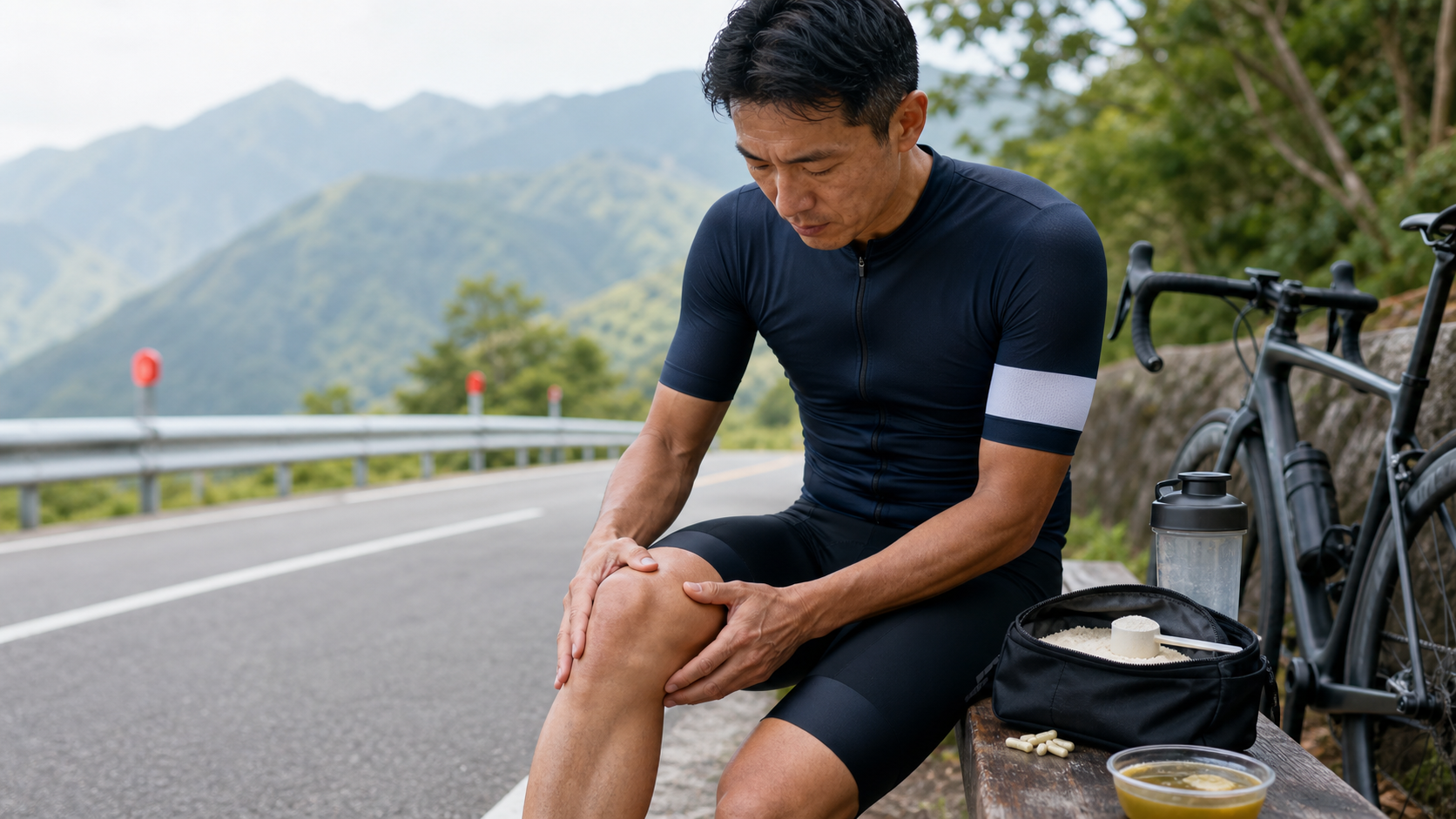
Starting with a Cyclist with a Grumpy Knee
I’ve been training athletes and general fitness enthusiasts for about fifteen years, and I’ve conducted over a thousand clinical consultations. If there’s one type of question I’ve heard so often I could recite it in my sleep, joint supplements are easily in the top three.
A few months ago, a cyclist in his early forties came to see me—let’s call him A-Hong. A-Hong rode three to four times a week, often logging over 100 kilometers on weekends, and was a regular at Wuling and Fengguizui. His issue: when pedaling downhill or standing up to sprint on long climbs, he’d feel a “clicking, dull” sensation on the inner side of his right knee, and the next day, going up and down stairs would still be uncomfortable. When he arrived, he was already carrying a big jar of glucosamine from a wholesale club, plus a collagen powder recommended by a friend, and asked me with a puzzled look: “Coach, which of these actually works? Which one should I take? Or should I take both together?”
This question seems simple, but it actually involves a whole framework of exercise physiology, nutrition, and sports medicine interpretation. Supplements aren’t just about taking something to feel better—either the evidence supports them, or you’re wasting your money and expectations. More importantly, many people treat supplements as the main event while overlooking the fundamentals that truly determine joint health.
In this article, I want to use the same tone I use with my athletes to explain the two most popular joint supplements—glucosamine and collagen—clearly: which side the evidence favors, what the physiological mechanisms are, how to take them, what common mistakes exist, and finally, a practical plan you can actually follow, tailored to different levels of athletes.
Setting the Foundation First: Joint “Pain” and Joint “Damage” Are Not the Same Thing
Before we talk about supplements, I always help my athletes clarify one concept first: Your knee being uncomfortable doesn’t necessarily mean your cartilage is worn down.
The sources of joint pain can be diverse—it could be poor patellar tracking due to weak quadriceps and glutes, overuse from improper saddle height and cadence settings on the bike, inflammation or degeneration of tendons (such as the patellar tendon or pes anserinus tendon), or it could genuinely be degenerative changes in the articular cartilage (osteoarthritis).
This matters because these two types of supplements—glucosamine and collagen—target different problems:
- Glucosamine: Traditionally used for cartilage issues in “osteoarthritis,” with the goal of slowing cartilage degeneration and reducing joint pain.
- Collagen: In recent years, sports science has focused more on its potential benefits for connective tissues like “tendons and ligaments,” as well as its effects on joint pain and function.
In other words, if your main problem is tendon overuse, gulping down glucosamine might not hit the spot; if your problem is clear cartilage degeneration, then collagen plays by a different logic. So the first thing I said to A-Hong was: “Don’t rush to decide which jar to take—we need to figure out what you’re actually dealing with first.”
Taiwan’s Healthcare Advantage—Don’t Leave It Unused
Here I want to give a special reminder to readers in Taiwan. Our National Health Insurance and the accessibility of orthopedics/rehabilitation medicine are among the best in the world. The threshold for getting an imaging study or a physical therapy assessment isn’t high. If your joint pain has persisted for more than two to three weeks, affects your daily stair climbing or sleep, or comes with swelling, locking, or noticeable weakness, please go get evaluated by an orthopedist or rehabilitation specialist first—rather than buying a bunch of supplements to try on your own. Supplements are at best an adjunct; they won’t replace a correct diagnosis.
The Science of Glucosamine: The Evidence Is More Ambiguous Than You Think
Glucosamine is an amino monosaccharide that the human body naturally synthesizes and is one of the raw materials for proteoglycans in the cartilage matrix. In theory, supplementing it can provide raw materials for cartilage repair—sounds reasonable, right? The problem is, between “sounds reasonable” and “actually works clinically” lies a whole gray zone of research evidence.
One of the most frequently cited large studies on glucosamine is the GAIT trial (Glucosamine/chondroitin Arthritis Intervention Trial), funded by the U.S. National Institutes of Health. It was a multicenter, double-blind trial with both placebo and drug controls, enrolling about 1,583 patients with symptomatic knee osteoarthritis, randomly assigned to glucosamine alone, chondroitin alone, both combined, an anti-inflammatory drug (celecoxib), or placebo, and followed for about 24 weeks (see references at the end).
The overall picture from this trial and subsequent meta-analyses is quite consistent: for the overall population, glucosamine’s pain-relieving effect is very limited, and most estimates don’t reach the clinically “noticeable” minimal important difference. One network meta-analysis even noted that on a 10-cm visual analog pain scale, the overall difference between glucosamine and placebo was only about -0.4 cm—a magnitude so small that patients usually can’t feel it themselves (see references at the end).
I know this is a bit jarring for people who have taken glucosamine for years and “feel it works.” So let me add a few honest caveats:
- Meta-analyses look at averages. An unclear average effect doesn’t mean “everyone” gets no benefit—it just means we can’t reliably predict in advance who will be the responder.
- Formulation and purity affect results. Some European studies used a specific prescription-grade crystalline glucosamine sulfate, which isn’t identical to the glucosamine HCl commonly found in stores—this is why different studies can come to conflicting conclusions.
- The safety profile is relatively good. Glucosamine has few overall side effects and isn’t dangerous for most people—but “safe” and “effective” are two different things.
So Should You Take Glucosamine or Not?
Here’s how I usually put it to my athletes: If you’re already taking it, feel it helps, it’s not a financial strain, and you have no relevant contraindications (e.g., watch the source if you have a shellfish allergy, monitor blood sugar if you’re diabetic, and consult your doctor if you’re on anticoagulants), then continuing is fine—treat it as a low-risk experiment. But if you’re still deciding whether to spend the money, and you expect it to “noticeably” relieve pain or “repair” cartilage, then I’d ask you to lower your expectations—your money might be better spent on more effective things, like strength training and weight loss.
I also want to flag something I repeatedly see in consultations—a psychological phenomenon: The placebo effect is especially strong in the joint pain domain. Pain is subjective and influenced by emotions and expectations. Many people start taking a supplement and “feel better,” and part of that likely comes from the psychological reassurance of “I’m finally doing something for my knees,” plus the fact that they usually adjust their activity levels at the same time. This isn’t a bad thing—the relief from placebo is a real experience—but it can make us overestimate the pharmacological effect of the supplement itself. So when someone tells me “I took it and it really works,” I don’t dismiss their experience, but I do remind them: how much of that “effect” comes from the supplement versus other things you did right at the same time is hard to separate. That’s also why I trust the average conclusions of randomized controlled trials more than any single person’s subjective testimony.
The Science of Collagen: Why Athletes Have Started Taking It Seriously in Recent Years
Collagen is the most abundant protein in the human body, found in tendons, ligaments, cartilage, skin, and bones. The commercially available “collagen peptides” (collagen peptide/hydrolyzed collagen) are collagen broken down into small-molecule peptides to facilitate absorption by the body.
The reason it has gained increasing attention in the sports world lies in the fact that it provides glycine, proline, and hydroxyproline—the amino acids particularly needed to build collagen—which theoretically can serve as raw materials for connective tissue synthesis.
In recent years, systematic reviews and randomized trials have provided some relatively positive, though cautiously interpreted, signals (see references at the end):
- In populations with degenerative arthritis, hydrolyzed collagen (common dosage around 10 grams daily for 3 to 6 months) has shown “mild” improvement in knee joint pain.
- In tendon-related studies, collagen peptides combined with resistance training have been observed to potentially increase tendon cross-sectional area and stiffness, with some studies showing greater pain reduction compared to exercise alone.
- One key detail: collagen synthesis requires vitamin C. Vitamin C participates in the hydroxylation of proline and lysine, serving as an essential cofactor for the formation of collagen’s helical structure and cross-links. This is why many sports science recommendations suggest taking collagen peptides together with at least about 50 mg of vitamin C.
Here, I also want to clarify the difference between “tendons” and “cartilage,” because it affects what expectations you should have for collagen. Tissues like tendons and ligaments, while relatively poorly vascularized and slow to repair, do respond clearly to “mechanical loading”—this is precisely why progressive resistance training can strengthen tendons, and why collagen supplementation has the opportunity to play a role as raw material. In contrast, articular cartilage has no blood vessels and has even more limited repair capacity. Expecting oral supplements to “grow back” worn cartilage is, based on current evidence, overly optimistic. Understanding this tissue-level difference explains why I am more optimistic about collagen’s signals for “tendons,” while remaining quite reserved about any supplement’s claims to “repair cartilage.”
I must be honest: most of this evidence still falls into the category of “mild effects, limited sample sizes, and needing more research to confirm”—not the kind of rock-solid, blindly recommendable strong evidence. But compared to glucosamine, collagen’s mechanism and signals for the “tendon connective tissue” pathway are actually more aligned with athletes’ real needs—because many athletes’ joint issues actually stem from overuse of tendons and ligaments, rather than purely cartilage wear.
A Frequently Overlooked Practical Key: “Timing”
One line of research suggests that consuming collagen peptides (e.g., around 15 grams) approximately 30 to 60 minutes before exercise may help deliver amino acid raw materials to tendon tissue that is under load. Because blood flow and synthetic signals in tendons are activated during exercise, providing raw materials at that moment theoretically gives them a better chance of being used where they’re needed.
This was one of the adjustments I later made for A-Hong: instead of fixating on glucosamine, I asked him to focus on the combination of “collagen + vitamin C + targeted strength training,” deliberately scheduled before cycling or training sessions.
An Easily Misunderstood Concept: Eating Collagen Does Not “Directly Become” the Cartilage in Your Knees
Let me break down a very common intuitive misconception. Many people think: “If I eat collagen, it will go directly to my knees and patch things up.” The actual physiological process is not that romantic.
The collagen you ingest is broken down into amino acids and small peptides in the digestive tract. After entering the bloodstream, the body decides where to use these raw materials based on its “current needs and signals.” In other words, simply providing raw materials does not mean the body will use them to repair your knees. What truly determines where the materials go is whether you give the tissue the signal that “this area needs repair”—and the most important source of that signal is “mechanical loading,” i.e., appropriate training stimulus.
This is why virtually all meaningful collagen studies are paired with resistance training or targeted loading. Think of supplements as “building materials delivered to the construction site,” and training as the “order to start work”; if you only deliver materials without giving the start order, the materials just pile up unused. I’ve used this analogy countless times with my clients, because it explains in one shot why “just taking powder without training” yields such poor results.
Practical Approach: Putting Supplements Back in Their Proper Place
At this point, I want to hammer in the most important concept: Supplements are the supporting cast; training and diet are the leads. No powder can replace the strength you need to build, the weight you need to lose, or the riding posture you need to correct.
The table below is how I prioritize joint care for general athletic populations. The direction for spending money and effort should be invested from top to bottom.
| Priority | Intervention | Impact on Joint Health | Practical Advice for Taiwan |
|---|---|---|---|
| 1 (Highest) | Lower-body strength training (quadriceps, glutes, core) | High, most solid evidence | Squats, split squats, bridges, single-leg deadlifts, 2x per week |
| 2 | Weight management (each 1 kg lost noticeably reduces knee joint load) | High | Control calories from eating out and sugary drinks; set a reasonable calorie deficit |
| 3 | Training load and posture management | Medium-high | Saddle height, cadence, weekly mileage increase no more than about 10% |
| 4 | Adequate protein and overall nutrition | Medium | Approximately 1.4–2.0 g protein per kg body weight, distributed across meals |
| 5 | Collagen peptides + vitamin C | Low to medium (newer signals) | Supplement before exercise; more reasonable when paired with strength training |
| 6 (Lowest) | Glucosamine | Low (overall weak evidence) | If already taking it with perceived benefit and low risk, can continue; not essential |
See the key point? I placed both popular supplements at the very bottom. This isn’t to say they’re worthless—it’s that if you haven’t nailed the top four items, the marginal benefit from supplements will be almost entirely drowned out.
A Concrete Reference Table for Dosage and Timing
If you decide to try supplements, the table below is the reference range I commonly give my clients. Please note: these are “general references,” not personal prescriptions. Consult a physician or dietitian before actual use, especially if you have chronic conditions or are taking medication.
| Supplement | Common Reference Dosage Range | Recommended Timing | Pairings/Populations to Note |
|---|---|---|---|
| Collagen peptides | Approximately 10–15 g daily | 30–60 minutes before exercise | Pair with at least about 50 mg vitamin C |
| Vitamin C | Approximately 50–200 mg | At the same time as collagen | Regular diet (guava, citrus) is often sufficient |
| Glucosamine | Approximately 1,500 mg daily | With meals | Watch source if allergic to shellfish; monitor blood glucose if diabetic; consult if taking anticoagulants |
I want to emphasize once more: these numbers are ranges, not precise magic figures. Everyone’s body weight, dietary baseline, and training volume differ—don’t treat a specific number as an ironclad rule you must hit.
A Beginner Lower-Body Strength Program for Knee Support
Since I keep saying strength is the real star, here’s a beginner program you can start right away. This is the most common starting version I give to cycling or running clients like A-Hong who have “mild discomfort but can still train normally.” No gym required—a pair of dumbbells or resistance bands at home is enough; if you have no equipment, bodyweight works too.
| Exercise | Primary Target | Sets × Reps | Coach’s Notes |
|---|---|---|---|
| Bodyweight or Weighted Squat | Quadriceps, Glutes | 3 × 10–12 | Don’t let knees cave inward; sit weight back into hips; no pain throughout |
| Rear-Foot Elevated Split Squat | Quadriceps, Glutes, Balance | 3 × 8 (each side) | Keep front foot planted firmly; control the eccentric phase slowly |
| Glute Bridge / Single-Leg Glute Bridge | Glute Max, Posterior Chain | 3 × 12 | Drive through the glutes; avoid lower back compensation |
| Single-Leg Romanian Deadlift | Glutes, Hamstrings, Stability | 3 × 8 (each side) | Move slowly; feel the hamstring stretch; don’t chase weight |
| Standing Calf Raise | Calves, Achilles Tendon | 3 × 15 | Important for runners to protect the Achilles; use full range of motion |
Execution principles: 2 sessions per week, on alternating days, with “no pain triggered throughout” as the highest rule. Spend the first four weeks refining movement quality before gradually adding load. I can say with confidence that this program’s protective effect on your joints far exceeds any supplement sitting on your shelf.
Diet: You Probably Don’t Need That Powder
Many people head straight to the supplement aisle when they think of “joint nutrition,” forgetting that your daily diet alone can provide most of the raw materials you need. I often joke with clients: “Instead of obsessing over which collagen powder brand, just eat enough protein at your three meals first.”
Starting with Taiwanese Meals and Eating Out
Taiwan’s food environment is actually not bad for joint nutrition—the key is knowing how to choose:
- Get enough protein, spread across meals: For the general athletic population, aim for about 1.4 to 2.0 grams of protein per kilogram of body weight. For a 70 kg person, that’s roughly 100 to 140 grams per day, distributed evenly across three meals. It’s not hard to hit this amount with Taiwanese eating out—add an extra piece of fish, a braised chicken leg, or a block of tofu at the buffet; convenience store tea eggs, unsweetened soy milk, and chicken breast are all good options.
- Natural sources of collagen: Meats with skin and tendon, chicken feet, pork tendon, fish skin, and slow-simmered bone or chicken broth are rich in collagen and glycine. Taiwanese braised snacks, chicken soup, and beef brisket dishes naturally contain these.
- Don’t skimp on Vitamin C: Guava, citrus, kiwi, and bell peppers are excellent sources, providing the cofactors needed for collagen synthesis. Taiwan has abundant fruit year-round—we’re fortunate in that regard.
- Omega-3 and an anti-inflammatory diet: Mackerel, Pacific saury, and salmon are rich in Omega-3, which helps the overall inflammatory environment. Cutting back on sugary drinks and reducing overly fried foods and refined sugar is itself a way of caring for your joints.
I often give clients a very practical self-check: Before thinking about what supplements to add, see if you can give up something that’s currently harming you. The most common pitfall for Taiwanese people is sugary hand-shaken drinks. One full-sugar drink a day, over the long term, places a burden on weight, inflammation, and metabolism that may silently cancel out all the effort you put into training and supplementation. Instead of spending money on supplements every month, first cut your hand-shaken drinks from one a day to one or two a week—this single change often delivers more direct and more cost-effective benefits for your joints and overall health than any supplement. I call this “stop the bleeding before tonifying”—the order can’t be reversed.
Practical Notes on Taiwan’s Climate and Terrain
Taiwan’s summers are hot and humid, making dehydration easy during long rides or runs, and dehydration will cause fatigue and form breakdown in the later stages of an event, indirectly increasing compensatory load on your joints. I often remind clients: joint care isn’t just about supplements—hydration, electrolytes, and post-training stretching and foam rolling all count.
Also, many people in Taiwan love riding riverside paths and mountain routes. The repetitive pedaling on long, flat riverside stretches and the eccentric load of long mountain descents are common sources of knee stress. Rather than trying to fix things afterward with supplements, it’s more practical to get your saddle height and cadence right beforehand (many people ride at too low a cadence with too heavy a gear, which puts the knees at a real disadvantage)—that’s more effective than any powder.
Common Mistakes and Fixes: The Six Pitfalls I See Most in Consultations
Over the years, I’ve seen too many people take the long way around on joint care. Here are the most common mistakes, compiled for you to check against.
Mistake One: Treating Supplements Like Painkillers and Pushing Through Acute Pain
Many people pop supplements aggressively the moment their knee hurts, then continue training as usual. The problem is, supplements are not painkillers, and they can’t repair the overuse that’s actively worsening right now. The correct approach: during acute pain, reduce volume or switch to pain-free alternative training, find the root cause, and give the tissue a chance to recover.
Mistake Two: Only Supplementing Nutrition, Never Training Strength
This is the most widespread pitfall. I’ve had clients spend thousands of dollars a month on supplements but refuse to do a single squat. Strong quadriceps and glutes protect the knee far more than any supplement. Supplements are at best the icing on the cake; strength is the horse.
Mistake Three: Misplaced Expectations, Especially with Glucosamine
As mentioned earlier, the overall evidence for glucosamine is weak. Piling a large budget and high expectations onto it often leads to disappointment. The fix: treat it as a low-risk, uncertain-efficacy experiment—not a lifeline.
Mistake Four: Taking Collagen Without Pairing It with Training and Vitamin C
The more meaningful signals for collagen tend to appear in contexts where it’s combined with resistance training. Simply drinking a scoop of powder daily while doing nothing else will greatly diminish the effect. The fix: collagen + Vitamin C + targeted strength training—all three together.
Mistake Five: Ignoring Body Weight, the Most Powerful Lever
For the knee joint, body weight is a very direct source of load. For every 1 kilogram lost, the force on the knee joint during walking and stair climbing decreases. For overweight athletes, the joint unloading from weight loss often outweighs all supplements combined.
Mistake Six: Chronic Disease Patients Self-Supplementing and Skipping Medical Care
If you have diabetes, high blood pressure, heart disease, or are taking anticoagulants, blood sugar-lowering, or other medications, supplements are not entirely risk-free and may interact with your drugs. For example, glucosamine’s effects on blood sugar, or certain supplements’ potential interference with clotting, require individualized assessment. These groups must consult their physician and pharmacist first—don’t treat internet recommendations as a prescription.
Actionable Advice for Readers at Different Levels
No single plan fits everyone. I’ve divided readers into three common scenarios—find where you fit.
If You’re a “Generally Active Person Without Obvious Joint Issues”
Congratulations—your focus is prevention over treatment.
- Schedule 2 lower-body strength sessions per week, starting with squats, split squats, and bridges.
- Eat enough protein, maintain a balanced diet, prioritize whole foods, and don’t skimp on Vitamin C.
- Progress training volume gradually, keeping weekly mileage increases to around 10% or less.
- Supplements? Optional. If you really want to invest, collagen peptides + Vitamin C is a more reasonable choice than glucosamine, but don’t put the cart before the horse.
If You’re an Athlete “Starting to Feel Mild Discomfort” (Like A-Hong)
Your focus is find the cause, strengthen the weakness, give the right signals.
- First, self-check your training setup: saddle height, cadence, running shoes, and whether your weekly increase is too aggressive.
- Strengthen targeted muscles, especially the quadriceps and glutes, to improve the joint’s mechanical environment.
- If you want to try supplements, collagen peptides (about 10–15 grams daily) + Vitamin C, taken before exercise and paired with strength training, observing for 8 to 12 weeks.
- If pain persists or worsens, don’t push through—get evaluated by a rehab or orthopedic specialist.
So what happened to A-Hong? I asked him to switch from a heavy gear while out of the saddle to a higher cadence, lower his saddle slightly, add two weekly glute and quadriceps sessions, and try collagen + Vitamin C before rides. About two months later, he reported that the “catching sensation” during descents and out-of-saddle efforts had noticeably decreased. I have to be honest: I can’t break down whether it was the supplements, the strength work, or the position adjustments—it was likely mostly the latter. But that’s exactly the point: joint care is a whole system, and supplements are just one small piece of the puzzle.
If You Are an Athlete with Established Joint Degeneration or Recurrent Pain
Your focus should be medical treatment first, individualized care, and supplements in a supporting role.
- First, have a physician evaluate you to confirm the nature of the problem (cartilage degeneration? tendinopathy? something else?).
- Under the guidance of your medical team, make strength training, weight management, and physical therapy (when necessary) the core of your approach.
- Supplements (whether glucosamine or collagen) serve as adjuncts; their effectiveness varies from person to person, so keep realistic expectations.
- If you have chronic conditions or take medication, check all supplements with your physician and pharmacist first.
Frequently Asked Questions (FAQ)
Q: Can glucosamine and collagen be taken together?
A: From a safety standpoint, most people can take them together without obvious issues. But you should understand that they don’t target exactly the same things, so don’t assume “taking both means double the effect.” Rather than taking both, it’s better to nail down your training and diet first.
Q: How long do I need to take them to know if they work?
A: These types of supplements typically need several weeks to months before you might see a difference; many studies use a 3- to 6-month observation window. If you feel absolutely nothing after two or three months, honestly, you can consider stopping and putting those resources toward something more effective.
Q: Is more expensive collagen powder always better?
A: Not necessarily. The key is an adequate dose and consistency, along with vitamin C and training. Rather than chasing premium brands, first make sure you’ve got the fundamentals in place.
Q: I’m allergic to seafood. Can I take glucosamine?
A: Some glucosamine comes from shellfish. If you have allergies, pay close attention to the source labeling, or choose a non-shellfish source, and consult your physician or pharmacist if needed.
Q: Can supplements replace seeing a doctor?
A: No. Supplements cannot replace a diagnosis. For joint problems that persist, worsen, or come with swelling or locking, please seek medical care.
Q: Can vegetarians supplement collagen?
A: Most commercially available collagen peptides come from animals (pork, beef, fish), so they are not suitable for vegans. Vegetarians can focus on adequate overall protein, vitamin C, and sources of glycine and proline (such as legumes and nuts combined with a balanced diet), and make sure your training stimulus is on point. Rather than obsessing over one specific amino acid, take care of your overall nutrition and training.
Q: I’m older—shouldn’t I take glucosamine to “protect my cartilage”?
A: Age does come with joint degeneration, but that doesn’t mean glucosamine will reverse it. For older adults, the better investment is regular strength training (to maintain muscle mass and balance and prevent falls), weight control, and a balanced diet. These do far more for maintaining mobility than supplements. If you want to try supplements, treat them as a low-risk adjunct, and remember to check with your physician about any interactions with your current medications.
Q: On days I don’t ride or run, should I still take collagen?
A: If you’re positioning collagen as a supplement to “pair with training load,” then its value is much lower on non-training days. Rather than making it a daily ritual of mixing a drink, align your supplementation timing with days when you have training stimulus. Of course, the evidence here is still accumulating, so don’t treat it as an ironclad rule.
A Counterexample: Not Everyone Needs Supplements
I want to use another client’s story as a lead-in before wrapping up, to give you a more concrete picture.
There was a female runner in her fifties, Xiao Hui, who came in driven by anxiety about “joint degeneration,” with three or four different supplements lined up on her table. But after my actual assessment, I found that her pain mainly came from a sudden spike in mileage over six months (jumping from 15 km per week to 40 km), plus obvious glute weakness causing compensatory running mechanics. What she really needed wasn’t a fifth supplement, but to pull her mileage back to a reasonable range, strengthen her glutes, and learn to progress gradually.
I asked her to stop most of her supplements (keeping one that she felt made a difference and was low-risk), and put the money saved toward a few running form and strength sessions. Three months later, her knee discomfort had almost disappeared, and her mileage had stably returned to over 35 km. The key takeaway from this case: supplements aren’t forbidden, but they’re often used as a substitute for the things that really need to be done—things that are harder and require more discipline. Recognize this, and you’re already halfway there.
Conclusion: Spend Your Money and Effort Where It Truly Works
Back to Ahong’s original question: “Coach, glucosamine or collagen—which one should I actually take?”
My answer is: Before you’ve nailed down the fundamentals of strength, weight, posture, and diet, this question isn’t actually that important. If you must choose, for athletes, the logic of collagen peptides paired with vitamin C and resistance training is closer to your actual needs than glucosamine. As for glucosamine, if you’re already taking it, feel it helps, and it’s low-risk, there’s no harm in continuing, but don’t expect too much from it.
Supplements have never been the main character in joint care. They’re the supporting actor standing behind strong muscles, healthy body weight, and proper training. Get your budget and attention priorities in the right order, and your joints will thank you more than they would any jar of powder.
Next time you’re hesitating in front of the supplement aisle, I hope this article gives you more confidence to make a choice—not led around by marketing, but knowing where the evidence stands.
This article is educational content and cannot replace individualized diagnosis and treatment advice from a physician, physical therapist, or nutritionist. If you have chronic conditions such as diabetes, hypertension, or heart disease, or are taking medication, please consult your medical team before using any supplement, and rely on individualized assessment.
References
- Clegg DO, et al. Glucosamine, Chondroitin Sulfate, and the Two in Combination for Painful Knee Osteoarthritis (GAIT trial). New England Journal of Medicine. https://www.nejm.org/doi/full/10.1056/NEJMoa052771
- Glucosamine, chondroitin, or placebo in patients with osteoarthritis of hip or knee: network meta-analysis. https://pubmed.ncbi.nlm.nih.gov/20847017/
- The effects of collagen peptide supplementation on body composition, collagen synthesis, and recovery from joint injury and exercise: a systematic review. https://pmc.ncbi.nlm.nih.gov/articles/PMC8521576/
- Collagen Supplementation on Tendon-Related Structural and Performance Outcomes: A Systematic Review. https://www.mdpi.com/2411-5142/11/1/130
Related Reading
- Collagen for Athletes: Tendons and Skin—A Complete Guide to the Evidence, Timing, and Dosage of Collagen + Vitamin C
- Magnesium Supplementation for Athletes: The Truth and Practical Guide to Cramps and Sleep
- Energy Gels and Bars Explained: Ingredients, Selection Logic, and a Complete Guide to DIY Recipes
- The Benefits of Glycine and Collagen Supplementation for Tendon Repair: Research on the Synergy of Vitamin C
一日北高/長距離團騎 常見問題補充篇 / 組團或跟團的眉角 / 壯車友容易被瘦車友慢性拉爆 / 原來屁股痛可能是這個原因...? / 風場配速法 / 公路車 / CT Yeh
2 年前
大家都在開箱的...單車用藍芽對講耳機真的有幫助嗎? SENA BiKom 20 長距離旅遊 & 海鷗繞圈賽 實際體驗心得 / 公路車 / CT Yeh
9 個月前
#公路車 #Fitting 靠人工智慧APP 幫你調整單車
6 年前
摔車後補裝備: 好市多新款單車安全帽& Specialized Romin 北高整路屁股都不痛的坐墊 | 一千元居然有MIPS | CT Yeh | 公路車
4 年前
一日北高常見問題大集合 | 攻略 | 路線 | 訓練 | 補給 | 自行車 單車 | 一日雙城 | 雙塔 | TWB北高360 | 屁股痛
6 年前
碟煞公路車 銑面器 !? 原來銑完差這麼多! 降低蹭碟機率! | TIME 公路車 保養小記錄 | CT Yeh
3 年前
單車 一日北高 ( 雙城 ) 肥宅雙人瘋狂行 紀錄片 REACTO
10 年前
大禹嶺 到 武嶺牌樓 全程前後實況錄影 | 北進武嶺 | 東進武嶺 | KOM | 訓練台 | 坡度分析 | Taiwan KOM Last 10 km HARD | 公路車
6 年前