Nutrition Time Management for the 9-to-5 Athlete: Even When You're Too Busy to Eat, You Can Still Make Your Training Pay Off
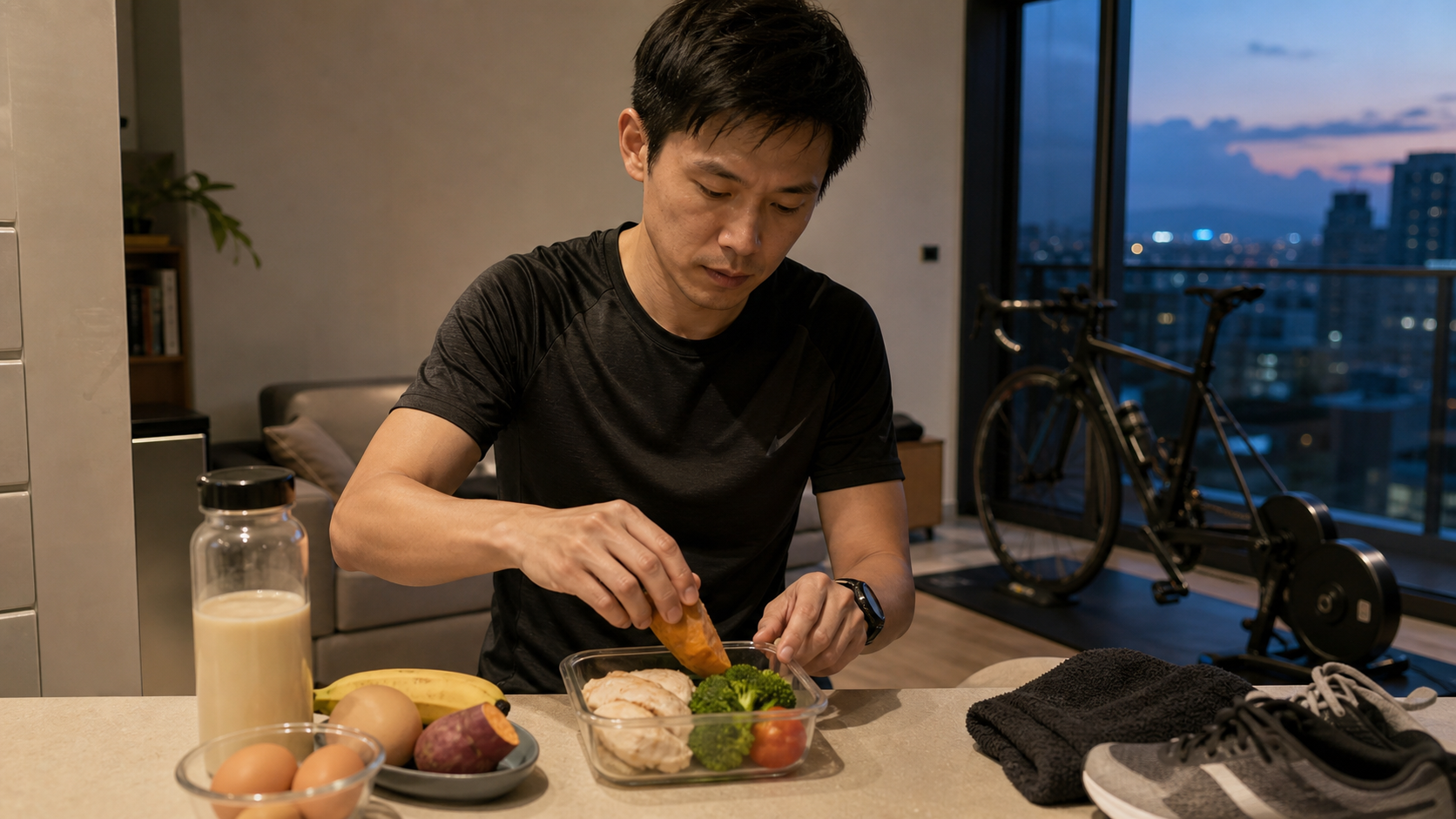
Opening: The Problem Is Often Not Your Training Plan, but “When You Eat and What You Eat”
I’ve coached athletes and general fitness enthusiasts for over fifteen years. In recent years, the most common type of client I see is the “commuter athlete”—someone who works in an office, at a science park, in a hospital, or on a construction site during the day, squeezes in one to two hours of training after work, and on weekends wants to push for a half marathon, a Taipei–Kaohsiung ride, or just squeeze out a few more watts. Almost all of them work hard, follow their training plans, and pile up the mileage, but their performance plateaus, recovery is poor, and their weight won’t budge in either direction.
One client who left a strong impression on me—let’s call him A-Kai. He was 36, an engineer, weighing about 72 kg. During the week he trained on the indoor trainer, and on weekends he ran long distances, but his power output was stuck near a plateau. When he first came to see me, all he could think about was, “Should I switch to a harder training plan?” I asked him to write down his “meal times” for a week. Here’s what he gave me: in the morning, he rushed to work with just a black coffee; at 12:30, a bento box for lunch; at 3 p.m., starving and shaky, he’d grab a pack of cookies; at 7:30 p.m., he’d train, then eat a big meal after 9 p.m.; and for a late-night snack, another serving of Taiwanese fried chicken.
I told him: “Your training plan isn’t the problem. Your nutritional time management is what’s holding you back.” After that, we didn’t change a single word of his training plan—we only rearranged how he ate each day, when he ate, and how he ordered when eating out. Three months later, his threshold power went up, the soreness after long runs was noticeably lighter, and his body fat dropped. This article is the complete write-up of the method I used with A-Kai and many other commuter-athlete clients.
To give you a clearer picture, I’ve put A-Kai’s before-and-after day side by side. You’ll notice that what changed wasn’t “eating some exotic foods,” but rather “when to eat, spreading out protein, and cutting the late-night snack”—seemingly ordinary yet critical details:
| Time Period | Before Adjustment (A Stalled Day) | After Adjustment (Rearranged Timeline) |
|---|---|---|
| Morning | Only a black coffee | 2 eggs + unsweetened soy milk + sweet potato, about 30 g of protein |
| Noon | Bento box, a couple of bites then off to a meeting | Bento box with recognizable whole-food protein + two servings of vegetables |
| Afternoon | Starving and shaky, a pack of cookies | A tea egg + a banana to tide over, eliminating the long gap |
| Before Training | Straight onto the trainer on an empty stomach | A banana for fuel |
| Evening | A big meal after 9 p.m. | A normal balanced dinner after training |
| Before Bed | A serving of fried chicken as a late-night snack | Late-night snack removed; everything needed was already spread across the day |
The key is this: the “types of food” in his day didn’t actually change much—what changed was the rhythm. Protein went from being concentrated in the evening to being spread throughout the day, the long afternoon gap was filled, he no longer trained on an empty stomach, and the late-night snack naturally disappeared (because he’d eaten enough during the day, so he wasn’t ravenous and out of control at night). That’s the power of nutritional time management—you don’t need a big overhaul, just the right timing.
Let me start with the most important point: for busy commuters, “nutritional time management” is more likely to be the bottleneck than “total nutritional intake.” It’s not that you don’t know you need protein or carbs—it’s that your work chops your day into fragments, so you often don’t eat when you should, and you binge when you shouldn’t. Get the timing right, and you’ll find that with the same effort, your body’s return on investment is completely different.
Concepts and Scientific Basis: Three Principles You Need to Understand First
Principle One: Protein Should Be “Spread Out,” Not “Stockpiled”
Many commuters eat protein like this: almost none at breakfast, average at lunch, and then one massive overload at dinner. That’s an inefficient way to eat. Muscle repair and synthesis (muscle protein synthesis) has a “saturation” characteristic when it comes to protein per meal—once a single meal exceeds a certain amount, the extra intake provides limited additional benefit for synthesis.
According to a widely cited review study, to maximize muscle protein synthesis, it’s recommended to consume about 0.4 g/kg of body weight of protein per meal, spread across at least four meals a day, bringing the daily total to about 1.6 g/kg of body weight or more (source listed in the references at the end). For a 70 kg person, that translates to roughly 28 g of protein per meal, four meals a day, starting at about 112 g per day.
The practical implication for commuters is straightforward: cramming 60 g of protein into one dinner does not equal splitting 20 g across breakfast, lunch, and dinner. Moving protein from “concentrated in the evening” to “evenly spread across three to four meals” is often the first—and most impactful—adjustment I make with my clients.
Principle Two: Carbs Should Be Aligned with “Training Timing”
Carbohydrates are the primary fuel for moderate-to-high-intensity training. They’re not the enemy; the key is placing them at the right time. The general principle is: the closer to training—and during and after training—the more you need easily digestible carbs; the farther from training and the lower your activity level (like a sedentary afternoon in the office), the more you can dial back carbs in favor of protein, vegetables, and good fats.
There’s also a reference range for fueling during training. For endurance exercise lasting over an hour, a common recommendation is about 30 to 60 g of carbohydrates per hour; for ultra-endurance events over three hours, well-trained athletes with adapted guts can push up to about 90 g per hour (source listed at the end). Daily carb needs depend on training volume; for non-elite endurance enthusiasts training one to three hours a day, the range is roughly 6 to 10 g per kg of body weight.
For commuters, this means: on easy days or rest days during the week, you don’t need to carb-load like it’s race week; but on days with quality sessions (intervals, long distance), you must give your body enough carbs before and after training. Letting carbs “follow the training plan” rather than staying the same every day is the key to having the energy to train while not easily storing fat.
I often use a very relatable analogy with my clients: carbs are like phone battery. If you’re going on a long trip tomorrow (quality session, long distance), you need to charge fully the night before and bring a power bank on the road (in-training fueling); if you’re just scrolling on your phone in the office today (sedentary, rest day), you don’t need to stay plugged in. Many commuters’ problem is “charging up like they’re going on a long trip every day,” so on sedentary days, excess starch slowly turns into stored fat; or the opposite—on quality-session days, they go out on an empty stomach in the morning, running on empty, and training quality naturally suffers. Letting carb portions fluctuate with the day’s “power usage”—once this concept clicks, many people see improvements in both body composition and training status simultaneously.
Principle Three: The “Window” Isn’t as Narrow as You Think, but “Going Too Long Without Eating” Is Real
In the past, everyone was obsessed with the “golden 30-minute post-training refueling window,” as if failing to down a whey shake within half an hour meant all was lost. Based on current understanding, this window is actually much more forgiving than imagined—if you’re eating regularly within a few hours before and after training, you don’t need to race the clock afterward.
But conversely, the real risk for commuters isn’t “missing the 30-minute window”—it’s “going too long without eating all day”: skipping breakfast, training then eating very late, or having six to seven hours between meals. Prolonged fasting leaves you without energy when you need to train, slows recovery afterward, and makes you more likely to binge at night. So what I tell my clients is: don’t obsess over that 30-minute window, but make sure you don’t have any “dangerous long gaps” during your day.
Principle 4: Taiwan’s Humid Heat Makes “Hydration and Electrolyte Timing” Even More Critical
I want to add this specifically for Taiwanese readers. Taiwan’s summers are hot and humid, with humidity often exceeding 70% or 80%. This reduces the efficiency of sweat evaporation for cooling. At the same training intensity, you’ll typically sweat more in Taiwan than in drier regions. For office workers, there’s also a hidden issue: you might sit in an air-conditioned office all day, get busy and forget to drink water, and by the time you leave work you’re already mildly dehydrated—then head straight to training.
I don’t like giving pseudo-precise numbers like “you must drink X liters per day,” because individual variation is huge. But here are some practical principles you can follow: keep a large water bottle at your desk during the day, and use the “seeing how much is left” method to remind yourself to take regular small sips; one to two hours before training, check that your urine is pale yellow rather than dark yellow; for summer training sessions lasting over an hour with heavy sweating, sports drinks or sodium-containing supplements maintain performance better than plain water, because you’re losing not just water but also electrolytes like sodium. If your body weight drops significantly after training, that’s mostly water—remember to replenish it gradually. Don’t treat hydration and electrolytes as trivial matters—in Taiwan’s summer, the performance decline and discomfort from dehydration arrive much earlier than you think.
Practical Method 1: Map Your Day as a “Nutrition Timeline”
The first step I take with my athletes is to have them plot their “work schedule” and “training window” on the same timeline, then mark out the periods for “eating, refueling, and tapering off.” Below are the three most common office-worker scenarios, with templates you can copy directly.
Scenario A: Training After Work in the Evening (Most Common)
This is the most typical pattern for Taiwanese office workers: work during the day, train at 7 or 8 PM. The key points are having a snack in the afternoon, consuming easily digestible carbs 60 to 90 minutes before training, and eating a normal dinner afterward.
| Time | Situation | What to Eat (Example for 70 kg) | Purpose |
|---|---|---|---|
| 07:00 | Wake up, go to work | 2 eggs + unsweetened soy milk + sweet potato or toast | ~25–30 g protein at breakfast; don’t just drink coffee |
| 12:30 | Lunch | Bento box (chicken leg/fish) + two vegetables + white rice | ~30 g protein, moderate carbs |
| 15:30 | Afternoon snack | Unsweetened yogurt + one piece of fruit, or tea egg + banana | Avoid the “dangerous long gap”; bridge to training |
| 18:30 | 60–90 min pre-training | Banana or onigiri + small amount of water | Easily absorbed carbs as fuel |
| 19:30 | Training | If over 60 min, supplement with sports drink/energy gel | ~30–60 g carbs per hour |
| 21:00 | Post-training dinner | Lean meat/chicken breast/tofu + rice + vegetables | ~30 g protein + carbs to replenish glycogen |
Scenario B: Early Morning Training (Morning Riders, Morning Runners)
Some athletes choose to train before work. The key here is: you don’t need to force down a big meal in the early morning, but you absolutely must eat a proper breakfast after training and before work to kickstart recovery.
| Time | Situation | What to Eat (Example for 70 kg) | Purpose |
|---|---|---|---|
| 05:30 | Wake up | One banana or a small cup of sports drink | A little fast-acting carbs; don’t train hard on an empty stomach |
| 06:00 | Morning training | Water only if under 60 min; supplement carbs if longer | Fuel based on duration |
| 07:30 | Post-training breakfast | Eggs + soy milk + sweet potato/oatmeal + fruit | ~30 g protein + carbs to replenish |
| 12:30 | Lunch | Normal balanced bento box | Spread out protein intake |
| 18:30 | Dinner | Protein + vegetables as the focus, taper carbs | Low evening activity; no need for excess carbs |
Scenario C: No Time at All—Relying on Convenience Stores and Takeout
Many athletes initially say, “I simply don’t have time to meal prep.” That’s fine—Taiwan’s convenience stores and takeout can actually make a pretty solid meal. Here’s your “convenience store tactical kit”:
- Protein sources: Tea eggs (about 7 g protein each; two = 14 g), unsweetened soy milk, ready-to-eat chicken breast packs, unsweetened yogurt, tuna onigiri.
- Carb sources: Sweet potato, onigiri, whole wheat toast, banana, oatmeal.
- Vegetables: Ready-to-eat salads, daikon radish and mushrooms from oden, lettuce.
- Sample meal: Ready-to-eat chicken breast + sweet potato + unsweetened soy milk + a salad—easily over 30 g protein, with both carbs and fiber covered.
Scenario D: Shift Workers (Nurses, Tech Industry Rotating Shifts, Service Industry)
Taiwan has a huge number of shift workers—healthcare, tech industry machine rotations, food service. Their schedules aren’t fixed daytime hours; they’re day-night reversed, with rosters changing weekly. Managing nutrition timing is trickiest for this group, but the principle is actually the same: it’s not about “what time it is,” but “where this meal falls relative to your wakefulness and training.”
What I have shift-working athletes do is think of the day in functional terms—“first meal after waking, main meal during shift, snack during shift, meal around training, pre-bed meal”—rather than being locked into breakfast/lunch/dinner. Treat the meal before a night shift as your “lunch” and eat it properly; bring your own protein snacks for during the shift (boiled eggs, unsweetened soy milk) so you’re not stuck eating instant noodles; and after training post-shift, have a balanced meal. The focus remains on spreading out protein, eliminating long gaps, and getting carbs around training—just swap the clock numbers for “positions relative to your schedule.” Shift workers typically have poorer sleep quality, so don’t add fuel to the fire with your diet—avoid heavy caffeine and excessive high-sugar, high-fat late-night snacks before bed. You’ll sleep better and recover better.
Case Study 2: Hsiao-Ling, the Frequent-Traveling Sales Manager
Let me share another case. Hsiao-Ling is a sales manager in her early forties, weighing about 58 kg. Two or three days a week she’s traveling to other cities to see clients and staying in hotels, while trying to maintain her running habit and manage her physique. Her frustration was that “everything falls apart on business trips”—business dinners, late-night snacks, going overboard on carbs at hotel breakfast buffets, then coming home feeling guilty, crash dieting, and her weight yo-yoing.
The adjustment I made wasn’t “no eating on business trips,” but rather treating travel as a predictable scenario and planning tactics in advance: at hotel breakfast, prioritize eggs, unsweetened soy milk or milk, and greens, with moderate carbs instead of piling on; at business dinners, eat protein and vegetables first, sip alcohol lightly, and cut the portions of the most tempting fried foods and desserts in half; always keep a few packs of whey protein and a small bag of nuts in your luggage as a rescue for long gaps. Three months later, she stopped yo-yoing, and her weight fluctuation during travel weeks shrank from two to three kilograms to nearly flat. Her takeaway was: “It turns out I didn’t need to be perfect—I just needed a minimum standard I could stick to even in bad situations.” That’s exactly the key I want to give all busy readers—nutrition timing isn’t about perfection; it’s about the baseline you can still hold on your busiest, messiest days.
Practical Method 2: Weekly Meal Prep—Outsource the “Decisions” to Your Sunday Self
The office worker’s biggest enemy is “decision fatigue” in the moment—after a long day, you can’t be bothered to think about what to eat, let alone cook, so you just order takeout or grab late-night snacks. The solution is moving the decisions to the weekend, using meal prep to make weekday choices simple.
I don’t have athletes prep seven days at once and drive themselves crazy. My recommendation is “semi meal prep”: only prep the two components most likely to fall apart—the protein staple and the carb staple—and handle vegetables by blanching them fresh that day or buying ready-to-eat options.
Sunday Two-Hour Meal Prep Checklist
| Item | Batch Size | Storage Method | Purpose |
|---|---|---|---|
| Sous-vide/pan-seared chicken breast, braised chicken legs | 5–6 servings | Refrigerate for 3 days, freeze for longer | Main protein for each meal |
| Hard-boiled eggs | 8–10 eggs | Refrigerate | Quick protein for breakfast/snacks |
| Steamed sweet potatoes, brown rice | 5–6 portions, portioned | Freeze in portions | Carbs for training days |
| Blanched broccoli/okra | 3–4 servings | Refrigerate | Add fiber and micronutrients |
Once these are portioned out, weekdays become “grab three containers, microwave, serve” — a five-minute meal with almost zero decision cost. This is the single most effective strategy I’ve seen for busy clients, bar none.
I also want to debunk a meal-prep myth: Meal prep does not mean “every meal is the same bland boiled food until you question your life choices.” Many people try a flavorless diet bento once and never want to meal prep again. In reality, you can absolutely nail the seasoning — marinate chicken breast with a bit of salt koji or soy sauce and garlic before searing, swap sweet potatoes for pumpkin or alternate with brown rice, and pair with different vegetables daily. The point of meal prep is “have the staples ready and save the decisions,” not “make eating miserable.” A meal-prep plan you can actually eat and sustain is a good one. I usually ask clients to start with just three days’ worth, maintain it for two to three weeks, confirm they can stick with it and it genuinely saves time, and only then consider extending the batch. First make it sustainable, then make it more efficient — never reverse that order.
A Note on Meal Prep in Taiwan’s Climate
Taiwan’s summers are hot and humid, and prepped food spoils easily at room temperature. Be sure to: refrigerate promptly after cooking and cooling, use an insulated bag for packed lunches, and thoroughly reheat overnight seafood and rice dishes before eating. Gastroenteritis will sideline your training for days — it’s simply not worth it.
Practical Method 3: How to Order When Eating Out Without Falling Off Track
Taiwan is a paradise for eating out, which is both a temptation and an opportunity. Instead of telling clients “don’t eat out,” teach them to pick the right combinations from existing options. Here’s the “eating-out ordering logic” I often share.
- Buffet-style cafeteria/bento box: First pick one or two proteins that still look like whole foods (braised chicken leg, grilled fish, braised egg, tofu), then add two vegetable sides. White rice is fine in normal portions, adjusted up or down based on that day’s training load. Avoid thickened sauces, fried items, and mixed stews where you can’t identify the ingredients.
- Noodle shops: Soup noodles beat dry noodles (less oil), then add an order of blanched vegetables and a braised protein side (dried tofu, egg, chicken gizzard).
- Breakfast shops: Upgrade “egg crepe + milk tea” to “egg crepe/vegetable egg crepe + unsweetened soy milk + extra egg or tuna” — protein goes up immediately.
- Hot pot: Actually a great option — plenty of vegetables, controllable protein (meat platters, seafood, tofu), and use scallion, garlic, and white vinegar for dipping instead of heavy satay sauce with egg yolk.
- Bubble tea shops: This is the invisible calorie and sugar black hole for office workers. Switch to unsweetened or lightly sweetened, and cut “one a day” down to “a few times a week” — just this one change drops body fat for many clients.
To make it easier to apply, I’ve put together a “common order vs. upgraded order” comparison for typical eating-out scenarios. You can reference it directly next time you order:
| Eating-Out Scenario | Common Order | Upgraded Order |
|---|---|---|
| Breakfast shop | Egg crepe + large iced milk tea | Vegetable egg crepe with egg/tuna + unsweetened soy milk |
| Noodle shop | Large dry noodles + braised pork rice | Soup noodles (regular portion) + blanched vegetables + braised egg and dried tofu |
| Buffet cafeteria | Three fried items + large white rice | Braised chicken leg/grilled fish + two vegetables + moderate rice |
| Convenience store | Instant noodles + sugary drink | Ready-to-eat chicken breast pack + sweet potato + unsweetened soy milk |
| Business dinner | Drinking alcohol with fried appetizers first | Eat protein and vegetables first, cut fried food and dessert in half |
I often tell clients: Eating out doesn’t mean becoming an ascetic — it means asking yourself two questions at every meal: “Where’s my protein, and where are my vegetables?” If you can answer those two, you’ve already won half the battle. Taiwan’s eating-out options are overwhelming, and that’s actually a good thing — you can find a “passable” combination almost anywhere. What’s missing is just the habit of asking yourself those two questions.
Common Mistakes and Fixes
Having coached so many office workers, I’ve found the pitfalls are highly repetitive. Here’s a table of the most common mistakes and their corresponding fixes — check how many you’ve hit.
| Common Mistake | Why It’s a Problem | My Suggested Fix |
|---|---|---|
| Only black coffee for breakfast | Protein distribution is off all day; low energy in the morning | Always add 25–30 g protein at breakfast (eggs, soy milk, yogurt) |
| Getting all protein in one dinner | Too much in a single meal; poor synthesis efficiency | Spread across three to four meals, roughly 0.4 g/kg per meal |
| Training fasted with no fuel | No fuel, quality sessions suffer, more fatigue | Eat easily digestible carbs 60–90 minutes before training |
| Eating too late after training | Slower recovery, higher risk of late-night bingeing | Eat a normal balanced dinner after training; don’t delay until late night |
| Same carb intake every day | Overeating on rest days, underfueling on training days | Match carbs to the training schedule — more on quality days, less on rest days |
| Compensating with late-night fried chicken | Calorie blowout, worse sleep | Spread proper meals across the day so you’re not starving at night |
| Prepping seven days at once and burning out | Unsustainable, easy to quit | Only half-prep protein and carb staples; handle vegetables the same day |
| Treating bubble tea like water | Invisible sugar and calorie black hole | Switch to unsweetened/lightly sweetened, reduce frequency |
Special Note: Supplements Aren’t the Priority — Don’t Get It Backwards
Many office-worker clients immediately ask, “Should I take whey? BCAA? Is creatine useful?” My stance has always been: Get your three meals’ timing and content sorted first; supplements are the last detail to consider. Whey protein is a convenient tool for busy people (great for quickly adding a protein serving when pressed for time), but it’s a “food substitute,” not the main event. Any supplement should be discussed with a doctor or dietitian first if you have a chronic condition, are on medication, or are pregnant or breastfeeding.
To help everyone avoid wasting money and prevent random supplementation, I’ve organized the supplements office workers ask about most into a table with their “practical positioning for busy people.” Please note this is general educational information, not an individualized prescription — consult a professional based on your own situation before use.
| Item | Positioning for Busy Office Workers | Reference for When to Use | Reminder |
|---|---|---|---|
| Whey protein | A “food substitute” for quickly adding protein when pressed for time | Breakfast/snacks/post-training to hit roughly 0.4 g/kg per meal | Eat real food when you can; it’s a convenience tool |
| General carb supplements (sports drinks, energy gels) | Fuel for sessions over an hour | 30–60 g carbs per hour during training | Not needed during normal sedentary hours |
| Caffeine | Alertness and focus; many office workers already drink it | Before training, but avoid too close to bedtime | Excess or late-day intake harms sleep and recovery |
| Comprehensive electrolytes | Maintaining status during heavy summer sweating | Long sessions in high heat with heavy sweating | Water is fine for short regular sessions; don’t treat it as a daily health tonic |
My one-sentence summary on supplements: They’re small tools that make an already-planned nutrition schedule run more smoothly — not a miracle cure for a chaotic diet. Get the order right, or you’ll spend money with nothing to show for it.
Action Recommendations for Readers at Different Levels
Everyone’s level of busyness and training stage differs. I’ve divided the action recommendations into three tiers — start wherever fits you best; there’s no need to do everything at once.
Beginner: Just Do These Three Things
- Add protein to breakfast: No matter how rushed, always include eggs, soy milk, or yogurt at breakfast to hit 25–30 g of protein.
- Eliminate dangerous long gaps: Don’t go more than five to six hours between any two meals; keep a tea egg or fruit on hand for the afternoon.
- Eat a banana before training: Stop training on an empty stomach — have easily absorbed carbs 60 minutes before your session.
Just these three things noticeably improve training energy and recovery for many sedentary office workers.
Intermediate: Start “Mapping Your Timeline” and “Semi-Prep”
- Following scenarios A/B/C above, map out your day on a nutrition timeline, noting the protein target for each meal.
- Spend two hours on Sunday doing semi-prep, portioning out protein and carbohydrate staples.
- Let carbs follow your training plan: on quality workout days, eat more carbs before and after training; on rest days, scale back.
Advanced: Precision and Periodization
- Estimate your daily targets based on body weight: protein starting at roughly 1.6 g/kg, carbs ranging from 6–10 g/kg depending on training load.
- Train your “gut adaptation” for long-distance events: practice consuming 30–60 g of carbs per hour during long sessions (advanced athletes can try up to 90 g) so your stomach doesn’t act up on race day.
- Track and fine-tune: monitor your weight, training feel, and sleep for two to three consecutive weeks, then adjust portions based on trends rather than obsessing over daily numbers.
FAQ
These are the questions I get asked most often during consultations, compiled here for you.
Q1: I want to lose fat. Should I avoid carbs before and after training?
This is a common misconception. The key to fat loss is “total daily calories and protein,” not “cutting carbs around workouts.” Removing carbs before and after training often leaves you feeling weak and reduces workout quality, making your training less effective. A better approach is to concentrate carbs in the periods around training where they’re actually needed, scale back carbs during sedentary periods far from training, and keep your daily total within a reasonable range. This way, you can train well and still lose fat.
Q2: If I finish training late and eat dinner after 9 PM, will I gain weight?
“When you eat” isn’t the main cause of weight gain; “how much you eat all day” is. Your body needs replenishment after training, so having a balanced meal at that time (protein + moderate carbs + vegetables) is reasonable. What actually causes weight gain is usually the extras added on top of that post-training meal—things like fried chicken, late-night snacks, or sugary drinks. Eating your proper meals well and cutting out the extra late-night snacks is far more useful than stressing over what time you eat.
Q3: I really have no time to meal prep at all. What should I do?
Then use the convenience store strategy from Scenario C and the self-prepared snacks from Scenario D. You don’t need to cook—Taiwan’s convenience stores can easily provide a complete meal like a ready-to-eat chicken breast pack + sweet potato + unsweetened soy milk + salad. Meal prep is an “easier advanced version,” not a requirement—start by simply asking yourself at every meal, “Where’s the protein? Where are the vegetables?”
Q4: How can vegetarian/lacto-ovo vegetarian office workers get enough protein?
It’s totally doable, but it requires more conscious effort. Soy milk, tofu, dried tofu, tempeh, edamame, eggs (for lacto-ovo), unsweetened yogurt, whey, or plant protein powder are all good sources. Since the amino acid profile of individual plant proteins isn’t as complete as animal proteins, vegetarians need to pay extra attention to “source variety” and “hitting total daily intake,” keeping each meal’s protein target in mind.
Q5: Do I have to weigh every meal in grams? That sounds exhausting.
No, you don’t. Weighing is a tool for advanced athletes to calibrate short-term, not a long-term lifestyle. For most office workers, I teach “hand-portion estimation”: one serving of protein is about the size of your palm, one serving of carbs is about a fist, and vegetables should be as plentiful as possible. Once you get the feel for it, you won’t need to weigh daily. For nutrition time management to be sustainable long-term, simplicity and consistency matter far more than precision.
An Important Note on Health and Seeking Medical Care
Office workers often have accompanying health conditions—high blood pressure, prediabetes, high cholesterol, digestive issues, and more. Here, I must remind you of a few things in a very cautious tone.
If you have diabetes or blood sugar issues, the type, amount, and timing of carbs must be highly individualized. In particular, fueling before and after training directly affects blood sugar, so be sure to discuss this with your physician and dietitian—don’t blindly copy any general carb advice. If you have high blood pressure or a history of heart conditions, the sodium content of eating out and your training intensity arrangements both require professional evaluation. Taiwan’s National Health Insurance makes seeing a doctor very convenient; family medicine, endocrinology/metabolism, and cardiology departments can all provide initial assessments. Many hospitals also offer nutrition consultation clinics—making good use of these resources is far safer than figuring things out on your own online.
Additionally, if you experience persistent dizziness, heart palpitations, unusual fatigue, or gastrointestinal discomfort after adjusting your diet, stop and seek medical attention—don’t “push through and finish the workout plan.” Athletic performance can always be built up gradually, but your health baseline is not something to gamble with.
Conclusion: Get the Timing Right, and Your Efforts Won’t Be Wasted
Let’s return to A-Kai from the beginning. We didn’t change a single word of his training plan—we just rearranged “how he ate throughout the day”: added protein to breakfast, added a snack in the afternoon to eliminate the long gap, gave him a banana before training, a proper meal after training, semi-prep on Sundays, and taught him to ask “where’s the protein?” when eating out. Three months later, he told me himself: “Turns out I wasn’t not working hard enough—I was spending my effort eating the wrong things at the wrong times.”
For busy athlete-office workers, this is exactly the core message I want to convey: You’re already working hard—don’t let nutrition timing hold your training back. You don’t need to become a nutrition expert, and you don’t need to weigh every gram of food every day. All you need is to get a few key time points right—protein at breakfast, no dangerous long gaps, carbs following your training plan, weekend semi-prep, and knowing how to pick the right combinations when eating out.
Turn these into habits, and you’ll find that with the same training volume, your body’s return on investment is completely different. Being busy isn’t an excuse for not eating well—it’s exactly the reason you need to manage your nutrition timing better. Start with tomorrow’s breakfast: add an egg.
This article is for educational purposes and does not replace individual diagnosis or treatment advice from a physician, physical therapist, or dietitian.
References
- Morton et al. review on per-meal protein quantity and daily distribution (~0.4 g/kg per meal, ≥1.6 g/kg daily): https://jissn.biomedcentral.com/articles/10.1186/s12970-018-0215-1 (Full text PMC: https://pmc.ncbi.nlm.nih.gov/articles/PMC5828430/ )
- International Society of Sports Nutrition (ISSN) position stand on nutrient timing: https://pmc.ncbi.nlm.nih.gov/articles/PMC5596471/
- Nutrition review on carbohydrate fueling for endurance exercise (30–60 g/hour, up to 90 g for prolonged efforts): https://www.tandfonline.com/doi/full/10.1080/02640414.2011.610348
Related Reading
- Athlete Meal Prep in Practice: A Complete Guide to Efficiency, Nutritional Balance, Storage, and Variation
- Sample Weekly Meal Plan Design for Athletes: A Complete Practical Guide from Weekly Structure to Training Day Adjustments
- Athlete Recovery Day Nutrition: How to Eat on Rest Days to Preserve Your Hard-Earned Gains
- Athlete Daily Meal Structure: Eating Right Without Weighing (A Complete Practical Guide to the Plate Method)
西進武嶺 免費訓練分析服務 Intervals | 練不夠還是練過頭?你哪一種類型選手?AI模型告訴你! | 備戰神器 | 公路車 訓練 | CT Yeh
4 年前
CT暗黑廚房) 車友必備 宇宙無敵鮮蚵湯 幫助訓練恢復 天然食補 好市多 超肥鮮蚵 破PR
7 年前
靠單車減肥35公斤 心得分享與整理
7 年前
一日北高/長距離團騎 常見問題補充篇 / 組團或跟團的眉角 / 壯車友容易被瘦車友慢性拉爆 / 原來屁股痛可能是這個原因...? / 風場配速法 / 公路車 / CT Yeh
2 年前
CT趣訪 西進武嶺 2小時組 EP2 全村的希望 蔣緯緯! 訓練菜單&技巧公開 |公路車 |CT Yeh
4 年前
一日北高前的高裝檢 | 北高 360 | 挑戰11小時的裝備 | 一日雙塔 | 補給
6 年前
一日北高常見問題大集合 | 攻略 | 路線 | 訓練 | 補給 | 自行車 單車 | 一日雙城 | 雙塔 | TWB北高360 | 屁股痛
6 年前
實景訓練台) 彰化經典百K 高強度喵團 90分鐘 跟著一起練功 2019 Indoor workout Changhua Classic 100 Taiwan
7 年前