Nutrition for Young Athletes in the Growth Period: Why "Eating Enough" Matters More Than "Eating Right," and the Reasons Not to Over-Restrict
Opening: The Eighth-Grade Girl Who “Got Leaner, Got Weaker, and Lost Her Edge”
I’ve coached youth athletes for about fifteen years—cyclists, runners, triathletes, and swimmers. Over the years, the question parents ask me most isn’t “Should my kid take whey protein?” or “Should we buy energy gels?” It’s something more fundamental, and more troubling to me—the situation where a kid is training hard, yet their performance plateaus, or even gets worse.
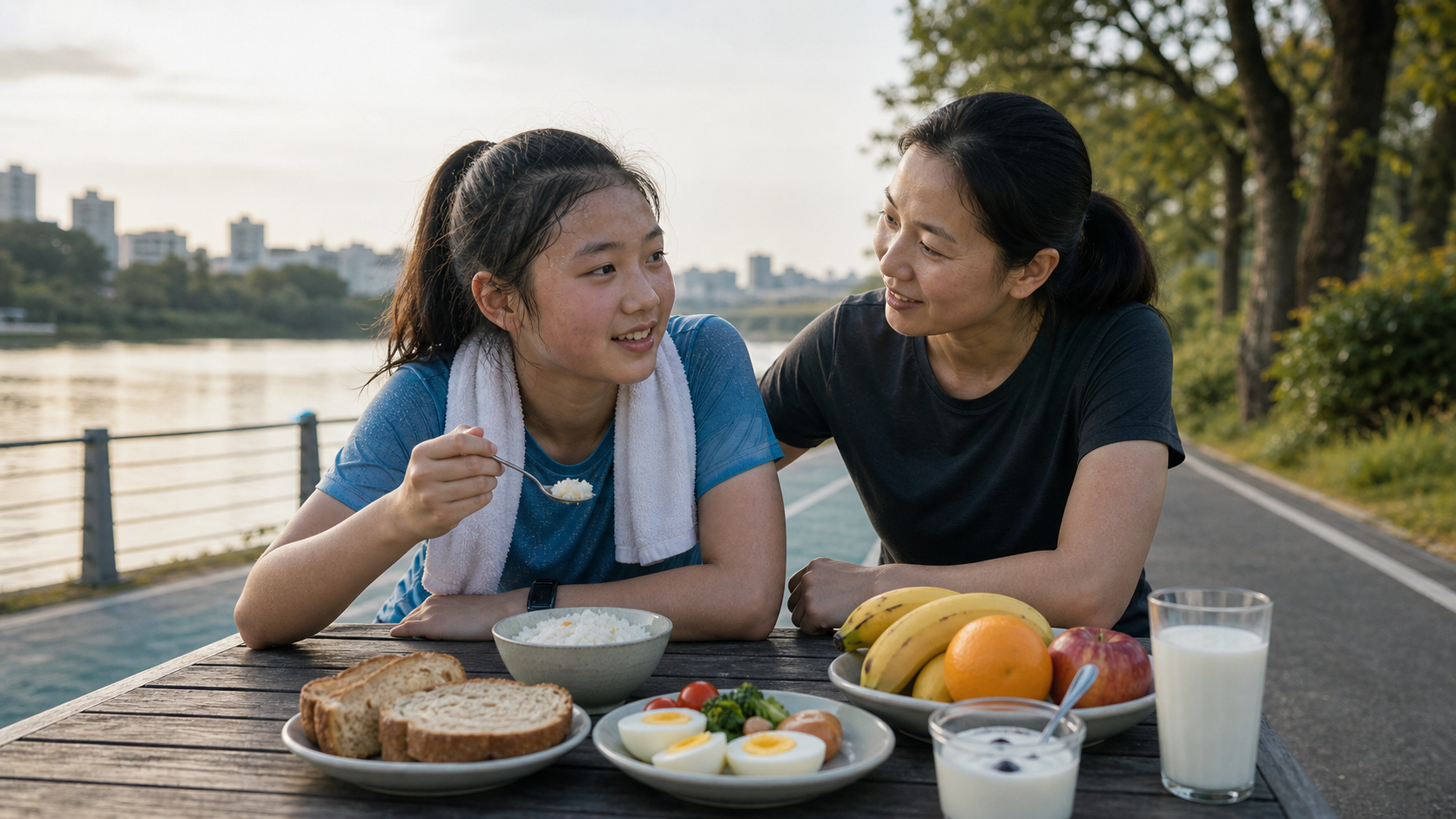
A few years ago, there was an eighth-grade girl on the team (let’s call her “Xiao Yun”; the scenario is reorganized for clarity, but the phenomenon I’m describing is absolutely real). She was one of the most dedicated riders on the team—reporting to the riverside bike path at 5:30 every morning, and riding 80 kilometers a day during school breaks. Her mom, wanting the best for her, had read a lot of articles on “athlete nutrition.” She cut the rice at dinner in half, banned fried food entirely, eliminated late-night snacks, and kept telling her to “not eat too many carbs.” Six months later, Xiao Yun had lost weight and her body fat looked great. But she told me: “Coach, I feel weak on climbs lately, I get sleepy in afternoon classes, and… I haven’t had my period in three months.”
Alarms went off in my head immediately. Because for a kid who is still growing and developing, this isn’t what “training well” looks like—this is what not eating enough looks like. In this article, I want to lay out clearly the principle I’ve seen repeated and corrected over these fifteen years: For young athletes in their developmental years, the first priority is “eating enough”—far more important than “eating right.” Over-restriction harms kids at this age more deeply, and for longer, than most adults realize.
This will be a longer read, because it deserves to be. Parents, coaches, and teenagers already training on their own can all follow along.
1. The Core Concept: Kids Are Not “Miniature Adults”
1.1 A Developing Body Is Doing Three Energy-Demanding Things at Once
Adult athletes eat basically for two reasons: maintaining basal metabolism and fueling training. But a developing teenager’s body is juggling three things at once:
- Maintaining basal metabolism (heartbeat, breathing, body temperature, organ function)
- Fueling training (the kilometers ridden that day, the pace run, the laps swum)
- Growth itself (gaining height, increasing bone density, muscle and organ development, brain maturation, pubertal hormonal changes)
The third item is a massive energy expenditure that no longer exists in adults. This is why sports science keeps emphasizing: the energy needs of adolescent athletes can be higher than those of adults doing the same training volume—and the “energy bill” for growth itself is non-negotiable. If you cut back on post-training recovery fuel, the kid just recovers a bit slower. But if you chronically cut into the portion meant for growth, the cost is paid in height, bone health, and endocrine function—and once the developmental window closes, you can’t get it back.
1.2 What Is “Energy Availability” (EA)
Here I want to introduce the most important concept in sports nutrition over the past decade: Energy Availability (EA).
Simply put, it asks: After subtracting the energy expended through exercise from the energy you take in today, how much is left for your body to “live and grow”?
Energy Availability ≈ (Daily Energy Intake − Exercise Energy Expenditure) ÷ Fat-Free Mass
When this “leftover energy” stays too low for too long, the body switches into a “power-saving mode,” shutting down functions it deems “non-essential” in order to survive. The International Olympic Committee (IOC) published consensus statements in 2014, 2018, and 2023, naming this condition Relative Energy Deficiency in Sport (RED-S / REDs). It doesn’t just affect athletic performance—it affects the entire system: decreased metabolic rate, menstrual dysfunction or amenorrhea, bone density loss, impaired immunity, disrupted protein synthesis, and impacts on cardiovascular and mental health.
Look back at Xiao Yun: her period stopping was her body screaming, “I don’t have enough energy to sustain this system.” This wasn’t a lack of effort on her part—quite the opposite. She was training hard and starving herself, burning the candle at both ends.
1.3 Two Things Especially Vulnerable During Puberty: Bones and Food Psychology
Two factors make adolescents especially vulnerable to energy deficiency:
- Bones: The fastest period of bone mass accumulation in a person’s life occurs during puberty—roughly 40% of total bone mass is banked during these years. This is a “once-in-a-lifetime” savings opportunity. Chronic energy deficiency directly impairs bone density accumulation, increases the risk of stress fractures, and sets the stage for osteoporosis later in life.
- Food Psychology: Puberty is the stage when Disordered Eating and Eating Disorders are most likely to take root. This is the age when kids are forming their relationship with food and their bodies. If we, as adults, keep sending messages like “carbs are scary,” “fat is dirty,” or “thin is good” during this time, we’re essentially installing a faulty program that will stay with them for life.
This is why I am extremely cautious about approaches like carb-cutting, fat-cutting, or fasting for teenagers.
2. How Much Does a Developing Athlete Actually Need? Translating the Numbers into Plain Language
What parents usually want most is “so how much should they eat?” Let me first make the principle clear: these numbers are meant to provide ranges and direction, not precise prescriptions to be measured to the gram on a scale. A child’s height, developmental stage (whether they’ve hit their growth spurt), and training volume change every day—any claim of “precision down to the single digit” should be taken with a grain of salt. The figures below are compiled from published reviews and guidelines on adolescent sports nutrition (links listed in the references at the end), translated into the way I’d explain them in coaching practice.
2.1 Macronutrient Ratios and Amounts
| Nutrient | General Recommendation | Coach’s Plain-Language Translation |
|---|---|---|
| Carbohydrates | Roughly half of total calories | Carbs are the main fuel, not the enemy. On training days, this half cannot be cut |
| Protein | About 1.2–1.5 grams per kilogram of body weight per day (for active adolescent athletes) | A 50 kg kid needs about 60–75 grams of protein per day |
| Fat | About 25–35% of total calories | Keep the good fats (nuts, fish, olive oil)—don’t ban them all |
Looking at general daily protein baselines for adolescents, publicly cited reference values commonly start around 46 grams per day for teenage girls and about 52 grams for teenage boys; young athletes in regular training typically fall in the 1.2–1.5 grams per kilogram range. One reminder: more protein isn’t necessarily better. Most Taiwanese kids eating a balanced diet already get enough—what actually tends to get cut to insufficient levels is carbohydrates.
2.2 Understanding Portions Through “What a Day Looks Like”
Portion tables can feel abstract, so I prefer showing parents “what a whole day looks like.” Below is a sample training day for a middle-school team rider weighing about 50 kg who has a two-hour practice after school (this isn’t the only correct answer—it’s to help you get a feel for it):
| Time | Sample Content | Focus of This Meal |
|---|---|---|
| Breakfast | Egg crepe + unsweetened/lightly sweetened soy milk + a banana | Carbs + protein to start the day—don’t go to school on an empty stomach |
| Morning Snack | An onigiri (rice ball) or a piece of bread | Get through to lunch, avoid a blood sugar crash |
| Lunch | Bento box: full portion of rice + main protein (chicken leg/fish) + vegetables | Fill up on carbs—this is the fuel tank for afternoon practice |
| 30–60 min Before Practice | A banana or a slice of toast | Quick carbs so the kid has energy to start training |
| During Practice (>60 min or hot weather) | Sports drink or diluted juice + water | Essential for Taiwan summers—prevents dehydration and slowdown |
| 30–60 min After Practice | Chocolate milk or rice ball + tea egg | The golden recovery window: carbs + protein together |
| Dinner | Normal portion: rice, protein, vegetables, soup | Don’t cut portions just because it’s late—the kid still needs to grow |
| Before Bed (optional) | A glass of milk or yogurt | Calcium plus a bit of protein for overnight repair |
You’ll notice that not a single meal in this table is about “restriction.” For a developing young athlete, the daily theme is “regularly eating enough,” not “cleverly eating less.”
2.3 Three Micronutrients That Are Especially Easy to Fall Short On
Beyond calories, there are three micronutrients that young athletes are especially prone to lacking and that are especially important. These are the three I watch most closely on the ground:
| Nutrient | Why It Matters | Common Gaps in Taiwanese Kids | Food Sources |
|---|---|---|---|
| Calcium | Key to building bone bank during puberty | Not drinking milk or eating small dried fish makes it easy to fall short | Milk, yogurt, small dried fish, tofu, dark leafy greens |
| Iron | Carries oxygen; affects endurance and energy | Common after menstruation in teen girls and in picky eaters | Red meat, pork liver, dark leafy greens, plus vitamin C to aid absorption |
| Vitamin D | Helps calcium absorption; supports bones and immunity | Staying indoors and overdoing sun protection leads to deficiency | Moderate sun exposure, salmon, egg yolks, fortified milk |
Many Taiwanese kids have “a rushed breakfast, too few vegetables, and not enough dairy,” so iron and calcium gaps are more common than people think. Iron deficiency in particular is often mistaken for “not trying hard enough” — the child is actually being held back by anemia, getting more and more tired with training, looking pale, and getting winded easily. In this situation, don’t buy iron supplements and start loading up on your own. Take the child to a doctor for a blood test first — it’s covered by National Health Insurance. This is something I always ask parents to do.
2.4 Growth Spurt: A Sudden Surge in Appetite Is a Good Thing, Not a Bad One
There’s one phenomenon I must remind parents about: when a child enters the growth spurt (peak height velocity, the period of fastest height gain), their appetite suddenly explodes. They get hungry like a bottomless pit and can never seem to eat enough. Many parents get anxious at this point, thinking, “They keep eating — are they going to gain weight?” and start putting on the brakes.
Please don’t. This is exactly when the body is working hard to grow taller and build bone bank. That huge appetite is the body’s correct signal. During this stage, energy, calcium, and protein needs all rise. If the child wants to eat, let them eat enough. The key is food quality (carbs, protein, vegetables, and dairy), not restricting portions.
The simplest way to tell if a child is in a growth spurt is to measure height regularly — I often suggest parents measure against the same wall, at the same time, every one to two months, and record it on the same chart. When you see a sudden jump of three or four centimeters over two months, that’s when the dinner table matters most. Also watch for this: during a growth spurt, coordination may temporarily “lag behind” the lengthening limbs, so injury risk is slightly higher. Training volume and intensity should follow the body’s lead — don’t push hard.
3. Practical Approaches: How to Make It Work in Real Life in Taiwan
No matter how sound the concepts are, they’re useless if they don’t fit into the daily life of Taiwanese families. Our kids eat out a lot, the weather is brutally hot, and the time between school dismissal and the training venue is tight. Here are the approaches I actually teach parents and athletes.
3.1 What to Eat Before, During, and After Training
This is the most practical section, so I’ve put it in a table:
| Timing | Goal | Specific Approach (Taiwan Version) | Common Mistakes |
|---|---|---|---|
| 1–3 hours before training | Fill the tank | Easy-to-digest carbs plus a little protein, e.g., rice balls, toast with egg | Training on an empty stomach, or eating something too greasy or too heavy |
| 30 min before training | Top up with quick carbs | Banana, a few sips of sports drink | Going in without eating anything |
| During training (>60 min or in heat) | Maintain blood sugar and hydration | Take small sips of water every 15–20 minutes; beyond one hour or in hot weather, use a carb-containing sports drink | Drinking only when thirsty, or drinking only plain water the whole session |
| 30–60 min after training | Restore glycogen and repair muscle | Chocolate milk, rice ball plus tea egg, bento box | Waiting two to three hours after training to eat, or having only a whey shake and skipping real food |
I especially want to emphasize the post-training meal. Many parents think, “You should eat light after exercise,” so the child comes home after training with just a whey shake, and dinner gets reduced too. That’s exactly backwards — the 30 to 60 minutes after training is the golden window when the body is most efficient at taking in nutrients for repair and growth. This meal needs both carbs and protein, and the portion needs to be adequate.
3.2 Taiwan Summers: Hydration and Electrolytes Are a Safety Issue, Not an Option
In Taiwan, summer temperatures routinely hit 33–34°C with extreme humidity. Teenagers’ thermoregulation is not as mature as adults’, so their risk of heatstroke and heat exhaustion is higher than adults’. This isn’t just a performance issue — it’s a safety issue.
- Drink before training: About 30 minutes before heading out, drink roughly 300–500 ml of water.
- Drink on a schedule during training: Don’t wait until you’re thirsty — by the time you feel thirsty, your body is already dehydrated. In hot weather, heavy sweating, or sessions over an hour, replace plain water with a sports drink containing sugar and sodium to replenish lost sodium and get some carbs in at the same time.
- Watch two indicators: One is urine color — dark yellow means you’re not drinking enough; aim for pale lemon. The other is body weight — if conditions allow, weigh before and after training. Losing more than 2% of body weight means hydration was clearly insufficient and needs to be corrected next time.
- Stop on danger signs: Dizziness, nausea, goosebumps, sudden cessation of sweating, confusion — stop immediately, move to shade, rehydrate and cool down, and seek medical help if severe. Riverside paths and tracks are especially dangerous at one or two in the afternoon in summer. Avoid the hottest hours whenever possible.
3.3 What to Do If You Eat Out Most of the Time: A Survival Guide for Convenience Stores and Bento Shops
Eating out is the norm for Taiwanese kids. I’m not going to tell parents to cook every day — that’s unrealistic. Instead, I teach them how to pick the right combinations in the eating environments they already have:
- Post-training convenience store combo: A rice ball or onigiri (carbs) + a tea egg or unsweetened yogurt (protein) + a sports drink or milk. These three items are available at any convenience store and are far more practical than the whey shakes people imagine.
- Bento shops: Don’t cut back on the white rice. Choose a main dish that isn’t fully deep-fried (chicken leg, grilled fish, braised pork chop are all good), and make sure to have one or two vegetable sides. If you really want fried food, a few times a week is fine — no need to ban it entirely.
- Breakfast shops: Egg crepes, radish cakes, and tuna sandwiches are all good choices. Choose unsweetened or lightly sweetened soy milk or fresh milk tea over full-sugar iced black tea — a much better option.
- Bubble tea and sugary drinks: No need to treat them as unforgivable sins, but don’t drink them like water. If you really want one, I usually suggest having it after training as a carb refill — smarter than having it as a midnight snack.
The point isn’t to hand a child a perfect menu that’s impossible to follow. It’s to teach them how to pick an 80-point combination at the places they actually go to. An 80-point choice every day beats a 100-point plan that falls apart twice a week.
3.4 A Week at a Glance: Think of “Training Days” and “Rest Days” Separately
Many parents ask: “Do I still need to eat this much on rest days?” The answer is — you can cut back slightly on carbs on rest days, but the energy for growth must not be cut. I like to give parents a “week at a glance” to help them find the rhythm, rather than obsessing over every single day. Here’s an example of a week of eating priorities for a junior high school cycling team rider (intensity is a relative concept, not a precise calculation):
| Day | Training Schedule | Eating Priorities |
|---|---|---|
| Monday | 2-hour aerobic ride after school | Top up carbs before training; refill carbs and protein fully after training |
| Tuesday | Interval / hill intensity session | Carb intake at its highest this day; post-training recovery meal is most critical |
| Wednesday | Easy recovery ride | Eat normally, get plenty of fruits and vegetables, keep up hydration |
| Thursday | After-school skills training | Moderate carbs, protein spread across three meals |
| Friday | Rest or easy spin | Carbs can drop slightly, but dairy, protein, and fruits/vegetables stay the same |
| Saturday | Long group ride (3–4 hours) | Highest energy demand of the week; refuel with carbs and fluids on a schedule during the ride |
| Sunday | Complete rest | Eat three good meals, sleep well, let the body repair and grow |
Notice that even on “rest days,” I never write “eat less” — at most it’s “slightly fewer carbs.” Because for a child this age, a rest day isn’t a “day of atonement.” It’s a day the body uses to grow and repair, and the energy bill still has to be paid.
3.5 Breakfast: The Meal Taiwanese Kids Most Often Get Wrong
I need to single out breakfast because it is the most common gap among young Taiwanese athletes. Too many kids rush off to school in the morning, grabbing a sugary drink on the way out or skipping breakfast entirely; by the time afternoon training rolls around, the tank is already on empty, and they train flat and lifeless.
A passing athlete’s breakfast needs at least two components: carbs + protein. Egg crepes with unsweetened soy milk, tuna sandwiches with milk, or rice balls with an egg are all great options. If your child genuinely can’t eat in the morning, split breakfast into two parts—eat something easy to get down before leaving (banana, toast), then top up with an onigiri or bread during the first break at school. “Can’t eat” should not become an excuse for “not eating”—it’s a signal to “eat in installments.”
4. Common Mistakes and Fixes: Things I Most Often Put the Brakes On
This section is the core of this article. Having worked with so many kids, I’ve found that injuries often don’t come from “not knowing,” but from “trying too hard in the wrong direction.” Every item below is something I’ve witnessed firsthand and corrected firsthand.
4.1 Mistake 1: Applying Adult Low-Carb, Low-Fat Diets to Kids
What it looks like: Parents who find low-carb diets or intermittent fasting effective for themselves casually apply the same approach to their children.
Why it’s dangerous: The goal of adult weight loss runs in the opposite direction of a developing child’s goal “to grow.” Carbohydrates are the primary—and most essential—energy source for adolescents; long-term carb restriction for a child who is both training and growing is like digging a hole from both ends.
Fix: Your child isn’t losing weight; they are growing + training. Never cut carbs on training days. If weight management is genuinely needed, it must be evaluated individually by a pediatrician or sports dietitian—don’t do it yourself.
4.2 Mistake 2: Using “Nice Body Fat Numbers” as a Measure of Good Training
What it looks like: Seeing a child get leaner and more defined makes parents happy, thinking “now that looks like an athlete.”
Why it’s dangerous: This is exactly what happened with Xiao Yun. Behind those pretty body-fat numbers could be chronic energy deficiency, loss of menstruation, and quietly declining bone density. Being “thin” in adolescence does not equal “healthy,” let alone “strong.”
Fix: When I judge whether a child is training well, I look at whether performance is improving, whether their spirits are good, whether they eat with appetite, whether they sleep deeply, whether girls have regular periods, and whether they’re still growing taller—not the number on a body-fat scale.
4.3 Mistake 3: Not Eating After Training, or Only Drinking Whey
What it looks like: After training, kids think “I can’t eat after exercise, I’ll gain weight,” or they believe a single whey shake is enough.
Why it’s dangerous: Missing the recovery window and only replenishing protein without carbs means glycogen isn’t restored, and the next day’s training quality drops immediately. Kids fall into a vicious cycle of “the more I train, the more tired I get, the worse my recovery.”
Fix: Within 30–60 minutes after training, replenish carbs + protein together. Chocolate milk, or a rice ball with a tea egg, is cheap and effective—no expensive supplements needed.
4.4 Mistake 4: Believing in Supplements and Ignoring Real Food
What it looks like: Glycogen packs, whey, BCAA, caffeine tablets, multivitamins… parents stock an entire cabinet for their child.
Why it’s dangerous: For adolescents, real food is always the first line of defense. Commercial supplement ingredients and dosages are typically designed for adults, and there’s insufficient safety data for teenagers; caffeinated products are especially not recommended for growing children. Additionally, the supplement industry has issues with contamination and mislabeling. If a bowl of rice and a glass of milk can solve it, don’t use a scoop of powder.
Fix: Spend the budget on making three solid meals a day and filling in dairy and vegetables. If there’s a genuine nutritional gap (e.g., confirmed iron or vitamin D deficiency), supplement under a doctor’s or dietitian’s guidance—don’t buy things online on your own.
4.5 Mistake 5: Ignoring the Early Warning Signs of Energy Deficiency
What it looks like: When a child’s performance declines, they get injured frequently, or a girl’s periods become irregular, the first reaction is “not training hard enough, not pushing enough.”
Why it’s dangerous: These are often exactly the early signs of Relative Energy Deficiency in Sport (RED-S), yet they’re misinterpreted as a need to “push harder,” making things worse.
Fix: Print out the self-check table below and stick it on the fridge. If multiple items apply, first consider “is my child eating enough,” and see a doctor—don’t increase training volume.
| Warning Sign | Explanation |
|---|---|
| Performance plateau or decline | Training is happening, but results keep getting worse |
| Irregular or missed periods in girls | A very important red flag—seek medical attention |
| Repeated injuries, stress fractures | Bone density may already be affected |
| Getting sick often, slow-healing wounds | Signs of a weakened immune system |
| Low mood, irritability, anxiety | Energy deficiency affects mental health too |
| Always cold, cold hands and feet | Signs of a lowered metabolic rate |
| Excessive anxiety about food, secretly eating less | A warning sign of disordered eating—pay special attention |
5. Actionable Advice for Different Readers
The same principles play out differently depending on your role. I’ll break this down for the three types of readers I interact with most.
5.1 For Parents: Your Role Is “Preparing the Table,” Not “Being the Monitor”
- Ensure enough food first, then talk about eating well. Don’t reduce white rice on training days, and have that post-training meal ready.
- Don’t pass on “food fear” at the table. Stop saying “this is fattening” or “carbs are scary”—kids will internalize that into a lifetime of food anxiety.
- Fill in dairy, vegetables, and protein. These are the three things Taiwanese kids are most often missing.
- Make good use of National Health Insurance. If your child has chronic fatigue, poor complexion, or menstrual irregularities, take them to a doctor for blood work. Iron and vitamin D can be checked through NHI—don’t guess on your own.
- When warning signs appear, think “not eating enough” first, not “not pushing hard enough.”
5.2 For Coaches: Your Words Are Law to Kids
- Watch your mouth. Teenagers will treat a coach’s casual remark like “you could stand to be a bit leaner” as a command, and that’s extremely dangerous at this age. Be extremely cautious about weight and body-fat topics—if you can avoid them, avoid them.
- Treat nutrition education as part of training. Teaching kids what to eat before training and what to replenish after is just as important as teaching pedaling and pacing.
- Pay attention to hydration protocols in summer. Taiwan’s heat can genuinely cause serious problems. Build hydration breaks into your training plans—don’t let kids wait until they’re thirsty to drink.
- When you see RED-S warning signs, step back and seek professional help. The right move is referring to a doctor and dietitian and temporarily reducing volume—not adding more training.
- Remember the value of a multidisciplinary team. The consensus in sports science on disordered eating is “multidisciplinary collaboration”—doctor, dietitian, psychologist, coach, and parents working together. You don’t have to go it alone, and you shouldn’t.
5.3 For Young Athletes Themselves: Eating Enough Is Part of Getting Stronger
- Carbs aren’t the enemy—they’re your fuel. If you don’t eat enough carbs, you’ll go soft on climbs and won’t hold your pace. That’s not a willpower issue; it’s an empty tank.
- Within 30 minutes after training, remember to refuel. A glass of chocolate milk or a rice ball with a tea egg is the key to having energy the next day.
- Don’t copy the fasting or low-carb trends you see adults doing online. You’re still growing, and your goals are completely different from theirs.
- If your period is irregular, you keep getting injured, or you’re losing strength, speak up. It’s not embarrassing—it’s your body asking for help. Tell your parents, tell your coach, see a doctor.
- Be friends with food, not enemies. Enjoy eating—that’s how it should be at your age, and it’s the foundation for staying in this sport for the long haul.
6. Finishing Xiao-Yun’s Story
Let’s return to Xiao-Yun from the beginning. What we did wasn’t complicated: we first asked her parents to restore her dinner portions, add back the post-training meal, stop halving her rice on training days, and took her to see a doctor to confirm her physical condition, with a dietitian also stepping in. We didn’t add training volume—instead, we reduced it slightly and shifted the focus back to “eating enough, sleeping enough, and staying consistent.”
A few months later, her period returned, she stopped fighting off drowsiness in afternoon classes, she had power again on climbs, and her performance gradually recovered. More importantly, her relationship with food became healthier—she began to understand that eating well before a ride and happily refueling afterward is part of getting stronger, not something to feel guilty about.
This is the message I want to leave for every parent, coach, and young athlete:
During the developmental years, letting your child eat enough is the best training aid there is; excessive restriction is often the most expensive harm.
Get “enough” right first, then slowly work on “optimal.” When the order is correct, children can stay in the sport they love—healthy, happy, and for the long haul.
Frequently Asked Questions (FAQ)
Q1: My child trains a lot—do they need supplements like whey protein or carb gels?
In most cases, no. For developing adolescents, real food always comes first—a bowl of rice, a glass of milk, or a tea egg can do what supplements can’t. If you suspect a specific deficiency (such as iron), see a doctor or dietitian for an assessment rather than buying supplements on your own. Products containing caffeine are not recommended for growing children.
Q2: My child wants to lose weight to improve their power-to-weight ratio on climbs. Is that okay?
This is one of the most dangerous ideas for adolescents. The goal during the developmental years is growth plus training, not weight loss. Deliberate weight loss can easily slide into low energy availability and disordered eating. If there is a genuine need, it must be handled through individual assessment by a pediatrician and a sports dietitian—parents and coaches should not take matters into their own hands.
Q3: My daughter’s period has become irregular since she started training. Is this a normal training response?
No, this is not a normal phenomenon to simply leave alone. Irregular or absent periods are a major red flag for low energy availability (RED-S). Please prioritize checking whether she is “not eating enough or training too much,” and take her to a gynecologist or pediatrician. Don’t treat it as a badge of “training hard enough.”
Q4: Should my child drink sports drinks during summer training? Doesn’t sugar make them bad?
In Taiwan’s summer, during training sessions over an hour, the sodium and carbohydrates in sports drinks serve a meaningful purpose—in that context, they are a tool, not junk food. The problem is drinking them like water during daily sedentary activities. Distinguish between “training situations” and “everyday situations,” and you won’t be trapped by a single label.
Q5: My child finishes training late at night. Should they eat a smaller dinner to avoid gaining weight?
This often gets it backwards. The post-training period and dinner are exactly when the body needs nutrients most for repair and growth—portions should be sufficient, with both carbohydrates and protein. For a developing child, cutting back on dinner may result in no energy the next day, poor recovery, and stunted growth. The trade-off simply isn’t worth it.
This article is educational content and does not replace individual diagnosis or treatment advice from a physician, physical therapist, or dietitian. The case scenarios described are reconstructed for educational purposes. For conditions involving menstrual irregularities, suspected low energy availability, anemia, or recurring injuries, please seek professional medical care and individualized assessment. Do not self-diagnose or adjust medications and supplements based on online information.
References
- International Olympic Committee (IOC) Consensus Statement on Relative Energy Deficiency in Sport (RED-S): 2018 Update — https://journals.humankinetics.com/abstract/journals/ijsnem/28/4/article-p316.xml
- IOC consensus statement on relative energy deficiency in sport (PDF) — https://stillmed.olympics.com/media/Documents/Athletes/Medical-Scientific/Consensus-Statements/REDs/IOC-consensus-statement-Relative-Energy-Deficiency-in-Sport-2018.pdf
- Optimizing Performance Nutrition for Adolescent Athletes: A Review of Dietary Needs, Risks, and Practical Strategies — https://www.ncbi.nlm.nih.gov/pmc/articles/PMC12430154/
- Youth Athlete Development And Nutrition — Gatorade Sports Science Institute — https://www.gssiweb.org/sports-science-exchange/article/youth-athlete-development-and-nutrition
- Protein for the Teen Athlete — HealthyChildren.org (American Academy of Pediatrics) — https://www.healthychildren.org/English/ages-stages/teen/nutrition/Pages/Protein-for-the-Teen-Athlete.aspx
- Nutrition for Children and Adolescents Who Practice Sport: A Narrative Review — https://www.mdpi.com/2072-6643/16/16/2803
Related Reading
- Nutrition for Young Athletes: Caloric Deficits, Developmental Needs, and Common Dietary Mistakes
- Sports Science for Children and Adolescents: Training Principles During Development—Growth Plates, Early vs. Late Maturation, and the Safety of Youth Strength Training
- Adolescent Body Weight and Athletic Performance: A Healthy Development Perspective That Discourages Weight Loss
- Special Nutritional Needs for Female Athletes: A Complete Coach’s Guide to Menstrual Cycles, Iron and Calcium, and Energy Availability
CT暗黑廚房) 車友必備 宇宙無敵鮮蚵湯 幫助訓練恢復 天然食補 好市多 超肥鮮蚵 破PR
7 年前
靠單車減肥35公斤 心得分享與整理
7 年前
CT 喇低賽) 單車 比賽總是沒照片? 攝影師的觀點大公開 姿勢就是力量! 請加速1.25倍收看
7 年前
一日北高/長距離團騎 常見問題補充篇 / 組團或跟團的眉角 / 壯車友容易被瘦車友慢性拉爆 / 原來屁股痛可能是這個原因...? / 風場配速法 / 公路車 / CT Yeh
2 年前
滑雪新手們慘摔學習全紀錄(請開字幕),滑雪好好玩 | Snowboard + Ski | 岩原 スキー場 | 滑雪APP使用 | GoPro Max
6 年前
16/02/16 - 夜訪中社路 緩慢進步中
10 年前
FTL 與 SYB 車隊專訪 西進武嶺 實用攻略分享! 2小時 如何練?!你不知道的眉角!新手準備武嶺必看 EP1 | 實力派女車友 | 精華版 | 公路車 | CTYeh
4 年前
一個測試有沒有認真練車的方法😂 #公路車
10 個月前