Hypertension and Exercise Nutrition: A Practical Guide to the DASH Diet, Sodium-Potassium Balance, and Exercise Synergy
Starting with a Student Whose Blood Pressure Wouldn’t Drop Despite Medication
I’ve been training athletes for over fifteen years, and the cases that trouble me most aren’t beginners with poor fitness—they’re people who “work hard, yet their blood pressure stays stuck.”
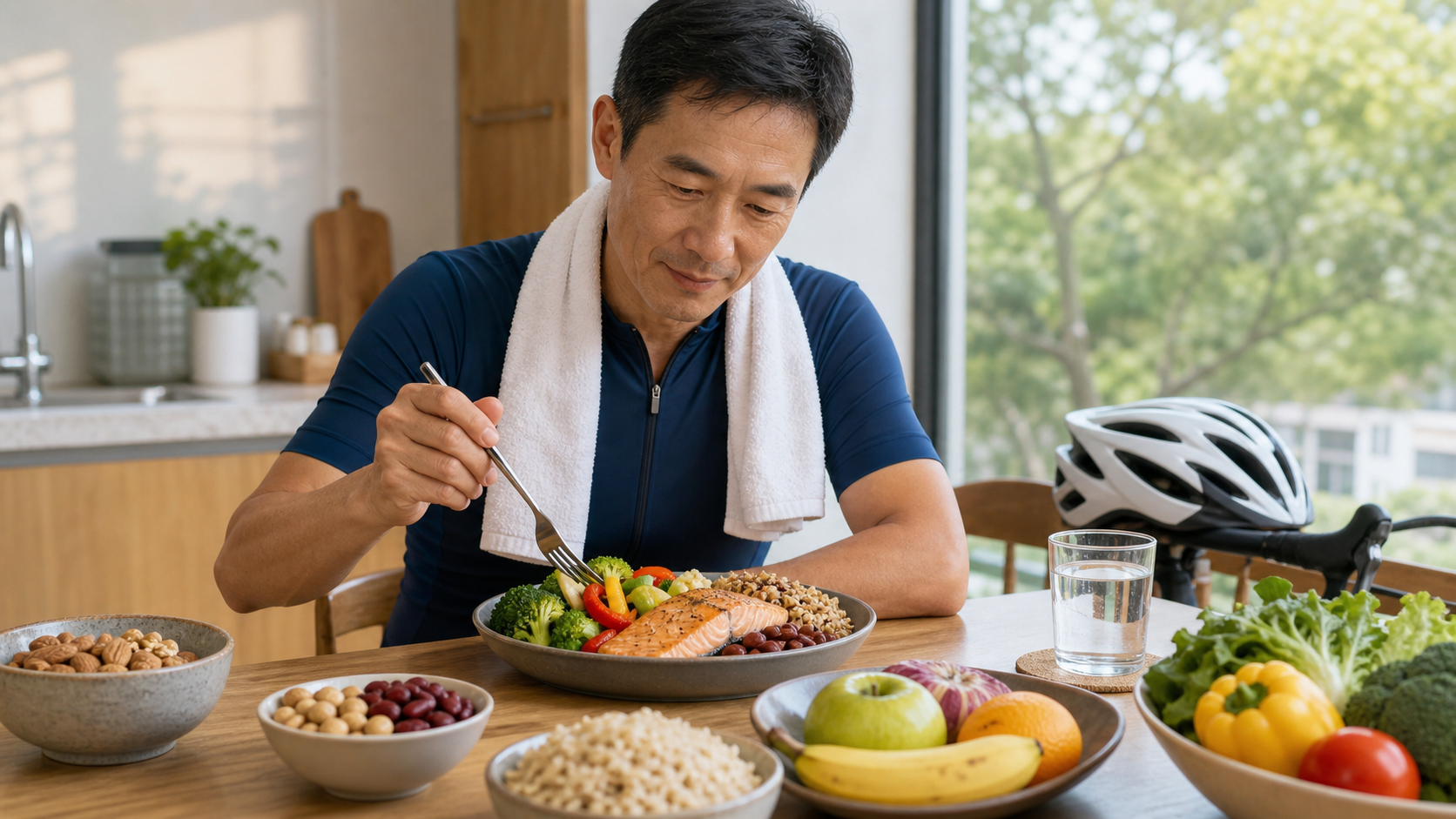
A few years ago, a man in his early fifties came to me; let’s call him Mr. A. He was a passionate road cyclist, easily riding 100 kilometers on weekends, with reasonably low body fat. But his blood pressure in the clinic consistently hovered around 150/95 mmHg, and his doctor had already prescribed first-line antihypertensive medication. Frustrated, he asked me, “Coach, I exercise more than my colleagues. Why is my blood pressure still so hard to control?”
I asked him to photograph a week’s worth of meals. The picture was clear: breakfast was a sesame flatbread with fried dough stick and a bowl of salty soy milk; lunch was usually a bento box with a side of soup; dinner rotated through hotpot, spicy mala hotpot, and Taiwanese fried chicken; and after workouts, he habitually downed a sports drink to “replenish.” His exercise was excellent, but his diet was like pressing the accelerator and the brake at the same time.
This article is the complete logic I used to redesign the diet for Mr. A (and many similar cases). It comes down to three core things: the framework of the DASH diet, adjusting the sodium-potassium balance, and creating synergy between exercise and diet. I’ll give you tables and steps you can follow directly, and I’ll clearly explain the most common pitfalls for people who eat out in Taiwan.
Let me state the key point upfront: Exercise and diet aren’t an either/or choice—they multiply each other. Relying on exercise alone often yields limited blood pressure improvement; relying on diet alone, many people can’t sustain it. Doing both together is the real path to lowering blood pressure long-term without sacrificing your cycling and running performance.
Friendly reminder: If you’re already taking antihypertensive medication, please discuss any dietary or exercise changes with your doctor and dietitian first, especially anything involving potassium and fluid intake. Never stop your medication or make drastic changes on your own.
Concepts and Scientific Basis: Why Blood Pressure Can Be “Eaten Up” and “Eaten Down”
A Simple Physiological Model of Blood Pressure
Think of blood pressure as pressure in a pipe. It’s mainly determined by two factors: the volume of blood (volume) and the resistance of the vessels (diameter and elasticity).
- Eating too salty (too much sodium) → the body retains water to maintain osmotic pressure → blood volume rises → pressure rises.
- Chronic inflammation, stiffness, and reduced elasticity in blood vessels → resistance rises → pressure rises.
- Overactive sympathetic nervous system (stress, poor sleep) → blood vessels constrict, heart rate increases → pressure rises.
Diet can influence all three pathways simultaneously, which is why “eating right” is so powerful.
I often use an analogy with my students: blood pressure medication is like “opening the valve on your pipe a bit wider” to let the water flow more smoothly; diet and exercise are about “reducing the water volume at the source and making the pipe itself more elastic.” The former is a quick fix for symptoms; the latter is a long-term project that addresses the root cause. They don’t conflict—they each have their role. That’s why I never tell students to treat medication as an enemy, but rather to view diet and exercise as a positive investment that “may give you a chance to reduce medication under your doctor’s guidance in the future.”
Taiwan’s Blood Pressure Standards and Current Situation
Currently, most clinical practice in Taiwan defines hypertension as systolic blood pressure ≥ 130 mmHg or diastolic blood pressure ≥ 80 mmHg under standard measurement, requiring active attention and lifestyle intervention (actual staging and medication timing depend on physician judgment). According to the Ministry of Health and Welfare’s educational materials, the general adult daily sodium intake should not exceed 2400 milligrams (roughly equivalent to 6 grams of table salt), with lower recommendations for those with hypertension-related conditions.
Here’s a key number to remember: the Ministry of Health and Welfare’s educational materials clearly state that if hypertensive patients can reduce their daily salt intake to within 6 grams, blood pressure can drop by an average of about 2 to 8 mmHg—an effect comparable to taking an extra long-acting antihypertensive pill every day. I’m not exaggerating; that’s what the official health education materials say.
What Exactly Is the DASH Diet
The DASH diet (Dietary Approaches to Stop Hypertension) is currently the most evidence-based and most extensively studied dietary pattern for lowering blood pressure. It’s not some magical ingredient but a complete adjustment of “food proportions”:
- Plenty of vegetables and fruits
- Whole grains replacing refined carbohydrates
- Low-fat or non-fat dairy products
- Moderate amounts of white meat, fish, legumes, and nuts
- Reduced red meat, sugary drinks, and high-sodium processed foods
According to the research data I’ve verified, the original DASH trial found that even without any additional sodium restriction, the DASH diet alone lowered systolic blood pressure by about 5.5 mmHg and diastolic by about 3.0 mmHg; among participants who already had hypertension, the reduction was even greater, reaching approximately 11.4/5.5 mmHg. If sodium was also reduced to very low levels (about 1500 mg/day), blood pressure dropped even further.
In other words, simply adjusting the “proportions of what you eat” can produce effects comparable to a medication. This is why I always emphasize: the DASH diet isn’t a supporting player—it’s a core part of primary treatment itself.
Sodium-Potassium Balance: The Real Key Isn’t Just “Less Salt”
Many people think of “eating less salt” when they hear about hypertension, but that’s only half the story. The real focus is the balance between sodium and potassium.
- Sodium (Na): Retains water and raises blood pressure. Taiwanese people who eat out typically consume too much.
- Potassium (K): Helps the kidneys excrete excess sodium and relaxes blood vessel walls—essentially the “antidote” to sodium.
Research data indicates that a large part of the DASH diet’s effectiveness comes from providing about 4700 milligrams of potassium per day (nearly double the average person’s intake). Potassium directly counteracts sodium’s pressor effect, promoting the excretion of excess sodium through urine.
So I often tell my students: “Instead of counting how many grams of salt you cut each day, do two things at once—push sodium down and push potassium up.” Vegetables, fruits, legumes, sweet potatoes, bananas, and unsweetened dairy products are all excellent sources of potassium.
There’s a concept called the “sodium-potassium ratio,” which refers to the ratio of sodium to potassium you consume. Research generally agrees that the lower the sodium-potassium ratio (relatively more potassium, relatively less sodium), the better for blood pressure. Taiwanese people often have a double problem: too much sodium and too little potassium, pushing this ratio in a very unfavorable direction. So when I design diets for my students, I don’t just watch the “salt shaker”—I also enlarge the “fruit and vegetable basket.” That’s the essence of the DASH diet—it was never a “prohibition list” but an “addition list”: add vegetables, add fruits, add whole grains, add legumes, and sodium naturally gets crowded out.
Beyond Sodium and Potassium: Magnesium and Calcium Also Help
Many people don’t know that the DASH diet’s blood pressure-lowering effect involves magnesium and calcium in addition to potassium. Dark green vegetables, nuts, and whole grains are rich in magnesium; low-fat dairy, soy products, and dried small fish are rich in calcium. These minerals work synergistically to help relax vascular smooth muscle and regulate blood pressure. That’s why I don’t recommend relying on a single “supplement pill” and thinking you’re done—what’s truly effective is the overall dietary pattern, not a single nutrient. A pill can never replicate the complete value of a plate of vegetables.
Important warning: For patients with chronic kidney disease, or those taking certain antihypertensive medications (such as potassium-sparing diuretics or ACEI/ARB drugs), increasing potassium intake could actually create a dangerous risk of hyperkalemia (high blood potassium). These groups must consult their doctor before increasing potassium—don’t go overboard on bananas and vegetable juices on your own.
Practical Methods: Making the DASH Diet Work for Taiwanese People
Now that the concepts are covered, the key is “how to do it.” I’ve translated the DASH diet into a version that Taiwanese people who eat out can understand and follow.
DASH Diet Daily Serving Reference Table
The following is a serving framework for a general adult at about 2000 kcal/day (actual calories should be adjusted based on your weight and training volume). This is a “direction,” not a “rigid rule”—just grasp the general principles.
| Food Category | Daily Recommended Servings | Approximate Serving Size | Taiwanese Local Options |
|---|---|---|---|
| Whole grains and root vegetables | 6–8 servings | Half a bowl of brown rice / one slice of whole wheat toast | Brown rice, sweet potato, oats, pumpkin |
| Vegetables | 4–5 servings | Half a bowl cooked / one bowl raw | Sweet potato leaves, spinach, broccoli, tomatoes |
| Fruits | 4–5 servings | One fist-sized portion | Guava, banana, kiwi, papaya |
| Low-fat dairy | 2–3 servings | One cup of skim milk / unsweetened yogurt | Unsweetened yogurt, skim milk |
| White meat / fish / legumes | ≤ 6 servings | Palm-sized portion | Chicken breast, mackerel, tofu, edamame |
| Nuts / seeds | 4–5 servings per week | A small handful | Unsalted almonds, cashews, walnuts |
| Oils | 2–3 servings | One teaspoon | Olive oil, camellia oil |
| Red meat / sweets | As little as possible | — | Minimize processed meats |
I usually ask students to start with three things: “double the vegetables and fruits, halve the refined carbohydrates, and eliminate sugary drinks.” You don’t need to do it all at once—getting to 60% will already make a difference.
Daily Sodium-Potassium Balance Targets
| Item | General Adult Recommendation | Hypertensive Recommendation | Current Taiwanese Situation (Common) |
|---|---|---|---|
| Sodium intake | ≤ 2400 mg/day | Lower, most recommendations aim for 1500–2000 mg (per medical advice) | Often exceeds 3500–4500 mg |
| Salt equivalent | ≤ 6 g/day | Often recommended ≤ 5 g | Often exceeds 9–12 g |
| Potassium intake | 3500–4700 mg/day (for those with normal kidney function) | Same as left, but restricted for kidney disease | Most people are deficient |
See that? Taiwanese people who eat out typically consume 1.5 to 2 times the recommended sodium. So reducing sodium isn’t “icing on the cake” for most people—it’s an “urgent priority.”
Practical Sodium-Reduction Tips for Taiwanese People Who Eat Out
I know it’s unrealistic to tell everyone to cook at home; most people eat out for all three meals. Here are the most feasible strategies I actually teach my students:
- Only take a few sips of soup, don’t finish it: Noodle soup, hotpot broth, and bento side soups are often sodium bombs. One bowl of ramen soup can approach an entire day’s sodium limit.
- Keep sauces separate—dip instead of pour: For braised foods, dumplings, and sashimi, put soy sauce and chili sauce on the side and dip. You’ll immediately use half as much.
- Avoid processed meats: Sausages, ham, bacon, meatballs, fish dumplings, and similar hotpot ingredients have shocking sodium levels. Cut back whenever possible.
- Proactively order blanched vegetables or add a vegetable serving: At bento shops, ask for extra vegetables and less braising sauce; at convenience stores, add a sweet potato or unsweetened yogurt for potassium.
- Read nutrition labels: For convenience store rice balls, microwave meals, and instant noodles, flip to the back and check sodium content. A single pack of instant noodles often contains 1800–2200 mg of sodium—nearly an entire day’s allowance.
- Watch snacks, pickled cucumbers, fermented tofu, and kimchi: These “small but salty” items are hidden sodium bombs.
“Hidden Sodium” Comparison for Common Taiwanese Eats
Many students initially don’t believe they eat salty food—until I lay out the numbers. Here’s a rough range of sodium content for common Taiwanese foods (actual amounts vary by vendor and portion; this is just to give you a “sense of scale”). Remember, the daily sodium upper limit is about 2400 mg.
| Common Food | Approximate Sodium Range | Coach’s Commentary |
|---|---|---|
| One bowl of ramen (including drinking the broth) | About 2000–4000 mg | One bowl can blow the limit; the broth is the key |
| One pack of instant noodles (including seasoning) | About 1500–2200 mg | Half to a full day’s allowance |
| One bento box (including braising sauce) | About 1200–2000 mg | Braising sauce and processed sides are the main culprits |
| One serving of Taiwanese fried chicken | About 1000–1800 mg | Triple saltiness from batter + seasoning + sauce |
| One convenience store rice ball | About 400–700 mg | Looks light but isn’t low |
| One slice of ham / bacon | About 300–500 mg | Processed meat has high sodium density |
| A small dish of pickled cucumber / fermented tofu | About 400–800 mg | Small portion but very damaging |
After seeing this table, most students understand: the problem often isn’t “whether you added salt” but “how much sodium is hidden in processed foods and sauces without you noticing.” That’s why I keep emphasizing “drink less soup, keep sauces separate”—these two strategies target the main stronghold of hidden sodium.
One-Week Sample Meal Plan for People Who Eat Out
This is a “week of easy-to-follow” sample I designed for students who eat out. The point is to demonstrate “how to assemble DASH principles at convenience stores, bento shops, and buffet restaurants”—not to have you copy it exactly.
| Day | Breakfast | Lunch | Dinner |
|---|---|---|---|
| Monday | Unsweetened soy milk + sweet potato + boiled egg | Buffet: brown rice + 2 blanched vegetables + steamed fish | Tomato, tofu, and egg drop soup + blanched broccoli + chicken breast |
| Tuesday | Unsweetened yogurt + guava + oats | Bento: half rice + extra vegetables + no braising sauce | Mushroom chicken soup (drink less broth) + sweet potato leaves |
| Wednesday | Whole wheat toast + avocado + skim milk | Buffet: brown rice + edamame + dark green vegetables + tofu | Garlic stir-fried seasonal vegetables + steamed mackerel + one banana |
| Thursday | Unsweetened soy milk + banana + small handful of nuts | Cold noodles (half sauce) + blanched vegetables + braised egg | Tomato beef brisket (small amount of red meat) + lots of vegetables |
| Friday | Unsweetened yogurt + kiwi + oats | Bento: extra vegetables, white meat, only two sips of side soup | Hotpot (clear broth, avoid processed ingredients, lots of vegetables and tofu) |
| Saturday | Sweet potato + boiled egg + unsweetened black coffee | Buffet: brown rice + three-color vegetables + skinless chicken thigh | Steamed fish + stir-fried seasonal vegetables + brown rice |
| Sunday | Whole wheat mantou + skim milk + cherry tomatoes | Noodles (don’t finish the broth) + blanched vegetables + dried tofu | Vegetable-packed oden (drink less broth) + tofu |
The common logic in this meal plan is simple: every meal includes vegetables, starches are mostly whole grains and root vegetables, protein is primarily white meat, fish, and legumes, and you always leave some soup and sauce behind. You don’t need to hit 100% every day—if you’re on this track five days a week, your blood pressure and body composition will gradually reward you.
Smart Choices for Increasing Potassium
While reducing sodium, I ask students to deliberately “add potassium.” Here are high-potassium foods I commonly recommend that are also easy to find:
| Food | Potassium Benefit | Coach’s Tip |
|---|---|---|
| Banana | Convenient, great before/after exercise | 1–2 per day is enough; don’t treat them as unlimited fruit |
| Sweet potato | High potassium and fiber, available at convenience stores | Better with the skin; replace some white rice |
| Spinach / sweet potato leaves | Dark green vegetables with high potassium | Blanched is lower in oil and sodium than stir-fried |
| Unsweetened yogurt | Provides both potassium and calcium, a DASH favorite | Look for “unsweetened”; avoid sugary versions |
| Edamame / soy products | Plant protein + potassium | Avoid overly salty seasoned edamame |
| Tomatoes / cherry tomatoes | Potassium + antioxidants | Large tomatoes as vegetables, cherry tomatoes as fruit |
Reminder again: The above potassium recommendations are for people with normal kidney function. Those with kidney disease or taking potassium-sparing medications must consult their doctor and dietitian first.
Exercise Synergy: Making Diet and Training Complement Each Other
This is the part I most want to share with you who love exercise. Exercise itself is excellent medicine for lowering blood pressure, but how well exercise and diet work together makes a huge difference in the results.
The Dual Effects of Exercise on Blood Pressure
Regular aerobic exercise (cycling, running, brisk walking, swimming) provides two types of blood pressure benefits:
- Acute effect: After a single exercise session, blood pressure stays lower for several hours—known as “post-exercise hypotension.”
- Chronic effect: Long-term regular training improves vascular elasticity, lowers resting heart rate, and enhances insulin sensitivity, bringing baseline blood pressure down.
Generally speaking, regular aerobic training can lower systolic blood pressure by about 5–8 mmHg over the long term. Stack that on top of the DASH diet’s effects, and the results become very substantial.
Exercise Prescription for Those with Elevated Blood Pressure (General Principles)
The following is a beginner-to-advanced framework I commonly use, suitable for people with “elevated blood pressure who have been cleared for exercise by a physician.” Those at moderate-to-high risk or with poorly controlled blood pressure must undergo pre-exercise evaluation first.
| Phase | Frequency | Intensity | Duration | Example Content |
|---|---|---|---|---|
| Beginner (first 4 weeks) | 3–4 times/week | Easy, can talk without breathlessness (RPE 3–4/10) | 20–30 minutes | Flat-road easy cycling, brisk walking, low-resistance spinning |
| Building (weeks 5–12) | 4–5 times/week | Moderate, slightly breathless but can converse (RPE 5–6/10, about 60–70% max heart rate) | 30–45 minutes | Rolling-terrain cycling, jogging, swimming |
| Advanced (after week 12) | 4–6 times/week | Moderate to moderate-high, with some short intervals | 45–60 minutes | Zone 2 long rides + 1 low-intensity interval session per week |
Add low-to-moderate intensity strength training 2 times per week (large muscle groups, multi-joint movements, avoiding breath-holding under strain)—this benefits both blood pressure and metabolism. The key is to avoid maximal lifts with breath-holding, because the Valsalva maneuver (holding your breath while straining) can spike blood pressure dramatically.
Timing Diet Around Exercise
This is a detail many people overlook. I’ve organized it into a table for you:
| Timing | What to Do | Why |
|---|---|---|
| Before exercise | Small amount of easily digestible carbs (banana, sweet potato); avoid high-sodium, heavy-flavored foods | Provides energy without adding sodium burden |
| During exercise (<60 minutes) | Plain water is sufficient | Short sessions don’t need sports drinks |
| During exercise (>90 minutes, heavy sweating) | Moderate electrolyte replacement, but choose low-sodium formulas or dilute yourself | Avoids loading in large amounts of sodium while rehydrating |
| After exercise | Protein + high-potassium carbs (yogurt + fruit, soy milk + sweet potato) | Repairs muscle and replenishes potassium, synergistically lowering blood pressure |
Taiwan’s summers are hot and humid, and long-distance rides (like climbing Wuling or touring around Hualien-Taitung in summer) do cause significant sweating and electrolyte loss—electrolyte replacement is reasonable in those situations. But I want to caution: commercial sports drinks are not low in sodium or sugar, and people with elevated blood pressure shouldn’t chug them mindlessly. For short commutes or exercise under an hour, plain water is enough.
Mr. A’s Actual Adjustment Results (Scenario Demonstration)
Let’s return to Mr. A from the beginning. The adjustments I made for him weren’t complicated:
- Breakfast changed from sesame flatbread with fried dough stick + salty soy milk to unsweetened soy milk + sweet potato + one egg.
- Lunch bento: asked the shop to halve the sauce and add an extra serving of blanched vegetables; only took two sips of the side soup.
- Dinner: reduced the frequency of hotpot and Taiwanese fried chicken; switched to home-cooked stir-fries with fish.
- Post-workout: stopped drinking sports drinks; switched to unsweetened yogurt with banana.
- Exercise: maintained his original cycling volume but added two strength training sessions per week.
I won’t tell you “his blood pressure dropped X mmHg”—that would be fake precision without actual measured data. But the direction was clear: once the diet changed, combined with his existing exercise foundation, his doctor was noticeably more satisfied with his control at follow-up visits. That’s the power of diet and exercise synergy.
Another Case: Ms. B, Who Barely Exercised
In contrast to Mr. A, another student, Ms. B, rarely exercised and only came to me after being scared by her health check report. Her situation was typical: busy work, all meals eaten out, an afternoon milk tea habit, and late-night chips while watching shows. Her blood pressure hovered at the borderline for a long time.
Ms. B’s situation made me more cautious. Without an exercise background, I couldn’t dump a bunch of training on her at the start—she’d quit immediately. So I took a gradual “diet first, exercise second” approach:
- Month one: Only two requirements—switch milk tea to unsweetened tea or water, and add one serving of blanched vegetables to every meal. Nothing else changed.
- Month two: Added a 20-minute walk after work every day, and swapped chips for cherry tomatoes, unsalted nuts, and unsweetened yogurt.
- Month three: Upgraded walking to 30 minutes of brisk walking, 4 times per week, and started switching staple foods to brown rice and sweet potatoes.
I especially want to highlight Ms. B’s case because many people start from “not exercising,” and that’s completely fine. The beauty of the DASH diet is that it doesn’t require an exercise foundation—just adjusting the direction of your eating helps people with borderline blood pressure. Exercise can be added gradually; the key is “don’t skip it entirely just because you can’t do it perfectly.” Ms. B eventually developed a brisk-walking habit, which meant far more to her than any perfect training plan.
Common Mistakes and Corrections
In all my years of coaching, I’ve seen these pitfalls too many times. Let me help you avoid them.
Mistake 1: “I exercise, so I can eat whatever I want”
This is the most common misconception. The calories you burn through exercise are far fewer than you think, and the sodium from one heavy, salty meal out can’t be “worked off” by exercise. Exercise isn’t a free pass; diet is the foundation of blood pressure.
Mistake 2: Only reducing sodium, forgetting to increase potassium
Many people desperately cut salt but never touch vegetables or fruits, leaving them severely potassium-deficient. Sodium and potassium are a pair—you can’t have one without the other. While reducing sodium, you must actively add vegetables, fruits, and legumes.
Mistake 3: Treating “no salt” as the goal, ending up unable to stick with it
A completely salt-free diet tastes awful, and no one can sustain it. My strategy is to replace salt with natural spices: scallions, ginger, garlic, Thai basil, lemon, white pepper, and cilantro all add flavor without sodium. The goal is to “get used to lighter flavors,” not “painfully ban salt.”
Mistake 4: Holding your breath and lifting maximal weights during exercise
For people with elevated blood pressure, the most dangerous thing in strength training is breath-holding maximal effort, which can spike blood pressure instantly. The fix: use moderate weights, higher repetitions, exhale on exertion, and avoid training to failure.
Mistake 5: Fasting morning sprints combined with a salty dinner the night before
Some older adults like to head out for intense cycling or brisk walking before dawn, but early morning is already a peak blood pressure period, and if the previous night’s dinner was salty, that combination carries higher risk. The fix: warm up gently in the morning—don’t sprint from the start; keep dinner light and sleep well.
Mistake 6: Stopping medication on your own
This is the most dangerous one. Some people, after a period of diet and exercise, think “I should be fine now” and stop their medication on their own. Any increase or decrease in blood pressure medication must be decided by a physician. Suddenly stopping can cause a dangerous rebound in blood pressure.
Action Recommendations for Readers at Different Levels
Everyone starts from a different point. I’ve divided the action plan into three tracks—just find the one that fits you.
For “Just been told your blood pressure is elevated and you don’t usually exercise”
- See a doctor first: Get a complete evaluation from a family medicine or cardiology clinic to establish your true blood pressure baseline.
- Change one thing in your diet first: Start with “don’t finish the soup + eliminate sugary drinks.” These two are the easiest and most effective.
- Start exercise with walking: Brisk walking 3 times per week, 20–30 minutes per session—slightly breathless but able to talk is the right intensity.
- Buy a home blood pressure monitor: Measure at fixed times morning and evening, record the numbers, and show them to your doctor at follow-up visits.
For “You cycle or run, but your diet is heavy on salt”
- Change your post-workout replenishment: Swap sports drinks for unsweetened yogurt + fruit—add potassium, not sodium.
- Master three eating-out strategies: Keep sauces separate, drink less soup, and add a vegetable serving to every meal.
- Add strength training: 2 times per week, large muscle groups, moderate intensity, avoid breath-holding.
- Pay attention to summer hydration in Taiwan: Replenish electrolytes only for long sessions with heavy sweating; plain water is fine for short sessions.
For “Your blood pressure is already under treatment and you want to use diet and exercise as support”
- Everything is subject to medical advice: Diet and exercise are “adjuncts,” not replacements for medication. Discuss any changes with your healthcare team first.
- Ask before increasing potassium—whether and how much: Especially if you’re on potassium-sparing medications or have kidney issues.
- Get a risk assessment before exercising: Have your doctor confirm a safe exercise intensity range.
- Track long-term: Record your diet, exercise, and blood pressure numbers so your doctor can fine-tune medication accordingly.
FAQ
Q: Is the DASH diet expensive and hard to prepare?
A: Actually, no. Brown rice, sweet potatoes, seasonal vegetables, tofu, and unsweetened yogurt are all affordable. Taiwan has a wide variety of cheap fruits and vegetables—that’s our advantage. The key is getting the “proportions” right, not buying expensive ingredients.
Q: Can I rely only on diet and exercise and skip medication?
A: That’s for your doctor to decide. Mild, early-stage elevated blood pressure may indeed improve enough through lifestyle changes to avoid medication; but if you’ve already reached the threshold for medication, please follow medical advice and don’t stop on your own.
Q: Does drinking coffee raise blood pressure?
A: It can cause a temporary increase in some people, but moderate amounts (1–2 cups of unsweetened black coffee per day) have little effect on most people. The key is not adding lots of sugar and creamer.
Q: My blood pressure is lower after exercise—does that mean I’m fine?
A: That’s the temporary “post-exercise hypotension” effect, not an indication that your baseline blood pressure is normal. Blood pressure status should be judged by the average of multiple resting measurements taken when you’re not exercising.
Q: Can I use low-sodium salt (potassium-containing salt substitute)?
A: For people with normal kidney function, using low-sodium salt substitutes for part of your regular salt is a good strategy for both reducing sodium and adding potassium. But it’s not suitable for those with kidney disease or those taking potassium-sparing medications, as it could cause dangerously high blood potassium. Ask your doctor before using it.
Q: In Taiwan’s summer, riding long distances and sweating so much—could reducing sodium actually be dangerous?
A: Good question. Reducing sodium targets your “daily total,” not telling you to skip electrolytes entirely when sweating heavily. Taiwan’s summers are hot and humid, and long-duration endurance exercise with heavy sweating does cause sodium loss—moderate replenishment is reasonable and necessary in those situations. The principle is: keep daily meals light, and replenish specifically when exercising with heavy sweating. The two aren’t contradictory; the key is managing “timing” and “total amount.”
Q: My blood pressure is normal, but my parents have hypertension. Should I pay attention early?
A: Absolutely. Hypertension has clear familial and lifestyle associations. For those with a family history, developing DASH diet and exercise habits early is the best prevention. Prevention is always easier than treatment—don’t wait until the report shows red flags.
Q: What happens if I get too much potassium? Can I drink several glasses of vegetable juice a day to load up?
A: For people with normal kidney function, getting potassium from natural fruits and vegetables is generally very safe—the body regulates it. But large amounts of concentrated vegetable juice or potassium in supplement form can be excessive, especially for those with poor kidney function or on certain medications, posing a hyperkalemia risk. The principle is “balanced intake from whole foods,” not chugging one particular thing. When in doubt, ask your doctor and get blood work done.
Q: What should I pay attention to for accurate blood pressure measurement?
A: Avoid caffeine, tobacco, and vigorous exercise for 30 minutes before measuring; sit and rest for 5 minutes with your back supported, feet flat, and arm at heart level; measure at fixed times morning and evening, twice each time, and take the average. Recording it this way for your doctor gives it real reference value.
Conclusion: Making Diet and Exercise Lifelong Habits
Writing all this, I want to bring it back to the most essential point: Lowering blood pressure isn’t a sprint—it’s a lifelong cruise.
The DASH diet gives you the right “eating framework,” sodium-potassium balance helps you precisely “lower volume and relax blood vessels,” and regular exercise makes your blood vessels more elastic and your metabolism better. Each of these three works on its own, but together they form the most powerful combination.
I’ve seen too many people think it’s too hard and too painful, then give up after three days. You don’t need to be perfect—you just need to be a little better than yesterday: take a few fewer sips of soup, add one more serving of vegetables, swap sugary drinks for water, and keep exercise regular. These small choices accumulate into real changes on the blood pressure monitor.
If you love cycling and running, even better: you already have the hardest habit to build—exercise. All that’s left is to fill in the “eating” piece. Get your diet right, and not only will your blood pressure stabilize, but your cycling and running performance and recovery will improve too. This is an investment that can’t lose.
Wishing you stable blood pressure, long rides, and lasting runs. For any adjustments, remember to discuss them with your healthcare team first, and walk this road together—long and healthy.
This article is educational content and cannot replace individual diagnosis and treatment advice from a physician, physical therapist, or dietitian. Hypertension is a chronic disease requiring individualized management. For any dietary, supplement, or exercise adjustments—especially those involving potassium intake, electrolyte replenishment, and medication changes—please consult your doctor and dietitian first. Never stop medication or drastically alter your treatment plan on your own.
References
- DASH Diet: A Review of Its Scientifically Proven Hypertension Reduction and Health Benefits (PMC): https://pmc.ncbi.nlm.nih.gov/articles/PMC10551663/
- The DASH Diet: A Guide to Managing Hypertension Through Nutrition (StatPearls, NCBI): https://www.ncbi.nlm.nih.gov/books/NBK482514/
- Effects of Sodium Reduction and the DASH Diet in Relation to Baseline Blood Pressure (PMC): https://pmc.ncbi.nlm.nih.gov/articles/PMC5742671/
- 衛生福利部國民健康署 減鹽秘笈手冊:https://www.hpa.gov.tw/Pages/Detail.aspx?nodeid=1161&pid=6648
- 衛生福利部 高血壓與鈉攝取衛教:https://www.mohw.gov.tw/cp-3217-22903-1.html
Related Reading
- Exercise and Blood Pressure Management: Can You Lower It Without Medication? A Coach’s Guide to Mechanisms, Magnitude, and Exercise Prescription
- Mediterranean Diet and Athletic Performance: A Sports Science Consultant’s Practical Notes—Health Benefits, Applicability for Athletes, and a Taiwan Implementation Guide
- Hypertension and Exercise: General Principles, Why to Avoid Breath-Holding, and a Complete Guide to Monitoring Concepts
- When Exercise Becomes a Prison: On the Road to Eating Disorder Recovery, Is Exercise a Cure or a Poison?
CT暗黑廚房) 車友必備 宇宙無敵鮮蚵湯 幫助訓練恢復 天然食補 好市多 超肥鮮蚵 破PR
7 年前
水金九不厭五分 10度寒流冷到不願停!feat. 卡卡 / 公路車 / CT Yeh
6 個月前
CT 喇低賽) 武嶺牽車 才是王道 西進牽車四小時內秘訣 攝手位置 如何判斷 防抽筋小秘訣
7 年前
一日北高/長距離團騎 常見問題補充篇 / 組團或跟團的眉角 / 壯車友容易被瘦車友慢性拉爆 / 原來屁股痛可能是這個原因...? / 風場配速法 / 公路車 / CT Yeh
2 年前
靠單車減肥35公斤 心得分享與整理
7 年前
Never Stop 西進武嶺 前後雙機 完整全程錄影 訓練台 實境
8 年前
西進武嶺 免費訓練分析服務 Intervals | 練不夠還是練過頭?你哪一種類型選手?AI模型告訴你! | 備戰神器 | 公路車 訓練 | CT Yeh
4 年前
大武山20%魔王陡坡【JJSC南台灣遊騎Day2】!屁股真的要裂開了...凡士林抹滿也沒用?神秘金教堂還有超便宜夜市
3 個月前