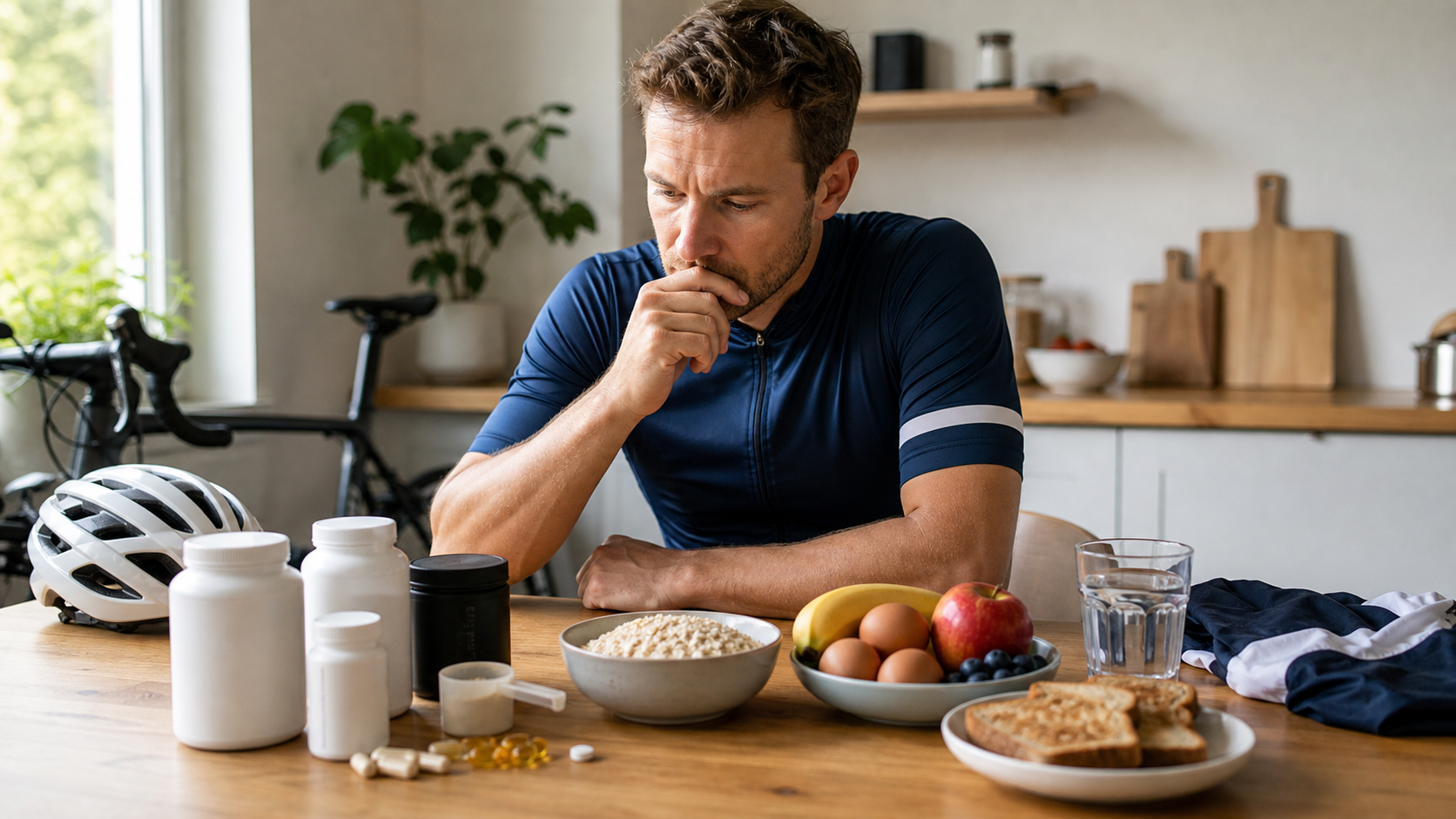
Let Me Start with a Scenario I See All the Time
Once, an amateur road cyclist came to me to adjust his training. His first question wasn’t about a training plan—he pulled out his phone and showed me his shopping cart: whey protein, branched-chain amino acids (BCAAs), glutamine, nitric oxide boosters, a multivitamin, fish oil, zinc, magnesium, melatonin, and two cans of “explosive power formula” whose Chinese names I’d have to look up. He asked me: “Coach, do I need to take all of these? It costs about NT$5,000 a month.”
I looked at it and asked him three questions back: “How many hours do you sleep a day?” He said work had been busy lately, about five to six hours. “What do you eat for breakfast?” He said he often didn’t have time—he’d grab a convenience store coffee and head out. “How many times a week do you train, and for how long?” He said he’d do one long ride each on Saturday and Sunday, and train during the week only when he felt like it.
I handed his phone back and said: “That entire cart of supplements would probably do less for you right now than getting your sleep up to seven hours and eating a proper breakfast.” He was taken aback. I’m not being preachy here—this is the truth I’ve seen repeated across athletes at every level and in the general exercising population for fifteen years: supplements sit at the very top of the performance pyramid, yet too many people try to build from the tip.
What I want to give you in this article isn’t a list of “what to take,” but a decision framework: so that when you face any new supplement—whether it’s newly released, recommended by a friend, or unboxed by an influencer—you can calmly ask the right questions and judge for yourself whether to take it, whether it’s worth the money, and how to use it safely.
Foundational Concepts: Where Supplements Sit in the Performance Pyramid
Why “Order” Matters More Than “Which Product”
Sports science often uses a pyramid to describe the factors influencing athletic performance, from bottom to top, roughly in descending order of impact:
- The Foundation: Training consistency and progression, adequate sleep, daily stress management
- The Middle Layer: Overall diet quality, total calories and macronutrients, hydration and electrolytes
- The Upper Layer: Training details (periodization, recovery planning)
- The Tip (a very small piece): Supplements
The meaning of this order is: if the lower layers aren’t solid, the benefits of the upper layers get severely diluted. A person sleeping only five hours and eating whatever convenience food they can grab will get only a fraction of the theoretical benefit even if they take every best-evidenced supplement on the market. Conversely, someone who has training, sleep, and diet dialed in gives supplements the chance to deliver that “last few percentage points” of added value.
I often tell my athletes: the English word “supplement” literally means “to add to, to fill up”—it’s meant to fill the small gap on top of a foundation you’ve already built well, not to rescue things you haven’t done at all.
Supplements Can Roughly Be Divided into Three Functional Types
Clarifying which category your problem falls into is the first step in decision-making:
| Type | Purpose | Common Examples | Decision Mindset |
|---|---|---|---|
| Filling nutritional gaps | Replacing nutrients lacking from diet or physiological status | Protein supplements, vitamin D, iron (when deficiency is confirmed by testing), electrolytes | “Am I actually deficient? Confirm first, then supplement” |
| Enhancing athletic performance | Directly boosting performance in specific situations | Caffeine, creatine, carbohydrates, nitrate (beetroot juice) | “Is this situation worth using it for? Is there evidence?” |
| Supporting recovery or health | Promoting recovery, maintaining overall health | Fish oil, certain vitamins, depending on individual circumstances | “How strong is the evidence? Does my diet already cover this?” |
Many people waste money because they project a “boost my performance” expectation onto a product that is really just “filling a gap”—or vice versa. Get the category clear, and your expectations will be aligned correctly.
A Harsh but Important Fact: Evidence for Most New Products Is Thin
Let me give you a heads-up here. The vast majority of “next-generation” supplements constantly hitting the market have scientific evidence far weaker than their marketing hype. The things that truly withstand time and extensive research are actually few—which is why the performance supplements with stronger evidence that sports science keeps mentioning are the same handful, over and over. When a product is “too new, too miraculous, too cheap to solve everything,” its evidence strength is usually inversely proportional to its promotion. Hold on to that healthy skepticism, and you’re already ahead of most impulse buyers.
Also, understand “individual variability.” The same supplement can produce wildly different responses in different people—some get a big performance boost from caffeine, while others just get heart palpitations and insomnia. Research gives you “group averages,” but what you care about is “you.” So any supplement ultimately needs to be validated through your own careful trial, not taken at face value just because someone else says it works.
The Decision Framework: Four Gates
This is the process I’ve gradually refined over the years and actually use with my athletes to make decisions. Run any supplement through these four gates before committing.
Gate One: Necessity—Do I Actually Need It?
Ask yourself first:
- What problem am I trying to solve? Is it slow recovery, hitting a wall, immunity, or just “everyone else is taking it”?
- Can this problem be solved with “food” or “behavior” first? Not enough protein? Start with eggs, chicken breast, tofu, or dairy. Poor sleep or slow recovery? Look at sleep and training volume before rushing to buy a recovery formula.
- Are my fundamentals (sleep, meals, training consistency) already in place? If not, put your budget and effort there first—the return on investment is far higher.
One-line principle: Food first, behavior first, supplements last.
Gate Two: Evidence—Does It Actually Work?
The supplement market has no shortage of beautiful marketing copy. You need to learn to distinguish “evidence” from “story.” When evaluating, look at:
- Level of evidence: Is it supported by multiple randomized controlled trials and systematic reviews, or just “user testimonials” and animal studies?
- Effect size: Even if it “works,” how big is the improvement? Is it a noticeable difference, or statistically marginal but practically negligible?
- Applicable context: How similar are the study subjects to you? What works in elite athletes doesn’t necessarily mean the same for someone just starting to exercise.
For endurance sports, the most solid evidence actually belongs to the oldest, cheapest things: caffeine, creatine, and adequate carbohydrates. According to the International Society of Sports Nutrition (ISSN) position stand and related systematic reviews, caffeine at approximately 3–6 mg/kg body weight, taken about 60 minutes before exercise, improves endurance performance by roughly 2–7%, with the most consistent benefits in aerobic endurance events (ISSN caffeine position stand). In contrast, many flashily packaged, trendily named proprietary blends have weak evidence.
One-line principle: The more effective something is, the more plain it tends to be; the flashier the packaging, the more alert you should be.
Gate Three: Safety—Could It Hurt Me?
This gate is especially important in Taiwan, and I’ll cover it in detail later. Worth noting: things with strong evidence and low prices tend to have relatively clear safety records. Take creatine as an example—the ISSN position stand, after reviewing extensive research, states that creatine monohydrate, used at recommended doses in healthy populations, is one of the most well-studied and safe supplements, and does not support the common myths about “creatine damaging kidneys or liver” (ISSN creatine position stand). This again shows: choosing the few items with solid evidence is generally safer than chasing flashy new products. Still, safety comes down to three things:
- Safety of the ingredient itself: dosage, known side effects, and whether it conflicts with your health conditions (e.g., high blood pressure, heart rhythm issues).
- Product purity: Is there third-party testing? Could it contain undeclared ingredients?
- Interactions: Could it interact with medications or other supplements you’re taking?
Gate Four: Cost-Effectiveness—Is This Money Well Spent?
Combine the answers from the first three gates and do the math: Given this product’s evidence strength, expected benefit for “me,” safety risk, and its price—is it worth it? For an expensive product with mediocre evidence, the answer is usually clear. The money you save is often better spent on higher-quality food or investing in sleep quality—the return on investment is typically higher.
Practical Approach: Priority Order and Dosage Reference
The table below is a general reference I give to endurance athletes who have “already nailed down sleep, diet, and training fundamentals.” Please note: this is educational general guidance, not a personal prescription for you. Individual dosages and whether to take anything still need to be adjusted based on your body weight, health status, diet, and (when necessary) medical professional advice.
Priority Reference Table for Common Supplements
| Priority | Item | Primary Use | General Reference Dosage Range | Evidence Strength | My Practical Notes |
|---|---|---|---|---|---|
| High | Protein supplements (whey/plant) | Filling daily protein gaps, supporting recovery | Fill according to dietary gap; a common daily target is about 1.4–2.0 g per kg body weight | Strong (as nutritional supplementation) | If you can get it from real food, no need to supplement |
| High | Caffeine | Enhancing endurance/focus, reducing perceived exertion | About 3–6 mg/kg, ~60 minutes before exercise | Strong | Caffeine-sensitive individuals should start with a low dose |
| High | Carbohydrates (during exercise) | Maintaining blood glucose and intensity during long sessions | Adjust by exercise duration; tens of grams per hour is a common range for long rides | Strong | For long summer rides in Taiwan, this matters more than any recovery powder |
| Medium-High | Creatine (creatine monohydrate) | Enhancing high-intensity repeat efforts, power, strength | Maintenance dose about 3–5 g daily | Strong (more toward power/strength) | More indirect for pure endurance, but high safety |
| Medium | Electrolytes (primarily sodium) | Replacing electrolytes lost through heavy sweating in heat | Adjust by sweat rate and duration | Medium–Strong (context-dependent) | Very practical in Taiwan’s hot, humid environment |
| Medium | Vitamin D | Correcting deficiency (especially for those with little sun exposure) | Supplement per recommendations after deficiency is confirmed by testing | Medium (only for those deficient) | Test first, then supplement—don’t guess |
| Medium | Iron | Correcting iron deficiency (especially women, vegetarians) | Only supplement per medical advice when deficiency is confirmed by testing | Medium (only for those deficient) | Excess is harmful—always get a blood test first |
| Medium | Fish oil (Omega-3) | General health, possibly supporting recovery | General daily dosage range | Medium | Eating more fatty fish can achieve the same |
| Low | BCAA/Glutamine | Claimed anti-fatigue/recovery | — | Weak (mostly redundant when protein intake is adequate) | Usually unnecessary if you eat enough protein |
| Low | Nitric oxide/explosive blends, etc. | Claimed performance enhancement | — | Weak–inconsistent | Most have thin evidence; low priority |
Table note: Dosages are deliberately written as “ranges” and “adjust by situation” because precise numbers must be individualized. Any marketing that states dosages with absolute certainty and guarantees results should make you more skeptical, not less.
Practical Trade-offs in Three Different Scenarios
Scenario One: The weekend warrior who rides until their legs burn
After getting the fundamentals in order, what’s genuinely worth it is often just “carbohydrate fueling during long rides” and “a cup of coffee before racing.” Most everything else can wait.
Scenario Two: The age-group athlete targeting a PB
On top of the fundamentals, you can rationally add creatine (if you have high-intensity interval needs), confirm your vitamin D and iron status (get blood work first), and practice your pre-race caffeine strategy. The key is that every item passes the four gates, rather than piling everything on at once.
Scenario Three: Someone just starting to exercise and wanting to get healthier
Honestly, at this stage supplements are barely the point. Building up sleep, regular meals, and consistent exercise will create far more change than any can of powder. If your budget is limited, invest in food and sleep first.
Common Mistakes and Corrections
These are the landmines I keep seeing in my athletes. See how many you’ve stepped on.
Mistake One: Using Supplements to Compensate for a Poor Foundation
Symptoms: Sleeping five hours, eating erratically, yet expecting a recovery formula to make your body better.
Correction: Supplements are “bonus points,” not “makeup exams.” Get your sleep up to around seven hours and eat enough protein and carbs at meals first, then talk about everything else.
Mistake Two: Equating “Effective” with “More Is More Effective”
Symptoms: Caffeine works, so let’s ramp it from 6 mg/kg all the way up; downing several shakes of protein powder a day.
Correction: Most supplements have a ceiling effect. Taking more doesn’t make it work better—it just brings side effects like heart palpitations, gastrointestinal discomfort, and worse sleep. Finding the lowest effective dose is smarter than chasing higher doses.
Mistake Three: Changing Everything at Once, Making It Impossible to Judge
Symptoms: Starting five new things simultaneously—if you feel better, you don’t know which one deserves the credit; if you feel worse, you can’t find the culprit.
Correction: Introduce only one item at a time, observe for two to four weeks, and track sleep, how you feel, and performance. That’s how you know whether each item actually works for “you.”
Mistake Four: Ignoring Purity and Adulteration Risks
Symptoms: Comparing only price and flavor, never checking for third-party testing.
Correction: This is actually a safety issue. A systematic review found that over 28% of analyzed supplements contained undeclared substances that could cause a positive doping test, with stimulants and anabolic steroids being the most common contaminants (Frontiers systematic review). For the general public, that’s a health risk; for athletes subject to testing, it’s a career risk. Prioritize products with third-party testing certification.
Mistake Five: Treating Supplements Like Medicine to Cure Illness
Symptoms: Using supplements to handle symptoms that clearly warrant a doctor’s visit (chronic fatigue, joint pain, heart palpitations, blood pressure issues).
Correction: Supplements are not medicine. When your body shows persistent, abnormal symptoms, the right move is to see a doctor. Taiwan’s National Health Insurance makes it easy to get care—don’t let a small problem become a big one.
Taiwan-Specific Context: Realities You’ll Definitely Encounter
Hot, Humid Climate and Electrolytes
Taiwan’s summers are hot and humid. During long rides or runs, sweat loss can be staggering. In this situation, hydration, sodium (electrolytes), and carbohydrate fueling during exercise matter far more than any recovery formula. Rather than agonizing over whether to buy an expensive recovery powder, get your “long-duration fueling strategy” dialed in first—that’s the most practical lesson for athletes in Taiwan. The hotter the weather and the longer the session, the more critical fueling becomes.
The Protein Gap for People Who Eat Out
Taiwan’s food scene is convenient and delicious, but many bento boxes and noodle dishes are “high in carbs, low in protein.” This is the most common real gap I see. Instead of jumping straight to protein powder, try adding one clear source of protein to each meal first (marinated egg, chicken breast, tofu, unsweetened soy milk, milk). For most people, just making that adjustment closes the gap without spending any extra money. Protein powder only becomes a convenient tool when you genuinely can’t eat enough due to time or appetite.
National Health Insurance and Medical Care: Test First, Then Supplement
For nutrients like vitamin D and iron—where “supplementing only makes sense if you’re deficient”—Taiwan’s healthcare system makes “test first, then supplement” very feasible. Rather than blindly taking iron supplements long-term based on a hunch (excess iron is actually harmful), get your status confirmed through a doctor’s visit and blood work when needed, then decide. This is what I always emphasize: if you’re unsure, get tested first—don’t supplement blindly.
Labeling and Sourcing
When purchasing, prioritize products with clear labeling, traceable sourcing, and third-party testing. Avoid those “exaggerated effects, vague ingredients, unknown origin” online purchases. The small price difference you save is nowhere near worth trading your health for.
Actionable Advice for Readers at Different Levels
If You’re a “Beginner Just Starting to Exercise”
- You barely need supplements at this stage. Put your energy into building consistent exercise, getting enough sleep, and eating regular meals.
- If you really want to start with one thing, prioritize “getting enough protein at every meal”—use food first, and only consider supplements if that’s not enough.
- Don’t get swept along by influencer unboxings. What you’re missing right now isn’t supplements—it’s time and consistency.
If You’re an “Advanced Athlete with Consistent Training”
- Run every item you want to take through the four gates. If it doesn’t pass, don’t buy it.
- The things worth mastering first are: carbohydrate/electrolyte fueling for long sessions, a pre-race caffeine strategy, and (if you have high-intensity needs) creatine.
- If you want to supplement vitamin D or iron, test first, then supplement.
- Introduce only one item at a time, observe for two to four weeks, then decide whether to keep it.
If You’re an “Athlete Subject to Doping Control”
- Purity is the top priority. Only choose products with credible third-party testing, and keep purchase records.
- For any new product, first confirm its ingredients aren’t on the prohibited list; when in doubt, don’t risk it.
- Your supplement strategy should be planned together with your coach, team physician, or sports nutritionist—don’t mix things on your own.
A Self-Checklist You Can Stick on the Fridge
Before you hit that buy button next time, run through this table:
| Check Question | Pass Criteria |
|---|---|
| Are my sleep, meals, and training fundamentals in place? | Yes—then continue |
| Can this problem be solved with food or behavior first? | No—only then is supplementation needed |
| Is it supported by multiple high-quality studies with a practically noticeable effect size? | Yes—then it’s worth it |
| Is my situation close to the study population? | Close—then it applies |
| Does it have third-party testing, safe ingredients, and no interaction concerns? | Yes—then it’s safe |
| Weighing evidence, benefit, risk, and price—is it worth it? | Worth it—then buy |
Six questions. If you fail even one, put the phone down and keep your money. This process has saved my athletes a considerable amount of wasted money over the years—and their performance hasn’t suffered one bit. In fact, because they put their resources in the right places, they’ve improved more steadily.
In-Depth Case Study: A Triathlete Who Wanted to “Buy Back Time” with Supplements
Let me share a case that left a strong impression on me. This was a man in his mid-thirties, an office worker who did amateur triathlon. He had a busy job and kids at home, and his training time was chopped into fragments. His core anxiety when he came to me was: “I don’t have time to train as much, so I want to use the best supplements to make up for the training I’m missing.”
That sentence hides a very common and dangerous misconception—treating supplements as a substitute for training, rather than an adjunct. I didn’t dismiss him outright. Instead, I worked with him on two things.
First, I asked him to write down “the supplements he actually took over the past month” and “the effects he felt.” He discovered that of the dozen-plus capsules he swallowed daily, he couldn’t articulate “what difference taking them made versus not” for a good half of them. That exercise alone helped him eliminate two-thirds of the items.
Second, we reallocated his limited time together. Rather than obsessing over supplements, we locked in “fragmented but high-quality training” and “consistent sleep” first. Of the three triathlon disciplines, his weakest was the run, so we prioritized putting his limited time into key run workouts. For supplements, we kept only two: carbohydrate and electrolyte fueling for long training sessions and races, and confirming and filling the protein he was chronically short on due to eating out.
Three months later, his split times had improved across the board. What struck him most was: “I finally don’t feel like I’m swallowing pills every morning. I feel much lighter, and I’ve saved money too.” I love this case because it highlights something: many times, subtraction is more powerful than addition. Removing what’s unnecessary and letting the few truly important things do their job is often more effective than stacking more on top.
Advanced Practice: Timing, Combinations, and “How to Take It” Also Matter
After deciding “whether to take it,” there’s the question of “how to take it.” The same product, taken at different times or in different ways, can produce very different results. Here are some general principles (still requiring individualization):
General Logic for Timing
| Purpose | General Timing Logic | Practical Reminder |
|---|---|---|
| Enhancing performance for a specific session (e.g., caffeine) | Take it a period before exercise so it has time to work | Taking it too late may affect that night’s sleep, especially for sensitive individuals |
| Maintaining energy during exercise (carbs/electrolytes) | Fuel in divided doses throughout long sessions | Don’t wait until you hit the wall or get cramps—it’s too late by then |
| Filling daily nutritional gaps (protein) | Spread evenly across meals throughout the day, not all at once | Spreading intake is usually more sensible than downing it all at once |
| Correcting deficiencies (vitamin D, iron) | Follow medical advice on method and timing | Absorption of some nutrients is affected by what you eat them with |
Reminders on Combinations and Interactions
- Coffee is too convenient in Taiwan—many people have one cup in the morning, another in the afternoon, and then add pre-race supplementation, easily accumulating too much in a day. Count your daily intake into the total so you don’t accidentally overdo it.
- Iron and certain other compounds can affect each other’s absorption when taken together—another reason “test first, supplement per medical advice” is safer than mixing things on your own.
- Sleep-related supplements (e.g., things people use to help them sleep) deserve special caution. Sleep problems often have more fundamental causes—don’t rush to cover them with supplements; get a proper evaluation if needed.
Core concept: Supplements aren’t just “swallow and done.” Timing, dosage, and the total of your daily intake are all part of safety and effectiveness.
When You Should Actually “Not Take It”
Half the value of a decision framework is helping you hit the brakes. In these situations, I’d recommend pressing pause:
- When your fundamentals aren’t in place. If sleep, meals, and training consistency aren’t handled, any supplement’s benefits will be diluted. Buying at this point is mostly waste.
- When you want to start many new things at once. Five at a time means you’ll have no way to diagnose problems. One at a time, slowly.
- When your body is sending signals that need medical attention. Persistent fatigue, unexplained pain, heart palpitations, abnormal blood pressure—these warrant a doctor’s visit, not supplements to cover them up. Taiwan’s healthcare is accessible; don’t put the cart before the horse.
- When you’re on medication or have a chronic condition. For people with diabetes, high blood pressure, heart disease, kidney disease, etc., supplements can interact with medications. Discuss with your physician or pharmacist first—don’t decide on your own.
- When pregnant, breastfeeding, or underage. Safety considerations are especially different for these groups and should be based on professional evaluation, not general adult practices.
- When product information isn’t transparent. Vague ingredients, no third-party testing, unknown origin—better to skip it. Safety always trumps a marginal possible benefit.
Knowing when not to take something is just as important as knowing when to—if not more.
How to Read a Supplement Label
Many people only look at the big print on the front (“EXPLOSIVE,” “EXTREME,” “FAST RECOVERY”) and never flip to the back to read the ingredients. When I teach athletes to read labels, I ask them to pay attention to these points:
- Are the active ingredients and dosages clearly stated? If it only says “proprietary blend XXX mg” without breaking down individual ingredient amounts, that “proprietary blend” is often a smokescreen that puts in tiny amounts of the active ingredients and pads the rest with cheap fillers.
- Are the ingredient names understandable and searchable? If you see a bunch of novel ingredient names you can’t find any information on, be alert.
- Is there a third-party testing certification mark? This is an important safeguard for purity—it’s what guards against the adulteration risk mentioned earlier.
- Warnings and target populations. Does it state that pregnant women, people with chronic conditions, or those on medication should consult a professional? A responsible product usually includes this.
- Source, expiration date, and storage instructions. If the origin is unclear or the labeling is incomplete, skip it.
One line: If you can’t understand the back label, don’t put it in your body.
FAQ
Q1: If I don’t take any supplements at all, will I perform worse than others?
A: As long as your training, sleep, and diet are all well managed, you can perform excellently without any supplements. Supplements are a bonus, not a passing grade. Many people with solid fundamentals outperform those who take a pile of supplements but have shaky foundations.
Q2: Should I take a multivitamin every day?
A: If your diet is balanced and varied enough, you generally don’t need a multivitamin for “peace of mind.” Rather than taking one pill daily to feel safe, focus on getting vegetables, protein, and whole foods on your plate. Certain groups (e.g., those with dietary restrictions) may have individual needs, but that should come from professional assessment, not a one-size-fits-all approach.
Q3: Does protein powder damage your kidneys?
A: For people with normal kidney function, within reasonable intake ranges, there’s currently no reliable evidence supporting the claim that “normal protein intake damages kidneys.” However, if you have kidney disease, protein intake needs to be individualized—follow medical advice. This is a classic example of “if you have a disease, see a doctor and get individualized care.”
Q4: I drink caffeine every day. Will adding more before a race still work?
A: For people habituated to caffeine, the acute ergogenic benefit can be blunted—this is a common real-world experience. Some people adjust their daily intake in the period before an important race, but this requires individual experimentation, and you need to watch for withdrawal symptoms like headaches and lethargy. Don’t try a new strategy for the first time on race day itself.
Q5: My budget is limited and I can only buy one thing. What should it be?
A: First, ask yourself the four gates. If your fundamentals are in place, for most endurance athletes, “carbohydrate/electrolyte fueling for long sessions” is usually the highest value-for-money and most noticeable option. But if your fundamentals aren’t in place, the best “one thing” is actually spending the money on better food—or a set of curtains that lets you sleep better.
Q6: Can I trust products recommended by influencers?
A: Treat it as a “starting point for information,” not the “endpoint of your decision.” Influencer recommendations often involve commercial partnerships. You still need to run through the four gates yourself: Is there evidence? Is it safe? Does it fit you? Is it worth it? Healthy skepticism isn’t coldness—it’s self-protection.
Q7: I’m older. Should I be taking more supplements?
A: Aging can indeed change certain nutritional needs, but that doesn’t equal “load up on supplements.” In fact, because older adults more often have chronic conditions and take medications, the risk of interactions is higher, requiring more conservatism and individualization. If you’re older and have chronic conditions, discuss every supplement with a medical professional before deciding—don’t take things long-term based on ads or word of mouth.
Q8: I don’t feel anything from a supplement. Does that mean the dose is too low and I should increase it?
A: Not necessarily. Some supplements have effects that are subtle by nature and only visible in data—“feeling it” isn’t the only definition of effectiveness. Some also simply don’t work for you. Rather than blindly increasing the dose based on how you feel (which may increase side-effect risk), go back to the four gates and re-examine: Does this thing have evidence supporting it for “your situation”? If not, adding more is just waste.
Conclusion: Put Supplements Back in Their Proper Place
Back to the cyclist from the opening. The first thing we did wasn’t adding anything—it was clearing out the shopping cart, keeping only the carbohydrate fueling for long rides. Then we got his sleep up to seven hours and added one clear source of protein to every meal. Two months later, his average speed on long rides had improved, and he no longer felt too exhausted to move by Wednesday. He told me: “Turns out most of the money I was spending was going to the wrong places.”
That’s the core message I want to convey through this article: Supplements aren’t off-limits—but they should be taken with logic, in the right order, with evidence, and with safety awareness. They’re the tip of the pyramid—beautiful, but that small point only means something once the foundation below it is solid.
Keep this framework in mind—“prioritize first, verify second, safety third”—and you won’t be led around by dazzling marketing. You’ll know when to spend, where to spend, and more importantly—when to save your money for better food and better sleep. That’s the most cost-effective and most sustainable “supplement” of all.
This article is educational content and cannot replace individual diagnosis and treatment advice from a physician, physical therapist, or nutritionist. If you have chronic conditions such as diabetes, high blood pressure, or heart disease, or are taking medication, discuss supplement use with your healthcare professional first and rely on individualized assessment; this article does not diagnose or prescribe for any individual situation.
References
- International Society of Sports Nutrition (ISSN) position stand: Caffeine and Exercise Performance: https://www.tandfonline.com/doi/full/10.1186/s12970-020-00383-4
- International Society of Sports Nutrition (ISSN) position stand: Safety and Efficacy of Creatine Supplementation: https://pmc.ncbi.nlm.nih.gov/articles/PMC5469049/
- Systematic review of undeclared prohibited substances and adulteration in dietary supplements (Frontiers in Sports and Active Living): https://www.frontiersin.org/journals/sports-and-active-living/articles/10.3389/fspor.2026.1740663/full
Related Reading
- The Science of Protein Powder: Do You Actually Need It, and How Should You Choose?
- Sleep Nutrition for Athletes: What to Eat to Sleep Well—A Coach’s Practical Guide from Kitchen to Bedside
- The Evidence Pyramid of Sports Supplements: What Actually Works, What’s Just a Fad, and How to Read the Research
- A Tiered Guide to Sports Supplement Evidence: What’s Supported, What’s Nearly Useless, and How to Avoid Marketing Traps
西進武嶺 免費訓練分析服務 Intervals | 練不夠還是練過頭?你哪一種類型選手?AI模型告訴你! | 備戰神器 | 公路車 訓練 | CT Yeh
4 年前
#公路車 #Fitting 靠人工智慧APP 幫你調整單車
6 年前
一日北高前的高裝檢 | 北高 360 | 挑戰11小時的裝備 | 一日雙塔 | 補給
6 年前
摔車後補裝備: 好市多新款單車安全帽& Specialized Romin 北高整路屁股都不痛的坐墊 | 一千元居然有MIPS | CT Yeh | 公路車
4 年前
CT暗黑廚房) 車友必備 宇宙無敵鮮蚵湯 幫助訓練恢復 天然食補 好市多 超肥鮮蚵 破PR
7 年前
2025 自行車錶排行榜 兩萬車友大數據 / Garmin Bryton 排名會大洗牌嗎? / 全新的碼表前身分析 /公路車 / CT Yeh
1 年前
單車 一日北高 ( 雙城 ) 肥宅雙人瘋狂行 紀錄片 REACTO
10 年前
西進武嶺 自製新版AI配速表產生器 x 賽前攻略 抱佛腳! 沒有功率計也可以產生配速表嗎?有什麼其他眉角賽前要注意的呢? | 西進武嶺 / 東進武嶺 KOM 攻略 | 公路車 | CT Yeh
4 年前