Athlete Body Weight and Body Composition Monitoring: How to Choose Measurement Methods, How Often to Measure, and What the Numbers Really Mean
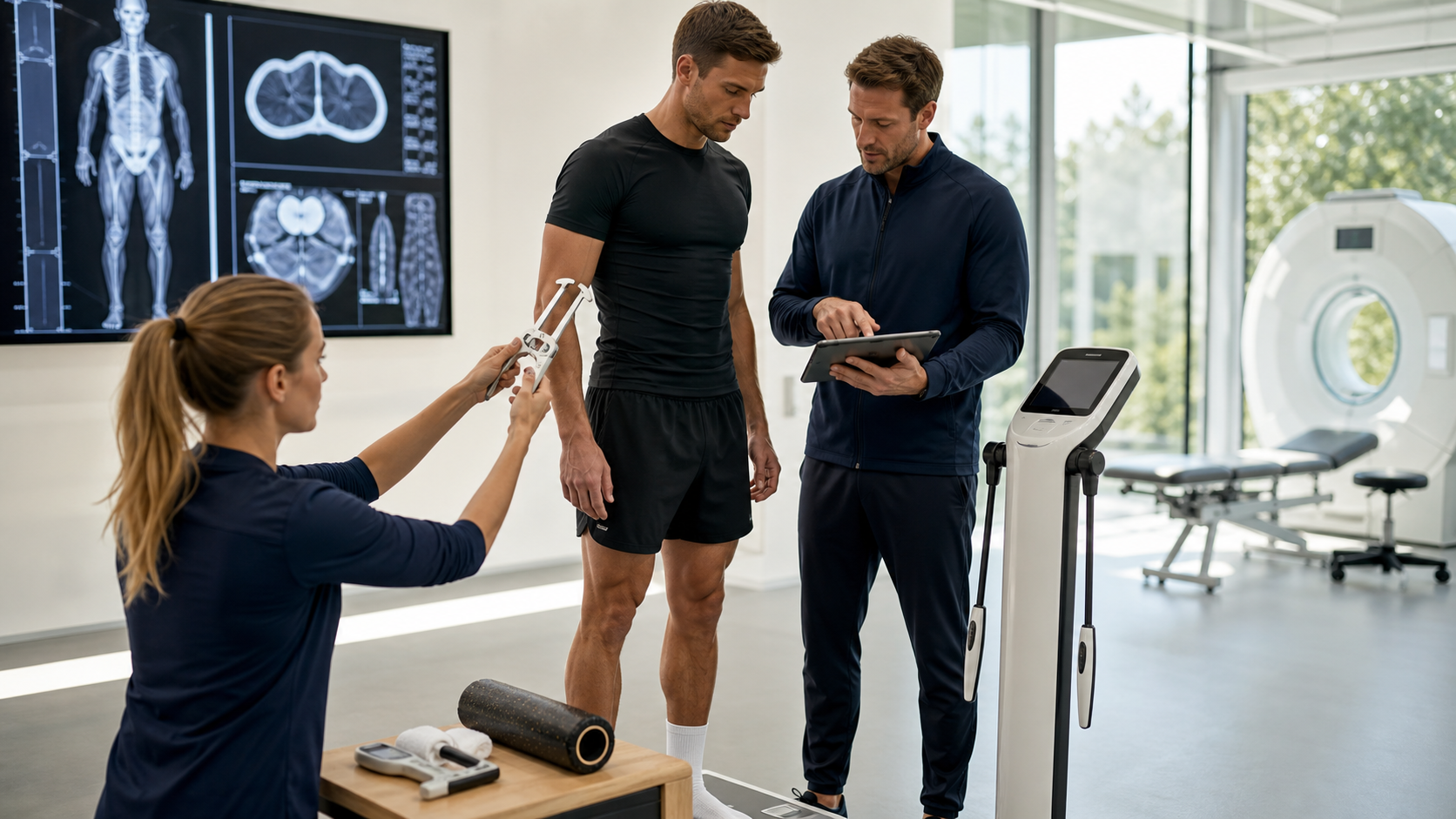
Opening: The Athlete Who Kept “Getting Lighter but Slower”
I’ve been coaching athletes and general fitness enthusiasts for about fifteen years now. The question I get asked most often isn’t “Coach, what should I eat?”—it’s “Coach, my weight hasn’t budged. Am I not making progress?”
A few years ago, I worked with a very dedicated amateur mountain biker—let’s call him A-Zhe. A-Zhe treated “losing weight” as his sole KPI for training. Every morning and every night, he’d step on the scale; when the number dropped, he was happy; when it rose, he was anxious. For a while, he did lose three or four kilograms and looked leaner, but strangely—his climbing power (in watts) didn’t go up; it went down. His times on the Wuling practice segment kept getting worse, and he was constantly catching colds and sleeping poorly.
I had him undergo a more comprehensive body composition assessment, and once the numbers were laid out, it all made sense: a large portion of the weight he’d lost was muscle and body water—his fat loss was actually minimal. He had used a misleading number (body weight) to push himself into a state that was detrimental to athletic performance. In sports science, this has a name: Low Energy Availability (LEA). If it persists long-term, it becomes what we now call RED-S (Relative Energy Deficiency in Sport).
In this article, I want to clarify three things for you:
- Measurement methods: DEXA, bioelectrical impedance analysis (BIA), skinfold calipers, and home scales—what each one actually measures, how much error it has, and which to use in which situation.
- Frequency: Should you measure daily, weekly, or quarterly? Different tools have different reasonable frequencies.
- What the numbers mean: When a number drops, is it fat, muscle, or water? How do you tell the difference? When should you be concerned and seek medical attention?
Let me start with a core concept I’ll repeat throughout this entire article: Body weight is a number with very little information and a lot of noise; body composition is what we actually care about. But measuring body composition is expensive and inconvenient, so the real skill is learning to use “cheap but noisy” tools to approximate “expensive but accurate” answers.
Concepts and Scientific Foundations: What We’re Actually Measuring
Body Weight Is the Sum of Several Different Things
The number you see when you step on the scale is actually the sum of these components:
- Adipose tissue (subcutaneous fat, visceral fat)
- Muscle (skeletal muscle)
- Bone and bone mineral content
- Body water (intracellular, extracellular, plasma)
- Food and feces in the digestive tract, urine in the bladder
- Glycogen and the water bound to it
There’s a key fact hidden here that many people don’t know: for every 1 gram of glycogen, the body stores approximately 3 grams of water along with it. So when you go low-carb the day before, or run a long distance and deplete your glycogen, your morning weight might “drop” one to two kilograms—but you haven’t lost a single gram of fat; you’ve just used up glycogen and the water bound to it. Conversely, when you replenish carbs, the weight comes back. This is why looking at a single day’s weight is almost meaningless.
Two-Compartment Model vs. Multi-Compartment Model
Methods for measuring body composition are categorized in science into several “models”:
- Two-compartment model: Simply divides the body into “fat mass” and “fat-free mass.” Skinfold calipers, bioelectrical impedance, and hydrostatic weighing all fall into this category.
- Multi-compartment model: Further subdivides the body into fat, muscle (lean tissue), bone mineral content, etc. DEXA (dual-energy X-ray absorptiometry) belongs to this category, which is why it can give you more detailed information, such as limb muscle distribution, bone density, and visceral fat.
The finer the model, the better it can theoretically answer the question “what exactly are you losing,” but correspondingly, the equipment is more expensive and less convenient.
“Accuracy” and “Precision” Are Two Different Things
These are two terms I absolutely need to help you distinguish, because they directly determine how you should use these tools:
- Accuracy: How close the measured number is to your “true” body fat percentage.
- Precision: How stable and repeatable the numbers are when the same person is measured multiple times under the same conditions.
For long-term monitoring of athletes, precision is often more important than accuracy. Why? Because most of the time, we don’t need to know “am I at 12.0% or 14.0% body fat today”—we need to know “after these three months of training, has my body fat actually trended down, and have I held onto my lean mass?” As long as the tool is stable, even if it systematically overestimates or underestimates, the trend in changes remains trustworthy. This is also why I often tell my athletes: pick one tool, keep the conditions consistent, and stick with it—don’t switch between different ones.
Practical Methods: A Full Comparison of Four Measurement Tools
The table below reflects how I mentally position these tools when actually working with athletes. The numbers are approximate ranges commonly cited in the literature; actual values will vary depending on the device model, the operator, and the subject’s condition.
| Method | Approximate Error Range (Body Fat %) | Cost (Approximate in Taiwan) | Convenience | Additional Information | Suitable Role |
|---|---|---|---|---|---|
| DEXA (Dual-Energy X-ray) | Standard error approx. 2.5–3.5% | Several hundred to one or two thousand NT$ per session | Requires visit to a medical facility/specialized institution | Bone density, visceral fat, limb muscle distribution | “Baseline calibration point” every few months |
| Skinfold Calipers | Two-compartment model approx. 3.5–6% | One-time caliper purchase: several hundred to a thousand NT$ | Requires a trained measurer | Changes in localized subcutaneous fat thickness | High-precision trend tool in skilled hands |
| Bioelectrical Impedance (BIA) | Two-compartment model approx. 3.5–6%, heavily affected by hydration | Home units: one or two thousand to several thousand NT$ | Can measure at home | Approximate lean mass, body water | Daily trend tracking under consistent conditions |
| Home Scale | Measures only total weight, no composition breakdown | Several hundred to one or two thousand NT$ | Most convenient | None (weight only) | Raw material for daily trends |
The errors in the table above are approximate ranges commonly seen in the literature. DEXA is often regarded as one of the reference standards for body composition measurement, but it is still not an “absolute true value”—differences also exist between different device models and software versions.
DEXA: Use It as a “Calibration Point,” Not for Daily Measurement
DEXA works by passing two different energy levels of X-rays through the body and, based on the absorption differences of various tissues, calculating the three components: fat, lean tissue, and bone mineral content. It is currently one of the most trusted reference tools for body composition in practice, with a standard error on the order of 2.5–3.5%—smaller than two-compartment model methods (skinfold, BIA, hydrostatic weighing, which are approximately 3.5–6%).
But DEXA has several practical limitations:
- Expensive and inconvenient: In Taiwan, you typically have to go to a specific medical facility or sports science center; you can’t go every week.
- Still affected by hydration and dietary status: The same person scanned fasting in the morning, dehydrated, just after a meal, or just after exercise will get different results.
- Involves radiation (though the dose per session is very low).
So my positioning for athletes is clear: DEXA is a “baseline calibration point” done every three to six months. Do one at the start and one at the end of a training cycle to calibrate whether your everyday cheap tools (BIA or skinfold) are accurate, and to confirm that the long-term trend direction is correct. On the day you get a DEXA scan, be sure to keep conditions consistent: fast in the morning, avoid extra-long training the day before, and don’t deliberately dehydrate or overhydrate—this way, different sessions can be compared.
Skinfold Calipers: Old-School, but Deadly Accurate in Skilled Hands
Skinfold calipers look crude, but in the hands of a trained, consistent measurer, their precision is actually very good. The reason is simple: they directly measure the subcutaneous fat thickness at a few fixed sites, without converting it into a vague “total body fat percentage.”
In practice, I prefer to look at the change over time in the sum of skinfold thicknesses (mm) at various sites, rather than rushing to convert it to a percentage. The conversion formulas themselves carry error, but the fact that “this point on the front of the thigh went from 15mm to 11mm in three months” is a solid, trustworthy trend signal.
The key is: always have the same person, using the same calipers, measuring the same sites, with the same technique. If you switch measurers each time, the error becomes so large that the numbers lose all meaning.
Bioelectrical Impedance Analysis (BIA): Most Convenient at Home, but Most Fooled by Water
BIA (including many home body-fat scales and the hand-grip, foot-plate machines at gyms) works by sending a weak electrical current through the body and estimating body composition based on the different conductivity of fat and lean tissue. Because lean tissue holds more water and conducts electricity better, while fat conducts poorly, your body’s hydration status directly dictates the results.
This means all of the following situations will make BIA numbers jump around:
- Just finished a workout and sweating (dehydrated) → body fat percentage may be overestimated
- Just drank a large bottle of water or just ate a meal → the result will be different again
- Water fluctuations at different phases of a woman’s menstrual cycle
- Drinking alcohol the night before, or eating salty restaurant food (super common for people in Taiwan who eat out often)
So BIA isn’t unusable, but you must lock down the conditions: I usually ask clients to measure at a fixed time—“waking up in the morning, after using the bathroom, before breakfast, before drinking lots of water, and before exercising.” Same machine, same time, same state. Then its trend becomes quite usable—even if the absolute numbers it gives may not be perfectly accurate.
Home Scale: Least Information, but Highest Frequency
A scale only gives you total weight; it can’t distinguish fat, muscle, or water. But it has one irreplaceable advantage: cheap, fast, and can be used daily. The value of daily weighing isn’t in the single-day number, but in accumulating a moving average that smooths out the noise—we’ll dive into that in the next section.
Frequency: How Often Should You Measure?
This is probably where most people go wrong. Here’s a simple principle table for you:
| Tool | Recommended Frequency | How to Interpret | Why |
|---|---|---|---|
| Home Scale | Daily (under fixed conditions) | Look at the 7-day moving average, not single-day readings | Smooths out noise from glycogen, water, and digestive tract contents |
| BIA Body Fat Scale | Every 1–2 weeks | Look at the 4–6 week trend | Single readings are too noisy; need multiple points to see a trend |
| Skinfold Calipers | Every 3–4 weeks | Look at changes in the sum of site measurements (mm) | Subcutaneous fat changes slowly; measuring too often is meaningless |
| DEXA | Every 3–6 months | Use as a calibration point at the start/end of a cycle | Expensive, involves radiation, and changes take time to accumulate |
Daily Weight: The Key is the “Moving Average”
What I most recommend for the general athletic population is actually weighing yourself daily under fixed conditions, but only looking at the 7-day moving average.
What does “fixed conditions” mean? It means: waking up in the morning, after using the bathroom, before eating or drinking, wearing the same thing (or nothing), and using the same scale. Then record the number each day and calculate the average of the last 7 days.
For example, let’s say a client’s morning weights for the week are:
- Mon 70.2, Tue 69.6, Wed 70.8, Thu 69.9, Fri 70.4, Sat 71.1, Sun 70.0
Looking only at the “0.9 kg drop” from Wednesday to Thursday, many people would be thrilled, thinking they’ve lost fat—but that’s just fluctuation from water and digestive contents. What you should really look at is the 7-day average of 70.3, and then compare it to the averages of last week and the week before. Trends are a matter of weeks, not a day or two.
Why I Don’t Recommend Measuring Body Fat (BIA) Daily
Because the single-reading noise of BIA is too large, measuring daily will only make your mood swing with water fluctuations, and it’s completely unhelpful. I’ve seen clients panic because their home scale showed “a jump from 15% to 18% in one day”—but that wasn’t fat change at all; it was the water effect from a salty lunch and a sports drink in the afternoon. Measurement frequency should match the actual rate of change of the metric you’re tracking. Subcutaneous fat doesn’t change much in a month; measuring every three days just amplifies the noise.
What the Numbers Mean: Are You Losing Fat, Muscle, or Water?
This is the most important section of the entire article. Because this is exactly where A-Jhe’s story fell apart—he lost weight, but didn’t know what he was losing.
Three Ways to “Get Lighter,” with Vastly Different Meanings
| What’s Being Lost | Speed | Impact on Performance | How to Tell |
|---|---|---|---|
| Water/Glycogen | Drops within a day or two, and comes back just as fast | Temporary; returns with carbs and hydration | Fluctuates quickly, reversible, often accompanies low-carb diets or heavy sweating |
| Fat | Slow, measured in “weeks” | Usually positive (up to a certain lower limit) | Moving average slowly declines, skinfold thickness drops in tandem, lean mass is maintained |
| Muscle/Lean Mass | Medium speed, often occurs with too-low calorie intake + insufficient protein | Negative; power drops, metabolism worsens | Weight drops but strength/watts also drop; DEXA shows a decrease in lean mass |
How do you tell in practice? I usually cross-reference three signals:
- Weight moving average: Is it steadily declining (about 0.3–0.7 kg per week is a relatively safe fat-loss rate; anything faster is risky)?
- Performance metrics: Are power (watts), pace, and strength being maintained? If weight is dropping but performance is also dropping, chances are you’re losing muscle or you’re simply under-fueled.
- Body composition tools: Is the sum of skinfold thicknesses also decreasing (meaning you’re truly losing fat), or does the DEXA calibration point show that lean mass is being maintained?
Weight loss + maintained or improved performance + decreasing skinfolds + maintained lean mass = healthy fat loss.
Weight loss + declining performance + frequent injuries or illness = a warning sign, likely muscle loss or low energy availability.
A Note on RED-S: When the Numbers Tell You “It’s Time to Stop”
Back to A-Jhe. His problem, in the language of modern sports medicine, is RED-S (Relative Energy Deficiency in Sport) caused by low energy availability (LEA).
The International Olympic Committee (IOC) introduced the RED-S concept in 2014 and updated its consensus statements in 2018 and 2023. The core concept is Energy Availability (EA), which is roughly defined as:
Energy Availability (EA) = (Daily Energy Intake − Exercise Energy Expenditure) ÷ Fat-Free Mass (kg)
In plain terms: After subtracting the energy you burn through exercise from the energy you consume, how much is left to maintain your body’s basic functions (hormones, immunity, bones, repair)? When this number stays too low for a long time, the body starts “turning off the lights to save power”—affecting metabolic rate, menstrual function, bone health, immunity, protein synthesis, cardiovascular health, and more. This is the cascade of effects explicitly listed in the IOC consensus.
The key point is: RED-S isn’t just a female issue; males get it too. In the past, everyone only talked about the “Female Athlete Triad,” but in recent years, more and more data shows that male athletes also experience problems under low energy availability. A-Jhe is a living example—his declining performance, recurring colds, and poor sleep were all his body protesting the lack of energy.
I need to be clear about the boundaries here: Body weight and composition numbers are meant to aid judgment and help detect warning signs early; they are not for self-diagnosing diseases or self-prescribing treatments. If you or someone you’re coaching experiences menstrual irregularities or amenorrhea, recurrent stress fractures, chronic fatigue, a noticeable drop in immunity, or abnormal mood or eating behaviors, these warrant individual assessment by a physician, sports dietitian, or other qualified professional. Don’t just match your symptoms online and start making drastic changes on your own.
Common Mistakes and Corrections
Having coached so many clients, I’ve compiled the most common mistakes. Check if any of these apply to you:
Mistake 1: Treating Body Weight as the Only KPI
This is A-Zhe’s original sin. Body weight is just one of many metrics, and it’s extremely noisy.
Fix: Include “performance” in the picture. For cyclists, power (watts) reflects training effectiveness better than body weight; for runners, the relationship between pace and heart rate (bpm) matters more. Do track body weight, but always look at it together with performance.
Mistake 2: Weighing Yourself Multiple Times a Day, Getting Scared by Water Fluctuations
One number in the morning, another at night, and panicking over a one-to-two-kilogram difference.
Fix: Weigh yourself just once a day, at a fixed time—right after waking up and using the bathroom. Don’t step on the scale at any other time. Watch the 7-day moving average.
Mistake 3: Switching Between DEXA, BIA, and Skin-Fold Calipers, Mixing Them Up
The absolute numbers from different tools simply don’t align. Mixing them only leads to the confusion of “what’s my body fat percentage, anyway?”
Fix: Pick one inexpensive tool for daily trend tracking (usually a scale + BIA), and use DEXA only as a calibration point every few months. Don’t compare BIA’s 16% to DEXA’s 13% and conclude you’ve gotten fatter—that’s a tool difference, not a change in your body fat.
Mistake 4: Losing Weight Too Fast
Many people think “if I slim down quickly, I’ll climb faster,” and drop one or two kilograms a week.
Fix: For active individuals, about 0.3–0.7 kg per week is a relatively safe rate that better preserves muscle. Losing too fast almost guarantees sacrificing lean mass and performance, and it’s easy to slide into low energy availability. Better to go slow than to trade muscle and hormones for a number on the scale.
Mistake 5: Ignoring Taiwan’s Humidity and Sodium Fluctuations
Taiwan’s summers are humid and hot. After a long outdoor ride or run, losing one or two kilograms through dehydration is completely normal; eating out tends to be salty, and high sodium makes the body retain water. All of this makes daily body weight and BIA readings jump around.
Fix: Understand that these fluctuations are “normal noise.” Don’t use post-exercise dehydrated body weight to fool yourself into thinking “I’ve lost weight,” and don’t panic because you gained a kilogram the day after a salty hot pot meal. Look at the trend, not single data points.
Actionable Advice for Readers at Different Levels
If You’re a Beginner Just Starting to Exercise
Honestly, at this stage you don’t need DEXA, and you don’t need to obsess over body fat percentage.
- Do just one thing: Weigh yourself every morning under fixed conditions, record it, and watch the 7-day moving average.
- Focus on whether exercise is getting easier, or whether your watts/heart rate on the same climb are improving—these matter far more than body fat percentage.
- No need to buy an expensive body fat scale; an accurate regular scale is enough.
- Whatever you do, don’t aggressively cut calories right from the start to chase rapid weight loss—that’s the fastest way to get injured, give up, and wreck your metabolism.
If You’re an Intermediate Athlete with Some Foundation
You can start incorporating body composition into your monitoring, but keep it simple:
- Daily body weight (moving average) + BIA every 1–2 weeks (under fixed conditions) as your primary tools.
- If you’re about to enter a defined fat-loss or body-shaping phase, do a DEXA scan at the start and end of the cycle as calibration points.
- Always pair body composition numbers with performance numbers: body fat dropping while power holds or rises—that’s the direction you want.
- Learn to ask yourself: if weight dropped this week, did performance get worse? If yes, that’s a warning sign.
If You’re an Advanced/Competitive Athlete
- Build a complete monitoring dashboard: daily body weight moving average, regular skin-fold caliper measurements (same tester), periodic DEXA scans, plus training performance data (watts, pace, heart rate, strength).
- Manage RED-S as a ceiling: don’t chronically under-eat to chase extreme lightness. In competition, “lighter is faster” has its limits—cross that floor and you’ll see hormones, bones, immunity, and performance collapse.
- If you need to manage weight before a season, strongly consider working with a sports dietitian for an individualized plan rather than dieting by feel.
- If any suspected RED-S signs appear (those mentioned earlier), prioritize medical evaluation and set the numbers aside.
A Daily/Weekly Checklist for Everyone
- Daily: Weigh yourself under fixed conditions, record it, update the moving average.
- Weekly: Review the body weight moving average vs. last week; check whether this week’s training performance held up.
- Every 1–2 weeks: Take a BIA measurement under fixed conditions (if you have one).
- Monthly: Review whether the overall trend is heading in the right direction and whether the rate of weight loss is within the safe range (weekly average of 0.3–0.7 kg).
- Quarterly: Consider a DEXA calibration (for advanced athletes) and check for any RED-S risk signs.
The Practical Side of Measurement Error: The Details That Fool You
I’ve been saying “fixed conditions” throughout—here I’ll lay out the details that most easily produce false numbers for athletes, because the devil really is in the details.
After a Long Ride/Run, You Haven’t Actually Lost Weight
In Taiwan’s summer, sweat loss from cycling or running is staggering. After a two-to-three-hour outdoor ride, dropping 1–2 kg from dehydration is par for the course. If you hop on the scale right then and see “wow, down 1.5 kg”—that’s all water, and it comes right back once you rehydrate. Worse, if you take a BIA reading at that moment, dehydration reduces conductivity in lean tissue, causing body fat percentage to be overestimated, and you’ll mistakenly think you’ve “gotten fatter.”
My rule is simple: Don’t weigh yourself or measure body fat within two to three hours after exercise. If you must measure, wait until the next morning, after you’ve rehydrated and eaten, when your body is back to baseline.
Water Fluctuations During the Menstrual Cycle
I always specifically remind female athletes: at different phases of the menstrual cycle, the body retains different amounts of water, and a one-to-two-kilogram fluctuation in body weight is a completely normal physiological phenomenon, not a change in fat. So when women look at trends, it’s best to compare across cycles (e.g., this month’s pre-menstrual reading vs. last month’s pre-menstrual reading at the same time point), rather than scaring yourself with peak-cycle water-retention weight. This has been misunderstood too many times, causing serious women to suffer needless anxiety.
The Sodium Trap for People Who Eat Out
Eating out in Taiwan tends to be salty—a bowl of beef noodle soup, a hot pot meal, a serving of fried chicken—all high in sodium. High sodium makes the body temporarily retain more water, so gaining 0.5–1 kg the next day is common. This is also water, not fat. Understanding this, you won’t collapse when the scale goes up the day after a hot pot dinner with friends.
Measurement Conditions Checklist
Save this table and check it before every measurement:
| Condition | Correct Practice | Common Mistakes |
|---|---|---|
| Time | Fixed time in the morning after waking up and using the bathroom | Measuring morning and night, measuring right after exercise |
| Dietary state | Fasting, before drinking large amounts of water | Just finished a meal, just chugged water |
| Previous day | Avoid extremely long training, binge eating, heavy salt and alcohol | Just ran a long distance, last night’s hot pot with alcohol |
| Equipment | Same device, placed on the same flat surface | Switching between different scales, placing on a soft mat or over a tile seam |
| Clothing | Fixed (none or a consistent light outfit) | Sometimes wearing a jacket, sometimes only underwear |
A Complete Case Study: Xiao-Min’s Three Months
Let me share another example from a female athlete to show you what “matching numbers with performance” actually looks like. Xiao-Min is a recreational triathlete who came to me with the goal of “getting a bit lighter before the season so climbing feels easier.”
The monitoring protocol I set up for her was: daily morning weigh-ins (looking at the 7-day moving average), BIA measurements every two weeks under fixed conditions, DEXA scans at the start and end of the cycle, and continued logging of power and pace during training as usual. The weight-loss target was deliberately conservative: around 0.4 kg per week on average.
Over three months, the numbers looked roughly like this (illustrative, used to explain the interpretation logic):
| Time Point | Weight Moving Average | Approx. BIA Body Fat | Sum of Skinfolds | Representative Power | Interpretation |
|---|---|---|---|---|---|
| Week 0 | 58.0 kg | ~24% | Baseline | Baseline | Starting point, DEXA calibration |
| Week 4 | 57.2 kg | ~23% | Slight decrease | Slight increase | Direction is right, steady slow decline |
| Week 8 | 56.5 kg | ~22% | Continued decrease | Maintained | Losing fat, performance holding |
| Week 12 | 55.8 kg | ~21% | Clear decrease | Slight increase | DEXA confirms lean mass preserved |
The key isn’t those absolute numbers (the BIA percentages shouldn’t be taken too seriously anyway), but looking at all four lines together: weight declining slowly, skinfolds declining in parallel, power not only holding but slightly increasing, and the end-of-cycle DEXA confirming lean mass barely changed. This means what she lost was genuinely fat, not muscle or water. This is the model example of “healthy fat loss.”
If the scenario were different—weight dropping faster than planned, but power starting to decline, skinfolds barely changing, and sleep beginning to suffer—then I would immediately call a halt to the weight loss and restore energy intake, because that’s a signal sliding toward low energy availability. Both are “weight loss,” but one is progress and the other is danger. The difference lies in whether you’re looking at performance and body composition together.
Frequently Asked Questions (FAQ)
Q1: Do I have to spend money on DEXA scans?
Not necessarily. For the general athletic population, “daily morning weigh-in moving average + BIA under fixed conditions” is sufficient for tracking trends. DEXA is more suitable for advanced/competitive athletes, or when you want precise calibration around a defined training block. Beginners really don’t need it.
Q2: Can I trust the numbers from a home body-fat scale?
Don’t take its absolute numbers (e.g., “you’re 18.5%”) too seriously—the error margin is significant and heavily influenced by hydration status. But as long as you keep conditions fixed and use the same device, its trend (whether it’s going up or down) does have reference value. Remember: look at the change, not the decimal point.
Q3: Why isn’t my weight moving even though I’m training and watching my diet?
A few possibilities: First, you might be gaining muscle while losing fat, so weight appears static but body composition is improving (this is a good thing, but only visible through skinfolds or DEXA). Second, you might be looking at single-day numbers instead of a moving average, letting noise obscure the trend. Third, you might not actually be in a calorie deficit. Confirm that you’re looking at a trend and that you’ve paired it with performance metrics before drawing conclusions.
Q4: Will losing weight make me faster?
For climbing-focused disciplines, being lighter does help your power-to-weight ratio. But there’s a lower limit: if you chronically under-eat in pursuit of lightness, your muscles, hormones, bones, and immune system will all suffer, and performance will collapse instead. Lighter doesn’t equal faster—optimal does.
Q5: Should I pursue “athlete-level low body fat”?
It’s strongly discouraged for the general population to blindly chase the extremely low body-fat numbers of competitive athletes. Those numbers are often only maintained short-term during competition season, and chronically holding very low body fat comes at a cost to health (especially hormones and bones). Finding a body composition you can maintain healthily while performing well matters far more than chasing a number from a magazine.
Q6: What symptoms warrant seeing a doctor?
Irregular or absent menstruation, recurrent stress fractures, persistent fatigue that won’t go away, noticeably weakened immunity (constantly catching colds), or losing control over or developing fear around food and weight—all of these warrant seeking help from a physician, sports dietitian, or relevant professional. In Taiwan, medical access is convenient and NHI coverage is readily available, so don’t tough it out.
Conclusion: Let Numbers Serve You, Don’t Be Held Hostage by Them
What happened to A-Zhe? I asked him to stop chasing weight loss, restore daily calories and carbohydrates to reasonable levels, eat enough protein, slow the weight-loss rate to within half a kilogram per week, and start looking at power instead of the scale. After about one training cycle, his weight actually crept up slightly—but his climbing watts came back, he stopped catching colds constantly, his sleep improved, and his Wuling Pass segment time hit a new personal best. He got heavier, yet he got stronger. Because what came back was the muscle he never should have lost and the energy he needed.
This is the core message I want to leave you with:
- Weight is a single number full of noise—look at the moving average and the trend.
- Body composition is what matters, but use the right tools, lock in your conditions, and interpret it alongside performance.
- DEXA as calibration points, BIA/skinfold calipers + scale for daily trends—each has its role.
- Before losing weight, ask: is it fat, muscle, or water? Is performance getting worse?
- When numbers push you into low energy availability that harms health and performance, that’s not a lack of willpower—that’s when you hit the brakes and seek professional help.
Measurement tools are maps to help you see your direction clearly, not whips to punish yourself with. Used correctly, they’ll be your most honest training partner; used wrongly, they’ll lead you further astray while making you think you’re improving—just like they did with A-Zhe.
This article is educational content and does not replace individual diagnosis or treatment advice from a physician, physical therapist, or dietitian. If you have menstrual irregularities, stress fractures, chronic fatigue, declining immunity, disordered eating behaviors, or underlying chronic conditions such as diabetes, hypertension, or heart disease, any weight or dietary changes should first be discussed with your medical team and implemented after individualized assessment. Do not self-diagnose or make major adjustments based solely on this article.
References
- DEXA for athlete body composition measurement and comparison of method errors: We Are BOD — DEXA Scans For Athletes
- Differences in body composition measurement across methods (DEXA, skinfold, BIA): NCBI PMC — Differences in Body Composition Analysis by DEXA, Skinfold and BIA Methods
- IOC consensus statement on RED-S (2018 update): International Journal of Sport Nutrition and Exercise Metabolism — IOC Consensus Statement on RED-S: 2018 Update
- IOC 2023 REDs consensus statement (PubMed): PubMed — 2023 IOC consensus statement on Relative Energy Deficiency in Sport
Related Reading
- Comparison of Body Composition Measurement Methods: From Body Fat Scales to DEXA, Sources of Error and Why You Shouldn’t Measure Daily
- 2026 Smart Scales and Body Composition Monitors: Practicality and Buying Guide for Athletes
- Athletes’ Hydration Habits: How Much Water Should You Really Drink a Day? A Complete Practical Guide from Daily Needs to Training Days
- The Science of Exercise Testing: How to Assess Fitness, Choose the Right Field Tests, and Tracking Methods
西進武嶺 免費訓練分析服務 Intervals | 練不夠還是練過頭?你哪一種類型選手?AI模型告訴你! | 備戰神器 | 公路車 訓練 | CT Yeh
4 年前
靠單車減肥35公斤 心得分享與整理
7 年前
#公路車 #Vo2Max #最大攝氧量 測驗 體驗 | 心肺測試
6 年前
#公路車 #Fitting 靠人工智慧APP 幫你調整單車
6 年前
2026 車錶排行榜!誰是最多車友正在使用?練家子最愛哪款?🏆 (2萬名車友數據) / 公路車 / CT Yeh
5 個月前
一個測試有沒有認真練車的方法😂 #公路車
10 個月前
大家都在開箱的...單車用藍芽對講耳機真的有幫助嗎? SENA BiKom 20 長距離旅遊 & 海鷗繞圈賽 實際體驗心得 / 公路車 / CT Yeh
9 個月前
CT 喇低賽) 單車 比賽總是沒照片? 攝影師的觀點大公開 姿勢就是力量! 請加速1.25倍收看
7 年前