Athlete's Travel Nutrition: How to Eat When Competing Abroad Without Undoing All Your Hard Work
It Starts with a Bowl of Noodles from a Street Stall
I once coached a very dedicated amateur cyclist—let’s call him A-Hong. He spent a full six months preparing for a criterium race in Southeast Asia. His power curve looked great, his weight was under control, and his form before departure was the best I’d seen in years. So what happened? The night before check-in, his teammates dragged him out for a tempting spread of street seafood. By the early hours of the next morning, he was vomiting and had diarrhea. On race day, he barely managed to stand on the start line, and by the first lap, he was pulled from the race due to dehydration and weakness. Six months of hard work, undone by a bowl of noodles and a plate of undercooked shrimp.
I’ve heard this story too many times, and I’ve witnessed it firsthand too many times. Many people think the outcome of an overseas race is decided on the course, but often, the seeds are quietly sown in the days spent on the plane, in hotel restaurants, and at local eateries. Travel itself is a physiological stressor: jet lag disrupts your circadian rhythm, dry cabin air causes you to dehydrate without noticing, unfamiliar food environments raise the risk of gastrointestinal infection, and the lack of familiar fuel leads to haphazard eating. Any one of these going wrong can wipe out all the fitness you’ve painstakingly built up, leaving you short-changed in a foreign land.
In this article, I want to break down “how to eat when competing abroad” clearly, in the same way I’d coach my athletes. We’ll cover the concepts, the scientific basis, the actual packing list I give my athletes, principles for handling local food, common mistakes, and finally, an actionable plan tailored to your level. Whether you’re a first-timer heading to your first overseas race or a veteran who’s crossed multiple time zones, I hope this helps turn “eating” from a variable into an advantage.
First, the Mindset: What Travel Actually Does to Your Body
Before we talk about what to eat, we need to understand what pressures travel puts on an athlete’s body. Know your enemy, and you can prepare with purpose.
1. Travel Fatigue and Jet Lag Are Two Different Things
Many people lump “travel fatigue” and “jet lag” together, but they’re actually separate issues. Travel fatigue comes from sitting still for long periods, disrupted sleep, the cabin environment, dehydration, and tension or anxiety—this kind of fatigue usually resolves after a day or two of rest. Jet lag, on the other hand, is caused by your circadian clock being out of sync with local time, involving melatonin secretion, core body temperature rhythms, and hormonal cycles. Recovery takes roughly about one day per time zone crossed to fully realign.
According to a consensus review in sports science, when traveling across time zones, behavioral strategies (strategic sleep, timed bright light exposure, meal timing) should take priority over pharmacological ones, with aids like melatonin used cautiously depending on the individual (Managing Travel Fatigue and Jet Lag in Athletes, PMC). The takeaway for us is clear: you can’t fix jet lag with food alone, but the timing and content of your meals are one of the most powerful tools for resetting your clock.
2. The Cabin Is a Dehydrating Environment
The relative humidity in an airplane cabin is typically as low as 10% to 20% (drier than a desert), and combined with lower cabin pressure and air circulation, you lose significant fluid through breathing and skin without even noticing. Over a long-haul flight, losing 1% to 2% of your body weight to dehydration is common. For a 70-kilogram athlete, that’s nearly 1 to 1.5 kilograms of water lost—and that level of dehydration is already enough to impair endurance performance and subsequent recovery.
A travel nutrition review in an international sports nutrition journal recommends replenishing about 200 to 300 milliliters of fluid per hour during long flights, and pairing it with electrolyte-containing drinks to help retain fluid, especially for athletes who board already in a low-hydration state (Nutrition for Travel: From Jet Lag to Catering, IJSNEM).
3. Unfamiliar Food Environments Are a Minefield for Your Gut
This is the risk I believe is most underestimated, yet most potentially devastating in overseas racing. Traveler’s diarrhea is the most common health killer for athletes competing abroad, primarily caused by consuming contaminated water or food. When you arrive somewhere with a gut microbiome, sanitation standards, and water quality completely different from home, your digestive system needs time to adapt. And in the days before the race, your immune system is already relatively vulnerable due to training and travel stress—essentially leaving the door wide open.
A-Hong’s story is the classic example. One unwise food choice can leave you dehydrated, depleted of electrolytes, unable to eat, and with disrupted sleep in the most critical 24 to 48 hours, directly destroying your race. In a foreign place, gut safety always trumps culinary adventure. Save the exploration for after the race.
4. Your Circadian Clock Affects Your Appetite and Metabolism
Jet lag doesn’t just make you sleepy; it throws your digestive system “out of whack.” Your gut has its own circadian rhythm. When you force down a big meal at local midnight while your body thinks it’s noon, digestion efficiency drops, leading to bloating and discomfort. Conversely, using “meal timing” as a tool can help your circadian clock align faster to the local time. That’s why meal timing is listed as one of the most powerful tools for adjusting your body clock.
5. Your Immune System Temporarily “Opens a Window” During Travel
There’s a concept that’s often overlooked: after high-intensity training, combined with travel stress, your immune system enters a relatively vulnerable “open window” period. Tapering athletes may reduce training volume, but the sleep deprivation, dehydration, jet lag, and close contact with people in a sealed cabin on a long flight are all extra burdens on the immune system. This is why so many people catch a cold as soon as they go abroad, or have stomach issues the moment they land.
What this means for us: during an overseas race period, protecting your immune system is just as important as protecting your gut. Getting enough sleep, consuming adequate carbohydrates (insufficient carbs can worsen immune suppression), washing hands frequently, avoiding unnecessary close contact, and not staying up late—these details that seem unrelated to “nutrition” are all part of getting you to the start line healthy. On the dietary side, ensuring sufficient energy and carbohydrate intake, and not resorting to extreme dieting or fasting before the race, is the foundation for supporting immune function.
6. Your Gut Also Needs Time to “Get Acquainted” with a New Environment
Your gut is home to trillions of bacteria, a microbiome that has been “negotiated” over the long term with your daily diet. When you suddenly switch to a place with different ingredients, water quality, and cooking methods, even if the food itself is clean, your gut needs time to adapt to new stimuli. That’s why some people, even without eating anything unclean, still experience bloating, irregular bowel movements, or mild discomfort when changing countries.
The practical response is to minimize variation: in the days before the race, maintain a dietary structure close to your usual routine (still centered on familiar carbohydrates, with a stable protein source), and treat your packed supplies as a “security blanket for your gut,” so your digestive system has familiar food to rely on in an unfamiliar environment. This again echoes the core principle—before the race, prioritize stability over novelty.
Practical Methods: An Executable Travel Nutrition Protocol
With the concepts covered, now comes the main event. I divide overseas race nutrition into four phases: before departure, during the flight, the adaptation period after arrival, and the 24 hours before the race. Each phase has different goals and different eating strategies.
Phase 1: 2 to 3 Days Before Departure
The core of this phase is to top off glycogen stores, hydrate fully, and pack your backup nutrition.
A review in the International Journal of Sport Nutrition and Exercise Metabolism points out that moderately increasing carbohydrate intake two days before departure helps maximize glycogen stores before travel disrupts your normal fueling routine (Nutrition for Travel, IJSNEM). Meanwhile, your last meal before departure should consist of familiar, well-tolerated, balanced foods—complex carbs plus protein plus healthy fats—to keep blood sugar stable and avoid digestive issues after boarding.
Here is the pre-departure checklist I give my athletes:
| Preparation Item | Specific Action | Purpose |
|---|---|---|
| Glycogen Loading | Increase carbs to 6–8 g/kg body weight/day for 2 days before departure | Maximize energy stores |
| Pre-Hydration | Drink 2–3 liters of water daily; monitor urine to a pale yellow color | Avoid dehydration before boarding |
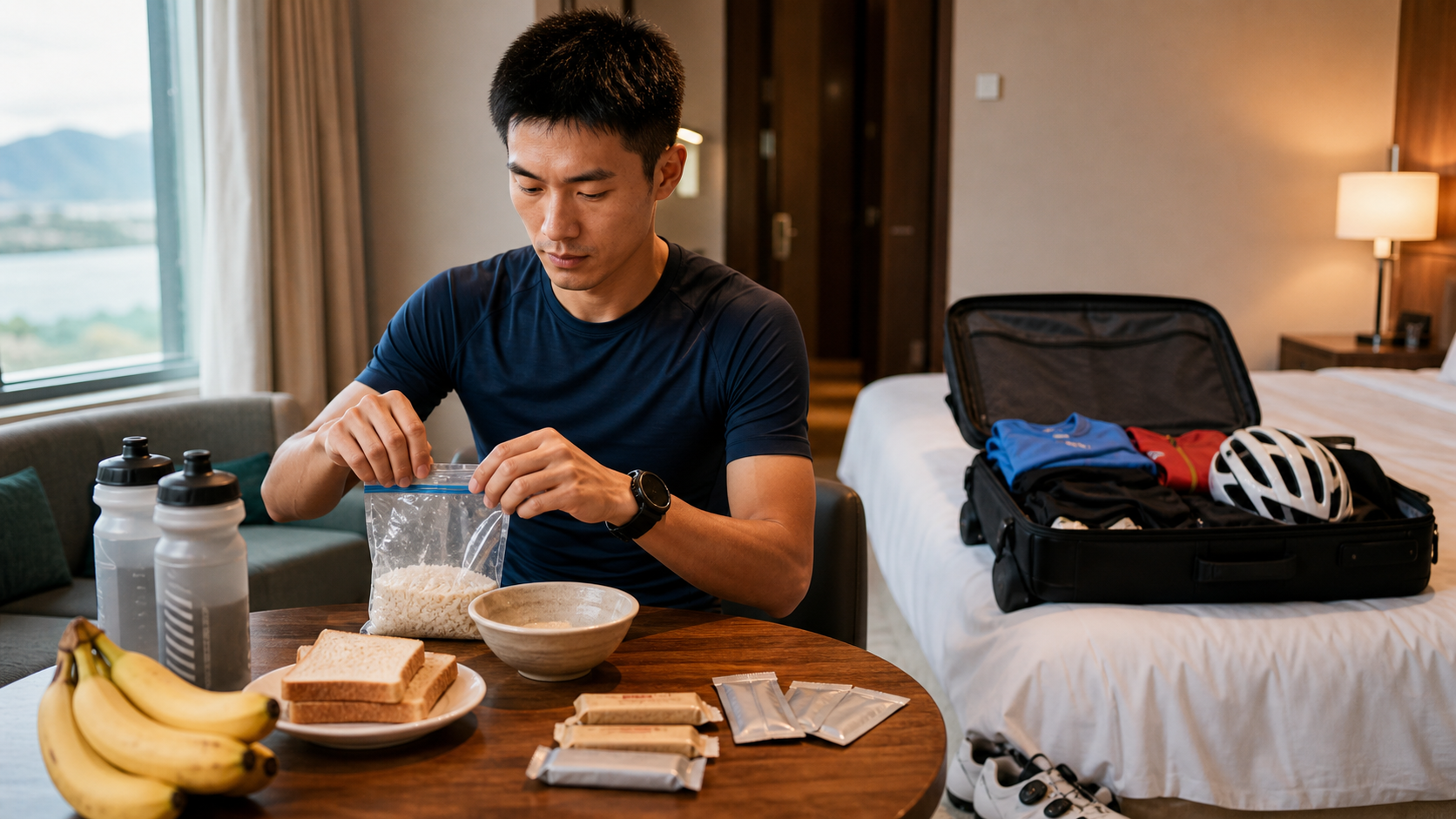
| Pack Backup Nutrition | Energy bars, oatmeal packets, electrolyte powder, nuts, vacuum-sealed instant rice | Lifesaver when familiar fuel isn’t available abroad |
| Medication Prep | Personal GI meds, electrolyte sachets, motion sickness pills | Self-sufficient in unexpected situations |
| Nutrition Rehearsal | No new foods or supplements in the final week | Eliminate GI variables |
Special note on supplements: If you use any supplements, make sure before traveling that they contain no banned substances and come from a reliable source. Products like melatonin are sold as “dietary supplements” in many places with loose regulation, posing a risk of contamination with prohibited substances. Competitive athletes must be strict on this front before using anything.
Phase 2: During the Flight
The goals on the plane are to fight dehydration, prevent blood clots, and start resetting your clock.
Here’s my in-flight nutrition rhythm suggestion, using an 8-hour long-haul flight as an example:
| Time Point | Food/Action | Notes |
|---|---|---|
| Before boarding | Drink 300–500 ml of water | Get a head start before takeoff |
| Every hour | Take in 200–300 ml of water | Counteract cabin dryness |
| Every 2 hours | Get up, walk around, stretch ankles | Promote circulation, prevent deep vein thrombosis |
| According to destination time | Align meal times with destination | Help adjust your body clock |
| Throughout | Minimize caffeine and alcohol | Both worsen dehydration and sleep disruption |
Here’s a key move: Set your watch to destination time as soon as you board, and decide when to eat and sleep based on local time there. If it’s late night at your destination, even if you’re not sleepy, try to rest with your eyes closed and avoid eating; if it’s daytime there, stay awake and eat normally. This is a practical way to use meal timing to help your body “reset its clock.”
Alcohol deserves special emphasis: that free glass of wine or beer on the plane may look appealing, but alcohol worsens dehydration, disrupts sleep quality, and affects next-day recovery. During pre-race flights, alcohol is zero tolerance.
Phase 3: Post-Arrival Adjustment Period
From landing to race day is the critical window for re-establishing rhythm and letting your gut adapt. I give my athletes three principles for this phase:
Principle 1: Make hydration visible. Keep drinking after landing, using urine color as your guide—pale yellow means adequate hydration, dark yellow is a warning sign. This is especially important for Taiwanese athletes arriving in places hotter or drier than home (e.g., the Middle East, inland plateaus).
Principle 2: Be conservative with food. These days are not for culinary exploration. Choose food that looks clean, is cooked to order, and thoroughly heated; avoid raw items, street stalls, and cold dishes or ice of unknown origin. This ties into the local food principles in the next section.
Principle 3: Let sunlight and routine help. Get plenty of sun during the day (morning light for eastbound travel, evening light for westbound—strategies differ), and reduce blue light at night to help your body accept “what time it is here” faster.
Phase 4: 24 Hours Before the Race
This is the final stretch, centered on familiarity, safety, and adequate carbs. From the day before the race through race-morning breakfast, my iron rule is “never eat anything you haven’t tried before.” Every food should be something you’ve rehearsed during training and your gut has proven it can tolerate.
| Time Window | Recommended Intake | Avoid |
|---|---|---|
| Pre-race dinner | White rice/noodles + moderate protein + low-fiber vegetables | High-fat, high-fiber, spicy, raw foods |
| Pre-race bedtime | Small amount of easily digestible carbs (banana, toast) | Caffeine, alcohol |
| Pre-race breakfast (3–4 hours before) | Familiar carb-focused meal, ~1–2 g/kg | High-fat, dairy (if it causes bloating) |
| 1 hour before | Small energy bar or banana, electrolyte drink | Large amounts of solid food |
Local Food: How to Eat Safely and Effectively in Unfamiliar Places
No matter how much backup nutrition you pack, you can’t eat only what you brought the whole trip. Learning to eat safely on the ground is a required course for racing abroad.
Golden Rules for Choosing Food
Travel medicine worldwide shares a classic mantra: “Boil it, cook it, peel it, or forget it.” Translated into practical judgment:
- Eat hot, freshly made, steaming food: High heat is the best sterilization method.
- Choose fruits you can peel: Bananas, oranges—things you peel yourself are relatively safe; pre-cut fruit platters carry higher risk.
- Avoid raw and undercooked items: Sashimi, raw salads, soft-boiled eggs, and undercooked seafood are all skips in places with unclear hygiene standards.
- Be careful with water and ice: Drink only sealed bottled water or boiled water; avoid ice of unknown origin (the ice in that drink could well be one of the culprits).
- Look at crowd flow at restaurants: Places with brisk business and fast table turnover generally have better ingredient freshness.
Common Pitfall Scenarios for Taiwanese Athletes
We Taiwanese love good food and have relatively “tough” stomachs, which makes us prone to letting our guard down. A few scenarios I specifically warn my athletes about:
- Ice treats and raw food in Southeast Asia: The hot climate is tempting, but ice water sources and raw food hygiene are high-risk zones.
- Heavy flavors and alcohol in plateau regions: Some areas have oily, salty diets, and high altitude already affects appetite and digestion—keep it light before the race.
- Dairy and large portions in Europe and America: Cheese and cream come in big servings, easily causing bloating—avoid them before racing.
- The social pressure to “do as the locals do”: Teammates or organizers offer hospitality, you feel awkward refusing, and you end up eating carelessly. Remember, you’re here to race—politely saying no is professionalism.
Finding Your “Safe Restaurant” Strategy
After landing, I advise athletes to do one thing: Find one or two restaurants you trust as soon as possible, lock in a few safe signature dishes, and repeat them in the days before the race. Racing abroad isn’t about sampling every local delicacy—stability and safety matter far more than variety. International fast-food chains, the hot-food section of hotel buffets, and places where you can see the cooking process are all relatively safe choices. Prioritizing stability over novelty is the highest principle of pre-race eating.
Energy Balance While Traveling: Don’t Unknowingly Fall Out of Balance During Your Taper
Competing abroad usually falls right in the taper period of training. Many athletes mistakenly think, “If training volume drops, I need to cut back significantly on food,” and end up on the starting line with glycogen stores unfilled, low on energy, and feeling empty. There’s also the other extreme: because travel is relaxing and local food is novel, athletes unknowingly overeat or consume too much fat, leaving them with a heavy digestive burden and weight gain before the race. I’ve seen plenty of both types of imbalance.
The correct concept is: During the taper, carbohydrate intake should not be drastically cut—it should even be relatively maintained or slightly increased to ensure glycogen loading; what truly needs to be reined in is fat and excessive portion sizes. For a 65 kg endurance athlete, maintaining daily carbohydrate intake at 6–8 g per kilogram and protein at 1.4–2.0 g per kilogram before a race is a common reasonable range—these are conceptual ranges for your reference; in practice, adjust according to the event, individual metabolism, and coach’s plan. There’s no need to chase precision down to every gram.
Here are the energy principles I often remind athletes to follow during a travel taper:
| Aspect | Common Mistake | Recommended Direction |
|---|---|---|
| Carbohydrates | Drastically cutting carbs because training volume is low | Maintain or slightly increase to ensure glycogen is topped up |
| Protein | Insufficient intake or unstable sources while traveling | Use backup food to maintain steady intake |
| Fat | Unknowingly consuming too much from oily local food | Actively cut back before the race; choose lightly cooked options |
| Total intake | Relaxing into all-you-can-eat or being too anxious to eat | Adjust flexibly based on hunger; aim for 70% full |
Monitoring body weight is a practical tool: if you’ve brought a scale or your accommodation provides one, weigh yourself at the same time every morning. If your weight noticeably rises or drops before the race, that’s a signal that energy balance is off, and you can correct it in time. But don’t let it cause anxiety that keeps you up at night—trends matter more than any single number.
Common Mistakes and Corrections
Over years of leading teams, I’ve compiled the most common mistakes athletes make into a comparison table you can use for self-checks:
| Common Mistake | Why It’s Dangerous | Correct Approach |
|---|---|---|
| Rushing out for local specialties upon landing | Digestive system hasn’t adapted yet; highest risk of trouble | Keep meals conservative for the first two days; explore after the race |
| Drinking lots of coffee on the flight to stay alert | Worsens dehydration, disrupts sleep and jet-lag adjustment | Prioritize water; minimize caffeine |
| Trying new supplements before the race | Extremely high risk of unknown gastrointestinal reactions | Only use supplements rehearsed during training |
| Relying on “drinking only when thirsty” | By the time you feel thirsty, you’re often already dehydrated | Drink on a fixed schedule; monitor with urine color |
| Not packing backup food to save luggage space | Can’t find familiar food abroad and end up eating anything | Backup food is a lifeline—always bring it |
| Pre-race dinner too heavy and too oily | Digestive burden and stomach discomfort the next day | Focus on easily digestible carbs; eat to 70% full |
| Using alcohol to sleep and fight jet lag | Worse sleep quality, slower recovery | Rely on sunlight, routine, and cautious melatonin use if needed |
Case Study Correction Example
Let’s return to A-Hong. He later went abroad to race again, and this time we prepared together. Two days before departure, he loaded up on carbs and hydrated well; his backup food box contained his usual energy bars, electrolyte powder, and several packs of instant oatmeal; on the flight, he drank water throughout, avoided alcohol entirely, and followed the destination’s time zone schedule; after landing, for the first three days he only ate freshly cooked hot meals at the hotel restaurant and avoided ice entirely; his pre-race dinner was white rice with chicken breast—a meal he’d eaten countless times during training. The result? He finished the race smoothly and even set a personal best. Same person—the only difference was whether travel nutrition was taken seriously.
Actionable Advice for Readers at Different Levels
If You’re a First-Time International Racer
Focus on risk management. Don’t think about optimizing performance; first, make sure nothing goes wrong.
- Pack a box of backup food before departure—better to overpack than underpack.
- Remember the three principles: “cooked, peeled, bottled water.” Eat only cooked food before the race.
- From one week before the race until after it ends, never try any new food or new supplements.
- Carry your usual gastrointestinal medication and electrolyte packets with you at all times.
- If you feel unwell, don’t push through it. If language barriers complicate overseas medical care, contact the event organizer or team leader for assistance first.
If You’re an Advanced Athlete with Several Overseas Experiences
You can start refining your process and nailing down the details.
- Design different sunlight and sleep strategies based on flight direction (eastbound/westbound).
- Align in-flight meal times precisely with the destination, actively using food to “reset your clock.”
- Build your own list of “safe restaurants” and look them up on maps in advance.
- Quantify daily hydration status using body weight and urine color.
- Fine-tune carbohydrate intake in the 24 hours before the race based on event duration and personal experience.
If You’re a Team Coach or Team Leader
Your responsibility is to build a system for the whole team, not let everyone figure things out on their own.
- Hold a pre-departure briefing on diet and hygiene, clearly explaining the pitfalls.
- Prepare team backup food and electrolyte supplies centrally to reduce variability from individual purchases.
- Scout or inquire about the local dining environment in advance and lock in safe meal locations.
- Establish a sickness response protocol: who handles medical contact, which common medications to stock, and where local medical resources are.
- Remind team members: all supplements must be verified to be free of banned substances and from reliable sources.
A Detail Taiwanese Athletes Should Pay Special Attention To
Departing from Taiwan, there are a few local contexts worth addressing separately. First, Taiwan’s climate is warm and humid—our bodies are accustomed to this environment. When flying to dry, cold, or extremely hot places, the challenges of dehydration and thermoregulation are amplified, so hydration strategies need to be more aggressive than at home. Second, we’re used to convenient eating out, bold flavors, and loving ice—these habits become risks in places with different hygiene standards, so consciously “dial down the flavor and prioritize stability” before going abroad. Third, Taiwan has convenient national health insurance and medical access, making us prone to taking “seeing a doctor when sick” lightly. But abroad, with language barriers, expensive healthcare, and unfamiliar medications, the cost of a bout of gastroenteritis is far higher than in Taiwan. Prevention done well is far more cost-effective than remediation after the fact. Before departure, also look up emergency medical contacts at your destination and confirm the coverage of your travel insurance or medical insurance.
A Condensed Backup Food Checklist
Finally, here’s a backup food box checklist you can copy directly, sorted by priority:
| Priority | Item | Recommended Quantity (Single Person, 5 Days) |
|---|---|---|
| Essential | Usual energy bars/gels | 8–12 servings |
| Essential | Electrolyte powder packets | 10–15 packets |
| Essential | Personal gastrointestinal medication | One full box |
| Recommended | Instant oatmeal/instant rice | 5–8 servings |
| Recommended | Unsalted nuts | 2–3 small packs |
| Recommended | Usual protein powder, portioned | 5–7 servings |
| Bonus | Sealed bottled water (for first day after landing) | 2–3 bottles |
A Sample “One Week Before Race” Schedule
Principles alone are too abstract. When I actually guide athletes, I give them a timeline they can follow. Below is a condensed schedule using “crossing 4–6 time zones, race on Sunday” as an example—adjust it to your own itinerary:
| Day | Main Tasks | Dietary Focus |
|---|---|---|
| Race D-7 to D-5 | Normal training, begin pre-taper preparation | Maintain balanced diet; no new foods |
| Race D-4 to D-3 | Pack backup food, confirm accommodation dining | Slightly increase carbs, pre-hydrate |
| Race D-2 (Departure day) | Fly, reset clock on board | Hydrate hourly, align meals with destination time |
| Race D-1 (First day after landing) | Light activity, get sunlight to adjust jet lag | Only freshly cooked hot meals at hotel, bottled water |
| Race D-0 (Adaptation day) | Course recon, easy ride/run to wake up the body | Familiarize with safe restaurants, keep diet conservative |
| Night before race | Sleep early, prepare next day’s supplies | Easily digestible carb dinner, 70% full |
| Race day | Eat 3–4 hours before start | Familiar carb breakfast, electrolyte intake before race |
The spirit of this schedule is: The closer to race day, the more conservative, familiar, and controlled your diet should be. Save your sense of adventure and your culinary curiosity—release them all after you’ve got your results in hand.
Climate and Environmental Differences: Tailoring Your Hydration Strategy
When Taiwanese athletes travel to different climate zones, their hydration and dietary strategies need to be adjusted accordingly. I’ve organized several common scenarios below so you have a clear picture before you depart:
| Destination Environment | Main Challenges | Key Responses |
|---|---|---|
| Hot and humid (Southeast Asia) | Heavy sweating, high risk from raw food and cold treats | Increase electrolytes, strictly follow cooked-food principle |
| Hot and dry (Middle East, inland areas) | Rapid hidden dehydration, decreased appetite | Proactively hydrate on a schedule, eat smaller frequent meals |
| High altitude (plateaus, mountainous regions) | Decreased appetite, slower digestion, increased dehydration | Light and easily digestible food, increase water intake |
| Cold and dry (European/American winters) | Delayed thirst sensation, burden from dairy products | Remind yourself to drink water, limit cheese and cream |
Let me specifically address high altitude. If your race location is at an elevation significantly higher than Taiwan (for example, above 1,500 meters), your appetite will decrease, digestion will slow, and fluid loss will accelerate. In this situation, forcing yourself to eat your usual portions will actually make you uncomfortable. The principle is light, easily digestible, smaller frequent meals, and plenty of water — give your body time to adapt. If your schedule allows, arriving early to let your body acclimate to the altitude will benefit both your dietary tolerance and athletic performance.
Quantifying Hydration: Stop Relying on Feelings
“Drink more water” is a useless statement because it lacks quantity. The quantitative guidelines I give my athletes are simple, and you can apply them directly:
- Daily baseline water intake: Body weight (kg) × 30–40 ml. For example, a 70 kg person needs about 2.1–2.8 liters, and you add more in hot environments.
- During flights: 200–300 ml per hour.
- During exercise: Based on sweat rate, generally 400–800 ml per hour; heavy sweaters need more, paired with electrolytes.
- Monitoring indicator: Urine color. Pale yellow (like diluted lemon juice) means adequate hydration; dark yellow or amber is a warning sign to hydrate immediately.
You don’t need to memorize these numbers rigidly. The key is to build the habit of “fixed timing and quantity, verified by urine color” rather than waiting until you feel thirsty to drink — by the time you clearly feel thirst, your body is often already mildly dehydrated.
Frequently Asked Questions (FAQ)
These are the questions athletes ask me most often when I lead teams abroad. I’ve compiled them here for you:
Q1: Can I eat local food when competing abroad? When is it appropriate?
Yes, but wait until after the race. In the days before the race, stability and safety matter far more than trying new things. Enjoying local cuisine after finishing is your reward and won’t affect your performance.
Q2: What if the in-flight meal doesn’t fit my nutrition plan?
This is exactly what your backup food is for. You can treat the in-flight meal as a “clock-checking” tool for meal timing, but for what and how much you actually eat, you can supplement or replace with your own energy bars and oatmeal packets. Don’t force yourself to eat an unsuitable airplane meal.
Q3: Can I actually use melatonin?
It does help with jet lag, but for competitive athletes there are two prerequisites: first, confirm the product contains no banned substances and comes from a reliable source (these supplements are loosely regulated and carry contamination risks); second, treat it as an aid — your primary tools remain sunlight exposure, sleep schedule, and meal timing. If you have chronic conditions or are taking medication, consult your physician before use.
Q4: If I get diarrhea abroad, can I still race?
It depends on the severity, and your health must come first. For mild discomfort, supplement with electrolytes, eat light food, and monitor yourself. If you have fever, severe dehydration, or bloody stools, seek medical attention immediately — don’t gamble your health for a race. If language barriers arise when seeking medical care overseas, contact your team leader or the event organizer for assistance. No race is worth sacrificing your body.
Q5: What should vegetarian athletes pay attention to when preparing food for overseas races?
Vegetarians face a greater challenge in unfamiliar regions when it comes to “finding suitable protein sources,” so backup food preparation is even more critical. Bring extra plant-based protein powder, instant legume packets, and nuts, and research local vegetarian restaurants in advance to avoid eating randomly or having insufficient protein intake.
Q6: What if I have to race before my jet lag is resolved?
If you’ve crossed many time zones and don’t have enough buffer days between arrival and the race, you may not fully adjust. In this case, focus on the controllable factors — sleep quality, hydration, familiar foods — and use sunlight exposure and strategic napping to boost your state as much as possible before the race. If you have the flexibility, departing a few days earlier is always the best solution. A common rule of thumb is: allow roughly one day of adaptation for each time zone crossed, and for long-haul travel crossing more than five time zones, arriving early is even more important.
Q7: Will my energy gels and electrolyte powders cause problems at customs?
Generally, commercially available sports nutrition products with simple ingredients are fine, but different countries have varying regulations on food and powdered substances entering their borders. Check the destination’s customs regulations before departure, and keep original packaging and ingredient labels to avoid misunderstandings. If carrying larger quantities, keeping them in original packaging and placing them in carry-on luggage is safer.
Q8: My stomach has always been fine. Do I really need to be this careful?
“Good digestion” is an experience from your familiar environment. When faced with unfamiliar water quality and microbial flora, even the strongest stomach can hit trouble. Moreover, before a race you’re in an immune-open window, leaving less room for error. Rather than gambling on luck, treat conservative eating as standard procedure — this isn’t timidity; it’s professionalism.
Conclusion: Make “Eating” Work in Your Favor
When you travel abroad to race, you’ve already invested significant time, money, and physical effort. By comparison, getting your travel nutrition right is actually the highest-return investment you can make — it costs you little extra, yet it protects everything you’ve worked so hard to build. I often tell my athletes: true competitors aren’t just comparing who trains harder, but who prepares more meticulously. Who drinks water diligently on the plane, who resists that tempting street stall in a foreign land, who sticks to familiar foods for the week before the race — these unremarkable choices will ultimately show up in your condition when you cross the finish line.
Don’t let six months of hard work be undone by a bowl of street noodles. Plan your “eating” well, set off fully prepared, and the only thing you’ll need to worry about when you step onto that overseas starting line is how to leave your rivals behind. May every international race you enter be worthy of every drop of sweat you’ve shed.
This article is educational content and cannot replace individual diagnosis and treatment advice from physicians, physical therapists, or nutritionists. If you have diabetes, hypertension, heart disease, or any chronic condition, be sure to consult your primary care physician regarding your diet, supplements, and medication arrangements before traveling abroad to compete, and make individualized plans. Do not follow the general recommendations in this article on your own.
References
- Managing Travel Fatigue and Jet Lag in Athletes: A Review and Consensus Statement (PMC): https://pmc.ncbi.nlm.nih.gov/articles/PMC8279034/
- Nutrition for Travel: From Jet Lag to Catering (International Journal of Sport Nutrition and Exercise Metabolism): https://journals.humankinetics.com/view/journals/ijsnem/29/2/article-p228.xml
Related Reading
- Overseas Race Nutrition Preparation for Road Running: Dietary Strategies and Prevention of Traveler’s Ailments for International Competitions
- Athlete’s Race Week Nutrition Plan: Glycogen, Gut Health, and Daily Meal Plate Strategies for the Week Before Competition
- Athlete’s Meal Prep Practical Guide: A Complete Strategy for Efficiency, Nutritional Balance, Storage, and Variety
- The Complete Guide to Athlete Nutrition and Immunity: From Season Strategies to Table Practice
CT暗黑廚房) 車友必備 宇宙無敵鮮蚵湯 幫助訓練恢復 天然食補 好市多 超肥鮮蚵 破PR
7 年前
FTL 與 SYB 車隊專訪 西進武嶺 實用攻略分享! 2小時 如何練?!你不知道的眉角!新手準備武嶺必看 EP1 | 實力派女車友 | 精華版 | 公路車 | CTYeh
4 年前
水金九不厭五分 10度寒流冷到不願停!feat. 卡卡 / 公路車 / CT Yeh
6 個月前
大家都在開箱的...單車用藍芽對講耳機真的有幫助嗎? SENA BiKom 20 長距離旅遊 & 海鷗繞圈賽 實際體驗心得 / 公路車 / CT Yeh
9 個月前
2026 輪霸西濱200K 挑戰VLOG / 第一集團 / 首次參加..經驗不足、膀胱不足 /死守6H內 / AI戰鬥力顯示系統 / 公路車 / CT Yeh
4 個月前
JJSC南台灣單車走春三日行 DAY 1 / 強度 x 美食 x 節慶體驗 / 公路車 CT Yeh
5 個月前
一個測試有沒有認真練車的方法😂 #公路車
10 個月前
拍單車比賽能賺多少?一日Phomi攝影師實境測試| #公路車 | CT Yeh | 用科學分析賺錢!
3 年前