Athlete's Quick Cooking: 15-Minute Nutritious Meals, Practical Recipes to Eat Right Even When Busy
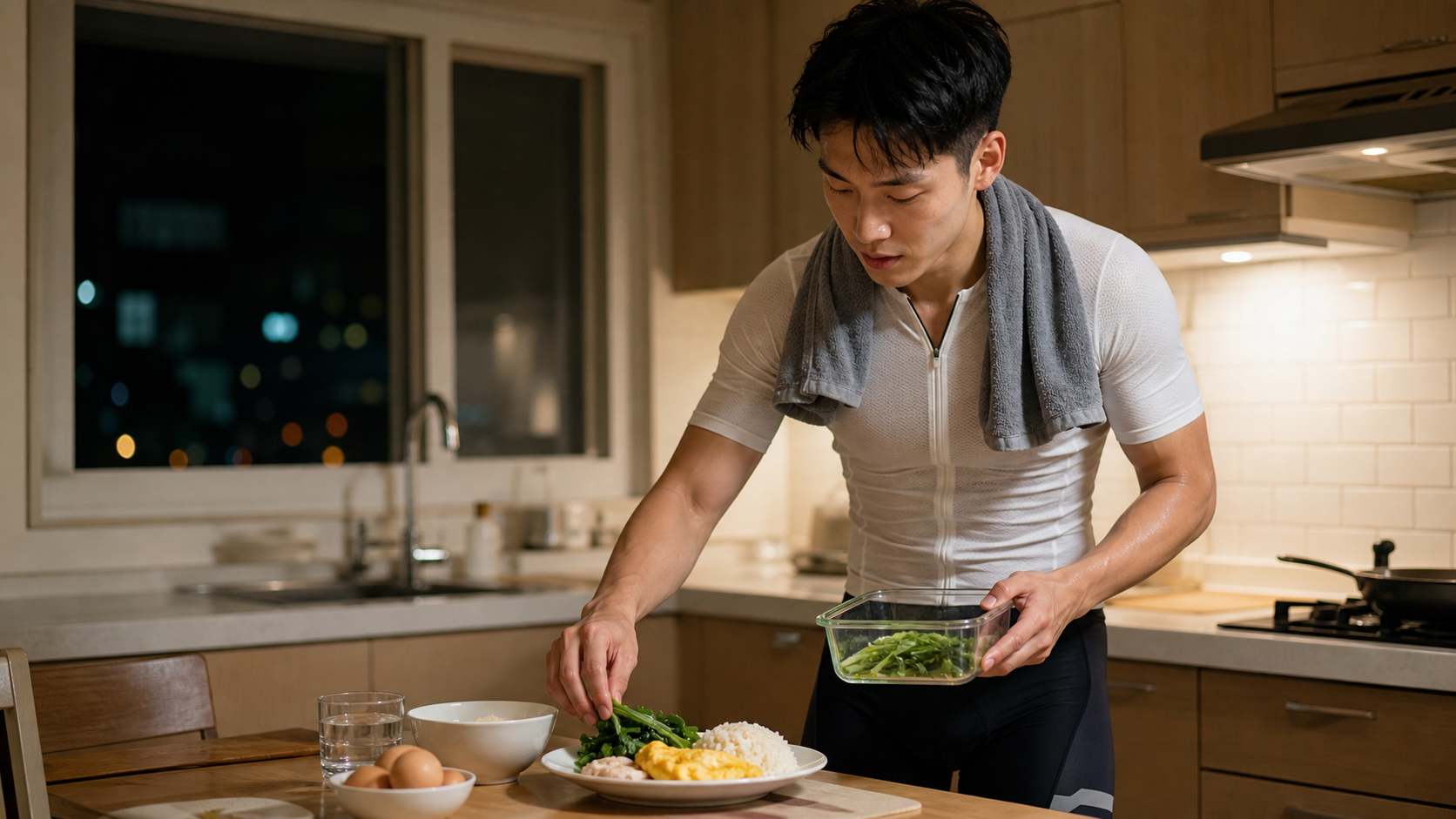
Starting with a Scene of Coming Home Too Exhausted to Cook
At 8:30 that night, a student who had been training with me for six months sent me a message: “Coach, I just rode 60 km and got home. I’m so tired I just want to lie down. The fridge only has eggs and a bunch of greens. Is it okay if I just eat instant noodles?”
I’ve been coaching athletes and general fitness enthusiasts for over a decade, and I get messages like this almost every week. Many people think the hard part of sports nutrition is the “knowledge”—how many carbs to eat, how much protein to supplement. But what actually trips everyone up is time and the effort of cooking. You’ve just finished a mountain ride, a long run, or a heavy lifting session. Your body is fatigued, your willpower is at zero, and you might even be so hungry you feel a bit nauseous. At that moment, asking you to look up recipes and spend forty minutes washing, chopping, and stir-frying is simply unrealistic. The result is one of two extremes: either you mindlessly stuff yourself with instant noodles and cookies, or you skip eating altogether until the next day. Both slow down your recovery.
So over time, when I work with students, I redefined the “recovery meal” as one thing: a meal that gets you carbs, protein, vegetables, and fluids in 15 minutes, using the fewest pots and pans and the least willpower. This article is the complete version of the system I use with my students—first I’ll explain the science behind it, then I’ll give you tables and recipes you can copy directly, and finally I’ll help you avoid the mistakes I’ve seen countless times.
This isn’t about complex molecular nutrition, and I’m not pushing any expensive supplements. What I want to give you is a method you can sustain long-term in the real-world context of “living in Taiwan, coming home after work, having a small kitchen, and easy access to takeout.” Because the most important thing about a nutrition strategy is never how perfect it is in theory, but whether you can actually do it today, tomorrow, and next month.
Why “This Post-Workout Meal” Is Worth 15 Minutes of Your Time
The Three Things Your Body Wants After Exercise
Let’s establish the concept first. After moderate-to-high-intensity exercise, your body roughly has three repair needs:
- Replenish glycogen (carbohydrates): Prolonged or high-intensity exercise heavily depletes the glycogen stored in your muscles and liver. This is the key to whether you can get moving again the next day.
- Repair and synthesize muscle protein (protein): The micro-damage to muscle fibers caused by training needs amino acids to repair, and this is also the foundation for getting stronger.
- Rehydrate and replenish electrolytes: Taiwan’s summers are hot and humid. The sweat and sodium you lose on a long ride or run can be more than you’d imagine.
These three things don’t require you to calculate to the decimal point, but the direction needs to be right. According to the sports nutrition community’s consensus, if you want to rapidly replenish glycogen after exercise, a more aggressive approach is to consume about 1.0 to 1.2 grams of carbohydrates per kilogram of body weight per hour within the first few hours after exercise. For protein, general recommendations are about 0.25 to 0.4 grams per kilogram of body weight per meal, or aiming for an absolute amount of about 20 to 40 grams (International Society of Sports Nutrition nutrient timing position stand).
The Carb-to-Protein Ratio: Just Aim for an Easy-to-Remember Range
Students love asking me: “What should the carb-to-protein ratio be?” Online, you’ll see all kinds of numbers—2:1, 3:1, 4:1. My practical advice is: Don’t overthink it. Just aim for a range of 2:1 to 4:1 (carbs:protein). The bigger your training volume and the more endurance-oriented it is (long rides, long runs), the more you lean toward the carb side; if you focus on weight training and want to build muscle, make sure the protein side is solid.
Here’s an easy-to-remember conversion: if you’re a 65 kg endurance athlete coming home from a ride of two hours or more, a good target for that meal is roughly 60 to 80 grams of carbs + 20 to 30 grams of protein. That sounds abstract, but it becomes concrete when translated into food—the tables below will help you convert grams into “bowls of rice, eggs, and cartons of soy milk.”
The Time Window Isn’t as Tight as You Think
Let me help you let go of a myth here. There used to be a popular idea about a “golden 30-minute window” after exercise, as if failing to down a protein shake within half an hour meant all was lost. In reality, if your total daily carb and protein intake is sufficient, that window is actually quite flexible—muscles can typically replenish glycogen within a day (International Society of Sports Nutrition nutrient timing position stand).
So why do I still tell students to try to eat a good meal within an hour or two after exercise? Because for busy people, “eating it while you still remember and still have an appetite” is more practical than chasing some magical timing. The point of loosening the time window isn’t to tell you to procrastinate—it’s to stop you from stressing. If you get home 90 minutes after your workout, you’re still completely fine; just eat a proper meal. The situation you should actually worry about is “training two days in a row and skimping on the meal in between”—that’s what builds up a recovery debt.
Total Daily Protein Matters More Than Any Single Meal
Many people fixate entirely on “that one post-workout shake” while overlooking the fact that total daily intake and distribution are what really determine results.
For endurance athletes (cycling, running, triathlon), the general consensus is to consume about 1.4 to 2.0 grams of protein per kilogram of body weight per day, spread across the day in meals of about 20 to 40 grams each (iRunFar: Protein for Endurance Athletes, Outside Online report). This number is higher than many people think—endurance athletes often assume, “I’m not building muscle, so I don’t need much protein,” but prolonged exercise also breaks down protein, and it needs to be replenished.
I’ve converted common body weights into daily protein targets for you. This is handy to stick on the fridge:
| Body Weight | Daily Protein Minimum (1.4 g/kg) | Daily Protein Maximum (2.0 g/kg) | Approximate Number of Meals (25-35g each) |
|---|---|---|---|
| 50 kg | 70 g | 100 g | 3 meals |
| 60 kg | 84 g | 120 g | 3 to 4 meals |
| 70 kg | 98 g | 140 g | 4 meals |
| 80 kg | 112 g | 160 g | 4 to 5 meals |
The point of this table isn’t to turn you into a calculator, but to give you a rough sense: if you’re a 70 kg person and your three main meals barely have any protein, relying only on one post-workout shake to hit over 100 grams is mathematically impossible. The real solution is to include a serving of protein at every meal, then add a bit extra at the post-workout meal.
A Quick Reference for Protein in Common Taiwanese Foods
This is another pocket table I give my students, to make “20-30 grams of protein” less abstract:
| Food | Common Serving Size | Approximate Protein |
|---|---|---|
| Egg | 1 | 6 to 7 g |
| Unsweetened soy milk | 400 ml | 12 to 14 g |
| Chicken breast | One palm-sized piece (about 100 g) | 22 to 25 g |
| Tuna (canned, in water) | Half a can | 12 to 15 g |
| Firm tofu | Half a block | 8 to 10 g |
| Greek yogurt | 1 small cup | 8 to 12 g |
| Ready-to-eat / sous-vide chicken breast | 1 pack | 20 to 24 g |
With these two tables, you can assemble a meal standing in a convenience store: one pack of ready-to-eat chicken breast + one carton of unsweetened soy milk + one tea egg, and you’re easily over 30 grams of protein. Add carbs with a rice ball or a sweet potato, and your recovery meal is complete.
Four Principles for a 15-Minute Nutritious Meal
Before I give you the recipes, let me lay out the methodology. These four principles are what I ask my athletes to internalize, because once you remember the principles, you don’t need to memorize recipes—you can just look at what’s in your fridge and build a meal yourself.
Principle 1: One Protein, One Carb, One Serving of Vegetables, One Glass of Water
This is the core mindset. For any meal, as long as you hit “one protein source + one good carb + one serving of vegetables + hydration,” you’re on the right track. It doesn’t need to be perfect—just make sure none of the four boxes are empty. The most effective thing my athletes report is drawing these four boxes on a sticky note and putting it on the fridge, so a quick glance when they get home tells them which box is missing.
Principle 2: Using “Semi-Processed” and “Ready-to-Eat” Foods Isn’t Lazy—It’s Strategic
A lot of people feel guilty, thinking that using frozen vegetables, ready-to-eat chicken breast, rice-cooker sweet potatoes, or canned tuna is “unhealthy” or “lazy.” I want to change your mind: Whatever lets you stick with it long-term is the good strategy. Frozen broccoli isn’t much less nutritious than fresh, and the protein in ready-to-eat chicken breast is just as real. Rather than chasing fresh-cut, fresh-cooked meals every time and then giving up three days later, use semi-processed foods to execute consistently for three months.
Principle 3: One-Pot Meals to Reduce the Willpower Drain of Washing Dishes
After a workout, the most expensive thing isn’t the ingredients—it’s your willpower. That’s why I design recipes that can be done with “one pan, one rice cooker, or one bowl.” Washing one pot versus washing four determines whether you’ll still want to cook tomorrow.
Principle 4: Prioritize Carbs and Protein First; Vegetables and Seasoning Are a Bonus
If you really only have five minutes left today, make sure you get your carbs and protein in first. For vegetables, you can get by with a cucumber, a handful of cherry tomatoes, or a pre-packaged salad. Don’t let “can’t make it perfect” become an excuse for “might as well not eat.” A 60-point meal is far better than a zero-point instant noodle.
Four Replicable 15-Minute Recipes
The following four recipes are ones I’ve actually sent to my athletes and that they use long-term. Portions are based on a post-workout recovery meal for a 60–70 kg athlete; adjust according to your body weight and training volume.
Recipe 1: Rice Cooker Lazy Donburi (Great After a Long Ride/Run)
Prep time: ~12 minutes (most of it is the rice cooker working, so you can go shower)
- 1 bowl of white or brown rice (cook extra the night before and refrigerate; microwaving is faster)
- 1 pack of ready-to-eat sous-vide chicken breast, sliced
- 1–2 eggs
- 1 handful of frozen mixed vegetables or broccoli
Method: Put the rice in a bowl. Add half a cup of water to the rice cooker’s outer pot, then steam the frozen vegetables and beaten eggs inside. Slice the chicken breast and lay it over the rice. Once steamed, pour everything over the rice and drizzle with a little soy sauce or Japanese-style dressing. Carbs, protein, and vegetables all in one go, and the only pot to wash is the rice cooker’s inner bowl.
Approximate nutrition: 60–70 g carbs, 30–35 g protein. Suitable for refueling after a high-volume session.
Recipe 2: Five-Minute Soy Milk Oatmeal Bowl (Great After Morning Training When You Have No Appetite)
Prep time: ~5 minutes
- 400 ml unsweetened soy milk
- Half to one bowl of instant oats
- 1 banana, sliced
- A small handful of nuts or a spoonful of peanut butter
Method: Pour the oats into a bowl, add hot soy milk, and let it soak for two minutes. Top with banana and nuts. That’s it. This one is especially good after a morning ride or run, when your stomach isn’t fully awake and you don’t want something savory. It’s liquid and soft, easy to get down. Protein comes from the soy milk and nuts; carbs come from the oats and banana.
Approximate nutrition: 55–65 g carbs, 18–22 g protein. If you want to boost the protein, add a scoop of whey or switch to a Greek yogurt base.
Recipe 3: Tuna and Egg Fried Rice (Fridge-Clearance Edition)
Prep time: ~10 minutes, one wok
- 1 bowl of leftover rice
- Half to one can of water-packed tuna (drained)
- 2 eggs
- 1 handful of frozen edamame or peas, plus chopped scallions
Method: Heat a little oil in the wok, scramble the eggs, add the rice, tuna, and edamame, and stir-fry. Before serving, sprinkle with scallions and a pinch of salt and pepper. One pan, ten minutes, and the protein stacks up nicely from the tuna and eggs.
Approximate nutrition: 55–65 g carbs, 28–34 g protein. The carb-to-protein ratio lands right around a healthy 2:1.
Recipe 4: Convenience Store No-Cook Combo (For When You’re Out or Renting Without a Kitchen)
Prep time: 3 minutes, no pan needed
- 1 onigiri (rice ball) or sweet potato (carbs)
- 1 pack of ready-to-eat chicken breast OR 2 tea eggs (protein)
- 1 carton of unsweetened soy milk (protein + hydration)
- 1 pre-packaged salad or 1 banana (vegetables/fruit)
This one is for renters, business travelers, or days when you just can’t be bothered. Taiwan’s convenience store density is our advantage—use it. The whole combo delivers 30+ grams of protein, plenty of carbs, and hydration.
Below is a comparison table of the four recipes so you can pick based on your situation:
| Recipe | Situation | Equipment Needed | Protein | Carbs |
|---|---|---|---|---|
| Rice Cooker Lazy Donburi | High-volume training, want to feel full | Rice cooker | 30-35 g | 60-70 g |
| Soy Milk Oatmeal Bowl | After morning training, no appetite | One bowl | 18-22 g | 55-65 g |
| Tuna and Egg Fried Rice | Fridge clearance, want hot food | One wok | 28-34 g | 55-65 g |
| Convenience Store Combo | Out and about, no kitchen | None | 30+ g | Depends on items |
Special Notes for the Taiwan Context: Climate, Eating Out, and Hydration
Humid and Muggy—Sodium and Water Need to Be Managed Together
Taiwan’s summers are hot and humid, which reduces the efficiency of sweat-based cooling. The water and sodium lost during a long ride or run are often underestimated. If you only chug plain water after exercise without replenishing sodium, you can actually dilute your blood sodium and feel weaker the more you drink. In practice, if your post-workout meal is a little salty (miso soup, a seasoned donburi, a bowl of clear soup) plus normal water intake, you’ll usually replenish sodium naturally—no need to buy expensive electrolyte powders. A simple indicator of adequate hydration is urine color: pale yellow usually means you’re good; dark yellow or tea-colored means you’re still dehydrated.
How to Order When Eating Out to Fill All Four Boxes
Eating out in Taiwan is so convenient that it’s easy to overload on carbs while falling short on protein and vegetables. My ordering principles for athletes who eat out are simple:
- Buffet-style (自助餐): First pick one or two main dishes (chicken leg, fish, tofu, eggs), then two vegetable dishes, and a normal portion of rice. Don’t let your bento become “three servings of fried noodles with one piece of fried food.”
- Noodle shops: A bowl of plain noodles (陽春麵) with a plate of blanched greens, a braised egg, and a plate of pork jowl or tofu—that covers your protein.
- Convenience stores: Just use the logic from Recipe 4.
The key is to proactively add one serving of protein and one serving of vegetables—you can eat well even when dining out.
Medical and Health Considerations
If you have a chronic condition—such as diabetes, hypertension, kidney disease, or heart-related issues—the carb and protein recommendations above need to be adjusted on an individual basis. For example, protein intake for someone with impaired kidney function requires individual assessment by a medical team and cannot simply follow the high-protein advice for general athletes. People with diabetes also need more careful planning around the type and timing of carbs. Taiwan’s National Health Insurance makes medical access easy, so if you have any of these conditions, please discuss with your doctor or dietitian first to get personalized guidance. The principles in this article should only serve as a general starting point.
Common Mistakes and Fixes
Having coached athletes for years, I’ve compiled the most common mistakes and their fixes below. Check whether any of these apply to you:
Mistake 1: Only Focusing on Protein, Forgetting Carbs
Many people are brainwashed by “eat protein to build muscle” and only chug a protein shake after exercise, with zero carbs. For endurance athletes, this slows down glycogen replenishment, leaving you unable to ride or run well the next day. Fix: Your post-workout meal must include a clear carb source (rice, noodles, sweet potato, oats, fruit). Don’t demonize carbs.
Mistake 2: Turning the “Anabolic Window” into a Source of Anxiety
Some people agonize all day if they don’t eat within 30 minutes, even force-feeding themselves things they can’t stomach right after a workout, leading to GI distress. Fix: Remember that total daily intake is the big picture; the window is very forgiving. Just eat a proper meal within an hour or two of getting home. Don’t stress about it.
Mistake 3: Chasing Perfect Recipes and Then Giving Up
This is the most regrettable one. People buy a ton of ingredients, follow a bunch of elaborate recipes, get tired after three days of training, and abandon everything to go back to instant noodles. Fix: Lower the bar to “don’t leave any of the four boxes empty.” Use semi-processed and ready-to-eat foods heavily so the barrier to execution is low enough that you can do it even when you’re completely exhausted.
Mistake 4: Drinking enough water but not replenishing sodium
After sweating heavily in summer, drinking only plain water can make you feel increasingly weak or even dizzy. Fix: After exercise, eat something salty or have a bowl of soup at that meal, along with normal water intake—that’s usually sufficient. Only consider electrolyte supplements for severe cases or extremely long workouts, and pay attention to your body’s signals.
Mistake 5: Using sugary drinks or fried foods as carbs
Bubble tea, sugary sodas, and Taiwanese fried chicken certainly have calories, but relying on them long-term for carbs sacrifices nutritional density and adds unnecessary burden. Fix: Prioritize whole-food starches (rice, sweet potatoes, oats, fruit). An occasional treat is fine, but don’t make it a habit.
Actionable advice for readers at different levels
If you’re a beginner just starting to exercise
Don’t think about meal plans yet. You only need to do one thing: have a visible source of protein at every meal, and add a good carb source to the post-workout meal. Starting with “convenience store combos” is the least painful approach. Execute this consistently for two weeks until it becomes second nature, then gradually add in rice-cooker meals. Don’t try to change too much at once—you’ll get exhausted and give up.
If you’re an intermediate athlete training on a fixed weekly schedule
Start paying attention to your total daily protein intake. Use the body-weight reference table earlier to calculate your daily target, and make sure each of your three meals contains 25 to 35 grams of protein. Rotate through the four recipes for your post-workout meal to avoid getting bored. Also start paying attention to hydration and sodium, especially during Taiwan’s summers. The key at this stage is “consistency”—make your recovery meal a habit that requires no thought.
If you’re an advanced athlete with high volume or in competition prep
You need a more proactive strategy: weekend batch prep (cook several portions of rice and chicken breast at once and freeze them), flexibly adjust carbs based on training load (increase carbs on big workout days, scale back on rest days), and track your totals more rigorously. At this stage, consider working with a sports nutritionist to fine-tune individualization. But even at this level, the four core principles still apply—no matter how brilliant the plan, you still have to actually eat it on a tired night.
A quick-reference table for the three stages
| Stage | Primary task | Which recipes to start with | Advanced focus |
|---|---|---|---|
| Beginner | Protein at every meal + carbs after workout | Convenience store combos | Build reflexive habits |
| Intermediate | Manage daily totals and distribution | Rotate through all four | Hydration and sodium, consistent execution |
| Advanced | Batch prep + adjust carbs by training schedule | All recipes + custom | Individualization, consult a nutritionist |
A real case study: From “getting more tired with training” to “recovery is back”
I’d like to share another case study (details have been adjusted, but it reflects a typical situation I’ve actually encountered). A 68 kg office worker who trained on the bike after work on weekdays and did long rides on weekends came to me with his biggest complaint being “I get more tired the more I train, my weight hasn’t changed, and my legs always feel heavy the next day.” He thought his training plan was too demanding and wanted to cut back further.
But after I asked him to log three days of food intake, the problem was obvious: his post-workout recovery meal was practically empty. After finishing training around 7 or 8 PM, he’d often just have a whey protein shake and two slices of toast before bed—protein was barely adequate, carbs were severely insufficient, and his total daily protein was only around 1.0 gram per kilogram of body weight, far below the 1.4 to 2.0 grams recommended for endurance athletes. Over time, this created a chronic state of “not refueling properly”—performance plateaued and fatigue accumulated.
I didn’t add more training to his plan; instead, I fixed his diet first. I did three things: first, changed his post-workout meal to a “lazy rice-cooker donburi,” pushing carbs above 60 grams and protein to 30 grams; second, set up weekend batch prep so he wouldn’t slack off during the week; third, set his daily protein target at roughly 100 to 110 grams, spread across four meals.
About three to four weeks later, he reported that “my legs don’t feel as heavy, I have more power on the bike, and I’m sleeping better.” His weight didn’t spike; in fact, because recovery improved and training quality went up, his physique gradually moved in a positive direction. The point of this case isn’t some magical recipe—it’s that his original problem wasn’t training too much; it was eating too little and eating wrong. Many people hit a plateau and immediately think about adding more training, overlooking the recovery half of the equation. Getting the recovery meal right is often more effective than adding another workout.
Your body is sending “not enough fuel” signals
How do you know if you’re chronically under-fueling like this athlete? The following signals are worth paying attention to (a single one may not indicate a problem, but if several appear together, take note):
- Legs feel persistently heavy the day after training, with slow recovery
- Training performance stagnates or even declines long-term, despite consistent training
- Poorer sleep quality and daytime fatigue
- Lack of motivation for training and low mood
- For female athletes, changes in the menstrual cycle deserve serious attention—this could be a warning sign of long-term inadequate energy intake and should be discussed with a physician
These signals aren’t meant to scare you, but to remind you to check the two most fundamental things: Are you eating enough throughout the day? Is your recovery meal on point? Often, the answer lies right there. If the signals persist after adjusting your diet, or if they come with other physical discomfort, be sure to seek medical evaluation to rule out other health factors—don’t just guess on your own.
Weekend batch prep: One hour for a week of ease
If you want to upgrade from “15-minute nutritious meals” to “eating in 3 minutes after getting home,” the key is spending one hour on the weekend doing batch prep. When I work with athletes in competition prep, this is the most impactful, highest-ROI strategy. The principle is simple: consolidate the most time-consuming “cooking” into one session, and during the week you only need to assemble and reheat.
Here’s the prep list and storage method I recommend—this is the actual version I give to my athletes:
| Prep item | Batch quantity | Storage method | Weekday use |
|---|---|---|---|
| White rice / brown rice | 4 to 6 bowls | Portion and freeze, reheat in microwave | Carb base for any meal |
| Boiled / sous-vide chicken breast | 4 to 5 pieces | Refrigerate up to 3 days, freeze for longer | Protein for donburi, salads, fried rice |
| Rice-cooker sweet potatoes | 5 to 6 pieces | Refrigerate, can be eaten cold | Quick carbs for breakfast or post-workout |
| Boiled eggs | 6 to 8 eggs | Refrigerate up to one week | Grab-and-go protein |
| Blanched vegetables / frozen vegetables | One large container | Refrigerate up to 2 days | Fills the vegetable slot |
Once these are prepped, your weekday routine becomes “grab a portion of rice, microwave it, top with chicken breast, add two eggs and a handful of vegetables”—literally three minutes. The most common feedback from my athletes is: once the food is prepped, you won’t be tempted by instant noodles halfway through. Because opening the fridge reveals ready-to-eat healthy ingredients, the barrier to execution drops to zero.
Two small reminders for prep. First, cooked chicken and rice must be cooled completely before refrigerating or freezing—don’t put hot food directly in the fridge, to avoid bacterial growth; Taiwan’s humid heat means food safety deserves extra attention. Second, refrigerated cooked food should be eaten within three days, and reheated thoroughly before eating. If it smells or looks off, don’t take the risk—throw it out.
Don’t overlook fueling during exercise and long sessions
This article focuses on post-exercise recovery meals, but I need to add a section on fueling during exercise, because many athletes’ recovery problems actually stem from not eating enough during the workout itself.
If your session exceeds roughly 60 to 90 minutes (for example, a medium-to-long mountain ride or a run longer than a half marathon), your muscle glycogen will gradually deplete. At that point, taking in some easily digestible carbs can maintain intensity and make post-workout recovery much easier. Practical options commonly used by Taiwanese cyclists include bananas, energy bars, onigiri rice balls, or even small steamed buns from convenience stores—the key is easy to digest and tolerable for your stomach. Never try a new fuel for the first time on race day; always test it during training first.
For hydration, aim for roughly 400 to 800 milliliters of water per hour during longer sessions—lean toward the higher end in hot weather or when sweating heavily—and remember to bring some sodium (sports drinks or salt tablets). There’s no single precise number that works for everyone, because sweat rates vary greatly from person to person—calibrating by feel and urine color is more practical than memorizing formulas. If you take care of hydration and carbs during exercise, the recovery burden of that post-workout meal naturally drops by half.
FAQ
Over the years of working with athletes, a few questions come up from almost everyone. I’ve compiled them into this FAQ.
Q1: I want to lose weight—do I still need carbs after exercise?
Yes. Weight loss comes down to your total daily calorie balance, not skipping carbs in the post-workout meal. Eating moderate carbs after exercise supports recovery and prevents binge-eating at the next meal. What you should actually adjust is your overall portion sizes and snacks throughout the day—not sacrifice the recovery meal. If you have specific weight-loss goals and health considerations, I recommend consulting a nutritionist for a personalized plan.
Q2: Do you have to drink protein shakes (whey)?
Not necessarily. Whey is just a “convenient source of protein.” Its advantages are that it’s fast, portable, and easily absorbed, making it practical for those with poor appetites or tight schedules. But getting enough protein from whole foods (chicken breast, eggs, soy milk, tofu, yogurt) works just as well and provides additional nutrients. Get your whole-food intake right first; whey is a supplement, not the main event.
Q3: It’s late after an evening workout—will eating make me gain weight or disrupt my sleep?
Eating a moderate amount after an evening workout won’t make you gain weight—weight gain depends on your total daily intake. If you’re worried about sleep, choose easily digestible combinations (like a soy milk oatmeal bowl, or rice with chicken breast and eggs) and avoid heavy fried or overly spicy foods. Most clients actually report that having a proper meal after training and refueling helps them sleep more soundly.
Q4: How can vegetarians get enough protein?
It’s entirely doable. Soy milk, firm tofu, silken tofu, edamame, chickpeas, tempeh, and vegetarian yogurt are all great sources. Vegetarians just need to deliberately pile up plant-based protein at every meal and diversify their sources, and they can fully meet their athletic needs. The only difference is that it requires more conscious planning, because the protein density per serving of plant-based protein is usually lower.
Q5: Will eating something “a bit salty” mean too much sodium and harm my blood pressure?
For generally healthy athletes who sweat heavily, taking in a little sodium after exercise is reasonable. But if you have high blood pressure or your doctor has told you to limit sodium, you can’t follow this principle—you should follow your medical advice. This is exactly why health conditions need to be individualized: the same principle can lead to opposite recommendations for different people.
Q6: With only three meals, should the recovery meal count as one of them, or should I add an extra meal?
It depends on your training time. If you train in the evening and go home afterward, that recovery meal usually just becomes your dinner—no extra meal needed; just make sure that meal covers your carbs and protein. If you train early in the morning and lunch is still far away, treat the recovery meal as an “enhanced breakfast” and don’t let your body go too long without fuel. The point isn’t to force a fourth meal, but to make sure the first proper meal after exercise is eaten correctly and sufficiently, and that your total daily intake hits the target.
Q7: Can sports drinks replace a recovery meal?
No. Commercial sports drinks mainly provide water, sugar, and small amounts of electrolytes, with almost zero protein and none of the amino acids needed to repair muscle. They’re convenient for hydrating and refueling with carbs during exercise, but they are not a meal. When you get home, you still need to eat a proper recovery meal with protein, whole-food carbs, and vegetables—the drink is just a supplement.
A Quick Reference Table for “Hydration and Sodium”
Here’s a simple reference table I often give clients to help you quickly figure out your hydration approach (this is only a general guideline; actual sweat rates vary from person to person):
| Scenario | Hydration Approach | Sodium/Electrolytes |
|---|---|---|
| Light exercise under an hour, minimal sweating | Plain water is sufficient | Usually no extra supplementation needed |
| One to two hours, noticeable sweating | Sip water periodically during exercise | Natural salty foods in meals are enough |
| Over two hours or heavy sweating in high heat | Keep hydrating during exercise, then top up after | Moderate sodium supplementation (sports drinks/salt tablets/salty foods) |
| High blood pressure or doctor’s order to limit sodium | Follow medical advice | Follow medical advice; don’t apply general principles |
Conclusion: The Best Nutrition Strategy Is One You Can Sustain Long-Term
Let’s return to that client who was too exhausted to cook. My reply to him that day was simple: “Don’t reach for instant noodles. There are eggs and greens in the fridge, plus the ready-to-eat chicken breast and a carton of soy milk you bought earlier. Steam the eggs and veggies in the rice cooker, pair it with a bowl of rice—ten minutes, done. You can eat right after your shower.” He did it and reported back the next day, “It wasn’t actually as much trouble as I thought.”
That’s the core message I want to convey: The success of sports nutrition often isn’t about how much you know, but whether you can still do it when you’re exhausted. Those beautiful recipes and precise calculations mean nothing for your recovery if you can’t execute them on a truly tiring night. So I’d rather teach you a system that’s 60 points but that you can follow every day, than a plan that’s 100 points but that you’ll abandon after three days.
Remember the four key principles—one serving of protein, one serving of carbs, one serving of vegetables, one glass of water; make good use of semi-prepared foods; cook everything in one pot; prioritize carbs and protein first. Then stick the four recipes and those quick-reference tables on your fridge. The rest is about turning it into a habit you don’t have to think about, day after day. When your recovery meal becomes as automatic as brushing your teeth, your training results, how you feel the next day, and your long-term progress will quietly reward you.
May every meal hit the spot, and every training session bring you a full recovery. See you in the kitchen.
This article is for educational purposes and does not replace individual diagnosis and treatment advice from a physician, physical therapist, or nutritionist. If you have diabetes, high blood pressure, heart disease, kidney disease, or other chronic health conditions, please consult your medical team before adjusting your diet and training for a personalized assessment.
References
- International Society of Sports Nutrition position stand on nutrient timing: https://pmc.ncbi.nlm.nih.gov/articles/PMC5596471/
- iRunFar: Protein for Endurance Athletes: https://www.irunfar.com/protein-for-endurance-athletes
- Outside Online: Endurance Athletes Need Protein, Too: https://www.outsideonline.com/health/nutrition/endurance-athletes-protein-needs/
Related Reading
- Athlete Meal Prep in Practice: A Complete Guide to Efficiency, Nutritional Balance, Storage, and Variation
- Athlete Recovery Day Nutrition: What to Eat on Rest Days to Preserve the Gains from Hard Training
- Nutrition Time Management for the Working Athlete: How to Fuel Your Training When You’re Too Busy to Eat
- Athlete Meal Prep Strategies: How One Weekly Prep Session Feeds a High-Training-Volume Body
CT暗黑廚房) 車友必備 宇宙無敵鮮蚵湯 幫助訓練恢復 天然食補 好市多 超肥鮮蚵 破PR
7 年前
西進武嶺 免費訓練分析服務 Intervals | 練不夠還是練過頭?你哪一種類型選手?AI模型告訴你! | 備戰神器 | 公路車 訓練 | CT Yeh
4 年前
靠單車減肥35公斤 心得分享與整理
7 年前
#公路車 #Fitting 靠人工智慧APP 幫你調整單車
6 年前
FTL 與 SYB 車隊專訪 西進武嶺 實用攻略分享! 2小時 如何練?!你不知道的眉角!新手準備武嶺必看 EP1 | 實力派女車友 | 精華版 | 公路車 | CTYeh
4 年前
單車 一日北高 ( 雙城 ) 肥宅雙人瘋狂行 紀錄片 REACTO
10 年前
實景訓練台) 彰化經典百K 高強度喵團 90分鐘 跟著一起練功 2019 Indoor workout Changhua Classic 100 Taiwan
7 年前
一日北高前的高裝檢 | 北高 360 | 挑戰11小時的裝備 | 一日雙塔 | 補給
6 年前