Sample Weekly Meal Plan Design for Athletes: A Complete Practical Guide from Weekly Structure to Training-Day Adjustments
First, a Real Situation I’ve Coached Through
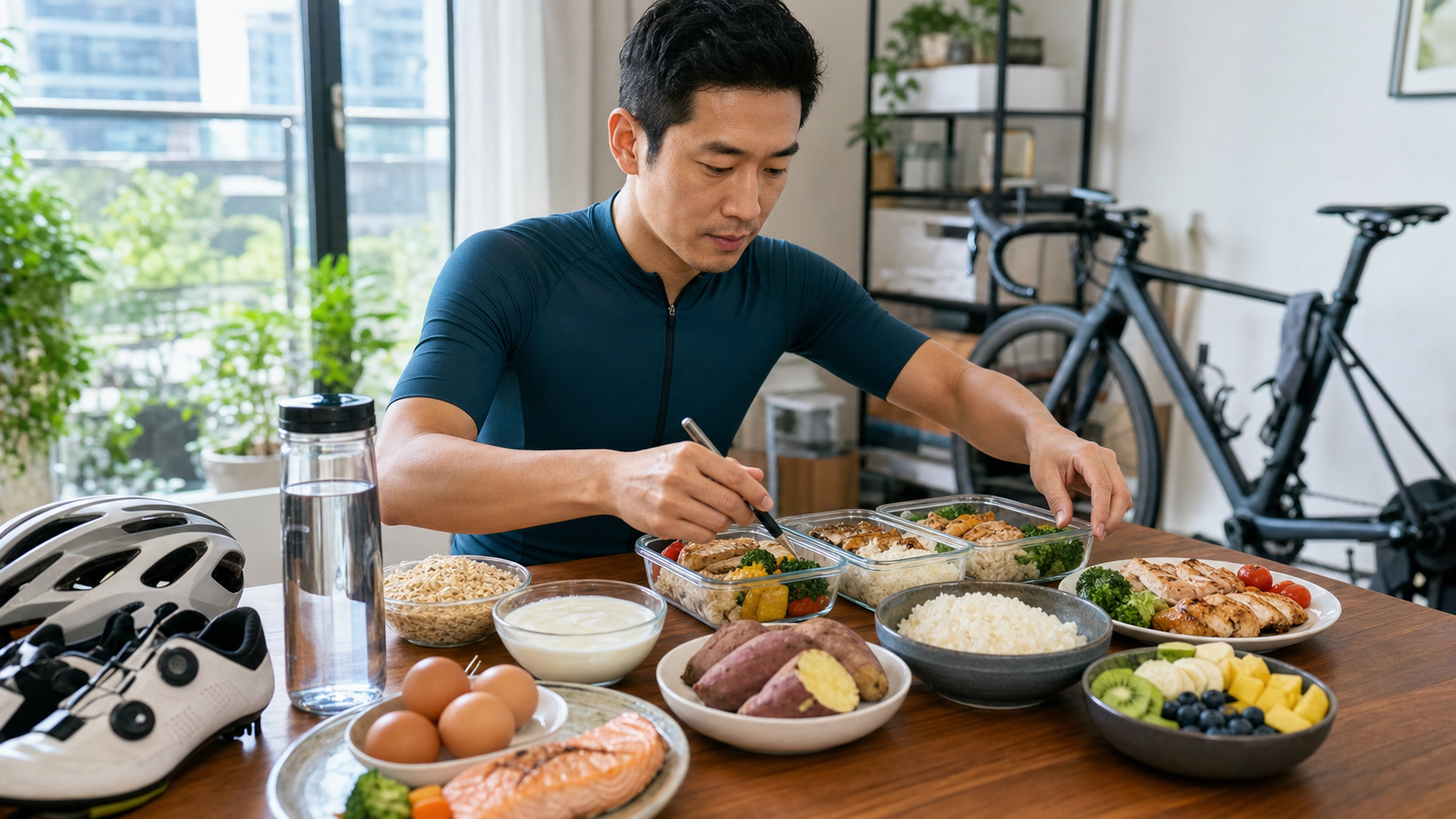
A few years ago, a client came to me—let’s call him A-Zhe. He was an engineer in Hsinchu Science Park, weighed about 72 kg, regularly climbed Fengguizui on weekends, occasionally rode the Yangjin P-route, and trained on his indoor trainer during the week. His problem was typical: the harder his training plan got, the more his performance plateaued. After a long Sunday ride, he’d feel like he’d been run over by a truck for three days—sleep-deprived, irritable, no power on climbs, and by Monday morning he could barely muster the energy to type at his desk.
I asked him to photograph everything he ate for a week and send it to me. After reviewing it, I understood immediately—he wasn’t training too little; he was eating without aligning his nutrition to his training. He ate the exact same thing on rest days as on high-intensity days, had fried chicken with bubble tea the night before a long ride, and after riding, he’d just chug a sports drink and go to sleep. He treated “eating” as something completely unrelated to training—just fill the stomach and move on. But for endurance athletes, the meal plan is part of the training plan itself. In fact, it’s the key factor determining whether you can actually “absorb” your training.
I often tell my athletes: You don’t get stronger from training; you get stronger from the recovery after training, and the raw materials for that recovery are what you eat. The training plan is just a signal telling your body “it’s time to get stronger.” What actually turns that signal into muscle, endurance, and power is the building material provided by sleep and nutrition. If the raw materials are insufficient, you can’t build the house.
In this article, I want to walk you through the complete logic I used to design A-Zhe’s weekly meal plan, so you understand one thing: A good athlete’s meal plan isn’t a fixed recipe—it’s a framework that shifts with training load. I’ll give you tables you can directly copy and adjust, and I’ll be honest about which numbers are principles and which depend on the individual. By the end, you should be able to sketch out your own weekly meal plan.
Foundational Concepts: Why the Meal Plan Must Follow Your Training
Glycogen Is the Star of Endurance Sports
Many people think exercise is all about burning fat, but during moderate-to-high-intensity endurance exercise, your body primarily burns carbohydrates (glycogen). The glycogen stored in your muscles and liver has a ceiling—a two-to-three-hour long ride or a half marathon can empty it out. If you don’t refill it afterward, the quality of your next day’s training will inevitably drop. Accumulate that over several days, and you get what’s called “non-functional overreaching”—you train a lot, but your body gets worse and worse. That was the core reason A-Zhe was “getting weaker the more he trained.”
Here’s an analogy: glycogen is like your fuel tank. You wouldn’t drive a car with an empty tank on a long trip, yet many athletes push through training day after day on a half-empty tank, then blame their willpower. The problem isn’t willpower—it’s that the tank wasn’t filled.
According to general sports nutrition recommendations, an endurance athlete’s daily carbohydrate intake should fluctuate within a range based on training volume. The numbers below are compiled from publicly available sports nutrition guidelines (sources listed at the end), providing ranges rather than precise values. The actual amount depends on your body weight, training hours, and individual response:
| Training Scenario | Daily Carbohydrates (per kg body weight) | Approximate Total for a 72 kg Athlete |
|---|---|---|
| Rest day / Low-intensity recovery | 3–5 g | Approx. 216–360 g |
| General training day (~1 hour) | 5–7 g | Approx. 360–504 g |
| Moderate-to-high intensity / Long duration (1–3 hours) | 6–10 g | Approx. 432–720 g |
| Pre-race glycogen loading (rest + high intake) | 10–12 g | Approx. 720–864 g |
Once you understand this table, you’ll see why “eating the same every day” is wrong—if you eat high-intensity-day portions on rest days, the excess carbohydrates get stored as fat; if you eat rest-day portions on high-intensity days, your glycogen never refills and you’ll have no power the next day. Your food intake should work like a throttle—press down when you need it, ease off when you don’t.
Protein: Endurance Athletes Can’t Skimp Either
People used to think protein was only for weightlifters and that endurance athletes just needed carbohydrates. That’s a big misconception. Recent research increasingly emphasizes that endurance athletes’ protein needs are actually quite high—because prolonged, high-intensity endurance exercise increases the oxidation of branched-chain amino acids. In other words, you’re breaking down your own muscle while you exercise, and you need enough protein to repair it.
Public guidelines generally fall in the range of 1.2–2.0 g per kg of body weight, leaning toward the higher end with greater training volume, higher intensity, or during weight loss phases (some studies even show a marked increase in post-exercise requirements). For A-Zhe at 72 kg, that’s roughly 86–144 g of protein per day. Here’s a key point: spreading protein across three meals plus a post-training supplement is more efficient than cramming it all into one meal. Your body can only effectively utilize a limited amount of protein per meal—eating half a chicken in one sitting at dinner is less effective than distributing it evenly.
Fat: Not the Enemy—It’s the Foundation for Hormones and Long-Duration Fuel
Fat often gets demonized, but it’s essential for hormone synthesis (including hormones related to recovery and immunity) and serves as an important fuel for low-intensity, long-duration exercise. Athletes don’t need to deliberately eat a high-fat diet, but they absolutely shouldn’t go extremely low-fat either. Good fats from olive oil, nuts, avocados, and deep-sea fish should be included in moderation. What you really want to cut back on are the “empty-calorie bad fats” from fried foods and processed snacks.
Hydration and Sodium: Taiwan’s Invisible Summer Threat
Taiwan’s summers are hot and humid, and sweat loss can be staggering. A typical active adult’s daily fluid needs often exceed 3–4 liters, and during endurance exercise, you can lose 1–2 liters or more of sweat per hour. Sweating also depletes sodium. For prolonged exercise (over 2 hours) or heavy sweaters, it’s recommended to replace both fluids and sodium during exercise. A common reference is about 500–800 mg of sodium per liter of fluid. This is why drinking only plain water on a long summer ride can easily lead to cramping and dizziness—you’re replacing water but not salt, diluting your blood sodium concentration. In severe cases, this can cause “exercise-associated hyponatremia,” which isn’t uncommon in long summer events. Mild cases cause dizziness and nausea; severe cases require hospitalization.
Practical Approach: How to Structure a Weekly Meal Plan
Step 1: Map Out Your Training Week First
The meal plan follows the training, so the first thing is to categorize your weekly training load. I like to label each day with one of three intensity levels: Low (L), Moderate (M), High (H). Using A-Zhe’s typical week as an example:
| Day | Training Content | Load Level | Carbohydrate Strategy |
|---|---|---|---|
| Monday | Rest / Walk | Low L | Low carb (3–5 g/kg) |
| Tuesday | Trainer intervals 60 min | Moderate M | Moderate carb (5–7 g/kg) |
| Wednesday | Easy ride 45 min | Low L | Low-to-moderate carb |
| Thursday | Trainer threshold 75 min | High H | High carb (6–10 g/kg) |
| Friday | Rest | Low L | Low carb |
| Saturday | Fengguizui climb 2 hours | High H | High carb + pre-race fueling |
| Sunday | Yangjin long ride 3 hours | High H | Highest carb + in-ride fueling |
This table is the skeleton of the entire meal plan. Max out carbohydrates on high-intensity days and pull them back on rest days—this is the beginner version of “carbohydrate periodization.” You don’t need to overcomplicate it. Simply reducing starches on rest days and properly fueling on long-ride days will produce noticeable improvements for most amateur athletes. You don’t have to calculate to the gram right away—just nailing the general direction of “eat more on high-intensity days, eat less on rest days” already puts you ahead of 80% of people.
Step 2: Design Separate “Training Day” and “Rest Day” Plates
I don’t like giving athletes meal plans calculated to the gram—it’s unrealistic, especially for people in Taiwan who eat out frequently and can’t weigh food every day. Eventually, everyone gives up on weighing. Instead, I prefer using “plate proportions” that are easy to follow—one glance at your plate tells you if it’s right. Here’s a comparison of plate principles for the two types of days:
| Plate Section | High-Intensity Training Day | Rest / Low-Intensity Day |
|---|---|---|
| Whole-grain starches | About half the plate | About a quarter of the plate |
| Protein | 1.5–2 palm-sized portions | 1–1.5 palm-sized portions |
| Vegetables | About a quarter of the plate | About half the plate |
| Good fats | Moderate (nuts, olive oil) | Moderate |
| Fruit | One serving before and after training | One serving |
This “palm and plate proportion” estimation method is, in my opinion, the friendliest approach for people who eat out. A palm-sized portion (thickness included) is roughly one serving of meat, a fist-sized portion is roughly one serving of主食 (staple), and two cupped hands is roughly one serving of vegetables. Walk into a buffet restaurant—no calculator needed—and you can build a sensible plate with this system.
Step 3: Schedule Your Nutrition Timing Around Training
This is the most overlooked yet most impactful piece. The timing of nutrition before, during, and after training directly determines how well you execute that session and how quickly you recover. Using A-Zhe’s three-hour Sunday long ride as an example, here’s the fueling timeline I set up for him:
| Time Point | Content | Purpose |
|---|---|---|
| 2–3 hours before departure | Sweet potato + eggs + a little toast, normal-sized breakfast | Fill glycogen stores, avoid GI discomfort |
| 30 minutes before departure | One banana or one energy food | Raise blood sugar, stabilize the start |
| Every hour during the ride | 30–60 g carbohydrates (60–90 g for ultra-long efforts) + sodium-containing fluids | Maintain blood sugar, delay glycogen depletion, replace sodium |
| 30–60 minutes after finishing | Carbohydrates + protein (e.g., rice ball + unsweetened soy milk + one egg) | Accelerate glycogen replenishment and muscle repair |
The 30–60 g of carbohydrates per hour during the ride is a critical number. Many people only bring water on long rides and suddenly “blow up” (hit the wall) after two hours—that’s because blood sugar and glycogen bottom out together. That feeling of legs suddenly turning to lead, vision going dark, and mood plummeting is something you never forget once you’ve experienced it. Taiwan has one of the highest convenience store densities in the world—a banana, a small pack of gummy candy, and a sports drink can easily add up to enough carbohydrates. There’s really no excuse not to do it.
Complete One-Week Meal Plan Example (72 kg Amateur Cyclist Version)
Putting the principles above into practice, this is the version I actually gave A-Zhe, refined over several weeks. Portions assume “readily available from typical eating-out options,” and the numbers are guidelines, not rigid rules. You can scale them proportionally to your own body weight and training content.
Monday (Rest Day, Low Carb)
- Breakfast: Unsweetened soy milk + two boiled eggs + a serving of blanched vegetables + half a bowl of brown rice
- Lunch: Buffet with one meat dish and two vegetable dishes + half a bowl of white rice (starches deliberately reduced)
- Dinner: Steamed fish + plenty of vegetables + a small amount of sweet potato
- Key Point: On rest days, pull back on starches while maintaining protein and vegetables, allowing the body to focus on repair and balancing out the calorie surplus from the weekend.
Tuesday (Moderate-Intensity Interval Day)
- Breakfast: Oatmeal + banana + nuts + unsweetened yogurt
- Pre-training: One slice of toast
- Lunch: Chicken leg bento (normal rice portion) + vegetables
- Dinner: Small bowl of braised pork rice + blanched vegetables + tofu
Wednesday (Easy Ride, Low-to-Moderate)
- Breakfast: Mantou with egg + unsweetened soy milk
- Lunch: Plain noodle soup + braised egg + side dishes (seaweed, dried tofu)
- Dinner: Vegetable-heavy hot pot, half portion of glass noodles, with tofu and lean meat
Thursday (High-Intensity Threshold Day)
- Breakfast: Sweet potato + eggs + unsweetened soy milk + a serving of fruit
- 30 min pre-training: One banana
- Post-training: Rice ball + unsweetened soy milk (the golden 30–60 minute refueling window)
- Dinner: Beef noodle soup (finish the noodles) + blanched vegetables
Friday (Rest Day, Low Carb)
- Same principles as Monday—reduce starches, focus on protein and vegetables, and conserve energy for the two big training days ahead. This is also a “GI rest day,” avoiding heavy, greasy restaurant food.
Saturday (Fengguizui Climb, 2 Hours)
- Breakfast: Extra starches, such as sweet potato + toast + eggs + banana
- During the ride: One banana or energy gummies per hour + sodium-containing sports drink
- Lunch (after descending): Double up on carbs + protein, such as chicken rice + miso soup + blanched vegetables
- Dinner: Normal balanced meal, refilling glycogen for the next day’s long ride
Sunday (Yangjin 3-Hour Long Ride)
- Follow the “pre-, during-, and post-training fueling timeline table” exactly
- Post-ride dinner: This meal can be a bit more relaxed—max out carbohydrates, get plenty of protein, and start settling the week’s fatigue. A little reward is psychologically necessary too; long-term deprivation often leads to binge eating.
Estimating Calories and Macronutrients
Some athletes ask, “Coach, how many calories should I eat per day?” Honestly, precise calculation isn’t very meaningful because everyone’s metabolism and activity levels vary widely. But giving a rough direction is still useful. Using A-Zhe—72 kg, about 6–8 hours of moderate-to-high-intensity training per week—as an example, here’s an illustrative estimate (direction only, not a precise prescription):
| Item | Rest Day Estimate | High-Intensity Training Day Estimate |
|---|---|---|
| Carbohydrates (g) | Approx. 250–360 | Approx. 500–700 |
| Protein (g) | Approx. 100–130 | Approx. 110–140 |
| Fat (g) | Approx. 55–70 | Approx. 60–80 |
| Total calories (kcal) | Approx. 2,000–2,400 | Approx. 3,000–3,600 |
Note two things: First, there should be a clear calorie difference between training days and rest days—that’s normal and necessary. Second, these numbers are a “starting point.” Actual adjustments should be guided by body weight trends and how training feels—if your weight is stable for two to three weeks, training feels strong, and sleep is good, you’re on the right track. If you’re consistently losing weight and feeling weak, you’re not eating enough. Your body will give you the answers; the numbers just help you get started.
Supplements: Do You Need Them? How to Read the Dosing
Let me state the conclusion first: 90% of problems can be solved with real food. Supplements are only for filling gaps where real food is inconvenient. Below are a few common categories with relatively clear evidence and general usage directions. The values are common ranges, not personalized prescriptions. If you have a chronic condition or are on medication, consult your doctor or pharmacist first:
| Item | Common Use | General Reference Direction |
|---|---|---|
| Sports drinks / Energy gels | Carbohydrate and electrolyte replacement during long exercise | Combine to reach 30–60 g carbs per hour |
| Electrolytes / Salt tablets | Sodium replacement for heavy sweating in heat | Adjust based on sweat rate and sodium concentration of fluids |
| Whey protein | Post-training or when protein intake is insufficient | One serving ≈ 20–30 g protein |
| Caffeine | Pre-race alertness, delaying perceived fatigue | Highly individual—never try it for the first time on race day |
Remember, supplements are “icing on the cake,” not “resurrection.” If your foundational weekly meal plan isn’t solid, swallowing endless pills and powders is just wasting money. And never try any supplement for the first time on race day—if your stomach or heart reacts badly, the whole event is ruined.
Common Mistakes and Fixes
After coaching athletes for years, I’ve seen people fall into the same traps over and over. Here are the most common ones, along with fixes:
| Common Mistake | Why It’s a Problem | Fix |
|---|---|---|
| Eating the same every day, regardless of training day | Overeating on rest days, undereating on training days | Use L/M/H levels to adjust carbohydrates |
| Bringing only water on long rides | Hitting the wall after two hours, cramping | Replenish 30–60 g carbs + sodium per hour |
| Waiting too long to eat after training | Missing the glycogen refueling window | Eat carbs + protein within 30–60 minutes |
| Drastically cutting carbs to lose weight | Training quality collapses, getting weaker | At minimum, maintain training-day carbohydrate intake |
| Cramming all protein into one meal | Poor absorption and utilization efficiency | Spread across three meals + post-training supplement |
| Chugging plain water all summer without salt | Dilutional hyponatremia, dizziness | Use sodium-containing fluids for long exercise |
| Eating casually all week, then overhauling the menu on race day | GI distress, diarrhea | Practice race-day fueling during training in advance |
I want to especially flag overly aggressive carb-cutting for weight loss. A-Zhe initially fell for the online “low-carb for muscle gain and fat loss” trend and cut out rice entirely. The result: no power on climbs, low mood, and no energy even at work. For endurance athletes, carbohydrates aren’t the enemy—they’re the fuel. Weight loss should come from a modest total calorie deficit (while maintaining protein and training volume), not from hacking your primary energy source down to the bone. Weight loss and performance improvement often need to be handled in separate phases or seasons. Trying to push both at full intensity simultaneously usually ends in failure on both fronts.
Actionable Advice for Readers at Different Levels
If You’re a Beginner Just Starting Out
Don’t try to be perfect all at once—perfectionism is the number one reason beginners quit. Just do one thing well first: add in-ride fueling on your long ride or long run days—one banana plus a sports drink per hour. That single step will end the “I feel like a wreck after exercise” state. Once that habit is solid and automatic, gradually add step two: “reduce starches on rest days.” Change one thing at a time, and you’ll actually stick with it.
If You’re an Advanced Enthusiast with a Regular Training Schedule
Start taking carbohydrate periodization seriously: use L/M/H to categorize your week, max out carbs on high-intensity days, and pull them back on rest days. Also review whether your protein is spread out and sufficient at each meal. I strongly recommend doing a simple sweat test yourself: weigh yourself before and after exercise (towel off and dry), and the difference in kilograms is roughly the liters of sweat you lost. Use that to adjust your fluid and sodium replacement strategy, especially for Taiwan’s summers. You’ll be surprised at how much you actually sweat.
If You’re a Competitive Athlete in Race Preparation
In addition to the above, start planning glycogen loading in the week before your race (1–2 days before, drastically reduce training volume and increase carbohydrates to about 10–12 g/kg), and rehearse your race-day fueling schedule exactly as you’ll do it in training—never try new foods or supplements on race day. GI issues can ruin an entire race, and I’ve seen too many heartbreaking cases. If possible, work with a sports nutritionist to design an individualized plan based on your body weight, sweat sodium concentration, and event characteristics. The payoff far exceeds guessing on your own.
Practical Tips for Taiwan
Taiwan is a paradise for eating out, which is actually an advantage for athletes—convenience stores, buffet restaurants, noodle shops, and street food stalls are everywhere. Getting enough carbohydrates and protein isn’t hard; the key is “how you choose.” A few local tips:
- Buffet restaurants are your best friend for a balanced plate—you can freely control the starch-to-vegetable ratio, taking more rice on training days and more vegetables on rest days.
- Convenience stores—sweet potatoes, tea eggs, unsweetened soy milk, bananas, onigiri, and chicken breast—are a golden combination for pre- and post-training fueling, available 24/7.
- Long summer rides absolutely require sodium replacement—sports drinks or salt tablets both work; don’t just drink plain water. You can also weigh your water bottles before heading out and estimate how much you consumed when you return.
- Noodle shops and street food stalls—watch out for sodium and oil. Soup noodles are lighter than dry noodles or fried rice. For braised snacks, choose eggs, dried tofu, and vegetables to add protein.
- If you experience persistent dizziness, heart palpitations, cramping that won’t stop, or confusion after exercise—or if you have chronic conditions like diabetes, hypertension, heart disease, or kidney disease—your diet and exercise plan must be individualized and discussed with a physician first. Taiwan’s National Health Insurance makes it easy to see a doctor; family medicine, cardiology, endocrinology, and nephrology departments can all help with evaluation. Don’t tough it out on your own, and don’t experiment with internet remedies or unverified supplements.
A Second Case Study: Adjusting the Framework for Different Populations
A-Zhe is a typical middleweight male cyclist, but the athletes I coach come in all shapes and sizes. The meal plan logic stays the same; the numbers change. Here’s a contrast: Xiao-Ya, a 55 kg office worker preparing for a half marathon, with less training volume than A-Zhe but a long-term desire to control her weight. Her challenge was the exact opposite of A-Zhe’s—he was “eating too casually, not enough”; she was “too afraid to eat, chronically under-fueled.”
Xiao-Ya’s initial problems: irregular menstrual cycles, constantly feeling cold, slow recovery after training, and frequent colds. This is a classic set of warning signs—what sports science calls “relative energy deficiency.” When long-term energy intake can’t keep up with training expenditure, the body starts diverting resources away from “non-essential” systems like reproduction, immunity, and bone health to handle the emergency. This isn’t something you can fix through sheer willpower—you have to eat your way back.
The first thing I did for her wasn’t a stricter meal plan—it was the opposite: increase carbohydrates and total calories on training days, especially on long-run days and the meal after the long run. At the same time, I brought her protein up from a severely insufficient level to roughly 1.4–1.8 g per kg, spread across three meals. Three months later, her recovery was faster, her energy was better, her weight didn’t spiral out of control—it actually stabilized—and she finished her half marathon successfully. The takeaway from this case: undereating can destroy your training just as much as overtraining, and it can even harm your health. “Eating less” is absolutely not “eating better.” Female athletes, adolescents, and anyone on a long-term low-calorie diet should be especially vigilant about this and should seek evaluation from a physician and nutritionist when necessary.
| Comparison Item | A-Zhe (72 kg male cyclist) | Xiao-Ya (55 kg female runner) |
|---|---|---|
| Primary issue | Casual eating, insufficient intake on training days | Chronic energy deficiency, fear of eating |
| Adjustment focus | Carbohydrate periodization, fueling timing | Overall increase in calories and protein |
| Protein direction | Approx. 1.4–2.0 g per kg | Approx. 1.4–1.8 g per kg |
| Common warning signs | Increasing fatigue with training, no climbing power | Feeling cold, slow recovery, frequent colds |
Diet, Sleep, and Recovery Are One System
Finally, I want to add a concept that’s often overlooked: the meal plan isn’t isolated—it’s tied together with sleep, stress, and recovery as one system. You can have a perfect meal plan, but if you’re only sleeping five hours a night and drowning in work stress, recovery still won’t happen. Conversely, adequate sleep makes the same meal plan work much better.
In practice, I ask athletes to track three small things simultaneously: sleep duration and quality, morning resting heart rate, and subjective fatigue levels. If resting heart rate runs high for several consecutive days and you feel tired no matter how much you sleep, that’s usually not a single meal-plan issue—it’s a signal of overall insufficient recovery. In that case, the right move might be “eat a bit more, train a bit less, sleep a bit earlier,” not adding more training. Taiwanese people generally don’t get enough sleep and eat out with heavy salt and oil. Improving both of those together often yields more visible results than any supplement.
Season and environment also matter. Taiwan’s summers are hot and humid, so hydration and sodium replacement need to be more aggressive, and your GI tract is more sensitive to greasy foods. When traveling for work or racing away from home, where the food is unfamiliar, bring your own familiar supplements and shelf-stable carbohydrates (like energy bars or onigiri). Don’t experiment on the fly in a new environment—don’t turn your stomach into a test lab.
FAQ
Q: It’s late after evening training—do I still need to eat carbohydrates? Won’t I gain weight?
A: I’d recommend still having a small amount of easily digestible carbs plus protein (for example, unsweetened soy milk with a small onigiri). Your depleted glycogen needs refilling, and this pre-bed meal is more likely to go into your muscles than turn into fat. What actually makes people gain weight is “total daily calorie surplus,” not the timing of “eating carbs at night.”
Q: I want to lose fat. Can I completely cut out starches?
A: For a training endurance athlete, I strongly advise against it. You can moderately reduce starches on rest days, but on training days you must keep enough carbohydrates—otherwise your training quality collapses and the loss outweighs the gain. Fat loss comes from a modest total calorie deficit while maintaining training, not from eliminating an entire food group.
Q: I don’t weigh my food or count calories. Is my diet hopeless?
A: Not at all. The “plate proportions + palm estimation” method from earlier is enough for 80% of people. Rather than precisely calculating for three days and then quitting, use a rough estimation method you can sustain for a full year. A method you can stick with is the best method.
Q: Can vegetarians follow this framework too?
A: Yes. The carbohydrate sources stay the same. For protein, use plant-based sources like tofu, soy milk, chickpeas, tempeh, and edamame, spread out to meet your total needs with variety. Long-term vegans may want to discuss certain micronutrients (like iron and B12) with a nutritionist.
Q: Do I have to buy sports drinks or energy gels? Can I use real food?
A: Absolutely. Bananas, onigiri, sweet potatoes, and honey water with a pinch of salt can all provide the carbohydrates and sodium you need during training. Energy gels are just a “portable, easily absorbed, no-chewing-required” convenience option that has an advantage in long or high-intensity races, but they’re not mandatory.
Q: The training-day and rest-day menus are so different—isn’t that a hassle to prepare?
A: You don’t need to overhaul everything daily. The core adjustment is just one variable: the portion of staples (starches)—reduce by half a bowl to a full bowl of rice on rest days, add it back on training days, and keep protein and vegetables steady. Changing just one variable makes execution much easier.
Advanced: Viewing the Meal Plan Across a Full Season
So far we’ve talked about “one week,” but true experts place their diet within the context of an entire season. In simple terms, a season typically has several phases, and the dietary focus shifts accordingly:
| Season Phase | Training Characteristics | Dietary Focus |
|---|---|---|
| Base phase | High volume, low-to-moderate intensity | Stable, sufficient carbohydrates; build a solid protein foundation |
| Build phase | Intensity rises, volume still high | Increase training-day carbs and post-training recovery |
| Pre-race taper | Reduced volume, maintained intensity | Maintain nutrition; avoid overeating due to reduced volume |
| Race phase | High intensity, peak performance needed | Glycogen loading; rehearse and lock in fueling protocols |
| Transition / Rest phase | Drastically reduced volume | Naturally reduce total calories; mental and physical relaxation |
Here’s a trap many people miss: the pre-race taper. Training volume drops noticeably, but many people don’t adjust their food intake accordingly—they keep eating as if they were still doing high volume, and end up gaining a kilo or two before the race, carrying extra weight up every climb. During the taper, total calories should naturally come down a bit (but don’t crash-diet and compromise glycogen stores) so you can show up on race day feeling light and with a full tank. Conversely, during the transition phase (the post-season rest period), there’s no need to guiltily maintain a strict meal plan—both body and mind need a breather. As long as you don’t let your weight spiral out of control, let your body rest and recover properly so you have the capital for the next cycle.
Once you understand the seasonal context, you’ll stop asking the narrow question “What should I eat this week?” and start asking the right question: “What phase of the season am I in, and what does my body need?” That’s the dividing line between copying a meal plan and actually knowing how to design one.
Conclusion
Back to A-Zhe’s story. About six weeks after adjusting his meal plan, he texted me: “Coach, I finally know what it feels like to not be run over by a truck after a long ride.” His climbing power came back, his sleep improved, and Mondays at work no longer felt like being a zombie. But the most important change was that he started treating food as part of his training, not as an optional chore. Once that mindset is internalized, everything else is just fine-tuning details.
Meal plan design isn’t as mysterious as you might think. The core comes down to one sentence: let your food intake follow your training load. Fill up the tank on high-intensity days, pull back moderately on rest days, nail the timing around training, and remember to replace sodium in the summer. Get these few things right, and your training effectiveness will jump a level—and it’s free, progress you can get just by adjusting habits.
You don’t have to get everything right at once, and you don’t need to chase perfection. Start with one small thing: “this week’s long ride day, add in-ride fueling.” One small step—but if the direction is right, let time do the accumulating. When food becomes a naturally functioning part of your training system, you’ll find progress comes more smoothly than you imagined, and lasts longer too. Here’s to eating right, training hard, and recovering well.
This article is educational content and does not replace individual diagnosis or treatment advice from a physician, physical therapist, or nutritionist. All values in this article are general principle ranges; actual needs vary by individual body weight, training volume, climate, and health status. Please evaluate on an individual basis. If you have a chronic disease or are taking medication, consult a qualified medical professional before adjusting your diet or exercise plan.
References
- Prioritizing Carbohydrates: A Guide for Endurance Runners (Utah State University Extension): https://extension.usu.edu/nutrition/research/prioritizing-carbohydrates-a-guide-for-endurance-runners
- Dietary Carbohydrate and the Endurance Athlete (Gatorade Sports Science Institute): https://www.gssiweb.org/sports-science-exchange/article/dietary-carbohydrate-and-the-endurance-athlete-contemporary-perspectives
- Protein Requirements Are Elevated in Endurance Athletes after Exercise (NCBI PMC): https://www.ncbi.nlm.nih.gov/pmc/articles/PMC4913918/
- Dietary Water and Sodium Requirements for Active Adults (Gatorade Sports Science Institute): https://www.gssiweb.org/sports-science-exchange/article/sse-92-dietary-water-and-sodium-requirements-for-active-adults
Related Reading
- Athlete Meal Prep in Practice: A Complete Guide to Efficiency, Nutritional Balance, Storage, and Variety
- Nutrition Time Management for the Office-Working Athlete: Too Busy to Eat, Still Fueling Your Training
- Athlete Recovery Day Nutrition: How to Eat on Rest Days to Keep the Results of Your Hard Work
- An Athlete’s Daily Eating Framework: Eating Right Without Weighing Food (A Complete Practical Guide to the Plate Method)
西進武嶺 免費訓練分析服務 Intervals | 練不夠還是練過頭?你哪一種類型選手?AI模型告訴你! | 備戰神器 | 公路車 訓練 | CT Yeh
4 年前
靠單車減肥35公斤 心得分享與整理
7 年前
CT暗黑廚房) 車友必備 宇宙無敵鮮蚵湯 幫助訓練恢復 天然食補 好市多 超肥鮮蚵 破PR
7 年前
#公路車 #Fitting 靠人工智慧APP 幫你調整單車
6 年前
一日北高/長距離團騎 常見問題補充篇 / 組團或跟團的眉角 / 壯車友容易被瘦車友慢性拉爆 / 原來屁股痛可能是這個原因...? / 風場配速法 / 公路車 / CT Yeh
2 年前
一個測試有沒有認真練車的方法😂 #公路車
10 個月前
單車AI教練!全新 ChatGPT4o 幫你分析訓練成果!排武嶺課表,分析騎車姿勢! 太神了! / 公路車 / CT Yeh / feat. 緯緯
2 年前
一日北高常見問題大集合 | 攻略 | 路線 | 訓練 | 補給 | 自行車 單車 | 一日雙城 | 雙塔 | TWB北高360 | 屁股痛
6 年前