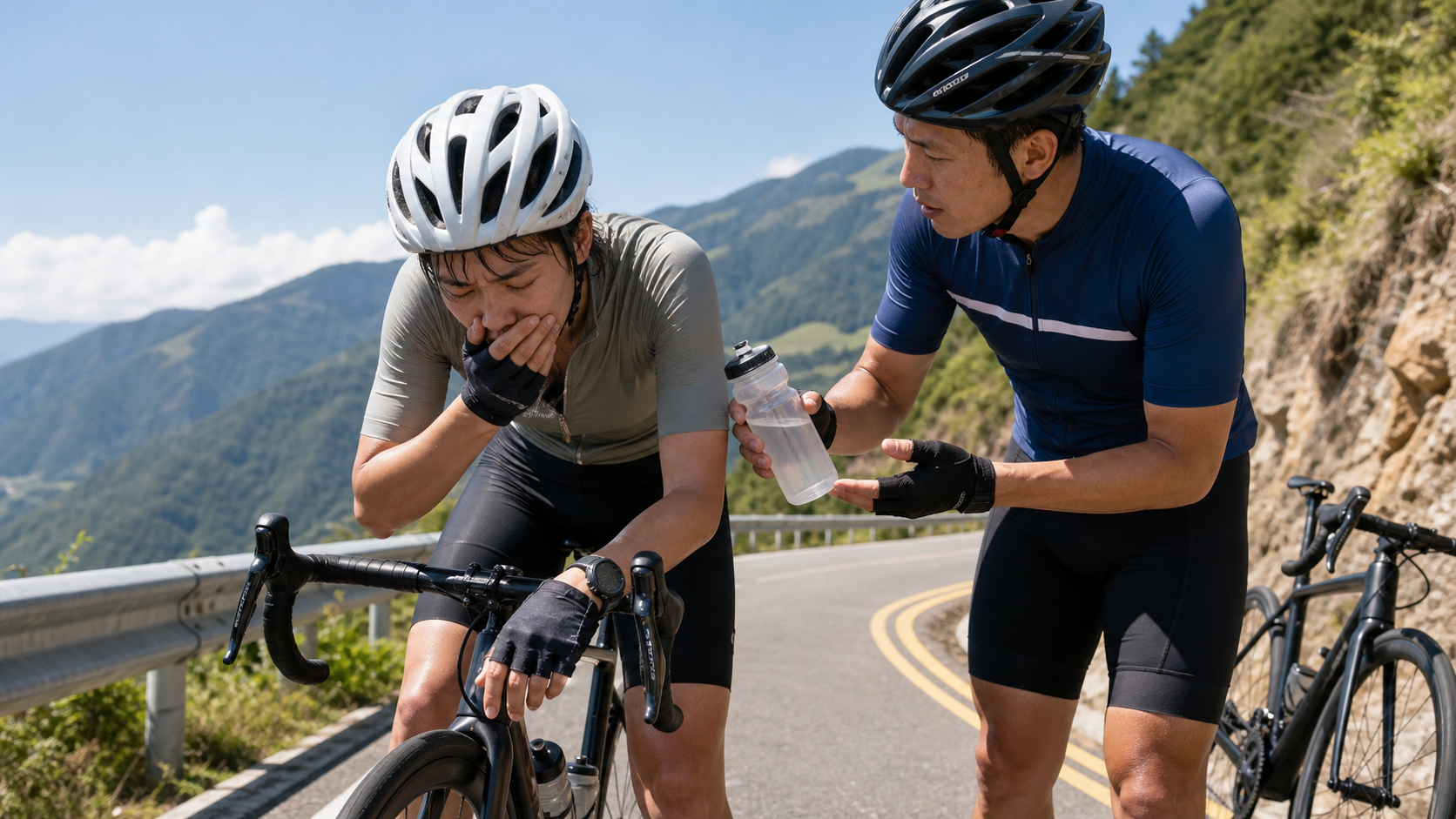
It Starts with a Student Who Couldn’t Descend
I still remember that Sunday morning, taking a student who was preparing for his first Wuling Challenge on a long ride. The first 60 kilometers he was doing great—steady pace, heart rate held within the target zone. But after passing Cingjing and heading toward Cuifeng, as the heat picked up and the gradient got steeper, he suddenly pulled over to the side of the road, pale-faced, and told me: “Coach, I feel like throwing up, I can’t swallow anything down.” I handed him water, but one sip made him even more nauseated. At that moment, it wasn’t that he was out of energy—his gut had gone on strike.
In 15 years of coaching, I’ve seen this situation far too many times—whether it’s cycling, road running, triathlon, or even just a two-hour ride along the riverside in summer. Nausea, queasiness, and dry heaving during exercise are among the most common reasons someone “still has legs but is forced to stop.” What’s worse, many people assume they were “born with a weak stomach” or that their nutrition “didn’t agree with them,” so they stop eating altogether—only to blow up even earlier from depleted blood sugar, falling into a vicious cycle.
In this article, I want to break down exercise-induced nausea the same way I’d coach a student: where it comes from, what’s happening in the body, how to adjust your fueling, how to train for it, and where the common mistakes lie. After reading this, I hope that next time you’re on Yangjin Highway or hitting the marathon wall at kilometer 30, you’ll have your own game plan instead of just sitting by the roadside waiting.
Why Does Intense Exercise Make You Want to Throw Up? First, Understand What Your Gut Is Going Through
To treat the problem, you first need to know the cause. Exercise-related gastrointestinal discomfort has a collective term in sports science: exercise-induced gastrointestinal syndrome. Research reviews indicate that depending on exercise intensity, duration, and environment, anywhere from 30% to 90% of endurance athletes have experienced nausea, bloating, diarrhea, or other GI symptoms—an astonishingly high rate. This means: if you feel nauseated, you are far from alone. It’s a normal physiological response, not a sign that you’re especially weak.
Mechanism One: Splanchnic Blood Flow Gets “Borrowed”
This is the most fundamental cause. During exercise, your muscles need large amounts of blood to deliver oxygen and carry away metabolic waste. The body is an allocator of finite resources, so it shifts a significant portion of the blood supply normally destined for the GI tract to the working muscles and the skin (for cooling). This phenomenon is called splanchnic hypoperfusion.
When intensity climbs to near or above the lactate threshold, blood flow to the gut can drop to only a fraction of resting levels. Once the intestinal mucosa becomes ischemic and hypoxic, several things happen:
- Delayed gastric emptying: What you’ve eaten gets stuck in the stomach, leaving you feeling bloated, like food is “floating in your throat”
- Impaired intestinal absorption: Sports drinks you’ve consumed aren’t absorbed in time and linger in the gut
- Intestinal barrier damage and increased permeability: Commonly known as “leaky gut”; in severe cases, endotoxins can enter the bloodstream and trigger a systemic inflammatory response
When gastric emptying slows and food piles up in the stomach, nausea and queasiness follow. This is also why the higher the intensity, the more likely you are to vomit—because more blood flow gets diverted away.
Mechanism Two: Dehydration and Heat Stress Add Fuel to the Fire
We all know what Taiwanese summers are like. When you’re riding along the riverside or on the Beiyi Highway at 32°C with 80% humidity, your body has to handle both exercise-generated heat and environmental heat simultaneously. Large amounts of blood are sent to the skin for cooling, squeezing splanchnic blood flow even further.
Dehydration thickens the blood and reduces plasma volume, increasing the burden on both the cardiovascular system and thermoregulation, which worsens gut ischemia. Research clearly shows that exercise-induced dehydration exacerbates GI discomfort. Simply put: the hotter it is and the less you drink, the more likely you are to vomit. In Taiwan’s summer events, this is almost a rule of thumb.
Mechanism Three: Sympathetic Nervous System Activation “Shuts Down” the Gut
During intense exercise, the sympathetic nervous system (the fight-or-flight response) becomes highly activated, which inherently suppresses digestive tract motility and secretion. Your body decides, “This is a moment for survival—digestion can wait,” so gastrointestinal peristalsis slows down. This also explains why nausea becomes more likely at the end of a race, when adrenaline is surging.
Mechanism Four: Problems with the Fuel Itself
Sometimes it’s not the body’s fault—it’s that what you’re feeding it is too hard to process:
- Concentration too high: Chugging a highly concentrated sugar solution or gel creates high osmotic pressure in the gut, pulling water into the intestinal lumen and causing bloating, diarrhea, and nausea
- Too much at once: Gastric emptying has an upper limit; overloading it means things pile up
- Excess fiber, fat, or protein: These three empty slowly and aren’t suitable in large amounts during exercise
- Swallowing too much air: Drinking while panting, or gulping large mouthfuls, traps air in the stomach and causes bloating
Why “Nausea” and Not Something Else?
It’s worth noting that GI symptoms come in many forms—upper GI (belching, bloating, GERD, nausea, vomiting) and lower GI (intestinal cramps, bloating, urge to defecate, diarrhea). Nausea and vomiting fall under upper GI symptoms, and their most direct link is delayed gastric emptying: when food stays in the stomach and can’t move down, the stomach becomes distended, pressure rises, and a queasy feeling is triggered. So you’ll notice that strategies to improve nausea almost all revolve around “making the stomach’s job easier”—lowering intensity to restore blood flow, reducing the amount per feeding, lowering concentration, and avoiding high-fat/high-fiber foods are all aimed at helping gastric emptying. Once you understand this core principle, you’ll have a yardstick to judge which of the countless fueling recommendations actually work for “preventing vomiting.”
Keep these four mechanisms in mind, and you’ll see: exercise-induced nausea is almost always a combination punch of “intensity × heat × dehydration × improper fueling.” Your countermeasures naturally need to target these same areas.
Fueling Concentration and Rate: Key Numbers Table
Let’s start with the most practical part. Many people feel nauseated because their fueling concentration and rate aren’t dialed in. Below is a summary of general international endurance fueling principles. The numbers are given as ranges—your actual tolerance still needs to be trained:
| Exercise Duration | Recommended Carb Intake per Hour | Carb Type | Notes |
|---|---|---|---|
| < 45 minutes | Usually no need for extra sugar | — | Rinsing the mouth is enough; most people have sufficient glycogen |
| 45–75 minutes | Small amounts, mouth rinse primarily | Single carbohydrate | Can use sports drink as a mouth rinse |
| 1–2 hours | Approximately 30–60 grams | Glucose-based | A single transporter is sufficient |
| 2–3 hours | Around 60 grams | Glucose + fructose | Multiple carbohydrates start to be needed |
| > 3 hours | Can go up to 90 grams | Glucose:fructose approximately 2:1 | Gut must be trained beforehand |
Here’s an important concept: multi-transportable carbohydrates. Glucose and fructose use different intestinal transporters. Using both simultaneously can raise the gut’s absorption ceiling from around 60 grams with glucose alone to 75–90 grams. That’s why gels and drinks for long events often advertise a 2:1 ratio or something similar—this is the reasoning behind it. If you stubbornly try to push 90 grams with pure glucose, the excess won’t be absorbed, and what lingers in the gut becomes a source of bloating and nausea.
How to Dial in Concentration Without Bloating
The recommended carbohydrate concentration for sports drinks is around 6–8% (i.e., 6–8 grams of carbs per 100 ml). This concentration is close to plasma osmolality, making gastric emptying and absorption smoother. Most commercial sports drinks available in Taiwan fall near this range, but if you mix your own sugar powder, it’s easy to make it too concentrated. A simple check: if it tastes noticeably very sweet and syrupy, it’s usually too concentrated.
On hot days when you’re sweating heavily, you can actually dilute the concentration a bit and increase your water intake, because at that point “rehydration” often takes priority over “carb replenishment.”
Making Your Gut More Resilient: Adding “Gut Training” to Your Schedule
This is the point I want to emphasize most, and the one most athletes overlook: the gut can be trained. Like muscles and the cardiovascular system, it adapts to repeated stimulation.
In sports science, this is called “gut training”—repeatedly and progressively consuming carbohydrates during training so the digestive tract gets used to processing larger amounts of fuel while exercising. Data from systematic reviews show that after gut training, gastrointestinal symptoms during exercise can be reduced by approximately 26–47%, while carbohydrate absorption capacity can be improved by approximately 45–54%. These numbers are very significant—meaning if you used to feel sick at 60 grams, after training you might handle 90 grams without issues.
The key point: “Not training your gut before race day but trying to load up on carbs during the race” is one of the most common reasons for a DNF (did not finish) in endurance events. You wouldn’t run a full marathon without training for it; by the same logic, you shouldn’t stuff yourself with fuel on race day without having trained your gut.
A 6-Week Progressive Gut Training Example
Below is a progressive framework I often give athletes, assuming the goal is to take in about 80–90 grams of carbohydrates per hour during prolonged exercise. Please do this during training, not for the first time on race day:
| Week | Carb Target Per Hour | Recommended Approach |
|---|---|---|
| Weeks 1–2 | 30–40 grams | Take a sip of sports drink or 1/3 of an energy gel every 20 minutes during long rides/runs |
| Weeks 3–4 | 50–60 grams | Increase gel and drink frequency, start adding solids (banana, rice balls) |
| Week 5 | 70–80 grams | Simulate race fueling rhythm, fuel consistently every 15–20 minutes |
| Week 6 | 80–90 grams | Full race fueling rehearsal, including the actual products you’ll use on race day |
A few execution details:
- Small, frequent amounts beat one big gulp: Break fueling into small, high-frequency portions—the stomach’s burden is much lighter than taking in a large amount all at once
- Train with the same products you’ll use on race day: Different brands of gels and salt tablets have very different formulas; switching to new products on race day is a major mistake
- Train at near-race intensity: Because gut ischemia is related to intensity, you must train your gut at high intensity for it to be meaningful
Already Feeling Nauseous? How to Fix It
That was prevention; now for first aid. If you’re already feeling queasy out on the road, handle it in this order:
Step 1: Reduce Intensity
This is the most effective and most counterintuitive move. Since the main cause of nausea is gut ischemia, lowering the intensity will allow blood flow to partially return to the gut. I usually tell athletes to cut power or pace by 20–30%, or even briefly stop to walk or coast, giving the stomach a chance to empty. For that Wuling athlete I mentioned earlier, I had him slowly walk his bike for 5 minutes and lower his heart rate, and the nausea subsided significantly afterward.
Step 2: Stop Solids, Switch to Small Sips of Water
When nauseous, don’t force down gels or food. Switch to small, frequent sips of water or diluted sports drink. If even water makes you nauseous, just hold it in your mouth, swish, and spit it out—at least it relieves dry mouth. Once the nausea subsides, gradually resume fueling.
Step 3: Change the Fuel Type
If energy gels are what keep making you nauseous, try switching to liquid carbs or easier-to-eat solids (such as diluted sports drink or sliced banana). Some people are especially sensitive to gels with a high fructose ratio; switching formulas often works wonders.
Step 4: Pay Attention to Cooling
On hot days, quickly find shade and pour some water on yourself to cool down. Once your body temperature drops, the stress on splanchnic blood flow decreases, and nausea will ease as well. In Taiwan’s summer, convenience stores are the best aid stations—go inside, enjoy the air conditioning, grab a popsicle or sports drink. That’s often far more useful than toughing it out.
Common Mistakes and Corrections
After coaching athletes for so many years, I see the same mistakes repeated over and over. Here are the most common ones—see how many you recognize:
Mistake 1: Trying a fuel for the first time on race day
This is the number one landmine. You don’t know how your gut will react to it, and if something goes wrong on race day, it’s too late. Fix: Every fuel you plan to use on race day must be rehearsed at least 2–3 times in training.
Mistake 2: Chugging a large amount at once, thinking “one and done”
Gastric emptying has its limits; stuffing too much in at once will inevitably cause buildup. Fix: Switch to small, high-frequency intake—split a large portion into several smaller ones, taking a small sip every 15–20 minutes.
Mistake 3: Eating nothing at all for fear of vomiting
This is the other extreme. If you don’t fuel at all, your blood sugar drops, glycogen depletes, and you’ll hit the wall sooner and feel weaker, which actually increases the risk of nausea and hypothermia. Fix: Train your gut, get the concentration and rate right, and make fueling a helper rather than a burden.
Mistake 4: Not drinking enough water or only drinking plain water
In hot weather, heavy sweating with only plain water causes sodium dilution and electrolyte imbalance, which can also cause nausea or even be more dangerous. Fix: For prolonged, heavy-sweating exercise, supplement with sodium-containing electrolytes. The general sodium recommendation is about 300–700 mg per hour (adjusted based on sweat rate and individual saltiness of sweat).
Mistake 5: Mixing sugar water too concentrated
This is the most common mistake for people who mix their own fuel. Fix: Keep the concentration at 6–8%; it shouldn’t feel sticky in your mouth.
Mistake 6: Gulping large amounts while breathing hard, swallowing lots of air
Fix: When fueling, try to do it on relatively flat sections, slow down your breathing rhythm, and take small sips and swallow slowly.
Actionable Advice for Different Levels
Everyone starts from a different point, so I’ve divided the advice into three levels:
Beginners New to Endurance Sports
- For exercise under two hours, first master “hydration first, sugar as a supplement”—just drink commercial sports drinks; no need to chase high carb intake yet
- Always bring enough water on hot days; better to bring extra
- If you feel nauseous, slow down first—this tip works best for you
- Don’t conclude your gut is weak just because you vomited once; it just hasn’t been trained yet
Intermediate Enthusiasts with Some Foundation
- Start incorporating “gut training” into long sessions, using the 6-week framework above to progress gradually
- Learn to calculate your hourly carbohydrate intake, with an initial goal of consistently hitting 60 g/hour
- Build your own fueling schedule (e.g., every 20 minutes) and make it a habit rather than relying on feel
- Record your gut reactions after each training session to identify specific products that cause discomfort
Competitive Athletes Preparing for Races
- Aim to push tolerance to 80–90 g/hour, making good use of glucose:fructose 2:1 multi-carb formulas
- Train your gut at near-race intensity—you can’t just do it on easy rides or slow runs
- Fully rehearse your race-day fueling plan, including actual products, timing, and environment (if it’s a hot-weather race, train in hot weather)
- For Taiwan’s summer races, pay extra attention to cooling and electrolyte strategies
Taiwan-Specific Context: Eating Out, Climate, and Seeking Medical Care
A few practical local reminders:
Don’t eat randomly for your pre-race meal: Eating out is convenient in Taiwan, but high-fat, high-fiber, and spicy foods (braised snacks, fried foods, spicy hot pot) should be avoided before races—they slow gastric emptying and increase gut burden. Eating easily digestible carbs (white rice, white toast, banana, sweet potato) 2–3 hours before the race is safer.
Use convenience stores as aid stations: Taiwan has one of the highest convenience store densities in the world. During long training sessions or long rides, convenience stores are your fueling and cooling base. When the heat gets unbearable, going inside for air conditioning and electrolyte drinks is a smart strategy.
Be more conservative in hot, humid weather: Taiwan’s summers are hot and humid, cooling efficiency is poor, and gut ischemia is more severe. In summer training, it’s advisable to discount both intensity and duration, and be more aggressive with hydration and electrolytes.
When to seek medical care: If your nausea and vomiting are repeated, severe, accompanied by severe headache, confusion, extreme weakness, cessation of sweating, or abnormally elevated body temperature, these could be signs of heat exhaustion or even heat stroke, or more serious issues like hyponatremia—stop exercising immediately and seek medical care. Taiwan’s National Health Insurance makes it easy to see a doctor; don’t tough it out. If vomiting persists after exercise, you’re unable to eat for an extended period, or you notice blood in your stool, you should also see a doctor to rule out other gastrointestinal issues.
Three Realistic Case Types: Find Your Profile and Solution
Now that the theory is covered, let me condense the nausea scenarios I’ve encountered over the years into three typical cases. You can probably find yourself in one of them. These three individuals’ symptoms, situations, and data are all common real-world patterns—use them to identify which type you are.
Case A: The “Weekend Warrior” on the Riverside Bike Path in Summer
This athlete is 40 years old, weighs 72 kg, and is usually sedentary. On weekend mornings, he rides for two to three hours along the Dahan River bike path. His problem: every summer, once he rides for more than 90 minutes, he starts feeling nauseous, dizzy, and doesn’t want to drink water.
Breaking it down, his main issue is dehydration plus heat stress, not the concentration of his fuel. He only brings one 750 ml bottle of water per ride, which is nowhere near enough in summer. The adjustments we made were simple:
- Increased fluid intake from one bottle per ride to 500–800 ml per hour, switching to an electrolyte drink containing sodium
- Moved his start time earlier to before 6 a.m. to avoid the hottest part of the day
- Every 45 minutes, stopped at a convenience store to cool down in the air conditioning for 3 minutes
Two weeks later, his nausea had almost completely disappeared. The core solution for this type is cooling and hydration, not sugar intake.
Case B: The Marathon Runner Who Saw Energy Gels as the Enemy
This 32-year-old female runner weighs 55 kg and has the ability to finish a full marathon in under four hours. Her problem is typical: after running 30 km, she feels like vomiting whenever she eats an energy gel, so she eventually stops fueling entirely in the second half. As a result, she always slows down dramatically after the 35 km mark.
Her issue is fuel concentration being too high, combined with an untrained gut. She was used to squeezing out an entire high-concentration gel at once without drinking enough water, causing a sudden spike in intestinal osmotic pressure. The adjustments:
- Eat each gel in two or three portions, drinking 100–150 ml of water with each portion
- Start gut training 8 weeks before the race, gradually building tolerance from 40 grams up to 70 grams per hour
- Switched to products with a lower fructose ratio and a thinner consistency
In her next full marathon, she was able to fuel steadily in the second half for the first time, and her time improved. The core solution for this type is concentration, water intake, and gut training.
Case C: The Triathlete Who Chased High Carb Intake Too Aggressively
This 45-year-old amateur triathlete had read a lot of foreign research and knew that “elite athletes can take in 90 or even 120 grams per hour,” so he went straight for 100 grams during a 113 half-distance race. The result: bloating on the bike leg and severe vomiting on the run.
His problem is aiming too high without building up progressively. Research does show that consuming up to 120 grams of carbs per hour is feasible for some athletes, but only after gut training. Going all-in without that preparation means the gut can’t absorb it, and the excess sugar just sits there and ferments. The adjustments:
- First, step back to a tolerable 60 grams per hour
- Over 12 weeks, gradually build the target up to 80–90 grams, always using a glucose:fructose 2:1 multi-sugar formula
- Treat every long training session as a fueling rehearsal, logging gut reactions
The core solution for this type is respecting the principle of progression—don’t skip levels.
Here’s a comparison table summarizing the key points of the three cases:
| Case Type | Main Symptoms | Root Cause | Core Strategy |
|---|---|---|---|
| A Weekend Warrior | Nausea and dizziness after 90+ min in hot weather | Dehydration + heat stress | Increase hydration and cooling, avoid peak heat hours |
| B Marathon Runner | Vomiting from gels in the later stages | Concentration too high + untrained gut | Eat in portions, drink water, train the gut |
| C Triathlete | Bloating and severe vomiting on high carb intake | Chasing too high too fast, no progression | Step back to tolerable amount, progress gradually |
How to Choose Your Fuel Type? Comparing Liquids, Gels, and Solids
Many athletes ask me: “Coach, should I eat gels, drink sports drinks, or chew solid food?” The answer is—it depends on timing, intensity, and your gut. Each type has its pros and cons, and the smart approach is to mix them.
| Fuel Type | Pros | Cons | Best Timing |
|---|---|---|---|
| Liquids (sports drinks) | Easy to absorb, hydrates at the same time, concentration easy to control | Limited carrying capacity, lower carb density | High intensity, hot weather, when you need hydration simultaneously |
| Energy gels | High carb density, easy to carry, quick to consume | High concentration requires water, taste can get cloying, some people feel nauseous | Quick sugar top-up in the mid-to-late stages, before a race surge |
| Solids (bananas, rice balls, energy bars) | Provides satiety, good texture, palatable over long periods | Slower to empty from the stomach, hard to digest at high intensity | Low-to-moderate intensity, ultra-long distances, psychological comfort |
My advice is: the higher the intensity and the closer you get to the end of the race, the more you should lean toward liquids and gels; the lower the intensity and the longer the duration, the more you can incorporate solids. For example, in an ultra-long cycling event, eat rice balls and bananas early on when intensity is low to maintain satiety, then switch to easily absorbed liquids and gels later when intensity rises and blood flow to the gut decreases. This way, you cover your calorie needs while reducing gut stress.
A Pre-Race Fueling Timeline from 3 Days Out to the Start
Extending your fueling strategy to the days before the race can significantly reduce the chance of race-day nausea. Here’s a general timeline I give to athletes preparing for a race:
| Time Point | Recommended Approach | What to Avoid |
|---|---|---|
| 2–3 days before | Gradually increase carb ratio (carb loading), drink plenty of water | Trying foods you’ve never eaten before |
| Night before | Easy-to-digest carbs as the main focus, go to bed early | Heavy meals, high-fat/high-fiber foods, alcohol |
| 2–3 hours before | Easy-to-digest carb meal (about 1–2 g/kg body weight), with moderate water | High-fiber, high-fat, spicy foods, excessive coffee |
| 30–60 minutes before | Small amount of easily absorbed carbs (banana, small gel), sip water | Chugging large amounts of water or high-concentration sugar |
| After the start | Fuel regularly according to the schedule above | Waiting until you’re hungry or thirsty to fuel |
A reminder here: carb loading (boosting your carb stores before the race) is very helpful for long distances, but it needs to be done in the days leading up to the race and with foods you’re familiar with. Don’t cram in a bunch of unfamiliar foods the night before as a last-minute effort.
Finding Your Own “Nausea Trigger Points”
Everyone’s gut sensitivities are different. Rather than copying someone else’s formula, spend a few training sessions building your own profile. I ask athletes to log the following after every long session:
- Temperature and humidity that day: If you’re prone to vomiting in hot weather, your cooling strategy needs to be stronger
- Type, brand, and concentration of fuel: Identify the specific products that cause discomfort
- Actual carbs consumed per hour: Compare against your tolerance ceiling
- When nausea occurs and the intensity at that moment: Check if it always happens after a hard climb or surge
- What you ate in the previous meal: Investigate the impact of pre-session food
After logging three or four sessions, patterns usually emerge. Some people find “I vomit whenever the temperature exceeds 30°C,” others find “a certain brand of gel always makes me sick,” and others find “I always feel nauseous after sprinting up a hill.” Knowing your trigger points lets you prevent the problem specifically, rather than leaving it to luck every time.
FAQ
Q: Is my stomach naturally weak, so I vomit whenever I exercise?
A: In most cases, this isn’t an inherent problem—it’s that your gut hasn’t been trained yet, or your fueling strategy is off. Gut tolerance can be significantly improved through progressive training.
Q: Will exercising on an empty stomach make me less likely to vomit?
A: For some people, short, low-intensity fasted exercise actually feels more comfortable, but prolonged fasted exercise can lead to hypoglycemia and earlier fatigue. Whether to train fasted depends on the duration of the session and your individual response. Test it during training—don’t gamble on race day.
Q: Does eating ginger or drinking ginger tea help with exercise-induced nausea?
A: Some people find ginger helpful for general nausea relief. It’s a low-risk option worth trying, but its effects vary from person to person and it can’t replace the core measures of reducing intensity, hydrating, and cooling down.
Q: Will caffeine make me more prone to nausea?
A: For some people, caffeine can irritate the gut and increase discomfort, especially at high doses or on an empty stomach. If you find that caffeine in your fueling products makes you nauseous, lower the dose or switch to caffeine-free products.
Q: How long does gut training take to show results?
A: Generally, noticeable improvement comes within weeks to months. The key is consistency, gradual progression, and training at intensities close to your target.
Q: Is it just my imagination that running makes me more likely to vomit than cycling?
A: It’s not your imagination. The up-and-down impact of running creates more mechanical stress on the gastrointestinal tract than cycling. This is why many triathletes feel fine on the bike leg but start feeling unwell once they hit the run. Runners should pay extra attention to taking in smaller, more frequent amounts of fuel and avoid going into high intensity immediately after fueling.
Q: Will drinking cold fluids make me less likely to vomit?
A: Moderately cool drinks can help lower core body temperature and reduce heat stress on hot days, and most people tolerate them well. But don’t chug too much or drink it too cold in pursuit of that icy feeling, as that can irritate the gut instead. Small sips of slightly cool fluids is the safer approach.
Q: I only ride on weekends. Do I really need to be this meticulous?
A: If your sessions are under an hour or two and at moderate intensity, staying on top of hydration and avoiding over-concentrated fuel mixes is usually enough. You don’t need to deliberately train yourself to take in 90 grams per hour. This full strategy is mainly for those doing longer, higher-intensity sessions or racing. Just do what suits your level.
Q: Can I keep exercising after vomiting?
A: If, after vomiting, you lower the intensity, rest briefly, take small sips of fluid, and feel noticeably better—without warning signs like headache, confusion, or abnormal body temperature—you can usually continue at a reduced pace. But if you’re repeatedly vomiting and growing weaker, stop decisively and seek medical attention. Don’t push through it.
An Easily Overlooked Detail: Breathing and Posture
One more point many people don’t think about. Your breathing pattern and torso posture during exercise also affect your gut. When climbing a steep hill or running uphill, if you tend to hunch over and compress your abdomen, you’re squeezing an already blood-deprived gut. Add in rapid mouth breathing that swallows a lot of air, and bloating and nausea become much more likely.
I often remind my athletes: when you fuel, try to do it on a relatively flat section where you can straighten your upper body slightly, breathe with some rhythm through your nose, take small bites and chew slowly, then wait a few dozen seconds for your stomach to settle before returning to high intensity. This small move seems trivial, but it can significantly reduce the chance of immediate nausea after fueling. Cyclists can also take advantage of descents or coasting moments to fuel—when leg load drops and blood flow partially returns to the gut, that’s the best time to take in fuel.
Conclusion: Treat Your Gut Like a Muscle That Needs Training
Back to that Wuling rider from the beginning. Over about two months, we worked gut training into his long-ride schedule, gradually increasing from 40 grams per hour to 75 grams, and we also reworked the concentration of his drinks. On the day he went up Wuling again—same heat, same climbs—he fueled smoothly and rode smoothly, without stopping once to dry-heave. He told me: “So this can be trained.”
Yes, and that’s exactly the takeaway I want you to have: exercise-induced nausea is not your fate—it’s a problem that can be understood, adjusted, and trained. Understand the four main causes—gut ischemia, dehydration, heat stress, and improper fueling—get the concentration and rate right, build gut training into your schedule, and avoid those common mistakes. You are fully capable of turning fueling from an enemy into an ally.
Next time you feel your stomach start to churn out on the road, don’t panic: slow down first, take small sips of fluid, pay attention to cooling. Most of the time, that will resolve it. And more importantly, when you get home, seriously schedule gut training into your plan so your next race isn’t held hostage by nausea.
If I had to condense this entire article into one sentence for athletes to take home, it would be: “Fueling doesn’t start on race day—it’s practiced in every single long training session.” How you train your gut, how you log your triggers, how you adjust cooling and hydration in Taiwan’s humid, hot summers—these accumulated efforts will determine, at your most exhausted and ready-to-quit moment, whether you’re stopped by the roadside dry-heaving, or steadily swallowing your fuel and pushing on toward the finish line. May your stomach behave on your next long ride and your next race.
This article is for educational purposes and cannot replace individual diagnosis and treatment advice from a physician, physical therapist, or nutritionist. If you have a chronic condition (such as diabetes, hypertension, heart disease, or gastrointestinal disease) or recurrent severe vomiting during exercise, please seek medical attention and individualized professional evaluation.
References
- ‘I think I’m gonna hurl’: A Narrative Review of the Causes of Nausea and Vomiting in Sport — https://www.ncbi.nlm.nih.gov/pmc/articles/PMC6680692/
- Systematic review: exercise-induced gastrointestinal syndrome—implications for health and intestinal disease — https://onlinelibrary.wiley.com/doi/10.1111/apt.14157
- Exercise-Induced Gastrointestinal Symptoms in Endurance Sports: A Review of Pathophysiology, Symptoms, and Nutritional Management — https://www.mdpi.com/2674-0311/2/3/21
- The Effect of Gut-Training and Feeding-Challenge on Markers of Gastrointestinal Status in Response to Endurance Exercise: A Systematic Literature Review — https://pmc.ncbi.nlm.nih.gov/articles/PMC10185635/
Related Reading
- Preventing Race-Day GI Issues: What to Do When You Feel Like Vomiting Mid-Run? A Coach’s Guide from Mechanisms to On-Spot Management
- GI Issues in Long-Distance Cycling: Causes of and Solutions for Digestive Discomfort
- GI Issues in Long Rides: Preventing Nausea Caused by Poor Fueling Timing
- Gut Training: Why Your Gut Needs Training Too, and How to Handle Race-Day GI Discomfort
約騎爆笑地獄梗 大腸怎麼了🤣 #公路車 #cycling
3 年前
一日北高/長距離團騎 常見問題補充篇 / 組團或跟團的眉角 / 壯車友容易被瘦車友慢性拉爆 / 原來屁股痛可能是這個原因...? / 風場配速法 / 公路車 / CT Yeh
2 年前
Never Stop 西進武嶺 前後雙機 完整全程錄影 訓練台 實境
8 年前
一日北高常見問題大集合 | 攻略 | 路線 | 訓練 | 補給 | 自行車 單車 | 一日雙城 | 雙塔 | TWB北高360 | 屁股痛
6 年前
CT暗黑廚房) 車友必備 宇宙無敵鮮蚵湯 幫助訓練恢復 天然食補 好市多 超肥鮮蚵 破PR
7 年前
FTL 與 SYB 車隊專訪 西進武嶺 實用攻略分享! 2小時 如何練?!你不知道的眉角!新手準備武嶺必看 EP1 | 實力派女車友 | 精華版 | 公路車 | CTYeh
4 年前
靠單車減肥35公斤 心得分享與整理
7 年前
單車 一日北高 ( 雙城 ) 肥宅雙人瘋狂行 紀錄片 REACTO
10 年前