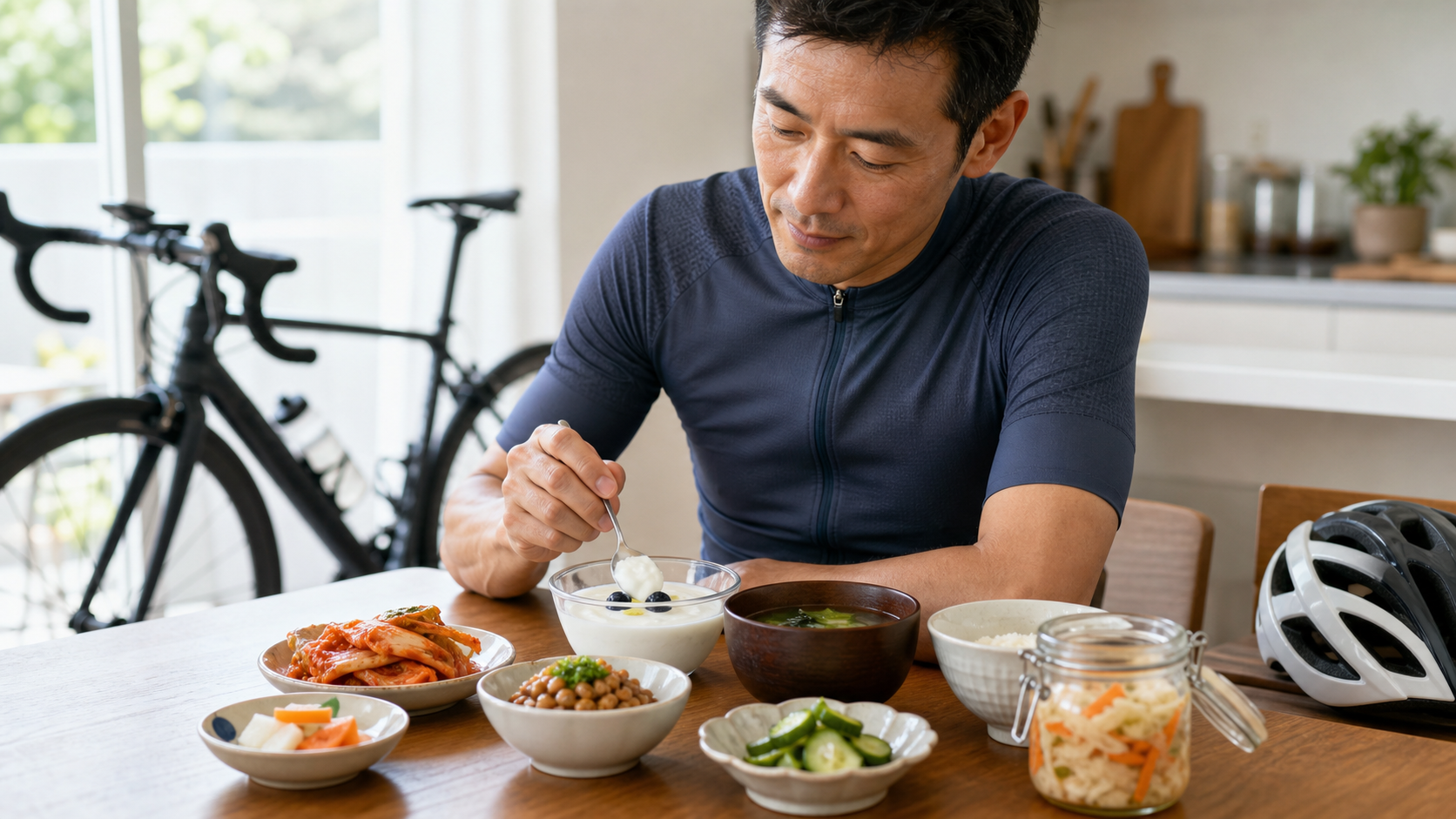
Starting with a Student Who Always Had “Pre-Race Diarrhea”
Over the years I’ve led teams, one of the cases that left the deepest impression on me was an amateur road cyclist in his early forties who worked at Hsinchu Science Park. Let’s call him A-Bin. A-Bin’s FTP was 4 W/kg; on weekday mornings he’d ride along the riverside, and on weekends he’d regularly head up Yangmingshan. Among amateur cyclists, he was quite competitive. But he had one problem that had plagued him for years: whether it was race day or a particularly important long-distance training session, he was guaranteed to have diarrhea.
That kind of diarrhea wasn’t from eating something bad—it was the classic “exercise-induced gastrointestinal discomfort.” He’d get nervous before the start, his heart rate would spike to over 90 bpm, his stomach would churn, and he’d get cramps in his lower abdomen. Often he couldn’t even ride 30 kilometers before needing to find a restroom. He’d tried not eating before races, drinking only water—and then he’d run out of energy in the latter half. He’d tried eating a big meal—and that was even worse. When he came to me, his first words were: “Coach, is my gut just naturally terrible?”
I told him that guts are rarely “naturally terrible.” What’s more common is that we’ve long neglected it, treating it like a passive pipe rather than a living ecosystem home to trillions of microbes. After that conversation, we spent about three months gradually rebuilding his gut environment—from dietary structure, to introducing fermented foods, to the pacing of pre-race fueling. In the end, he couldn’t claim he “never” had issues, but the frequency of pre-race gut meltdowns dropped from nearly every event to the occasional one.
In this article, I want to organize what I discussed with A-Bin back then, and with many students since: What exactly can fermented foods do for athletes? How do you choose among the types? And how do you practically incorporate them into a Taiwanese person’s everyday diet? This is an area that has gained increasing attention in sports nutrition in recent years, but it’s still unfamiliar territory for most cyclists and runners. I’ll keep it as plain-spoken as possible, and I’ll honestly tell you which parts are backed by research and which are still reasonable inference.
Why Should Athletes Care About the Gut?
Let’s establish a concept first: Your gut isn’t just where digestion and absorption happen—it’s also the body’s largest immune organ, and an independent “endocrine and neural hub.”
The human gut is home to trillions of bacteria, fungi, and other microorganisms, collectively known as the gut microbiota. These microbes do a lot for us: they break down the dietary fiber we can’t digest ourselves, produce short-chain fatty acids (like butyrate) that nourish the cells lining the gut wall, synthesize certain vitamins, train and regulate the immune system, and even influence mood and stress responses through the “gut-brain axis.”
For athletes, the gut matters especially for several reasons:
- High-intensity exercise can damage the gut barrier. When you do long-distance, high-intensity training, blood is heavily shunted to the working muscles and to the skin for heat dissipation, so blood flow to the internal organs (including the gut) is relatively reduced. This ischemia-reperfusion, combined with rising core body temperature, temporarily increases gut permeability—the tendency known colloquially as “leaky gut.” The tight junctions in the gut wall loosen, and contents (bacterial fragments, endotoxins) can seep into the bloodstream, triggering systemic low-grade inflammation and gastrointestinal symptoms. This is the physiological basis for why many people feel nauseous, have diarrhea, or feel bloated after long runs or long rides.
- People with high training volumes have a higher risk of upper respiratory infections. This is a phenomenon every veteran coach knows: once the competitive season peaks and training volume maxes out, colds tend to sweep through the team one after another. Exercise immunology calls this the “immune window” after high-intensity training. And the state of the gut microbiota and mucosal immunity (including the mucosa of the mouth, nose, and gut) is related to how deep that window is.
- Gut status directly affects fueling efficiency and race performance. A gut that can absorb carbohydrates well and isn’t prone to bloating or cramping gives your fueling strategy much more room to operate. Conversely, once your gut collapses, even the most precise power-pacing plan is just empty talk.
So I often tell my students: Your gut is your “invisible seventh muscle.” You train your cardiovascular system, your legs, and your core, but very few people actually “train their gut.” And fermented foods are the gentlest, most everyday way to train it.
Fermented Foods and Probiotics: Are They the Same Thing?
Let’s first clarify a concept that often gets confused, because it directly affects how you choose and how you eat.
- Fermented foods: Foods in which microorganisms (bacteria, yeast, molds) act to break down and transform the sugars and proteins in the ingredients. The key point is the process of “microbial fermentation.” Fermentation produces organic acids, gases, and flavor compounds, and may also leave behind live microorganisms.
- Probiotics: The academic definition is “live microorganisms that, when administered in adequate amounts, confer a health benefit on the host.” It emphasizes “specific strains, live, effective dosage, and health benefits.” Commercial probiotic supplements typically list down to the strain level (e.g., a certain Lactobacillus GG strain) and the count (CFU, colony-forming units).
The relationship between the two is: some fermented foods contain live probiotics, and some don’t. For example, yogurt, kefir, live-culture kimchi, and kombucha usually contain live cultures; but commercially sold soy sauce and miso, if they’ve been pasteurized at high temperatures or cooked for a long time, have mostly lost their live cultures—though even if the microbes are dead, the metabolites produced during fermentation (organic acids, bioactive peptides, transformed polyphenols, etc.) may still be beneficial.
I want to emphasize a shift in thinking in recent years: the benefits of fermented foods can’t be measured only by “live cell count.” Dead microbial cells (sometimes considered part of postbiotics) and fermentation metabolites may themselves have regulatory effects on immunity and metabolism. So rather than obsessing over how many live bacteria are still in a jar of kimchi, it’s better to treat “regularly and diversely consuming a variety of fermented foods” as a dietary habit to cultivate.
The Science: Can Fermented Foods Really Change the Gut?
Here I want to be very honest about the distinction: what has solid research support, and what is still reasonable inference.
One study I often cite, and which is relatively rigorous, is a ten-week randomized trial by a Stanford University team published in the journal Cell in 2021. The researchers divided healthy adults into two groups: one ate a high-fermented-food diet (yogurt, kefir, kimchi, kombucha, etc.), and the other ate a high-fiber diet. The results showed: in the high-fermented-food group, gut microbiota diversity rose significantly, and 19 inflammation-related proteins in the body (including IL-6, a marker associated with various chronic inflammatory and metabolic diseases) decreased; the more people consumed, the more pronounced the changes. Interestingly, within just ten weeks, the high-fiber-only group did not show the same rise in microbial diversity or drop in inflammation.
This study gives us several important takeaways:
- Diet can significantly change the gut ecosystem within just a few weeks—you don’t have to eat a certain way for a lifetime to feel the effects.
- Fermented foods may boost microbial diversity faster and more directly than simply adding fiber. But this doesn’t mean fiber is useless—fiber is the “food” for gut bacteria and remains very important long-term; it’s just that the speed of change differs in the short term.
- There’s a dose-response relationship: the more you consume (within a reasonable range), the more pronounced the effect.
As for athlete-specific evidence, it currently focuses mainly on “probiotic supplements” rather than “fermented foods” themselves. Multiple systematic reviews and meta-analyses of athletes indicate that supplementing with specific probiotic strains may help reduce the frequency, severity, and duration of upper respiratory infections, and improve some aspects of gut barrier function and gastrointestinal discomfort. However, these reviews also cautiously add that study quality varies, strains and dosages differ widely, and more large randomized controlled trials are needed to confirm; the optimal strain, dosage, and timing are still undetermined.
So my position is: fermented foods are worth incorporating into every athlete’s daily diet (low risk, with evidence supporting general health and microbial diversity); as for high-dose probiotic supplements, they’re a “consider it, individualize it, don’t mythologize it” tool.
Honest reminder: The research above describes “group average trends,” not a guarantee of how any individual will respond. Gut microbiota is highly individual—the same jar of kimchi may affect you and me differently.
Don’t Overlook the “Gut-Brain Axis”
There’s another aspect often underestimated by athletes: there is a bidirectional communication line between the gut and the brain, commonly known as the “gut-brain axis.” Through neural, immune, and endocrine pathways, the gut microbiota influences our stress response, mood, and sleep quality.
What does this mean for athletes? Think about it—the nervousness, anxiety, and poor sleep before a competition are “psychological” factors, but they are actually interconnected with your gut state. Take someone like A-Bin, who gets diarrhea when nervous—that’s a classic example of the gut-brain axis in action: the brain sends stress signals to the gut, and the gut protests in its own way.
I won’t go so far as to say “eating fermented foods will cure pre-race anxiety”—that’s an overstatement without sufficient evidence. But I will say this: a gut that has been well cared for long-term, with diverse microbiota and lower inflammation, is better equipped to handle the physiological and psychological stress of training and racing. It’s the concept of “a stable foundation supports a stable superstructure.” When you take care of your gut, you’ll find that not only does digestion improve, but your emotional stability and sleep quality may also benefit. That’s why I view gut care within the framework of overall athletic performance, rather than treating it in isolation as a “digestive issue.”
An Overview of Fermented Food Types and Their Application in Sports
Taiwan is actually a place rich in fermented foods; we just don’t often look at it from that perspective. The table below organizes common fermented foods, whether they contain live cultures, their characteristics, and practical notes for athletes.
| Fermented Food | Often Contains Live Cultures | Main Characteristics | Practical Notes for Athletes |
|---|---|---|---|
| Unsweetened Yogurt | Yes | Easy to find, contains protein and calcium | Convenient as a recovery snack with fruit after training; choose unsweetened or low-sugar |
| Kefir | Yes | More diverse strains than yogurt, thinner texture | Suitable as a breakfast drink or post-workout option; relatively better tolerated by those with lactose intolerance |
| Kimchi (Korean/Taiwanese sauerkraut) | Depends on process | Contains live cultures + fiber + polyphenols | High sodium; watch portions if losing weight or have high blood pressure |
| Miso | Mostly pasteurized/heated | Rich in fermentation metabolites, savory flavor | Easy for soups, but high sodium; usually few live cultures |
| Tempeh | Mostly inactivated after heating | High protein, quality plant-based protein source | Great protein for vegetarian athletes, very satiating |
| Natto | Yes | High protein, contains vitamin K2 | Acceptance in Taiwan is polarizing, but nutritionally dense |
| Kombucha | Yes | Slightly fizzy, contains organic acids | Watch sugar content and trace caffeine/alcohol |
| Traditional Soy Sauce/Fermented Tofu | Mostly dead cultures | Used for seasoning, fermentation metabolites | Extremely high sodium; use only as seasoning, not as a “probiotic source” |
| Sourdough Bread | Inactivated after baking | Fermentation improves digestibility | Easier to digest than regular white bread, but still refined carbs |
Looking at this table, I want you to grasp two key points:
- For “live cultures,” rely mainly on yogurt, kefir, live-culture kimchi, natto, and kombucha.
- Items like miso, soy sauce, tempeh, and sourdough bread—which usually have no live cultures after heating—still have value because their fermentation metabolites are beneficial and their nutritional density is high; just don’t expect them to “supplement bacteria.”
A special reminder for Taiwan is sodium content. Kimchi, miso, soy sauce, and fermented tofu are all on the salty side, and eating out already tends to push sodium over the limit. If you already have high blood pressure, you should still eat fermented foods, but control portions and be sure to discuss this with your physician—more on that later.
A Reference Portion Guide
The question students ask most often is: “Coach, so how much should I eat per day?” Honestly, fermented foods don’t have precise dosages like medication, and I don’t advocate measuring everything with a cup. But to give you a “feel” for it, I’ve converted common fermented foods into everyday portion sizes for you to gauge. These are practical experience values, not strict medical prescriptions, so treat the numbers as ranges.
| Fermented Food | One Serving (Everyday Portion) | Introductory Phase (Weeks 1–2) | Stabilization Phase (From Week 3) |
|---|---|---|---|
| Unsweetened Yogurt | About half a bowl (100–150 g) | 1 serving per day | 1–2 servings per day |
| Kefir | About 150–200 ml | 1 serving every other day | 1 serving per day |
| Live-Culture Kimchi | About one small dish (30–50 g) | 1 small dish per day | 1–2 small dishes per day |
| Natto | About 1 small pack (40–50 g) | 2–3 times per week | 3–5 times per week |
| Kombucha | About 150–200 ml | 2–3 times per week | Adjust based on sugar content |
| Miso (for soup) | About 1 tablespoon of miso | 3–4 bowls per week | Adjust based on sodium intake |
When using this table, remember three principles: prioritize variety, progress gradually, and listen to your gut. If you feel particularly bloated or gassy on a certain day, scale back to smaller portions and build up again after a few days. Your gut won’t undo all progress because you skipped a day, but it might protest all day if you binge once.
Practical Approach: How to Fit Fermented Foods into Your Week?
Now that the concepts are covered, here’s something you can implement directly. The principle I give my students is simple: variety, small amounts, daily inclusion, and gradual progression. Don’t get a sudden urge today and down a big jar of kimchi with kombucha—that kind of binge will only cause bloating.
Below is a one-week fermented food introduction example I often give to “amateur cyclists/runners with average training volume.” This isn’t a rigid schedule but a demonstration of how to naturally incorporate fermented foods into Taiwanese meals and eating out.
| Day | Breakfast Period | Main Meal/Eating Out Pairing | Post-Training Recovery |
|---|---|---|---|
| Monday | Unsweetened yogurt + banana | Bento box with a small dish of kimchi | A glass of kefir |
| Tuesday | Miso soup + breakfast | Buffet with tempeh or braised soy products | Yogurt + berries |
| Wednesday | Natto mixed with rice (optional challenge) | Noodle shop, choose something with pickled mustard greens | Mostly water; give the gut a rest |
| Thursday | Kefir + oatmeal | Bento box with a small amount of kimchi | Unsweetened yogurt |
| Friday | Sourdough bread + eggs | Miso soup set meal | Kombucha (watch sugar) |
| Saturday (long ride) | Light and easy to digest; no new foods | Stick to familiar foods for fueling | Eat fermented foods a few hours after the event |
| Sunday | Yogurt + nuts | Home-cooked meal with a bit of kimchi | Adjust based on training |
A few key operational principles:
- “Start with small portions”: In the first week, stick to one serving per day (e.g., half a bowl of yogurt, a small dish of kimchi) to let your gut microbiota adapt gradually. In weeks two and three, increase to 2–3 servings of different types per day. In that Stanford study, the people with good results eventually consumed quite a lot of fermented foods, but they also increased gradually, not starting with a huge amount.
- “Prioritize variety over quantity of a single type”: Eating five different fermented foods in small amounts is generally better for increasing microbiota diversity than eating a lot of just one.
- “No new foods on heavy training days or race days”: This is a hard rule. No matter how good fermented foods are, never try them for the first time on a long ride, long run, or race day. The gut adjustment period can cause bloating and increased gas—you don’t want to experience that on the course.
- “Pair with fiber”: Fermented foods provide the microbes; dietary fiber (vegetables, whole grains, legumes) provides food for the microbes. Combining both is the complete strategy for long-term gut health.
Common Mistakes and Corrections
Having coached students for so long, I’ve seen all sorts of ways people turn good intentions into a mess. Here are the most common ones—check whether any apply to you.
Mistake 1: Binge Eating, Then Bloating So Bad You Question Life
Many people hear fermented foods are good, and the next day they binge on kimchi, chug kombucha, and top it off with a big tub of yogurt. The gut microbiota hasn’t adapted yet, gas production spikes, and they end up bloated, gassy, or even with diarrhea all day—then wrongly conclude “fermented foods wrecked my gut.”
Correction: Start with one small serving per day and gradually increase over two to three weeks. The gut is a living ecosystem; change takes time.
Mistake 2: Treating “Sickeningly Sweet Yogurt Drinks” as Health Food
Many yoghurt drinks and lactic acid bacteria beverages in supermarkets tout “probiotics,” yet their sugar content is shockingly high. You think you’re replenishing bacteria, but you’re actually loading up on sugar. For athletes managing weight or body fat, this is a hidden trap.
Fix: Choose sugar-free or low-sugar versions, and sweeten them yourself with fruit. Check the “sugar” line on the nutrition label, not just the “probiotics” marketing on the front.
Mistake 3: Ignoring Sodium—Eating Kimchi and Miso Heavily While Blood Pressure Is Already High
As mentioned earlier, many common fermented foods in Taiwan are high in sodium. I’ve had clients whose blood pressure was already borderline; to “take care of their gut,” they paired kimchi with every meal and had miso soup daily—only to see their blood pressure rise instead of fall.
Fix: Do eat fermented foods, but control portions of the high-sodium ones (kimchi, miso, soy sauce, fermented tofu), and prioritize low-sodium, salt-free sources of live cultures (such as sugar-free yoghurt, kefir, natto). If you already have high blood pressure, heart disease, or kidney disease, discuss dietary changes with your doctor or nutritionist—don’t improvise on your own.
Mistake 4: Thinking About “Gut Health” Only the Day Before a Race
Adjusting the gut microbiome is a project measured in “weeks,” not something a probiotic taken the day before a race will fix overnight. A last-minute scramble might actually add gastrointestinal uncertainty on race day.
Fix: Treat fermented foods as a long-term lifestyle habit, building them in during the off-season and base phase. In the days before a race, instead, return to familiar, easily digestible foods—don’t experiment.
Mistake 5: Believing Probiotic Supplements Can Replace Eating Properly
Some people buy expensive probiotic capsules, then continue eating haphazardly and skimping on vegetable fiber. But without fiber—the “food for the bacteria”—the bacteria you ingest struggle to colonize and multiply.
Fix: Supplements are “support,” not “substitutes.” The foundation is always a diverse, natural diet: plenty of vegetables and fruit, whole grains, legumes, plus fermented foods.
Case Follow-Up: Breaking Down “Pre-Race Diarrhea” into Manageable Variables
Let’s revisit A-Bin’s case in more detail, because it encapsulates the entire approach I want to convey. Many people think “gut health” equals “taking probiotics,” but truly effective management means breaking the problem into several individually adjustable variables.
At the time, we drew up a checklist and examined each item:
- Intensity and emotions: A-Bin’s heart rate often spiked above 90 bpm before races—a classic stress-induced irritable bowel response. For this, we standardized a 20-minute pre-race breathing rhythm and warm-up routine to reduce excessive sympathetic nervous system arousal.
- Fuel concentration: He habitually used very concentrated energy drinks with high osmolality, which, in the later stages of long rides when intestinal blood flow is already reduced, easily caused fluid retention and cramping. We diluted his sports drinks and switched to a fuel schedule that separated solids and liquids.
- Familiarity of pre-race food: He used to try “things that are supposedly good for the gut” the night before races, which only added variables. We set a hard rule: On race day, eat only foods already validated in training.
- The everyday gut foundation: This is where fermented foods come in. Over about 8 to 10 weeks in the off-season, we took his fermented food variety from “almost none” to “3–4 types daily, gradually increasing amounts,” while also ensuring adequate daily vegetable fiber.
You’ll notice that fermented foods are just one piece of this entire puzzle, not a panacea. That’s why I keep emphasizing: Don’t outsource gut problems to a bottle of supplements—manage it as a system. Three months later, A-Bin reported that his pre-race gastrointestinal breakdowns dropped from “almost every race” to “occasionally once,” and he also became better at knowing how to soothe his gut on race day. This ability to “learn to get along with your own body” is worth more than any supplement.
Actionable Advice for Readers at Different Levels
Everyone starts from a different point, so I’ve divided the advice into three tiers. Find where you are now and start there.
Beginners / General Health-Conscious Exercisers
- Goal: Make fermented foods a daily habit, without chasing precision.
- Approach: Start with one serving of sugar-free yoghurt or kefir daily for two weeks; then add a second type (e.g., a small dish of kimchi with your lunchbox). Pair this with at least 2–3 servings of vegetables daily.
- Mindset: Don’t obsess over “did I get enough bacteria”—regularity and variety matter most. If you experience obvious gastrointestinal discomfort, scale back to smaller portions.
Advanced Riders/Runners with Regular Training and Frequent Race Participation
- Goal: Use gut health to support training recovery and race-day stability.
- Approach: During the base phase and off-season, actively build fermented food diversity (3–5 types daily, gradually increasing amounts), while also doing “pre-race gut rehearsals”—in several simulated long rides/runs, test which fuels and foods leave your gut most comfortable, and use that “validated combination” on race day.
- Mindset: Fermented foods are your everyday foundation; on race day, return to familiar formulas. Manage the two separately.
Those with Recurring Exercise-Related Gut Issues, or Considering Probiotic Supplements
- Goal: More systematically identify and manage gastrointestinal symptoms.
- Approach: First examine variables such as training intensity, fuel concentration (high-osmolality drinks are often the culprit), pre-race anxiety, and caffeine intake. Beyond long-term cultivation of fermented foods and fiber, if you’re considering probiotic supplements, I recommend choosing products with clearly labeled strains and colony counts, and discussing them with a sports nutritionist or physician—not just grabbing any jar.
- Important: For recurrent, severe, or gut issues accompanied by bloody stools, unexplained weight loss, or persistent abdominal pain, absolutely do not tough it out as a “training side effect”—seek medical attention to rule out gastrointestinal disease. Taiwan’s National Health Insurance makes it easy to see a doctor, and gastroenterology clinics are highly accessible. Go when you need to.
A “Fermented Food Introduction” Self-Checklist
Here’s a simple checklist you can stick on your fridge:
- [ ] Have I eaten at least 3 different types of fermented foods this week?
- [ ] Is the yoghurt/dairy I chose sugar-free or low-sugar?
- [ ] Am I increasing gradually, rather than bingeing all at once?
- [ ] Besides fermented foods, is my daily fiber from vegetables and fruit sufficient?
- [ ] Am I controlling portions of high-sodium fermented foods (kimchi, miso)?
- [ ] On heavy training days/race days, am I avoiding trying new foods?
- [ ] If I have a chronic condition, have I discussed dietary changes with my doctor/nutritionist?
If you’ve checked four or more of the seven, you’re on the right track; if most are unchecked, don’t rush—just start with the first item.
FAQ
Over the years of coaching, questions about fermented foods always revolve around a few core themes. Here they are, all in one place.
Q1: Fermented foods or probiotic capsules—which is better?
It’s not a matter of one replacing the other. Fermented foods are “food”—they provide a comprehensive package of diverse strains, fiber, nutrients, and fermentation metabolites, at low cost and with minimal side effects, suitable for daily consumption. Probiotic capsules are “high-dose tools for specific strains”; in certain clear situations (e.g., recurrent upper respiratory infections, specific gut symptoms), they may have supportive value, but you need to choose the right strain and dosage, ideally with professional guidance. My advice is always: Build the foundation of fermented foods and fiber first, then consider whether to add supplements.
Q2: I keep farting and feeling bloated after eating fermented foods—are they not for me?
In most cases, it’s increasing the amount too quickly; the gut microbiota produces more gas during the adaptation period, which usually subsides as your body adjusts. Try scaling back to smaller portions and slowing the rate of increase. But if you have chronic, severe bloating, or even abdominal pain and diarrhea, that’s not simply an adaptation issue—seek medical evaluation for conditions like IBS, and don’t just tough it out.
Q3: Can I eat yoghurt or kimchi on race morning to “boost” my gut?
I don’t recommend treating race day as a time to replenish bacteria. Managing the gut microbiome is measured in “weeks”; eating something last-minute on race day won’t take effect in time and may add gastrointestinal variables. The principle on race day is to eat “familiar, easily digestible, and validated” foods. Enjoy fermented foods to the fullest during regular training and the off-season.
Q4: Can I actually drink kombucha? I heard it has caffeine and alcohol?
Kombucha does contain trace amounts of caffeine (from the tea) and extremely trace amounts of alcohol (a fermentation byproduct), and moderate consumption is fine for most people. What really matters is the sugar content—some commercial kombuchas add considerable sugar for taste. For athletes managing weight, reading the nutrition label matters more than anything. Pregnant women and those sensitive to caffeine should be more conservative.
Q5: How Do Vegan Athletes Get Fermented Foods?
In fact, vegetarians have many excellent options: tempeh, natto, miso, kimchi, sourdough bread, and plant-based yogurt are all great sources. Tempeh and natto are also high in protein, making them a cost-effective protein choice for vegan athletes. For those who don’t eat dairy, these plant-based fermented foods can still help cultivate gut diversity.
Q6: Can Fermented Foods Improve Athletic Performance?
To be honest: there is currently no solid evidence that “eating fermented foods will make you faster or stronger.” Their value lies in supporting recovery, immunity, and gastrointestinal stability—these are the “foundation” of performance, not a direct performance boost. Think of them as tools to reduce penalties (fewer illnesses, fewer gut issues), not as magic enhancers. That’s the right mindset.
Practical Tips for the Taiwanese Context
Here are a few practical points specifically for Taiwanese readers that foreign articles won’t tell you:
- Practical choices for those who eat out: The pickled cabbage at bento shops, the kimchi at noodle shops, the miso soup at buffet restaurants, the miso and pickled sides at Japanese set meals, and the side dishes at Korean restaurants are all readily available sources of fermented foods. The key is to choose sugar-free options, watch sodium intake, and consume in moderation.
- Storage in a humid, hot climate: Taiwan’s summers are humid and hot, making homemade or bulk fermented foods prone to spoilage. After opening, be sure to refrigerate, pay attention to expiration dates, and throw away anything with an off smell or mold—don’t be reluctant to toss it. It would be counterproductive if gut-health foods end up giving you food poisoning.
- Lactose intolerance is common: Many Taiwanese people have varying degrees of lactose intolerance. If regular milk causes bloating or diarrhea, try yogurt or kefir (the fermentation process breaks down some lactose, making them generally better tolerated), or opt for plant-based fermented foods (tempeh, natto, kimchi).
- Easy access to healthcare is our advantage: Taiwan’s accessibility to gastroenterology and family medicine is among the best in the world. Rather than self-diagnosing “leaky gut” online, let professionals evaluate obvious or recurring symptoms. Fermented foods are for maintenance, not treatment.
Conclusion: Treat Your Gut as a Training Partner That Needs Long-Term Commitment
Back to A-Bin from the beginning. His gut eventually stabilized—not through some miracle supplement, but through three very simple things: regularly eating a variety of fermented foods, getting enough fiber in his daily diet, and sticking to familiar foods on race day without experimenting. Together with adjusting his pre-race fueling concentration and pre-race anxiety, this “invisible teammate”—the gut—gradually came around to his side.
The core concept I want to leave you with is this: Gut health is not a sprint; it’s an ultramarathon. The benefits of fermented foods are real and supported by research, but their effects come from “day-after-day, diverse, and consistent” accumulation, not from last-minute cramming before a race. Treat it as part of your training plan—manage it patiently, just as you would your cardiovascular system and your legs.
When your gut is healthy, absorbs well, and doesn’t easily break down, you’ll find that not only are race days more reassuring, but your recovery, immunity, and mental state after daily training are also more stable. This is a very worthwhile long-term investment.
May you ride far and run steady, with your gut fighting alongside you.
This article is for educational purposes and cannot replace individual diagnosis and treatment advice from physicians, physical therapists, or nutritionists. If you have chronic conditions (such as diabetes, hypertension, heart disease, kidney disease) or recurrent, severe gastrointestinal symptoms, please seek medical attention and receive individualized assessment. Do not replace proper medical care with diet or supplements on your own.
References
- Stanford Medicine News: A fermented-food diet increases microbiome diversity and lowers inflammation, study finds — https://med.stanford.edu/news/all-news/2021/07/fermented-food-diet-increases-microbiome-diversity-lowers-inflammation.html
- ScienceDaily coverage of the same study: https://www.sciencedaily.com/releases/2021/07/210712122151.htm
- Probiotic Supplementation and Respiratory Infection and Immune Function in Athletes: Systematic Review and Meta-Analysis of Randomized Controlled Trials (PMC): https://pmc.ncbi.nlm.nih.gov/articles/PMC8582629/
- The Role of the Gut Microbiome and Probiotics in Sports Performance: A Narrative Review Update (MDPI, Nutrients): https://www.mdpi.com/2072-6643/17/4/690
- Effects of Probiotics Supplementation on Risk and Severity of Infections in Athletes: A Systematic Review (PMC): https://pmc.ncbi.nlm.nih.gov/articles/PMC9517237/
Related Reading
- Exercise and Gut Health: Turning Your Gut Microbiota into Your Sixth Muscle—Exercise Prescriptions from Gut Microbiota to Gut Diseases
- IBS and Athlete Diets: A Complete Guide to Low-FODMAP, Gut Health, and Pre-Race Eating
- Exercise and Gut Microbiota: The Emerging Performance Factor—The Second Engine from Endurance to Recovery
- Gut Training: Why Your Gut Needs Training Too, and How to Handle Race-Day GI Issues
約騎爆笑地獄梗 大腸怎麼了🤣 #公路車 #cycling
3 年前
CT暗黑廚房) 車友必備 宇宙無敵鮮蚵湯 幫助訓練恢復 天然食補 好市多 超肥鮮蚵 破PR
7 年前
一日北高/長距離團騎 常見問題補充篇 / 組團或跟團的眉角 / 壯車友容易被瘦車友慢性拉爆 / 原來屁股痛可能是這個原因...? / 風場配速法 / 公路車 / CT Yeh
2 年前
Never Stop 西進武嶺 前後雙機 完整全程錄影 訓練台 實境
8 年前
一個測試有沒有認真練車的方法😂 #公路車
10 個月前
FTL 與 SYB 車隊專訪 西進武嶺 實用攻略分享! 2小時 如何練?!你不知道的眉角!新手準備武嶺必看 EP1 | 實力派女車友 | 精華版 | 公路車 | CTYeh
4 年前
鎮西堡 公路車首航 你排乳酸 我排卵... | 宇老又爆胎 要直接棄坑了嗎?
4 年前
靠單車減肥35公斤 心得分享與整理
7 年前