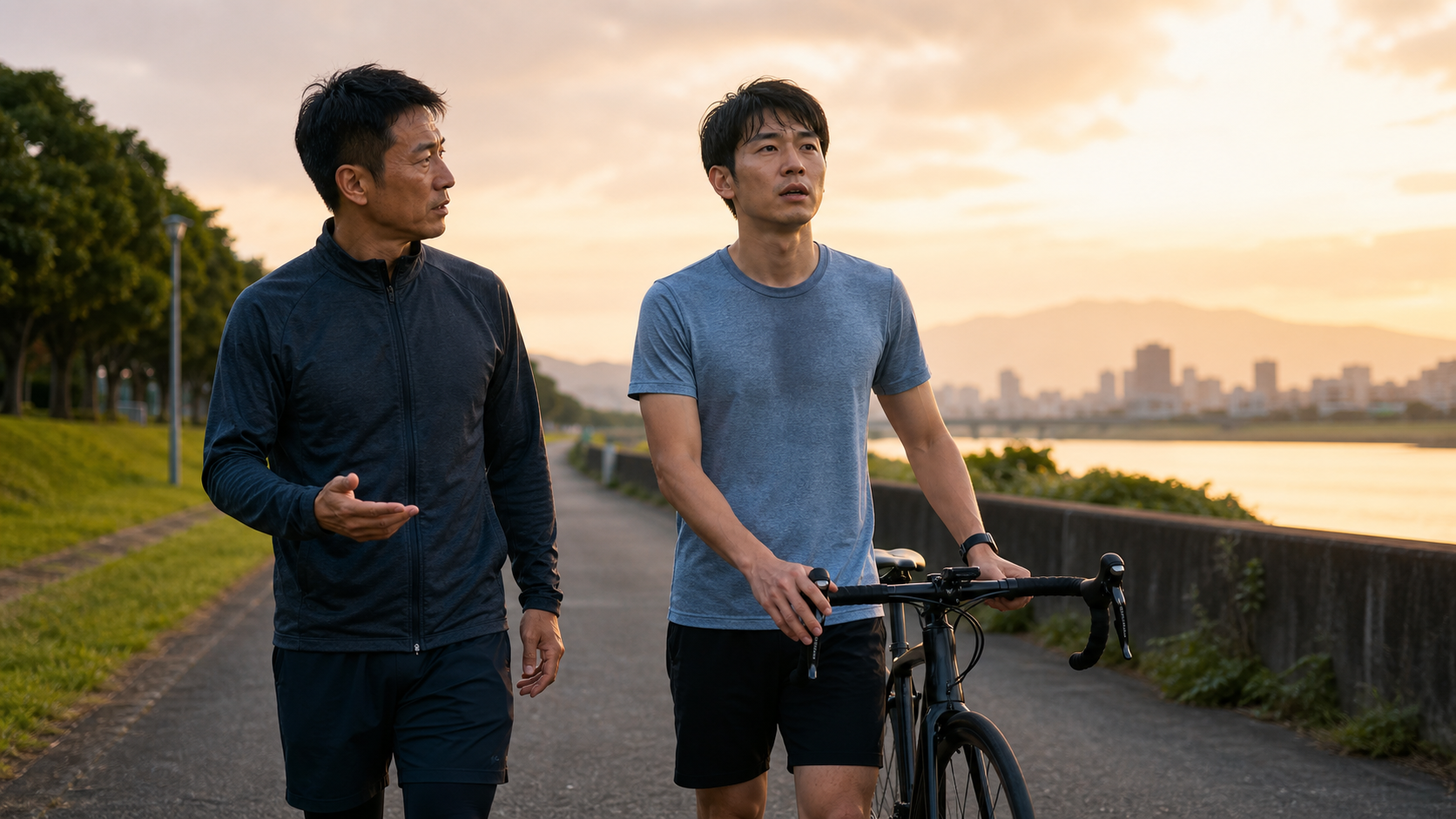
Starting with a Student Who Was Shaking on the Riverside Levee
A few years ago, an office worker in his thirties came to see me—let’s call him A-Kai. At our first meeting, he sat on a chair at the riverside sports center, knees trembling, speaking rapidly, and constantly glancing down at his phone. He said that for the past six months, he’d often felt heart palpitations and sweaty palms before meetings, and at night he’d lie in bed with his mind racing, tossing and turning until three or four in the morning before falling asleep. He’d seen a psychiatrist, who diagnosed him with anxiety disorder, prescribed medication, and advised him to “exercise more.” The problem was, those two words—“exercise more”—meant nothing to someone so anxious that even leaving the house felt exhausting. It might as well have been empty advice.
I didn’t start by handing him a brutal training plan. In the first week, all we did was walk along the levee for twenty minutes every evening, at a pace slow enough that we could chat while walking. By the third week, he started pulling out his dusty commuter bike and riding on flat roads for forty minutes at a very relaxed cadence. Three months later, when he went back for a follow-up, his doctor found that his sleep had improved significantly and his daytime heart palpitations had become less frequent. He described the feeling this way: “It was like there was an engine in my head that was constantly revving, redlining with no load. After exercising, it felt like someone helped me ease off the throttle a little.”
I’m opening with A-Kai’s story because it gets to the heart of what this article is about: Exercise isn’t a cure-all for anxiety, but it’s one of the few self-regulation tools you can take charge of yourself, with virtually no side effects and fairly solid scientific backing. In my 15 years of coaching athletes at all levels and working with the general population, I’ve seen exercise pull many people back from the edge of tension, and I’ve also seen people who pushed themselves the wrong way and ended up more anxious than before. In this article, I want to lay out the mechanisms, the methods, the common mistakes, and the approaches for readers at different levels—all in one go.
Let me say one important thing first: if you’re currently experiencing severe anxiety, panic attacks, or any thoughts of self-harm, please seek professional help first. Taiwan’s psychiatric and counseling resources are more accessible than many people realize, and they’re covered by National Health Insurance. Exercise is a great complement, but it can’t replace medical treatment. I’ll emphasize this again at the end of the article.
What’s Actually Happening in Your Body When You’re Anxious
To understand why exercise helps, you first need to understand what anxiety is physiologically.
Anxiety is essentially the result of a “threat detection and fight-or-flight readiness” system being over-activated. When the brain—particularly the amygdala—judges that there’s a threat, it triggers the sympathetic nervous system, putting the body into a state of readiness for “fight or flight”: heart rate increases, breathing becomes shallower and faster, muscles tense up, blood sugar rises, and digestion is temporarily shut down. In ancient times, this was incredibly useful when encountering a wild beast—it could save your life. The problem is that in the modern world, the “wild beasts” have become unread work messages, mortgages, and health checkup reports. These threats can’t be resolved by a fight or a sprint, so the body stays stuck in a state of readiness that never lets up.
Chronic overactivity of the sympathetic nervous system shows up as several common symptoms: elevated resting heart rate, frequent palpitations, light or early-morning sleep, chronically tight neck and shoulders, digestive discomfort, and that feeling of “I can’t quite explain why, but I just can’t settle down.” Many people think anxiety is just “overthinking,” but it’s actually a very real physiological state—visible and measurable.
There’s a key concept here called autonomic nervous system balance. The autonomic nervous system is divided into two branches: the sympathetic (the accelerator) and the parasympathetic (the brake). A healthy state isn’t one with no sympathetic activity at all—it’s one where the two can switch flexibly, pressing the accelerator when needed and actually being able to brake when it’s time to stop. Anxious people often have a failing brake while the accelerator stays floored. A big part of why exercise helps is that it retrains the coordination between this accelerator and brake.
The Mechanisms by Which Exercise Relieves Anxiety
Exercise doesn’t improve anxiety through a single pathway; it works through several routes at once. I’ll break down the main mechanisms using the analogies I often use with my students.
One: Helping the Body “Finish” That Escape It Never Got to Run
As I said, anxiety is a state of readiness with nowhere to release. Aerobic exercise, in a sense, helps the body “complete” that escape it was supposed to run but never did. When you actually get moving—your heart rate naturally rises, you sweat, you breathe hard—your body receives the message: “The fight-or-flight has been executed. We can stand down now.” After exercise, the parasympathetic nervous system takes over, bringing a distinct period of relaxation. That feeling many people have after a workout—“tired but loose”—is the parasympathetic system regaining control.
Two: Regulating Stress Hormones and Neurotransmitters
Regular exercise affects several chemicals closely tied to mood. During exercise, it promotes the release of endorphins and endocannabinoids, producing what’s often called a sense of euphoria. Long-term regular exercise is also thought to help regulate the secretion rhythm of the stress hormone cortisol, making the body’s response to stress less extreme and allowing for faster recovery. Additionally, exercise is linked to the balance of neurotransmitters like serotonin, norepinephrine, and dopamine—which happen to be the very targets that many anti-anxiety and antidepressant medications work on. This isn’t to say exercise equals medication, but rather that their pathways partially overlap.
Three: Reducing Excessive Fear of Bodily Sensations
This is something many people overlook, but I think it’s extremely important. Anxious people are often especially sensitive to—and afraid of—their own bodily sensations: a slightly faster heartbeat makes them worry it’s heart disease; a little breathlessness makes them fear something’s wrong. In psychology, this is called “anxiety sensitivity.” Aerobic exercise happens to produce exactly those sensations—a racing heart, heavy breathing, sweating—but in a safe, controlled context where you know the cause. Over time, the brain relearns: “A fast heartbeat doesn’t necessarily mean danger.” This “desensitization” to bodily sensations is particularly helpful for people prone to panic.
Four: Improving Sleep, and Sleep in Turn Improving Anxiety
Anxiety and insomnia are practically inseparable companions, and they feed each other: the more anxious you are, the worse you sleep; the worse you sleep, the more anxious you are the next day. Regular aerobic exercise is one of the few non-pharmacological methods widely recognized to improve sleep quality. When sleep improves, your emotional regulation capacity during the day naturally rises, and the overall level of anxiety slowly comes down. That’s also why, when I worked with A-Kai, sleep was the first indicator I saw clearly improve.
Five: Restoring a Sense of Control and Self-Efficacy
Anxiety often comes with a feeling of helplessness—“I’ve lost control of my own life.” Exercise is one of the few things you can decide entirely on your own and see clear progress in. This week you can ride continuously for forty minutes; next month, sixty. A small hill that used to leave you winded becomes an easy climb after three months. These concrete experiences of “I can do this, I’m improving” gradually rebuild self-efficacy, and self-efficacy is a key psychological resource for fighting the helplessness of anxiety.
What the Scientific Evidence Says
I’ve never liked overstating things, so here I’ll only mention conclusions that have actual research support and point in a consistent direction.
In recent years, multiple meta-analyses (which pool together many randomized controlled trials for analysis) have broadly reached the same conclusion: exercise can effectively reduce anxiety symptoms, with effects observed across different age groups and populations, and the effect size is roughly moderate. Among these, aerobic exercise shows particularly clear benefits for anxiety (BMJ related coverage, systematic review of exercise as a treatment for anxiety). Interestingly, some studies have observed that when it comes specifically to anxiety, shorter-duration, low-to-moderate intensity exercise actually shows a stronger association with anxiety relief—which runs counter to the common intuition that “the harder you train, the more effective it is.”
On exercise volume recommendations, the World Health Organization’s physical activity guidelines suggest adults accumulate at least 150 to 300 minutes of moderate-intensity aerobic activity per week, or 75 to 150 minutes of vigorous-intensity aerobic activity, and note that regular physical activity has clear benefits for mental health, including reducing symptoms of anxiety and depression (WHO guidelines on physical activity and sedentary behavior).
Putting these two things together gives us a very practical takeaway: You don’t need to suffer through brutal workouts to see results. For people dealing with anxiety, exercise that’s sustainable, regular, and at a comfortable intensity is often far more valuable than an occasional hellish training session. That’s also the core principle I use with anxious students—first build consistency, then pursue progress.
Aerobic Exercise × Mindful Exercise: Walking on Two Legs Together
When it comes to using exercise to relieve anxiety, I divide my toolbox into two broad categories: aerobic exercise and mindful exercise. The mechanisms differ slightly, and the ideal approach is to use them in combination.
Aerobic exercise (cycling, running, brisk walking, swimming, etc.) primarily handles what I mentioned earlier—“finishing that escape,” regulating neurochemistry, and improving sleep. Its strength lies in releasing accumulated tension and helping the body step down from a state of heightened readiness.
Mindful exercise (yoga, tai chi, qigong, mindful breathing, and “sensory-focused” slow riding) primarily trains the parasympathetic nervous system, pulling attention away from mental worries and back to the present body and breath. Its strength lies in actively practicing the ability to “apply the brakes.”
For cyclists, these two can actually be combined into a single ride. I often ask anxious clients to practice “breath-synced cadence” while riding: on easy, flat sections, deliberately slow and deepen the breath, making the exhale longer than the inhale (for example, inhaling for four counts and exhaling for six), while placing attention on the rhythm of the pedaling legs, the feeling of the wind, and the changes in the road surface—rather than on the mental to-do list. This is essentially a form of “dynamic mindfulness,” containing both aerobic and mindful elements.
The table below helps you quickly compare the positioning of the two types of exercise.
| Aspect | Aerobic Exercise | Mindful Exercise |
|---|---|---|
| Representative activities | Cycling, running, brisk walking, swimming | Yoga, tai chi, qigong, mindful breathing, slow riding |
| Primary function | Releases tension, regulates neurochemistry, improves sleep | Trains the parasympathetic system, pulls attention back to the present |
| Intensity | Primarily moderate, with occasional high intensity | Usually low intensity |
| During acute anxiety episodes | Not necessarily suitable for vigorous activity | Breathing and stretching are more suitable in the moment |
| Long-term effects | Increases stress tolerance, improves overall emotional baseline | Enhances emotional awareness and self-regulation capacity |
| Recommended combination | 3 to 5 sessions per week as the core | 2 to 3 sessions per week, or short daily sessions interspersed |
A Beginner’s Weekly Schedule for the Anxious
Here I provide an eight-week progressive schedule for people who “struggle with anxiety, want to use exercise as a supplement, and currently don’t have much of an exercise habit.” Please note that this is a general framework, not a medical prescription; if you are on medication or have other chronic conditions, please confirm with your physician before starting.
I mark intensity using two methods you can easily judge yourself while cycling outdoors in Taiwan: one is the “talk test,” and the other is Rating of Perceived Exertion (RPE, on a scale of 1 to 10).
| Week | Aerobic Sessions per Week | Duration and Intensity per Session | Mindfulness Element | Key Reminder |
|---|---|---|---|---|
| Week 1 | 3 sessions | 20 minutes, able to chat easily (RPE 3-4) | 5 minutes of deep breathing after each session | Just aim to get out and stay consistent, not for intensity |
| Week 2 | 3 sessions | 25 minutes, able to chat (RPE 3-4) | Practice slow exhales during the ride | Record changes in sleep after exercise |
| Week 3 | 4 sessions | 30 minutes, able to chat (RPE 4) | Add 1 session of 15-minute stretching/yoga | Observe whether heart palpitation frequency decreases |
| Week 4 | 4 sessions | 35 minutes, slightly breathless but can speak in short phrases (RPE 4-5) | Breath-synced cadence practice | You may want to quit this week—push through |
| Week 5 | 4 sessions | 40 minutes (RPE 4-5) | 1 mindful slow ride | You’ll start to feel exercise becoming a habit |
| Week 6 | 4-5 sessions | 40-45 minutes (RPE 5) | 5 minutes of breathing practice daily | Sleep and mood should be more stable |
| Week 7 | 5 sessions | One session may include a short gentle climb (RPE 5-6) | Slow-ride cool-down | First attempt at slightly higher intensity |
| Week 8 | 5 sessions | 40-50 minutes, one session includes intervals | Fixed mindful cool-down | Assess overall condition and decide the next phase |
The design philosophy of this schedule boils down to one sentence: Better simple enough that you’ll keep doing it than complex enough that you quit by week two. What anxious people fear most isn’t insufficient intensity—it’s turning exercise into another source of stress where “failing to meet the goal” triggers self-blame.
Intensity and Dosage: A Table for You to Judge Yourself
Many people ask me: “Coach, exactly how fast should I ride, or how breathless should I get?” For anxious individuals, I generally don’t recommend staring at a heart rate monitor and pushing yourself into high heart rate zones from the start, because for those prone to panic, seeing the heart rate number spike can itself be an anxiety trigger. I prefer using bodily sensation to judge.
The table below organizes different intensity zones, how you’ll feel, and their applicability for anxiety.
| Intensity Zone | Talk Test | RPE | Approximate Heart Rate Sensation | Applicability for Anxiety |
|---|---|---|---|---|
| Very easy | Can sing | 2-3 | Barely any breathlessness | Recovery days, higher-anxiety days, beginners |
| Easy | Can chat fluidly | 3-4 | Breathing slightly deeper but steady | The main zone for anxiety relief |
| Moderate | Can only speak short phrases | 5-6 | Clearly feel like you’re exercising | Add gradually once stable |
| Somewhat hard | Speech becomes broken | 7-8 | Clearly breathless, requires focus | Advanced users, occasional use on good days |
| High intensity | Barely able to speak | 9-10 | Very breathless, heart racing | For those with well-controlled anxiety, and not before bedtime |
A few practical principles:
- Focus primarily on “easy to moderate.” This zone offers the best cost-benefit for anxiety and is least likely to associate exercise with “suffering.”
- High intensity isn’t forbidden, but timing matters. Once you’re stable and no longer fearful of exercise, moderate high-intensity intervals benefit both cardiovascular fitness and mood. But if you’re prone to panic, avoid it at first, and try not to do high-intensity work within three hours of bedtime, to avoid an overstimulated sympathetic nervous system keeping you awake.
- On days when anxiety is especially high, allow yourself to lower the intensity. That day, walk slowly, ride slowly, or even just do breathing and stretching—it all counts. The point is “to move,” not “to move hard.”
A Step-by-Step Mindful Ride/Jog Practice
Many people find “mindful exercise” vague, but it can actually be very concrete. I’ve written out the process I use with clients—you can follow it once this evening.
- Before departure (1 minute): Standing or sitting on the bike, take three slow, deep breaths, with the exhale longer than the inhale. Feel your current level of tension and give it a score (0 to 10).
- First 10 minutes (warm-up and settling in): Move at a very easy intensity, deliberately placing attention on “the body in the present”—the feel of your feet on the pedals, the direction of the wind, the sounds of the road surface. Worries popping into your head are normal; you don’t need to chase them away. Just notice, “Oh, I’m thinking about work again,” and gently bring attention back to the breath.
- Middle section (main body): Maintain easy to moderate intensity, letting the breath naturally deepen. You can do the “breath-synced rhythm” practice: inhale for a few counts, exhale for more counts. The goal here isn’t to build fitness—it’s to practice “staying with the body.”
- Final 5 minutes (cool-down): Drop the intensity back to a level where you could sing, letting the heart rate gradually settle.
- After finishing (1 minute): Score your tension level again and compare it with before departure. You’ll very often find the number has dropped by two or three points.
This little “score before and after” routine may seem trivial, but it serves a crucial function: it lets you see with your own eyes that exercise actually works. For anxious people, this kind of concrete positive feedback is far more convincing than anyone’s empty encouragement.
Common Mistakes and Corrections
After years of coaching, I’ve noticed that anxious individuals tend to fall into a few particular traps with exercise. Let me lay them all out clearly here.
Mistake One: Giving Yourself a Brutal Schedule from Day One
Many people, the moment they decide “I’ll use exercise to improve my anxiety,” enthusiastically plan a one-hour high-intensity program every day. Three days later, they’re sore all over and overwhelmed by schedule pressure; by day five, they quit—and then turn “I can’t even exercise properly” into a new source of self-blame.
Correction: Start with an amount “so small it can’t possibly fail.” Even just walking twenty minutes a day in the first week is perfectly fine. Building the habit matters far more than the intensity of any single session.
Mistake 2: Pushing Too Hard, Which Triggers the Body’s Alarm System
For people prone to panic, suddenly spiking their heart rate and gasping for air can feel so similar to a panic attack that it actually triggers anxiety.
Fix: In the beginning, focus on easy-to-moderate intensity so the body first learns that “a fast heartbeat is safe.” Once you’re no longer afraid of exercise, you can gradually add higher intensity.
Mistake 3: Doing High-Intensity Exercise Before Bed
Some people get off work too late and can only squeeze in a high-intensity session late at night. The result is that their sympathetic nervous system gets overstimulated, making it even harder to fall asleep and leaving them more anxious the next day.
Fix: Schedule high-intensity workouts during the day or early evening whenever possible. If you can only exercise at night, switch to low-intensity easy riding, stretching, or breathing exercises before bed.
Mistake 4: Turning Exercise Data into a New Source of Anxiety
Some people buy heart rate monitors and power meters, then start staring at the numbers every day. If today’s power output is lower than yesterday, they get anxious; if resting heart rate is slightly elevated, they worry. Exercise tools that were meant to help become a new source of stress.
Fix: Before you get your anxiety under control, put the data away and rely on how your body feels (talk test, RPE). Data is a servant for your reference, not a master that judges you.
Mistake 5: Only Doing Aerobic Exercise, Never Training the “Brakes”
Relying solely on aerobic exercise to burn off tense energy, without ever practicing mindfulness and breathing, is like constantly working on the accelerator but never training the brakes. Over time, the parasympathetic nervous system’s ability to “actively relax” never gets trained.
Fix: Schedule mindfulness elements into your week on a regular basis, even if it’s just five minutes of deep breathing before bed each night.
Mistake 6: Treating Exercise as the Only Solution and Toughing It Out When You Should See a Doctor
This is the one I want to emphasize the most. Exercise is a great complement, but for moderate-to-severe anxiety disorders, it cannot replace professional treatment. Some clients insist on “getting better on their own” and refuse to see a doctor, only to let their symptoms drag on until they become severe.
Fix: Treat exercise as one part of overall care, not the whole picture. See a doctor when you need to, seek counseling when you need to. Exercise and treatment run in parallel and reinforce each other—it’s not an either/or choice.
Practical Tips for the Taiwanese Context
We can’t talk about exercise without addressing our own living environment. Here are some practical suggestions tailored to readers in Taiwan.
Climate and Timing: Taiwan’s summers are humid and hot, with frequent afternoon thunderstorms. Doing high-intensity exercise outdoors at noon is not only dangerous, but the feeling of being out of breath and your heart racing can easily make anxious individuals uncomfortable. I recommend scheduling outdoor exercise in the early morning or evening, carrying water with you, and replenishing fluids and electrolytes to avoid dehydration or heatstroke triggering physical discomfort that makes you more panicked. In winter, pay attention to staying warm and warming up properly, especially in mountainous areas where temperature differences between day and night are large.
Venue Selection: Taiwan’s riverside bike paths, floodplain sports parks, and school tracks are all very beginner-friendly venues—flat, safe, with clear turnaround points, and you can stop anytime. For anxious individuals, knowing “I can stop anytime and go home” itself reduces unease. I usually advise beginners not to ride alone to remote mountain roads with poor cell reception; wait until your condition is stable before taking on those challenges.
Eating Out and Nutrition: Eating out is convenient in Taiwan, but be mindful of the relationship between excessive caffeine (bubble tea, coffee) and anxiety—caffeine speeds up your heart rate and intensifies feelings of tension, which can make things worse for people prone to palpitations. For those who exercise, pay attention to eating regularly and not letting yourself get so hungry that your blood sugar drops too low (the trembling and heart palpitations from low blood sugar feel very similar to anxiety), and make sure to get enough whole foods and protein. If you’re taking any supplements or ergogenic aids, especially ones with stimulant ingredients, it’s best to check with your doctor or pharmacist first.
NHI and the Healthcare Environment: Seeing a psychiatrist in Taiwan is actually very convenient, and it’s covered by the National Health Insurance. There’s no need to treat “seeing a psychiatrist” as something serious or embarrassing. If you find that anxiety is already affecting your work, sleep, relationships, or daily functioning, or if it’s accompanied by noticeable physical symptoms, treat seeing a doctor as naturally as “seeing a doctor for a cold.” Exercise can be part of a care plan you discuss with your medical team.
Actionable Advice for Readers at Different Levels
Finally, I’ve divided my advice into three categories based on your current situation. You can find the one that fits you.
If You Have No Exercise Habit at All and Your Anxiety Is Noticeable
Set your goal extremely low. This week’s task is not “improve anxiety” but simply “go out for a walk or easy ride for twenty minutes, three days in a row.” Keep the intensity easy enough that you can sing, and finish with five minutes of deep breathing. If anxiety is already affecting your daily functioning, arrange to see a doctor as well—don’t tough it out alone. Remember: Starting itself is progress, and doing it imperfectly still counts.
If You Have Some Exercise Foundation and Want to Manage Your Emotions More Systematically
You can directly apply the eight-week plan from earlier, using aerobic exercise as the core and scheduling mindfulness elements two to three times a week. Start practicing easy riding with “breathing synced to cadence,” and build the habit of rating your tension level before and after each session, using concrete feedback to reinforce a positive cycle. Once your condition stabilizes, you can cautiously add high-intensity intervals on good days, but avoid doing them before bed.
If You’re Already a Regular Exerciser and Want to Turn Exercise into an Emotional Tool
Your fitness isn’t the issue—what you need to train is “awareness and switching.” I suggest deliberately keeping at least one session per week as a purely low-intensity mindful ride or run, practicing actively engaging the parasympathetic brakes. Also watch out for a common trap: don’t let performance anxiety (like power dropping or times getting slower) become a new source of stress. Exercise is meant to help you live better, not to be another exam you need to pass.
Here’s a small summary table.
| Your Situation | The One Thing to Do This Week | The One Thing to Avoid |
|---|---|---|
| No habit + noticeable anxiety | Go out for 20 minutes of easy walking/riding on three days | Planning a brutal workout that scares you off |
| Has foundation, wants systematic management | Follow the eight-week plan + rate yourself before and after each session | High-intensity before bed, obsessing over data |
| Already exercises regularly | One purely mindful low-intensity session per week | Turning performance declines into new stress |
Second Case Study: Xiao-Ling, Who Used High-Intensity Riding to De-Stress but Became More Anxious
I want to share a very different case study because it breaks the common myth that “exercise always relieves stress.”
Xiao-Ling is a woman in her early forties who had been cycling for several years. She was in good shape and often went on mountain rides with her cycling club on weekends. When she came to see me, her complaint was: despite exercising regularly, her anxiety and insomnia were getting worse. After talking through her training and lifestyle in detail, I identified several issues. First, nearly every ride she did was about being “faster, farther, more climbing,” keeping her body under high intensity for long periods, leaving her sympathetic nervous system almost no real rest. Second, she was extremely fixated on every number on her sports watch—if power dropped slightly or heart rate recovery was a bit slow, she would repeatedly check and worry that she was regressing. Third, she often did high-intensity training late after work, right before bedtime.
In other words, she had turned exercise into “another exam demanding perfection” rather than an outlet for stress. Exercise itself wasn’t the problem; the problem was that her approach kept her body with the accelerator floored, never training the brakes.
The adjustment we made wasn’t telling her to exercise less, but to redistribute. I asked her to re-categorize her weekly rides into three roles: roughly 60–70% as easy-to-moderate, conversational “aerobic base rides”, giving her body real room to recover and de-stress; about 20% as the high-intensity or climbing rides she originally loved, but deliberately scheduled during the day or at non-bedtime hours; and the remaining 10% as purely low-intensity mindful rides, with no data tracking at all, just feeling her breath and body. Three months later, her sleep improved, her subjective anxiety dropped, and interestingly—her riding performance actually got better, because her body finally had a chance to recover.
Xiao-Ling’s story is a reminder that: for exercise to relieve stress, the key isn’t just “whether you’re moving,” but “how you’re moving.” If, like her, you’ve been doing only high intensity for a long time while obsessing over data, your exercise might be feeding your anxiety rather than dissolving it.
Immediate Actions for Acute Anxiety Spikes
The previous sections mostly discussed the effects of long-term, regular exercise. But many readers ask: “Coach, what if I’m anxious right now, right this moment, or even close to a panic attack? What can I do?” Here are a few physical tools you can use in the moment. To be clear upfront: these are self-regulation techniques, not a treatment for panic disorder; if you have recurrent panic attacks, you should still seek medical evaluation.
- Extended exhale breathing: Focus on making your exhale longer than your inhale. For example, inhale for four counts, then slowly exhale for six to eight counts, repeating for several minutes. Extending the exhale helps shift the body from the sympathetic toward the parasympathetic nervous system.
- Walking in place with small steps or slow walking: When anxiety rises, the body is full of energy that wants to “move.” Forcing yourself to sit still can sometimes feel even worse. Getting up and walking around, moving your body, gives that energy an outlet and is often better than staying frozen in place.
- Sensory grounding exercise: Name five things you can see, four sounds you can hear, and three things you can feel by touch. This is a simple way to pull your attention away from catastrophic thoughts in your mind and back to the actual environment around you.
- Gentle stretching: Do a few slow stretches for chronically tense shoulders, neck, and upper back, coordinated with your breathing. When the body relaxes a bit, the tension often follows.
The common logic behind all these actions is influencing your emotions through your body—because in the midst of anxiety, trying to “reason” yourself into calmness usually doesn’t work, but directly regulating your physiological state through breathing and movement is often far more effective.
FAQ
These are questions I’ve been asked countless times while coaching clients. Here are answers to the most common ones.
I feel more anxious and my heart races more after exercise. Does that mean exercise isn’t for me?
Don’t jump to that conclusion just yet. This situation usually has two causes: one is that the intensity is too high, pushing your heart rate to a level that reminds you of panic; the other is that you’re overly sensitive and fearful of the physical sensations during exercise (breathlessness, rapid heartbeat). My advice is to drastically reduce the intensity first, back to a level where you can “sing,” letting your body relearn that a fast heartbeat is safe. If you still experience significant discomfort even at a very light intensity, or if you have chest pain, dizziness, or feel like you might faint, stop and seek medical evaluation to rule out cardiac or other physical issues.
How long should I exercise each day to get stress-relief benefits?
There’s no magic number, but the good news is the threshold is lower than you think. For many people, twenty to forty minutes of light-to-moderate aerobic exercise provides a sense of relaxation in the moment; long-term regularity (aligning with the WHO’s direction of 150+ minutes per week) gradually lowers your overall anxiety baseline. Instead of obsessing over whether it’s “long enough,” focus first on making sure it’s “regular enough.”
Is it better to do only yoga or only cycling?
They have different strengths, so combining them is best. Aerobic exercise (cycling) excels at releasing pent-up energy and improving sleep; mindfulness-based practices (yoga) excel at training active relaxation and emotional awareness. If you truly have to pick just one, choose the one you’re more willing to keep doing consistently—because “being able to sustain it” is always the most important variable.
I’m taking anti-anxiety medication. Can I still exercise?
Usually yes, and exercise is often considered a great adjunct, but please be sure to confirm with your physician first, especially since certain medications can affect heart rate, blood pressure, or your body’s response during exercise. Exercise is not a tool to replace your medication or to secretly stop taking it; any decision to adjust medication must be made by your doctor.
How long until I see improvement in my anxiety from exercise?
A single session may bring immediate relaxation, but lowering your overall anxiety level typically requires weeks to months of consistent accumulation. From my experience coaching clients, sleep is often the first indicator to improve, followed by a decrease in the frequency of daytime heart palpitations and tension. Please give yourself at least eight to twelve weeks of patience—don’t quit just because you don’t feel a difference after two weeks.
Below is a quick-reference table summarizing the key points from the FAQ.
| Question | One-sentence Key Point |
|---|---|
| More anxious after exercise | Usually intensity is too high; drop to a level where you can sing |
| How long to exercise | Regularity matters more than duration; 20-40 minutes often already helps |
| Yoga or cycling | Combining both is best; if choosing one, pick the one you’ll stick with |
| Can I exercise while on medication | Usually yes, but ask your doctor first; don’t stop medication on your own |
| How long until results | Sleep improves first; overall takes about 8-12 weeks |
Conclusion: Treat Exercise as Your Built-In Brakes, Not Another Whip
Back to A-Kai from the beginning. A year later, he still gets anxious—the pressures of life don’t disappear, and work still has difficult meetings. But he has one more tool: when he feels that engine starting to rev idle again, the RPMs climbing toward the redline, he knows that an easy 40-minute ride along the levee in the evening, followed by a shower, will bring those RPMs back down to a normal range. He no longer feels completely helpless over his own body.
That’s the core message I want to leave you with. Exercise and anxiety isn’t about “defeating anxiety through willpower”—that’s just another form of internal depletion. It’s more like helping you install a functional set of brakes in your body, so that when you’re being carried away by your emotions, you have a way to gradually slow down. It requires regularity, it requires patience, but it has almost no side effects, and it’s something you can do yourself.
So, if you remember only one thing after reading this today, I hope it’s this: Don’t treat exercise as another whip to lash yourself with; treat it as a set of brakes you carry with you, ready to engage whenever you need. Start with an easy twenty minutes—slow over fast, steady over intense. Your nervous system will gradually learn how to relax.
This article is educational content and does not replace individual diagnosis or treatment advice from physicians, physical therapists, or nutritionists. If you have anxiety disorder, panic disorder, or other mental or physical conditions—especially accompanied by chronic conditions such as heart disease, hypertension, or diabetes—please discuss with your healthcare team and undergo individualized assessment and planning before starting or adjusting an exercise program. If anxiety symptoms are already affecting your daily functioning, please seek psychiatric or psychological professional help early.
References
- WHO Guidelines on Physical Activity and Sedentary Behaviour (recommendations): https://www.ncbi.nlm.nih.gov/books/NBK566046/
- BMJ Group: Report on aerobic exercise possibly being most effective for relieving depression/anxiety symptoms: https://bmjgroup.com/aerobic-exercise-may-be-most-effective-for-relieving-depression-anxiety-symptoms/
- Systematic review of exercise as an anxiety treatment (PMC): https://pmc.ncbi.nlm.nih.gov/articles/PMC4498975/
Related Reading
- Exercise, Depression, and Anxiety: Turning Sweat into Your Natural Antidepressant
- Exercise and Stress Management: A Coach’s Guide to Using Physiological Mechanisms and Daily Exercise Prescriptions to Ride Stress Back into Control
- Riding as Therapy: How Cycling Repairs Our Mental Health
- The Immediate Benefits of Aerobic Exercise for Anxiety Disorders: Research on the Acute Anxiolytic Effects of a Single Session
西進武嶺 免費訓練分析服務 Intervals | 練不夠還是練過頭?你哪一種類型選手?AI模型告訴你! | 備戰神器 | 公路車 訓練 | CT Yeh
4 年前
[教學] Premiere 影片 手震 修正 教學 防抖 單眼 影像 GoPro 穩定 Video Stabilization
8 年前
一日北高/長距離團騎 常見問題補充篇 / 組團或跟團的眉角 / 壯車友容易被瘦車友慢性拉爆 / 原來屁股痛可能是這個原因...? / 風場配速法 / 公路車 / CT Yeh
2 年前
Never Stop 西進武嶺 前後雙機 完整全程錄影 訓練台 實境
8 年前
一個測試有沒有認真練車的方法😂 #公路車
10 個月前
元宇宙運動 ! RouvyAR 虛擬實境約騎! 台灣路段開箱 帶你日月潭環潭一圈 | 團騎競賽參加教學 | 常見小問題整理 三人共享一年不用一千 | 公路車 | 訓練台 | CTYeh
5 年前
4K 東眼山 x 水蜜桃冰沙 百人單車約騎! 操完再吃冰 多爽快
7 年前
西進武嶺 自製新版AI配速表產生器 x 賽前攻略 抱佛腳! 沒有功率計也可以產生配速表嗎?有什麼其他眉角賽前要注意的呢? | 西進武嶺 / 東進武嶺 KOM 攻略 | 公路車 | CT Yeh
4 年前