The Science of Injury Prevention in Sports: Risk Factors, Load Management, and the Invisible Line
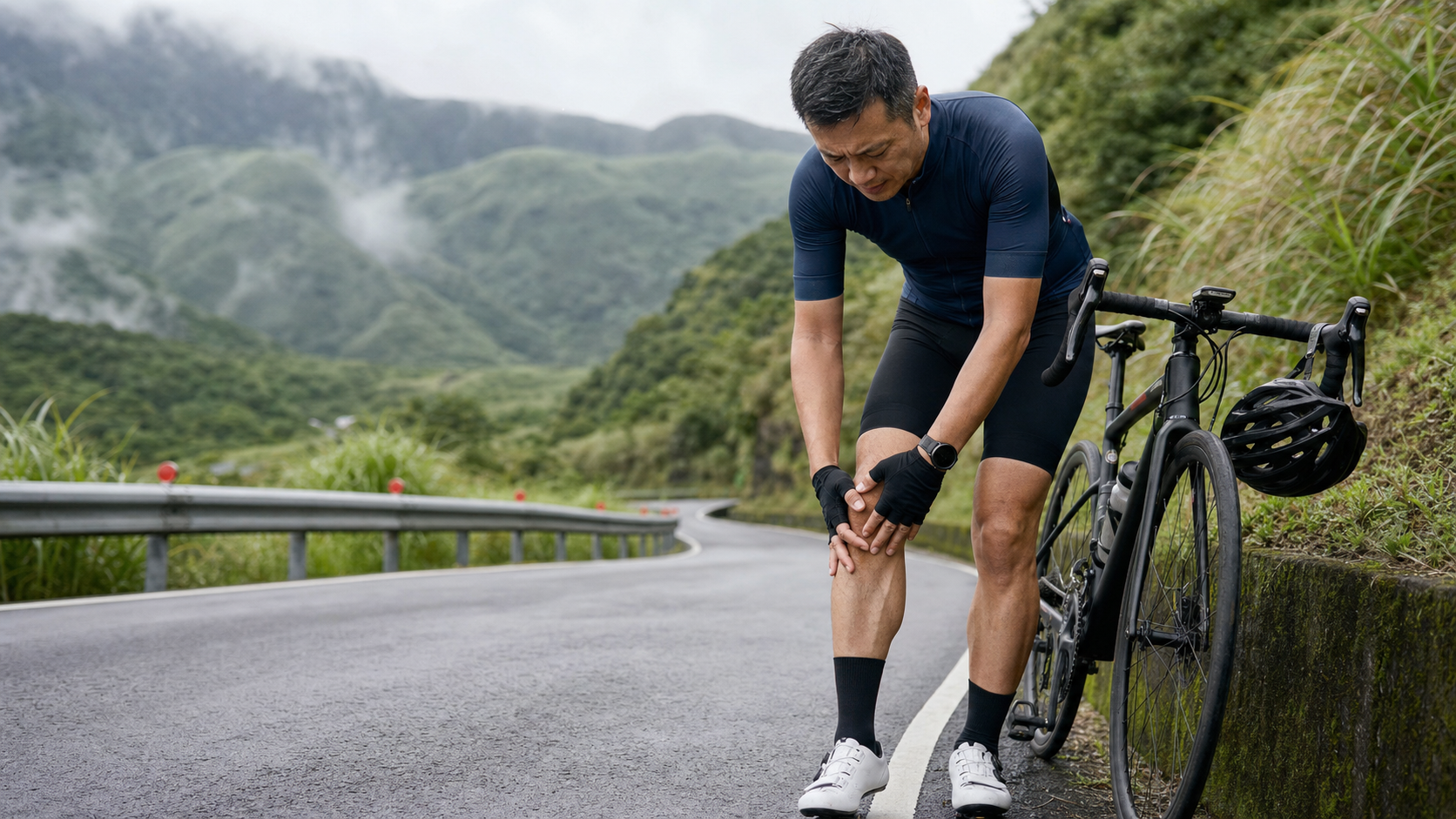
Opening: The Student Who Collapsed at Fengguizui
I’ve been coaching athletes and general fitness enthusiasts for fifteen years now. Over all these years, if you ask me, “Coach, how do sports injuries actually happen?”, my answer has barely changed: The vast majority of injuries aren’t bad luck—they’re the inevitable result of load spiraling out of control.
One student stands out in my memory—let’s call him A-Cheng. Forty-two years old, a tech-industry engineer, weighing 82 kilograms, who loved riding up Fengguizui and Yangmingshan on weekends. By the time he came to me, his right knee had been hurting for three months. Going down stairs hurt, and when riding, the outer side of his thigh would tighten up unbearably in the latter part of each pedal stroke. His first question to me was: “Is it my cleat position? Or should I change my saddle?”
I asked him to pull up his riding logs from the past three months. The picture was immediately clear: for the first eight weeks, he rode about 80 to 100 kilometers per week. Then, because he’d signed up for a 160-kilometer challenge event, he suddenly jumped to 240 kilometers in one week, followed by two consecutive weekends of long rides. The problem was never the saddle—it was that he nearly tripled his training volume within two weeks. His tendons, ligaments, and bones couldn’t adapt fast enough, so the tissues around his knee joint raised the white flag first.
In this article, I want to lay out, in full, what I’ve learned about the science of injury prevention over these fifteen years. This isn’t about telling you not to exercise—it’s about teaching you how to get stronger while keeping injuries at bay. I’ll explain the science behind it as clearly as I can, and I’ll give you tables and checklists you can use directly.
A note up front: This article is educational content and cannot replace individual diagnosis or treatment advice from a physician, physical therapist, or nutritionist. If you’re in pain right now—especially with redness, swelling, heat, pain, night pain that wakes you, or a joint that’s locked and can’t generate force—please see a doctor first. Don’t use this article as an excuse to push through.
1. Foundational Concepts: Injury Is Not an “Event,” It’s a “Process”
Tissue Adaptation Takes Time
Let’s establish a core concept first. When you exercise, your muscles, tendons, ligaments, and bones all experience stress, producing microscopic damage. This is a good thing—your body repairs these tissues during the recovery period, making them stronger than before. This “damage → recovery → get stronger” cycle is the source of all training effects.
But here’s the key: different tissues adapt at wildly different rates.
- The cardiorespiratory system adapts fastest—you can feel a difference within a few weeks.
- Muscles adapt at a moderate pace—weeks to months.
- Tendons, ligaments, and bones adapt very slowly—often taking months or even over a year.
This is why so many people find that “their cardio keeps up, but their joints don’t.” Your heart and lungs are ready for 200 kilometers a week, but your patellar tendon is still at the 100-kilometer adaptation level. When you decide whether to increase volume based only on “I can still ride,” you’re being fooled by the fastest-adapting system. Injury happens at the slowest link in the chain.
Injury Is a Continuous Spectrum
I often tell my students that injury isn’t an on-off event—like “fine today, suddenly torn tomorrow.” It’s a continuous spectrum:
- Accumulated micro-damage—tissues endure stress beyond their repair capacity, but you don’t feel it yet.
- Functional discomfort—tightness after exercise, mild soreness the next day, resolves with rest.
- Clear symptoms—specific movements consistently hurt, and the pain starts affecting training.
- Structural injury—tendinopathy, stress fractures, ligament tears, requiring long-term rehabilitation.
Most people only come to a coach or doctor at stages three or four, but the real intervention should happen at stages one and two. Learning to read the body’s early signals is the cheapest and most effective injury-prevention skill there is.
2. Risk Factors: Breaking Down Where Injuries Come From
Sports medicine generally divides injury risk factors into two broad categories: intrinsic factors (what you carry with you) and extrinsic factors (what training and the environment bring). Understanding this classification tells you which ones you can change and which ones you can only manage.
Intrinsic Risk Factors (Personal Conditions)
| Intrinsic Factor | Why It’s a Risk | Can It Be Changed? |
|---|---|---|
| History of prior injury | The single strongest predictor—tissue and neuromuscular control at old injury sites often haven’t fully recovered | Partially changeable (full rehabilitation) |
| Muscle weakness / left-right asymmetry | Poor force absorption and joint stability | Changeable (strength training) |
| Limited flexibility and mobility | Compensatory movement patterns, concentrated local loading | Changeable |
| Increasing age | Declining tissue elasticity and repair speed | Can only be managed |
| Excess body weight | Higher absolute load on joints and tendons | Partially changeable |
| Poor movement control / technique | Faulty force transmission pathways, local overload | Changeable (technique training) |
Here I want to draw a red line under “history of prior injury.” Research and clinical experience consistently show that previously injured sites have a significantly higher rate of re-injury. The reason is that many people assume “no pain means healed,” but in reality, their strength, neuromuscular control, and tissue integrity haven’t returned to pre-injury levels. As for A-Cheng’s knee—when I asked further, it turned out he’d sprained that same leg playing basketball in college. His foundation was already more fragile to begin with.
Extrinsic Risk Factors (Training and Environment)
| Extrinsic Factor | Why It’s a Risk | Local Context in Taiwan |
|---|---|---|
| Sudden increase in training volume | Tissues can’t adapt in time (the most common controllable factor) | Last-minute volume spikes after signing up for events |
| Insufficient recovery | Poor sleep, consecutive high-intensity sessions, no deload weeks | Overtime at work, cramming intensity on weekends |
| Improper equipment and fit | Cleats, saddle, frame size, shoes | Second-hand bikes without fitting, worn-out shoes |
| Environmental conditions | Heat, humidity, road surface, gradient | Taiwan’s hot humid summers, long mountain descents |
| Inadequate nutrition and hydration | Lack of repair materials, dehydration affecting tissues | Insufficient protein from eating out, not drinking enough water |
Notice something? Extrinsic factors are almost entirely controllable. That’s the good news: the highest-leverage points for injury prevention are mostly in your own hands.
The Most Common Overuse Injuries in Endurance Athletes
To give you a clearer picture, I’ve compiled the most common overuse injuries among cyclists and runners into the table below. Almost none of these are caused by “a single impact”—they’re accumulated over time when load chronically exceeds repair capacity. If you see yourself in any of these, that’s your body telling you it’s time to adjust.
| Common Injury | Most Affected Group | Typical Symptoms | Common Triggers |
|---|---|---|---|
| Patellofemoral pain syndrome (runner’s knee / cyclist’s knee) | Runners, cyclists | Dull pain around the front of the knee and patella, worse going downstairs or after prolonged sitting | Too-rapid volume increase, weak glutes and thighs, poor bike fit |
| Iliotibial band syndrome | Runners, cyclists | Sharp pain on the outside of the knee, consistently appearing after a certain distance | Sudden mileage spikes, excessive downhill, weak hip abductors |
| Achilles tendinopathy | Runners | Stiffness and pain in the tendon above the heel, most noticeable in the morning | Sudden increase in speed work, insufficient calf strength and flexibility |
| Shin splints (medial tibial stress syndrome) | Runners | A long strip of soreness along the inner shin | Mileage increasing too fast, overly hard surfaces, worn-out shoe cushioning |
| Lower back pain | Cyclists | Tightness and soreness in the lower back after long rides | Frame too long, weak core, limited flexibility |
| Ulnar nerve compression (cyclist’s numb hand) | Cyclists | Numbness in the pinky and ring fingers | Excessive handlebar pressure, fixed posture for too long, insufficient glove padding |
The purpose of this table isn’t to make you self-diagnose and scare yourself by finding a match. It’s to help you build the connection between “symptom → possible trigger.” When you can link your pain to a controllable training or setup factor, you shift from being a “victim” to being “someone who can take action to solve the problem.”
3. Load Management: The Core Engine of Injury Prevention
If you can only remember one section from this entire article, I hope it’s this one. Load management is the most evidence-supported method for injury prevention in modern sports science.
The “Acute Load vs. Chronic Load” Ratio
A concept that has become very popular in sports science in recent years is the “acute:chronic workload ratio” (ACWR). In plain language:
- Acute load: Your training volume over the most recent week.
- Chronic load: Your average training volume over the past roughly four weeks (representing the level your body is currently “accustomed” to).
- Ratio = This week ÷ Past four-week average.
Research has found that this ratio has a roughly U-shaped relationship with injury risk: when it falls within the approximate range of 0.8 to 1.3, injury risk is lowest; once it spikes to 1.5 or above, the risk of non-contact soft tissue injuries rises significantly; and at extremely high ratios (around 2.0 or above in studies), injury risk is highest. Interestingly, a ratio that is too low (below 0.8) also carries risk—meaning that training too little, or being inconsistent, actually makes the body more fragile (see references at the end of the article).
Applying this to A-Cheng’s example: his average over the past four weeks was about 90 km per week, and then he jumped to 240 km in one week, giving a ratio = 240 ÷ 90 ≈ 2.7. This is far beyond the red line. That his knee gave out is almost predictable from the numbers alone.
I’ve organized this concept into a practical traffic-light table:
| Acute/Chronic Workload Ratio | Risk Signal | Plain-Language Interpretation | Recommended Action |
|---|---|---|---|
| < 0.8 | Yellow Light | Training too little or inconsistently, losing adaptations | Gradually and consistently build volume back up |
| 0.8 – 1.3 | Green Light (Sweet Spot) | Steady load progression, adaptations keep up | Maintain, progress with confidence |
| 1.3 – 1.5 | Yellow Light | Starting to progress too quickly, watch body signals | Observe for a week, don’t add more |
| > 1.5 | Red Light | Excessive spike in load, injury risk clearly elevated | Pull back immediately, schedule a deload |
Reminder: ACWR is a risk management tool, not a precise prediction instrument. It helps you grasp the big picture and avoid absurd spikes, but it cannot guarantee that “as long as you’re in the green zone, you won’t get injured.” Treat it as a warning light on your dashboard, not a fortune teller.
Is the “10% Rule” Actually Reliable?
Many people have heard the old rule: “Don’t increase weekly volume by more than 10%.” I have to be honest with you: this rule doesn’t have very solid scientific backing. It’s more of a rule of thumb passed down through coaching circles decades ago. It sounds reasonable, but when actually put into controlled studies, it hasn’t been proven that those who follow the 10% rule have a lower injury rate (see references at the end). Some studies have even found that, under certain conditions, a 24% increase and a 10% increase showed no significant difference in injury rates.
So how should we use it? My suggestion is: treat 10% as a “conservative default,” not a “sacred, inviolable law.” For beginners, for those returning from an old injury, and for older populations, using 10% or even more conservative is reasonable; but for people with a solid training foundation, tolerating up to around 20% in the short term is usually still safe. The real red line you must hold is not exceeding a 30% increase in a single week—empirically, spikes beyond 30% are indeed associated with an increased risk of injury.
Don’t Forget: “Chronic Load” Itself Is a Protective Umbrella
This point is often overlooked: research shows that people with a higher chronic load (long-term accumulated training base) are actually more resistant to injury. In other words, someone who trains consistently, long enough, and steadily has a thicker “reserve” in their body, and can tolerate a higher-volume week occasionally. This is also why I oppose the “weekend warrior” pattern of not training all week and then doing one massive session—that’s precisely the combination most likely to cause problems.
4. Practical Methods: Turning Science into What You Can Do This Week
Enough theory—here’s what you can put into action directly. These are the methods and training frameworks I actually use with my athletes.
Method 1: Periodize Your Training (Including Deload Weeks)
The body needs a “stress → recovery” rhythm. If you continuously increase volume, recovery will never catch up. The simplest approach I use most often and recommend for the general population is a 3:1 periodization—accumulate for three weeks, deload for one week.
| Week | Training Volume (Relative to Baseline) | Purpose |
|---|---|---|
| Week 1 | 100% | Build the base |
| Week 2 | 108% (approx. +8%) | Gentle accumulation |
| Week 3 | 115% (approx. +7%) | Reach the peak of this cycle |
| Week 4 (Deload Week) | 60–70% | Allow tissue repair and adaptation absorption |
Many people resist that deload week the most, thinking “resting will make me lose fitness.” Quite the opposite—adaptation happens during recovery, and the deload week is exactly when you truly “bank” the efforts of the previous three weeks into your body. Skipping it is just digging a hole for yourself.
Method 2: Strength Training Is the Strongest Protective Charm
If I had to pick the single “highest return on investment” preventive measure, the answer without hesitation is strength training. Multiple systematic reviews and meta-analyses have shown that regular strength training can significantly reduce sports injuries—especially overuse injuries, cutting them by nearly half (see references at the end). The mechanism is intuitive: stronger muscles and tendons absorb more impact, share joint load, and improve neuromuscular control, reducing faulty movement patterns and localized overload.
For endurance athletes like cyclists and runners, I typically set up a basic strength framework like this:
| Movement Category | Example Exercises | Frequency | Sets × Reps |
|---|---|---|---|
| Lower Body Push | Squats, split squats, leg press | 2x per week | 3 × 6–10 |
| Posterior Chain | Deadlifts, hip bridges, leg curls | 2x per week | 3 × 8–12 |
| Core / Anti-rotation | Planks, side planks, bird dogs | 2–3x per week | 3 × 30–45 sec |
| Single-leg Stability | Single-leg squats, single-leg deadlifts | 1–2x per week | 2–3 × 8/side |
Key reminder: strength training itself must also follow load management principles—weights and sets should progress gradually. I’ve seen too many people who, in their first week of “getting serious about lifting,” train until walking hurts. That’s not effort; that’s creating a new injury for yourself.
Method 3: Warm-up Isn’t Stretching—It’s “Waking Up the Neuromuscular System”
Many people’s warm-up is just casually doing a few static stretches. But evidence shows that what you should do before exercise is dynamic warm-up and neuromuscular activation: raising muscle temperature, activating the movement patterns you’re about to use, and waking up balance and coordination. Structured neuromuscular warm-up programs designed for sports like soccer and basketball (e.g., combinations including running, jumping, balance, and strength elements) have been proven to effectively reduce lower-limb injuries.
The simple warm-up framework I give endurance athletes is: 5 minutes of progressive aerobic work (easy spin / brisk walk) + dynamic mobility (leg swings, hip circles, jumping jacks) + a few sets of low-intensity, sport-specific activation. Save static stretching for after exercise or for a separate flexibility session.
Method 4: Learn to Read Your Body’s Dashboard
Load management can’t rely only on objective mileage; it also needs to incorporate subjective feelings. I ask my athletes to spend thirty seconds each day doing a simple self-check:
- Sleep quality: Did you sleep well last night? (1–5 scale)
- Muscle soreness: How sore are you right now? (1–5 scale)
- Energy/Mood: Do you feel like moving? (1–5 scale)
- Resting heart rate: Is your morning heart rate noticeably higher than usual? (A rise of 5–10 bpm is often a sign of inadequate recovery or something being off)
If scores are poor for two or three consecutive days, or resting heart rate stays elevated, that day’s session should be scaled down rather than forcing the plan. The plan serves you; you don’t serve the plan.
5. Common Mistakes and Fixes: The Pitfalls I’ve Seen Over the Years
Mistake 1: Treating Pain as a Badge of Effort
“Coach, it only counts if it hurts!”
This mindset has ruined far too many people. We need to distinguish between two types of sensations:
- Acceptable: Muscle “soreness” and “tightness,” general fatigue during exertion, and delayed-onset muscle soreness (DOMS) 24–48 hours after exercise.
- Dangerous: Joint “stinging/sharp pain,” pain at a fixed single point, pain severe enough to alter movement patterns, pain that worsens rather than improves with rest, or nighttime pain.
The latter category is your body sounding an alarm, not handing you a medal. Pushing through will only escalate stage-two discomfort into stage-four structural damage.
Mistake 2: Only Training What You Enjoy, Ignoring Weaknesses
Many people who cycle only cycle, and runners only run, never touching strength training or mobility work. The result is repeatedly overloading the same tissues while weaknesses remain weaknesses forever. A master of a single sport is often also a candidate for injury in a single area. Cross-training and strength work are how you reinforce the areas you don’t normally use but that protect you in critical moments.
Mistake 3: Ignoring the Three Pillars of Recovery
Recovery isn’t just “not exercising.” It rests on three pillars, and all are essential:
- Sleep: 7–9 hours is generally recommended for adults. This is the most critical window for tissue repair and hormonal regulation. Many people in Taiwan work overtime, stay up late, and still want to train hard—it’s like rebuilding a house while simultaneously demolishing it.
- Nutrition: Repair requires raw materials. Eating out in Taiwan commonly means insufficient protein and excess refined carbohydrates. For the general athletic population, roughly 1.2–2.0 grams of protein per kilogram of body weight per day is a common reference range, ideally distributed evenly across three meals.
- Hydration: Dehydration affects tissue elasticity and metabolism. Taiwan’s summers are hot and humid, and prolonged outdoor exercise leads to staggering sweat loss. Don’t wait until you’re thirsty to drink. For exercise lasting over an hour, or with heavy sweating, remember to replenish electrolytes—plain water alone can actually dilute blood sodium.
I often use an analogy with my athletes: Training is “withdrawal,” recovery is “deposit.” Every high-intensity session is a withdrawal from your body’s account. If you only withdraw and never deposit, the account will eventually be overdrawn—and the overdraft comes in the form of injury and overtraining. Sleep, nutrition, and hydration are your three daily deposit channels. Many people plan beautiful training schedules but go completely bankrupt on the deposit side, then blame their “poor constitution” or being “injury-prone.” Constitution was never the main cause; the imbalance between deposits and withdrawals is.
Let me also re-emphasize the often-overlooked “total stress load.” Your recovery capacity is finite, and training stress and life stress share the same account. During weeks when work deadlines pile up, family issues arise, or you’re chronically sleep-deprived, even if your training volume hasn’t changed, your actual available recovery has decreased. The smart approach: during high-life-stress periods, proactively dial training load down a notch, then bring it back up once life stabilizes. That’s not laziness; it’s precision management.
Mistake 4: Making Do with Gear and Setup
For cyclists, a good fitting (bike fit) can often resolve years of knee pain, lower back pain, or hand numbness. Saddle height, fore-aft position, cleat angle—if any one of these is off, a joint may absorb improper loading with every single pedal stroke. Runners should pay attention to the mileage lifespan of their shoes—once midsole cushioning degrades, all the impact returns straight to your legs. Compared to rehab costs and lost training time, this money is actually very cheap.
Mistake 5: Returning Too Quickly
The most dangerous moment after an injury is often the moment you “feel fine.” I’ve seen too many people jump straight back to their previous training volume the moment the pain stops, only to be re-injured within two weeks—and often more severely. Returning should be planned as a brand-new progressive overload, starting from low volume to rebuild chronic load, while paying extra attention to signals from the previously injured area.
Part 5-2: The Second Case Study: Runner Xiao-Ting and “Invisible Load”
Let me share another case, quite different from A-Cheng’s, because it highlights an easily overlooked point.
Xiao-Ting, 35, works an administrative job and runs regularly, maintaining a steady weekly volume of about 30 kilometers for over half a year with no issues. She came to see me not because of an injury, but because her left Achilles tendon had started feeling stiff in the morning. The strange part: her running volume hadn’t increased at all in recent weeks. Why would a problem suddenly appear?
I asked her to lay out her life circumstances as well, and the answer emerged. Her company was in a project crunch, and she’d been working late nearly every day for three straight weeks. Her sleep had dropped from around seven hours to about five, and many meals were just a single bread roll. Her running volume hadn’t changed, but her “recovery capacity” had been heavily consumed by life stress and sleep deprivation. The same training load, placed on a body with diminished recovery ability, becomes a relatively heavier load.
This is what I call “invisible load”: work stress, insufficient sleep, poor nutrition, even emotional lows—all of these consume the resources your body uses for repair. The mileage in your training log hasn’t changed, but that doesn’t mean the relative stress on your body hasn’t.
Our approach wasn’t to pile on rehab exercises. Instead, we focused on restoring recovery first—finding ways to get sleep back to six to seven hours, ensuring protein at each meal, and proactively cutting her running volume by 20% for those three weeks. Within two weeks, the morning stiffness had noticeably improved. Xiao-Ting’s case shows us: load management can’t just count the training side of the ledger. You have to balance the bigger account of “total stress vs. total recovery.”
6. Actionable Advice for Readers at Different Levels
Everyone starts from a different point, so I’ve split the advice into three tiers. Find the tier that fits you and follow it directly.
If You’re a Beginner / Just Starting Regular Exercise
- Know your limits; better to go slow: Your goal for the first few months is “building the habit and establishing a chronic load base,” not chasing mileage.
- Be conservative with weekly increases: Use roughly 10% as your default; if it feels hard, don’t add more.
- Incorporate strength training from day one: Two basic strength sessions per week are the best injury insurance you’ll ever buy.
- Learn the early warning signs: Any pain that recurs at a fixed location—reduce volume immediately. Don’t wait for it to get worse.
- Sleep well and eat enough protein: These two things deliver more real results than any supplement.
If You’re an Intermediate Enthusiast / Training Consistently for Over Six Months
- Introduce periodization: Use a 3:1 build-to-deload rhythm. Don’t let yourself be in a perpetual state of increasing volume.
- Monitor your load ratio: Roughly calculate your acute-to-chronic workload ratio each week. Stay in the 0.8–1.3 sweet spot and avoid spiking past 1.5.
- Taper before races: In the 1–2 weeks before a goal event, be sure to reduce volume so your body is fully recovered before race day.
- Proactively address weaknesses: Identify the areas that repeatedly feel tight or sore, and target them with strength and mobility work.
- Check your gear regularly: Get a fitting or shoe assessment at least once a year.
If You’re an Advanced Athlete / Have Specific Race Goals
- Quantify your load management: Use tools like power meters, heart rate, and Training Stress Score (TSS) to make load management more precise.
- Respect non-training stress: Work, life, sleep, and psychological stress all consume your recovery capacity. Don’t only count the training side of the equation.
- Establish your personal baselines: Resting heart rate, heart rate variability (HRV), and long-term trends in how you feel will understand you better than any generic advice.
- Be more conservative if you have an injury history: Treat your past injury record as the number-one risk factor, and always leave an extra margin of load for those areas.
- Seek professional help when needed: Physical therapists, sports medicine physicians, and certified coaches can help you see blind spots you can’t see yourself.
7. Special Notes for the Taiwan Context
Let me close with some practical reminders specific to Taiwan, because prevention science only works when it’s applied on the ground.
- Heat and humidity: Taiwan’s summer outdoor exercise carries significant heat stress. Dehydration and heat exhaustion themselves raise the risk of other injuries. Avoid midday hours as much as possible, stay on top of hydration and electrolyte intake, and gradually acclimate your body to the heat.
- Long mountain descents: Routes like Wuling, Beiyi, and various climbing roads—long descents place heavy eccentric loads on brake-arm muscles for cyclists and on knees for runners. Don’t forget that descending is also a form of training load.
- Eating out: Eating out in Taiwan is convenient but often leads to insufficient protein. Be intentional about adding an extra egg, soy product, or meat to your bento or noodle meal so your body has enough raw materials for repair.
- Healthcare access: Taiwan’s National Health Insurance and rehab resources are relatively accessible. Don’t let “waiting for it to heal on its own” be your only strategy. For pain that doesn’t improve after two weeks, or any injury affecting daily life, seek early evaluation from a rehab, orthopedic, or sports medicine specialist—it can often save months of recovery time.
Conclusion: Treat Your Body as a Long-Term Investment
Back to A-Cheng. What we did afterward was actually quite straightforward: first, we had him rest and seek medical treatment for the acute inflammation. Then, we rebuilt his chronic load from a very low starting point, introduced lower-limb and core strength training twice a week, did a proper bike fitting, and taught him to spend thirty seconds each day on self-checks. Six months later, not only was his knee pain gone, but he also completed that 160-kilometer challenge race—this time, built up to it progressively.
Injury prevention has never been some mysterious high-tech secret. Its core can be summed up in three sentences:
- Respect the time tissues need to adapt—don’t be fooled by a cardiovascular system that gets fit faster than your body can handle.
- Manage your load—hold the sweet spot and stay clear of the red line of sudden spikes.
- Treat recovery, strength, and equipment as part of your training, not as optional extras.
Treat your body as a long-term investment, not a machine you can push to its limits whenever you want. You’ll find that when you stop getting injured and can accumulate training steadily year after year, your progress will far outpace those who train sporadically and spend the rest of the time nursing injuries. Training healthily for the long haul is, in itself, the strongest competitive edge.
Wishing you happy and sustainable training. See you on the road.
Frequently Asked Questions
Q1: I’m sore all over the day after exercise—am I injured?
Most likely not. Generalized, symmetrical muscle soreness appearing 24–48 hours after exercise is usually delayed onset muscle soreness (DOMS), a normal training response that resolves on its own within a few days. What warrants caution is pain that is localized to a single point, fixed in position, joint-related, and that worsens rather than improves with rest—that’s more likely a sign of injury. A simple rule of thumb: soreness is “muscular,” diffuse, and will pass; pain is “joint or specific point,” sharp, and stuck.
Q2: Should I ice or heat an injury?
There’s no one-size-fits-all answer to this, and it’s not something an article should decide for you. The principles for the acute phase (just sprained, swollen and warm) differ from those for the chronic phase, and sports medicine’s view on “always ice” has been evolving in recent years. Rather than agonizing over ice versus heat, the more important step is to assess severity first—if there’s obvious swelling, inability to bear weight, joint deformity, or severe pain, seek medical attention immediately; don’t guess on your own. For minor discomfort, focus on relative rest and avoiding activities that aggravate it.
Q3: Can stretching prevent injuries?
Static stretching alone doesn’t have as strong an effect on “preventing sports injuries” as many people think. It helps improve flexibility and range of motion, but if your goal is to reduce injury risk, strength training and progressive load management are far more effective than stretching. Rather than spending large amounts of time stretching, invest that time in regular strength training.
Q4: Will wearing knee braces or protective gear prevent injuries?
Braces and supports have value in specific situations (such as protecting old injuries or providing proprioceptive feedback), but they cannot replace strength and load management. Over-relying on them may actually cause you to overlook the real root issues that need addressing—insufficient strength and uncontrolled training volume. Treat protective gear as an aid, not a get-out-of-jail-free card.
Q5: I’m older (over 50)—can I still start exercising? Am I more prone to injury?
Absolutely, and it’s highly encouraged. Age does slow tissue repair and reduce elasticity, so the strategy should be more conservative progression, with greater emphasis on strength training and recovery. The principles don’t change; you just leave a little more margin in every step. If you have chronic conditions (such as hypertension, diabetes, or heart disease), be sure to discuss with your primary care physician before starting a new exercise program and undergo individualized assessment—this step cannot be skipped.
Disclaimer: This article is educational content and cannot replace individual diagnosis and treatment advice from physicians, physical therapists, or dietitians. If the content involves exercise planning for those with existing conditions (such as diabetes, hypertension, or heart disease), be sure to discuss with your primary care physician and adjust individually—do not increase or decrease medication or training on your own based on this article. If you experience chest pain, severe shortness of breath, dizziness, or continuously worsening pain during exercise, stop immediately and seek medical attention promptly.
References
- Acute:Chronic Workload Ratio — Science for Sport: https://www.scienceforsport.com/acutechronic-workload-ratio/
- The acute:chronic workload ratio predicts injury (PubMed): https://pubmed.ncbi.nlm.nih.gov/26511006/
- Is there evidence for an association between changes in training load and running-related injuries? A systematic review (PMC): https://pmc.ncbi.nlm.nih.gov/articles/PMC6253751/
- The effectiveness of exercise interventions to prevent sports injuries: a systematic review and meta-analysis of randomised controlled trials (PubMed): https://pubmed.ncbi.nlm.nih.gov/24100287/
Related Reading
- Understanding and Preventing Sudden Cardiac Death in Sports: Causes, Screening, and the Warning Signs That Shouldn’t Be Ignored
- Sports Insurance and Safety: Coaches Help You Turn “What Ifs” into Manageable Risk
- Sudden Cardiac Death in Sports: How Real Is the Risk, What the Screening Debate Is About, and How to Read Your Body’s Warning Signs
- Exercise and Rehabilitation: A Complete Map from Injury to Returning to the Race
風櫃嘴時間 預測西進武嶺時間?13000名車友統計數據分析告訴你 !
5 年前
風櫃嘴 | 全台最多大砲的單車路線 | 尋寶網攝影師告訴你怎麼擺拍起來才好看 | 熱門攝影地點巡禮
6 年前
一日北高/長距離團騎 常見問題補充篇 / 組團或跟團的眉角 / 壯車友容易被瘦車友慢性拉爆 / 原來屁股痛可能是這個原因...? / 風場配速法 / 公路車 / CT Yeh
2 年前
摔車後補裝備: 好市多新款單車安全帽& Specialized Romin 北高整路屁股都不痛的坐墊 | 一千元居然有MIPS | CT Yeh | 公路車
4 年前
風櫃嘴! 現實與虛擬騎乘 會有誤差嗎? 背著iPad邊騎一趟風櫃嘴實際測試一次 | 公路車 | CT Yeh
3 年前
約騎爆笑地獄梗 大腸怎麼了🤣 #公路車 #cycling
3 年前
西進武嶺 自製新版AI配速表產生器 x 賽前攻略 抱佛腳! 沒有功率計也可以產生配速表嗎?有什麼其他眉角賽前要注意的呢? | 西進武嶺 / 東進武嶺 KOM 攻略 | 公路車 | CT Yeh
4 年前
風櫃嘴 衝刺慢動作回放!
8 年前