The Achilles Tendon Doesn't Just Break Overnight: A Complete Guide to the Mechanisms of Achilles Tendon and Calf Pain, Eccentric Training, and Load Management
First, a Scenario Many of You Have Experienced
I once coached a long-distance cyclist in his early fifties, let’s call him A-Hong. He typically rode three to four times a week, covering fifty to sixty kilometers per ride, and occasionally joined group climbs on weekends. The first thing he said when he came to see me, I still remember to this day: “Coach, that first step when I get out of bed in the morning, that tendon behind my heel is so tight I don’t dare put weight on it. It takes a dozen or so steps before it slowly loosens up, but when I’m riding, it’s actually fine. What’s going on?”
He thought it was a strain, a “stuck tendon,” or even suspected a calcium deficiency. But when I asked him to run two fingers up from his heel, when he reached the spot about three to six centimeters above the heel bone, he pressed down and winced—right there, it felt a bit swollen, a bit thick, and tender to the touch. This is almost the textbook presentation of a classic midportion Achilles tendinopathy: morning stiffness, loosening up with movement, localized tenderness, and the affected area feeling thicker than the other leg.
In this article, I want to lay out in one go the concepts about “Achilles tendon and calf problems” that I’ve accumulated over more than a decade of coaching athletes and reading the literature. I’m not going to scare you into complete rest, and I’m not going to give you some “just stretch it and it’ll heal” folk remedy. I want to talk about three things: how the tendon actually breaks down (the mechanism), why eccentric training is currently the first-line approach, and how to use load management to gradually turn it back into a strong tendon.
Let me give you the conclusion first: the Achilles tendon almost never “breaks overnight.” It’s built up slowly, bit by bit, because you’ve been giving it loads that exceed its ability to repair. Once you understand this, you’ll know why “complete rest” often doesn’t work, and why “intelligently continuing to apply load” is the real solution.
Concepts and Scientific Basis: How the Achilles Tendon Breaks Down
It’s Not Simply “Inflammation”
When many people hear “tendon pain,” they think “tendonitis,” and their gut reaction is to take anti-inflammatories, ice it, and rest. That instinct is half right and half wrong.
In the past, we used the term “Achilles tendinitis,” where the suffix -itis means inflammation. But over the past two decades, sports medicine thinking has shifted: in chronic Achilles problems, the main culprit is often not the classic inflammatory response of redness, swelling, heat, and pain, but rather the tendon’s own “degeneration and failure to remodel.” That’s why the term “tendinopathy” is now more commonly used.
The Achilles tendon is primarily made of collagen arranged into neat, cable-like bundles. In a healthy tendon, the fibers are parallel, dense, and efficiently transmit the force generated by the calf muscles. When this tendon is subjected to loads that exceed its repair capacity over a long period, several things happen:
- Collagen fiber arrangement becomes disorganized: The neat cable starts to loosen and the fibers become misaligned.
- Increased matrix water content and local swelling: This is why it feels “thick and swollen” to the touch.
- New blood vessels and nerves grow in: This is thought to be related to “why it hurts.”
- Repair signals are activated but can’t keep up with the rate of damage: So the tendon ends up in a stalemate of “always trying to repair but never quite succeeding.”
This is why “pure rest” is often not as effective as you’d think—when you remove the load, the damage stops, but the signal that stimulates the tendon to realign and strengthen is also removed. Without the “appropriate stress,” collagen remodeling stalls. You rest for three months, come back, and that first step still feels tight and still hurts.
Midportion vs. Insertional Tendinopathy: Location Determines Strategy
This is a key point that many people (including plenty of newer coaches) overlook: where the Achilles pain is located changes how you should treat it. Clinically, it’s roughly divided into two categories:
| Type | Pain Location | Characteristics | Tolerance for “Heel Dropping Past Midline” |
|---|---|---|---|
| Midportion | About 3–6 cm above the heel bone | Most common; morning stiffness, localized tenderness, thickened tendon | Usually can do full-range eccentric (heel lowering below the step) |
| Insertional | At the junction behind the heel bone | Near the bony attachment; may involve bone spurs or retrocalcaneal bursa issues | Excessive heel lowering often worsens pain; usually only go to floor level, avoiding deep compression |
A-Hong’s pain was in the section above the heel bone, which is midportion tendinopathy—this is also the group with the most research support and the clearest evidence for eccentric training. If your pain is right at the back of the heel bone, and “lowering the heel past the step” makes it worse, you’re likely the insertional type, and you’ll need to limit the range of the eccentric movement and not force the heel down. I’ll remind you about this again in the training plan later.
The Calf: The Upstream of the Achilles Tendon
The Achilles tendon isn’t isolated. It connects upward to two main calf muscles:
- Gastrocnemius: Crosses both the knee and ankle joints; it works hardest when the knee is straight.
- Soleus: Crosses only the ankle joint; it’s the primary player when the knee is bent.
This is why a complete Achilles training program includes both “straight-knee” and “bent-knee” calf raises—straight-knee targets the gastrocnemius, bent-knee targets the soleus, and tension from both muscles transmits to the same Achilles tendon. Many people only train the straight-knee version, leaving the soleus chronically weak, which means the Achilles has relatively less protection in positions like bent knees, squats, or climbing pedal strokes.
For cyclists, there’s another practical reality: pedaling actually places relatively low eccentric and impact loads on the Achilles (unlike the repetitive impact of foot strikes when running), which is why many cyclists find that “riding doesn’t hurt much, but walking and going downstairs do.” This is both good news and a trap—the good news is you can usually maintain a certain level of activity; the trap is that you might assume “no pain means it’s healed,” ignoring the fact that it’s still degenerating.
One more often-overlooked detail worth mentioning: cleat position, saddle height, and ankle movement patterns during pedaling all change the load on the Achilles. Some people habitually “point the toe and press” (commonly called ankling), which involves a large range of ankle motion and repeated Achilles activation; a saddle set too high can cause excessive ankle extension at the bottom of each pedal stroke. This isn’t to say you should immediately overhaul your bike fit—changing your fit is itself a new load and should be done gradually—but rather to remind you: when the Achilles won’t heal no matter what, besides training, also look back at whether your pedaling habits and bike setup have been quietly adding extra load.
Practical Methods: Eccentric Training and Load Management
Why Eccentric Training
“Eccentric” refers to the muscle producing force while being lengthened—in the case of heel raises, it’s the phase where “the heel slowly lowers.” For mid-portion Achilles tendinopathy, the most classic and most researched protocol is the so-called Alfredson eccentric heel-drop protocol.
The core of this protocol is high-volume eccentric heel drops: performed with both a straight knee and a bent knee, accumulating a considerable number of repetitions daily for about 12 weeks. A common version compiled from multiple sources is: 3 sets of 15 straight-knee heel drops, and 3 sets of 15 bent-knee heel drops, performed twice a day (morning and evening), totaling roughly 180 reps per day (JOSPT-related RCT, sports coaching summary). Clinically, many people begin to notice a clear reduction in pain around weeks 6 to 8, after which they gradually return to sport via a “walk-run” or progressive reconditioning approach.
Its mechanism, simply put, is: using controlled, regular, and sufficient tension to stimulate disorganized collagen fibers to realign into a more orderly and stronger structure (collagen remodelling). You’re not “resting and waiting for it to heal”; you’re “giving it a clear, tolerable reason to get stronger.”
However, I have to honestly add: eccentric training is not the only solution. In recent years, more and more studies have compared “Heavy Slow Resistance (HSR)” training with eccentric training, and the results show that both are effective, with similar long-term outcomes; one randomized controlled trial with a 12-week intervention and 52-week follow-up found that both groups significantly improved in function and pain and maintained it for a year, with HSR showing slightly higher patient satisfaction at 12 weeks, but no difference between the two at one year (HSR vs eccentric RCT, PubMed). Systematic reviews also indicate: whether eccentric, heavy slow resistance, concentric, or isometric, any training that “loads the tendon” is an effective and recommended intervention (systematic review and meta-analysis).
So what I always tell my athletes is: Exercise details can be flexible, but “consistently applying progressive load to the tendon” is non-negotiable. You can choose eccentric heel drops as the main course (most researched, doable at home), or combine them with heavy slow heel raises in the gym.
How to Perform the Core Eccentric Heel Drop
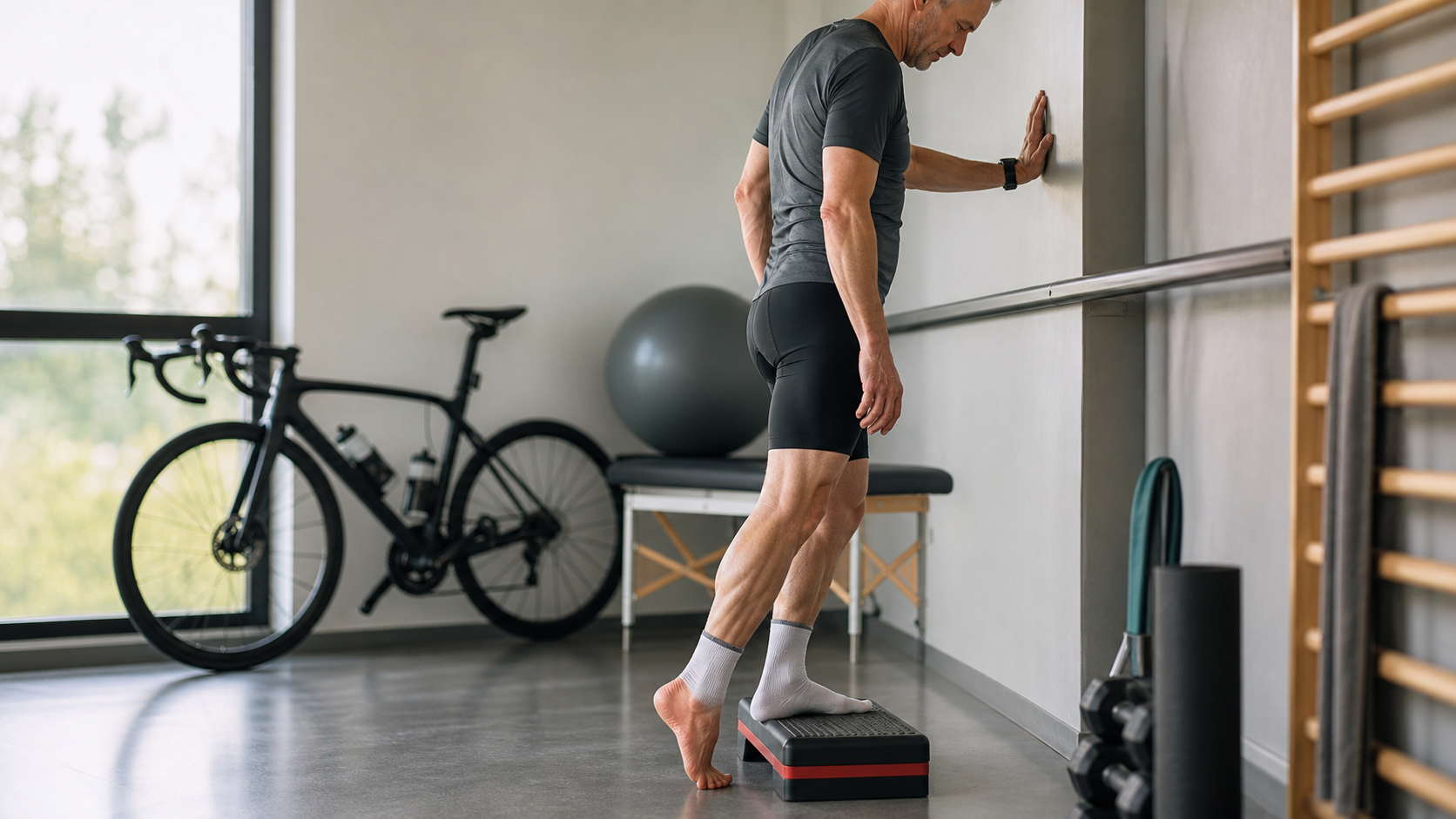
Starting position: standing on the edge of a step, forefoot firmly planted, heels hanging off the edge.
- Use the “good leg” or both legs to push your body up to the top (rise up onto your toes). This phase is concentric; we don’t want to put excessive load on the affected tendon here.
- Shift your weight onto the affected single leg.
- Slowly (about 3 seconds) lower the heel on the affected leg, dropping below the level of the step, feeling a stretch in the back of the calf. This slow lowering is the eccentric phase and the focus of the entire exercise.
- Return to the top using the good leg to help push up, then repeat.
The straight-knee version targets the gastrocnemius, and the bent-knee version (knee slightly flexed) targets the soleus. Both versions should be performed.
Note for insertional-type pain: If your pain is at the junction at the back of the heel bone, do not lower the heel below the level of the step—only lower it to level with the ground. This avoids excessive stretching and compression at the tendon’s insertion point, which could worsen the pain.
Reference 12-Week Progression Table
Below is the progressive framework I practically use with my mid-portion tendinopathy athletes. This is a reference range, not a rigid rule; the actual pace depends on your pain response (see the traffic light system in the next section).
| Week | Training Focus | Approximate Volume & Intensity | Goal for This Phase |
|---|---|---|---|
| Weeks 1–2 | Establish the eccentric movement, learn to control the lowering speed | Assisted up with both legs, eccentric with affected leg; prioritize quality over hitting rep counts | Get the tendon used to regular stretching; don’t chase high volume yet |
| Weeks 3–6 | Progressively approach the classic high volume | Straight-knee + bent-knee, 3×15 each, twice daily | Accumulate stimulus; pain is usually still present but manageable |
| Weeks 6–8 | Begin to feel noticeable improvement | Maintain high volume; can progressively add load (backpack/dumbbells) | Pain and morning stiffness decrease; tendon tolerance increases |
| Weeks 8–12 | Add load + transition back to training | Increase load; introduce walk-run or progressive pedaling intensity | Transition from “rehab” to “performance” |
| After week 12 | Maintenance and prevention | 2–3 sessions per week of loaded heel raises as maintenance | Keep the tendon strong and prevent recurrence |
Load Management: The Real Deciding Factor
The eccentric exercise is just a “tool”; load management is the real strategy. In plain terms, load management means: keeping the total stress you put on the tendon always slightly ahead of its capacity, but never too far ahead at once.
I often use a simple but effective analogy with my athletes: the tendon is like a bank account. Training is a withdrawal; recovery is a deposit. You can swipe the card (apply load), but you can’t max out the card (load far exceeding recovery). People with Achilles tendinopathy have usually “swiped too hard without letting the account recover” at some point—whether from a sudden spike in volume, switching to stiff-soled shoes,密集 climbing, or poor sleep and high stress leading to impaired recovery.
Practical principles of load management:
- Progress gradually, don’t jump levels: Keep the increase in weekly training volume within a conservative range (e.g., roughly a 10% increase per week as a concept, not an exact magic number), and only add more once the body has adapted.
- Monitor the “next day” and “next morning” response: Not feeling pain at the moment doesn’t mean everything is fine; tendon reactions often show up delayed, appearing the next day or upon waking.
- Sleep and nutrition are invisible deposits: Without enough sleep and protein, recovery speed can’t keep up. In Taiwan, eating out is common, and meals often have excessive carbs and insufficient protein—this is detrimental to recovery, which we’ll discuss later.
- Don’t push through training volume with painkillers: Suppressing the pain and then training hard is like covering up the dashboard and driving fast.
Pain Traffic Light: How Much Pain Is Okay to Continue With
This is something I believe everyone with an Achilles tendon issue should memorize. Having “a little pain” during and after training is usually acceptable; the key is whether it subsides quickly and whether it gets progressively worse with training.
| Light | Situation | What to Do |
|---|---|---|
| Green | Mild discomfort during/after training; next-morning stiffness is the same as usual or better | Proceed with the plan; consider a small progression |
| Yellow | Noticeable soreness after training, but returns to baseline within 24 hours | Maintain current volume; don’t increase; observe for 1–2 sessions |
| Red | Next-morning stiffness is significantly worse, pain increases and lasts beyond 24 hours, or limping while walking | Drop back to the last tolerable volume, extend recovery, and seek medical attention if necessary |
This “next morning” observation window is especially important for the Achilles tendon, because morning stiffness is almost a real-time dashboard of its condition. Ahong later relied on the feeling of that first step out of bed each morning to decide whether to increase volume that day—this was more accurate than any app.
Isometric Contractions: A Fallback When Pain Is Too High
Some people find even eccentric heel drops too painful at the start, or they’re just extra sensitive on a given day. In that case, “isometric contractions” are a gentle transitional tool—isometric simply means the muscle works but the joint doesn’t move, for example, rising onto your toes and holding the position mid-air for a period of time before lowering. It delivers steady, non-repetitive tension to the tendon, which for some people provides temporary pain relief and helps maintain strength.
I typically use it this way: on days when pain is too high and full-range eccentric work isn’t appropriate, use isometric heel holds to maintain stimulus, then return to the eccentric protocol once pain subsides. You can think of it as isometrics being “keeping the tendon from regressing,” while eccentric and heavy slow training are the main drivers of “making the tendon progress.” Research also supports a broad direction—whether isometric, eccentric, concentric, or heavy slow, as long as you load the tendon regularly, all are effective paths (systematic review and meta-analysis), so you don’t need to be stuck on “it has to be this one.” Instead, pick a version you can do right now without triggering a red flag, and keep doing it consistently.
The Four Pillars of Recovery: Invisible Deposits Outside Training
I always emphasize to my athletes that Achilles tendon recovery doesn’t only happen during the ten minutes you spend doing heel drops—it happens mostly in the other 23 hours when you’re not training. Here’s a table summarizing the key recovery points. These numbers are ranges, not precise prescriptions:
| Recovery Pillar | Why It Matters | Practical Direction (Range, Not Prescription) |
|---|---|---|
| Sleep | The main stage for tissue repair and hormonal environment | Aim for regular, sufficient sleep; chronic sleep deprivation slows recovery |
| Protein | The raw material for collagen and muscle repair | Have a clear protein source at every meal; spreading intake throughout the day beats one big bolus |
| Progressive Loading | Gives the tendon “a reason to get stronger” | Increase weekly volume in small increments, add more only after the body adapts—don’t jump levels |
| Stress and Overall Fatigue | Overtraining drains the repair account | Heavy work, poor sleep, and forced volume increases are the easiest way to crash |
Many people only fixate on “how many sets I did today” while ignoring the other three pillars. The same eccentric program can yield vastly different results between someone who sleeps well and eats enough versus someone who chronically sleeps five hours and eats very little protein. This isn’t mysticism—it’s simple math of whether repair speed can keep up with breakdown speed.
Ahong’s Full Journey: What a Realistic Timeline Looks Like
Let me walk you through Ahong’s entire process so you have a concrete reference for “reasonable progress” (the numbers are from his specific case, not a guarantee you’ll follow the same path).
First two weeks, he was actually somewhat resistant—“Can such a simple movement really work?” I asked him not to rush into high volume, focusing instead on “the lowering phase should be slow and controlled.” At that point, his morning first-step stiffness and pain self-rated around 6 out of 10.
Weeks three to six, he progressed to straight-knee plus bent-knee, 3×15 each, twice daily. Midway through, he pushed too hard on a weekend climb, and the next morning his morning stiffness jumped to 7–8—a classic red flag. I had him step back a level, extend recovery, and only return to the original volume after two or three days. That minor setback actually taught him the real lesson: “the next morning is your dashboard.”
Weeks six to eight, the turning point came. One morning he told me, “That first step out of bed today didn’t feel as stuck.” His self-rating dropped to 3–4. This aligns well with the literature’s observation that “most people begin to see clear improvement around weeks 6 to 8” (coach’s summary).
Weeks eight to twelve, we started adding load (first a backpack with water bottles, then dumbbells), and gradually reintroduced climbing volume step by step. By week twelve, he barely noticed anything getting out of bed in the morning, and stair descent was pain-free.
After week twelve, I didn’t let him stop there. I asked him to keep weighted heel drops as a maintenance habit 2–3 times per week—because the Achilles tendon’s biggest fear is “stop once healed, detrain once stopped, then re-injure once detrained.” Building it strong and maintaining it is the real finish line.
Common Mistakes and Corrections
After years of coaching, I’ve found that people tend to fall into highly repetitive traps. Here are the most common ones:
Mistake One: Complete Immobilization at the First Sign of Pain
This is the most common and the most regrettable. As mentioned earlier, pure rest stalls collagen remodeling. The tendon needs “adjusted load,” not “zero load.” The right approach is stepping down, not zeroing out: reduce volume, intensity, and range to a level that doesn’t trigger a red flag, then keep providing stimulus within that safe zone.
Mistake Two: Obsessing Over Stretching and Aggressively Stretching the Calf
“Tight means stretch” is an intuitive idea that often backfires. Excessive, forceful static stretching can be a source of compression and irritation for a sensitized Achilles tendon (especially insertional types). Gentle mobility is fine, but don’t make stretching your primary treatment—what actually changes tendon structure is “load,” not “lengthening.”
Mistake Three: Chasing “Zero Pain Today”
The Achilles tendon is a slow healer. Its remodeling happens on a scale of “weeks” and “months,” not “days.” Many people give up after three to five days without feeling better, or conversely, spike their volume out of impatience, ending up two steps forward and three steps back. Eccentric protocols often take 6–8 weeks to show a clear turning point, and 12 weeks is a reasonable observation window. Your mindset has to be right, or no plan—no matter how good—will be completed.
Mistake Four: Training Only Straight-Knee and Ignoring the Soleus
As mentioned earlier, the soleus—trained with bent-knee heel drops—is the primary player in knee-flexed scenarios like climbing, deep stepping, and stair descent. Those who only train straight-knee leave the Achilles unprotected under bent-knee load. Do both versions; it’s a low-cost but frequently skipped key.
Mistake Five: Ignoring Sudden Changes in Equipment and Terrain
Many Achilles problems are triggered by “sudden changes”: switching to new shoes with a very low heel-to-toe drop, changing insoles, adjusting cleat position or saddle height, or suddenly starting intensive climbing or cross-training with running. Any “sudden change” is a new load on the tendon. Change equipment and training plans gradually, giving the tendon time to adapt.
Mistake Six: Using Anti-Inflammatory Painkillers as a Long-Term Solution
Short-term use for discomfort that affects sleep, under a physician’s assessment, is understandable. But using painkillers as a long-term tool to keep pushing through hard training is masking the dashboard. Moreover, since chronic Achilles tendinopathy isn’t primarily a classic inflammatory condition, the logic of relying on long-term anti-inflammatories doesn’t hold up well. Whether to use medication or not should be left to your physician’s individual judgment.
Local Context in Taiwan: Climate, Eating Out, Venues, and Medical Care
Theory aside, I care more about how you put this into practice in your daily life in Taiwan.
Climate and warm-up. Taiwan’s summers are hot and humid, and winters (especially in the central and northern regions) are damp and cold. On cold mornings, morning stiffness in the Achilles tendon is more pronounced and the tissue feels “stiffer.” On cold days, be sure to give your calves extra warm-up time before heading out—don’t rush up a hill or into a fast pace shortly after getting out of bed. In summer, watch out for dehydration and sleep quality—if the heat keeps you from sleeping well, your repair reserve runs low.
Eating out and nutrition. Collagen and overall tissue repair require adequate protein. In Taiwan, people who eat out often get “a big box of rice with only a few thin slices of meat,” leaving protein chronically low. The general recommendation is: aim for a clear protein source at every meal (soy milk, eggs, chicken breast, fish, lean meat, tofu, etc.), and spreading intake across three meals beats loading up in one sitting. This is a direction for you, not a precise prescription—for exact protein grams and calorie (kcal) targets, if you have chronic conditions or special circumstances, leave that to a dietitian for individualization.
Venues. Many cyclists in Taiwan love climbing (Fengguizui, Yangmingshan, the Central Cross-Island Highway, and various classic local climbs). Climbing puts repeated strain on the ankle joint and high tension on the Achilles tendon; if you cross-train by running on hard surfaces with lots of downhill, the impact is also high. Treat increases in climbing volume and running volume as a “load” that needs to be progressed gradually—don’t blow it all out in one weekend. For eccentric heel drops, the stairs at home, park steps, or a step board at the gym are all convenient—you can do them anywhere.
NHI and medical care. Access to medical care in Taiwan is relatively convenient, and that’s an advantage. If any of the following happens, don’t tough it out on your own—see a doctor right away: a sudden “pop” at the Achilles tendon followed by inability to push up on your toes or a clearly abnormal gait (to rule out rupture); pain that persists for weeks without improvement or gets progressively worse; redness, swelling, heat, combined with systemic symptoms like fever; or if you have a chronic condition such as diabetes or inflammatory joint disease. Rehabilitation medicine, orthopedics, and sports medicine clinics can all evaluate you, and physical therapists can individualize your eccentric protocol. If you have a chronic condition (such as diabetes, hypertension, or heart disease), you must discuss the intensity and progression of any exercise plan with your physician first and get an individualized assessment—the general principles in this article cannot replace your primary physician’s judgment.
Action Recommendations for Readers at Different Levels
If You’re in the “Just Tight, Not Really Painful Yet” Prevention Group
You’re actually the luckiest group—the problem hasn’t taken shape yet. The approach is simple: make loaded heel drops (straight knee + bent knee) a routine maintenance practice 2–3 times per week, and check whether there have been any sudden changes in gear or training volume recently. Strengthening the Achilles tendon is the best prevention.
If You’re in the “Already Have Morning Stiffness and Localized Tenderness” Mid-Portion Pathology Group
This is the main group this article targets. Recommendations:
- Make eccentric heel drops the core, doing both straight-knee and bent-knee versions, progressing according to the 12-week framework above.
- Use the pain traffic light to decide whether to add volume each day, paying special attention to “the next morning.”
- Give yourself at least 6–8 weeks before evaluating results—don’t rush.
- Review sleep, protein, and any recent training/gear changes.
- If there’s no improvement after 2–3 weeks, or things get worse, see a rehabilitation specialist or physical therapist.
If You’re in the “Pain Behind the Heel Bone” Insertional Group
Keep the eccentric range of motion conservative—lower the heel only to floor level, don’t push deep below the step; avoid excessive stretching and friction pressure from stiff shoe heel counters. This type is trickier, and I’d recommend seeking professional evaluation sooner rather than later—don’t just improvise on your own.
If You’re in the “Already Can’t Push Up on Your Toes, or Heard a Pop”
Don’t train yet—see a doctor first. This may involve a partial or complete rupture that requires professional imaging and a physician’s judgment—it’s beyond the scope of self-rehabilitation.
A Minimal Daily Plan You Can Copy Directly
For those who want to “start today,” here’s a minimal version (for mid-portion pathology, without suspected acute rupture):
| Item | Content |
|---|---|
| Morning | Straight-knee eccentric heel drops 3×15, bent-knee eccentric heel drops 3×15 (each lowering phase ~3 seconds) |
| Evening | Same routine once more |
| Monitoring | Record the tightness/pain level (0–10) of the first step the next morning |
| Progression trigger | Only consider adding load after several consecutive days of stable or decreasing morning scores |
| Red light rule | Step back to the last tolerable load, extend recovery, and see a doctor if necessary |
Stick it on your fridge—it takes less than ten minutes each morning and evening. That’s exactly what A-Hong did—at first he thought, “Can something this simple really work?” But two months later, that first step out of bed went from “afraid to put weight on it” to “slightly tight, loosens up after two steps,” and after a while, even going down the stairs barely registered. Tendons don’t do miracles—they just honestly respond to the regular, reasonable load you give them.
FAQ
Over the years of coaching athletes, a few questions come up from almost everyone. Here they are, all in one place.
Q1: If it “hurts a little” during training, can I keep going?
Yes, as long as it’s in the green or yellow light range. Achilles rehab is different from the general “stop if it hurts” rule—mild, tolerable pain that returns to baseline by the next morning is usually safe. The real signal to stop is a red light: significantly worse morning stiffness the next day, pain that rises and lingers past 24 hours, or a limp when walking. Focus on “how it feels the next morning,” not “does it hurt right now.”
Q2: Can I keep cycling while doing eccentric training?
For most riders with mid-portion pathology, yes—because pedaling puts relatively low impact on the Achilles tendon. The approach is to manage cycling intensity and climbing volume as part of your total load—during the rehab phase, don’t rush into big climbs or long distances; stay within a range that doesn’t trigger a red light, and gradually add back as the tendon gets stronger. If a particular type of ride (say, a specific climb) consistently makes the next morning’s stiffness worse, it’s too much right now—back off.
Q3: Do I need to ice? Do anti-inflammatory drugs help?
Icing may provide short-term relief for “immediate discomfort,” but it won’t change the tendon’s structure—structure is remodeled through load. Same logic applies to anti-inflammatories: short-term use might be reasonable if pain is affecting sleep and a physician has evaluated you, but since chronic Achilles tendinopathy isn’t primarily classic inflammation, relying on anti-inflammatories as a long-term solution doesn’t hold up logically—and it may cause you to ignore the dashboard. Leave medication decisions to your physician.
Q4: How long will it take to heal?
No one can give you an exact number of days, but a reasonable expectation is: eccentric protocols often take 6–8 weeks to show a clear turning point, with 12 weeks as a common observation window (relevant JOSPT RCT). Chronic cases that have dragged on longer may take more time. The key is having the right direction, doing it consistently, and regulating with the traffic light—not chasing “better by this week.”
Q5: Do I have to use the high-volume Alfredson version?
Not necessarily. High-volume eccentric training is the classic, most thoroughly studied version, but heavy slow resistance training (HSR) has shown comparable results to eccentric training in studies, with similar long-term outcomes (HSR vs eccentric RCT). The most important thing is to pick a version you can stick with, sustain consistently, and that doesn’t trigger a red light. If you have gym access and enjoy lifting, heavy slow heel raises are an excellent choice; if you just want to use a step at home, eccentric heel drops are more than sufficient.
Q6: Should I train both legs?
The painful one, of course—but I usually also ask athletes to maintain the healthy side as well—first, for movement symmetry, and second, to prevent the other side from developing problems later. After all, the issue is usually driven by overall load and habits, not bad luck on one leg.
Conclusion: Treat Your Achilles Tendon Like a Long-Term Relationship
If you take only three sentences from this article, I hope they’re these:
- The Achilles tendon doesn’t break down suddenly—it’s the accumulation of long-term load—so it also takes time and consistency to build it back.
- Eccentric training (or heavy slow resistance training) is the first-line tool, but the real key is load management—keep the stimulus always slightly ahead of capacity, and use “the next morning” as your dashboard.
- Complete rest is usually not the answer—smartly continuing to give load is.
This “steel cable” of a tendon has ridden many kilometers with you and climbed many hills—it deserves to be treated the right way. It’s okay to go slower; as long as the direction is right, you’ll get there.
This article is educational content and cannot replace individual diagnosis and treatment advice from a physician, physical therapist, or dietitian. If you suspect an Achilles tendon rupture, symptoms are progressively worsening, or you have chronic conditions such as diabetes, hypertension, or heart disease, please seek medical care and receive an individualized assessment.
References
- Alfredson eccentric heel-drop protocol summary and clinical observations (compiled by sports coaches): https://sportcoaching.com.au/alfredsons-eccentric-heel-drop-protocol/
- Randomized controlled trial comparing the Alfredson protocol with a lower-repetition protocol (JOSPT): https://www.jospt.org/doi/10.2519/jospt.2014.4720
- Randomized controlled trial of heavy slow resistance training vs eccentric training for Achilles tendinopathy (PubMed): https://pubmed.ncbi.nlm.nih.gov/26018970/
- Systematic review and meta-analysis of exercise loading protocols for mid-portion Achilles tendinopathy (PMC): https://pmc.ncbi.nlm.nih.gov/articles/PMC10240875/
Related Reading
- Why Does the Achilles Tendon Keep Relapsing? A Complete Guide from the Truth About Tendinopathy to Load Management
- Achilles Tendon (Tendo Achilles) Pathology: Why Eccentric Training Is the Gold Standard for Rehabilitation
- Achilles Tendinopathy: The Eccentric Solution for Morning Stiffness and Start-Up Pain
- What to Do When Achilles Tendinitis Becomes Chronic? The Critical Timing of Eccentric Training and Shockwave Therapy
一日北高/長距離團騎 常見問題補充篇 / 組團或跟團的眉角 / 壯車友容易被瘦車友慢性拉爆 / 原來屁股痛可能是這個原因...? / 風場配速法 / 公路車 / CT Yeh
2 年前
摔車後補裝備: 好市多新款單車安全帽& Specialized Romin 北高整路屁股都不痛的坐墊 | 一千元居然有MIPS | CT Yeh | 公路車
4 年前
一日北高常見問題大集合 | 攻略 | 路線 | 訓練 | 補給 | 自行車 單車 | 一日雙城 | 雙塔 | TWB北高360 | 屁股痛
6 年前
CT 喇低賽) 武嶺牽車 才是王道 西進牽車四小時內秘訣 攝手位置 如何判斷 防抽筋小秘訣
7 年前
滑雪新手們慘摔學習全紀錄(請開字幕),滑雪好好玩 | Snowboard + Ski | 岩原 スキー場 | 滑雪APP使用 | GoPro Max
6 年前
西進武嶺 免費訓練分析服務 Intervals | 練不夠還是練過頭?你哪一種類型選手?AI模型告訴你! | 備戰神器 | 公路車 訓練 | CT Yeh
4 年前
Never Stop 西進武嶺 前後雙機 完整全程錄影 訓練台 實境
8 年前
Canyon 公路車斷把手 五年老車特規還能修嗎? 維修保養全記錄 feat. 501單車監理站 | 公路車 | CT Yeh
4 年前