The Complete Guide to Plantar Fasciitis: From Causes, Stretching and Strengthening to a Safe Return to Activity
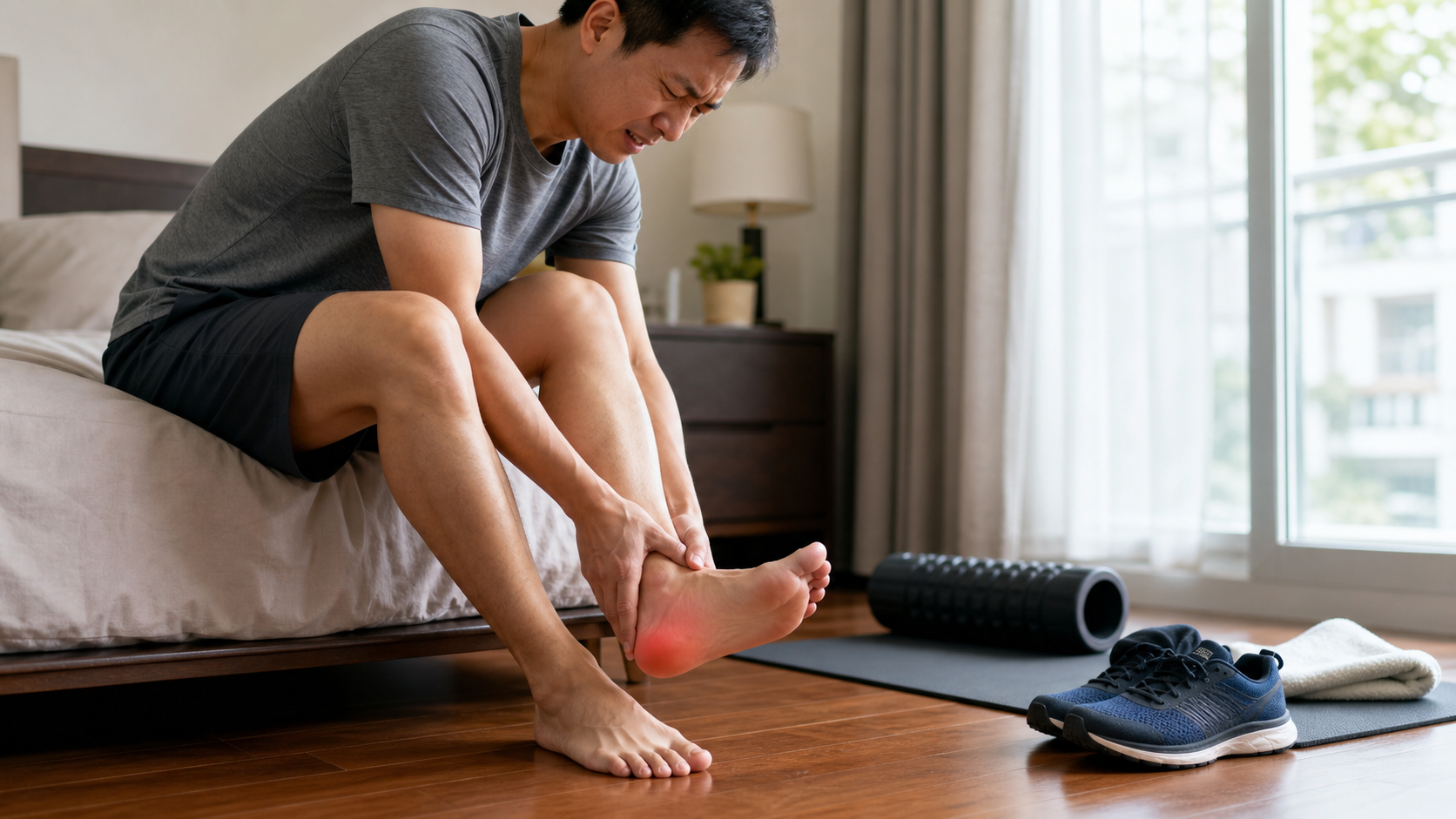
It Starts with the First Step of the Morning
Among the athletes I’ve coached, there was a tech engineer in his early forties named A-Zhe. He commuted by bike regularly and ran on weekends, so he was in decent shape. One day he messaged me: “Coach, I didn’t get injured from a fall, and I didn’t sprain anything, but every morning when I step onto the floor, it feels like someone is stabbing my heel with a needle from the inside. It hurts so much I gasp. After a few steps, the pain gradually fades, but it comes back when I stand up after sitting for a while, or when I walk after a bike ride.”
I could tell almost immediately without even looking—this was the classic presentation of plantar fasciitis. That signature pattern of “worst pain on the first step, easing slightly with movement, then hurting again after prolonged activity” is its hallmark.
Over the past fifteen years, I’ve worked with athletes at all levels as well as many recreational exercisers, and plantar fasciitis is probably one of the most common overuse injuries of the lower limb I encounter. It has a frustrating characteristic: unlike an acute strain that forces you to stop immediately, it slowly seeps into your daily life—at first it only hurts in the morning, and you think, “It’ll feel better once I move around,” so you keep cycling, keep running, keep standing at work, and it drags on into a chronic problem lasting months or even over a year. By the time people can’t take it anymore and come to me, they’ve often already gone down a lot of wrong paths.
In this article, I want to explain plantar fasciitis clearly and completely: what it actually is, why it targets you, how to do the stretching and strengthening, what dosage to use, when to see a doctor, and how to safely return to cycling and running. It’s on the longer side, but I suggest you read it patiently, because this injury most of all hates “doing things halfway.”
A note upfront: This article is educational content and shares training experience, and cannot replace individual diagnosis from a physician, physical therapist, or podiatrist. If your heel pain already affects walking, hurts even at rest at night, or comes with numbness, redness, heat, or swelling, please see a doctor first to rule out other issues.
Concepts and Scientific Basis: What the Plantar Fascia Actually Is
An Underestimated “Bowstring”
The plantar fascia is a thick band of connective tissue that runs from the heel (calcaneus) all the way to the base of the five toes, like a highly tensioned bowstring that supports your arch. With every step you take, it absorbs impact, stores and releases energy, helping push your body forward. You can think of it as the arch’s “shock-absorbing spring” plus “trigger cord.”
What we call plantar fasciitis has traditionally been understood as the fascia near its attachment to the heel bone repeatedly experiencing excessive tension, causing micro-tears and inflammation. But research over the past decade or so has refined this view: chronic plantar fascia problems are actually more like a degenerative, poorly repaired tissue change (fasciosis), rather than simple acute inflammation (-itis). This difference matters—it explains why relying solely on anti-inflammatory drugs or ice often doesn’t produce lasting results, because the core issue is that “the tissue needs to be properly loaded and remodeled,” not just have the fire put out.
How Common It Is
Plantar fasciitis is the most common cause of pain under the heel, accounting for about 80% of all heel pain cases, with a prevalence in the general population of roughly 4% to 7%; in other words, about one in ten adults will experience it at some point in their lives (Cureus / PMC comprehensive review, 2025). It’s not a rare athlete-only condition—service industry workers who stand all day, restaurant staff, teachers, nurses, and office workers who suddenly spike their exercise on weekends are all high-risk groups.
How to Confirm “It’s This” and Not Something Else: Differential Diagnosis
I often remind my athletes not to jump to conclusions and self-diagnose “it must be plantar fasciitis” just because they have heel pain. There are several other possibilities for heel pain, and the treatment approaches are completely different. This is also why you should see a doctor when it’s time to see a doctor:
- Plantar fasciitis: Pain is on the inner-lower side of the heel, at the origin of the arch; the hallmark is “worst pain on the first step in the morning, pain when standing up after sitting, easing slightly with movement.”
- Heel fat pad syndrome: Pain is in the very center of the heel, a dull bruise-like ache that worsens after prolonged standing or walking; the morning pain pattern isn’t as typical.
- Plantar fascia tear: Often follows a distinct “pop” from a twist injury, followed by bruising, swelling, and inability to bear weight. This is an acute condition—don’t tough it out like regular fasciitis.
- Nerve entrapment (e.g., tarsal tunnel syndrome): Comes with numbness, electric shocks, or burning sensations, and can even hurt at night at rest. This isn’t simple overuse; see a doctor.
- Stress fracture: Persistent, localized bone pain after a sudden spike in running volume, with significant pain when pressing directly on the bone. Marathon trainees need to be especially alert to this.
Below is a “should I see a doctor immediately” red flag checklist that I recommend you save:
| Warning Sign | Possible Meaning | Recommendation |
|---|---|---|
| Severe pain and swelling after a distinct “pop” from a twist | Fascia tear / fracture | Seek medical attention promptly |
| Pain even at rest at night | Nerve or inflammatory issue | Seek medical evaluation |
| Numbness, electric shocks, or burning in the heel | Nerve entrapment | Seek medical evaluation |
| Redness, heat, or significant swelling | Infection or inflammatory arthritis | Seek medical attention promptly |
| No improvement at all after 2–3 weeks of self-treatment | Diagnosis may be different | Seek medical evaluation |
| Both sides affected simultaneously, with multi-joint pain | Systemic inflammatory disease | Seek medical evaluation |
Why It Targets You: Causes and Risk Factors
Plantar fasciitis is almost never caused by a “single factor.” Instead, several factors stack up and exceed what the tissue can handle. I usually categorize risk factors into three main groups for my athletes:
1. Sudden increase in load (the most common trigger)
- Training volume spikes in a short period: increasing weekly mileage too much at once, suddenly starting stair-climbing training, switching treadmills, or changing running surfaces.
- Going from a sedentary lifestyle to suddenly exercising: for example, deciding to get fit after the New Year and running 5 km every day in the first week.
- Changing jobs to one that requires prolonged standing: moving from an office to a retail store or production line.
2. Biomechanical and structural factors
- Tight posterior calf muscles (gastrocnemius, soleus) and insufficient ankle dorsiflexion: This is the most critical and most correctable factor I see clinically. When the calves are tight, the arch is forced to absorb more tension on landing.
- Arch type: excessively flat (low arch) or excessively high arch can both increase fascial load.
- Higher body weight: every additional pound of body weight means more force on the sole of the foot with each step.
3. Other personal factors
- Age (fascial elasticity declines after middle age).
- Shoes with insufficient support or excessive wear (especially the thin-soled flip-flops and flat shoes that Taiwanese people love).
- Hard training or work surfaces (concrete, tile floors).
The table below is a “risk factor self-assessment” I commonly use with my athletes. You can check how many items apply to you:
| Risk Factor | Specific Scenario | Risk Weight | Can You Modify It Yourself? |
|---|---|---|---|
| Sudden spike in training volume | Weekly running mileage increases more than 10% | High | Yes (adjust training plan) |
| Tight calves, insufficient ankle dorsiflexion | Heels lift during squats, can’t easily touch toes | High | Yes (stretching and strengthening) |
| Occupation requiring prolonged standing | Standing more than 6 hours daily | Medium-High | Partially (insoles, rest) |
| Old or ill-fitting footwear | Running shoes with over 600–800 km | Medium | Yes (replace shoes) |
| Higher body weight | High BMI, recent weight gain | Medium | Yes (long-term management) |
| Hard surfaces | Frequently training or standing on concrete, tile | Medium | Partially |
| Arch type | Clearly flat or high arch | Low-Medium | Partially (insoles as support) |
Here’s the key takeaway: most of these items are “modifiable.” This is the point I always emphasize to my athletes—the vast majority of plantar fasciitis cases can be improved with conservative treatment, and your path forward is clear.
Practical Methods: Stretching, Strengthening, and Night Management
This section is the core of the entire article. I break rehabilitation into four pillars: targeted stretching, progressive strengthening, night and morning management, and load management. All four pillars are essential—doing only stretching without strengthening, or only taking medication without changing training, is the most common reason for failure.
Pillar One: Targeted Stretching (Fascia + Calves)
Stretching is the most evidence-supported component of conservative treatment. Research indicates that a stretching program needs to continue for more than eight weeks and ideally include both stretches targeting the plantar fascia itself and the calves for better results (Cureus / PMC comprehensive review, 2025). One clinical trial on chronic plantar fasciitis even followed patients for two years and found that specific plantar fascia-specific stretching significantly improved symptoms (PubMed 16882901, two-year follow-up clinical trial).
My favorite stretch to teach athletes is the “plantar fascia-specific stretch” because it directly targets the problem tissue and can be done seated at your desk or on the edge of your bed:
- Sit and cross the affected foot over the opposite knee (cross-legged position).
- Grab your toes (especially the big toe) and pull them back toward your shin, lifting the toes up.
- You should feel the fascia along the arch tighten. You can feel the taut band with your other hand.
- Hold for 10 seconds, relax, and repeat 10 times for one set.
Key timing: do one set before getting out of bed in the morning and before standing up after prolonged sitting. This is when the fascia has shortened overnight and is at its most vulnerable. Stretching it before putting weight on it can dramatically reduce that “first-step sting.”
Calf stretching is also essential, because tight calves are the biggest correctable factor:
- Straight-knee calf stretch (targeting the gastrocnemius): Face a wall in a lunge position, back leg straight with the heel on the ground, lean forward, feeling the upper calf stretch. Hold for 30 seconds.
- Bent-knee calf stretch (targeting the soleus): Same position but with the back knee slightly bent, stretching the deeper calf near the ankle. Hold for 30 seconds.
Pillar Two: Progressive Strengthening (Making the Tissue Stronger)
This is the key that many people miss but that determines “whether it will recur.” Just loosening the fascia isn’t enough—you need to make it and the surrounding muscles more capable of handling load. My top recommendation is the “heavy slow heel raise,” a progressive resistance exercise designed specifically for the plantar fascia:
- Place a rolled towel under your toes on the edge of a step (keeping the toes dorsiflexed to increase tension on the fascia).
- Stand with the ball of your foot on the step edge, heels hanging off.
- Slowly raise your heels (calf raise) over 3 seconds, hold at the top for 2 seconds, then slowly lower over 3 seconds until the heel drops below the step.
- Start with both feet, progress to single-leg as you improve; then add a backpack or handheld dumbbells for weight.
The purpose of this “slow, high-tension” movement is to give the fascia and calf tendons a “correct and progressive loading stimulus” to promote tissue remodeling. Remember the principle: some pain is acceptable, but it must not exceed a tolerable level, and morning pain the next day must not be significantly worse.
To give you a more concrete execution guide, I’ve organized the progressive dosage for strengthening exercises into the table below. This is the ladder I commonly use with my athletes; in practice, let your pain feedback be your guide:
| Week | Exercise | Sets × Reps | Tempo | Frequency | Progression Rule |
|---|---|---|---|---|---|
| Weeks 1–2 | Toe towel scrunches, short foot exercise | 3 sets × 15 reps | Slow and steady | Daily | Build awareness first, no added load |
| Weeks 3–4 | Double-leg slow heel raises (towel under toes) | 3 sets × 12 reps | Up 3s-Hold 2s-Down 3s | Every other day | Progress only when pain-free |
| Weeks 5–6 | Single-leg slow heel raises | 3 sets × 10 reps | Same as above | Every other day | Add load once single-leg is manageable |
| Weeks 7–8 | Single-leg heel raises + backpack/dumbbells | 3 sets × 8 reps | Same as above | Every other day | Add about 2–5 kg each time |
| After week 9 | Add balance and light jumping prep | Per training plan | Progressive | Every other day | Transition to sport-specific training |
Regarding “how heavy should the dosage be,” I give a very practical self-calibration principle: pain during the exercise session within 3 to 4 out of 10 is acceptable, above 5 means it’s too heavy; more importantly, “the pain on the first step the next morning must not be significantly worse than yesterday.” Use these two indicators as your dashboard—it’s much safer than blindly chasing reps.
I also add intrinsic foot muscle and hip strengthening, because plantar fasciitis is often not “just a foot problem”:
- Toe towel scrunches / short foot exercise: Trains the small intrinsic muscles of the foot to actively support the arch.
- Side-lying clamshells, single-leg balance: Strengthens hip abductors and glutes, improving overall leg alignment during landing.
Pillar Three: Night Splints and Morning Management
The culprit behind that “worst pain on the first step in the morning” is the fascia shortening and stiffening overnight while the foot is in a plantar-flexed position. Night splints work by keeping the ankle in about 0 to 5 degrees of dorsiflexion during sleep, keeping the fascia in a slightly lengthened position throughout the night to prevent it from shortening.
Research shows that in randomized trials, night splints achieve clinically meaningful pain reduction in about 65% to 80% of patients, with effects typically appearing after 4 to 8 weeks of consistent use (Lower Extremity Review / related clinical review). But a word of caution: night splints work best as “part of a comprehensive program”; using them alone while doing nothing else will diminish the results.
If you find it uncomfortable and can’t sleep at first, start by wearing it for short periods during the night or during naps, and gradually adapt.
Putting the Program Together: A 12-Week Progressive Plan
I’ve integrated the four pillars into a phased schedule you can follow. This is a general framework; adjust the actual intensity based on your pain response and do it under professional guidance:
| Week | Phase | Stretching (Daily) | Strengthening | Night / Load Management |
|---|---|---|---|---|
| Weeks 1–2 | Acute relief | Fascia-specific stretch 3 sets, calf stretches 3 sets each | Hold off on high-load work; start with toe towel scrunches | Start night splint; pause running, switch to swimming/cycling |
| Weeks 3–4 | Building foundation | Same as above, must do before getting up and before standing from sitting | Double-leg slow heel raises 2–3 sets × 12 reps | Continue splint; gradually increase daily walking volume |
| Weeks 5–8 | Progressive strengthening | Maintain stretching | Progress to single-leg heel raises, can add light load | If pain is stable, try very short slow runs with walk-run intervals |
| Weeks 9–12 | Return to sport | Continue stretching before and after exercise | Increase load, add balance and jumping prep | Gradually resume cycling and running mileage, 10% rule |
Positioning Common Adjunct Treatments
Beyond the four pillars you can do yourself, you’ll hear about various treatments. I’ve put together a table to help you understand their general roles (whether they’re appropriate for you should be determined by your physician or therapist):
| Treatment | General Role | My Practical Observations |
|---|---|---|
| Ice / rolling a frozen water bottle | Acute pain relief | Useful but treats symptoms; combine with stretching |
| Arch support insoles / supportive shoes | Share fascial tension during the day | Especially helpful for those who stand long hours and have flat feet |
| Taping (kinesiology tape) | Short-term support and pain reduction | Good for race day or days when you must stand for long periods |
| NSAIDs (non-steroidal anti-inflammatory drugs) | Short-term pain and inflammation relief | Requires physician evaluation; not for long-term reliance |
| Extracorporeal shockwave therapy | Chronic stubborn cases | Common next step when conservative treatment fails after months |
| Manual therapy / dry needling | Adjunct relaxation and pain relief | Performed by professionals; not essential but can help |
| Corticosteroid injections | Intervention for stubborn cases | Has its timing but carries risks like fascial rupture; requires careful physician assessment |
Common Mistakes and Corrections
This section might be the most helpful part of the entire article for you. I’ve compiled the landmines I’ve seen over more than a decade of coaching, each with the correct approach.
Mistake One: Toughing It Out and Continuing Your Original Training Volume
This is the number one landmine. Many people (especially those who are generally fit like A-Zhe) think, “I’m not injured, it’ll feel better once I move,” so they keep running and riding as usual. As a result, the tissue never gets a window to repair, and the acute issue becomes chronic.
Correction: During the acute phase, what you need is “relative rest”—not complete inactivity, but replacing high-impact activities that provoke pain with alternatives. This is where cycling and swimming shine—they’re low-impact cardiovascular alternatives that maintain fitness without torturing the fascia.
Mistake Two: Only Stretching, Not Strengthening
Stretching makes you “feel better in the moment,” but it can’t make the tissue more resilient. People who only stretch without strengthening are often the ones who “get better for a while, then relapse.”
Correction: Do stretching and heavy slow heel raises in parallel. Treat strengthening as “investing in not relapsing in the future.”
Mistake Three: Being Inconsistent
Tissue remodeling of the plantar fascia happens on a scale of “weeks” or even “months.” Research emphasizes that stretching needs to continue for more than eight weeks before stable results appear. Giving up after three days because you don’t see improvement means all your effort was wasted.
Correction: Anchor stretching to fixed situations—“one set before getting out of bed, one set before standing up from sitting, one set before bed.” Attaching it to existing habits makes it hardest to forget.
Mistake Four: Walking Barefoot on Hard Floors and Loving Thin-Soled Slippers
Taiwanese homes mostly have tile floors, and many people walk around barefoot or in thin-soled flip-flops as soon as they get home. For a fascia in the acute phase, this is like constantly irritating it all day long.
Correction: During the acute phase, wear indoor slippers with arch support or well-cushioned sports sandals at home, and avoid prolonged barefoot walking on hard surfaces.
Mistake Five: Going Heavy and Stretching Hard Right from the Start
Some people are overeager and immediately add heavy weight to heel raises or stretch so hard they’re grimacing in pain. Excessive load prevents the tissue from adapting.
Correction: Follow the red line of “pain is tolerable, and morning pain the next day isn’t significantly worse.” Calibrate dosage based on pain feedback, not on “how hard I worked today.”
Mistake Six: Ignoring the Two Big Factors—Calves and Body Weight
Many people focus all their attention on the heel but fail to see that the real upstream causes are extremely tight calves or body weight load.
Correction: Seriously stretch your calves daily (both straight-knee and bent-knee versions), and treat weight management as a long-term background task. Improvements in body weight reduce plantar load around the clock, relieving pressure with every single step.
Action Recommendations for Readers at Different Stages
No single training plan fits everyone. Based on your current status, I’ve divided recommendations into three scenarios.
Scenario One: Acute Phase (Pain started within the last two weeks, morning pain is significant)
Goal: Pain relief, unloading, building habits.
- Immediately replace high-impact activities like running and jumping with cycling or swimming.
- Perform the plantar fascia-specific stretch and calf stretches daily, especially before getting out of bed and before standing up from sitting.
- Start using arch support insoles, and don’t walk barefoot on hard floors at home.
- Roll a frozen water bottle under your arch for 10 to 15 minutes in the evening for pain relief.
- Consider introducing a night splint.
- A reminder: If self-treatment shows no improvement at all after two to three weeks, or if the pain is severe enough to cause limping, see a doctor.
Scenario Two: Chronic Phase (Pain has lasted more than six weeks to months)
Goal: Tissue remodeling, identifying upstream factors.
- Implement all four pillars, with particular emphasis on “heavy slow heel raises” for strengthening.
- Seriously review your training history: Did you increase volume too quickly at some point? Are your shoes too old (running shoes over 600 to 800 km should be replaced)?
- If conservative treatment shows no significant progress after months, discuss advanced options like extracorporeal shockwave therapy with your physician.
- Start a “pain diary”: record your morning pain score (0 to 10) and daily activities, using the trend to determine whether you’re heading in the right direction.
Scenario Three: Return Phase (Pain has significantly improved, want to return to cycling and running)
Goal: Safe return, avoiding relapse.
This is the phase I’m most cautious about, because too many people get overexcited when they’re “almost better” and add too much at once, undoing all their progress. Returning requires following several principles:
- Pass the test before running: Only start walk-run intervals when you can do 20 consecutive single-leg slow heel raises without significant pain, and a 30-minute brisk walk doesn’t worsen morning pain the next day.
- 10% rule: Weekly running mileage or cycling hours should not increase by more than 10% over the previous week.
- Cycling returns first, running returns later: Cycling is low-impact and can usually resume earlier than running; use cycling as the main way to maintain fitness during the return phase, and gradually layer running back in.
- Red line monitoring: If morning pain significantly worsens on any day, or you feel a sharp heel pain during exercise, step back to the previous level. Don’t push through.
Below is a reference walk-run interval rhythm for the return phase (just an example; adjust based on your individual response):
| Stage | Walk / Run Ratio (minutes) | Total Duration | Progression Condition |
|---|---|---|---|
| Stage 1 | Walk 4 / Run 1, repeat | 20–25 minutes | Morning pain not worse the next day |
| Stage 2 | Walk 3 / Run 2, repeat | 25–30 minutes | No discomfort for two consecutive sessions |
| Stage 3 | Walk 2 / Run 3, repeat | 30 minutes | No discomfort for two consecutive sessions |
| Stage 4 | Walk 1 / Run 4, repeat | 30 minutes | Transition to continuous slow running |
Two Real-Life Scenarios: Seeing the Difference Between “Doing It Right” and “Doing It Wrong”
No amount of concepts beats seeing actual cases. The two scenarios below are teaching illustrations (data are typical ranges, not specific medical records), but they reflect patterns I’ve seen repeatedly over more than a decade.
Case One: Weekend Warrior Xiao-Mei (a typical example of doing it wrong)
Xiao-Mei is an elementary school teacher who stands while teaching and loves running on weekends. One month, she signed up for a half marathon and ramped her weekly mileage from 15 km to 40 km in the month before the race. Two weeks before race day, her heel started hurting in the morning. She thought, “I’ve trained this long, I can’t stop now,” and ran the race through the pain. Afterward, she was limping from the pain and it took a full eight months to slowly recover. Her problems were clear: a sudden spike in mileage (far exceeding the 10% rule) + toughing it out through pain + resting without doing any strengthening. If she had taken relative rest when the morning pain first appeared, replaced long runs with cycling to maintain fitness, and seriously stretched her calves, she likely could have wrapped it up in two to three months without sacrificing the joy of that race for so long.
Case Two: Long-Standing Server A-Liang (a typical example of doing it right)
A-Liang works in a restaurant’s front-of-house, standing over eight hours a day in thin-soled company-issued shoes. He came to me about three weeks into his heel morning pain. I asked him to do three things: switch to insoles with arch support, do the plantar fascia and calf stretches every day before getting out of bed and during shift breaks, and wear a night splint plus roll a frozen water bottle under his arch in the evening. I also scheduled double-leg slow heel raises three times a week. He was very disciplined. After six weeks, his morning pain dropped from a daily 6–7 out of 10 to an occasional 2, and after a little over two months, it was almost imperceptible. A-Liang’s success came from: addressing it early, identifying the upstream factors (footwear and prolonged standing), doing all four pillars together, and persisting beyond eight weeks without giving up halfway.
These two contrasts tell us the same thing: the prognosis for plantar fasciitis depends largely on “how early you start treating it correctly, and whether you have the patience to complete the full course.”
Practical Reminders for the Taiwanese Context
Since this is for Taiwanese readers, let me add a few very local, very practical suggestions.
Climate and surfaces: Taiwan’s summers are hot and humid, and many people love wearing flip-flops and sandals out. These thin-soled, unsupportive shoes are very unfriendly to the acute phase. During the rainy season, floors are slippery, and indoor tile is hard and slick—be extra careful about walking barefoot at home. I recommend giving your feet some support both indoors and outdoors during the acute phase.
Eating out and weight management: Eating out is convenient in Taiwan, but the food tends to be oily, salty, and high in refined carbs. Body weight is a direct factor in plantar load. Long-term weight management may be slow to show results, but it’s an investment that “relieves pressure with every step.” You don’t need extreme dieting—just follow the general direction of “more vegetables and protein, fewer sugary drinks and fried foods.” For details, consult a nutritionist.
Healthcare and the NHI system: Medical access is convenient in Taiwan. If self-treatment doesn’t improve within two to three weeks, you can see an orthopedic doctor, a rehabilitation specialist, or a foot and ankle specialist. Rehabilitation courses under the NHI (including manual therapy and modality treatments) and exercise therapy are relatively accessible—make good use of them. When you see a doctor, clearly describing the pattern of “worst pain in the morning, easing with movement, hurting again after prolonged activity” is very helpful for diagnosis.
Exercise habits: Taiwan has a strong cycling and road-running culture, and many people do one very long ride or run on weekends. That weekend-warrior style of volume spike is exactly the breeding ground for plantar fasciitis. Spreading training across weekdays and progressing gradually is far safer than blowing it all out on the weekend.
FAQ
Q: How long does plantar fasciitis take to heal?
A: It varies by person. Most conservative treatment cases improve significantly within weeks to months, but chronic cases that have dragged on may take six months or more. The key is doing all four pillars fully, consistently, and without giving up halfway.
Q: Can I keep cycling while it hurts?
A: Cycling is a low-impact activity and is usually much friendlier than running. Many people can continue riding with adjusted intensity. But if the pain significantly worsens after riding or the next morning, that means the dosage is too high and you need to back off. Pedal position and shoe sole stiffness can also be fine-tuned.
Q: Do I have to buy insoles or a night splint?
A: Not everyone absolutely needs them, but for people who stand long hours, have flat feet, or have particularly severe morning pain, insoles and night splints are often very helpful accelerators. You can start with basic stretching and strengthening first, then add them as needed.
Q: If I have a heel spur, does that mean it can’t be cured?
A: Heel spurs seen on imaging are often a “result” rather than the “main cause of pain,” and many people without symptoms also have spurs. Most cases don’t need surgery just because a spur is present; the focus remains on conservative treatment. In practice, defer to your physician’s assessment.
Q: Should I get injections?
A: Corticosteroid injections have a role in stubborn cases, but they also carry risks like fascial weakening and rupture. They’re an intervention that requires careful physician assessment, not a first-line option to jump to.
Q: Is it normal for my heel to hurt at night while sleeping?
A: Typical plantar fasciitis is mostly “pain when stepping down, not much pain when not stepping.” If you hurt even lying still or at night at rest, that’s less like simple overuse. I’d recommend seeing a doctor to rule out nerve or inflammatory issues.
Q: Can I buy insoles myself, or do I need custom ones?
A: Most people get help from over-the-counter arch support insoles first; custom ones aren’t necessarily the first step. If you’ve tried them for a while with limited results, or if your foot shape is unusual, then consider having a professional evaluate you for custom insoles.
Q: Both feet hurt—is that more serious?
A: Not necessarily more serious, but when both sides are affected simultaneously, I pay more attention to “systemic factors”—body weight, footwear, prolonged standing patterns, or even the possibility of systemic inflammatory disease. In this case, it’s worth seeing a doctor for a comprehensive evaluation.
Q: When is the best time to stretch and strengthen?
A: For stretching, I recommend anchoring it to “before getting out of bed, before standing up from sitting, and before bed.” For strengthening (slow heel raises), do it during a time when you have better energy, and separate it from your cycling or running training to avoid fatiguing the plantar area on the same day.
Conclusion: Treat It as a Manageable Journey
Let’s return to A-Zhe from the beginning. He was initially frustrated, thinking, “How can a heel pain drag on this long?” I told him: the most discouraging thing about plantar fasciitis is that it heals slowly; but the most reassuring thing is that the vast majority of cases can improve through your own efforts—most of those risk factors are in your hands.
In the end, he followed through honestly: during the acute phase, he replaced running with cycling and swimming, stretched before getting out of bed every day, seriously did slow heel raises, wore a night splint, and replaced his worn-out old running shoes. In about two months, that “first-step sting” went from daily, to occasional, to almost gone. During the return phase, he held the 10% rule, let cycling come back first, then gradually layered running back in. He hasn’t relapsed since.
What I want to tell you is this: Don’t tough it out through pain, and don’t panic and treat it randomly. Do all four pillars fully, give the tissue enough time, and hold that red line of “morning pain not worsening the next day.” Most people can get back to the sports they love. Your heel is the first point of contact between you and the ground—take good care of it, and it will repay you with steady steps.
If you’ve been in pain for a while and self-treatment isn’t progressing, don’t wait any longer. Seeking professional evaluation is always the smart move.
This article is educational content and cannot replace individual diagnosis and treatment advice from a physician, physical therapist, or nutritionist. If you have diabetes, peripheral vascular or neurological conditions, gout, or other chronic diseases, the management of heel pain must be highly individualized and should prioritize medical consultation. Do not follow this article’s instructions on your own.
References
- Comprehensive Review and Evidence-Based Treatment Framework for Optimizing Plantar Fasciitis Diagnosis and Management (PMC / Cureus comprehensive review): https://pmc.ncbi.nlm.nih.gov/articles/PMC12294660/
- Plantar fascia-specific stretching exercise improves outcomes in patients with chronic plantar fasciitis (two-year follow-up prospective clinical trial, PubMed 16882901): https://pubmed.ncbi.nlm.nih.gov/16882901/
- Night splint treatment of plantar fasciitis pain (Lower Extremity Review): https://lermagazine.com/article/night-splint-treatment-of-plantar-fasciitis-pain
Related Reading
- Plantar Fasciitis: The Root Cause of Morning First-Step Pain and Rehabilitation
- The Complete Treatment Path for Plantar Fasciitis: From Morning First-Step Pain to Returning to the Marathon
- Analysis of Plantar Fasciitis Causes and a Runner’s Recovery Plan
- The Complete Guide to Plantar Fasciitis: Treatment Strategies and Training Adjustments for the Most Common Running Injury
一日北高常見問題大集合 | 攻略 | 路線 | 訓練 | 補給 | 自行車 單車 | 一日雙城 | 雙塔 | TWB北高360 | 屁股痛
6 年前
單車 一日北高 ( 雙城 ) 肥宅雙人瘋狂行 紀錄片 REACTO
10 年前
一日北高/長距離團騎 常見問題補充篇 / 組團或跟團的眉角 / 壯車友容易被瘦車友慢性拉爆 / 原來屁股痛可能是這個原因...? / 風場配速法 / 公路車 / CT Yeh
2 年前
Never Stop 西進武嶺 前後雙機 完整全程錄影 訓練台 實境
8 年前
摔車後補裝備: 好市多新款單車安全帽& Specialized Romin 北高整路屁股都不痛的坐墊 | 一千元居然有MIPS | CT Yeh | 公路車
4 年前
高雄綠園道鐵路自行車道 / 外地人能輕鬆駕馭 還是整路崩潰? / 2025 全線開通 春節實地探索一次!(附GPS連結)/ 公路車 / CT Yeh
1 年前
滑雪新手們慘摔學習全紀錄(請開字幕),滑雪好好玩 | Snowboard + Ski | 岩原 スキー場 | 滑雪APP使用 | GoPro Max
6 年前
CT 喇低賽) 武嶺牽車 才是王道 西進牽車四小時內秘訣 攝手位置 如何判斷 防抽筋小秘訣
7 年前