Sharp Pain on the Outside of the Knee Making It Impossible to Run? A Complete Breakdown of ITBS Mechanisms, Glute Strengthening, and Running Form
Starting with a weekend runner’s lateral knee pain
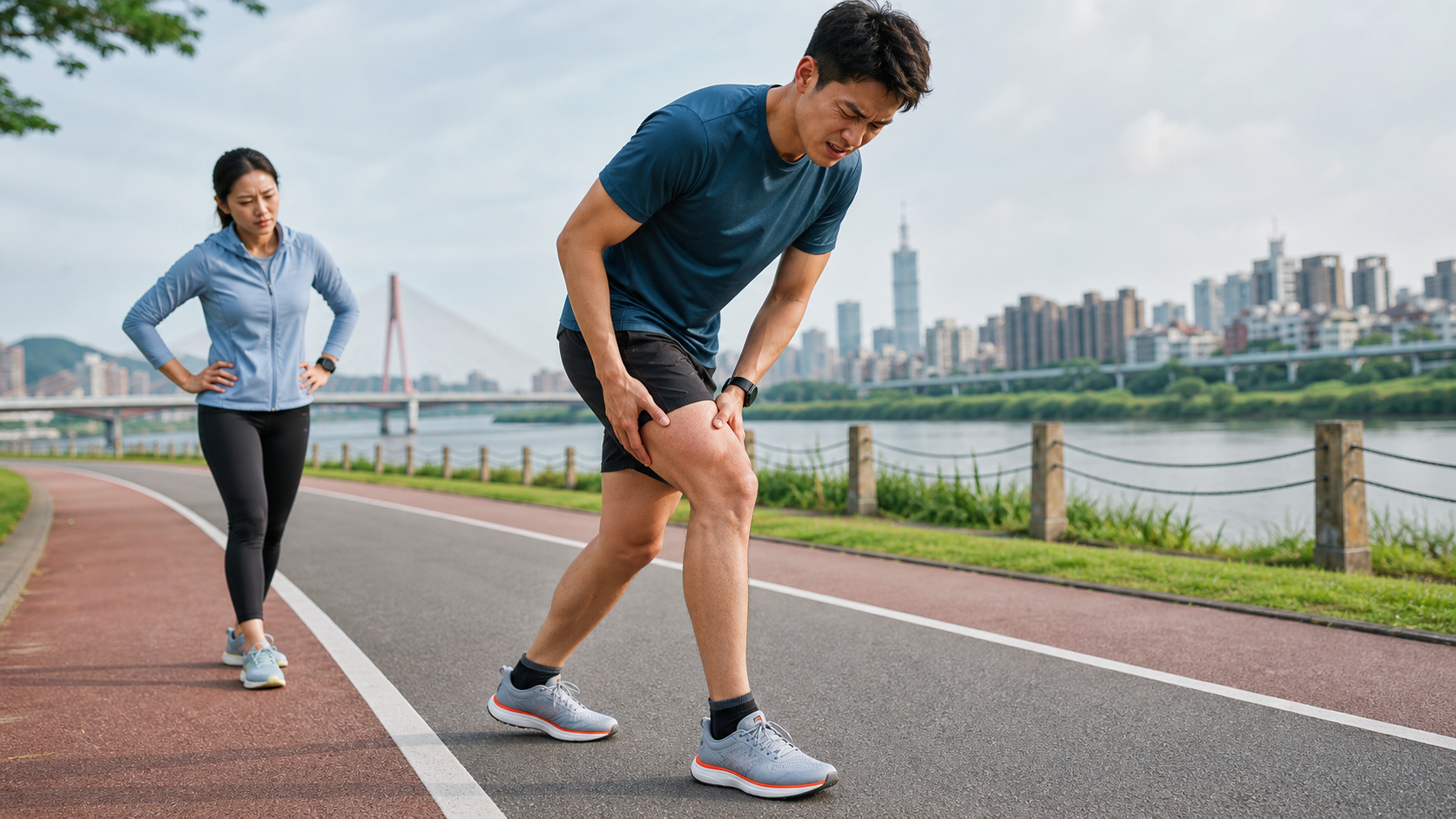
I remember this clearly: a student who worked in the tech industry—let’s call him A-Kai. He was in his early forties, weighed about 72 kg, and was preparing for his first full marathon. The first few months of training went smoothly, with weekly mileage gradually building from 30 km toward 50 km. Then, one Sunday, while doing an LSD (long slow distance) run on the riverside bike path, around the 8th kilometer, his right knee suddenly developed a “sharp, tight, like something is being rubbed” sensation on the outside. He stopped, walked a bit, felt better, but the pain returned as soon as he started running again. Eventually, he had to limp back to where his car was parked.
The first thing he said when he came to see me was: “Coach, is it because my IT band is too tight? I roll my outer thigh on the foam roller every day until I almost cry, so why does it still hurt?”
This is almost the exact question every runner with Iliotibial Band Syndrome (ITBS) asks. And my usual reply is: “You’re putting your effort in the wrong place.” The real key to ITBS usually isn’t the fascia on the outside of your thigh that you’re desperately rolling—it’s your gluteal muscles and running form. In this article, I want to lay out the complete framework I’ve used over the past 15 years working with athletes at all levels, as well as everyday office workers, to address ITBS.
What exactly is the iliotibial band? Let’s correct the concept first
The iliotibial (IT) band is a band of connective tissue that runs along the outside of the thigh, extending from the pelvis all the way down to the tibia on the outer, lower part of the knee. Its upper end connects to the gluteus maximus and the tensor fasciae latae (TFL), and its lower end attaches to the lateral side of the knee joint. It is not a muscle that can be stretched like a rubber band, but rather a very tough, dense fibrous tissue that barely yields.
This point is extremely important because it directly overturns a long-standing myth: “ITBS is caused by a tight IT band, so you need to stretch and roll it relentlessly to loosen it up.” In reality, the mechanism more widely accepted in research and clinical practice is compression and friction: as the knee repeatedly bends and straightens during running, the fat pad rich in nerves and blood vessels beneath the IT band gets repeatedly squeezed and irritated in the “impingement zone” near 20 to 30 degrees of knee flexion, producing pain and inflammation.
This is why ITBS has several very typical characteristics:
- The pain is concentrated on the outside of the knee (around the lateral femoral epicondyle), sometimes radiating up the outer thigh or down the outer calf.
- It hurts when running, but eases with walking or rest, especially noticeable on downhills or stairs (because the knee spends more time in that impingement angle when descending).
- It typically starts hurting after a certain distance or duration (like A-Kai’s consistent 8th kilometer), because it’s cumulative irritation.
- Pressing on the bony prominence on the outside of the knee produces clear tenderness.
If your pain follows this pattern, it’s almost certainly ITBS. But the next real question is: Why is the IT band being repeatedly compressed? The answer almost always points upstream—to your hip control.
The core mechanism: it’s not a tight band, it’s glutes that don’t fire
This is the section I most want you to remember from this entire article.
Running is a sport of single-leg support, alternating sides. At the moment of each foot strike, your entire body weight is on one leg. The muscles primarily responsible for keeping your pelvis “level and stable” are the gluteus medius—a hip abductor—along with the gluteus maximus and the deep hip rotators.
When the gluteus medius is strong and fires on time, the pelvis on the stance side stays level, the knee tracks properly over the toes, and the alignment of the entire leg is stable.
But when the gluteus medius is weak or slow to activate, a chain reaction occurs:
- The pelvis on the stance side drops on the opposite side (like a model’s hip sway).
- The thigh consequently undergoes excessive adduction and internal rotation, causing the knee to cave inward (commonly called “knee valgus”).
- This adducted and internally rotated position tightens and increases the compression of the IT band against the outside of the knee.
- Step after step, thousands of steps accumulate—and pain arrives.
On this point, the sports science literature has accumulated considerable evidence. Studies have observed that runners with ITBS often exhibit greater hip adduction and knee internal rotation angles during the stance phase; research on distance runners also indicates that the ITBS population generally has weakness in the hip abductors (especially the gluteus medius) (see the StatPearls and related research links at the end of this article).
So I often tell my students: “Your IT band is just the scapegoat; the real culprit is the glute that won’t fire.”
This is also why relying solely on foam rolling, stretching, and rest often leads to the same cycle: rest for two weeks, no pain, go back to running, pain returns—because the movement patterns and strength deficits that caused the problem were never fixed.
I like to use this analogy: the IT band is like a clothesline pulled tight at both ends, and the glutes and pelvic control are the posts holding the line. If the posts (glutes) are unstable and leaning, the line (IT band) gets pulled and rubbed at a certain point. You can keep rubbing the line, but it will still be pulled—because the posts were never straightened. You need to fix the posts, not the line. Once this concept clicks, your entire approach to ITBS changes: from “desperately relaxing downstream” to “rebuilding upstream stability.”
One more point many people overlook: fatigue degrades glute control. Both research and clinical observation show that in the later stages of a long run, as muscles fatigue, hip and knee alignment tends to break down, with more adduction and internal rotation. This explains why ITBS often “only hurts in the later part of the run”—it’s not just cumulative friction; it’s also because your stabilizers can’t hold up anymore. So strength training shouldn’t just target maximal strength, but also muscular endurance, so the glutes can keep firing over long durations.
Three major upstream factors: glutes, running form, and training load
When breaking down the causes of ITBS, I clinically examine three areas. These three often go wrong together.
Factor 1: Insufficient hip abductor strength and neuromuscular control
This is the core of the core. Many people don’t lack muscle “strength”—they just can’t activate it at the right time. Especially for sedentary office workers who sit eight hours a day, the glutes are chronically switched off, so they simply won’t respond when you run.
Factor 2: Running form issues (low cadence, overstriding, poor hip control)
Low cadence and excessive stride length (overstriding) increase the impact of every step and lengthen the time the knee spends in the impingement zone. This is why slightly adjusting cadence is such an effective intervention for ITBS—there’s a dedicated section on this later.
Factor 3: Sudden changes in training volume or environment
ITBS is a classic “too much, too soon” injury. Like A-Kai jumping from 30 km to 50 km per week within a few weeks, the body doesn’t have time to adapt. Also watch out for these common trigger scenarios for runners in Taiwan:
- Suddenly running a lot of downhill (e.g., Yangmingshan, Guanyinshan, or riverside routes with many bridges).
- Continuously running the same direction on a track or riverside path, causing one leg to bear the road camber (cross-slope) for extended periods.
- Changing shoes, heavily worn soles, or suddenly switching to much harder surfaces.
- Spiking mileage before a race without a gradual build-up.
The table below helps you quickly self-assess which factors are at play:
| Risk Factor | Common Scenario (Taiwan) | Self-Check Method | Corresponding Approach |
|---|---|---|---|
| Weak gluteus medius | Sedentary office job, almost no strength training | Does your pelvis drop during a 30-second single-leg stand? Does your knee cave in during a single-leg squat? | Hip abductor strength training |
| Low cadence | Habit of long, slow strides | Measure cadence with a watch or app; below about 170 spm | Cadence adjustment +5% |
| Overstriding | Foot lands in front of the body, heavy heel strike | Side video to check if the landing point is far ahead of the center of mass | Shorten stride, land closer to the center of mass |
| Training volume spike | Sudden pre-race mileage increase, excessive weekly jump | Check if weekly mileage increase exceeds >10% | Progress gradually, control increases |
| Lots of downhill/cambered surfaces | Running mountains, bridges, same-direction track loops | Recall if pain worsens after downhills | Reduce downhill volume, alternate directions |
Practical Method 1: Glute strengthening program (ready to follow)
Okay, concepts done—now let’s get real. This is the beginner strength program I actually prescribe to ITBS students, focusing on activation and muscular endurance of the gluteus medius and gluteus maximus. No gym required; you can do it at home.
Movement principle: slow, controlled, and you should feel it in the upper-outer part of the glutes. If you only feel it in your thighs or lower back, you’re using the wrong muscles again—drop down to an easier variation.
Beginner Weekly Program (acute phase / early return, 3 times per week, every other day)
| Exercise | Sets × Reps | Key Cues | Target Muscles |
|---|---|---|---|
| Side-lying hip abduction (clam) | 3 × 15 (each side) | Don’t let the pelvis roll back; open the knee like a clam | Gluteus medius |
| Side-lying straight leg raise | 3 × 12 (each side) | Slightly rotate the heel back; feel the upper-outer glute working | Gluteus medius |
| Glute bridge (double leg) | 3 × 15 | Squeeze glutes to lift; don’t hyperextend the lower back | Gluteus maximus |
| Side plank (knee-down version) | 3 × 20 sec (each side) | Body in a straight line; don’t let the pelvis sag | Gluteus medius / core |
| Wall-supported single-leg stand, pelvic stability | 3 × 30 sec (each side) | Keep the stance-side pelvis level, no dropping | Gluteus medius control |
Advanced Weekly Program (2–4 weeks after pain-free, 2–3 times per week)
| Exercise | Sets × Reps | Key Cues | Target Muscles |
|---|---|---|---|
| Banded lateral walk (monster walk) | 3 × 15 steps (each direction) | Push knees out against the band; toes pointing forward | Gluteus medius |
| Single-leg glute bridge | 3 × 10 (each side) | Keep pelvis level, no tilting | Gluteus maximus |
| Bulgarian split squat | 3 × 8 (each side) | Knee tracks over toes, no caving in | Glutes / quadriceps |
| Single-leg Romanian deadlift (bodyweight or light load) | 3 × 8 (each side) | Hip hinge pattern; control pelvis rotation | Gluteus maximus / posterior chain |
| Side plank (full version) + top leg abduction | 3 × 10 (each side) | High difficulty; regress if you can’t control it | Gluteus medius |
I usually ask students to place their fingers on the upper-outer part of their glutes and feel the muscle contracting during each movement. If you can’t feel it, the movement isn’t correct—and that matters more than how many reps you do. Rebuilding neuromuscular control depends on doing every rep correctly, not just grinding out numbers.
Here’s another practical tip: incorporate glute activation into your pre-run warm-up. Many people just do a few static stretches and start running, without their glutes ever “coming online.” I ask students to do 1–2 sets of clamshells or banded lateral walks before running to wake up the gluteus medius first. That way, it’s helping stabilize the pelvis from the very first step, rather than you discovering halfway through the run that it’s been absent the whole time. This habit of “waking up the glutes before running” is low-cost but high-benefit—especially for office workers who run after sitting all day. Your glutes have been sitting for eight hours; they really need to be woken up.
One more reminder: strength training isn’t a few days of work that you drop once the pain is gone. The most frustrating thing about ITBS is recurrence, and recurrence is almost always linked to “stopping the exercises once the pain is gone.” I ask students to treat glute training like brushing their teeth—a long-term habit, maintained 2–3 times per week. This is the most practical insurance against relapse.
Practical Method 2: Running form correction, focusing on cadence and foot strike
Strength is the foundation, but if you go back to the road with the same poor form, the problem will return. In running form correction, the approach I recommend most—and the one with the strongest evidence—is slightly increasing your cadence.
Why is cadence so critical?
A case study on gait retraining for ITBS in a long-distance runner found that increasing cadence by about 5% (above the runner’s habitual cadence) significantly reduced knee joint loading, shortened stride length, reduced excessive heel strike in front of the body, and decreased peak hip adduction and internal rotation during stance—and hip adduction and internal rotation are precisely the culprits compressing the IT band discussed earlier (see the PMC gait retraining study link at the end).
In other words: increase your cadence, and you naturally get: shorter stride → landing point closer to the center of mass → less hip adduction → reduced IT band compression. One fix solves a whole chain.
How to actually do it?
- First, measure your current cadence (steps per minute, spm). Most sports watches or running apps can do this. Let’s say yours is 162 spm.
- The goal is to add about 5%, which would be roughly 170 spm (162 × 1.05 ≈ 170). Don’t add too much at once—increasing by more than 10% can create new problems.
- Use a metronome app or music with a fixed BPM to help you keep the beat, landing your steps on the beat.
- Imagine “smaller steps, quicker steps, lighter steps,” landing your foot beneath your body rather than far out in front.
- Start practicing only during easy runs, beginning with 5–10 minutes, then gradually extend. Once it feels natural, bring it into your regular training.
The table below maps out your cadence targets clearly:
| Current Cadence (spm) | +5% Target Cadence | Suggested Metronome Setting | Practice Method |
|---|---|---|---|
| 155 | ~163 | 163 BPM | Start with 5 minutes of easy running |
| 160 | ~168 | 168 BPM | Easy run for 5–10 minutes |
| 165 | ~173 | 173 BPM | Practice in intervals, rest in between |
| 170 | ~179 | 179 BPM | Already decent; just fine-tune |
Besides cadence, there are two more running form points:
- Land close to your center of mass: avoid heavy heel strikes far in front of your body (overstriding). The closer your landing point is to directly beneath your body, the less impact and braking force.
- Don’t let your pelvis drop: this goes back to the gluteus medius. You can have a friend record a video of you from behind to see if your pelvis is dropping side to side and if your knees are caving in. Visual feedback is often more effective than a hundred things I say.
Practical Method 3: How to handle the acute phase—should you rest?
Many people, upon hearing “it’s not a tight band,” assume you should completely ignore the IT band itself. In reality, during the acute pain phase, some appropriate management is still helpful—it’s just a supporting role, not the lead.
My advice for the acute phase (currently painful, hurts when running):
- Relative rest: not complete inactivity, but avoid activities that provoke pain (especially downhills and long runs), and switch to pain-free cross-training such as swimming, stationary cycling (make sure the saddle height doesn’t put your knee angle right in the impingement zone), or water running.
- Manage inflammation and pain: ice the lateral knee pain point for about 10–15 minutes at a time. If pain significantly affects daily life, short-term use of pain-relieving or anti-inflammatory medication should be discussed with a physician or pharmacist—don’t self-medicate long-term.
- Soft tissue release: foam rolling and massage can relax the TFL, glutes, and outer thigh, reducing overall tension and easing discomfort—that’s reasonable. But remember, it cannot replace glute strengthening and running form correction. Foam rolling without strength training is like mopping the floor while never turning off the faucet.
- Pain-scale self-management: I use a simple 0–10 pain scale principle—if pain during training stays at or below 3, and returns to baseline within 24 hours after the run, it’s usually acceptable. If you’re limping from pain, it gets worse as you run, or it’s more painful the next day after rest, that’s your body telling you to stop—time to back off or see a professional.
When should you see a doctor or physical therapist?
Medical access in Taiwan is quite convenient, with rehabilitation and orthopedic clinics relatively accessible under the NHI. I’d recommend getting evaluated rather than toughing it out in the following situations:
- Pain persists beyond 2–3 weeks without improvement despite adjustments.
- The knee shows swelling, catching, giving way, or obvious instability (this may be more than ITBS—meniscus, ligament, and other issues need to be ruled out).
- Pain is severe enough to affect walking, stairs, or sleep.
- You’re completely unsure of the source of the pain—rather than guessing, get a professional assessment. A physical therapist can also provide movement analysis and individualized strength prescriptions, far more precise than any online program.
Common mistakes and corrections: the five landmines I see most often
After all these years, ITBS runners tend to step on the same landmines with remarkable consistency. Here’s a “mistake → correction” comparison table:
| Common Mistake | Why It’s Wrong | What To Do Instead |
|---|---|---|
| Only aggressively rolling the outer thigh fascia | The IT band can barely be stretched; treats symptoms, not causes | Use the roller as a supplement; focus on glutes + running form |
| Complete rest and inactivity when it hurts | Muscles weaken further, making recurrence more likely on return | Relative rest + pain-free strength and cross-training |
| Immediately resuming full mileage once pain-free | Movement and strength haven’t been fixed; relapse is quick | Progress gradually, keep weekly increases to about 10% |
| Strength training only for quads, heavy squats | Misses the gluteus medius, the key stabilizer | Add lateral, single-leg, and hip abduction exercises |
| Always running the same direction on a track/cambered surface | Unilateral loading over time; road camber worsens adduction | Alternate directions, change routes, vary surfaces |
I want to emphasize the first one again. I’ve genuinely seen students roll their outer thighs until they were bruised, gritting their teeth in pain, and it did nothing—it just made the surrounding tissue more sensitive. The roller is fine for releasing tension and as a warm-up aid, but please don’t treat it as the only solution.
Don’t assume every lateral knee pain is ITBS: the concept of differential diagnosis
I want to specifically caution you here: lateral knee pain doesn’t always equal ITBS. I’ve seen students who self-diagnosed as ITBS after searching online, only to find out three months later—after imaging—that it was something else entirely. Here are several conditions that are easily confused with ITBS and require professional evaluation to clarify. This is to give you a concept (not for self-diagnosis, but to remind you when to see a doctor):
| Possible Condition | Pain Characteristics (approximate) | Difference from ITBS |
|---|---|---|
| Iliotibial band syndrome (ITBS) | Lateral knee, hurts after a certain distance, worse on downhills | Typical “cumulative” lateral pain |
| Lateral meniscus problem | Deep pain, possible catching or giving way, pain with rotation | Often accompanied by mechanical catching, swelling |
| Lateral collateral ligament issue | Lateral-posterior, after varus stress or sprain | Usually has a clear injury event |
| Femoral condyle cartilage/joint surface | Deep pain, worse with stairs or prolonged squatting | Deeper location, not a superficial band-like pain |
| Peroneal nerve-related | Numbness, electric sensation, radiating to the outer calf | Neurological symptoms (numbness/tingling) are the clue |
The key point: if your pain is accompanied by swelling, catching, giving way, a clear history of trauma, or radiating numbness/tingling, don’t just categorize it as ITBS—seek medical attention. Orthopedic and rehabilitation clinics in Taiwan are relatively accessible and affordable under the NHI. Getting clarity early can save you a lot of detours.
What should cyclists watch out for? ITBS isn’t exclusive to runners
Although this article primarily uses runners as examples, since it’s in the cycling health category, I want to specifically address cyclists. Lateral knee IT band discomfort is also common among cyclists, though the triggers differ from running—the key issues often lie in bike fit and pedaling mechanics.
Common cycling-related triggers:
- Saddle too high: the knee over-extends at the bottom of the pedal stroke (bottom dead center), causing the IT band to be repeatedly stretched and rubbed near the knee. This is a very typical cause of ITBS in cyclists.
- Poor cleat positioning: the angle of the cleat makes the foot excessively toe-in or toe-out, altering knee alignment and increasing lateral tension.
- Sudden heavy climbing or long distances: same as runners doing “too much, too soon”—a sudden spike in training load doesn’t give the tissue time to adapt. In Taiwan, classic climbs like Wuling, Fengguizui, and Beiyi can cause knee issues if you pile on mileage without a gradual build-up.
- Glutes still not firing: cycling also requires hip stability. With weak glutes and an unstable core, the knee wobbles side to side and drifts in and out during the pedal stroke, causing lateral rubbing.
So for cyclists, my treatment logic is: check the fit first (especially saddle height and cleats), then strengthen the glutes and core, while controlling training load. If you’re a cyclist with lateral knee pain, I strongly recommend getting a professional bike fit. Often, lowering the saddle by a few millimeters or making a small cleat angle adjustment brings significant improvement. This is the same spirit as adjusting cadence for runners—fix the upstream movement and setup first, rather than aggressively releasing the downstream fascia.
The table below puts runner and cyclist ITBS triggers and solutions side by side for easy comparison:
| Aspect | Common Runner Triggers | Common Cyclist Triggers | Shared Solutions |
|---|---|---|---|
| Movement/Setup | Low cadence, overstriding, knee valgus | Saddle too high, poor cleat angle | Correct movement/setup upstream |
| Strength | Weak gluteus medius, pelvic drop | Weak glutes and core, knee wobble | Hip abduction and core strengthening |
| Training Load | Weekly mileage spike, excessive downhill | Sudden long distance or big climbs | Progress gradually, control increases |
| Environment | Cambered surfaces, same-direction loops | Prolonged fixed posture and angle | Vary conditions, allow adequate rest |
A complete six-week case timeline
Many people ask, “So how long until I’m better?” Let me give you a reference framework using A-Kai’s actual journey. To be clear: everyone recovers at a different rate; this is illustrative, not a guarantee, and it doesn’t replace an individualized plan from a professional assessment.
| Week | Primary Goal | Training Content | Pain/Return Status |
|---|---|---|---|
| Weeks 1–2 | Reduce inflammation, activate glutes | Relative rest, beginner glute program, icing, cross-training | Running paused; no pain in daily activities |
| Week 3 | Build strength, start walk-run | Increase beginner program volume, walk-run intervals (short, flat) | No pain on short, flat runs |
| Week 4 | Introduce cadence, advanced strength | Metronome cadence +5%, start advanced glute program | Easy runs of 3–5 km possible |
| Week 5 | Extend distance, consolidate form | Gradually increase distance (weekly increase ≤10%), continue cadence practice | No pain at medium distances |
| Week 6 | Return to normal training | Regular program + 2–3 glute maintenance sessions per week | Back to normal mileage, pain-free |
You’ll notice that in the first two weeks, I barely let him run. Many people struggle with this part. But I often say: “Enduring two weeks of not running buys you months or even years of not having it recur. That’s a very good deal.” Rushing back usually leads to repeated flare-ups and a longer overall ordeal.
FAQ
Q1: Should I foam roll or not?
You can roll, but as a supplement, as a warm-up release—don’t make it the main event. It can temporarily reduce tension and make you feel better, but the real fix comes from glutes and running form. Rolling without strength training is like mopping the floor while never turning off the faucet.
Q2: Do I need to stop running completely?
It depends on severity. In the acute phase, where running hurts, I recommend relative rest and avoiding pain-provoking activities. But usually you don’t need to be completely inactive—you can do pain-free cross-training to maintain fitness. Whether you can run, and how much, is best determined by a professional based on your situation.
Q3: Does stretching the IT band help?
The IT band itself is very difficult to truly lengthen, so directly “stretching” it has limited effect. What’s more meaningful is releasing tension in the upstream TFL and glutes, and strengthening the gluteus medius. Rather than obsessing over whether you can stretch that band, spend your time on strength and running form.
Q4: Should I get injections or shockwave therapy?
These are medical treatments that must be decided by a physician’s evaluation. Conservative treatment (strength, form, activity modification) is the first line, and most people improve with these alone. If conservative treatment doesn’t work after a period, a physician may consider other options, but that’s an individualized clinical decision—not something an online article can decide for you.
Q5: Will a new pair of shoes help?
Worn-out shoes with poor support can indeed be one contributing factor, and changing shoes or surfaces sometimes helps. But shoes are usually not the root cause. Pinning all your hopes on equipment often leads to disappointment. Movement and strength are the core.
Q6: Both sides hurt—is that normal?
It can be bilateral, especially if both glutes are weak and your running form issues are symmetrical. But if both sides are significantly painful at the same time, I’d be more cautious and recommend seeing a doctor to rule out other systemic or structural factors.
Action recommendations for readers at different stages
Everyone’s situation is different, so I’ve divided the recommendations into three levels. Find where you fit.
If you’re currently in pain (acute phase)
- Reduce training volume first, avoid downhills and long runs, switch to cross-training.
- Ice the painful point; consult a physician about medication if necessary.
- Start the beginner weekly glute program (prioritize correct form over load).
- If pain persists beyond 2–3 weeks without improvement, or if there’s swelling or catching, see a doctor.
If you’re pain-free and want to return to running
- Return using the rhythm of “walk before run, short before long, flat before hills.”
- Build the cadence +5% habit from the start, using a metronome for support.
- Continue the advanced glute program, 2–3 times per week as a regular routine.
- Keep weekly mileage increases to about 10% or less—don’t rush.
If you’ve never been injured and want prevention
- Treat hip abductor strength as a fundamental skill for runners, maintained year-round—don’t wait until it hurts to train.
- Periodically record your running form on video to self-check pelvis and knee alignment.
- Assess before changing seasons or increasing volume; don’t suddenly spike mileage before a race.
- Replace worn shoes, and pay attention to the camber direction of the routes you run repeatedly.
Some local reminders for Taiwan
Finally, a few very practical, locally relevant tips:
- Weather and hydration: Taiwan’s summers are hot and humid. Long runs easily lead to dehydration and fatigue, and when movement quality and muscle control deteriorate, injuries are more likely. Pay attention to hydration and electrolytes before, during, and after runs. Don’t push through poor form when fatigued.
- Nutrition for those who eat out: muscle repair requires adequate protein. Eating out in Taiwan is convenient, but meals often have too many carbs and too little protein. I suggest actively adding a serving of eggs, beans, fish, or meat to each meal. This is a general principle; if you have a specific condition (such as kidney disease) that requires protein restriction, follow the individualized advice of your physician or dietitian.
- Venue selection: riverside paths and tracks are great, but remember to vary directions and routes to avoid prolonged unilateral loading. If you want to build downhill tolerance, increase it gradually—don’t run a bunch of steep downhills all at once.
- Healthcare resources: rehabilitation and orthopedic clinics in Taiwan are relatively accessible and affordable under the NHI. Don’t treat “seeing a doctor” as a last resort. Getting a movement assessment early often saves you a lot of detours.
Conclusion: put your effort in the right place
Back to A-Kai’s story. We didn’t have him keep rolling his thigh until he cried. Instead, we spent about six weeks: the first two weeks with relative rest plus the beginner glute program, then gradually adjusting his cadence from 160 to 168, and in the final weeks returning to running with advanced strength work. He not only finished his first full marathon successfully, but his lateral knee pain never returned. The most memorable thing he said to me was: “Turns out the problem was never where I thought it was.”
That’s the most important lesson of ITBS: it’s an upstream control problem, not a downstream fascia problem. Shift your effort from desperately rolling your thigh to training your glutes, fixing your running form, and managing your training load—and you’ll find that this lateral knee pain that plagues so many runners can actually be truly resolved.
Train slowly, do every rep correctly, and progress gradually. Your knees will thank you.
This article is educational content and cannot replace individual diagnosis and treatment advice from a physician, physical therapist, or dietitian. If pain persists, worsens, or is accompanied by swelling, joint instability, or other conditions, please seek medical evaluation promptly.
References
- Iliotibial Band Syndrome — StatPearls, NCBI Bookshelf (NIH): https://www.ncbi.nlm.nih.gov/books/NBK542185/
- Treatment of distal iliotibial band syndrome in a long distance runner with gait re-training emphasizing step rate manipulation — PMC (NIH): https://pmc.ncbi.nlm.nih.gov/articles/PMC4004127/
- Effects of conservative treatment strategies for iliotibial band syndrome on pain and function in runners: a systematic review — PMC (NIH): https://pmc.ncbi.nlm.nih.gov/articles/PMC11377285/
- Iliotibial Band Syndrome (ITBS): Causes, Symptoms & Treatment — Cleveland Clinic: https://my.clevelandclinic.org/health/diseases/21967-iliotibial-band-syndrome
Related Reading
- Iliotibial Band Syndrome (ITBS) Complete Analysis: Mechanisms of Lateral Knee Pain, Trigger Factors, and Training Adjustment Guide
- Iliotibial Band Syndrome (ITBS): A Complete Management Manual for Runners’ Lateral Knee Pain
- Iliotibial Band Syndrome Complete Guide: A Full Record of Home Rehabilitation for Runners’ Lateral Knee Pain
- Iliotibial Band Syndrome (ITBS): Load-Based Solutions for Lateral Knee Pain
一日北高常見問題大集合 | 攻略 | 路線 | 訓練 | 補給 | 自行車 單車 | 一日雙城 | 雙塔 | TWB北高360 | 屁股痛
6 年前
一日北高/長距離團騎 常見問題補充篇 / 組團或跟團的眉角 / 壯車友容易被瘦車友慢性拉爆 / 原來屁股痛可能是這個原因...? / 風場配速法 / 公路車 / CT Yeh
2 年前
西進武嶺 免費訓練分析服務 Intervals | 練不夠還是練過頭?你哪一種類型選手?AI模型告訴你! | 備戰神器 | 公路車 訓練 | CT Yeh
4 年前
Never Stop 西進武嶺 前後雙機 完整全程錄影 訓練台 實境
8 年前
iPhone內建一秒變長腿🤣 車友必備#cycling
2 年前
CT 喇低賽) 武嶺牽車 才是王道 西進牽車四小時內秘訣 攝手位置 如何判斷 防抽筋小秘訣
7 年前
單車 一日北高 ( 雙城 ) 肥宅雙人瘋狂行 紀錄片 REACTO
10 年前
再一組! 全碳幅條 碟煞/無內胎輪組 開箱! 到底好騎嗎? UNAAS X40 | 公路車 | CT Yeh
4 年前