Carpal Tunnel Syndrome and Exercise: Causes, Posture Adjustments, and Prevention — A Wrist Care Guide for Everyone from Cyclists to Office Typists
Starting with a Fellow Cyclist’s “Midnight Numb Hands”
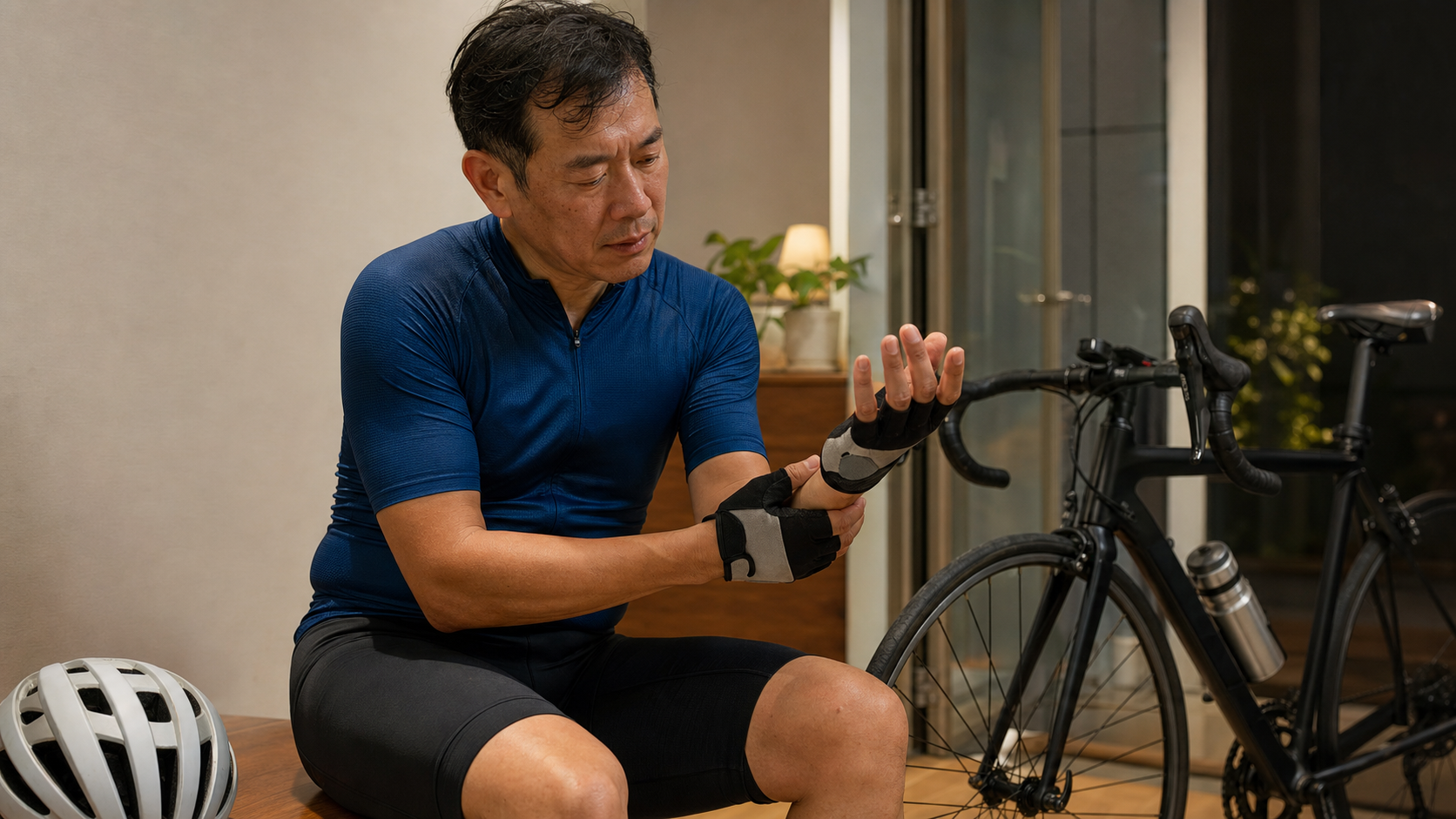
A few years ago, I coached a long-distance cycling enthusiast in his forties—let’s call him A-Jhe. His fitness was actually decent; he could complete several 100-kilometer-plus challenges a year, and he’d ridden classic routes for Taiwanese cyclists like Wuling and Fengguizui. But one day he came to see me with a grim expression, saying he’d recently been waking up at night with a numb, painful sensation in his right hand, and only shaking it out brought some relief. After riding for more than an hour, his thumb, index finger, and middle finger would go numb, and he even felt weakness in his palm—he could barely grip his water bottle.
I first asked a few key questions: Which fingers are numb? Is it the whole hand or a specific area? Does it wake you up at night? His answers pointed almost textbook-style to a common yet often overlooked issue—Carpal Tunnel Syndrome (CTS).
Many people hear “carpal tunnel syndrome” and immediately think of office workers typing all day, checkout cashiers, or homemakers. That’s true, but as a coach who has worked with athletes and general fitness enthusiasts for over a decade, I want to tell you: athletes—especially cyclists, weightlifters, and yoga practitioners—are actually a high-risk group for carpal tunnel and related nerve compression issues. It’s just that few people connect “numb hands” with “exercise.”
In this article, I want to take a fairly comprehensive look at carpal tunnel syndrome from start to finish: what it actually is, why it targets athletes, how it relates to cycling posture, how you can prevent it through posture and equipment adjustments, and—when symptoms have already appeared—what you can handle yourself and when you absolutely must see a doctor. It’ll be a bit long, but I hope that after reading it, you’ll truly take your wrists seriously.
Let me first address a common gap in understanding I see with trainees: people usually pay close attention to caring for their knees, lower back, and Achilles tendons because “the pain is obvious and directly affects running or riding.” But wrist and hand nerve issues tend to accumulate slowly and worsen quietly—at first it’s just a bit of soreness and numbness after riding, which you brush off. By the time you’re waking up numb at night or experiencing obvious grip weakness, it’s usually been going on for a while. Nerve tissue recovers slowly after prolonged compression, so “catching it early and adjusting early” is far more worthwhile than “dealing with it once problems arise.” That’s also why I wanted to write this.
1. First, Understand: What Exactly Is the Carpal Tunnel?
A Nerve Passing Through a Narrow Passage
On the palm side of your wrist, there’s a passage formed by the carpal bones and a band called the “flexor retinaculum (transverse carpal ligament),” shaped somewhat like a tunnel—this is the carpal tunnel. This tunnel is actually quite crowded, packed with nine flexor tendons and one very important nerve—the median nerve.
The median nerve supplies sensation to the thumb, index finger, middle finger, and the thumb-side half of the ring finger. It also controls a muscle at the base of the thumb called the “thenar muscles,” enabling the “thumb opposition” movement for gripping. When this nerve is compressed or inflamed inside the carpal tunnel, you get the classic numbness, tingling, and pain in the thumb, index finger, middle finger, and half the ring finger—that’s carpal tunnel syndrome.
Here’s a crucial distinguishing point: if the numbness is in the pinky and the pinky-side half of the ring finger, that’s usually not the median nerve—it’s the “ulnar nerve.” This distinction is especially critical for cyclists, and I’ll cover it in detail later.
Why Does the Tunnel Get Crowded?
The carpal tunnel is a closed structure with fixed space. Anything that causes the contents to swell or the passage to narrow increases pressure inside the tunnel and compresses the median nerve. Common causes include:
- Repetitive wrist motions and prolonged force: Repeatedly flexing and extending the wrist, or sustained gripping, causes tendon friction and inflammation of the tendon sheaths.
- Wrist held in extreme positions for long periods: Excessive wrist extension (bending toward the back of the hand) or flexion (bending toward the palm) significantly raises pressure inside the tunnel.
- Direct local compression: Such as bearing body weight on the base of the palm for extended periods—this is the core issue for cyclists.
- Systemic factors: Pregnancy, hypothyroidism, diabetes, rheumatoid arthritis, obesity, etc., all increase risk.
- Anatomical factors: Some people are simply born with a narrower carpal tunnel.
A frequently cited concept is: wrist posture and grip style directly change the pressure inside the carpal tunnel. Keeping the wrist neutral (straight) and avoiding large degrees of flexion/extension is the basic principle for lowering tunnel pressure and reducing nerve compression. This holds true whether you’re a typist or an athlete.
2. Why Are Athletes a High-Risk Group?
Cyclists: Not Just Carpal Tunnel, but Also “Cyclist’s Palsy”
When it comes to exercise and hand nerves, cycling is the most typical and most studied activity. During long rides, a significant portion of your upper body weight passes through your hands onto the handlebars. This pressure concentrates at the base of the palm, right over the paths of two nerves:
- Median nerve (passes through the carpal tunnel; supplies the thumb, index, and middle fingers)
- Ulnar nerve (passes through the “Guyon’s canal” on the pinky side of the palm; supplies the pinky and half the ring finger)
Hand nerve compression from long-distance riding has a clinical umbrella term: “Cyclist’s palsy” or “Handlebar palsy.” The most typical presentation is ulnar nerve compression, but the median nerve (i.e., the carpal tunnel) is also affected.
This isn’t a rare, minor issue. According to literature reviews, the prevalence of riding-induced ulnar or median nerve compression in the hand ranges from roughly 10% to 70% across different studies—a wide range depending on riding distance, intensity, rider population, and definitions. In other words, if you’re a serious long-distance rider, hand numbness is almost “something you’ll eventually encounter, just a matter of severity.”
One electrophysiological study tracked nerve conduction changes in cyclists before and after multi-day long-distance events. Results showed that after long rides, the motor latency of the deep branch of the ulnar nerve was significantly prolonged—meaning nerve function showed measurable changes. Additionally, some riders’ carpal tunnel symptoms worsened after the event. This tells us: long-distance riding does place physiological stress on the hand nerves—it’s not just “a little hand soreness.” Other observations have noted that a significant proportion of road and mountain bikers experience decreased grip strength after long-distance events.
I want to emphasize: these are all results of “accumulated pressure,” and they can be dramatically reduced through posture, equipment, grip changes, and training—it’s not “riding inevitably means numb hands.”
Why Does Cycling Particularly Compress These Two Nerves?
Several reasons:
- Wrist extension posture: Many people, when riding on the drops or aero bars, bend their wrists backward (extension) to grip securely. This angle raises pressure inside the carpal tunnel.
- Weight pressing directly on the palm base: People with weak cores who rely too much on their arms for upper body support dump excessive weight onto their hands, directly compressing the nerve pathways.
- Not changing hand positions for long periods: Gripping the same spot for one to two hours straight means continuous nerve compression without blood flow recovery.
- Road vibration: Many of Taiwan’s mountain roads and industrial roads aren’t smooth. Prolonged vibration adds to the burden on nerves and soft tissues.
Other Sports Aren’t Immune Either
- Weight training: Movements like bench press, push-ups, and overhead press can irritate the carpal tunnel if the wrist is excessively extended. Farmer’s walks or heavy deadlifts with prolonged high-intensity gripping can also be problematic.
- Yoga and bodyweight training: Poses like downward dog, plank, and handstands involve significant wrist extension under load—a common source of wrist discomfort.
- Racquet sports and climbing: Tennis, badminton, and climbing require repeated gripping and wrist force, also falling under repetitive load.
So, while this article is categorized under cycling health, the concepts apply to all athletes who use their wrists.
3. How to Tell If It’s Carpal Tunnel: Start with This Self-Check Table
Before you scare yourself or brush it off, use the table below for a preliminary assessment. Please note: this is only a self-awareness tool and cannot replace a doctor’s diagnosis.
| Observation Item | Likely Carpal Tunnel (Median Nerve) | Likely Cyclist’s Palsy (Ulnar Nerve) | Possibly Just General Muscle Fatigue |
|---|---|---|---|
| Numb fingers | Thumb, index, middle, half of ring finger | Pinky, half of ring finger | No specific fingers; whole area feels sore |
| Night symptoms | Commonly wakes you at night; shaking hand relieves | Less likely to wake you at night | Usually resolves by the next day after rest |
| Triggering situations | Wrist extension, prolonged gripping, typing | After long rides, pressure on pinky side of palm | During or right after exercise |
| Weakness presentation | Thumb opposition, weakened grip | Difficulty spreading fingers, weakened pinch | Normal strength, just sore |
| Duration | Recurs and becomes more frequent | Hours to days after riding | Usually subsides within a day or two |
A Few Simple Observations You Can Do at Home
- Shake-out test: If your hand goes numb at night or after prolonged sitting and shaking it noticeably relieves the numbness, that’s a fairly typical sign of carpal tunnel.
- Sensory area comparison: Carefully feel whether it’s the “three and a half fingers on the thumb side” or the “one and a half fingers on the pinky side” that’s numb. This is very helpful for distinguishing median vs. ulnar nerve involvement.
- Grip strength changes: If wringing a towel, opening a bottle cap, or gripping the handlebar is noticeably weaker than before, this means it’s no longer just a sensory issue—you need to be more proactive.
When you absolutely must see a doctor (rehabilitation, neurology, or orthopedics):
- Numbness or weakness persists for more than one to two weeks without improvement.
- Muscle atrophy begins to appear (the muscle at the base of the thumb becomes flat and soft).
- Numbness and pain are severely affecting sleep or daily gripping.
- You have concurrent systemic conditions like diabetes, thyroid disease, or rheumatoid arthritis.
Seeking medical care in Taiwan is actually quite convenient. Under the National Health Insurance, you can make an appointment with a rehabilitation or neurology department. The doctor will perform a physical exam and, if necessary, arrange nerve conduction studies (NCV) and electromyography (EMG) to confirm the location and severity of nerve compression. Don’t just buy braces online or take unverified supplements and call that treatment.
4. Core Principles for Prevention and Improvement
Bringing together the scientific foundation above, preventing carpal tunnel and cyclist’s palsy revolves around a few core principles. I’ve organized them into a “Principle–Practice” comparison table below; the practical sections that follow are essentially expansions of this table.
| Core Principle | Why It Works | Specific Practices |
|---|---|---|
| Keep wrist neutral | Lowers carpal tunnel pressure, reduces nerve stretching | Adjust handlebar height and angle; don’t deliberately bend wrist when gripping |
| Distribute palm pressure | Prevents pressure from concentrating on one point for too long | Use wider bar tape, padded gloves, ergonomic grips |
| Change hand positions regularly | Allows compressed nerves to recover blood flow | Switch hand positions every 3–5 minutes |
| Strengthen core and upper body | Keeps body weight from resting entirely on hands | Train core, back muscles, and shoulder girdle stability |
| Control total load | Reduces cumulative pressure | Progressively increase mileage, prioritize rest |
| Address systemic factors | Reduces overall inflammation and swelling tendency | Manage weight, blood sugar, maintain regular routines |
Let’s go through the practical applications one by one.
5. Cycling in Practice: From Posture and Equipment to Riding Habits
5-1 Wrist and Upper Body Posture
The ideal handlebar grip focuses on “relaxation” and “neutrality”:
- Keep your wrist straight, roughly in line with your forearm—don’t deliberately bend it upward (extension) or let it droop (flexion).
- Keep your elbows slightly bent, not locked straight. Let your elbows act as shock absorbers to take in road vibration instead of letting it all transmit to your wrists.
- Relax and lower your shoulders—don’t shrug. Keep your spine in a natural neutral position, with your head and back in a line.
- Lighten your grip. Imagine your hands are “resting” on the bar rather than “death-gripping” it. Many people squeeze harder when tense, and over time that wreaks havoc on nerves and tendons.
I often tell my trainees: “Your hands are for balance and control, not for bearing weight.” If you find that you slide forward without gripping hard and your body weight keeps pressing onto your hands, the real problem lies in your core and bike fit—not the handlebar itself.
5-2 Change Hand Positions Regularly—The Cheapest and Most Effective Trick
One of the biggest advantages of a road bike is having multiple hand positions: on the hoods, on the brake levers, and in the drops. Actively switching hand positions every 3 to 5 minutes so different contact points take turns bearing pressure is the simplest, most cost-free way to prevent nerve compression—yet it’s the one most people skip.
Flat-bar or mountain bikes have fewer hand positions, so ergonomic grips (discussed later) and adding bar ends become even more important for variety. During long climbs or descents when you’re focused, it’s easiest to “grip one position all the way through”—and that’s exactly when hand numbness strikes. Remind yourself: focus is fine, but remember to switch hands.
5-3 Equipment and Bike Fit
This is an area many people overlook, but it’s a high-ROI investment:
- Gloves: Choose cycling gloves with palm padding that distributes pressure, especially models with adequate cushioning over the nerve pathways at the base of the palm.
- Bar tape/grips: Thicker or double-wrapped tape absorbs vibration. For flat bars, consider ergonomic (wing-shaped) grips that increase the palm contact area and allow a more neutral wrist.
- Frame size and Bike Fit: If your bike “stretches you out too far” (top tube too long, stem too low/long), your center of gravity shifts too far forward, putting weight on your hands. A proper professional Bike Fit adjusting stem length and height, saddle fore/aft and tilt, often resolves hand numbness, neck/shoulder pain, and saddle discomfort all at once.
- Tire pressure and tires: You don’t need to pump tires to maximum pressure. Dropping it slightly, or going with wider tires, noticeably reduces road vibration—kinder to both wrists and backside. This is especially noticeable on Taiwan’s rough mountain and industrial roads.
A practical reminder: Equipment is a supplement; posture and core strength are the foundation. Spending a fortune on top-tier gloves while continuing to hunch over and death-grip with a weak core will yield limited results.
5-4 A Bike Fit Checklist You Can Bring to a Shop
Many cyclists know they should adjust their bike but don’t know where to start. I’ve compiled the wrist-related checkpoints into the table below. You can do a rough self-check or bring it to a fitter for discussion. Remember: these numbers are “common ranges,” not one-size-fits-all. Individual body proportions, flexibility, and riding goals differ, so ultimately, comfort during actual riding is what matters.
| Checkpoint | Common Problem | Adjustment Direction |
|---|---|---|
| Stem height (drop) | Too low causes excessive forward lean, weight on hands | Add spacers, flip the stem, raise the handlebar |
| Top tube/stem length | Too long causes locked arms, tight neck/shoulders | Use a shorter stem, adjust saddle fore/aft |
| Brake lever angle | Wrist forced into extension, pressure at the web of the thumb | Fine-tune handlebar rotation and lever position |
| Saddle angle | Nose-down causes body to slide forward, pressing on hands | Level the saddle or tilt slightly upward |
| Saddle height/fore-aft | Incorrect position prevents core from supporting | Adjust based on pedaling efficiency and pelvic stability |
| Handlebar width | Too wide or too narrow makes shoulders/hands unnatural | Align with shoulder width, fine-tune per riding needs |
I usually advise cyclists: get the saddle right first, then address the handlebar. Because if the saddle position is wrong (too far forward, nose-down), you’ll unconsciously slide forward and dump weight onto your hands—at that point, any handlebar adjustment is just treating the symptom. Once the saddle is stable and your core can support your upper body, your hands naturally feel lighter.
5-5 A-Jhe’s Case: Where Exactly Was the Problem
Let’s return to A-Jhe from the opening. When I watched him ride on the trainer, I spotted several typical problems stacked together: First, his stem was too low and top tube too long, so he was stretched out far forward with his shoulders collapsing. Second, he habitually gripped the drops with his wrists bent upward, holding them in extension for long periods. Third—and most critically—his core strength was insufficient, so as he rode longer, he “propped” himself up with his arms, essentially pressing most of his upper body weight onto the base of his palms. Fourth, he held one position almost the entire ride, rarely switching.
Add those four together, and it would be hard for the median and ulnar nerves not to be compressed. See—this isn’t a single cause, but a combined result of posture, equipment, strength, and habits. That’s also why I dislike single-point solutions like “just buy gloves for numb hands”—truly effective intervention usually requires addressing multiple aspects simultaneously.
6. At Home and in the Gym: Wrist Care and Strengthening Routine
Prevention isn’t just about “being careful while riding”—it also includes daily wrist mobility, strength, and nerve-gliding exercises. The routine below applies to general athletes and takes about 8 to 10 minutes a day.
| Exercise | Purpose | Recommended Dosage | Notes |
|---|---|---|---|
| Wrist flexion/extension stretch | Relax forearm flexors/extensors | 20–30 seconds per side × 2–3 sets | Stretch to mild tension, not pain |
| Median nerve glide | Promote nerve sliding in the tunnel, reduce adhesions | 10 reps × 2 sets | Move gently; back off if you feel numbness/tingling |
| Forearm pronation/supination | Maintain forearm mobility | 10–15 reps per side × 2 sets | Keep elbow close to body; move only the forearm |
| Grip and release (squeeze ball) | Gently strengthen grip muscles, promote blood flow | 15–20 reps × 2–3 sets | Use a soft ball; avoid high-intensity hard squeezing |
| Reverse wrist curl (light weight) | Balance forearm extensor strength | 12–15 reps × 2–3 sets | Start with 1–2 kg; quality over quantity |
| Scapular and core stability | Reduce hand load-bearing | Per training plan | Planks, bird dogs, rows, etc. |
How to Perform a Few of These Exercises
Wrist flexion/extension stretch: Extend your arm straight in front of you. Use one hand to bend the other hand downward (stretching the top of the forearm), then upward (stretching the underside of the forearm), holding each for 20 to 30 seconds. This is the most basic relaxation and can be done before and after riding.
Median nerve glide: These “nerve gliding” exercises aim to help the nerve slide smoothly through its passage and reduce adhesions. The movements should be very gentle—if you feel significant numbness or electric sensations, back off. Because there are many variations, I recommend having a physical therapist demonstrate it for you the first time. Learning the correct version before practicing on your own is much safer than blindly following diagrams.
Reverse wrist curl: Modern people’s forearm flexors (palm-side) tend to be overly tight, while extensors are relatively weak. Moderately training the extensor side helps balance things out. The key is light weight, slow tempo, and feeling the muscle—not chasing heavy loads.
Sleep Posture Matters Too
Many people don’t realize that unconsciously curling your wrist (flexion) while sleeping worsens nighttime hand numbness. If you frequently wake up numb at night, one of the first-line recommendations doctors commonly give is wearing a wrist splint (brace) at night to hold the wrist in a neutral position. These braces are available at medical supply stores in Taiwan or through a doctor’s prescription. However, whether you need one, which type, and how long to wear it should be assessed by a doctor or physical therapist—don’t buy and strap one on randomly.
7. Common Mistakes and Corrections
In my years of coaching, I’ve seen too many cases of “the more I try to care for it, the worse it gets,” usually falling into the following myths.
Mistake 1: Pushing Through Numb Hands—Keep Riding, Keep Training
“I’ll just tough it out” is the most dangerous mindset. Nerve compression accumulates. If you push through brief numbness every time, it can progress to persistent numbness or even muscle weakness and atrophy. The correct approach: when you feel numbness, change hand position, loosen your grip, and if necessary, stop, shake your hands, and move around. If it keeps recurring despite adjustments, reduce volume and seek medical evaluation.
Mistake 2: Thinking “Wearing More Braces Will Fix It”
Braces (especially night splints) do help in specific situations, but wearing a brace all day can actually make wrist muscles weaker and more dependent. Braces are a supplement, not a cure-all. Whether to wear one, and for how long, depends on the situation—leave that to professional assessment.
Mistake 3: Only Changing Equipment, Not Posture and Core
Many people’s first reaction to numb hands is “new gloves, new grips”—that’s not wrong. But if your core is weak, your body is slumped forward, and all the weight is on your hands, even the most expensive gear is just delaying the problem. The fundamental solution is Bike Fit + core and upper body training.
Mistake 4: Treating All Hand Numbness as Carpal Tunnel
Hand numbness has many causes: cervical nerve root compression (neck issues can also cause hand numbness), ulnar nerve compression at the elbow or wrist, thoracic outlet syndrome, and more—their presentations can look very similar. Self-diagnosing and self-medicating may delay the real problem. For recurrent or severe hand numbness, let a doctor clarify the source—that’s the right approach.
Mistake 5: Ignoring Systemic Factors
If you have diabetes, thyroid dysfunction, are overweight, or are pregnant, these significantly affect carpal tunnel risk and recovery. Treating only the wrist while ignoring the underlying systemic condition will yield diminished results. Readers in these categories especially need to discuss individualized plans with their doctors—medication, blood sugar control, and weight management all need attention.
8. Actionable Advice for Readers at Different Levels
Everyone’s situation differs. I’ve divided common groups into three categories with more concrete starting directions.
General Recreational Riders / Commuters (No current symptoms, want prevention)
- Develop the habit of changing hand positions every 3–5 minutes, especially on longer rides.
- Do 2–3 minutes of wrist stretching and relaxation before and after riding.
- Wear a pair of gloves with palm padding; check whether your bar tape is too thin.
- Schedule 2–3 core and upper back sessions per week (planks, bird dogs, rows) so your body weight doesn’t rest entirely on your hands.
- If you’re a commuter who also works at a keyboard, remember to keep your wrists neutral at work too. Adjust keyboard/mouse height and chair armrests so “8 hours at work + 1 hour of riding” doesn’t double-team your wrists.
Advanced / Long-Distance Riders (High mileage, occasional numbness)
- Get a professional Bike Fit done properly—this is the highest-ROI step.
- Check whether you’re “stretched too far, stem too low”; shorten and raise as needed to reduce forward lean.
- For flat-bar bikes, add bar ends or switch to ergonomic grips to increase hand position variety.
- Integrate the wrist care routine above into your weekly training as a scheduled part of the plan, not something you do only when you remember.
- Before long events (like Wuling, island tours, 200 km+), start building core and grip strength several weeks in advance—don’t let your hands face that kind of load for the first time on event day.
Already Have Obvious Symptoms (Persistent numbness, weakness, nighttime waking)
- See a doctor first: rehabilitation, neurology, or orthopedics. Get nerve conduction studies if necessary to clarify severity.
- Undergo rehabilitation under the guidance of a doctor and physical therapist, including nerve gliding, stretching, and strength training, with a night splint if needed.
- Reduce training volume and grip intensity first; return to mileage progressively once symptoms stabilize.
- If you have concurrent conditions like diabetes, thyroid disease, or rheumatoid arthritis, address those simultaneously and discuss an individualized plan with your doctor.
- Do not delay until muscle atrophy appears. Early intervention generally has much better outcomes.
Symptom Severity Levels and Corresponding Actions (For self-awareness only, not a diagnosis)
To give you a better sense of “where you might be now and what to do,” I’ve roughly divided severity into three levels. This is only to help you judge “whether to raise your alert level”—actual grading and treatment should be based on a doctor’s assessment.
| Level | Typical Presentation | Recommended Direction |
|---|---|---|
| Mild | Occasional numbness, relieved by changing hand position or shaking; no obvious weakness | Adjust posture/equipment, add care routine, monitor |
| Moderate | Numbness more frequent, wakes you at night, grip slightly weaker | Reduce training volume, seek medical evaluation, consider night splint and rehab |
| Severe | Persistent numbness, obvious weakness, thenar muscle flattening/atrophy | Seek medical attention promptly, full nerve workup, discuss advanced treatment |
How to Progressively Return to Mileage After Symptoms Improve
Many people rush back to their original training volume the moment symptoms improve, only to relapse. My advice is to treat “return” as a gradual process: start with short, low-intensity rides on smooth routes, deliberately practicing a light grip and regular hand position changes throughout. After each ride, check whether your hands are numb and whether any symptoms linger the next day. Only add distance progressively if there are no issues. If symptoms return, step back to the previous tolerable volume—don’t push through. This “advance three, retreat one” rhythm is far faster than going all-in and repeatedly getting injured.
9. FAQ
Q1: My hands go numb briefly after a ride and it resolves in a few minutes. Should I be worried?
A: Occasional, brief numbness that resolves with a hand position change or shaking is usually a temporary response to compression. Start by adjusting posture, grip strength, and hand-switching habits. But if frequency increases, numbness lasts longer, or weakness begins, you should take it seriously and consider seeing a doctor.
Q2: Do compression wrist sleeves or kinesiology tape help?
A: They may help somewhat with “support and posture reminder,” but they’re not a core treatment for carpal tunnel and can’t replace posture correction or necessary medical evaluation. Don’t treat tape as a miracle cure.
Q3: Can taking B vitamins or fish oil cure hand numbness?
A: A balanced diet is certainly important for nerve health, but there’s currently insufficient evidence that any supplement can “cure” carpal tunnel. Rather than pinning hopes on supplements, focus on posture, load management, core strength, and overall health first. If you do want to supplement, consult a doctor or nutritionist first—especially if you have chronic conditions or are on medication.
Q4: What should people who eat out often or work at desks pay attention to?
A: Eating out in Taiwan commonly means high sodium and low vegetable intake, making weight and metabolic control difficult—and obesity and metabolic issues increase carpal tunnel risk. Diet-wise, increase vegetables and quality protein, and control refined carbs and overly salty soups/broths. Office workers who type for long hours especially need to maintain good wrist posture at work so workplace and athletic wrist loads don’t stack up.
Q5: Is surgery inevitable?
A: Most mild-to-moderate carpal tunnel cases improve through posture adjustment, activity modification, rehabilitation, and (if needed) bracing. Surgery is usually considered only when conservative treatment fails, or when significant nerve damage/muscle atrophy is already present. Whether surgery is needed should be determined by your doctor based on your test results and severity. This article cannot—and should not—make that decision for you.
Q6: Does Taiwan’s hot, humid summer relate to wrist discomfort?
A: Climate itself doesn’t directly cause carpal tunnel. But Taiwan’s summer heat and humidity cause heavy sweating and electrolyte loss during long rides, and hands tend to “grip tighter” for stability when slippery—constant grip tension adds to the burden. In summer, pay more attention to hydration, choose breathable, moisture-wicking gloves, and deliberately remind yourself to relax your grip. In winter, the opposite: cold weather reduces hand blood flow and stiffens joints, so spend more time warming up and getting your wrists and forearms warm before heading out.
Q7: Do phone scrolling and gaming affect this too?
A: Yes. Modern people often spend far more time scrolling phones and typing than exercising—these are all repetitive loads on the wrists and fingers. If you’re already using 3C devices for long hours during the day and then do a high-grip workout in the evening, your wrists essentially never rest. To truly protect your wrists, you also need to address “daily usage habits” beyond exercise: put down the phone regularly, let your wrists rest, and avoid holding fixed postures until your hands go numb.
10. Conclusion: Treat Your Wrists as a Long-Term Asset
Let’s return to A-Jhe from the opening. Here’s what he did afterward: he found a trusted coach and physical therapist to redo his Bike Fit, raising the stem and reducing forward lean; he developed the habit of switching hand positions every few minutes and lightening his grip; he added core and upper back training so his body weight no longer rested entirely on his hands; and at night, he used a splint short-term as advised by his doctor to let his wrists rest. Within a few weeks, his nighttime hand numbness improved significantly, and he was able to return to the long-distance riding he loves.
The key message I want to convey is: between carpal tunnel syndrome and exercise, it’s not an either/or choice of “give up sports or grit through the pain.” In the vast majority of cases, by understanding the causes, adjusting posture and equipment, strengthening the core and upper body, controlling training load, and adding professional intervention when necessary, you can absolutely continue enjoying cycling and exercise while protecting your wrists.
Your hands are a vital part of how you operate in life and experience the world. Don’t wait until you can’t grip a water bottle, can’t hold the handlebar, or wake up numb at night to start taking them seriously. Starting today, put these small habits into your daily routine—keep your wrists neutral, switch hand positions regularly, grip lightly, and train your core—so your hands can carry you further and longer on the bike.
This article is educational content and cannot replace individual diagnosis and treatment advice from a physician, physical therapist, or nutritionist. If you have persistent or worsening hand numbness or weakness, or concurrent conditions such as diabetes, hypertension, heart disease, or thyroid disorders, please seek medical attention and receive individualized evaluation and treatment.
References
- Median and ulnar nerve injuries in cyclists: A narrative review, PMC — https://pmc.ncbi.nlm.nih.gov/articles/PMC8823486/
- The effect of long-distance bicycling on ulnar and median nerves: an electrophysiologic evaluation of cyclist palsy, PubMed — https://pubmed.ncbi.nlm.nih.gov/16000656/
- Effect of Grip Type, Wrist Motion, and Resistance Level on Pressures within the Carpal Tunnel of Normal Wrists, PMC — https://www.ncbi.nlm.nih.gov/pmc/articles/PMC4305197/
- Cyclist’s palsy, Physiopedia — https://www.physio-pedia.com/Cyclist’s_palsy
Related Reading
- Carpal Tunnel Syndrome: A Complete Guide to Hand Numbness and Pain for Cyclists
- Exercise and Hand & Wrist Health: From Bike Handlebars to Daily Support—A Coach’s Guide to Building Strong, Pain-Free Wrists
- Numb Hands and Feet While Riding: Causes of Nerve Compression and Saddle Position Adjustments
- Numb Hands and Weak Grip While Riding? Understanding the Common Causes and Adjustments for Ulnar and Median Nerve Compression in Cyclists
Never Stop 西進武嶺 前後雙機 完整全程錄影 訓練台 實境
8 年前
CT 喇低賽) 武嶺牽車 才是王道 西進牽車四小時內秘訣 攝手位置 如何判斷 防抽筋小秘訣
7 年前
2024 如來神掌 百人約騎挑戰!feat. 秘境單車社團 / 神人們太可怕 / 全程錄影 x 完整坡度解析 / 公路車 / CT Yeh
2 年前
一日北高常見問題大集合 | 攻略 | 路線 | 訓練 | 補給 | 自行車 單車 | 一日雙城 | 雙塔 | TWB北高360 | 屁股痛
6 年前
一日北高/長距離團騎 常見問題補充篇 / 組團或跟團的眉角 / 壯車友容易被瘦車友慢性拉爆 / 原來屁股痛可能是這個原因...? / 風場配速法 / 公路車 / CT Yeh
2 年前
Insta 360 One 超級防手震技術實測
7 年前
Canyon 公路車斷把手 五年老車特規還能修嗎? 維修保養全記錄 feat. 501單車監理站 | 公路車 | CT Yeh
4 年前
風櫃嘴 | 全台最多大砲的單車路線 | 尋寶網攝影師告訴你怎麼擺拍起來才好看 | 熱門攝影地點巡禮
6 年前