Recognizing and Managing Sports Concussions: A Complete Guide to Symptoms, On-the-Spot Response, and Staged Return to Play
Starting with a Crash: The Myth of “If You Can Stand Up, You’re Fine”
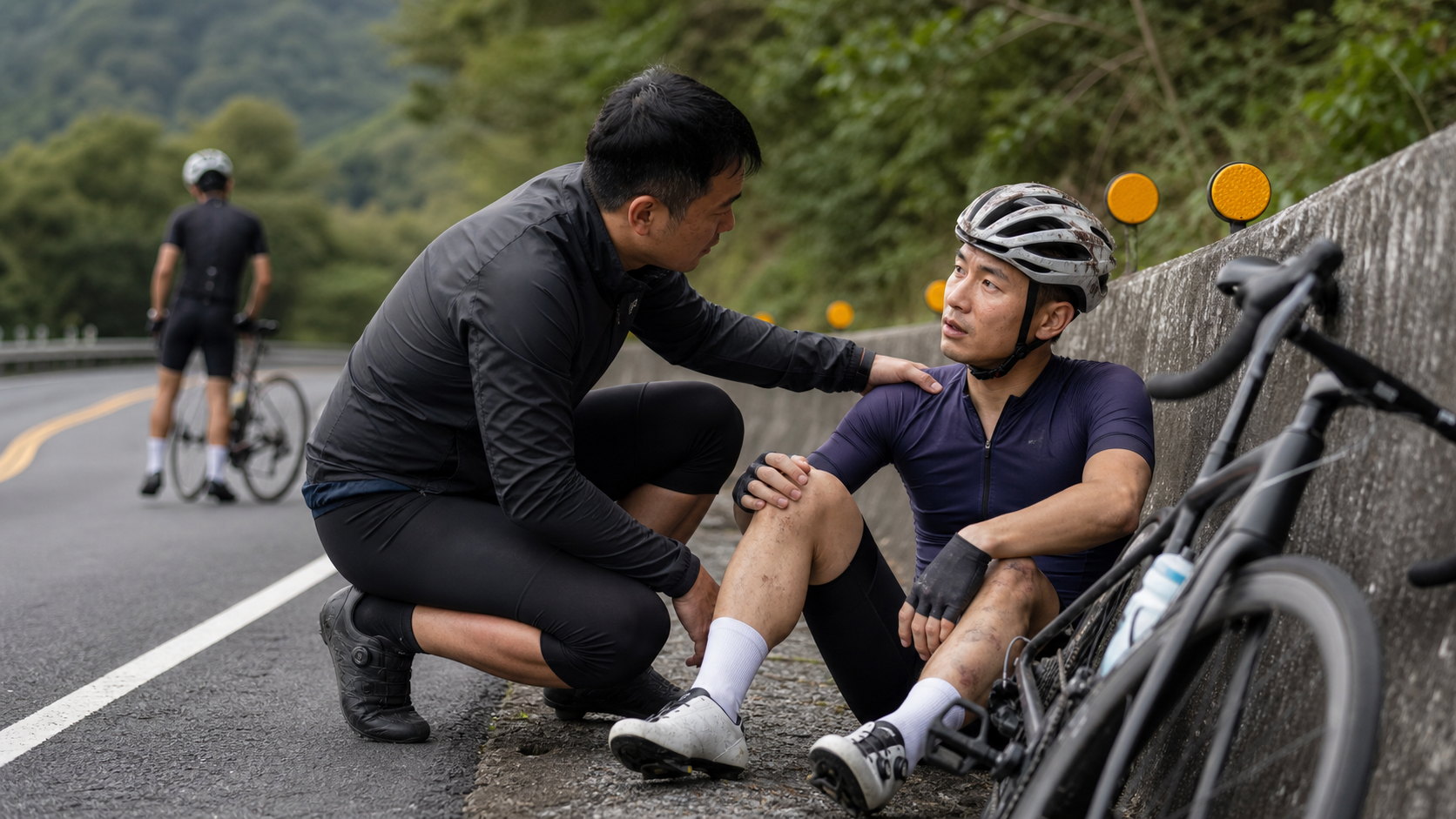
I’ll never forget a weekend a few years ago when I was leading a training ride on the Beiyi Highway. A usually steady rider—let’s call him A-Kai—slipped on loose gravel in a downhill corner. He was thrown forward, the side of his helmet scraped the ground, and his head took a hard knock. He got up quickly, brushed himself off, and said with a smile, “Coach, I’m fine. I had my helmet on. Let’s keep riding.”
At that moment, my internal alarm bells rang even louder. Because in my years of working with athletes, the most dangerous cases have never been the ones who stay down or pass out on the spot—everyone knows to call an ambulance for those. The ones who actually get into trouble are usually the ones who “look fine,” can still talk, and can still walk their bike. I pulled A-Kai over to the side of the road, sat him down, and asked him a few simple questions: “Do you remember how you crashed just now?” “Where did we start from today?” “What time is it roughly?” He paused for two seconds, gave vague answers, and his eyes seemed a bit unfocused. That two-second hesitation was a classic sign of concussion.
In this article, I want to explain sports concussion in the most practical way, tailored to Taiwan’s cycling and sports environment. Not to scare you, but to ensure that every sports enthusiast—whether you ride, run, play ball, or do contact sports—can make the right call at the critical moment. Because the brain is an organ with no spare parts and no second chances. The most important thing I’ve done on the sidelines isn’t teaching technique; it’s deciding within thirty critical seconds whether someone should continue. I hope you can take that judgment with you after reading this.
Foundational Concepts: What Exactly Is a Concussion?
It’s a “Functional” Injury, Not a “Structural” Tear
A concussion is medically classified as a type of mild traumatic brain injury (mTBI). Its essence is this: after a direct blow to the head, or a strong impact to another part of the body where the force travels through the neck to the brain, the brain undergoes rapid acceleration-deceleration or even rotational movement inside the skull. This process causes an immediate imbalance in the brain cells’ ion channels, a massive release of neurotransmitters, and disrupted energy metabolism—simply put, the brain “reboots” for a moment.
Here’s a very important and most misunderstood concept: A concussion usually does not show up as abnormal on a standard CT scan or MRI. Because it’s a “functional” injury, not “structural” damage like a brain bleed or skull fracture. This is why many people go to the ER, get a report saying “no abnormalities,” and assume they’re fine—but concussion is diagnosed through clinical symptom assessment, not imaging. The purpose of imaging is to rule out more serious bleeding or fractures, not to “confirm whether a concussion exists.”
Loss of Consciousness Is Not a Requirement—This Surprises Many People
One thing I constantly emphasize to athletes and parents on the sidelines is: Not fainting does not mean no concussion. According to compiled international medical data, the proportion of sports-related concussion cases involving actual loss of consciousness is quite low—most statistics put it under ten percent. In other words, over ninety percent of people with concussions never lose consciousness.
This number matters because too many people (including coaches, teammates, and even the injured person) use “did they pass out” to judge severity. In reality, someone who remains fully conscious and can walk and talk the whole time can absolutely have a clear concussion. Conversely, while a brief loss of consciousness is a definite danger sign, “no loss of consciousness” can never be a reason to feel relieved.
Concussion vs. More Severe Brain Injury: How to Tell the Difference
Many people can’t distinguish between a “simple concussion” and a “severe brain injury requiring emergency treatment.” The comparison table below helps you grasp the key points—but remember, this is just for understanding. If any red flag warning sign appears, treat it as serious and seek immediate medical attention. Don’t try to make the call yourself.
| Aspect | Simple Concussion | More Severe Brain Injury to Watch For |
|---|---|---|
| Consciousness | Mostly clear, or brief confusion | Coma, increasingly difficult to wake, consciousness steadily worsening |
| Headache | Present, but usually stable or gradually easing | Continuously worsening, increasingly painful |
| Vomiting | Possible nausea, maybe once | Repeated, projectile vomiting |
| Neurological function | Generally normal | Limb weakness or numbness, slurred speech, unequal pupils, seizures |
| Imaging | Usually normal | Possible bleeding or fracture |
| Management | Rest, monitoring, gradual return | Immediate ER visit, possible emergency intervention |
Second Impact Syndrome: Why “Return” Requires Such Caution
The core reason concussion is taken so seriously in sports medicine is the risk of a “second impact.” When the brain is still in the metabolic chaos of the first injury and hasn’t repaired itself, a second impact—even a relatively mild one—can trigger a failure of the brain’s blood flow autoregulation, leading to rapid brain swelling. This rare but extremely dangerous condition is especially concerning in young athletes.
This is the fundamental reason all return-to-play protocols exist: not to delay your return to sport, but to ensure your brain is not exposed to the risk of a second impact before it has fully recovered. I often tell my athletes that the return-to-play protocol isn’t bureaucracy; it’s a life-saving guardrail.
Common Mechanisms of Force: It’s Not Only “Hitting Your Head” That Causes Concussion
Many people think you have to hit your head on something hard to get a concussion. That’s also a misconception. The key to concussion is “the brain undergoing rapid acceleration-deceleration or rotation,” and the point of impact isn’t necessarily on the head. Here are several common scenarios that can cause a concussion:
- Direct impact to the head: Falling and hitting the ground, being struck by a ball or equipment, hitting a barrier or the ground with your head.
- Force transmitted from another body part: For example, a heavy fall on the back or buttocks, where the force travels up the spine to the brain, causing the head to whip around (commonly known as the whiplash mechanism). A concussion can occur even if the head doesn’t directly hit anything.
- Rotational impact: Oblique or rotational impacts are considered particularly damaging to brain tissue through shearing forces.
So the focus of assessment should always be “are symptoms present,” not “did the head actually take a direct hit.” When I’m leading a group, if I see someone take a hard fall with obvious head whipping, even if they say their head didn’t hit anything, I still do a symptom assessment.
Sideline Recognition: The Symptom Checklist You Should Know
I teach athletes to recognize concussion symptoms by dividing them into four categories. The advantage of this classification is that you won’t just focus on the most obvious symptom—headache—while missing other equally important clues.
| Category | Common Symptoms | Key Sideline Observations |
|---|---|---|
| Physical symptoms | Headache, dizziness, nausea or vomiting, blurred or double vision, sensitivity to light or sound, poor balance | Does walking in a straight line veer off? Do they sway when standing? Squinting due to light sensitivity? |
| Cognitive symptoms | Slowed reaction, “foggy” thinking, difficulty concentrating, can’t remember what just happened | Can’t answer simple questions, repeats the same question, delayed responses |
| Emotional symptoms | Irritability, unexplained anxiety or sadness, mood swings more than usual | Personality suddenly seems different, unprovoked anger |
| Sleep symptoms | Drowsiness, insomnia, poor sleep quality (usually emerges hours to days after injury) | Follow-up observation over the next few days; family members notice it most easily |
The “Maddocks Questions”—The Most Practical Orientation Test on the Sideline
For rapid sideline assessment of a possible concussion, sports medicine commonly uses a set of simple orientation questions (derived from the concept of the Sport Concussion Assessment Tool). They’re easy for coaches and teammates to memorize. You don’t need to be a medical professional to ask them:
- “Where are we right now?” (the venue or training route location)
- “Is it the first half or second half? What time is it roughly?”
- “What was the last landmark we passed / who was leading the last segment?”
- “Do you remember how you got injured?”
- “Where did we start from today?”
The key isn’t whether the answers are “textbook correct,” but whether there’s hesitation, confusion, or behavior that’s clearly out of character. Like A-Kai pausing for two seconds and failing to answer—that’s a clear red light. If they can’t answer any question or seem clearly off, treat it as a concussion—this is the “better safe than sorry” approach. Err on the side of caution.
The One-Sentence Principle: When in Doubt, Sit Them Out
There’s a widely known slogan in international sports medicine: “When in doubt, sit them out.” I translate it into more practical coaching language: “Not sure? Sit them out.” This is the single most important and non-negotiable principle in all of concussion management. Because if you misjudge and make someone who’s fine rest, the worst outcome is missing one day of training. But if you misjudge and let someone with a concussion continue exercising, the cost could be irreversible.
Danger Signs: These Situations Require Immediate Medical Attention
The symptoms described above are for a “general concussion,” requiring rest and monitoring. But there’s a set of symptoms that are red flags, indicating it might not be a simple concussion but a more severe brain injury (such as intracranial bleeding). If any of the following appears, don’t hesitate—call 119 immediately or go to the emergency room. In Taiwan, make good use of the National Health Insurance emergency resources. When it’s time to go, go. Don’t skip this trip to save trouble.
| Danger Signs (Red Flags) | Why They’re Dangerous |
|---|---|
| Loss of consciousness (no matter how brief) | Indicates significant force to the brain; requires medical evaluation |
| Repeated vomiting | May indicate elevated intracranial pressure |
| Headache that keeps worsening, increasingly painful | One of the classic signs of intracranial bleeding |
| Seizures or convulsions | Requires immediate medical intervention |
| Worsening consciousness (increasingly drowsy, hard to wake, increasingly incoherent) | A warning sign of ongoing brain function deterioration |
| Numbness or weakness in limbs, slurred speech, worsening double vision | May involve neurological damage |
| Agitation, unusual emotional excitement, or clearly confused behavior | Manifestation of impaired brain function |
| Neck pain or tenderness (suspected concurrent cervical spine injury) | Must immobilize the neck when moving to avoid secondary injury |
| Unequal pupil size | May be an emergency sign of elevated intracranial pressure |
Special reminder: If the injured person has neck pain, or the impact was high-speed (such as a cycling crash or car accident), do not move or turn their head and neck until a cervical spine injury has been ruled out. Keep them in their current position, stabilize the head and neck, and wait for professional medical help. This is especially critical in cycling crashes, because they often involve force to both the head and neck.
At the Moment of Injury and the First 48 Hours: Management Principles
Immediate Management: The 3R Principle
I teach athletes to remember what to do at the moment of injury with a simple “3R”:
- Recognise: Use the symptom checklist and Maddocks questions above to determine if a concussion is possible.
- Remove: If there’s any suspicion, immediately stop exercising and leave the field or route. Do not return to exercise that day under any circumstances—this is the “no same-day return” rule, and it’s ironclad.
- Refer: If red flags are present, go to the ER immediately. Even without red flags, it’s recommended to seek medical evaluation as soon as possible after the injury and arrange follow-up.
The First 24 to 48 Hours: Relative Rest, Not Complete Bed Rest
The old-school belief was “a concussion means being locked in a dark room with complete rest and doing nothing.” But this concept has been updated by the latest international consensus. According to the 6th International Consensus Conference on Concussion in Sport, published in 2023 (from the 2022 Amsterdam meeting), the current recommendations are:
- For the first 24 to 48 hours after injury, take “relative rest”—meaning moderately reducing physical and cognitive activities that worsen symptoms (such as intense exercise, prolonged screen time, mentally demanding work), but you don’t need to lie in a dark room doing absolutely nothing.
- After this initial rest period, the consensus recommends early, gradual introduction of light aerobic activity that doesn’t worsen symptoms (such as easy walking or low-intensity stationary cycling). Research suggests that starting this type of low-intensity aerobic exercise within the first few days after injury, as long as symptoms don’t worsen, can help reduce the likelihood of symptoms persisting too long.
- The principle for judging intensity is simple: If symptoms don’t noticeably worsen during or after the activity, it’s fine. If an activity clearly makes the headache or dizziness worse, step back down to the previous intensity.
Let me emphasize: “early activity” does not mean “hurry back to exercise.” Light aerobic activity is part of rehabilitation, which is different from the return-to-play protocol. Returning to play must follow the staged process described later.
Observation and Companionship: Practical Advice for Taiwanese Families
During the first 24 hours after injury, it’s best to have a family member or roommate nearby to observe. Traditionally, people worry about “what if they fall asleep and don’t wake up.” In modern medical opinion, if there are no red flags after medical evaluation, letting the injured person rest and sleep normally is fine. The key is that those around them should watch for worsening symptoms. If any red flag from the table above appears—such as becoming increasingly hard to wake, repeated vomiting, or worsening headache—go to the ER immediately.
Return-to-Play Protocol: Staged, with at Least 24 Hours per Stage
This is the most core practical tool in the entire article. The international consensus provides a graduated return-to-sport (GRTS) protocol. Its spirit is: Start from rest, increase intensity stage by stage, spend at least 24 hours at each stage, and symptoms must not be provoked or worsened during the process. If symptoms appear at any stage, drop back to the previous stage, rest for at least 24 hours, and then try again.
Here’s the return-to-play stage table I give to my athletes (presented as the common six-stage model; in practice, it’s individualized based on the person and sport type):
| Stage | Goal and Activity | Specific Examples (Cycling / General Sports) | Minimum Time per Stage |
|---|---|---|---|
| Stage 1 | Daily activities within symptom limits | Normal daily routine, gradually returning to activity levels that don’t provoke symptoms; avoid prolonged screen time | At least 24 hours |
| Stage 2 | Light aerobic exercise | Easy walking, low-intensity stationary cycling, keeping intensity at a level where heart rate rises slightly but symptoms don’t worsen (e.g., can hold a normal conversation) | At least 24 hours |
| Stage 3 | Individual sport-specific training | Slightly higher intensity riding or running, still avoiding any impact or fall risk; no technical or high-concentration movements | At least 24 hours |
| Stage 4 | Non-contact training | Adding more complex training content, resistance training, intervals; beginning to resume activities with higher cognitive load | At least 24 hours |
| Stage 5 | Full-contact training | After medical professional clearance, resuming normal training (including contact drills for contact sports) | At least 24 hours |
| Stage 6 | Full return to competition | Resuming normal competition | — |
There are several key points I always explain to athletes word for word:
- It takes at least several days: Because each stage requires at least 24 hours, even if everything goes smoothly with no symptom recurrence, going from initial rest after injury to full return to competition typically takes about a week or more. Any approach claiming “you can be back in a day or two” violates the spirit of the protocol.
- Drop back a stage if symptoms appear: This is the soul of the protocol. Dizziness returns during Stage 3 training? Drop back to Stage 2, rest at least 24 hours, then try again. Don’t push through, and don’t skip stages.
- Professional evaluation recommended before returning to contact sports: Before entering Stage 5 (full-contact training), it’s strongly recommended to get clearance from a physician familiar with sports concussion.
- Be more conservative with children and adolescents: The developing brain typically recovers more slowly. Young athletes should progress more cautiously, and priority should be given to ensuring “return to learn” (academics) is going well before discussing return to sport.
Common Mistakes and Corrections: I’ve Seen These Too Many Times on the Sidelines
Over the years of leading teams, I’ve seen all kinds of mishandling. Here are the most common mistakes and the correct approaches:
Mistake 1: “Wearing a Helmet Means No Concussion”
Correction: Helmets significantly reduce the risk of skull fractures, scalp lacerations, and fatal brain bleeds. You must wear a helmet when cycling, wear it correctly, and fasten it properly—there’s no question about that. But a helmet cannot completely prevent concussion, because concussion results from the brain’s acceleration-deceleration and rotation inside the skull, which can’t be eliminated by outer shell cushioning alone. Wearing a helmet is necessary protection, but it’s not a “wear it and you’re immune” charm. A-Kai’s case was an example of getting a concussion while wearing a helmet.
Mistake 2: “He Can Walk and Talk, So He’s Probably Fine—Keep Going”
Correction: As mentioned earlier, over ninety percent of people with concussions never lose consciousness. Being able to walk and talk does not rule out a concussion at all. The basis for judgment is symptoms, not “can they still stand.” When in doubt, sit them out.
Mistake 3: “Rest a Bit, Then Get Back Out There”—Same-Day Return
Correction: Never return to play on the same day. This is the highest-risk scenario for second impact syndrome. Feeling a bit better after resting for half an hour doesn’t mean the brain has healed—temporary symptom relief and physiological recovery are two different things. When the day is over, it’s over.
Mistake 4: “Lock Them in a Dark Room with Complete Bed Rest, Doing Nothing”
Correction: This is an outdated concept. Current recommendations are “relative rest” for the first 24 to 48 hours, followed by early introduction of light aerobic activity that doesn’t worsen symptoms. Excessive and prolonged complete rest can actually prolong recovery.
Mistake 5: “Symptoms Are Gone, So Go Straight Back to Competition”
Correction: Symptom resolution is just the starting point for return, not the finish line. You still need to complete the return-to-play protocol stage by stage, with at least 24 hours per stage, confirming that symptoms don’t recur as intensity increases, before it’s truly safe. Skipping stages is why many athletes have recurring problems.
Mistake 6: “Just Take Painkillers to Suppress the Headache”
Correction: Medication in the early phase (especially certain painkillers) should be discussed with a physician, because some medications may affect your ability to judge symptom changes, and there may be other considerations. More importantly, suppressing symptoms with medication is not recovery—symptoms are a key indicator for judging your return progress. Suppressing them removes your most important warning light.
Actionable Advice for Readers at Different Levels
For General Recreational Athletes
- Get your gear right: Always wear a certified helmet when cycling and fasten it properly. If the helmet has been in a crash or has cracks in the shell, replace it (a helmet that has absorbed one impact has reduced protective capacity).
- Remember three words: Recognize, Remove, Refer. After hitting your head, self-check using the symptom checklist. If there’s any doubt, stop exercising for the day.
- Don’t tough it out alone: If you hit your head while riding solo, it’s better to end the ride early and find someone to be with you rather than pushing on. Mountain routes in Taiwan often have poor signal coverage. First, move to a safe location with signal and people.
- Make good use of the NHI: If any red flag appears, go to the ER directly. Medical care is easily accessible in Taiwan—don’t delay because you want to avoid the hassle.
For Coaches, Team Captains, and Event Organizers
- Establish consensus before the event: Explain to team members before departure that “when in doubt, sit them out” is an ironclad rule, so everyone is mentally prepared and no one feels that sitting out is “ruining the fun.”
- Learn the Maddocks questions: Memorize those orientation questions so they’re ready to use immediately after a crash or impact.
- Prepare emergency contacts and location info: When leading a group, know the route, the nearest medical facilities, and emergency contact methods. Many popular cycling routes in Taiwan (such as Beiyi, Fengguizui, and along the Wuling line) have large elevation changes and variable weather, so advance planning is important.
- No same-day return, no rushing return: The organizer’s and coach’s role is to be a guardrail, not a pusher.
For Athletes Committed to Long-Term Participation
- Know your own “baseline”: Understand your usual reaction speed, balance, and emotional state so you have something to compare against when injured.
- Report symptoms honestly: Be honest with your brain. Hiding symptoms to return early may look proactive in the short term, but in the long term, you’re trading your health for one practice or competition. It’s a terrible deal.
- Respect the cumulative effect: Multiple concussions, especially when injured again before full recovery, are considered associated with risks of long-term sequelae. Handling each one properly is being responsible to your athletic career.
- Seek professional evaluation before returning: Before returning to contact sports or high-intensity competition, it’s worth getting evaluated by a physician or physical therapist familiar with sports concussion.
Case Follow-Up: A-Kai’s Seven-Day Return Timeline
Principles alone are too abstract. Let me lay out A-Kai’s actual management process as a timeline so you can see how the protocol works in reality. This is an “everything went smoothly, no recurrence” ideal case; if symptoms had appeared, it would have taken longer.
| Time Point | Status and Management | Corresponding Stage |
|---|---|---|
| Day 0 (moment of injury) | Crashed, head hit the ground, couldn’t answer orientation questions, eyes unfocused. Immediately removed from ride, teammate accompanied him down the mountain, medical evaluation that day confirmed no red flags | Recognize → Remove → Refer |
| Days 0–2 | Relative rest: reduced intense activity and prolonged screen time, but maintained normal routine and light walking. Headache gradually eased from moderate | Initial rest |
| Day 2 | Light aerobic test: indoor trainer / low-intensity stationary cycling for about 15–20 minutes, symptoms did not worsen | Stages 1–2 |
| Day 3 | Individual sport-specific: easy flat-road riding outdoors, avoiding heavy traffic and downhill sections, no symptom recurrence | Stage 3 |
| Day 4 | Non-contact training: added intervals and resistance, resumed higher cognitive load work, all without discomfort | Stage 4 |
| Days 5–6 | Resumed more complete training, cleared after evaluation | Stage 5 |
| Day 7 onward | No symptom recurrence throughout, fully returned to normal riding and competition | Stage 6 |
You’ll notice that even in an “everything went smoothly” case, it took a full week. That’s why I say no to anyone who wants to “get back out there tomorrow.” The brain’s repair doesn’t speed up just because you’re in a hurry.
Frequently Asked Questions (FAQ)
Q1: How long does a concussion generally take to heal?
A: Most adults see symptoms gradually resolve within a few days to about two weeks, but individual variation is significant. Adolescents and children may take longer. If symptoms persist without improvement for more than a few weeks, you should return to the doctor for evaluation and discuss whether further rehabilitation is needed.
Q2: Can I look at my phone or watch shows after the injury?
A: During the initial 24 to 48 hours, it’s recommended to reduce cognitive activities that worsen symptoms, such as prolonged screen time, but it doesn’t need to be completely forbidden. The principle is the same: “fine as long as symptoms don’t worsen.” If the headache or dizziness gets worse, rest.
Q3: Do I definitely need a CT scan or MRI?
A: Not necessarily. Imaging is mainly used to rule out more serious bleeding or fractures. Whether it’s needed is determined by the physician based on symptoms and the mechanism of injury. A concussion itself usually doesn’t show up on imaging; diagnosis relies on clinical assessment.
Q4: Can I have a drink to relax?
A: Alcohol is not recommended in the early phase of injury. Alcohol can affect your ability to judge symptom changes and may also impact recovery and sleep quality.
Q5: I’ve had a concussion before. Will this one be more severe?
A: People with a history of concussion may recover more slowly from subsequent concussions and need to be even more careful with management and full recovery. This is exactly why every concussion needs to be taken through the return-to-play protocol properly.
Q6: Symptoms seem to improve and then come back. Is that normal?
A: Fluctuations in symptoms during recovery are not uncommon, especially during stages of increased intensity. The principle is: if a specific activity clearly provokes symptoms, drop back a stage, rest at least 24 hours, and try again. If the recurrence persists and you can’t progress, return to the doctor for evaluation and arrange targeted rehabilitation (such as vestibular, cervical spine, or exercise tolerance management).
Q7: Where in Taiwan can I find medical resources familiar with sports concussion?
A: You can start with hospital neurology/neurosurgery departments, rehabilitation departments, or medical institutions with sports medicine clinics. When you see a doctor, clearly explaining “how you were injured, whether you lost consciousness, what symptoms appeared, and how symptoms have changed” is very helpful for the physician’s assessment. Medical care is easily accessible in Taiwan—don’t delay evaluation because you’re afraid of the hassle.
Prevention Over Treatment: Things You Can Do to Lower Risk
No matter how well you manage it, it’s always better to avoid the injury in the first place. Concussions can’t be 100% prevented, but there are several things that can substantially reduce risk:
- Wear your helmet correctly and consistently: Proper fit, fastened securely, positioned correctly (forehead not too exposed). Replace it after a crash or if the shell has cracks.
- Strengthen neck muscles: Stronger neck musculature helps stabilize the head during impact and reduces the amplitude of head whipping. This is especially worth incorporating into regular training for those in contact or high-speed sports long-term.
- Manage technique and environment: Control downhill speed when riding, anticipate loose gravel and wet surfaces. In Taiwan, summer afternoon thunderstorms and mountain fog can worsen road conditions and visibility. Know your limits and call it a day early when necessary.
- Don’t push through fatigue: Fatigue slows reactions and increases the chance of crashing. Rest when you’re tired; don’t push technical sections when physically depleted.
- Team culture: Making “when in doubt, sit them out” a team norm rather than something embarrassing is the most effective long-term prevention.
Conclusion: Bring Every Brain Home Safely
Back to A-Kai at the beginning. That day, I didn’t let him continue riding. I had a teammate accompany him down the mountain, he got medical evaluation that day, and then he followed the return-to-play protocol stage by stage. About a week or so later, he had fully recovered and was back riding with the team. He’s been fine ever since. He later told me, “Coach, I’m glad you made me sit out that day.”
What I want to say is this: managing sports concussion is never some esoteric medical technique. The core comes down to a few sentences: No loss of consciousness doesn’t mean you’re fine, when in doubt sit them out, never return the same day, come back gradually through stages, and go to the ER immediately if red flags appear. Remember these, actually do them, and you’ll avoid the vast majority of tragedies.
The purpose of sports is to help us live healthier, happier lives. Don’t let one stubborn return to play cost you decades of life ahead. The brain is an organ that deserves your most cautious treatment. Next time you hit your head, remember to stop first and assess carefully—your brain will thank you, and your future self will thank the you who made the right decision now. Ride safely, train safely, and we’ll be able to stay on the road together for much longer.
This article is educational content and cannot replace individual diagnosis and treatment advice from a physician, physical therapist, or nutritionist. If you experience any head injury symptoms after exercise, especially the danger signs listed in this article, please seek medical evaluation as soon as possible.
References
- NCAA.org — International panel of experts revises recommendations for diagnosis, management and prevention of concussion in sport (Overview of the 6th International Consensus Conference on Concussion in Sport, 2023): https://www.ncaa.org/news/2023/6/14/media-center-international-panel-of-experts-revises-recommendations-for-diagnosis-management-and-prevention-of-concussion-in-sport.aspx
- CDC HEADS UP — Responding to a Sports-related Concussion (Sideline management and removal principles): https://www.cdc.gov/heads-up/response/
- Nebraska Medicine — Concussion symptom red flags and when to seek medical care (Danger signs and when to seek care): https://www.nebraskamed.com/health/conditions-and-services/sports-medicine/concussion-symptom-red-flags-and-when-to-seek
- Complete Concussions — When Should I Go to The Emergency Department for Concussion? (ER red flags): https://completeconcussions.com/concussion-tips-information/when-should-i-go-to-the-emergency-department-for-concussion/
Related Reading
- How to Assess Yourself After a Crash: Which Situations Require Immediate Medical Attention, Which Can Be Observed, and Concussion Red Flags
- Concussion Recognition and Management for Cyclists: Brain Injury Prevention Beyond Helmet Protection
- How to Return After a Crash: Progressive Principles from Wound Care, Concussion Warnings to Getting Back on the Bike
- Concussion Assessment: Managing a Basketball Player’s Head Impact
摔車後補裝備: 好市多新款單車安全帽& Specialized Romin 北高整路屁股都不痛的坐墊 | 一千元居然有MIPS | CT Yeh | 公路車
4 年前
Never Stop 西進武嶺 前後雙機 完整全程錄影 訓練台 實境
8 年前
一日北高/長距離團騎 常見問題補充篇 / 組團或跟團的眉角 / 壯車友容易被瘦車友慢性拉爆 / 原來屁股痛可能是這個原因...? / 風場配速法 / 公路車 / CT Yeh
2 年前
爬陡坡被爆胎的車友跑步超車 #cycling #里佳部落
9 個月前
小野田真的存在!日本赤城山爬坡公路賽 台灣首發團完全實錄 | 頭文字D真實賽道! | 看完東奧自行車賽後好想再去騎一次啊! | 公路車 | CT Yeh
4 年前
CT 喇低賽) 武嶺牽車 才是王道 西進牽車四小時內秘訣 攝手位置 如何判斷 防抽筋小秘訣
7 年前
一日北高常見問題大集合 | 攻略 | 路線 | 訓練 | 補給 | 自行車 單車 | 一日雙城 | 雙塔 | TWB北高360 | 屁股痛
6 年前
一個測試有沒有認真練車的方法😂 #公路車
10 個月前