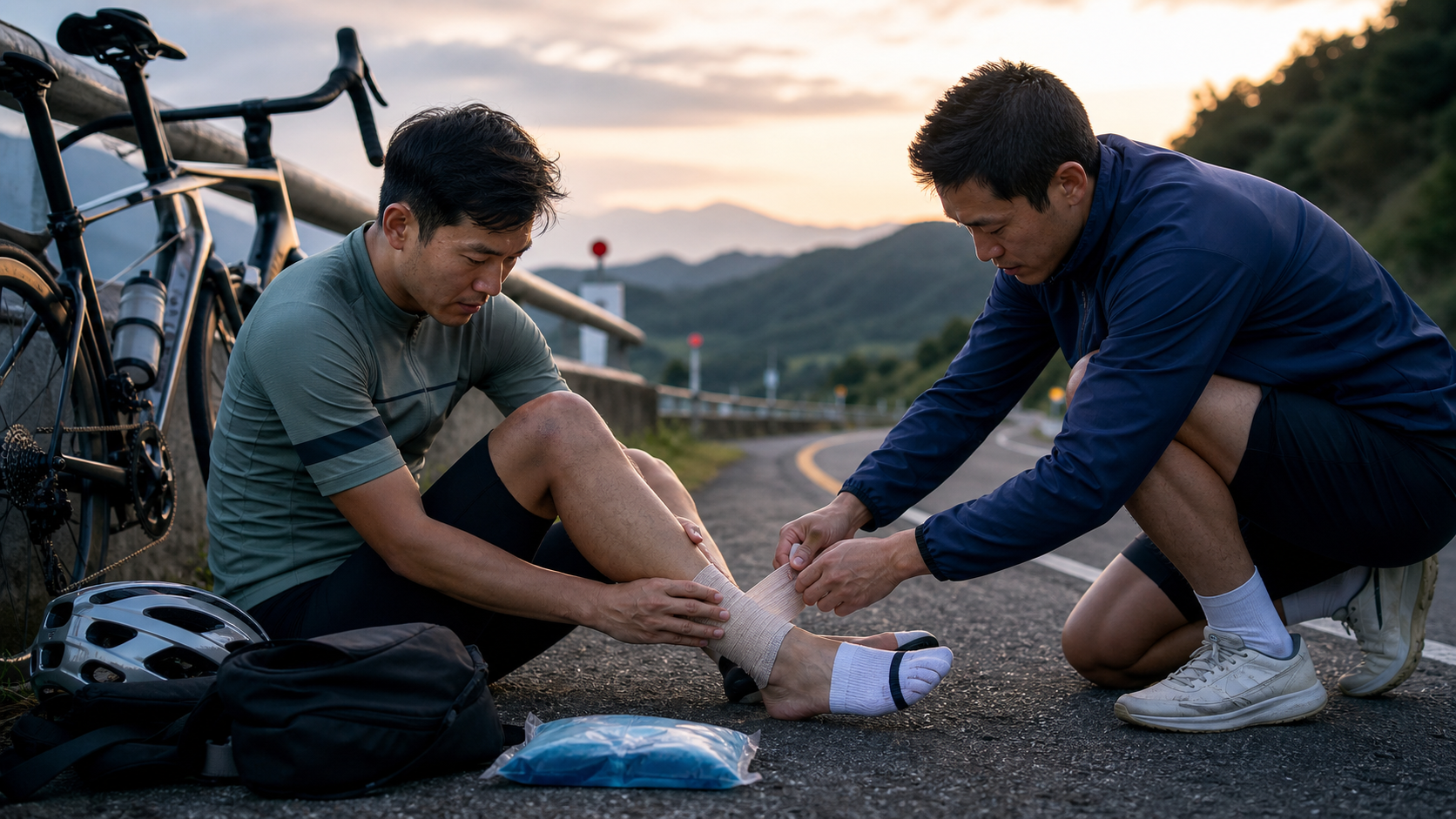
A Late-Night Message That Made Me Write This
It was late on a Sunday night when a message popped up on my phone from a long-time client: “Coach, I just crashed on a descent and my right ankle is swollen. I’m icing it now—how long should I ice it? Should I wrap it tight and keep it still?”
I’ve been working with athletes and general fitness populations for about fifteen years, and I get messages like this almost every month. In the past, my instinctive reply would have been: “Ice, compress, elevate, rest—ice it for twenty minutes first.” But in recent years, my answer has become completely different. I replied to her: “Don’t rush to keep icing. Can you put weight on the foot? How bad is the pain on a scale? Is there any obvious deformity?”—because the sports medicine community has undergone a crucial shift in thinking over the past few years about how acute soft tissue injuries should actually be managed.
If you’re the kind of rider who attacks descents, hits the mountains on weekends, or occasionally “rolls” an ankle or wrist, this article is worth ten minutes of your time. Because the RICE protocol you were taught growing up—Rest, Ice, Compression, Elevation—is being gradually replaced by a new set of principles: PEACE & LOVE. And the most controversial, most counterintuitive part of it all is the topic of “icing.”
Let me give you the bottom line first: this doesn’t mean RICE is entirely wrong, nor does it mean icing is now forbidden. It means our understanding of “inflammation” and “recovery” has deepened, and the mindset has shifted from “suppression” to “guidance.” Below, I’ll walk you through it step by step, in the same tone I use with my clients.
The Conceptual Foundation: Inflammation Is Not the Enemy—It’s the Starting Point of Repair
The Historical Baggage of RICE
The RICE acronym was first proposed in 1978 by a sports medicine physician, written into his best-selling book, and from there became the standard mantra for coaches, PE teachers, and parents worldwide. Its core logic was simple: when you’re injured, you need to suppress inflammation, reduce swelling, and avoid movement.
That logic made perfect sense at the time. Swelling hurts and restricts movement, so suppressing it makes people feel better. The problem is—subsequent research has shown us that inflammation itself is actually a necessary process for the body to repair tissue, not a bad thing that needs to be eliminated.
What Is Inflammation Actually Doing?
When your muscle, ligament, or tendon is injured, the body triggers a cascade of responses: blood vessels dilate, immune cells (such as macrophages) flood into the injured site, clear away necrotic tissue debris, and simultaneously release various signaling molecules that recruit the cells needed for repair, promote new blood vessel formation, and ultimately rebuild the tissue.
This entire process requires blood flow and the transmission of inflammatory mediators. If we aggressively suppress it—for example, by prolonged icing that keeps blood vessels constricted, or by taking large doses of anti-inflammatory drugs to block the inflammatory pathway—we may theoretically be interfering with the early repair signals instead.
This is the core message behind the new guidelines: Don’t blindly fight inflammation—guide it, support it, and let it finish the job it’s meant to do.
Distinguishing “Inflammation” from “Persistent Chronic Inflammation”
Let me clear up a common misconception here. When we say “inflammation is good,” we’re referring to that acute, purposeful, self-limiting inflammatory response in the early stage of injury. It’s like a construction crew on site: they move in, clear the area, rebuild, and then pack up and leave.
What’s truly harmful is that lingering, unresolved inflammation that drags on into a chronic state—that’s the problem that needs addressing. But for a typical acute sprain, strain, or contusion, the body is fully capable of letting inflammation subside naturally once its job is done. When we over-ice and over-medicate to suppress it, it’s like kicking the construction crew out the moment they arrive—the project just takes longer.
So the right mindset is: respect acute inflammation as a “time-limited repair process,” while using moderate compression and elevation to manage the discomfort and movement restriction caused by “swelling”—managing swelling and suppressing inflammation are two different things.
The Icing Controversy: The Most Shocking Part of All This
I know many readers will frown at this point: “Isn’t icing just common sense? Even the physician who originally proposed RICE has come out and spoken about this?”
Yes, and that’s exactly what makes this so dramatic. The physician who originally proposed RICE and put “Ice” into the acronym has publicly stated in recent years that, based on current evidence, icing (and rest) may actually delay tissue repair—and that if he were to rewrite his book, he would revise the concept. That statement caused a major stir in the sports medicine community.
What’s Actually Happening When You Ice?
Let me use the analogy I often use with my clients. Icing causes local blood vessels to constrict, which does provide temporary pain relief and slows the spread of swelling—that part is true, and nobody denies it. But the problem is:
- Icing constricts blood vessels, which reduces the delivery pathway for repair cells and signals to the injured site. The transport of inflammatory mediators and scavenger cells is delayed, slowing down the very first step of repair.
- Prolonged or repeated icing may turn “temporary pain relief” into “prolonged recovery.” Some literature reviews have found that longer-duration icing applications delay long-term recovery and may even have adverse effects on muscle; there’s also the view that icing’s effect on healing (for better or worse) may be mainly limited to superficial injuries in individuals with lower body fat.
- The pain-relieving effect itself is limited. Ice does produce analgesia, but the evidence for “sustained pain relief beyond the immediate treatment window” is actually limited.
So Can I Still Ice or Not?
Please note: I never tell my clients that “icing is sinful and absolutely off-limits.” That’s a common misreading. The practical approach is:
- When pain is unbearable and you need short-term relief, icing remains a usable tool. Treat it as a “symptom management” measure, not a “recovery accelerator” miracle cure.
- Keep it short and restrained in frequency. General recommendations are no more than about 15 to 20 minutes per session, with adequate intervals in between, to avoid frostbite; don’t ice endlessly all day. Some views suggest that if the goal is just swelling and pain control, short-term use (e.g., intermittent use within about a two-hour window) is sufficient.
- Place a cloth barrier between the skin and the ice to avoid direct contact and frostbite. In Taiwan’s summers, many people press freezer ice directly against their skin—that’s an easy way to cause problems.
Downgrading ice from “the core of recovery strategy” to “an option for temporary pain relief”—that’s the biggest conceptual shift.
PEACE: What to Do in the First Few Days After Injury
The new framework splits injury management into two phases. For the first few days (acute phase), use PEACE; afterward (subacute to chronic phase), LOVE takes over. This framework was proposed by Dubois and Esculier in late 2019 and published in the British Journal of Sports Medicine. Its biggest advancement is that it doesn’t just cover the first three days—it spans the entire recovery process and incorporates psychosocial factors.
Let’s start with the acute-phase PEACE:
| Letter | English | Chinese Meaning | Coach’s Plain-Language Interpretation |
|---|---|---|---|
| P | Protection | Protection | For the first 1 to 3 days after injury, avoid movements that aggravate pain, but don’t over-immobilize |
| E | Elevation | Elevation | Raise the injured area above heart level to help fluid return and reduce swelling |
| A | Avoid anti-inflammatories | Avoid anti-inflammatories (medication/ice) | Reduce routine use of anti-inflammatory drugs and icing; don’t over-suppress inflammation |
| C | Compression | Compression | Use an elastic bandage for moderate compression to control swelling |
| E | Education | Education | Understand that the body repairs itself; avoid unnecessary over-treatment |
Breaking It Down, Case by Case
P — Protection, but not “do absolutely nothing.” There’s a key phrase here: avoid unnecessary rest. Under the old RICE protocol, the R stood for Rest, leading many to believe an injury meant lying still for a week. The new philosophy emphasizes that excessive immobilization decreases tissue strength and causes muscle atrophy. Protection means “avoid movements that will worsen the injury,” not “do nothing at all.” For the student who crashed earlier, the first thing I asked her to do was determine whether she could bear weight on the injured foot. If she could step down lightly without severe pain, there was no need for complete immobilization.
E — Elevation. This one is uncontroversial. Elevate the ankle above heart level, prop a pillow under your feet when sleeping—this helps swollen tissue fluid return. Simple and effective.
A — Avoid routine use of anti-inflammatories and ice. This is the biggest point of divergence between PEACE and RICE. Anti-inflammatory painkillers (NSAIDs) and ice both suppress the inflammatory response. Note the wording: this is “avoid routine, heavy use,” not “absolutely forbidden.” If pain is severe enough to disrupt sleep or daily life, short-term medication is certainly acceptable, but please don’t treat it as a “healing aid”—and any medication use should be discussed with a physician or pharmacist, especially if you have a history of stomach ulcers, kidney issues, or are taking other medications.
C — Compression. Use an elastic bandage or compression sleeve to wrap the area moderately, controlling swelling. The key word is “moderate”—if the wrap causes numbness, purple toes, or tingling, it’s too tight and needs to be redone.
E — Education. This is my favorite letter. Its spirit is: help the injured person understand that the body has self-healing capacity, and avoid over-reliance on passive treatments, excessive testing, and excessive medication. Taiwan’s healthcare system is very convenient, but precisely because of that, there’s a tendency to “want an X-ray, a bunch of procedures, and a pile of medications the moment you get hurt.” Appropriate medical evaluation to rule out serious problems is necessary, but for simple mild sprains and strains, over-treatment can actually backfire.
LOVE: A Few Days Later, Get the Body Moving
Once the acute phase (roughly the first few days) has passed, you enter the LOVE phase. The philosophy here is completely different—shifting from “protection” to “active loading and activity.”
| Letter | English | Chinese Meaning | Coach’s Plain-Talk Interpretation |
|---|---|---|---|
| L | Load | 負荷 | Progressively apply stress to the tissue within tolerable limits to stimulate repair |
| O | Optimism | 樂觀 | Psychological state genuinely affects recovery speed; don’t catastrophize |
| V | Vascularisation | 促進循環 | Pain-free aerobic activity increases blood flow, driving repair |
| E | Exercise | 運動 | Restore strength, mobility, and proprioception to reduce re-injury risk |
L — Progressive Loading: The Soul of the Entire New Guideline
If I had to pick the single concept in PEACE & LOVE that everyone should remember, it’s Load (progressive loading).
The body’s tissues—muscles, tendons, ligaments, bones—all follow one principle: give them appropriate stress and they get stronger; give them no stress and they get weaker. This is called “mechanical loading stimulates tissue remodeling.” If, after an injury, you rest completely and never dare to use the area, the tissue loses strength and tolerance to force, making future re-injury more likely.
So the focus of recovery isn’t “waiting for it to heal on its own,” but rather gradually adding load back, bit by bit, on the condition that symptoms don’t worsen. The golden rule here is “pain that is tolerable”—some tightness and soreness during movement is fine, but it shouldn’t trigger sharp pain, nor should it be significantly worse 24 hours after activity.
I often give my students a “progressive loading pain traffic light” chart:
| Light | Pain During Activity (0-10) | 24 Hours After Activity | What to Do |
|---|---|---|---|
| 🟢 Green | 0-2 | No significant worsening | Can maintain or slightly increase load |
| 🟡 Yellow | 3-5 | Returns to baseline within 24 hours | Maintain this intensity; don’t increase yet |
| 🔴 Red | 6 or above, or sharp stabbing pain | Clearly more swollen and painful the next day | Step back to the previous level; reduce load |
This chart is far more practical than any “fixed-day schedule,” because every person, every injury, and every severity is different. Using symptoms as your traffic light is smarter than using the calendar as your standard.
O — Optimism: Not Just Chicken Soup
Many people hear “optimism” and think it’s too esoteric, unrelated to sports science. But PEACE & LOVE deliberately includes psychosocial factors for good reason. Fear, catastrophic thinking (“my life is over,” “I’ll never get better”), and excessive anxiety about pain have all been observed to correlate with poorer recovery outcomes. How the brain interprets pain genuinely affects whether you dare to move and how much you move, which in turn affects tissue remodeling. Maintaining pragmatic optimism—moving when you should—is part of the recovery process.
V — Vascularisation
Remember earlier when we said “inflammation needs blood flow”? Doing some light aerobic activity without pain—for example, if your ankle is injured but you can ride a spin bike, or if your upper limb is injured but you can walk briskly—increases systemic and local circulation, bringing in the nutrients and cells needed for repair. This is exactly the opposite direction of ice’s “vasoconstriction,” which is why the new guideline emphasizes “movement” over “ice.” In practice, I ask students to choose aerobic modalities that don’t stress the injured area and don’t provoke pain, starting with short durations (e.g., 10 to 15 minutes at easy intensity) and gradually extending based on tolerance. The focus is “regular, pain-free, promoting systemic circulation,” not pushing intensity.
E — Exercise
The final E, Exercise, refers to systematically restoring three things: strength, joint range of motion, and proprioception (the body’s awareness of joint position). Especially for joints prone to recurrent sprains like the ankle and knee, proprioceptive training (e.g., single-leg stands, eyes-closed balance) is crucial for reducing re-injury rates. If the injury is more complex, I strongly recommend working with a physical therapist for a tailored program.
Full Comparison: RICE vs PEACE & LOVE
Putting the two frameworks side by side makes the shift in thinking clearer:
| Aspect | Old: RICE | New: PEACE & LOVE |
|---|---|---|
| Scope | Only covers the first few days of the acute phase | Covers the full course: acute → subacute → chronic |
| Attitude toward inflammation | Suppress, eliminate | Guide, support |
| Role of ice | Core treatment | Downgraded to a short-term pain-relief option |
| Anti-inflammatory medication | Routine use | Reduced routine use; avoid suppressing repair |
| Rest | Emphasizes rest and immobility | Avoids unnecessary immobilization; emphasizes progressive loading |
| Psychological factors | Not covered | Includes psychosocial factors like “optimism” |
| Active vs. passive | Primarily passive treatment | Active movement and exercise at the core |
I suggest you screenshot this table. The next time someone around you gets injured, you’ll be the one who can explain the reasoning.
Common Mistakes and Corrections (Fifteen Years of Coaching Lessons, the Hard Way)
Mistake 1: Icing Relentlessly All Day After Injury
“Coach, I’ve been icing since yesterday—almost ten times!”—This is the most common one. Correction: Ice is a pain-relief tool, not a healing engine. 15 to 20 minutes per session, with a cloth barrier, and keep the frequency restrained. What actually heals you is the progressive loading that comes later.
Mistake 2: Not Daring to Move at All, Lying in Bed for a Week
Excessive immobilization weakens tissue, causes muscle atrophy and joint stiffness, making re-injury more likely later. Correction: During the acute phase, just avoid movements that cause pain; bear weight as tolerated. After a few days, begin progressive activity within the “tolerable pain” range.
Mistake 3: Taking Anti-Inflammatory Painkillers Like Daily Supplements
Anti-inflammatories suppress inflammation—and they also suppress repair signals. Long-term or routine use doesn’t necessarily help recovery and carries risks of gastrointestinal and kidney side effects. Correction: Limit medication to short-term needs when “pain significantly disrupts daily life or sleep,” and consult a physician or pharmacist.
Mistake 4: Compression Wrapped Too Tightly
Wrapping so tightly that your toes go numb, turn purple, or tingle can impair circulation. Fix: Apply moderate compression, then check the color, temperature, and sensation of the extremities (toes/fingers) after wrapping. If anything seems off, rewrap.
Mistake 5: Waiting Until Pain Is Completely Gone Before Moving
Many people wait until they feel “zero pain” before moving, only to find the tissue has already weakened and mobility has become restricted. Fix: Use the “pain traffic light” system. Green and yellow lights both allow progressive movement under monitoring—you don’t have to wait for zero pain.
Mistake 6: Ignoring the Warning Signs That You Should See a Doctor
The new guidelines emphasize self-healing and avoiding over-treatment, but this absolutely does not mean every injury should be handled on your own. Please seek medical attention in the following situations—don’t tough it out:
- Visible joint deformity, inability to bear weight or step down, or inability to use the limb normally
- Rapid severe swelling after hearing a “pop” sound
- Extremely intense pain, or swelling that keeps worsening without subsiding
- Numbness, coldness, or discoloration of the affected extremity (possible circulation issue)
- Suspected fracture, complete ligament tear, or an open wound
- Impact involving the head, cervical spine, or spinal column
In Taiwan, seeing an orthopedist, a rehabilitation specialist, or going to the ER is quite convenient, and the barrier to using NHI-covered care is low. If an X-ray is needed to rule out a fracture, get one. The new guidelines are about avoiding “unnecessary over-treatment”—not about “toughing out serious injuries.” These are two completely different things.
At-a-Glance Timeline: From Day 0 to Return to Play
What many trainees really want is a map of “what should I do on which day.” A reminder—this is only a general guideline. The actual timeline varies by injury severity, location, and individual constitution. Symptoms (the pain traffic light) always take priority over the calendar. Using a mild to moderate ankle sprain as an example:
| Phase | Approximate Time | Corresponding Framework | Main Actions | Goal at This Stage |
|---|---|---|---|---|
| Acute Phase | Day 0–3 | PEACE | Protect by avoiding painful movements, elevate, moderate compression; restrain from icing and anti-inflammatories; understand that the body will repair itself | Control swelling, stop worsening, rule out warning signs |
| Early Activity | Day 3–7 | Enter L/V of LOVE | Begin weight-bearing within pain-free range, slow joint movement; light aerobic exercise to promote circulation | Restore basic mobility, maintain circulation |
| Subacute Phase | Week 1–3 | Full LOVE | Progressive loading (monitored by traffic light), begin strength and balance/proprioception training | Rebuild tissue strength and neuromuscular control |
| Pre-Return | Depends on recovery | LOVE wrap-up | Sport-specific movements, cutting and deceleration, power testing; confirm bilateral symmetry | Reduce re-injury rate, return to training safely |
You’ll notice that the part that takes the most time and most determines success is the later “progressive loading” phase—not the first three days of acute management. This is also why PEACE&LOVE goes into such detail on the LOVE half—because that’s where recovery is truly won.
Two Adapted Case Studies from Real-Life Scenarios
To give you a clearer picture, I’ve adapted two common scenarios into case studies (the scenarios are for teaching demonstration, and the data are general ranges, not conclusions from specific research).
Case A: 42-Year-Old Office Worker Injures Wrist in a Weekend Cycling Crash
This trainee typically rides two or three times a week. One time, he lost control on a descent, caught himself with his hand, and his wrist became swollen and painful. His first reaction was classic—“ice it aggressively at home, wrap it super tight, and don’t move it at all.” Three days later, he came back to see me, and his wrist was swollen and stiff—even turning a doorknob hurt.
The first thing I did was confirm he had no obvious deformity, could move it slightly, and had no high-suspicion warning signs of fracture (severe pain, inability to bear weight). Because wrist injuries carry a certain fracture risk, I still asked him to see an orthopedist for an X-ray to rule it out. After confirming it was only a soft tissue sprain/contusion, we switched to PEACE&LOVE:
- First three days: Changed “aggressive icing” to “ice only when the pain is unbearable, no more than 15 minutes per session,” changed compression to “moderate, with the extremity still able to move and feel,” and began gentle wrist flexion/extension and side-to-side movements within the pain-free range.
- From day 4: Added very light grip strength (squeezing a soft ball) and forearm rotation, monitoring reactions with the traffic light. Green light meant a small increase; yellow light meant maintain.
- Around two weeks: Grip strength and mobility had improved significantly, and he returned to daily life, then progressively returned to cycling.
His most memorable takeaway afterward: “So it turns out icing more frequently doesn’t mean faster recovery—you need to start moving earlier.”
Case B: 28-Year-Old Runner Afraid to Run After a Calf Muscle Strain
This runner was training for a half marathon. During a pace session, her calf “twinged,” and afterward she fell into fear—completely afraid to run, worried about re-injury. As a result, she rested for two weeks, her strength dropped, and every time she ran, it felt tight.
This is a classic case of “missing Optimism (O) + insufficient Load (L).” Her tissue had actually passed the acute phase long ago, but she was stuck in psychological fear and over-restriction. Our focus was entirely on LOVE:
- First, we used pain-free brisk walking and spinning to maintain aerobic fitness and circulation (V), rebuilding her confidence that “I can still move.”
- Progressive loading (L): walking → brisk walking → alternating jog/walk → continuous jogging. Each stage was confirmed with the traffic light—only advancing when there was no pain or worsening.
- Simultaneously, we did calf eccentric strength training to rebuild tissue tolerance.
- Psychologically (O): I kept reminding her that “soreness and tightness are normal adaptations, not re-injury,” dismantling the catastrophic thinking.
In about three weeks, she returned to her original training pace, and because she had added strength work, she felt more stable running than before the injury.
These two cases map neatly onto the two core lessons of PEACE&LOVE: don’t over-suppress during the acute phase (Case A), and don’t over-protect during the subacute phase (Case B).
FAQ
Q1: So is icing completely off the table now?
No. Icing can still be used as a short-term pain relief tool—use it when pain is unbearable, 15–20 minutes per session, with a cloth barrier, and keep the frequency restrained. Just don’t treat it as the core of “accelerating recovery,” and don’t ice endlessly all day.
Q2: How soon after an injury can I start exercising?
There’s no fixed number of days. The principle is: after getting through the acute phase (roughly the first few days) and once symptoms stabilize, you can progressively start under the condition of “pain is tolerable and doesn’t worsen after activity.” Using the pain traffic light to judge is more accurate than memorizing a day count.
Q3: Can I actually take anti-inflammatory painkillers?
Yes, but their role should be clear. They are for short-term symptom management (when pain affects sleep or daily life), not recovery accelerators; avoid long-term routine use like a supplement. If you have stomach, kidney, or cardiovascular issues, or are taking other medications, be sure to consult a doctor or pharmacist first.
Q4: Does severe swelling mean the injury is serious?
The degree of swelling doesn’t fully equal severity, but rapid and intense swelling, accompanied by severe pain or inability to bear weight, or hearing a “pop” sound, are all warning signs to seek medical attention. Rather than guessing on your own, let a professional assess it.
Q5: Does PEACE&LOVE apply to all sports injuries?
It mainly targets acute soft tissue injuries (sprains, strains, and contusions of muscles, ligaments, and tendons). Fractures, dislocations, severe ligament tears, and head/neck/spine impacts require professional medical management and can’t be handled with this self-care approach alone.
Q6: How tight and how long should compression be applied?
“Moderate” is the key—after wrapping, check that the extremities (fingers/toes) have normal color, temperature, and sensation. Numbness or purple discoloration means it’s too tight. Use it during the acute swelling phase, adjusting as swelling improves; usually loosen it while sleeping to avoid excessive pressure all night.
Action Recommendations for Readers of Different Levels
If You’re a General Sports Enthusiast (Weekend Cycling, Jogging, Ball Sports)
- Update your mantra. From today, replace “ice, compress, rest” in your mind with “PEACE for the first few days, LOVE from there on.”
- In your home first-aid kit, an elastic bandage will come in handy more often than an ice pack. Ice is only for occasional pain relief.
- For mild sprains and strains, remember three steps: protect + elevate + moderate compression for the first few days; avoid endless icing; start pain-free range-of-motion activity after a few days.
- If warning signs appear, see a doctor—don’t be stubborn.
If You Are an Advanced Athlete Training on a Structured Plan (with a Clear Schedule and Performance Goals)
- Make “progressive loading” the core of your rehabilitation plan. Use the pain traffic-light system to quantify your response to each session and log it in your training diary.
- Don’t pop anti-inflammatories and push through the pain just to protect your performance. This can interfere with tissue adaptation and do more harm than good.
- Use cross-training to maintain aerobic fitness and circulation. If your ankle is injured, switch to a spin bike or swimming to sustain cardiovascular fitness while promoting circulation (V).
- Don’t skip proprioception and strength training. This is key to reducing the risk of re-injury—make sure you’ve done enough before returning to sport.
If You Have a Chronic Condition or Are Older
- Always consult your doctor before taking any medication (including anti-inflammatory painkillers). Especially if you have high blood pressure, diabetes, heart disease, kidney issues, or stomach ulcers, the risks of anti-inflammatories need individual assessment.
- Be more conservative and slower with progressive loading. Tissue repair rates vary with age and health status—don’t rush it.
- Recovery for those with comorbidities must be individualised and discussed with your medical team. This article provides general principles and cannot replace professional judgment tailored to your specific situation.
Local Tips for Taiwan
- In the hot, humid summer, wearing compression bandages for long periods can easily cause heat rash or eczema. Keep the area dry and check your skin regularly.
- Don’t apply ice directly from the freezer to your skin. Ice cubes in Taiwanese homes are very cold and can cause frostbite—always wrap them in a cloth.
- If you eat out often and need to support recovery nutrition, make sure you get enough quality protein (a palm-sized portion of meat, fish, beans, or eggs per meal) and fruits/vegetables. Don’t overeat or skip meals just because you’re injured and less active.
- Easy access to healthcare is Taiwan’s advantage. Make good use of rehabilitation medicine and physical therapy, especially for complex or recurring injuries—professional assessment is well worth it.
Conclusion: A Shift in Mindset from “Suppressing” to “Guiding”
After years of coaching athletes, my deepest takeaway is this: managing sports injuries is essentially a process of “cooperating with your body” rather than “fighting against your body.”
In the RICE era, we treated inflammation as the enemy and suppressed it whenever possible. In the PEACE & LOVE era, we finally understand—inflammation is the starting point of repair. What we need to do is protect it, guide it, and then give the tissue appropriate loading at the right time so it becomes stronger than before.
Back to the athlete who crashed her bike at the start of this article. That night, she didn’t keep icing aggressively. For the first three days, it was protection plus elevation plus moderate compression. From day four, she started pedaling gently within a pain-free range and doing ankle mobility work. A week later, she was back in class, and in just over two weeks, she had almost fully returned to daily life. Of course, her injury wasn’t severe to begin with—and I had first confirmed there were no warning signs of fracture or deformity.
That brings me to my final point for you: The new guidelines help you help your body recover more intelligently, but part of being “smart” is knowing when to hand the problem over to the professionals.
This article is educational content and cannot replace individual diagnosis and treatment advice from a physician, physical therapist, or nutritionist. If you suspect a fracture, ligament tear, severe swelling, or notice any warning signs, seek medical attention promptly.
References
- Dubois B, Esculier JF. Soft-tissue injuries simply need PEACE and LOVE. British Journal of Sports Medicine (PubMed abstract): https://pubmed.ncbi.nlm.nih.gov/31377722/
- Soft-tissue injuries simply need PEACE and LOVE (full-text PDF): https://nelsonbayphysiotherapy.com.au/wp-content/uploads/2020/11/2019-Dubois-SofttissueinjuriessimplyneedPEACEandLOVE.pdf
- Peace and Love Principle — Physiopedia: https://www.physio-pedia.com/Peace_and_Love_Principle
- Is it time to put traditional cold therapy in rehabilitation of soft-tissue injuries out to pasture? (PubMed): https://pubmed.ncbi.nlm.nih.gov/34141774/
- The use of ice in the treatment of acute soft-tissue injury: a systematic review of randomized controlled trials (NCBI): https://www.ncbi.nlm.nih.gov/books/NBK70552/
- Is There a Better Way to Use RICE for Your Injury? (Yale Medicine): https://www.yalemedicine.org/news/rice-protocol-for-injuries
Related Reading
- RICE vs MEAT vs PEACE & LOVE: The Latest Recommendations for Acute Sports Injury Management
- RICE vs MEAT vs PEACE & LOVE: The Evolution of Acute Sports Injury Management
- Modern Update on Cold Therapy and Compression Recovery (RICE): The PEACE & LOVE Framework
- The POLICE Principle: A Modern Guide to Running Injury Management Replacing Traditional RICE
摔車後補裝備: 好市多新款單車安全帽& Specialized Romin 北高整路屁股都不痛的坐墊 | 一千元居然有MIPS | CT Yeh | 公路車
4 年前
碟煞公路車 銑面器 !? 原來銑完差這麼多! 降低蹭碟機率! | TIME 公路車 保養小記錄 | CT Yeh
3 年前
把帶被我推爛,換新的防推爛款💪 #cycling #公路車 #曜越單車
2 年前
4K 東眼山 x 水蜜桃冰沙 百人單車約騎! 操完再吃冰 多爽快
7 年前
[教學] Premiere 影片 手震 修正 教學 防抖 單眼 影像 GoPro 穩定 Video Stabilization
8 年前
滑雪新手們慘摔學習全紀錄(請開字幕),滑雪好好玩 | Snowboard + Ski | 岩原 スキー場 | 滑雪APP使用 | GoPro Max
6 年前
爬陡坡被爆胎的車友跑步超車 #cycling #里佳部落
9 個月前
西進武嶺 免費訓練分析服務 Intervals | 練不夠還是練過頭?你哪一種類型選手?AI模型告訴你! | 備戰神器 | 公路車 訓練 | CT Yeh
4 年前