The Complete Guide to Sports Massage and Soft Tissue Therapy: Balancing Benefits, Timing, Professional Care, and Self-Care
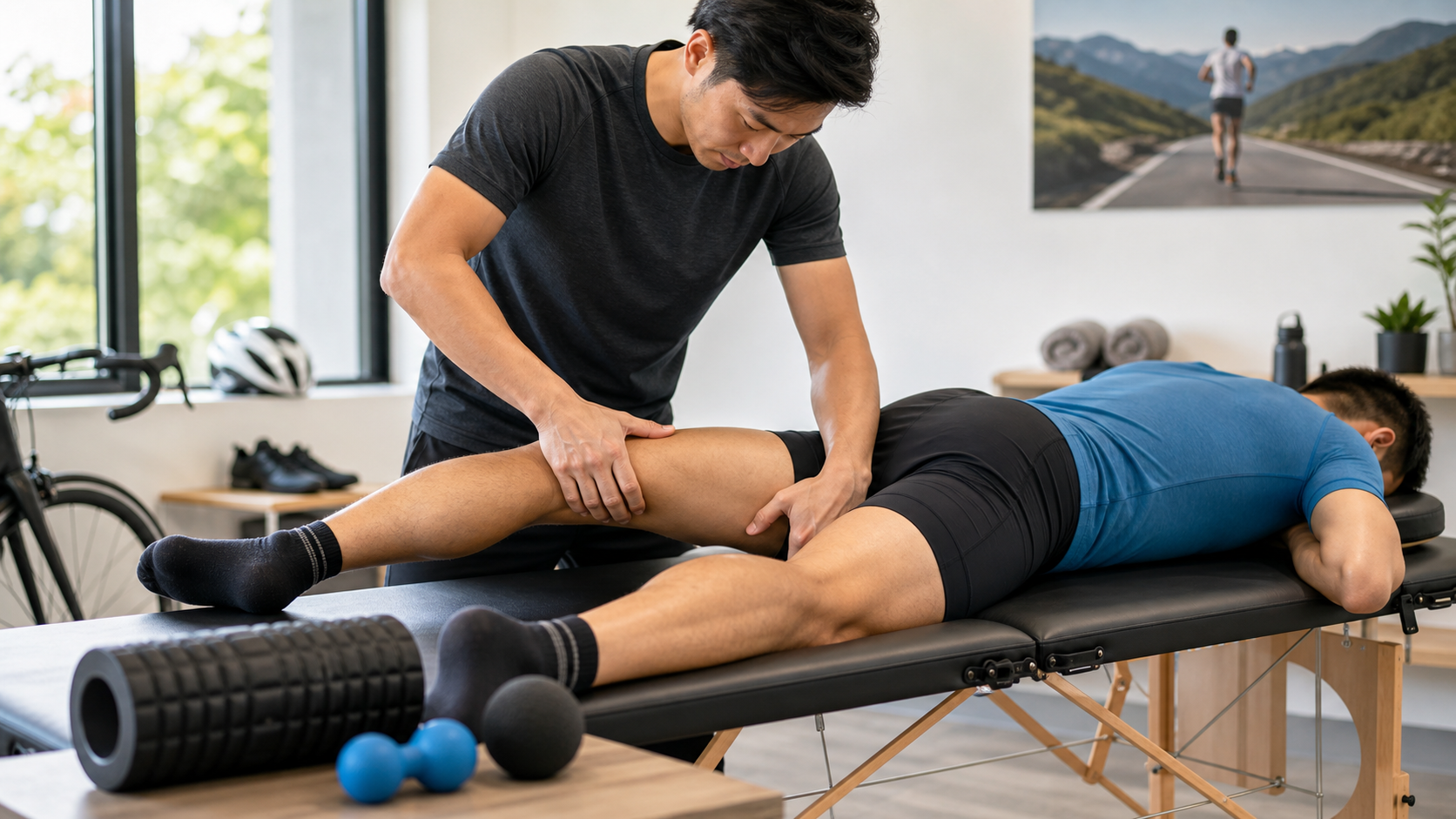
First, a Question I Often Hear Beside the Massage Table
Over the years of leading teams, the question I hear most often from athletes beside the therapist’s table is: “Coach, my thighs are super tight today—does it work better if I press harder?” Every time, I ask back: “How many kilometers did you ride yesterday? How many hours did you sleep?” Because soft tissue issues are never a single problem, and massage is neither a cure-all where more pain means better results nor where more is always better.
Let me share a real scenario (I won’t exaggerate the numbers). There was an amateur cyclist, A-Kai, who regularly rode Beiyi Highway and Fengguizui on weekends, plus two one-hour indoor trainer sessions during the week. When he came to me, his biggest complaint was “my outer thigh and the outside of my knee always feel stuck, and I start feeling uncomfortable after riding more than 60 kilometers.” He thought he needed deep sports massage twice a week to “loosen up the tightness.” But what we actually did over three weeks was pull his training volume back from a sudden 40% weekly spike to a reasonable progression, teach him to spend 8 minutes a day on targeted self-soft-tissue release, and pair that with professional massage every two weeks to address the truly adhered spots. Four weeks later, he could comfortably finish a 90-kilometer ride. The key wasn’t “more massage” but “the right dose, the right timing, and the right division of labor.”
In this article, I want to explain sports massage and soft tissue therapy clearly: what it actually does physiologically, how far the scientific evidence supports it, when you should see a professional, when you can handle it yourself, and what common mistakes will waste your money or even cause injury. I’ll give you tables and schedule templates you can directly copy and use at home.
Bottom line first: The most solid evidence for sports massage lies in relieving delayed onset muscle soreness (DOMS), improving flexibility and range of motion, and enhancing psychological and subjective recovery. As for directly making you stronger, jumping higher, or sprinting faster—current evidence is quite limited. Understanding this boundary is what keeps you from treating it as a substitute for training.
Concepts and Scientific Foundations: What Massage Actually Does to the Body
Soft Tissue Isn’t Just “Muscle”
What we colloquially call “getting a massage to loosen up” actually addresses an entire soft tissue system: muscles, tendons, fascia, and the connective tissue wrapping around them. The tightness, soreness, and reduced range of motion caused by exercise often involve several of these layers at once. That’s why “soft tissue therapy” is a more precise term than “massage”—it encompasses effleurage, petrissage, deep longitudinal friction, trigger point release, fascial gliding, and other techniques, each targeting different tissues and problems.
How Delayed Onset Muscle Soreness (DOMS) Develops
Many people think soreness comes from “lactic acid buildup,” but that’s an outdated misconception. Lactic acid is largely cleared within an hour or two after exercise, so it has nothing to do with that “wobbly legs on the stairs” soreness you feel the next day or the day after.
The mainstream explanation for DOMS is microscopic muscle damage from eccentric contractions, followed by an inflammatory response. When you do a lot of downhill running, stand up and grind up a long climb, or try a new movement for the first time, your muscles generate force while being lengthened (eccentric contraction), causing tiny structural damage. The body then initiates repair and inflammation, with pain typically peaking 24 to 72 hours after exercise. That’s why you often feel fine the next day but worst the day after.
The Evidence for Massage on DOMS: This Is the Most Solid Ground
This is where the evidence for sports massage is strongest. Multiple systematic reviews and meta-analyses indicate that massage after exercise has a clear effect on relieving DOMS pain, with the effect most pronounced 48 to 72 hours post-exercise—right when soreness peaks. Interestingly, the evidence level for this pain-relieving effect is rated relatively high, and some reviews even note its pain reduction is comparable to certain analgesics (such as nonsteroidal anti-inflammatory drugs), but without the gastrointestinal or renal side-effect risks.
Mechanistically, current thinking is that several things work together: promoting local circulation, potentially lowering inflammation-related biochemical markers, and—very importantly—neurological and psychological relaxation with pain modulation. In fact, multiple reviews candidly state that the psychological effects of massage may outweigh the purely physiological ones: athletes’ anxiety, stress, and fatigue decrease, while subjective recovery and relaxation increase. This isn’t “it’s just placebo, so it’s useless”; rather, “subjective recovery matters for training consistency.”
What About “Getting Stronger”? Let’s Be Honest About the Evidence’s Limits
Here I have to be honest. The same body of systematic reviews almost unanimously concludes that massage has no reliable evidence for improving strength, power (jumping), sprinting, endurance, or reducing fatigue—those performance metrics. The only performance aspect with reasonably solid support is a small improvement in flexibility/range of motion.
In other words, if someone tells you “this massage will raise your FTP or make your pace faster,” be skeptical. Massage’s contribution to performance is indirect—it reduces soreness, relaxes you mentally, and improves range of motion, allowing you to train more consistently and race with more focus and relaxation. This indirect value is real, but it is not a direct performance enhancer.
The Evidence for Self-Myofascial Release (Foam Rolling / Massage Balls)
Many people can’t afford weekly professional massage or can’t fit it into their schedules—does foam rolling at home work? Yes, and the evidence direction is fairly clear: self-myofascial release (e.g., foam rolling) acutely increases joint range of motion without a concomitant decrease in strength or muscle activation—this is important because it means it’s suitable for warm-ups, unlike static stretching held for long periods, which may transiently reduce power.
On the recovery side, studies have also observed that foam rolling can reduce post-exercise soreness and modestly improve hip range of motion. Overall, the two most reliable uses for foam rolling are: opening up range of motion during warm-up and relieving subjective soreness after training. As for directly enhancing performance—again, aside from range of motion, the evidence is limited.
I want to distill the entire scientific foundation into one memorable sentence: Massage and self-release are tools that “make you more comfortable and better able to keep training,” not shortcuts that “make you directly faster or stronger.” That may not sound sexy, but precisely because you understand this boundary, you won’t invest time and money in the wrong places, and you won’t use a massage to mask real problems in training planning, sleep, or nutrition. Recovery is a whole-system project; massage is one useful screw, but it can’t turn the entire machine. When you set your expectations in the right place, it will genuinely help.
What Each Common Technique Actually Does
Many people think “massage is massage,” but different techniques serve very different purposes. Understanding them lets you know what’s happening when you’re being pressed on, and when to ask for a different technique.
- Effleurage: Long, smooth gliding strokes, mostly used for opening and closing a session. Its main purpose is promoting circulation and easing the body into relaxation, with light intensity. This is the most common technique for pre-race activation and post-race calming.
- Petrissage: Lifting, grasping, and kneading the muscle, addressing larger areas of tightness at moderate intensity.
- Deep longitudinal friction: Deeper pressure moving along the muscle fiber direction, targeting specific adhesion bands. It can be quite sore and is best suited for the off-season.
- Trigger point release: Sustained pressure on “active trigger points” that refer pain when pressed, allowing them to gradually release. The key is “sustained and steady,” not “poke hard.”
- Fascial gliding/mobilization: Addresses poor sliding between fascial layers; the feel is slower and covers a broader area.
I often remind athletes: No technique is inherently good or bad—only appropriate or inappropriate for the current goal. Before a race, you want effleurage and shaking; 48 hours after a race, deeper work is acceptable for soreness; during the acute inflammatory phase, no deep technique should be touched.
Practical Methods: How to Arrange Timing, Dosage, and Techniques
Now that the concepts are covered, here’s the most practical part. I’ll break down “timing” into four scenarios—pre-race, during training/multi-day stages, post-race, and off-season—then give you principles for dividing labor between professional massage and self-massage.
Massage Goals and Techniques by Timing
| Timing | Primary Goal | Recommended Technique/Method | Rhythm and Intensity | Cautions |
|---|---|---|---|---|
| Pre-race (30–5 minutes) | Energize, awaken muscles, slightly open range of motion | Fast-paced, short effleurage and shaking; foam rolling 30–60 seconds per area | Light to moderate, fast | Avoid deep sustained pressure; deep relaxation makes muscles “sleepy” and can reduce power |
| 1–2 days pre-race | Address known tight spots so the body feels good on race day | Moderate-depth work on specific problem areas | Moderate | Don’t try deep massage for the first time right before a race; it may cause soreness |
| Between training sessions / multi-day stages | Maintain circulation, relieve fatigue, psychological relaxation | Light-to-moderate effleurage and petrissage; short foam rolling | Light to moderate | Principle is “comfortable and relaxing”—don’t create new pain |
| 2–24 hours post-race | Relieve fatigue, help relaxation and sleep | Gentle effleurage primarily | Light | Tissue is sensitive right after; avoid deep pressure |
| 48–72 hours post-race | Relieve peak DOMS pain | Moderate depth, longer duration (40–60 minutes per session) | Moderate | This is the better window for deeper work |
| Off-season / base period | Address chronic adhesions, trigger points, postural issues | Deep tissue, trigger point, fascial techniques | Moderate to deep | Deep work may cause soreness for 1–2 days; don’t schedule it before key training |
I want to emphasize one thing from this table that’s often overlooked: deep pressure before a race is a major mistake. Deep relaxation puts the neuromuscular system into “relaxation mode,” which can transiently reduce power and muscle tone. Pre-race, you want “awakening,” not “hypnosis,” so pre-race massage should be short, fast, and light. Adhesions and trigger points that truly need deep work should be handled in the off-season or at least 2–3 days away from competition.
Recommended Frequency and Dosage for Professional Massage
Based on the review evidence, if the goal is relieving soreness and addressing specific issues, sessions of about 40–60 minutes roughly every two weeks is a relatively common and effective arrangement. But I’ll be honest: this is an “average,” not a commandment. Actual frequency depends on your training volume, budget, and bodily response.
The table below is my practical reference by training volume for different groups. I’m giving ranges—please discuss and adjust with your therapist based on your own situation:
| Group | Weekly Training Volume Reference | Recommended Professional Massage Frequency | Self-Release Frequency | Key Areas (Cyclists/Runners) |
|---|---|---|---|---|
| Beginner, exercising 2–3 times/week | 60–100 km cycling or 15–25 km running per week | Book as needed, or once monthly | 3–4 times/week, 8–10 minutes each | Quadriceps, hip flexors, calves, gluteus medius |
| Advanced, regular training | 150–250 km cycling or 40–60 km running per week | Once every 2–4 weeks | Nearly daily, 10–15 minutes each | Add around the iliotibial band, lower back, plantar fascia |
| Race season preparation | High volume, including high-intensity sessions | Once every 1–2 weeks, adjusted pre-race | Daily, one block before and after training | Adjust dynamically based on that week’s sore spots |
A Basic Self-Soft-Tissue-Release Menu
This is a basic routine you can do at home or in the gym, suitable for most cyclists and runners. The principle: during warm-up, go fast and light (open up range of motion); during recovery, go slow and steady (relieve soreness).
Warm-up version (pre-training, 5–6 minutes total)
- Quadriceps: slow foam rolling back and forth, 30–45 seconds per side
- Glutes/gluteus medius: seated, pressing onto a ball or roller, find tight spots and hold with deep breaths for 20–30 seconds
- Calves: foam rolling 30 seconds per side
- Upper back/thoracic spine: roller placed horizontally for thoracic extension, 5–8 reps
Recovery version (post-training or before bed, 10–15 minutes total)
- Foam roll each target muscle group for 60–90 seconds, moving slowly
- When you find a clearly sore spot, stop on it and take 3–5 deep breaths, letting it gradually release—don’t aggressively roll back and forth
- Rate pain on a 1–10 scale and keep it within the “tolerable, can breathe and relax” range of no more than 6–7
A Real Four-Week Adjustment Case
Back to A-Kai from the opening. His outer thigh and lateral knee discomfort was a classic case of insufficient hip and gluteal stability, combined with a sudden spike in training volume, causing the outer thigh to overcompensate. Our approach wasn’t “aggressively pressing the iliotibial band” (which is very hard to actually change and extremely painful anyway), but rather:
| Week | Training Adjustment | Soft Tissue Treatment | Subjective Discomfort (0–10) |
|---|---|---|---|
| Week 1 | Weekly mileage reduced to 75% of original | Daily 8-minute self-release (gluteus medius, quadriceps, calves) | 6 |
| Week 2 | Maintain, add gluteal strength training | 1 professional massage (addressing gluteal and outer thigh trigger points) | 5 |
| Week 3 | Mileage back up to 90% | Continue self-release; light foam rolling the day before the race | 3 |
| Week 4 | Full mileage, including a 90 km long ride | 1 professional massage, 48 hours post-race to relieve soreness | 2 |
I’m not showing this table for you to copy the numbers exactly, but to show that massage is one component of a whole plan—it only makes sense when combined with training volume management and strength work. Massage alone cannot rescue a body whose training plan is flawed.
Common Mistakes and Corrections
Having led teams for so long, I’ve seen the same mistakes far too many times. Here are the most common ones, along with directions for correction.
Mistake 1: Believing More Pain Means Better Results
This is the most widespread myth. Pain is not a measure of effectiveness. Excessive pain makes your body tense up defensively, prevents relaxation, and can even cause bruising and secondary tissue irritation. Correction: Keep pain within the “painful but can still breathe and relax” range (roughly below 6–7). True release happens when you can breathe and let go.
Mistake 2: Scheduling Deep Massage Right Before a Race
Many people get nervous the night before a race and go get a “big deep loosening” massage, only to find their legs feel weak and sore the next day. Correction: Deep work should be at least 2–3 days away from competition. Pre-race, only do light, quick, activating massage.
Mistake 3: Treating Massage as a Substitute for Training
“I’m too tired to train today, so I’ll go get a massage to make up for it”—massage won’t build muscle strength or increase your aerobic engine. It’s a recovery tool, not training. Correction: Position massage as “support that helps you train more consistently,” not as training itself.
Mistake 4: Aggressively Pressing the Iliotibial Band and Bony Prominences
Many cyclists with lateral knee pain desperately press on the iliotibial band. But it’s a very tough connective tissue structure that’s extremely hard to “press loose,” and there are often sensitive nerves and bursae beneath it. Correction: Addressing the upstream gluteus medius, tensor fasciae latae, and lateral quadriceps, plus strengthening hip stability, is far more effective than death-pressing the IT band. Never apply heavy pressure to bony prominences, directly over joints, or along obvious nerve pathways.
Mistake 5: Pressing Hard on Acute Injuries or Inflammation
When you’ve just sprained something, there’s obvious swelling and heat, or you suspect a muscle tear, vigorous massage can worsen bleeding and inflammation. Correction: During the acute phase (significant swelling and pain within 48–72 hours of injury), prioritize protection, relative rest, appropriate ice, and medical evaluation—do not self-administer deep pressure.
Mistake 6: Ignoring the True Foundations: Sleep, Nutrition, and Hydration
I often say massage is “the icing on the cake,” while sleep and nutrition are “the foundation.” Many Taiwanese office-worker cyclists and runners sleep only 5–6 hours a week, eat heavy, salty, oily restaurant meals for all three meals, and don’t drink enough water—then spend money on massage hoping for “quick recovery.” Correction: First get sleep to 7+ hours, eat enough protein (roughly 1.4–2.0 grams per kilogram of body weight is a common reference range for athletic populations), and hydrate adequately—then talk about massage as a bonus. This order cannot be reversed.
Common Mistakes and Corrections Reference Table
| Common Mistake | Why It’s a Problem | Correction Direction |
|---|---|---|
| More pain means better results | Pain triggers defensive tension, prevents relaxation, may cause bruising | Keep intensity within a range where you can breathe and relax |
| Deep massage before a race | Transiently reduces power and muscle tone | Deep work 2–3 days before race; pre-race only light, quick activation |
| Massage replaces training | Massage doesn’t build strength or aerobic capacity | Position it as a recovery support tool |
| Aggressively pressing the IT band | Ligament-like tissue is hard to press loose; sensitive structures beneath | Address glutes and lateral quadriceps, strengthen hip stability |
| Pressing hard on acute injuries | May worsen bleeding and inflammation | Protect during acute phase, seek medical evaluation, no deep pressure |
| Ignoring sleep and nutrition | Recovery foundation isn’t solid | Prioritize sleep, protein, and hydration first |
Putting Massage Into a Complete Recovery Strategy
I keep emphasizing that massage is “one component”—so how does it fit with other recovery methods? This table helps you see each recovery modality’s strengths and positioning, so you won’t pile all your expectations onto massage alone.
| Recovery Method | Primary Value | Positioning | Reminder |
|---|---|---|---|
| Sleep (7+ hours) | The biggest foundation for repair and adaptation | First priority | No tool can replace sleep |
| Protein and overall nutrition | Provides repair materials and energy replenishment | First priority | Especially important for those eating out |
| Hydration and electrolytes | Maintains circulation, reduces cramping and fatigue | First step after training | Even more critical in Taiwan’s humid, hot summers |
| Active recovery (easy ride/jog) | Promotes circulation, relieves stiffness | Regular scheduling | Intensity must be genuinely easy |
| Sports massage / soft tissue therapy | Relieves DOMS, improves range of motion, psychological relaxation | Icing on the cake | Indirect benefit to performance |
| Self foam rolling / massage balls | Opens range of motion in warm-up, relieves soreness in recovery | Usable daily | Control intensity, don’t overdo it |
Once you understand this table, one thing becomes clear: if the sleep, nutrition, and hydration boxes are empty, fill those first—the benefit is far greater than scheduling one more massage. Massage is best placed in the position of “the foundation is already solid, and you want to further optimize recovery quality.” This is also the ordering principle I use with athletes—fix the foundation first, then talk about decoration.
Professional vs. Self-Care: How to Divide the Work Smartly
This is one of the practical questions readers care about most: when should you spend money on a professional, and when can you handle it yourself?
What Self-Care Can Handle
- General soreness and fatigue after training
- Opening up range of motion during warm-up
- Known, simple tight areas (foam rolling and massage balls can relieve these)
- Routine maintenance relaxation
When to See a Professional Therapist
- Recurring specific pain points that haven’t improved with self-care
- Obvious trigger points or deep adhesions that your hands can’t reach or that need professional techniques
- Wanting periodic deep maintenance during the season
- Suspecting chronic issues related to movement patterns or posture that need assessment
When You Should See a Doctor or Physical Therapist Instead of a Massage Therapist
This is especially important in Taiwan because medical care is convenient and accessible through the National Health Insurance system—there’s no reason to tough it out or rely only on massage when you should see a doctor. In the following situations, prioritize evaluation by a physician or physical therapist:
- Acute significant trauma: sudden severe pain, swelling, joint instability, inability to bear weight
- Neurological symptoms: numbness, electric-shock sensations, radiating pain, marked muscle weakness
- Pain persisting for weeks without improvement: or pain that keeps worsening
- Atypical warning signs such as being woken by pain at night, unexplained weight loss, or fever accompanied by pain
- Those with chronic diseases (e.g., diabetes, hypertension, heart disease, clotting disorders, deep vein thrombosis risk): consult a medical professional before massage; deep massage may not be appropriate in certain situations and requires individualized assessment
Taiwan actually has plenty of channels for sports injury care: rehabilitation medicine, orthopedics, sports medicine clinics, and licensed physical therapists. The roles of massage therapists and physical therapists are different—diagnosis, treatment planning, and managing specific injuries are the domain of medical professionals; massage therapists provide value in recovery, relaxation, and maintenance. Understanding this boundary prevents you from delaying care for injuries that need medical attention.
Practical Advice for Choosing a Massage/Soft Tissue Therapist
- Ask about their training background and experience, especially whether they’re familiar with your sport
- A good therapist will first ask about your training status, pain points, and goals—not immediately start pressing hard
- They will communicate intensity throughout and check in on how you feel, rather than applying one-way pressure
- A therapist who honestly tells you “this issue may need a doctor” is one you can trust
The Taiwan Context: Connecting Methods to Your Real Life
After all these principles, I want to connect them back to the real environment of Taiwanese cyclists and runners so they’re easier to put into practice.
Humid, hot climate and hydration: Taiwan’s summers are humid and hot. After long rides or runs, dehydration and electrolyte loss are significant, which worsens fatigue and cramping risk. Massage can’t fix dehydration—the first step in recovery is always replenishing fluids and electrolytes. After summer training, hydrate and take in adequate sodium first, then talk about relaxation massage.
The protein gap for those eating out: Many Taiwanese office-worker athletes eat all meals out—a rice ball for breakfast, a bento box for lunch—and protein is often insufficient. Recovery needs protein as repair material. Massage without replenishing is like hiring workers but not providing building materials. After exercise, try to get enough quality protein (soy milk, eggs, chicken breast, tuna, and dairy are all convenient options).
Common routes and mileage management: Beiyi, Fengguizui, Yangjin, Wuling, East-to-West crossings—these classic routes involve massive climbing and eccentric load (especially long descents), making them high-risk scenarios for DOMS. Runners often accumulate mileage on riverside paths, tracks, and trails. The key point: don’t spike mileage or climbing within a single week—the training volume ladder should be gradual. This prevents soreness and injury better than any massage.
NHI and healthcare accessibility: Taiwan’s convenient medical access is a huge advantage. Don’t skimp on seeing a doctor when you should, especially with the warning signs mentioned earlier. Place massage in the “recovery and maintenance” position and medical care in the “diagnosis and treatment” position—each has its own role.
Actionable Advice for Readers at Different Levels
If You’re a Beginner (Exercising 2–3 Times a Week)
- First establish a self-release habit: 3–4 times per week, 8–10 minutes of the basic foam rolling routine
- Warm-up uses “fast and light”; recovery uses “slow and steady”
- Book professional massage as needed—don’t rush into weekly appointments
- Prioritize sleep, protein, and hydration—these will recover you better than massage
- Progress training volume gradually; don’t let your body protest with soreness
If You’re an Advanced Trainee (Regular, Substantial Mileage)
- Schedule 10–15 minutes of self-release nearly every day, one block before and after training
- Arrange professional massage every 2–4 weeks to address accumulated trigger points
- Schedule deep work in the off-season or 2–3 days away from key sessions
- Learn to distinguish “general soreness” from “pain that needs medical attention”
- Keep massage records alongside your training log, and observe which arrangements give you the best recovery
If You’re in Race Season Preparation
- Pre-race, only do light, quick activating massage—deep pressure before a race is strictly forbidden
- The 48–72 hour post-race window is the better time to relieve DOMS
- Between multi-day stages, focus on gentle relaxation and psychological recovery
- Finish all new deep work 2–3 weeks before the race; pre-race is maintenance only, no experiments
- Trust the value of subjective recovery—relaxation and focus are themselves part of performance
Questions Readers Ask Me Most (FAQ)
These are the questions I get asked to death at lectures and in clubs—let me answer them all at once.
Q1: I’m sorer the day after a massage. Is that normal?
If it was deep work, mild soreness and swelling 1–2 days after is possible and usually resolves on its own. But if the soreness affects your training or you even get bruising, the intensity was too high. Next time, proactively ask for “lighter pressure.” Effective treatment doesn’t require leaving you black and blue.
Q2: How long and how painful should foam rolling be?
30–90 seconds per target muscle group is sufficient—rolling longer isn’t better. Keep pain within a range where you can breathe and relax (roughly below 6–7). If you’re holding your breath and tensing up, it’s counterproductive.
Q3: Are massage guns (percussion devices) useful?
They’re a convenient self-release tool that can quickly relieve subjective tightness. They’re fine for large muscle groups, warm-ups, or light recovery. But avoid bony prominences, joints, the front of the neck, directly over the spine, and obvious nerve pathways, and don’t hammer the same spot at high intensity for extended periods. They can’t replace professional assessment and treatment.
Q4: Should I ice or massage immediately after exercise?
It depends on the goal. For an acute injury with obvious swelling, prioritize protection and evaluation. For simple post-training fatigue, gentle relaxing massage, plus hydration, protein, and good sleep, usually matters more than agonizing over ice. Don’t miss the forest for the trees.
Q5: I have a chronic condition (like high blood pressure or diabetes). Can I get deep massage?
You must consult your physician first. Certain conditions (such as poorly controlled blood pressure, peripheral neuropathy, clotting disorders, or thrombosis risk) are not suitable for specific deep massage techniques and require individualized assessment. This isn’t to scare you—it’s about safety first.
Q6: Can one massage “fix” tightness once and for all?
No. Soft tissue status continuously interacts with your training, posture, and lifestyle habits. Massage is “maintenance,” not “one-time repair.” The real long-term solution is doing the whole package—training planning, strength, and recovery habits—properly.
A Second Case: A Runner’s Plantar and Calf Issues
Let me share another runner’s example. Xiao-Ting was a half-marathon runner with a weekly volume of about 40 km. Her chief complaint was “my foot hurts badly on the first step out of bed in the morning, and my calves are constantly tight.” She initially hammered her plantar fascia daily with a massage ball—short-term relief, but no cure.
Our adjustment direction was: change “aggressively pressing the foot” to gentle release of the posterior calves and plantar fascia, add calf and foot strength training, and review her running shoes and the rate of weekly mileage increase. A large part of her problem actually came from jumping her mileage from 25 km to 40 km within two weeks—the familiar “sudden spike” again. Massage can relieve symptoms, but if you don’t address the cause, the symptoms keep coming back. Six weeks later, her first-step morning pain dropped from 7 to 2, again through “doing the whole package together,” not more forceful massage.
I include this second case so runners—not just cyclists—can see the same principle: soft tissue discomfort is often your training plan talking to you. Massage is responsible for making you comfortable and able to keep going, but the real solution usually lies beyond the massage table.
Conclusion: Putting Massage Back in Its Proper Place
Sports massage and soft tissue therapy are good tools, but they are “tools,” not “magic.” Looking honestly at the evidence: it has solid value in relieving DOMS, improving range of motion, and enhancing subjective recovery and psychological relaxation; its evidence is weak for directly enhancing strength, power, or endurance. Understanding this boundary lets you use it in the right place—as support that helps you train consistently and joyfully, not as a substitute for training or a patch for gaps in sleep and nutrition.
Back to A-Kai: four weeks later, he could comfortably finish a 90 km ride, not because of “more and more painful massage,” but because of the right dose, the right timing, and putting training, strength, and recovery together as a whole. That’s also the message I want to leave you with: First build the foundation (training planning, sleep, nutrition, hydration), then let massage be the icing on the cake. When the order is right, every bit of time and money spent on recovery is truly worth it.
Next time you lie on a massage table or pick up a foam roller, don’t ask “should it hurt more to work better?” Instead, ask yourself: “Does my training, sleep, and nutrition this week match the recovery I’m expecting?” Answer that question well, and you’ll find your body gives back far more than any single deep massage ever could.
This article is educational content and cannot replace individualized diagnosis and treatment advice from a physician, physical therapist, or nutritionist. If you have chronic conditions (such as diabetes, hypertension, heart disease), acute injuries, or neurological symptoms, please seek individualized evaluation and management from a medical professional first.
References
- Massage Alleviates Delayed Onset Muscle Soreness after Strenuous Exercise: A Systematic Review and Meta-Analysis (Frontiers in Physiology): https://www.frontiersin.org/journals/physiology/articles/10.3389/fphys.2017.00747/full
- The Effects of Massage Therapy on Sport and Exercise Performance: A Systematic Review (PMC): https://www.ncbi.nlm.nih.gov/pmc/articles/PMC10302181/
- Effect of sports massage on performance and recovery: a systematic review and meta-analysis (PMC): https://pmc.ncbi.nlm.nih.gov/articles/PMC7228568/
- A Meta-Analysis of the Effects of Foam Rolling on Performance and Recovery (PMC): https://pmc.ncbi.nlm.nih.gov/articles/PMC6465761/
Related Reading
- The Effect of Massage on Running Recovery: Self-Massage vs. Professional Sports Massage
- A Scientific Examination of Massage and Foam Rolling: Mechanisms, Effect Sizes, and the Overlooked Placebo Component
- The Real Benefits of Massage for Athletic Recovery: What’s Supported, What’s Exaggerated, and How to Use Foam Rollers and Massage Guns Correctly
- Muscle Recovery After Cycling: Massage, Cold/Hot Therapy, and the Science of Sleep
一日北高/長距離團騎 常見問題補充篇 / 組團或跟團的眉角 / 壯車友容易被瘦車友慢性拉爆 / 原來屁股痛可能是這個原因...? / 風場配速法 / 公路車 / CT Yeh
2 年前
西進武嶺 免費訓練分析服務 Intervals | 練不夠還是練過頭?你哪一種類型選手?AI模型告訴你! | 備戰神器 | 公路車 訓練 | CT Yeh
4 年前
一日北高常見問題大集合 | 攻略 | 路線 | 訓練 | 補給 | 自行車 單車 | 一日雙城 | 雙塔 | TWB北高360 | 屁股痛
6 年前
Never Stop 西進武嶺 前後雙機 完整全程錄影 訓練台 實境
8 年前
大禹嶺 到 武嶺牌樓 全程前後實況錄影 | 北進武嶺 | 東進武嶺 | KOM | 訓練台 | 坡度分析 | Taiwan KOM Last 10 km HARD | 公路車
6 年前
碟煞公路車 銑面器 !? 原來銑完差這麼多! 降低蹭碟機率! | TIME 公路車 保養小記錄 | CT Yeh
3 年前
#公路車 #Fitting 靠人工智慧APP 幫你調整單車
6 年前
CT趣訪 西進武嶺 2小時組 EP2 全村的希望 蔣緯緯! 訓練菜單&技巧公開 |公路車 |CT Yeh
4 年前