The Complete Guide to Foam Rolling and Self-Myofascial Release: Evidence, Proper Use, and Common Mistakes
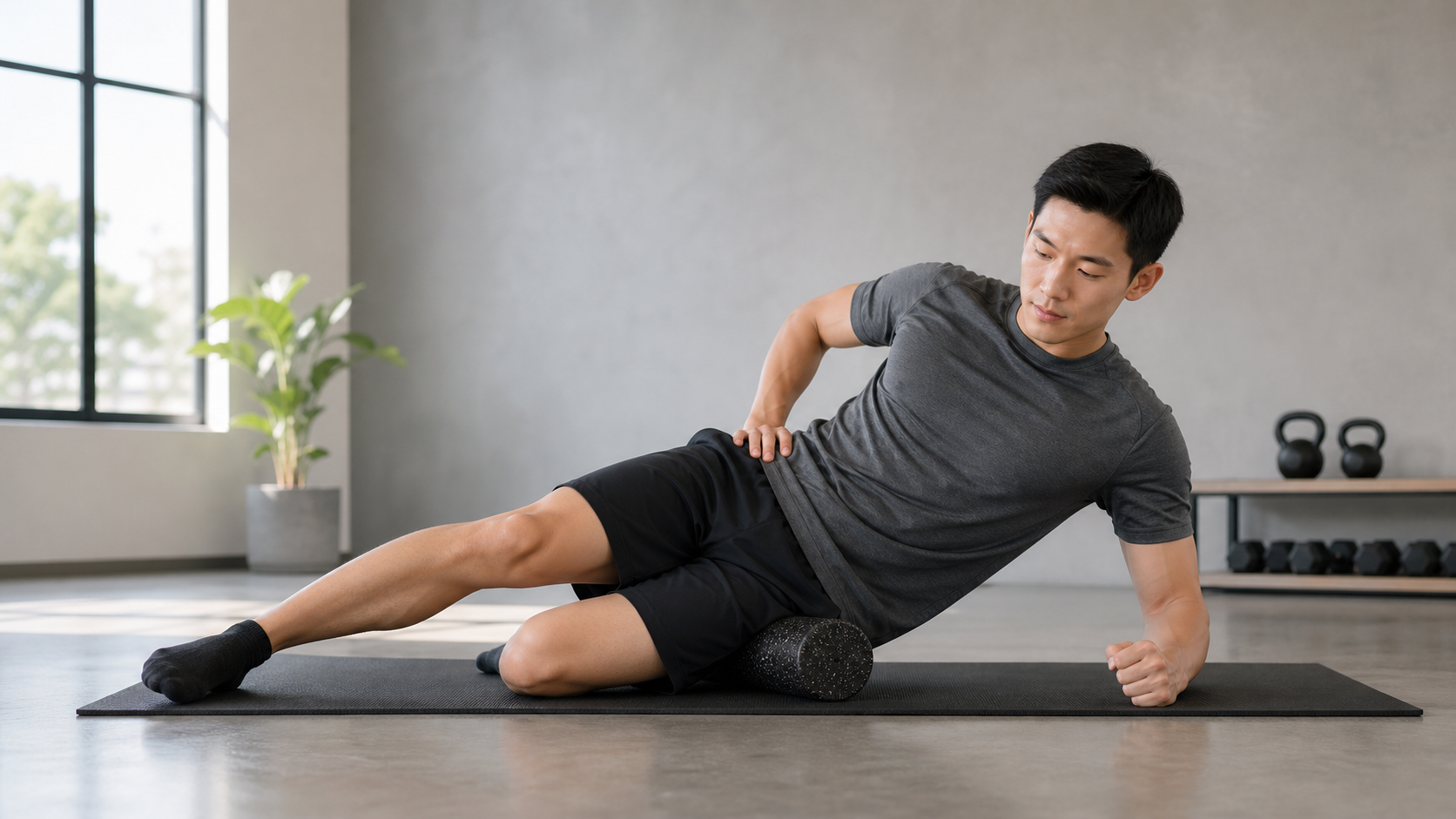
Starting with a Student Whose Knees Were Too Tight to Squat
A few years ago, an engineer working in the Hsinchu Science Park came to see me—let’s call him A-Hong. His complaint was simple: after long rides along the riverside, his outer thighs felt as tight as iron plates, and the next day his knees would catch on the outer edge when climbing stairs. He had bought a wildly popular “wolf-club” foam roller online and pressed on his thighs every night until he grimaced in pain. It felt looser right after rolling, but the tightness returned the next day. He asked me: “Coach, am I not pressing hard enough? My friend said you have to press until it hurts so much you break a sweat for it to work.”
That question basically sums up every misconception I’ve seen over the years. Foam rollers and self-myofascial release (SMR) have exploded in popularity over the past decade or so in gyms, running clubs, and cycling teams—so much so that they’ve almost become a ritual: if you don’t roll, it feels like you didn’t finish your workout. But very few people truly understand what it can do, what it can’t do, and how to use it properly.
I redesigned A-Hong’s foam rolling routine from his original random ten-plus minutes of pressing into a three-minute warm-up protocol plus a brief post-workout cooldown, and changed “press until it hurts” to “press until you feel it but can still breathe normally.” Three weeks later, he reported back: his outer thigh mobility was noticeably better during warm-up, he could squat deeper, and the catching sensation around his knees had largely disappeared. What changed wasn’t some miracle tool he bought—it was that he finally got the dosage and timing right.
In this article, I want to lay out everything for you: the practical experience I’ve accumulated from coaching students over the years, plus the evidence that holds up in current sports science literature. I’ll be as honest as possible—including the parts where foam rolling has been overhyped.
Conceptual Foundations: What Is Foam Rolling Actually Releasing?
The Name “Fascial Release” Is Actually a Bit Misleading
Let’s clarify the terminology first. “Self-myofascial release” literally suggests you’re loosening tight fascia (the connective tissue wrapping your muscles). But from a biomechanical standpoint, human fascia has extremely high tensile strength. To actually “stretch and deform” fascia using just your body weight and a foam roller would require far more force than what we’re actually applying.
So the more mainstream explanation in sports science leans toward the neurophysiological level:
- Altered pain threshold: Rolling stimulates mechanoreceptors and nociceptors in the tissue, and through a neural mechanism similar to “massage-induced analgesia,” temporarily reduces your perception of tightness and soreness, making you feel “looser.”
- Parasympathetic nervous system and muscle tone regulation: Moderate rolling is thought to temporarily reduce overly elevated muscle tone, helping muscles “let go” a bit.
- Local blood flow changes: The massage effect of rolling may temporarily increase local circulation—another mechanism discussed in recovery contexts.
In other words, the “looseness” you feel from foam rolling is largely a nervous system response, not the physical stretching of any tissue. This concept matters because it directly affects how you should use it—you’re chasing a “signal,” not “destruction.”
This also explains a phenomenon many people find puzzling: why you feel loose right after rolling, but tight again the next day. If the root cause of the tightness (training load, posture, muscle imbalances) hasn’t changed, once the “relaxation signal” you gave your nervous system wears off, the tightness naturally returns. That doesn’t mean foam rolling is useless—it’s a reminder that foam rolling is a tool for managing “sensation” and “current state,” while long-term structural issues still need to be addressed through training and lifestyle. Once you understand this, you won’t fall into the dead end of “rolling harder and harder, trying to fix it all in one go.”
What Does the Evidence Say? Don’t Overhype It, but Don’t Dismiss It Either
Research on foam rolling has accumulated considerably. A systematic review and meta-analysis pooling multiple studies found that foam rolling’s effect on increasing range of motion is consistent and clear—nearly all the range-of-motion studies included showed positive effects, with moderate-to-large effect sizes. The same review also noted that beyond range of motion, foam rolling cannot clearly demonstrate significant benefits for athletic performance (such as strength, jumping, or agility), but it also doesn’t cause harm, and the effects are similar between men and women. This is crucial: using a foam roller as a warm-up aid won’t hurt your performance.
For delayed onset muscle soreness (DOMS), the evidence generally leans positive. Some studies show that foam rolling helps reduce muscle soreness after intense exercise and improves performance markers like sprint speed, power, dynamic muscular endurance, and range of motion; other studies have observed that foam rolling accelerates recovery of muscle tone, stiffness, and elasticity. But to be honest, regarding “pain relief” alone, the evidence is not one-sided—some studies have found that foam rolling or massage guns are not necessarily significantly better than passive rest for pure pain reduction.
Here’s how I often summarize it for my students:
Foam rolling’s most defensible functions are “temporarily increasing range of motion” and “subjectively accelerating the feeling of recovery.” It’s an excellent warm-up and recovery aid, but it’s not a treatment, not a miracle cure, and it won’t replace training itself.
Set your expectations in the right place, and you won’t be disappointed—and you won’t injure yourself from over-pressing.
Practical Methods: Timing, Dosage, and Target Areas
This section is the core of the article. I’ve organized the principles I actually use with my students into tables you can follow directly.
When to Roll? Warm-Up vs. Recovery Serve Different Purposes
There are two ideal times to use a foam roller: pre-training warm-up and post-training/before-bed recovery. The purposes differ, and so do the techniques.
| Timing | Primary Goal | Intensity | Tempo | Recommended Duration |
|---|---|---|---|---|
| Pre-training warm-up | Temporarily increase mobility, wake up the body | Moderate (noticeable, not teeth-clenching) | Slightly faster, rolling back and forth | 30–60 seconds per area, 3–5 minutes total |
| Post-training recovery | Reduce tightness, relax the nervous system | Light to moderate | Slow, can pause | 60–90 seconds per area, 5–10 minutes total |
| Before-bed relaxation | Lower tension, promote sleepiness | Light | Very slow, coordinated with breathing | 5–8 minutes total |
Key reminder: Don’t roll too long or too hard during warm-up. If you aggressively press a primary working muscle for over a minute before training, to the point of significant pain, you might temporarily “soften” that muscle and impair explosive performance. Warm-up rolling is about “opening up” and “waking up,” not “flattening out.”
Key Points and Hold Times for Each Area
The table below is my standard template for general athletic populations and cycling/running enthusiasts. For tight “hot spots,” you can do small-range back-and-forth movements or hold on that point.
| Area | Commonly Tight In | Technique | Recommended Time | Cautions |
|---|---|---|---|---|
| Front of thigh (quadriceps) | Cyclists, runners | Plank position, roll from hip to above knee | 60 seconds | Avoid the kneecap |
| Outer thigh (iliotibial band area) | Those with lateral knee catching | Side-lying roll, keep pressure light | 45–60 seconds | This area is nerve-sensitive; don’t press hard enough to bruise |
| Back of thigh (hamstrings) | Sedentary workers, runners | Seated, stack legs to increase pressure | 60 seconds | Pause and breathe at tight points |
| Calves (gastrocnemius/soleus) | Runners, climbers | Seated roll, can rotate inner/outer | 45–60 seconds | Those with cramp history should use lighter pressure |
| Glutes (gluteus maximus/piriformis area) | Sedentary workers, those with lower back tightness | Sit on roller, cross one leg, roll one side | 60 seconds | Sciatic nerve pathway is sensitive—go slowly |
| Upper back (thoracic spine) | Desk workers, cyclists | Lie on back with roller horizontal, do thoracic extension | 60–90 seconds | Never roll the lumbar spine or cervical spine |
| Latissimus dorsi/side under armpit | Upper-body trainees | Side-lying, arm raised, roll the side of the back | 45 seconds | Use light pressure |
I’ve bolded “never roll the lumbar spine or cervical spine” because these are the most common injury spots and the most frequently done wrong—I’ll expand on that in the mistakes section below.
A Ten-Minute Full-Body Routine You Can Copy
What many athletes really want is a routine they don’t have to think about, just follow. This is the version I give to general cyclists or runners after training:
- Glutes: 60 seconds per side
- Hamstrings: 60 seconds per side
- Quadriceps: 60 seconds per side
- Outer thighs (IT band area): 45 seconds per side (use lighter pressure)
- Calves: 45 seconds per side
- Upper back (thoracic spine): 90 seconds
- Throughout, breathe in through the nose and exhale slowly through the mouth; when you find a tight spot, hold for 2–3 breaths
That adds up to roughly ten minutes. If using this as a warm-up, cut the time for each area in half, use lighter pressure, and increase the pace.
Five Common Mistakes and How to Fix Them
This is the section I most wanted to write, because incorrect technique isn’t just ineffective, it can also cause injury.
Mistake 1: Believing “The More It Hurts, The More It Works”
This is the number one myth, just like Ahong from the opening story. Pain is not an indicator of effectiveness; pain is your body’s warning signal. For ideal rolling pressure, I often teach clients a standard: on a discomfort scale of 0 to 10, aim to stay around 5 to 7, meaning “you feel it clearly, but you can still breathe normally, you’re not holding your breath, and your body isn’t tensing up.” Once you’re in so much pain you’re gritting your teeth or holding your breath, your sympathetic nervous system kicks in, and your muscles will actually tighten protectively, which is the complete opposite of the relaxation you’re after.
Fix: Reduce the pressure. Methods include using your body weight to ease off (for example, when rolling your hamstrings, keep the other foot on the ground to take some weight), choosing a softer foam roller, and shortening the time you spend on any single spot. Remember: you want a neurological signal, not tissue destruction.
Mistake 2: Rolling Directly on Bones, Joints, and Nerves
I’ve seen people trying to loosen their lower back by placing the roller horizontally across their lumbar spine and rolling hard. The lumbar spine isn’t protected by the ribs, and the roller’s pressure can force it into excessive extension, which over time puts strain on the disc structures. Similarly, the kneecap, elbows, spinal processes, and neck should never be rolled directly.
Fix:
- If you want to relieve lower back tightness, the root cause is often in the glutes and hamstrings; relaxing those areas is usually far more effective than aggressively rolling the lumbar spine.
- The upper back (thoracic spine) is the only area where placing the roller horizontally is safe, and the movement should lean toward “extending the thoracic spine” rather than forcefully rolling back and forth.
- Avoid the bony prominences on the outer thigh near the knee and hip; those areas are sensitive in both nerves and bone.
Mistake 3: Grinding Away at the Same “Pain Point” for Several Minutes
Some people find an extremely tender spot and just grind on it for three to five minutes, thinking “I have to break it up.” Excessive, prolonged mechanical pressure can cause local tissue irritation or even bruising, especially in areas where nerves are superficial (such as the outer thigh, back of the knee, and armpit), where the risk is higher.
Fix: For a single spot, stick to 20 to 30 seconds, or 2 to 3 deep breaths as a guideline. Once you feel it ease slightly, move on; don’t obsess. Truly stubborn tight spots usually require training adjustments and changes in movement patterns, not grinding them into submission.
Mistake 4: Treating the Foam Roller as a “Treatment” for Pain
This is the point that requires the most caution. The foam roller is a maintenance and warm-up tool, not a diagnostic or therapeutic method for pain. If you have any of the following conditions, please don’t try to tough it out with a roller:
- Pain that persists for more than two weeks without improving
- A clear mechanism of injury (a fall, a twist, or immediate sharp pain during a strain)
- Accompanying swelling, heat, redness, or spreading bruising
- Numbness, tingling, or weakness (which may involve nerves)
- Waking up at night due to pain, or pain that doesn’t ease with rest
In Taiwan, seeing an orthopedist, a rehabilitation specialist, or a sports medicine clinic is actually quite convenient, and physical therapy under National Health Insurance is also quite accessible. Rather than at home rolling a problem that might be tendonitis or nerve compression into a worse state, it’s better to seek medical attention early and have a physical therapist do an individual assessment. My principle with clients has always been: when you can’t tell whether it’s “just tightness” or “actually injured,” leave it to the professionals to judge; don’t play doctor yourself.
Mistake 5: Wrong Timing and Wrong Breathing
Many people are used to aggressively rolling the main muscles they’ll be using right before a workout, or they hold their breath the entire time. The former can temporarily reduce explosive power, and the latter keeps the body in a tense state, diminishing the relaxation effect.
Fix: Use a light, brisk pace for warm-ups and a slow, gentle pace for recovery; maintain slow breathing in through the nose and out through the mouth throughout, and especially remember to exhale and relax when pausing on a tight spot. Breathing rhythm is actually the most underestimated key in self-myofascial release.
How to Choose Equipment? Don’t Be Led Astray by Marketing
The variety of foam rollers on the Taiwanese market is dizzying, from smooth flat EVA rollers, to “wolf claw” style rollers with raised bumps, to massage balls, peanut balls, and even electric vibrating rollers. My advice is very practical:
| Equipment Type | Suitable For | Advantages | Cautions |
|---|---|---|---|
| Flat EVA Roller | Beginners, general population | Even and gentle pressure, easy to use | Choose medium firmness |
| Bumpy/Textured Roller | Experienced users, those wanting more concentrated pressure | Stronger stimulation for trigger points | Beginners tend to overdo the pressure |
| Massage Ball / Peanut Ball | For targeting the glutes, plantar fascia, or small areas around the scapula | Precise, portable | Pressure is concentrated, so control intensity even more |
| Vibrating Roller | Advanced users, those with high recovery needs | Vibration may increase comfort and relaxation | Expensive, not a necessity |
For beginners, I almost always recommend starting with just a medium-firmness flat EVA roller. A harder, bumpy roller will tempt you to chase intense stimulation, which leads you right back into the “more pain, more gain” trap. A vibrating roller is a nice bonus, but the evidence for its additional benefits over a regular roller isn’t overwhelmingly superior, so there’s no need to stretch your budget for it.
Actionable Advice for Readers at Different Levels
Everyone starts from a different point, so I’ve divided my advice into three levels.
Complete Beginner: Prioritize Safety First, Build the Habit
If you’ve never seriously used a foam roller:
- Just buy a medium-firmness flat roller.
- Start with the large muscle groups: front and back of the thighs, calves, and glutes. Don’t tackle the upper back or sides yet.
- Keep the pressure at a level where you “feel it but could still hold a conversation.”
- Do it 3 times a week after training, 5–8 minutes each session. Build the habit before worrying about advancing.
- Stay focused on your breathing throughout; it’s also a great practice for body awareness.
Regular Exerciser at an Intermediate Level: Integrate It Into Your Program
If you already cycle, run, or lift weights regularly:
- Before training: Schedule 3–5 minutes of light, brisk rolling, combined with dynamic stretching as part of your warm-up. Focus on the muscles you’ll use that day, but avoid heavy pressure on your primary working muscles.
- After training: Schedule 5–10 minutes of slow, gentle rolling to aid relaxation and recovery.
- For problem areas: List the spots where you tend to get tight (for cyclists, often the outer thighs and upper back; for runners, often the calves and glutes) as regular maintenance priorities.
- Observe and record: if a certain area is tight every day no matter how much you roll it, the problem isn’t insufficient release, it’s training load, posture, or muscle imbalance. In that case, what needs adjusting is your training, not doubling down on the roller.
Advanced Athletes or Those with Old Injuries: Individualize and Collaborate with Professionals
For athletes with high training volumes:
- The foam roller is one part of a recovery strategy, but sleep, nutrition, and training periodization are the main drivers of recovery; don’t get the priorities backwards.
- If you have a history of old injuries or recurring pain, I recommend working with a physical therapist to individualize which areas you release and how, rather than applying a generic routine.
- Before races (such as high-intensity events common in Taiwan like the Wuling climb or the Taroko Marathon), light rolling can help reduce pre-race tension and muscle tightness, but never try new, aggressive rolling techniques right before a race, as it could backfire.
Where the Foam Roller Fits in Your Recovery Toolkit: A Comparison with Other Methods
The question students ask me most often is: “Coach, should I use a foam roller, stretch, use a massage gun, or get deep-tissue massage?” My answer is usually—they don’t replace each other; they each have their own role. The comparison table below is what I commonly use in class to help students build an overall framework.
| Recovery Method | Primary Function | Strength of Evidence (Mobility / Recovery Sensation) | Cost / Accessibility | My Practical Role |
|---|---|---|---|---|
| Foam Rolling / Self-Myofascial Release | Temporarily increases mobility, reduces tightness | Good for mobility, moderate for recovery sensation | Low, can be done at home | The mainstay of daily self-care |
| Static Stretching | Increases flexibility, promotes relaxation | Good for flexibility | Very low, can be done anytime | Pairs with foam rolling, done after training |
| Dynamic Stretching | Warm-up, neuromuscular activation | Excellent for warm-up | Very low | The star before training |
| Massage Gun (Vibration Therapy) | Localized relaxation, recovery sensation | Similar to foam rolling, no overwhelming advantage seen | Medium, requires purchase | A bonus, not essential |
| Professional Manual Therapy / Physiotherapy | Targeted treatment, assessment | Highest level of individualization | High, requires appointment | The solution when there’s a specific problem |
| Adequate Sleep and Nutrition | Whole-body repair | The true foundation of recovery | Low cost but requires discipline | The foundation of recovery, cannot be skipped |
I want to emphasize the last row of the table: Sleep and nutrition are the true foundation of recovery. I’ve seen too many people willing to spend thousands of dollars on the most advanced vibrating foam roller, yet they stay up late every night and don’t eat enough protein. It’s like building a house without a proper foundation while spending lavishly on decorating the top floor. The foam roller is great decoration, but don’t forget the foundation.
Designed for Cyclists: Foam Rolling Focus After a Ride
Because this article is categorized under cycling health, I want to specifically address the common tightness patterns cyclists experience. Maintaining a riding position for extended periods creates several typical “hot spots” in the body:
- Front of the thighs (quadriceps): The primary power source for pedaling, often tightest after long climbs.
- Outer thighs and hips: The riding position keeps the hip flexors and lateral muscles in a semi-contracted state, making them prone to tightness.
- Upper back and neck/shoulders: Hunching over the handlebars and looking up the road for extended periods puts heavy strain on the thoracic spine, neck, and shoulders.
- Glutes: Prolonged sitting on the saddle combined with force production often leaves the deep gluteal muscles stiff.
For cyclists, I’ve designed an “8-Minute Post-Ride Maintenance” routine. Many students have reported great results after long climbing rides like Wuling or Fengguizui:
| Order | Area | Time | Focus |
|---|---|---|---|
| 1 | Glutes (one side at a time) | 45 seconds each | Sit on the roller with one ankle crossed over the other knee, find deep tight spots and hold while breathing |
| 2 | Front of thighs | 45 seconds each | Slow roll in a prone plank position, avoid the kneecap |
| 3 | Outer thighs | 30 seconds each | Use light pressure, don’t chase pain |
| 4 | Calves | 30 seconds each | Often tight after climbs, roll slowly |
| 5 | Upper back / Thoracic spine | 90 seconds | Place the roller horizontally and do thoracic extensions to counteract the hunched riding posture |
This routine deliberately places the upper back/thoracic spine last and gives it the most time, because the area cyclists most often neglect—yet most need—is “opening up the upper back that’s been hunched too long.” After finishing, you’ll noticeably feel your breathing is smoother and your neck and shoulders feel less compressed.
Another Case Study: Runner Xiao Lin’s Calves and Achilles
Let me share another case, different from A-Hong’s. Xiao Lin is an office worker and runner who has completed several half marathons and is aiming for a full marathon. When he came to see me, his main complaint was that after every long run, his calves were so tight that walking felt stiff, and he occasionally experienced tightness and discomfort around his Achilles tendon. As soon as he heard about “myofascial release,” he started using a very hard massage ball to press directly and aggressively on his Achilles tendon and the back of his ankle.
This is exactly what I need to warn everyone about: Tendon tissue like the Achilles, as well as areas dense with nerves and blood vessels like the back of the knee and ankle, should never be rolled with direct, heavy pressure. I asked him to stop pressing directly on the Achilles and instead:
- Release the calf muscle bellies (gastrocnemius and soleus), not the tendon itself.
- Reduce the pressure from “painful enough to flinch” down to “noticeable but still able to breathe.”
- Never hold a single spot for more than 30 seconds.
- More importantly—I slowed down his weekly mileage increase and added progressive calf strengthening exercises.
Three to four weeks later, Xiao Lin’s calf tightness had improved significantly, and the Achilles discomfort had also diminished. The key takeaway from this case is: Many so-called “insufficient recovery” problems actually stem from training volume increasing too quickly or inadequate muscle strength. The foam roller can help alleviate symptoms, but what truly solves the problem is often adjusting your training strategy. Moreover, pressing directly on tendons and nerves is dangerous—this is something you must always remember.
Fitting the Foam Roller into Your Week: An Integrated Example
Many people get stuck at “I know I should roll, but I don’t know how to fit it into my life.” Here’s an integrated example for a typical regular exerciser (working out 3–4 times per week). You can adjust it to your own situation.
| Day | Planned Activity | Foam Rolling Application |
|---|---|---|
| Monday | Strength training or intervals | 3 min light warm-up roll before + 8 min recovery roll after |
| Tuesday | Rest | 5 min gentle full-body relaxation roll before bed |
| Wednesday | Cycling or running | 3 min warm-up roll before + 8 min targeted hot-spot roll after |
| Thursday | Rest | 5 min maintenance on your personal tightest areas |
| Friday | Strength training or long distance | 3 min warm-up roll before + 10 min full recovery roll after |
| Saturday | Easy activity or rest | 5 min relaxation roll before bed (optional) |
| Sunday | Complete rest | Decide based on how your body feels, don’t force it |
The point isn’t to roll thoroughly every single day, but to turn it into a low-cost, sustainable habit. Rather than occasionally rolling for half an hour until you’re bruised, spending five to ten minutes daily with gentle pressure to take care of your body is the approach that will last long-term.
The Local Taiwan Context: Climate, Eating Out, and Lifestyle
Taiwan’s hot and humid climate means that after a summer ride along the riverside or a run around the track, many people end up exhausted and dehydrated, which makes muscle tightness feel even more pronounced. I remind my students: The prerequisite for recovery is replenishing fluids and electrolytes first. If your body is already mildly dehydrated and prone to muscle cramps, aggressively pressing on your calves could actually trigger a cramp. Rehydrate first, cool down a bit, and then foam rolling will feel much more comfortable.
For those who eat out frequently, recovery isn’t just about rolling. Eating out is convenient in Taiwan, but many people don’t get enough protein and eat too few vegetables, which directly impacts tissue repair. The foam roller can give you the subjective feeling of being “loosened up,” but the actual building blocks for repair still need to come from your diet—consuming adequate protein and carbohydrates after training is far more important than rolling for five extra minutes.
As for venues, people in Taiwan often foam roll on their home floors, gym mats, or in parks. My tip: on slippery surfaces (like tile floors), the roller tends to slide around when you’re working on your upper back—using a yoga mat will make it much safer. For outdoor locations, pay attention to roller hygiene, as bacteria thrive in hot, humid environments.
Regarding access to medical care, Taiwan’s rehabilitation and physical therapy resources are quite widespread, and the barrier to physical therapy under National Health Insurance is low. Don’t put off seeking help just because you think “it’s only tightness” —for recurring tightness and pain, getting a professional assessment once often saves more time than blindly rolling on your own for three months.
Frequently Asked Questions (FAQ)
Q: Can I use a foam roller every day?
A: Yes, as long as the pressure is moderate and you’re not chasing pain. Gentle daily foam rolling is generally safe. However, if a specific area feels tight every day and doesn’t improve no matter how much you roll, shift your focus to training adjustments and posture correction.
Q: Can a foam roller replace stretching or warm-ups?
A: Not entirely. Foam rolling, dynamic stretching, and warm-ups each play distinct roles. They work best when combined, not as an either/or choice.
Q: Is bruising from rolling normal?
A: No, it’s not. Bruising indicates excessive pressure or prolonged duration on one spot. Bruises are a signal that tissue has been subjected to excessive mechanical compression—reduce the intensity.
Q: Can I roll if I have varicose veins, blood clotting issues, or skin wounds?
A: In these cases, consult a physician or physical therapist first. Do not roll directly over affected areas. Diabetics with peripheral neuropathy or reduced sensation should also be extra cautious with pressure and seek professional advice beforehand.
Q: Can pregnant women use a foam roller?
A: It’s recommended to consult your obstetrician and physical therapist first, avoid the abdominal area and certain regions, and take a conservative approach.
Q: Can a foam roller slim legs or eliminate cellulite?
A: This is a common marketing exaggeration. Foam rolling does not eliminate fat. Any temporary “firmer look” is mostly due to local circulation and fluid shifts, not fat loss.
Q: How long until it “works”? How soon can I see changes?
A: The effect of foam rolling on mobility is largely “immediate”—you might feel your hip or shoulder mobility improve right after a warm-up roll. That’s the acute effect. But this immediate improvement doesn’t last long. For more stable, long-term mobility gains, research suggests that consistent intervention over several weeks (e.g., four weeks or more) is more helpful than sporadic short sessions. My advice: make it a small daily habit and accumulate over time, rather than expecting a one-time fix.
Q: I feel sorer the day after rolling. Is that detox?
A: There’s no such thing as “detox” in this context—that claim has no scientific basis. Feeling sorer the next day usually means you pressed too hard and irritated the tissue. Reduce the intensity. Foam rolling should make you feel better, not create new soreness.
Q: Can children or older adults use a foam roller?
A: Yes, but both should use lighter pressure and shorter durations. Older adults with osteoporosis, cardiovascular disease, or those taking anticoagulant medication should consult a physician first. For adolescents in their growth phase, avoid firm pressure near the epiphyseal plates (growth plates); it’s safer to have guidance from an experienced coach or therapist.
Q: How should I allocate foam rolling and stretching before and after training?
A: Before training, focus on “light, brisk foam rolling + dynamic stretching” to awaken the body; after training, focus on “slow, gentle foam rolling + static stretching” to promote relaxation. Simple rule: before—dynamic and activating; after—slow and relaxing.
How to Tell If It’s “Working”? Three Practical Indicators
Students often ask me how to know if they’re rolling correctly and whether it’s effective. Here are three practical self-check indicators that require no equipment:
- Compare mobility tests before and after: Before rolling, perform a movement (e.g., a full-depth squat or touching your toes) and note where you feel restricted. After rolling the same area, do it again. If your range of motion feels smoother and greater, the rolling session had an immediate effect.
- Subjective reduction in tightness: The rolled area should feel “looser and lighter” afterward, not more painful or tighter. If it’s the latter, you’ve overdone the pressure.
- You can breathe normally: This is the immediate indicator I value most. If you can maintain smooth breathing throughout the process, the intensity is in the right zone. The moment you start holding your breath or tensing up, lighten the pressure.
Use these three indicators to calibrate yourself as you go—you’ll gradually develop sensitivity to your own body, which is more valuable than any fixed routine.
Conclusion: Put the Foam Roller Back in Its Proper Place
Back to A-Hong from the beginning. He later told me his biggest takeaway wasn’t learning how to roll, but finally understanding that the foam roller is a supporting role, not the lead. He took the time he used to spend “grinding through painful trigger points” and redirected it toward proper warm-ups, diligently replenishing post-training nutrition, and getting good sleep—and the tightness in his outer thighs improved on its own.
That’s the core message I want to leave you with: the foam roller is a useful, safe, and reasonably evidence-supported adjunct tool. It can temporarily increase your mobility and provide subjective relaxation and recovery. But it won’t replace training, it won’t heal injuries, and it certainly shouldn’t require you to press until you’re miserable. Use the right dose, at the right time, and listen to your body—it will be a gentle and reliable companion in your athletic life.
When you can’t tell whether it’s tightness or an injury, don’t push through it—seek professional assessment. That’s the one sentence I’ve wanted to emphasize most in my fifteen years of coaching. May the foam roller in your hands become a good partner that helps you enjoy exercise more and understand your body better—not a torture device that makes you grit your teeth.
This article is educational content and does not replace individual diagnosis and treatment advice from physicians, physical therapists, or nutritionists. If you have persistent pain, a confirmed injury, or neurological symptoms such as numbness or weakness, seek medical attention early and obtain individualized assessment.
References
- Wilke J. et al., A systematic review and meta-analysis of the effects of foam rolling on range of motion, recovery and markers of athletic performance (PubMed): https://pubmed.ncbi.nlm.nih.gov/32825976/
- Foam Rolling Training Effects on Range of Motion: A Systematic Review and Meta-Analysis (PMC): https://www.ncbi.nlm.nih.gov/pmc/articles/PMC9474417/
- Foam Rolling for Delayed-Onset Muscle Soreness and Recovery of Dynamic Performance Measures (PMC): https://pmc.ncbi.nlm.nih.gov/articles/PMC4299735/
- Foam Rolling or Percussive Massage for Muscle Recovery: Insights into Delayed-Onset Muscle Soreness (PMC): https://www.ncbi.nlm.nih.gov/pmc/articles/PMC12286022/
Related Reading
- The Scientific Basis of Foam Rolling: Genuinely Effective or Just a Placebo?
- A Scientific Examination of Massage and Foam Rolling: Mechanisms, Effect Sizes, and the Overlooked Placebo Component
- The Science of Foam Rolling: Debunking Myths and Mastering Proper Fascial Release Techniques
- Foam Rolling Massage: Target Areas and Duration for Common Cycling Muscle Groups
一日北高常見問題大集合 | 攻略 | 路線 | 訓練 | 補給 | 自行車 單車 | 一日雙城 | 雙塔 | TWB北高360 | 屁股痛
6 年前
Never Stop 西進武嶺 前後雙機 完整全程錄影 訓練台 實境
8 年前
詳測) 小米 電動打氣筒 公路車胎要充多久? 值得買嗎? 米家充氣寶 小心燙手!
7 年前
Insta 360 One 超級防手震技術實測
7 年前
大禹嶺 到 武嶺牌樓 全程前後實況錄影 | 北進武嶺 | 東進武嶺 | KOM | 訓練台 | 坡度分析 | Taiwan KOM Last 10 km HARD | 公路車
6 年前
#公路車 #Fitting 靠人工智慧APP 幫你調整單車
6 年前
碟煞公路車 銑面器 !? 原來銑完差這麼多! 降低蹭碟機率! | TIME 公路車 保養小記錄 | CT Yeh
3 年前
一日北高/長距離團騎 常見問題補充篇 / 組團或跟團的眉角 / 壯車友容易被瘦車友慢性拉爆 / 原來屁股痛可能是這個原因...? / 風場配速法 / 公路車 / CT Yeh
2 年前