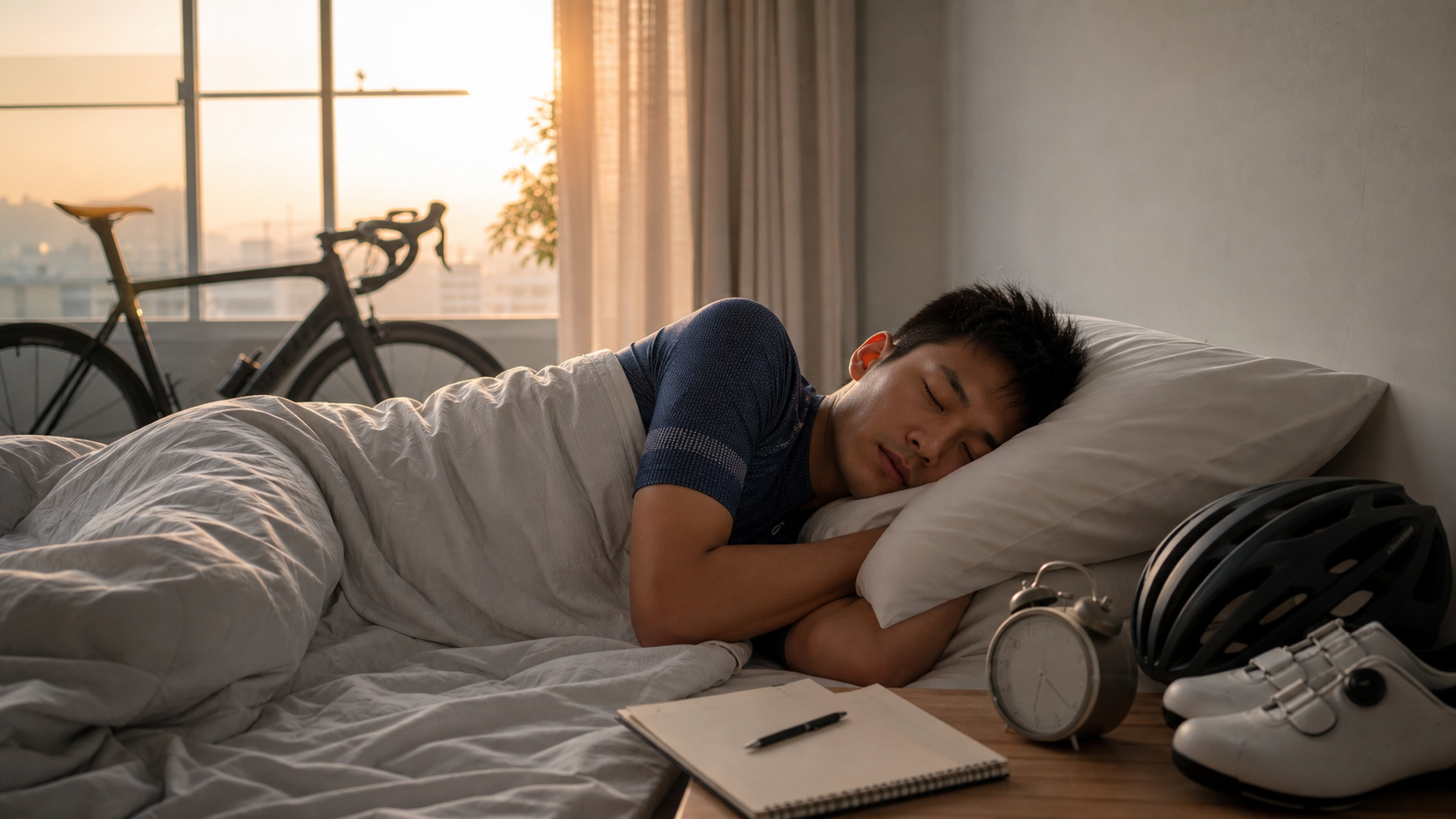
Starting with a Student Who Always “Trained Hard but Plateaued”
A few years ago, I coached an amateur road cyclist—let’s call him A-Bin. His weekly training volume ranked near the top among amateur riders his age: rollers at 5:30 AM on weekdays, century-plus rides on weekends, and a full arsenal of power meters, heart rate straps, and training apps. By all logic, that kind of commitment should have yielded a steady improvement curve. But strangely, his Functional Threshold Power (FTP) was stuck at the same wattage for six full months, while his perceived fatigue grew heavier by the day. His morning resting heart rate ran 5 to 8 bpm higher than usual, and he kept catching colds easily.
I flipped through his training logs page by page—the plan was fine, nutrition was acceptable. Then I asked one question: “What time do you usually go to bed, and how many hours do you sleep?” He paused, then said, “Around 12:30 or 1:00 AM, and I get up at 6:00 to train, so about five and a half hours. I catch up on weekends.”
At that moment, I already had my answer. A-Bin wasn’t training too little—he was recovering too little. And the most core, most cost-free, yet most frequently sacrificed piece of recovery is sleep. We didn’t add a single interval afterward. We did only one thing: gradually stretched his sleep from five-plus hours per night to seven and a half to eight hours over four to six weeks. Three months later, his FTP moved by an amount he hadn’t been able to budge in six months of training, his resting heart rate returned to baseline, and the colds became rare.
In this article, I want to lay out clearly, in one go, the sleep knowledge I’ve accumulated over 15 years from athletes and from the sports physiology and sports medicine literature. Sleep is not an accessory to training—it should be your fourth training discipline, right after “aerobic, intervals, and strength.” And it may well be the one with the highest return on investment.
Let me say the most important thing first: if you could change only one thing today to get stronger, don’t add more training volume—fix your sleep first.
Why Sleep Is So Critical for Athletes: Building the Foundation
Many people’s understanding of sleep stops at “getting enough sleep makes you more energetic”—that’s too superficial. For someone who trains, sleep is actually the primary window during which the body performs repair, hormonal regulation, and the consolidation of memory and motor learning. Training merely delivers the “stimulus” to the body; the process that truly converts that stimulus into progress (i.e., supercompensation) happens largely while you’re asleep.
What the Body Is Actually Doing During Sleep
Human sleep cycles between deep sleep (slow-wave sleep) and rapid eye movement (REM), repeating about four to six cycles per night. Each stage has its own significance for athletes:
- Deep sleep: Linked to tissue repair and the peak secretion of growth hormone. The muscle micro-damage, glycogen depletion, and connective tissue load from daytime training are largely processed during this stage.
- REM sleep: Linked to the brain’s memory consolidation, motor learning, and emotional regulation. Learning a new cornering technique or practicing a complex lifting movement—these “neurological gains” need REM to file them away.
This is also why people who don’t sleep enough aren’t just “tired”—they experience slower recovery, slower learning, worse mood, and impaired judgment. For cyclists, that last one can even be a safety issue on descents or in a pack.
The Specific Effects of Sleep Deprivation on Athletic Performance
Based on research into sleep and athletic performance, insufficient or poor-quality sleep typically causes impairment in the following areas. I’ll express these as ranges because individual variation is large—you shouldn’t treat any single number as gospel:
| Aspect | Common changes with insufficient sleep | Implications for cycling / training |
|---|---|---|
| Endurance performance | Shorter time to exhaustion, higher perceived exertion | The same wattage feels more breathless, you crack earlier |
| Reaction and judgment | Slower reaction time, reduced focus | Slower responses in group rides, descents, and intersections—higher risk |
| Recovery | Growth hormone and repair-related hormones affected | Muscle soreness lasts longer, fatigue accumulates faster |
| Immunity | Reduced immune function | More likely to catch colds or get sick during race season, interrupting training |
| Mood and motivation | Irritability, lower motivation, lack of drive for training | Workouts feel more like punishment, easier to quit halfway |
| Appetite hormones | Ghrelin rises, leptin falls | More prone to mindless eating, harder weight management |
Conversely, the good news is: when you make up the sleep deficit, these aspects also move in the right direction—and often faster than you’d expect.
Sleep Debt Accumulates
I want to add one more concept many people overlook: sleep debt accumulates. You think losing just one hour of sleep per night from Monday to Friday is “no big deal,” but that’s five hours owed by the end of the week, and your body keeps the ledger. It shows up as progressively worse training feel toward the weekend and a higher chance of blowing up before a race. I often tell my athletes: sleep debt is like credit card compound interest—if you don’t pay it off, it snowballs, and eventually it wrecks your performance and health. Moreover, looking at the overall body of sleep research, the “catch-up all at once” approach of sleeping until noon on weekends cannot fully offset the impact of chronic weekday shortfall—so the best strategy is always don’t let it pile up in the first place.
Sleep and the Systems Most Relevant to Athletes
To give you more motivation to prioritize sleep, let me highlight the systems sleep affects most deeply and that matter most to the training population, so you can see exactly what you lose when you sleep poorly:
- Hormones and recovery: The deep stages of sleep are tied to the secretion of growth hormone and other repair-related hormones; skimping on sleep is like shutting down half the repair factory right when you need it most after training.
- Immunity and illness: Chronic sleep deprivation is associated with reduced immune function. This explains why so many people ramp up training volume during race season while staying up late, only to come down with a bad cold before the race—the body had already been sending warning signs.
- Metabolism and weight management: Sleep deprivation disrupts the hormones that regulate hunger and satiety, making people crave high-calorie foods. For riders trying to manage weight or body fat, sleep is an often-overlooked piece of the puzzle.
- Cardiovascular health: Chronic poor sleep, or untreated sleep apnea, is associated with increased cardiovascular risk. This isn’t scare-mongering—it’s why I always urge students who “snore heavily and are sleepy during the day” to see a doctor.
- Psychology and motivation: Sleep is closely tied to emotional regulation and stress tolerance. When you’re sleep-deprived, the same workout suddenly feels “miserable”—that often isn’t you getting weaker, it’s you being too tired.
Once you understand this list, you’ll see: sleep isn’t a “performance bonus”—it’s the foundation that holds up your entire training and health.
How Many Hours Do You Actually Need? What Science Says
This is the question I get asked most. Let’s start with the general adult baseline: most sleep guidelines recommend 7 to 9 hours per night for adults aged 18 to 64 (National Sleep Foundation / CDC). That’s the health baseline for the general population.
But you’re someone who “trains and puts extra daily stress on the body”—your situation is different. Athletes’ sleep needs typically fall at the upper end of the recommended range, or even higher. The literature indicates that recommendations for elite athletes are 9 hours or more per night, treating sleep as equally important as training and nutrition (Sleep Foundation).
“Sleep Extension” Is a Genuinely Effective Intervention
There’s a fascinating concept in sleep science called sleep extension—deliberately increasing sleep duration to see if performance improves. A classic Stanford basketball team study found that after players extended their sleep to about 10 hours per night, their short-distance sprint times improved, and their free-throw and three-point shooting percentages also went up (Sleep Foundation). A systematic review also indicates that for athletes who typically sleep only about 7 hours per night, extending sleep by roughly 46 to 113 minutes is a reasonable general recommendation, and increasing nighttime sleep or adding naps is one of the most effective interventions for improving performance (Springer / Sports Medicine - Open).
I want to emphasize: these numbers are average trends from research populations, not guarantees. But they point in a very consistent direction—for those who train, the lower limit for “getting enough good sleep” should be set higher, not skimped on.
Setting a Realistic Sleep Goal for Yourself
This is how I usually help athletes set their targets—you can compare yourself against it:
| Target Group | Recommended Nighttime Sleep | Notes |
|---|---|---|
| General health maintenance, light exercise | 7 to 8 hours | Get the basics right first |
| Amateur athletes training regularly | 7.5 to 9 hours | Aim higher during high-volume weeks |
| High training volume / pre-competition peak | 8 to 9+ hours, plus naps if needed | Sleep is the main driver of recovery |
| Significant sleep debt (chronic insufficiency) | Start by adding 30 to 60 minutes per night | Progress gradually over weeks; don’t try to catch up all at once |
Besides the number of hours, here are some practical self-assessments to gauge if you’re sleeping enough: whether you need an alarm clock desperately ringing to wake you, whether you feel sleepy during the day, whether your resting heart rate is stable, and whether your perceived effort during training matches your power output. If you wake up naturally around the same time without an alarm and don’t feel groggy during the day, your sleep duration is usually about right.
Practical Approach: Turning “Sleep Hygiene” into an Executable Pre-Sleep Routine
Enough theory—here’s the key part. Knowing you should sleep 8 hours and actually being able to sleep well for 8 hours are two different things. In this section, I break down sleep hygiene into concrete actions you can follow. You don’t need to do all of them at once; pick three or four to start, and add more once they’re consistent.
Core Sleep Hygiene Principles
Based on common principles from sleep guidelines (National Sleep Foundation, Harvard Health, CDC) and what I’ve seen work in practice:
- Consistent schedule: Go to bed and wake up at roughly the same time every day, even on weekends. This is the most important principle because it trains your circadian rhythm.
- Bedroom should be dark, quiet, and cool: Taiwan’s summers are hot and humid; setting up the AC or a fan before bed to keep the room comfortable is a worthwhile investment. Living environments in Taiwan often have issues with street lights, neighbor noise, and poor apartment soundproofing. An eye mask, a pair of earplugs, and blackout curtains are small investments of a few hundred dollars that can significantly improve sleep quality—don’t be stingy.
- Turn off 3C devices at least 30 minutes before bed: The bright screens and stimulating content from phones and tablets delay sleep onset.
- Avoid caffeine in the afternoon and evening: This is especially important for Taiwanese people who love bubble tea and coffee—more on this later.
- Avoid heavy meals and alcohol before bed: Alcohol might make you “fall asleep faster,” but it disrupts sleep quality in the second half of the night—a common blind spot.
- Regular exercise: You’re already doing this, and it’s a plus for sleep; just avoid high-intensity training close to bedtime.
A Pre-Sleep 60-Minute Routine I Often Give Athletes
| Time Point | Action | Purpose |
|---|---|---|
| 90 minutes before bed | Finish the day’s high-intensity training and weightlifting | Lower core body temperature and sympathetic nervous system activity |
| 60 minutes before bed | Take a warm shower, prepare gear for the next day | Post-shower body temperature drop helps with falling asleep; reduces pre-sleep anxiety |
| 45 minutes before bed | Dim room lights, set AC to a comfortable temperature | Signal to the brain that it’s time to wind down |
| 30 minutes before bed | Put away the phone, switch to a paper book or stretching | Reduce screen and information stimulation |
| 15 minutes before bed | Slow nasal breathing, simple body scan relaxation | Activate the parasympathetic nervous system, promote relaxation |
| After lights out | If you can’t fall asleep in 20 minutes, get up, go somewhere else, do something boring, then return | Prevent the bed from becoming a “place of anxiety” |
Many people don’t know this last point: if you’re still awake after 20 minutes, don’t just lie there staring at the ceiling. Get up, go to the living room, dim the lights, do something boring and non-stimulating (don’t scroll on your phone), and go back to bed only when you feel sleepy. This maintains the association of “bed = sleep” and prevents your brain from linking the bed with anxiety.
How to Nap Without Hurting Your Sleep
For those with high training volume or compressed nighttime sleep, napping is a great supplement. The principle is: shorter is better than longer, earlier is better than later.
- A short nap of 10 to 30 minutes usually leaves you feeling most refreshed, with little post-nap grogginess.
- If you want to sleep longer, aim for about 90 minutes (one full sleep cycle), which is usually better than being woken up mid-cycle.
- Try to schedule naps earlier in the afternoon; napping too late can interfere with falling asleep at night.
Common Sleep Problems and Fixes: A Taiwan Context Edition
This section is specifically tailored to the daily lives of Taiwanese athletes, because many sleep issues stem from our lifestyle habits—and changing your approach can make a big difference.
Problem 1: Caffeine Too Late in the Day—The Sweet Trap of Bubble Tea and Americanos
Taiwan’s coffee and bubble tea culture is incredibly vibrant; many people still grab an Americano or a half-sugar black tea at 3 or 4 PM for a pick-me-up. The problem is that caffeine takes time to metabolize and its effects linger for a long time. I often ask athletes to remember a conservative rule: try to avoid caffeinated beverages after noon, and those sensitive to caffeine should stop even earlier.
Many athletes think, “I can still fall asleep after drinking coffee,” but when we actually look at their sleep quality, we find deep sleep is being eroded—you think falling asleep means you’re fine, but your sleep becomes lighter and recovery is compromised. The fix is simple: concentrate your caffeinated pick-me-ups in the morning and before training, and switch to decaf or water in the afternoon.
Here’s a simple caffeine schedule I give athletes to get a feel for it (this is a general guideline; if you’re sensitive to caffeine, shift everything earlier):
| Time Period | Recommendation | Explanation |
|---|---|---|
| After waking up in the morning | Allowed | For alertness, also useful before morning training |
| Before noon | Moderate amounts OK | Try to have your last cup of the day before this |
| Afternoon to evening | Avoid as much as possible | Caffeine’s effects linger into the night, eating into deep sleep |
| A few hours before bed | Avoid | This includes milk tea, green tea, cola, and some energy drinks |
Many people forget: chocolate, some over-the-counter pain relievers and cold medicines, and energy drinks can also contain caffeine. If you’ve been careful not to drink coffee in the afternoon but still sleep poorly, check these “hidden caffeine” sources.
Issue 2: Too Wired to Sleep After Evening Training
It’s common for Taiwanese office workers to only have time to train in the evening, finishing around 8 or 9 PM. By the time you get home and shower, it’s past 10 PM, and your sympathetic nervous system is still fired up, leaving you tossing and turning in bed. This isn’t your fault—it’s just that your time is compressed. Here are some practical fixes:
- Move your highest-intensity intervals as early in the session as possible, and deliberately spend a few minutes cooling down and stretching afterward.
- Leave a cool-down buffer between finishing your workout and going to bed. Don’t jump straight under the covers right after your shower and force yourself to sleep.
- Before bed, use slow, deep nasal breathing to help shift your body from “fight mode” back to “rest mode.”
Issue 3: Oversleeping on Weekends to Catch Up, Wrecking Your Schedule
This was Abin’s old habit at first. Sleeping five hours on weekdays and sleeping in until noon on weekends sounds reasonable, but this kind of drastic schedule drift keeps your body clock in a constant state of “jet lag.” You end up unable to sleep on Sunday night and feel even worse on Monday. A better approach is to get enough sleep during the week as much as possible, and limit weekend catch-up sleep to about an hour, so your wake-up time doesn’t vary too much.
Issue 4: Can’t Stop Scrolling on Your Phone Before Bed
Almost everyone is guilty of this. Besides the bright screen, the bigger problem is that the content itself keeps your brain stimulated. In practice, I don’t tell my athletes they can’t touch their phones at all—that’s unrealistic. Instead, I ask them to set a “phone curfew”—when the time comes, put the phone outside the bedroom or in the living room to charge. Creating physical distance helps break the habit.
Issue 5: Chronic Insomnia, Loud Snoring, or Daytime Sleepiness—Time to See a Doctor
Sleep hygiene can fix “sleep problems caused by habits.” But some conditions can’t be resolved just by adjusting habits, such as chronic difficulty falling asleep or waking up too early (possible insomnia), very loud snoring with severe daytime sleepiness, or waking up gasping for air (possible sleep apnea). In Taiwan, seeing a doctor is very convenient. Under the National Health Insurance (NHI), there are sleep clinics in neurology, pulmonology, and ENT departments, as well as sleep studies available.
If you’ve practiced good sleep hygiene for several weeks and still can’t sleep well long-term, or your partner has noticed you stop breathing during sleep, please don’t tough it out on your own or buy random supplements. Go get evaluated at a sleep-related clinic. Untreated sleep apnea can affect your cardiovascular health in the long run—it’s not just a minor “snoring” issue.
I especially want to remind cyclists with chronic conditions: if you have diabetes, high blood pressure, or heart disease, sleep problems and these diseases often affect each other—poor sleep can make blood sugar and blood pressure harder to control, and certain diseases or medications can in turn affect your sleep. In this situation, don’t try to self-adjust based on internet articles. You must discuss this with your primary care physician and bring up your sleep difficulties proactively at your next follow-up visit. This article can give you concepts, but your condition requires individualized professional assessment—I won’t be vague about that.
Issue 6: Jet Lag and Early Morning Races
Taiwanese cyclists who travel abroad for races or join large early-morning events (like many famous hill climbs or the Tour of East Coast, which start before dawn) often face the problem of “my body isn’t awake yet.” The principle is to adjust a few days in advance: for races abroad, shift your schedule to the destination time zone a few days ahead; for early morning events, move your bedtime and wake-up time earlier in the days leading up to the race so your body can gradually adapt. Don’t expect to force it the night before—that usually just makes you more anxious and less able to sleep.
Supplements and Pitfalls: Better to Be Conservative
My athletes often ask me, “Coach, is there anything I can eat to help me sleep?” My stance has always been conservative: getting your behavior and environment right is the foundation; anything you ingest should never be the first line of defense, and should always be viewed with caution.
Here’s a quick reference table of common “sleep-related substances,” focusing on concepts rather than dosages—because individualization is crucial, especially if you have a chronic condition or are on medication, as any supplement can have interactions:
| Substance / Practice | Common Belief | My Caution |
|---|---|---|
| Caffeine | Boosts alertness and performance | Concentrate it in the morning and before training; avoid in the afternoon |
| Alcohol | “A little drink helps sleep” | Actually disrupts sleep quality in the second half of the night; not recommended as a sleep aid |
| Melatonin products | Helps with falling asleep / jet lag | Regulated in Taiwan; requires physician evaluation; don’t buy overseas and use casually |
| Various sleep supplements | Relaxation and sleep aid | Effects vary by person; check with your doctor or pharmacist if you have a chronic condition or take medication |
| Large amounts of water before bed | — | Easily causes middle-of-the-night bathroom trips that disrupt sleep; drink moderately before bed |
| Black tea / green tea before bed | “Warms the stomach and relaxes” | Don’t forget tea also contains caffeine |
I want to be very clear about melatonin: it can be bought as a general supplement in some countries, but regulations in Taiwan are different. Please don’t buy it from abroad and take it long-term on your own. If you need to adjust your circadian rhythm due to shift work or races across time zones, the right path is to discuss it with a doctor, not to copy someone else’s usage from the internet.
Actionable Advice for Readers at Different Levels
By now, you might feel a bit overloaded with information. Don’t worry—I’ve condensed it into three tiers. Find where you fit and start with the bottom tier.
If You’re a Beginner Whose Sleep Is “Always Sacrificed”
What you need most right now isn’t studying sleep cycles—it’s making up the quantity first:
- Set a fixed bedtime, work backward from your wake-up time, and give yourself the chance to get at least 7.5 hours of sleep.
- No more caffeine after noon.
- Put your phone outside the bedroom 30 minutes before bed.
- Just do these three things consistently for two weeks, and you’ll feel a real difference.
If You’re an Intermediate Athlete with Regular Training
Your volume is probably sufficient, but quality and consistency could be better:
- Pick a few items from the 60-minute pre-sleep routine above and make them a habit.
- During high-volume weeks or the week before a race, deliberately add 30 to 60 minutes of sleep, or take a short nap.
- Monitor your morning resting heart rate and how your training feels—treat it as a fatigue dashboard. If it’s consistently elevated, your body is telling you to sleep more and train less.
- Keep high-intensity intervals away from bedtime as much as possible, and leave a cool-down buffer after training.
If You’re an Advanced / Competitive Athlete “Chasing Breakthroughs”
You already understand training; sleep is the remaining margin you can squeeze out:
- Formally build sleep into your training plan and manage it as a “fourth discipline” rather than “sleeping only if there’s time left.”
- In the week before a race, pay special attention to sleep consistency. Don’t put all your hopes on the night before—it’s normal to sleep poorly the night before a race due to nerves; the nights leading up to it matter more.
- For time zone changes or early morning races, adjust your schedule a few days in advance, and seek professional help (doctor / sleep specialist) if needed. Don’t self-medicate with drugs or supplements.
- If you’ve had chronic sleep problems, don’t just grit your teeth and push through—go get evaluated if you need to.
A Weekly Sleep Self-Checklist You Can Stick on Your Wall
Finally, here’s a simple weekly checklist. Spend two minutes on Sunday evening going through it to see how well you slept this week:
- [ ] Did I average my target sleep duration (7.5 hours or more) this week?
- [ ] Was the difference between weekday and weekend bedtimes and wake-up times within one hour?
- [ ] Did I restrain myself from caffeine after noon?
- [ ] Did I stay away from my phone 30 minutes before bed?
- [ ] Did I mostly wake up without needing an alarm, and not feel very sleepy during the day?
- [ ] Was my resting heart rate stable this week?
- [ ] Did my training feel roughly in line with my power output?
The more boxes you check, the more solid your recovery foundation. If you’re checking very few boxes for several weeks in a row, it’s your body’s way of telling you: you can hold off on adding more training volume—get your sleep sorted out first.
Another Case: Sleep Consistency Matters More Than Total Hours
Let me share another case that’s quite different from A-Bin’s. Let’s call her Xiao-Hui. She’s a triathlon enthusiast who does both running and cycling, and her total sleep hours aren’t actually low—she can get over seven hours on weekdays. But she has one problem: her schedule is very irregular. Sometimes she goes to bed at 10 PM, other times she stays up binge-watching until 2 AM; her wake-up time also depends on her mood, and weekends are a completely different story.
At first, she didn’t think it was a problem because “it adds up to enough sleep.” But she had long-term complaints of poor daytime energy, lack of motivation in training, and irregular menstrual cycles. The first thing I asked her to do wasn’t to extend her sleep, but to fix her bedtime and wake-up time—even on holidays, her wake-up time was only allowed to be one hour later than on weekdays.
About three weeks later, she reported that the most noticeable change was “waking up is easier in the morning, and I’m not as sleepy during the day.” This actually echoes what sleep science has been increasingly emphasizing: a regular, consistent sleep schedule is itself key to health and performance, not just total hours (National Sleep Foundation). Your circadian clock loves predictability—the more you sleep and wake at roughly the same times each day, the better it can schedule the hormones it needs to secrete and arrange deep sleep and REM at the right times.
So if your total hours are actually fine but you still feel like you never get enough sleep, don’t rush to extend your sleep—focus on the “consistency” of your schedule first, and you’ll often feel the difference.
Common Questions Quick-Fire FAQ
These are the questions I get asked most often by athletes, compiled here:
Q: I really can only sleep six hours on weekdays. Can I make it up on the weekend?
A: You can recover part of it, but not all of it. Instead of pinning your hopes on the weekend, find ways to move your weekday bedtime 30 to 60 minutes earlier—even just half an hour more sleep makes a big difference over the long run.
Q: Is it okay to exercise before bed?
A: Low-to-moderate intensity, relaxation-focused activities (walking, stretching, easy foam rolling) are usually fine and can even help you relax. What you really want to avoid before bed are high-intensity intervals and heavy lifting, which raise both your sympathetic nervous system activity and core body temperature, making it harder to fall asleep.
Q: I track my sleep with a sports watch. Can I trust the data?
A: Consumer-grade wearables’ sleep staging isn’t medical-grade, so looking at trends is more meaningful than looking at single-day absolute values. You can use it to observe “whether this week’s sleep is more stable than last week’s,” but don’t get anxious because one day’s data looks bad—anxiety itself will ruin your sleep. For medical-grade data, you’d need a sleep study.
Q: Can I drink a little alcohol to help me fall asleep when I can’t sleep?
A: Not recommended. Alcohol will make you fall asleep faster, but it disrupts your sleep structure in the second half of the night, causing you to wake up easily in the middle of the night and feel even more tired the next day. It’s “fake sleep aid.”
Q: I need to do a morning ride at 5 AM. What time should I go to bed the night before?
A: Work backwards. If you need 7.5 hours, waking at 5 AM means you should be in bed around 9:30 PM. The most common mistake morning riders make is “waking up early but refusing to go to bed early,” which is like accumulating a sleep debt every day. Either go to bed earlier, or adjust your morning ride frequency to a level you can actually afford to sleep for.
Conclusion: Sleep Is Your Most Cost-Effective Training Investment
Back to A-Bin’s story. He later often jokes with his cycling buddies that the most effective “training plan” he’s ever done in his life is “going to bed earlier.” That half-joking remark isn’t an exaggeration at all. Having coached so many athletes, I’m increasingly convinced of one thing: sleep is the most underestimated, yet highest value-for-money training tool. It costs nothing, requires no equipment, carries no injury risk, and it works for almost everyone.
You don’t need to become a sleep model citizen overnight. Pick one or two of the easiest changes to start with—fixing your wake-up time, skipping afternoon coffee, putting your phone away before bed—stabilize those, then gradually add more. Give yourself four to six weeks, and you’ll feel it firsthand: riding feels easier, recovery is faster, your mood is more stable, and you get sick less often.
Treat sleep as something to train with the same seriousness as your training itself.
This article is educational content and does not replace individual diagnosis and treatment advice from a physician, physical therapist, or nutritionist. If you have sleep disturbances related to insomnia, sleep apnea, or any chronic condition (such as diabetes, hypertension, or heart disease), please seek medical attention for individualized assessment and management.
References
- National Sleep Foundation / CDC — About Sleep: https://www.cdc.gov/sleep/about/index.html
- Sleep Foundation — How Sleep Affects Athletic Performance: https://www.sleepfoundation.org/physical-activity/athletic-performance-and-sleep
- Sports Medicine - Open (Springer) — The Impact of Sleep Interventions on Athletic Performance: A Systematic Review: https://link.springer.com/article/10.1186/s40798-023-00599-z
- National Sleep Foundation — Healthy Sleep Starts Before You Hit the Sheets: https://www.thensf.org/healthy-sleep-starts-before-you-hit-the-sheets/
- National Sleep Foundation — Consistent Sleep Schedules (Sleep Timing Guideline): https://www.thensf.org/sleep-schedules-sleep-timing-guideline/
- Harvard Health — Sleep hygiene: Simple practices for better rest: https://www.health.harvard.edu/staying-healthy/sleep-hygiene-simple-practices-for-better-rest
Related Reading
- Sleep and Athletic Performance: The Most Underrated Recovery Tool
- Sleep: The Cheapest Legal Performance Enhancer—A Coach’s Guide to Stealing Back Your Training Gains
- Sleep Is the Strongest Legal Performance Enhancer: A Practical Guide to Sleep Optimization for Athletes
- Sleep Nutrition for Athletes: What to Eat for Better Sleep—A Coach’s Practical Guide from the Dining Table to the Bedside
西進武嶺 免費訓練分析服務 Intervals | 練不夠還是練過頭?你哪一種類型選手?AI模型告訴你! | 備戰神器 | 公路車 訓練 | CT Yeh
4 年前
單車AI教練!全新 ChatGPT4o 幫你分析訓練成果!排武嶺課表,分析騎車姿勢! 太神了! / 公路車 / CT Yeh / feat. 緯緯
2 年前
一個測試有沒有認真練車的方法😂 #公路車
10 個月前
沉浸室內單車練功房開箱! 100吋大畫面,最便宜的花費? 居然還能K歌!? | 公路車 | CT Yeh
3 年前
FTL 與 SYB 車隊專訪 西進武嶺 實用攻略分享! 2小時 如何練?!你不知道的眉角!新手準備武嶺必看 EP1 | 實力派女車友 | 精華版 | 公路車 | CTYeh
4 年前
CT暗黑廚房) 車友必備 宇宙無敵鮮蚵湯 幫助訓練恢復 天然食補 好市多 超肥鮮蚵 破PR
7 年前
昇陽SYB車隊 & Fuji 菁英選手們的趣味經驗分享,長知識了!市民車友必看~ 一路被拉爆後才給問 | 戀戀197 武嶺 凸台經驗分享 | 公路車 | CT Yeh
4 年前
西進武嶺 自製新版AI配速表產生器 x 賽前攻略 抱佛腳! 沒有功率計也可以產生配速表嗎?有什麼其他眉角賽前要注意的呢? | 西進武嶺 / 東進武嶺 KOM 攻略 | 公路車 | CT Yeh
4 年前