Preventing and Treating Heatstroke During Exercise: A Coach's Guide to Heat Illness Severity Levels, the Golden 30 Minutes of Cooling, and Practical Strategies for Summer Cycling in Taiwan
Starting with a Scary Incident on Yangjin Highway
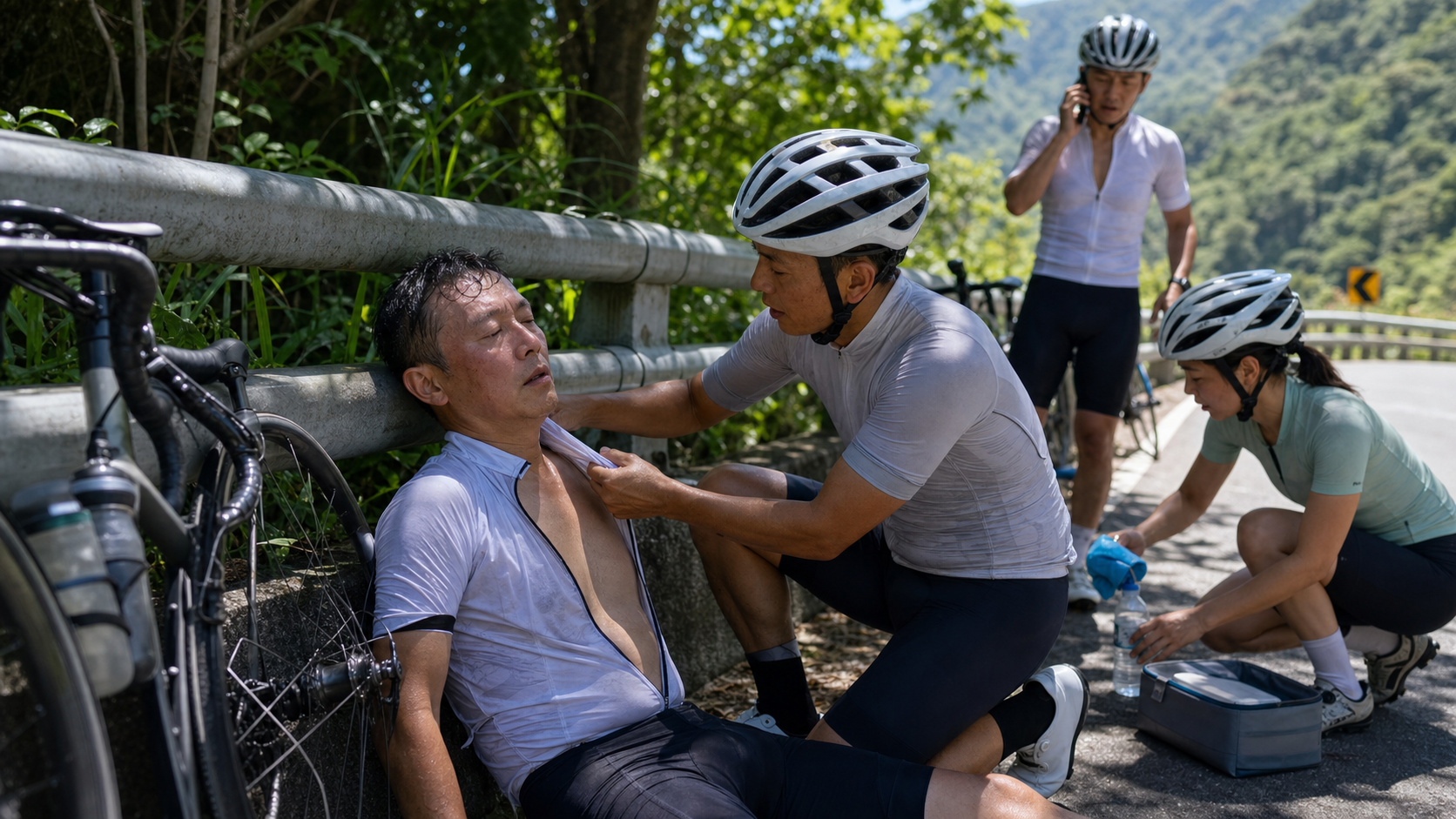
I still remember that Sunday morning in late June. The community college cycling club was scheduled to depart from Jinshan and climb Yangjin Highway. The night before, I reminded everyone in the group chat, “Humidity is high, take it easy.” But one member in his fifties, who had bought his road bike just three months earlier, relied on his basketball fitness and charged to the front from the start. Around 600 meters of elevation, I saw his pedaling rhythm start to fall apart and his body swaying side to side from my rearview mirror. By the time I caught up, his face was pale, his speech was incoherent, and he kept saying, “I’m so dizzy, I want to throw up.” My first move wasn’t to give him water—it was to help him sit down by a guardrail in the shade, loosen his helmet and unzip his jersey collar, while asking a teammate to call 119 and report our location.
He was lucky that day—it was heat exhaustion, not heat stroke. He was taken to the hospital in Jinshan, given IV fluids, and stabilized after a few hours of rest. But that incident stayed with me for a long time: the danger of heat injury isn’t that it’s rare—it’s that it comes on fast and quietly, and many people think “I’m just a little tired” right up until they collapse.
In this article, drawing on years of leading rides, I want to explain exertional heat illness from start to finish: its classification, what actually happens in the body, how to prevent it, and what to do when you encounter it. Taiwan’s summers are hot and humid, and those of us who cycle, run, and hike are chronically exposed to this risk. This isn’t meant to scare you—it’s meant to help you treat this as basic knowledge, just like fixing a flat tire or watching for traffic lights.
Let me start with the bottom line: The most dangerous form of heat injury—heat stroke—has one core principle for first-line response: the faster you lower the core body temperature, the better, and cooling takes priority over waiting during transport to the hospital. This principle will be repeated throughout the article.
Foundational Concepts: How the Body “Overheats and Shuts Down”
Humans are warm-blooded animals; core body temperature must be maintained within a narrow range around 37°C. During exercise, muscle contractions generate a large amount of heat, and the body relies on four main mechanisms to dissipate it: radiation, conduction, convection, and evaporation (sweating). In Taiwan’s summer, when ambient temperature often approaches or exceeds body temperature, the first three mechanisms become nearly ineffective, making sweat evaporation almost the only cooling pathway.
This brings us to Taiwan’s most troublesome factor—humidity. Sweat must evaporate to carry away heat. If the air is already highly humid (Taiwan’s summer often sees 70% to 90% humidity), sweat just runs off without evaporating, and cooling efficiency drops dramatically. That’s why I often tell my students: “Don’t just look at the thermometer—pay attention to how it feels.” At the same 32°C, a dry plateau and the muggy Taipei Basin are two different worlds for the body.
Internationally, the Wet Bulb Globe Temperature (WBGT) is commonly used to assess the threat of a hot environment to exercise, as it accounts for air temperature, humidity, wind speed, and solar radiation. You don’t need to calculate it, but remember this key point: on high-humidity days, even if the temperature hasn’t exceeded 35°C, conditions can still be extremely dangerous.
When heat dissipation can’t keep up with heat production, core temperature starts to climb. The body first activates compensatory mechanisms: heart rate increases, blood rushes to the skin for cooling, and sweating intensifies. These compensations come at a cost—sweating depletes water and electrolytes, less blood is allocated to muscles, and the heart’s workload increases. When compensation fails and body temperature continues to rise, the condition progresses from mild heat cramps and heat syncope, to heat exhaustion, and finally to potentially fatal heat stroke.
Why Heat Stroke Is Fatal
Many people think heat stroke just means “feeling unwell from the heat,” but it’s far more than that. When core temperature rises to a certain level and persists, the high heat directly damages cellular proteins, harms the central nervous system, and triggers a systemic inflammatory response, leading to multi-organ damage—the liver, kidneys, coagulation system, and brain can all be affected. This is why heat stroke is classified as a medical emergency, on the same level as myocardial infarction and stroke. According to international guidelines on exertional heat stroke management, the rate at which core temperature drops is directly correlated with survival—the faster it’s brought down to a relatively safe range, the better the prognosis (see references at the end).
Who Is Especially Vulnerable: A Review of Risk Factors
Heat injury is never just “bad luck”—it favors specific people and specific situations. I’ve compiled the most common risk factors into the table below. Check how many apply to you or your teammates. The more factors you have, the more you need to proactively slow down and have someone watching you.
Heat Injury Risk Factor Reference Table
| Category | Risk Factor | Why It’s Dangerous |
|---|---|---|
| Environmental | High temperature, high humidity, no wind, direct sun | All four cooling pathways nearly fail, especially high humidity making sweat useless |
| Personal condition | Sleep deprivation, alcohol the night before, just recovering from fever/cold, diarrhea/dehydration | Body is already imbalanced; cooling and compensation capacity are reduced |
| Behavioral | Overexertion, refusing to back down, unfamiliar intensity, insufficient water carried | Heat production exceeds cooling capacity, with no buffer from supplies |
| Physiological groups | Elderly, children, obesity, poor fitness, long inactivity | Weaker thermoregulation or cardiopulmonary compensation |
| Disease & medication | Cardiovascular disease, diabetes, thyroid issues; diuretics, some blood pressure medications, antihistamines, psychiatric medications | Affects sweating, heart rate, and fluid regulation (always consult a physician first) |
| Lack of heat acclimatization | Returning from air-conditioned environments or cool countries and immediately doing heavy exercise | Body hasn’t yet built heat tolerance mechanisms |
I often say: “Heat injury is usually several small red flags stacking up until something bursts.” A single factor might be manageable, but “poor sleep + drinking the night before + skipping breakfast + overexertion + extreme heat” stacked together is an accident waiting to happen. Spending thirty seconds checking this table before you head out is worth more than an extra training session.
Another Case: A Runner on the Riverside in the Evening
Let me share a different scenario from cycling. A female student in her early thirties who regularly ran signed up for an evening road race one July, thinking “it shouldn’t be hot in the evening” and ran at her usual pace. The problem was that the plum rain season had just ended, the air was muggy like a steam box, humidity was near 90%, and even after sunset, the ground was still radiating heat. At the 10-kilometer mark, she started feeling dizzy, nauseous, and unsteady on her feet. Fortunately, a fellow runner noticed she was “responding slowly and her eyes looked unfocused,” immediately pulled her to a shaded spot at an aid station, sat her down, splashed water on her, fanned her, had her sip electrolytes, and notified medical staff. Fortunately, it was heat exhaustion, and she stabilized after rest and rehydration.
I want to emphasize two things from this case: First, evening or cloudy conditions are never a guarantee of safety—humidity and ground heat retention can still take you down. Second, what saved her was a fellow runner noticing that “her mind wasn’t right”—proof once again that a companion’s observation is often earlier and more accurate than the person’s own self-assessment.
Classification of Heat Injury: Understanding It from Mild to Severe
Taiwan’s Ministry of Health and Welfare and clinical practice typically classify heat injury into four levels, from mild to severe. Understanding the levels tells you whether “this person needs to rest and drink water” or “this person needs an ambulance immediately.” This is the most important table in the entire article—please make sure you understand it.
Four-Level Heat Injury Reference Table
| Level | Primary Cause | Typical Symptoms | Core Temperature | Consciousness | Management Level |
|---|---|---|---|---|---|
| Heat cramps | Heavy sweating, electrolyte loss | Cramping and pain in calves, thighs, abdominal muscles | Mostly normal | Alert and normal | On-site management |
| Heat syncope | Blood pooling to skin, orthostatic hypotension | Sudden dizziness, brief fainting when standing | Mostly normal or slightly elevated | Brief loss then recovery | On-site management |
| Heat exhaustion | Significant loss of water and salt | Headache, fatigue, weakness, nausea/vomiting, pale skin, profuse cold sweat, rapid heart rate | Normal or slightly elevated (usually below 40°C) | Alert but possibly agitated, disoriented | On-site management + medical care as needed |
| Heat stroke | Thermoregulation failure | Hot, dry, red skin (may still be sweating), confusion, seizures, coma | Often elevated above approximately 40°C | Clearly abnormal: confusion, incoherent speech, coma | Medical emergency: immediate cooling + call ambulance |
Let me add a few key distinguishing points in plain language—these are what I use most often in the field:
- Heat cramps: The person is alert and speaking normally, just a specific muscle is painfully contracted. Don’t force-stretch it; let them rest and drink electrolyte-containing fluids. It usually resolves gradually.
- Heat syncope: Often occurs after sprinting across a finish line and stopping suddenly, or after standing for a long time (e.g., at awards ceremonies or in rest-area lines). Blood is still pooled in the skin and lower limbs; when they stand up, the brain doesn’t get enough blood and they faint. Lay them flat and elevate their legs; they usually recover quickly.
- The most important dividing line between heat exhaustion and heat stroke is “consciousness and neurological status.” A person with heat exhaustion, though very uncomfortable, can still hold a normal conversation. Once you see incoherent speech, irrelevant answers, failure to recognize people, bizarre behavior, seizures, or coma, strongly suspect heat stroke. This is the life-threatening level—don’t hesitate.
I’ve set a personal rule for leading rides: If the person’s “mind” seems off, treat it as heat stroke, cool them first, then call for transport. Better to find out it was a false alarm than to gamble that it’s a mild case.
A Common Misconception: Whether the Skin Is Dry
Traditional textbooks say people with heat stroke have “hot, dry skin and don’t sweat,” but this only holds true in some cases. Many patients with exertional heat stroke (e.g., occurring during cycling or marathon running) still have moist skin and are still sweating when they collapse. So never rule out heat stroke just because “they’re still sweating.” The judgment always comes back to—abnormal consciousness and neurological status + high temperature + being in a hot, humid exercise setting. These three are the key, not whether the skin is dry or wet.
Prevention: Stopping the Risk Before Collapse
First aid is the last line of defense; the real effort should go into prevention. I break prevention into four areas: heat acclimatization, hydration and electrolytes, environment and timing choices, and equipment and self-monitoring.
1. Heat Acclimatization
This is the most underestimated yet most effective measure. The human body’s heat tolerance can be “trained.” When you exercise regularly in a hot environment for about 1 to 2 weeks, your body undergoes a series of adaptations: sweating starts earlier, sweat volume increases but salt concentration in sweat decreases, plasma volume increases, and heart rate at the same intensity is lower. In short, you become more heat-resistant and better at cooling.
In practice, here’s how I arrange training for students who are just entering summer or returning outdoors from air-conditioned environments:
Two-Week Heat Acclimatization Progressive Schedule (illustrative; adjust to individual conditions)
| Day | Environmental Exposure/Exercise Time | Intensity | Key Focus |
|---|---|---|---|
| Days 1–3 | 30–45 minutes | Easy (can chat comfortably) | Let the body start getting used to sweating and cooling; don’t overdo it |
| Days 4–7 | 45–60 minutes | Light to moderate | Can add short climbs; pay attention to hydration |
| Days 8–11 | 60–75 minutes | Moderate | Start approaching normal training volume |
| Days 12–14 | 75–90 minutes | Moderate to slightly higher | Close to formal training intensity; monitor recovery |
Key reminder: Heat acclimatization can’t be achieved all at once, and it can’t be interrupted for too long. If you travel abroad to compete or spend weeks hiding in air conditioning without sun exposure, the adaptation gradually fades, and you need to rebuild it progressively. For those just returning to Taiwan from cooler places abroad, or who spent the entire plum rain season indoors, don’t schedule anything too demanding for your first summer ride.
2. Hydration and Electrolytes
Everyone says “drink more water,” but how to drink, what to drink, and how much to drink are the real points. Sweat loses not just water but also electrolytes like sodium, potassium, and magnesium. If you only chug plain water without replacing salt, you can actually dilute blood sodium, potentially causing hyponatremia (also a dangerous condition).
The table below is a rough guideline I give my students—all values are ranges and need to be adjusted based on body size, sweat rate, and weather; they are not precise prescriptions:
Exercise Hydration and Electrolyte Reference Table
| Timing | Recommended Intake (Range) | Key Content |
|---|---|---|
| 2 hours before exercise | Approximately 300–500 ml | Mostly plain water, to “pre-load” the body |
| 15 minutes before exercise | Approximately 150–250 ml | Top up so you’re not thirsty at the start |
| During exercise (every 15–20 minutes) | Approximately 150–250 ml | For hot, humid exercise over 1 hour, switch to electrolyte sports drinks |
| Long duration (over 60–90 minutes) | Continue based on sweat rate | Sodium supplementation of several hundred mg per hour (adjust based on formula and sweat rate) |
| After exercise | Replace based on weight loss | For every 1 kg of body weight lost, replenish approximately 1.2–1.5 liters |
A few practical tips:
- Weighing yourself is the most honest measure: Weigh yourself before and after exercise; the difference is almost entirely water. Losing more than 2% of body weight means dehydration has already affected performance and cooling.
- Check urine color: Clear to light yellow is ideal; dark yellow or even tea-colored is a clear warning sign of dehydration.
- Don’t wait until you’re thirsty to drink: By the time you feel thirsty, dehydration has already begun—especially for older adults, whose thirst sensation is blunted.
- Convenience stores are your best friend for summer rides in Taiwan: Plan routes with convenience stores as aid stations. Sports drinks and salty snacks (like salt-flavored crackers or savory rice balls) can quickly replenish sodium. But don’t rely on sugary hand-shaken drinks as your primary hydration—too much sugar actually slows absorption.
3. Environment and Timing Choices
Smart people aren’t the ones who can endure heat the best—they’re the ones who know how to avoid the hottest hours.
- Avoid midday to afternoon (roughly 10 a.m. to 4 p.m.): This is when UV and heat load are highest. In summer, I almost always schedule training to start at dawn or after sunset in the evening.
- Choose routes with shade and aid stations: Many classic routes in Taiwan, like riverside bike paths, are actually very exposed with little shade—be especially careful in summer. Mountain forest roads have shade, but watch out for poor cell reception and difficulty calling for help.
- Watch for the “heat island effect”: Urban asphalt retains heat in the afternoon, making it feel much hotter than the forecast temperature.
- Check weather and heat warnings: Before heading out, check the Central Weather Administration’s high-temperature information and feels-like temperature. On days with orange or red alerts, cancel if necessary. No training session is worth ending up in the ICU.
4. Equipment and Self-Monitoring
- Clothing: Light-colored, breathable, moisture-wicking jerseys; wear a cap brim or use a ventilated helmet; apply appropriate sunscreen (sunburn reduces the skin’s cooling capacity).
- Monitoring: Wear a sports watch to track heart rate. An abnormally elevated heart rate at the same intensity, or slower recovery, is often an early sign of overheating or dehydration.
- Ride with others: People with heat injury often don’t realize it themselves; a teammate’s “he seems off” is often more accurate than the person’s own assessment. Exercising alone carries higher risk—always let family know your route and expected return time.
First Aid: What to Do When It Actually Happens
Please memorize this section, or even screenshot it and save it to your phone. I’ll break it into two protocols: “mild” (heat cramps, heat syncope, heat exhaustion) and “severe” (heat stroke).
Universal First Step: Shade, Remove Clothing, Cool
The Ministry of Health and Welfare’s mnemonic is easy to remember. For any suspected heat injury, do these three steps first:
- Shade: Immediately move the person to a cool, ventilated area (under trees, in air-conditioned indoor spaces, or a convenience store).
- Remove clothing: Loosen or remove excess or tight clothing and helmets to help heat escape.
- Cool: Fan, splash water, or wipe with wet towels. For moderate to severe cases, be more aggressive with active cooling.
Mild Heat Injury Management Protocol
For alert individuals with heat cramps, heat syncope, or heat exhaustion:
- Move to a shaded area and have them lie down to rest. For heat syncope, elevate the legs slightly.
- If alert and not nauseous, have them sip electrolyte-containing water or sports drinks in small amounts (don’t chug all at once, to avoid vomiting).
- Use wet towels and fanning to help cool.
- Continue observing for 10 to 30 minutes. If symptoms resolve, consciousness is clear, and they can converse normally, they may rest and end the day’s exercise—don’t push it.
- If any of the following occurs, immediately escalate management, seek medical care, or call an ambulance: changes in consciousness, vomiting that prevents rehydration, worsening symptoms, or a clearly elevated body temperature.
Severe (Heat Stroke) Management Protocol—Cooling Is Key
If you suspect heat stroke (confusion/coma + high temperature + hot, humid exercise setting), do these things simultaneously and in parallel—don’t do them one at a time:
- Call 119 immediately, clearly stating “suspected heat stroke, altered consciousness” and your location.
- Begin aggressive cooling at the same time—don’t just wait for the ambulance. This is the key to survival in severe heat stroke. Research shows that the faster core temperature is lowered, the better the prognosis (see references at the end).
- The most effective method is “cold/ice water immersion”: If conditions allow (e.g., a large tub, bucket, or large ice chest), immerse the body in cold water, keeping the head above water. This is internationally recognized as the fastest cooling method.
- If immersion isn’t available on-site, alternatives: Continuously apply ice packs or cold wet towels to the neck, armpits, and groin (where major blood vessels pass), splash water over the entire body, and fan vigorously to promote evaporative cooling.
- For unconscious or vomiting patients, place them on their side to keep the airway clear and prevent choking on vomit.
- Do not give any food or drink to an unconscious person—there’s a risk of choking and aspiration.
- Continue cooling until EMS takes over, and report what you’ve done and how the patient’s condition has changed.
The Ministry of Health and Welfare’s Three “Don’ts” for First Aid
Many people get these three points wrong, so I’m calling them out specifically. These are general guidelines for the public on-site:
- Don’t use ice water (referring to methods that cause pores to constrict) / don’t chug ice-cold drinks: General health education emphasizes not using methods that rapidly constrict skin blood vessels, as this hinders heat dissipation.
- Don’t wipe with alcohol: Alcohol constricts skin blood vessels and can be absorbed through the skin; not recommended.
- Don’t self-administer fever-reducing medication: The high body temperature in heat injury comes from “loss of thermoregulatory control,” which is a different mechanism from infectious fever. Antipyretics (like acetaminophen or aspirin-type drugs) are not only ineffective but may increase liver and kidney burden.
Let me clarify what seems like a contradiction: The Ministry of Health and Welfare’s advice to the general public to “not use ice water” refers to not using crude methods like dumping a bucket of ice water or causing rapid skin vasoconstriction without monitoring. Meanwhile, international sports medicine recommendations for “exertional heat stroke” state that for professionals or experienced personnel, whole-body cold/ice water immersion is the fastest golden method when monitoring is possible. The two apply to different audiences and situations. The practical takeaway for the general public is: move the person to shade, splash plenty of water + fan + apply ice to major blood vessel areas, and call an ambulance simultaneously—this is safe and effective for the vast majority of on-site situations. If you’re at a race medical station with proper equipment and experience, cold water immersion is the first choice.
Cooling Method Comparison Table
| Method | Cooling Speed | Suitable Situations | Cautions |
|---|---|---|---|
| Whole-body cold/ice water immersion (head above water) | Fastest | Facilities like bathtubs, large tubs, race medical stations | Requires personnel to secure and monitor, prevent drowning; be especially careful with unconscious patients |
| Whole-body water splash + vigorous fanning | Fast | Most practical for outdoor settings | Relies on evaporative cooling; efficiency drops slightly in high humidity but remains effective |
| Ice packs on major vessel areas (neck, armpits, groin) | Moderate | Used alongside the above two | Slower if used alone; recommended in combination |
| Moving to air-conditioned room to rest | Slow (but stable) | Mild cases or continued management after cooling | For severe heat stroke, “air conditioning alone” is too slow and cannot replace active cooling |
Common Mistakes and Corrections
Over years of leading rides, I’ve seen many well-intentioned but incorrect responses. Here are the most common ones, to help you avoid them.
Mistake 1: “He’s just tired; he’ll be fine after resting.”
Correction: Heat exhaustion and early heat stroke symptoms are often mistaken for simple fatigue. The key isn’t “tired or not” but consciousness, nausea, and body temperature. If the mind seems off, err on the side of overreacting.
Mistake 2: Just chugging lots of plain water.
Correction: Replacing only water after prolonged heavy sweating can cause hyponatremia. For hot, humid exercise lasting over 1 hour, replenish with electrolyte-containing drinks.
Mistake 3: Waiting for the ambulance to arrive before doing anything.
Correction: Severe heat stroke damages organs every single minute. On-site cooling must begin immediately, in parallel with calling the ambulance. Waiting is losing.
Mistake 4: Wiping with alcohol or forcing fever-reducing medication.
Correction: Both are ineffective or even harmful for heat injury. Don’t do it.
Mistake 5: Giving water or medication to an unconscious person.
Correction: Any oral intake for someone with altered consciousness risks choking and aspiration—very dangerous. Instead, place them on their side to maintain the airway and focus on cooling.
Mistake 6: Thinking “if they’re still sweating, it can’t be heat stroke.”
Correction: Many people with exertional heat stroke are still sweating when they collapse. Don’t be fooled.
Mistake 7: Going back to riding after symptoms resolve.
Correction: After a heat injury episode, the body’s thermoregulation is already compromised. End exercise for the day, rest and replenish properly, and reassess the next day.
Practical Reminders for Taiwan’s Local Context
Let’s apply these principles to our real-life scenarios:
- For people who eat out often, sodium is usually not lacking, but potassium often is: Taiwanese restaurant food tends to be salty, so sodium is usually sufficient, but fruit and vegetable intake is often inadequate, leading to low potassium. Beyond electrolyte replacement during exercise, eating more vegetables and fruit in daily life helps overall electrolyte balance. (Those with kidney disease or potassium restrictions should follow medical advice and not self-supplement large amounts of potassium.)
- Healthcare is easily accessible under NHI—don’t delay because you don’t want the hassle: Taiwan has excellent healthcare accessibility. If you suspect heat exhaustion or worse, go to the emergency room without hesitation. For heat stroke, don’t hesitate—call 119 directly. Don’t miss the golden treatment window because you’re “too embarrassed to bother others.”
- Common venues each have their own risks: Riverside bike paths are exposed, have little shade, and aid stations are spread out; mountain forest roads are cool but have poor reception and slow rescue; tracks and closed circuits need attention to ground radiation heat from asphalt and PU surfaces. Based on the venue, plan ahead: “If someone collapses, where’s the nearest shade, water source, convenience store, and hospital?”
- The first heat wave after the plum rain season is the most dangerous: Taiwan often transitions suddenly to hot and humid weather after the plum rain ends. At this point, people haven’t completed heat acclimatization, making it a peak period for heat injury. Deliberately slow down and shorten sessions during these days.
- Elderly and chronically ill populations need extra caution: Older adults have reduced thirst sensation and sweating regulation. People with diabetes, hypertension, heart disease, and those taking diuretics, certain blood pressure medications, antihistamines, or psychiatric medications may have impaired thermoregulation. Exercise plans for these groups must be discussed with their physician for individualized assessment; this article cannot replace a doctor’s judgment for your specific case.
Action Recommendations for Readers at Different Levels
If You’re a Beginner New to Exercise
- First learn to read how it feels and check the weather: On red or orange alert days, reschedule or move indoors.
- Start in the early morning or evening, with short duration and light intensity, and complete heat acclimatization gradually over two weeks.
- Carry water and sports drinks with you, sip small amounts every 15–20 minutes—don’t wait until you’re thirsty.
- Always let someone know where you’re going and when you’ll be back; it’s best to go with a partner.
- Screenshot the “Heat Stroke Management Protocol” from this article and save it to your phone.
If You’re an Advanced Enthusiast with Some Foundation
- Weigh yourself before and after exercise to understand your sweat rate and customize your hydration plan.
- For long rides, plan aid stations; sodium replacement should keep pace with sweat loss.
- Use heart rate as an “early overheating alarm”—if heart rate spikes abnormally at the same intensity, proactively slow down, stop, and cool off.
- After returning from racing abroad or extended time without sun exposure, redo heat acclimatization before resuming intensity.
- Learn to recognize abnormalities in teammates and develop the ability to actively cool someone on-site.
If You’re a Team Coach or Event Staff Member
- Before departure, know each member’s chronic medical history and medications; give extra attention to high-risk individuals.
- Prepare cooling supplies with the team or at medical stations: plenty of water, ice, ice packs, containers for immersion, wet towels.
- Establish a clear response protocol and communication responsibilities (who calls for transport, who cools, who guides the ambulance in).
- Empower anyone to “call a stop”: If anyone feels the weather or conditions are wrong, they can halt the activity without waiting for the highest authority to decide.
- Before summer each year, have the whole team review heat injury recognition and first aid.
FAQ
Q: Can drinking very salty soup or taking salt tablets prevent heat stroke?
A: Moderate sodium supplementation helps with prolonged heavy sweating, but excessive salt intake increases gastrointestinal and kidney burden and can’t be “stored up in advance.” Sports drink formulas are usually more balanced than self-supplementing. Those with hypertension or kidney disease should be especially cautious and consult a physician first.
Q: How long after heat stroke can I resume exercise?
A: For mild heat exhaustion, stop exercising that day and rest and replenish fully. Afterward, resume exercise gradually and avoid the hottest hours. For those who have had severe heat stroke, heat tolerance may be reduced for a period of time. Whether and how to resume exercise must be evaluated by a physician.
Q: Can’t you get heat stroke indoors at spin class or the gym?
A: Yes, you can. Poorly ventilated, hot, humid indoor spaces with heavy sweating can still cause heat injury, especially in rooms with insufficient air conditioning or crowded classes. The principles are the same: pay attention to hydration, and stop if something feels wrong.
Q: What should children and the elderly pay attention to?
A: Children have immature thermoregulation, and older adults have diminished thirst sensation and sweating regulation. Both are high-risk groups. Proactively remind them to hydrate on a schedule during exercise or outdoor activities—don’t wait for them to say they’re thirsty—and shorten exposure time.
Q: How do I quickly decide whether to call an ambulance?
A: In one sentence—if there’s any abnormality in consciousness or behavior (incoherent speech, failure to recognize people, seizures, coma), regardless of whether the skin is wet or dry, call 119 immediately and start cooling. This is a red line that requires no hesitation.
Q: Are commercial “electrolyte effervescent tablets” or “salt candies” useful?
A: The value of these products is convenient sodium replacement, plus a bit of sugar to aid absorption—they’re a good option for prolonged heavy sweating. But they’re not a miracle cure; the “amount” and “timing” of hydration are equally important. Also, those with diabetes, kidney disease, or sodium/potassium restrictions should check ingredients and consult a physician—don’t consume unlimited amounts just because it says “sports” on the label.
Q: Do arm sleeves or sun-protection jackets make you hotter?
A: The key is fabric and humidity. Light-colored, breathable, quick-drying sun-protective fabrics reduce direct heat absorption from strong sunlight and prevent sunburn (sunburn reduces cooling capacity), so the benefits usually outweigh the drawbacks. But if the material is non-breathable and traps sweat, it hinders evaporative cooling. The principle is: block the sun, but allow ventilation and sweat evaporation.
Q: Is it better to drink cold or room-temperature fluids?
A: During exercise, slightly cooler drinks are fine for lowering perceived temperature, and better palatability encourages more intake. The key isn’t the “temperature” but avoiding chugging large amounts of very cold liquid at once, which can cause gastrointestinal discomfort. Small, regular sips matter more than temperature.
Q: If someone survives heat stroke, are they out of the woods?
A: Not necessarily. Severe heat stroke can cause organ damage (liver, kidneys, brain, coagulation system) requiring hospitalization and follow-up monitoring. This is why even if the person appears alert after on-site cooling, they should still be taken to the hospital so doctors can assess for invisible internal damage.
Conclusion: Make Prevention Instinctive
Let’s return to the man on Yangjin Highway from the beginning. He later told me that what he regretted most wasn’t how miserable he was that day, but that “the group chat had warned us, yet I thought it was meant for someone else.” I’ve never forgotten that, and it’s the reason I wrote this article.
Heat injury is almost always preventable. It’s not like sudden cardiac issues that are hard to predict—it has clear risk factors (heat and humidity, dehydration, overexertion, lack of heat acclimatization) and clear early warning signs. All you need to do is turn these habits—“check how it feels, take it easy, hydrate frequently, watch your teammates, and if the mind seems off, cool and call”—into instincts as natural as checking traffic lights while riding.
Taiwan’s summer is long, hot, and humid, but with proper preparation, we can still safely enjoy the joy of cycling, running, and hiking. May every ride you take bring you home safely. See you on the road.
This article is educational content and cannot replace individualized diagnosis and treatment advice from physicians, physical therapists, or nutritionists. If you have chronic conditions, are taking medication, or have experienced severe heat injury, please discuss individualized exercise and prevention plans with your physician. In emergencies, call 119 immediately.
References
- Health Promotion Administration, Ministry of Health and Welfare – Heat Injury First Aid: https://www.hpa.gov.tw/Pages/Detail.aspx?nodeid=577&pid=10751
- Health Promotion Administration, Ministry of Health and Welfare – Diagnosis and Management of Heat Injury: https://www.hpa.gov.tw/Pages/Detail.aspx?nodeid=577&pid=10746
- National Health Insurance Administration, Ministry of Health and Welfare – Heat Exhaustion and Heat Stroke: https://www.nhi.gov.tw/ch/cp-2778-ae885-2951-1.html
- Centers for Disease Control, Ministry of Health and Welfare – High Temperature and Extreme Cold: https://www.cdc.gov.tw/Category/ListContent/wL-8Abm9o5_5l4gSOR8M5g?uaid=_VBRPRbLJSqI9J9_wSjD2w
- First aid cooling techniques for heat stroke and exertional hyperthermia: A systematic review and meta-analysis (Resuscitation): https://www.resuscitationjournal.com/article/S0300-9572(20)30028-9/abstract
- Management of exertional heat stroke: a practical update for primary care physicians (PMC): https://pmc.ncbi.nlm.nih.gov/articles/PMC5819979/
Related Reading
- Prevention and Management of Exercise-Related Hypothermia: A Complete Practical Guide from a Sports Science Consultant
- Heat Injury and Heat Stroke Prevention While Cycling: Safe Riding Guidelines for Taiwan’s Summer Heat
- Complete Guide to Distinguishing Heat Exhaustion from Heat Stroke: Classification, On-Site Management, and Hospital Warning Signs You Can’t Delay
- Summer Heat Injury in Taiwan: Emergency Management for Runner Heat Stroke and Heat Exhaustion
水金九不厭五分 10度寒流冷到不願停!feat. 卡卡 / 公路車 / CT Yeh
6 個月前
單車 一日北高 ( 雙城 ) 肥宅雙人瘋狂行 紀錄片 REACTO
10 年前
日本公路最高登山賽,台灣首位YT挑戰實錄,乘鞍登山賽40週年,賽前篇完整版,請到我的YT收看 #公路車 #cycling
11 個月前
一日北高/長距離團騎 常見問題補充篇 / 組團或跟團的眉角 / 壯車友容易被瘦車友慢性拉爆 / 原來屁股痛可能是這個原因...? / 風場配速法 / 公路車 / CT Yeh
2 年前
#KOM 夏季登山王之路 比賽實況 #東進武嶺
7 年前
TBA 北高360 逆風爆熱再送空汙 苦行挑戰賽全記錄 4K沈浸式臨空畫質| 公路車 | CT Yeh
3 年前
4K單車實境) 舊陽金P字道 第1P 仰德大道至小油坑 誤跟武嶺神人們 被拉爆爽飛天 Taiwan Cycling Climb Route Recommend
7 年前
一個測試有沒有認真練車的方法😂 #公路車
10 個月前