Identifying and Managing Exercise Dehydration: A Complete Guide to Severity Levels, Symptoms, and Hydration Strategies
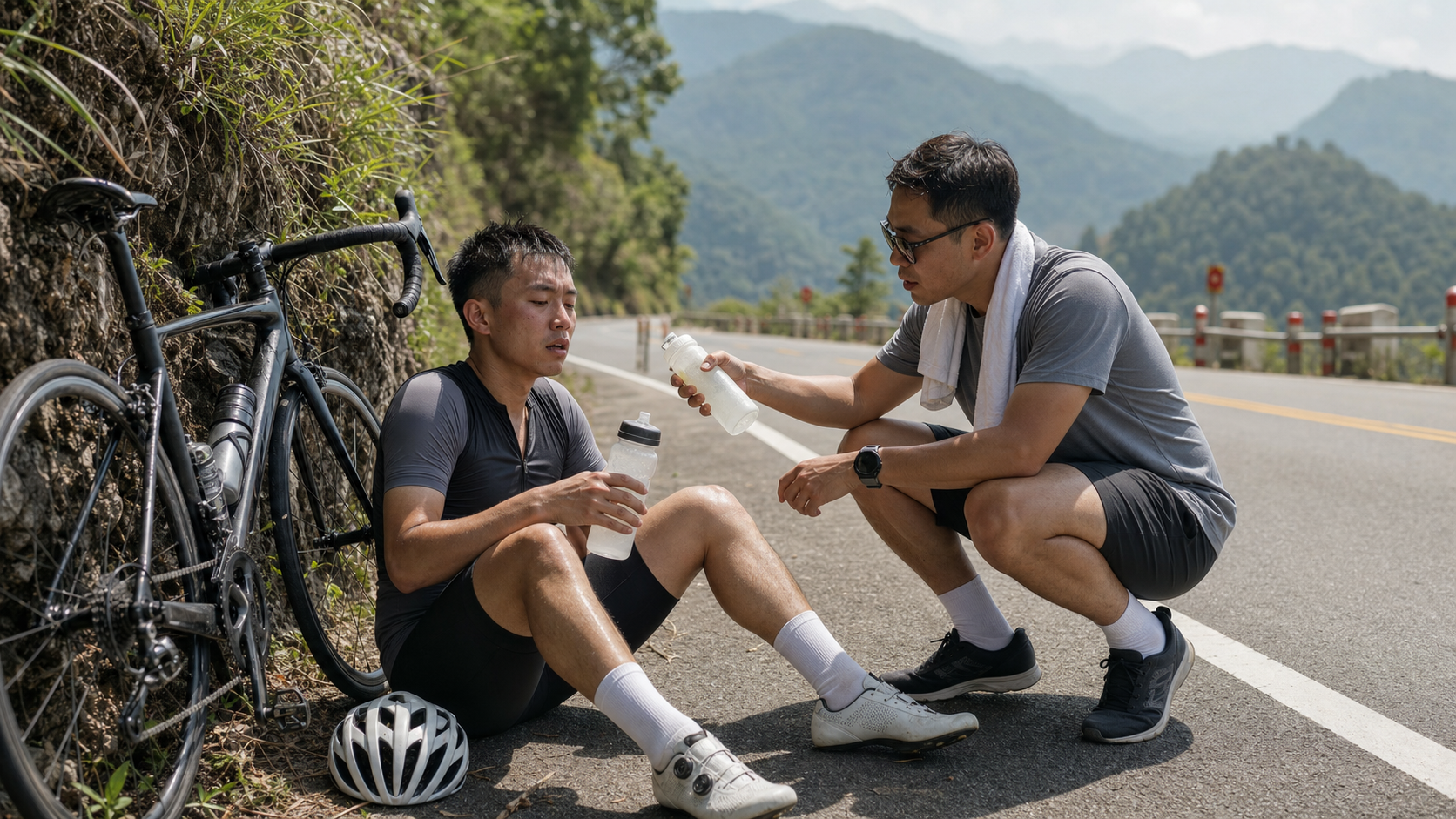
Starting with a Cramp on Wuling
A few summers ago, I took a student up Wuling. He trained hard on the riverside bike paths, had solid power numbers, weighed about 72 kg, and was the type who thought, “My fitness is definitely not a problem.” That day, the temperature was around 31°C with high humidity, and he drank less than one bottle of water the entire way, thinking, “It’s a climb, riding slowly, why would I need to keep drinking?” But after passing Yuanfeng, his pedaling rhythm started to fall apart. He told me his inner calf felt “weird,” and ten minutes later, he cramped up and stopped right by the roadside, pale-faced and a bit dazed when speaking.
I helped him sit down in the shade and assessed the situation: his heart rate was noticeably elevated, his skin felt dry to the touch, and he said he hadn’t felt the urge to urinate for a while. This wasn’t just “legs giving out”—it was a classic case of exercise dehydration combined with electrolyte loss. I had him slowly consume a sodium-containing sports drink, rest, and cool his body down. It took about half an hour before he gradually recovered.
After we descended, I gave him a homework assignment: weigh himself before and after his next ride. From departure to returning home, after accounting for the water he drank, he had a net loss of nearly 3% of his body weight. For him, that was the first time he truly “saw” dehydration—it wasn’t about whether he could drink or not; it was that he had no idea how much he was sweating or how much he needed to replace.
In this article, I want to organize the pitfalls I’ve encountered over 15 years of coaching students and in my own riding: how dehydration is classified, what signals your body sends, and how to hydrate properly before, during, and after events in Taiwan’s hot, humid environment. I’ll do my best to give you tables and steps you can follow directly, rather than just saying “drink more water” and leaving it at that.
Why Dehydration Hurts Athletic Performance So Much
Let me start with a concept many people don’t intuitively grasp: you don’t need to be severely dehydrated to get slower. Research generally uses “losing 2% of body weight” as a key threshold. Beyond that point, athletic performance begins to decline noticeably—including reduced endurance, increased perceived exertion, decreased strength and power, and even impaired cognitive functions like judgment and reaction time.
Using my student’s 72 kg example, 2% is roughly 1.4 kg of water. That sounds like a lot, but in Taiwan’s humid, hot summer, losing that amount over a two-to-three-hour climb or long ride is actually very easy.
More seriously, when losses reach above 3% of body weight, the risk of exertional heat illness (heat cramps, heat exhaustion, and even heat stroke) increases significantly; and when losses exceed 5%, work capacity drops by about 30%. High-intensity exercise that leads to exhaustion in a short time is even more sensitive to dehydration—studies show that even losing just about 2.5% of body weight can cause a significant decline in high-intensity exercise capacity.
The physiological mechanisms behind this aren’t hard to understand:
- Decreased plasma volume: Sweat is water drawn from your blood. As blood becomes more concentrated, each heartbeat pumps out less blood, so your body has to rely on raising your heart rate to maintain output. That’s why you feel like “my heart rate is spiking at the same pace” when dehydrated.
- Worse heat dissipation: Blood has to supply working muscles while also going to the skin to help dissipate heat. When water is insufficient, both sides are strained, and core body temperature rises more easily.
- Electrolyte imbalance: Sweat isn’t just water; it also carries away electrolytes like sodium, chloride, potassium, and magnesium. Sodium loss is linked to muscle cramps, nausea, and fatigue, which is why sometimes “only drinking plain water” makes you feel worse the more you drink.
- Feeling more effort: At the same power or pace, dehydration raises your rating of perceived exertion (RPE)—meaning “you’re not working harder, but it feels harder.” This subjective fatigue makes you unconsciously slow down or want to quit earlier, which has a big impact on completing long-distance efforts.
I often ask my students to remember this image: your blood is a limited resource that must simultaneously “deliver oxygen to muscles” and “carry heat to the skin to dissipate.” Dehydration is like turning down the water flow in that pipe—both sides get strained, so your heart rate is forced up, your body temperature is forced up, and the effort feels heavier—these three things happen together, not independently. Once you understand this, you’ll see why “holding that 2% line” isn’t being fussy; it’s about keeping the entire system running with a comfortable margin.
Key reminder: Thirst is usually a signal that appears after dehydration has already begun, especially in older individuals, whose sensitivity to thirst declines. So during prolonged exercise, you can’t wait until you’re thirsty to drink—you need to hydrate on a plan.
Dehydration Severity Levels and Symptom Comparison
Clarifying the severity levels of dehydration is so you can “assess on the spot and act on the spot.” The table below is the mental map I actually use when leading groups. Please note: the percentages here refer to the proportion of body weight lost, and treat the numbers as ranges and references—individual variation is large.
| Severity | Body Weight Loss (Approximate) | Common Symptoms | On-Site Management Direction |
|---|---|---|---|
| Mild | About 1–2% | Thirst, reduced urine output, darker urine, slight fatigue, slightly declining performance | Actively hydrate, slow the pace, find shade |
| Moderate | About 3–5% | Obvious thirst, elevated heart rate, headache, weakness, decreased skin elasticity, almost no urge to urinate, cramps beginning | Stop high-intensity effort, sodium-containing fluids, actively cool down, monitor closely |
| Severe | About 6% and above | Dizziness, nausea/vomiting, confusion, slurred speech, cool/clammy or abnormally hot skin, no sweating, possible fainting | Treat as a medical emergency, cool down and seek medical attention ASAP / call 119 |
Here I want to specifically warn about a dangerous misconception: “stopping sweating” is not a sign of improvement—it’s a warning sign. When someone is exercising in the heat and suddenly stops sweating, their skin becomes dry and hot to the touch, and they start talking incoherently, this is very likely a precursor to heat stroke—a potentially fatal emergency. You absolutely cannot just “let them rest and drink water”; you must actively cool them down and get them to a hospital immediately.
Three “On-the-Spot Self-Checks”
I teach my students three methods that require no equipment to quickly assess their hydration status:
- Urine color: This is the most practical tool for daily use and pre-event checks. Ideally, it should be a light yellow, like pale lemonade; if it’s as dark as strong tea or apple juice, that means you’re under-hydrated. (Note: just taking B vitamins, beets, or certain medications can make urine darker or discolored, so rule those out when interpreting.)
- Urine volume and frequency: If you haven’t felt the urge to urinate all morning, that usually means you haven’t been drinking enough.
- Body weight change: Weigh yourself before and after exercise (wearing similar clothing, drying off sweat). The weight lost is almost entirely water. This is the most objective method, and the next section will show you how to use it to calculate your sweat rate.
Hyponatremia: The Other Easily Overlooked Extreme
Many people think the only danger in exercise is “drinking too little,” but actually drinking too much plain water is also dangerous, especially in slow, long-duration activities (like the later stages of a full marathon or ultra-distance events). When you only chug plain water and dilute the sodium in your blood, you can develop exercise-associated hyponatremia (EAH). Symptoms include nausea, headache, bloating, confusion, and in severe cases, seizures and life-threatening conditions. Its symptoms closely mimic dehydration/heat exhaustion, making it easy to misdiagnose.
Key principles for distinguishing:
- If someone drinks large amounts of water but their weight doesn’t drop—or even rises—and they develop neurological symptoms, be highly alert for hyponatremia. In this case, do not keep giving them water.
- During prolonged exercise, only consuming plain water with no sodium at all is a high-risk behavior for hyponatremia.
So the real goal is never “drink as much as you can,” but rather replace the water and electrolytes you’ve lost, just right.
From Dehydration to Heat Illness: A Continuum You Must Understand
Many people treat “dehydration” and “heat stroke” as two unrelated things, but in Taiwan’s summers, they are actually different segments of the same spectrum. Dehydration impairs your body’s ability to dissipate heat, raising core body temperature; a rising core temperature then forces more sweating, which accelerates dehydration—this is a self-amplifying vicious cycle. Let me lay out the common exertional heat illnesses from mild to severe, so you know what to do at each stage.
Heat Cramps
The mildest and most common. They typically occur with heavy sweating and high sodium loss, presenting as sudden cramping or spasms in the calves, thighs, or abdomen. The person remains fully conscious. Management: Stop, move to shade, gently stretch, and consume a sodium-containing sports drink—this usually resolves it. If cramps keep recurring after sodium replacement and rest, consider whether the intensity is too high or if other factors are at play.
Heat Exhaustion
One step up from heat cramps. Core body temperature usually rises but hasn’t yet reached a dangerous high. You may feel weak, dizzy, nauseous, sweat profusely, have a rapid heartbeat, and look pale; you might feel like vomiting. At this stage, consciousness is generally still clear, which is the most important distinction from heat stroke. Treatment: Stop exercising immediately, move to a shaded, well-ventilated area, loosen clothing, elevate the legs, actively cool down (splash water, fan, apply ice to the neck and armpits), and sip sodium-containing drinks. If there’s no significant improvement within a short time, or symptoms continue to worsen, seek medical attention.
Heat Stroke
This is a life-threatening medical emergency—every second counts. The most critical warning sign is central nervous system dysfunction: confusion, incoherent speech, bizarre behavior, unsteady gait, seizures, or even coma. The skin may be hot and dry (but it can also still be sweating—don’t let the fact that “they’re still sweating” lull you into complacency). The treatment principle is only two words: cool down, and do it fast. While waiting for the ambulance, begin whole-body cooling immediately—cold water, ice packs, fanning—do whatever you can. In this situation, cooling takes priority even over hydration, because drinking water won’t save someone whose core temperature has already spiked. Call 119 immediately.
The table below helps you quickly distinguish between the three conditions—it could save a life in the field.
| Heat Illness | Consciousness | Skin | Key Indicator | First Step |
|---|---|---|---|---|
| Heat Cramps | Clear | Heavy sweating | Muscle cramping/pain is primary | Rest, sodium, stretching |
| Heat Exhaustion | Generally clear | Heavy sweating, pale | Weakness, dizziness, nausea | Stop, cool down, sodium-containing drinks |
| Heat Stroke | Confused/Abnormal | Burning hot, may be dry or wet | Neurological symptoms = emergency | Active cooling + call 119 |
One sentence to remember: If “they’re talking strangely, acting strangely” occurs in a hot environment, treat it as heat stroke. Better to be overly cautious than to gamble that it’s just fatigue.
Practical Method 1: Calculate Your Own Sweat Rate
Sweat rates vary enormously between individuals, ranging from 0.5 liters to over 2 liters per hour, influenced by body size, intensity, weather, and acclimatization. Rather than copying someone else’s fluid intake, spend one training session to measure your own numbers.
Simple sweat rate calculation:
Sweat volume (liters) ≈ (pre-exercise body weight − post-exercise body weight) + fluid consumed during exercise
Sweat rate (liters/hour) = Sweat volume ÷ exercise duration
Here’s a real example: An athlete does a 60-minute session, weighing 68.0 kg before and 66.8 kg after (a loss of 1.2 kg), and drinks 0.5 liters of water during the session.
- Sweat volume = 1.2 + 0.5 = 1.7 liters
- Sweat rate = 1.7 ÷ 1 hour = approximately 1.7 liters per hour
This means that under similar weather and intensity, if they want to keep dehydration within 2%, they need to plan to replace a large portion of what’s lost each hour (in practice, it’s usually impossible to replace 100%, but aim to get as close as possible to avoid crossing that 2% line).
Practical tips:
- Dry off sweat and remove soaked outer layers before stepping on the scale for accurate numbers.
- Measure at least once in different weather conditions (cool day, hot-humid day)—you’ll find the same workout can cause significantly more fluid loss in Taiwan’s July and August.
- If you use the restroom during the session, account for that weight separately.
| Scenario | Weather | Intensity | Approximate Sweat Rate Reference |
|---|---|---|---|
| Easy riverside ride | Cool and dry | Low | ~0.5–0.8 L/hour |
| Weekend long distance | Warm | Moderate | ~0.8–1.3 L/hour |
| Summer climbing/intervals | Hot and humid | High | ~1.3–2.0+ L/hour |
(These are general ranges; always rely on your own measurements.)
Practical Method 2: Three-Phase Hydration Strategy—Pre-Race, Mid-Race, Post-Race
Hydration isn’t something that “starts when you hit the road.” I break it into three phases, each with a different goal.
Pre-Race: Aim to “Top Up”
The general recommendation is to drink gradually in divided amounts 2–4 hours before exercise, giving your body time to absorb the fluid and eliminate the excess (which is also why you should leave time for a bathroom stop before the start). A common approach is about 4 hours before exercise, consuming roughly 5–7 mL of fluid per kilogram of body weight; for a 70 kg person, that’s about 350–490 mL. Before heading out, just confirm your urine is pale yellow—no need to chug until your stomach is bloated.
Don’t slam a big bottle 10 minutes before departure—it won’t be absorbed in time, and you’ll just spend the whole ride needing to pee with an uncomfortable stomach.
Mid-Race: Fixed Intervals and Amounts, Don’t Wait for Thirst
During exercise, a practical common target is to replenish approximately 0.4–0.8 liters of fluid per hour, adjusted based on your measured sweat rate and the day’s weather. My recommendations:
- Set timed reminders: Take a sip every 15–20 minutes (about 150–200 mL)—far more stable than “waiting until thirsty and chugging.”
- Add sodium after 1 hour: For exercise lasting over 60 minutes, or when sweating heavily in hot, humid weather, plain water isn’t enough—you need sodium-containing sports drinks. A general guideline is about 0.5–0.7 grams of sodium per liter of fluid.
- Pair with carbohydrates: For longer efforts, a sports drink with carbs helps replenish energy and speeds up water absorption—two birds with one stone.
Post-Race: Fill the Gap
After exercise, many people drink a few sips to quench thirst and then forget to keep hydrating. A practical rule of thumb: for every 1 kg of body weight lost during exercise, replenish about 1.25–1.5 liters of fluid in divided amounts (because some of what you drink is lost through urination, so you need to drink more than the amount lost), paired with sodium-containing food or drinks to help your body retain the fluid rather than peeing it right out.
Taiwan’s advantage is the convenience of eating out: a bowl of danzai noodles with soup and salt, savory rice porridge, or miso soup, paired with a sports drink or unsweetened soy milk, makes an excellent post-race recovery combo—covering water, sodium, and carbohydrates all at once.
Viewing Hydration Across “a Full Day” and “a Full Week”
Many people only think about hydration during exercise, but dehydration prevention actually starts the day before. I often tell my athletes: Your hydration status when you start is the cumulative result of the previous 24 hours—not determined by that one glass of water before you head out.
Everyday Hydration the Day Before
The average adult’s daily fluid intake (including water from food) falls in the range of about 2–3 liters, but this varies greatly with body size, activity level, and weather. In practice, you don’t need to memorize numbers—using pale yellow urine as your daily indicator is the simplest approach. The day before a long ride or long-distance run, avoid heavy alcohol and excessive caffeine, and steadily maintain adequate hydration so you don’t start with “hidden dehydration.”
Here’s a sample hydration timeline from “the day before” to “race day” that I give athletes preparing for weekend long distances. Use it to get a feel, then adjust based on your own sweat rate.
| Time Point | Action | Purpose |
|---|---|---|
| All day the day before | Normal meals + regular drinking, keep urine pale yellow | Avoid going to sleep with hidden dehydration |
| Previous evening | Lightly salted meal, avoid heavy alcohol | Help the body retain fluid |
| 2–4 hours before exercise | ~5–7 mL water per kg, in divided amounts | Top up with time to eliminate excess |
| 10–20 minutes before departure | Small sips, check urine color | Final touch, no chugging |
| During exercise | A sip every 15–20 minutes, add sodium after 1 hour | Keep loss within 2% |
| 2–6 hours after exercise | 1.25–1.5 L per kg lost + sodium-containing food | Complete replenishment |
Heat Acclimatization: Getting Your Body “Used To” Taiwan’s Summer
There’s a highly effective strategy that many people overlook called heat acclimatization. When you progressively exercise in a hot environment over a period of time (typically one to two consecutive weeks, for a period each day), your body undergoes a series of adaptations: sweating starts earlier, sweat volume increases, but the sodium concentration in your sweat decreases (meaning you lose less salt), plasma volume increases, and your heart rate and core temperature become more stable at the same intensity.
For people in Taiwan, this means: if you train in air-conditioned rooms or cool early mornings during spring, and then jump straight into a humid, hot race when summer arrives, your body is “unprepared,” and the risk of dehydration and heat illness is particularly high. A safer approach is to deliberately and progressively increase training in hot conditions after summer begins, giving your body about two weeks to adapt, rather than forcing it. It’s important to note that during the heat acclimatization period, you’ll sweat more, so you need to pay even more attention to fluid and sodium replacement.
Sodium-Containing Fluids and Electrolyte Dosage Reference
Many athletes ask me, “So how concentrated should I mix it?” The table below shows common reference ranges to help you get a feel for it. This is a general guideline, not a prescription. Actual needs should be adjusted based on your sweat rate, saltiness (some people are “salty sweaters,” leaving white salt stains on clothes when they dry), and activity duration.
| Scenario | Recommended Fluid | Sodium Reference | Key Points |
|---|---|---|---|
| Under 60 minutes, cool weather | Plain water primarily | Usually no extra sodium needed | Drink as needed based on thirst |
| Over 60 minutes, hot & humid | Sports drink / electrolyte water | Approximately 0.5–0.7 grams sodium per liter | Drink at regular intervals, pair with carbohydrates |
| Ultra-long duration, heavy sweating | Sports drink + salty food | Increase based on sweat and saltiness | Monitor body weight, avoid drinking only plain water |
| Post-race recovery | Sodium-containing drink + meals | Consume salt with meals | Replenish 1.25–1.5 times the amount lost |
About salt tablets: For athletes with exceptionally high sweat rates, or “salty sweaters” doing long-distance events, salt tablets are an option. But treat them as a supplement tool, taking them with plenty of water rather than swallowing a bunch dry, which can irritate your stomach. If you have chronic conditions like kidney, heart, or high blood pressure issues, be sure to consult a doctor or nutritionist before supplementing sodium—don’t just increase the dose on your own.
Another Case Study: The Runner Who Felt Worse the More She Drank
Let me share a story that’s the “opposite direction” from the Wuling case, to show you that dehydration management isn’t about “the more water, the better.”
A runner came to me complaining, “I kept drinking water the whole time, but in the second half of the marathon, I had a headache, felt nauseous, and was so bloated.” She was very disciplined, chugging a big cup of plain water at every aid station, terrified of dehydration. Once I asked for details, I had a pretty good idea: she drank almost exclusively plain water and barely any sodium, and her finish time was on the longer side, in hot, humid weather—she was even taking in more than she was losing.
This is a classic exercise-associated hyponatremia risk scenario: long duration, slow pace, drinking large amounts of plain water, diluting blood sodium. Her symptoms (headache, nausea, bloating) were very similar to dehydration. If she’d misjudged it as “still not drinking enough” and kept chugging, it would have only become more dangerous.
My adjustment for her was simple: switch to a sodium-containing sports drink during the race, control total volume based on thirst and sweat rate rather than “drinking at every station,” and stop over-hydrating before the race. At her next race, she reported that in the same hot, humid weather, the bloating and nausea in the latter half were gone. I love using this case to remind my athletes: the goal of hydration is “just right,” not “the more, the safer.” Dehydration and over-hydration are two ends of a scale, and falling off either side can cause problems.
A Pocket-Sized Hydration Decision Flowchart
Here’s a condensed flowchart of the principles above that you can quickly assess on the go. Save it to your phone or tape it to your nutrition bag.
- Will this session last over 1 hour, or is it hot and humid? Yes → Prepare sodium-containing drinks; No → Plain water is fine.
- Is your urine pale yellow before you head out? No → Replenish in divided doses beforehand, don’t chug right before starting.
- Are you taking a sip every 15–20 minutes? Use your timer or device to remind yourself.
- Feeling dizzy, nauseous, unusually high heart rate, or cramping? Yes → Stop, cool down, drink sodium-containing fluids, and monitor.
- Are you slurring words, confused, or losing consciousness? Yes → Treat as a medical emergency, actively cool down, and call 119.
- Weighing yourself after exercise and replacing fluids based on losses? Don’t neglect the post-race phase.
Common Mistakes and Fixes
Over these 15 years, the hydration mistakes I’ve seen could fill a book. Let’s cover the most common and impactful ones.
Mistake 1: Waiting Until You’re Thirsty to Drink
Thirst is a lagging indicator that you’re “already dehydrated.” Fix: For longer sessions, drink on a schedule. Set reminders on your timer or device—don’t rely solely on your body’s thirst signal.
Mistake 2: Drinking Only Plain Water on Long Distances
This is a breeding ground for cramps and hyponatremia. Fix: For sessions over 1 hour, or in hot, humid weather, you must replenish with sodium-containing sports drinks or electrolytes.
Mistake 3: Chugging Before You Head Out
Your body can’t absorb it in time; it just leaves you bloated and needing the bathroom. Fix: Move your hydration to 2–4 hours before the session, drinking in divided doses. Check your urine color before heading out to confirm.
Mistake 4: Blaming All “Leg Weakness” and Cramps on Insufficient Training
Many so-called “late-race slowdowns” are actually dehydration at play. Fix: Rule out hydration issues first, then review your training volume. Weigh yourself before and after one session, and a lot of confusion will clear up.
Mistake 5: Ignoring Cooling
In Taiwan, dehydration is often tied to high heat. If you only drink water but don’t cool down, your core temperature will still spike. Fix: Use shade, pour water over your head, neck, and thighs, train in cooler times like early morning or evening, and wear breathable, moisture-wicking clothing.
Mistake 6: Treating Caffeine and Alcohol as Hydration
A cup of coffee before a race is fine, but don’t use large amounts of caffeinated drinks or alcohol as a hydration source. Drinking alcohol after exercise, in particular, impairs fluid replacement and recovery. Fix: Stick to water and electrolyte drinks as your primary hydration.
Actionable Advice for Readers of Different Levels
General Recreational Athletes (1–2 times per week, shorter duration)
- Develop the habit of checking your urine color, keeping it pale yellow.
- Drink a glass of water 1–2 hours before exercise, and drink when thirsty during—don’t hold it in.
- For easy sessions under an hour, plain water is usually sufficient.
- Always carry water in the summer, choose early morning or evening, and don’t push hard at noon.
Advanced Athletes (following a structured plan, regularly riding long distances or running)
- Do a session to measure your sweat rate, testing once in cool weather and once in hot, humid weather.
- Plan your hourly fluid intake during races based on your sweat rate; supplement with sodium-containing drinks for sessions over 1 hour.
- Finish with the “replace 1.25–1.5 times the loss” principle post-race.
- Learn to recognize symptoms of moderate dehydration, and look out for your teammates during group rides.
Competitive Athletes / Coaches
- Build a personalized sweat and saltiness profile for each athlete, customizing hydration plans.
- Educate athletes pre-race on distinguishing dehydration from hyponatremia, and prepare sodium-containing supplies and cooling tools (ice sleeves, ice water, shade).
- Have an emergency protocol on race day: any severe symptoms (confusion, no sweating with high fever, fainting) are treated as medical emergencies—actively cool down and transport to medical care.
Practical Tips for the Taiwan Context
Taiwan’s summers are hot and humid. High humidity makes it harder for sweat to evaporate, reducing cooling efficiency, which means you’re more prone to dehydration and heat illness at the same intensity—this is very different from dry, hot regions. Here are some localized, concrete suggestions:
- Venue selection: Riverside and mountain areas have lower temperatures in the early morning, making them great for summer training. The radiant heat from asphalt at noon is significant—avoid it if you can.
- Aid station planning: For long routes, scout out convenience stores and water points in advance so you don’t end up stranded with no water. Taiwan’s high density of convenience stores is a great resource.
- Getting sodium from food is easy: As mentioned earlier, noodle soups, savory rice porridge, and miso soup are all natural sodium sources—use them post-race.
- Medical access: Taiwan has highly accessible healthcare. If you experience persistent vomiting, confusion, inability to eat or drink, very low urine output, or urine the color of cola after exercise, don’t push through—seek medical attention promptly. If you suspect heatstroke (confusion + hot, dry skin), actively cool down while calling 119 to buy time.
A Frequently Asked Question
Q: Is exercise-related cramping always caused by dehydration or sodium deficiency?
A: Not necessarily. The causes of exercise-related cramping actually include multiple factors such as muscle fatigue, electrolytes, and neuromuscular control; science currently does not attribute it solely to dehydration. However, in hot and humid environments, when you sweat heavily and fail to replenish adequately, dehydration and sodium loss are indeed common triggers. In practice, the reasonable first steps are to ensure adequate fluid and sodium intake, reduce intensity, stretch, and cool down; for recurrent severe cramping, professional evaluation is recommended.
Q: Sports drinks are too sweet. Can I dilute them myself?
A: Yes, but be aware that over-diluting will also lower the sodium concentration. During prolonged exercise in hot and humid conditions, it is better to choose products specifically designed for sports with sufficient sodium content, or supplement sodium separately, rather than diluting the drink until it only tastes sweet.
Q: I don’t sweat much normally. Do I not need to worry about dehydration?
A: Sweating less does not mean you are not losing fluids. Even if sweating does not appear heavy in hot and humid environments, evaporation and respiration continue to cause water loss. Please judge objectively based on urine color and body weight changes, rather than relying solely on the feeling of “not sweating much.”
Q: What water temperature is best to drink? Is ice water harmful?
A: Under normal circumstances, slightly cool water tastes better and is easier to drink, and moderate cool drinks can also help lower body temperature in hot environments. Ice water is not harmful for the vast majority of people; only those with particularly sensitive gastrointestinal tracts, or those already experiencing gastrointestinal discomfort during exercise, may feel uncomfortable drinking large amounts of ice water. The key point is “being able to drink it and drinking regularly”; temperature is a secondary personal preference.
Q: Is drinking only when thirsty really not enough for the average person?
A: For short-duration, low-intensity daily activities, relying on thirst is generally sufficient. However, once you enter prolonged, high-intensity exercise in hot and humid environments, the thirst signal lags behind the actual level of dehydration, and the sensitivity to thirst is also blunted during intense exercise. That is why I emphasize that for prolonged exercise, you should “drink on a fixed schedule and amount, not just rely on thirst.”
Q: Coffee and tea have diuretic effects. Should they be completely excluded from fluid intake?
A: Moderate amounts of caffeinated beverages have a limited impact on overall fluid balance through their diuretic effect, and drinking them in moderation daily will not cause “net dehydration.” However, I do not recommend using “large” amounts of caffeinated beverages or alcohol as the primary source of fluid replenishment before and after exercise, especially alcohol, which significantly interferes with post-exercise fluid restoration and recovery.
Q: Do children and older adults need special attention during exercise?
A: Yes. Children’s thermoregulation and heat dissipation efficiency differ from adults, while older adults often have reduced thirst sensitivity, chronic diseases, or medication use (such as diuretics or antihypertensives). Both groups need proactive, scheduled fluid intake in hot and humid environments, and those around them should pay extra attention to their mental state. For those with chronic diseases, please discuss the details of fluid and sodium replenishment individually with your medical team.
Conclusion: Turning Hydration into a Manageable Habit
Let’s return to the student who cramped on Wuling at the beginning. He later did three very simple things: weighing himself before and after training, calculating his sweat rate, and changing his in-race hydration to a fixed schedule and amount while adding sodium-containing drinks. The following year, he returned to Wuling—same route, hotter weather—and not only did he not cramp, but he reported, “I even had energy to attack on the climbs in the latter half.” What changed was not his fitness, but that he could finally see and manage his own hydration.
The most troublesome aspect of dehydration is that it happens quietly; by the time you feel it, it has often already affected performance or even approached danger. But the good news is that it can almost entirely be prevented through advance planning. You don’t need expensive equipment—a scale, some discipline, and a basic understanding of symptom severity levels can reduce the risk to a very low level.
If you can only remember three things from this article, I hope they are: First, don’t wait until you’re thirsty to drink; second, replenish sodium when exercise exceeds one hour or when the weather is hot and humid; third, weigh yourself before and after exercise and hold the 2% line. Turn these into habits, and you can ride safely and run with peace of mind even in Taiwan’s summer.
This article is educational content and cannot replace individual diagnosis and treatment advice from physicians, physical therapists, or nutritionists. If you have chronic conditions such as kidney disease, heart disease, hypertension, or diabetes, or are taking medications that affect fluid and electrolyte balance, please discuss your hydration and sodium replenishment strategy with your medical team first. Do not make major adjustments on your own.
References
- Human Kinetics — Dehydration and its effects on performance: https://us.humankinetics.com/blogs/excerpt/dehydration-and-its-effects-on-performance
- Does Hypohydration Really Impair Endurance Performance? (PMC): https://pmc.ncbi.nlm.nih.gov/articles/PMC6901416/
- ACSM Position Stand: Exercise and Fluid Replacement (PubMed): https://pubmed.ncbi.nlm.nih.gov/17277604/
- National Athletic Trainers’ Association — Fluid Replacement for Athletes: https://www.nata.org/sites/default/files/2025-08/FluidReplacementsForAthletes.pdf
- NFHS Hydration Position Statement: https://assets.nfhs.org/umbraco/media/1014751/nfhs-hydration-position-statement-final-april-2018.pdf
Related Reading
- Fluid Balance During Exercise: How Much Dehydration Does It Take to Drag Down Your Performance?
- The Complete Guide to Hydration Strategies: Build a Personalized Hydration Plan with a Sweat Rate Test
- Fluid and Electrolyte Strategies: Starting with a Sweat Rate Test
- Judging Dehydration by Urine Color During Wuling Race: Hydration Strategies for 4 Color Stages
雨戰! 西進武嶺員工旅遊 加料 各路段大數據分析 | 同事端出5公斤的公路車來挑戰!? EP1
4 年前
Never Stop 西進武嶺 前後雙機 完整全程錄影 訓練台 實境
8 年前
CT 喇低賽) 武嶺牽車 才是王道 西進牽車四小時內秘訣 攝手位置 如何判斷 防抽筋小秘訣
7 年前
西進武嶺 免費訓練分析服務 Intervals | 練不夠還是練過頭?你哪一種類型選手?AI模型告訴你! | 備戰神器 | 公路車 訓練 | CT Yeh
4 年前
西進武嶺 自製新版AI配速表產生器 x 賽前攻略 抱佛腳! 沒有功率計也可以產生配速表嗎?有什麼其他眉角賽前要注意的呢? | 西進武嶺 / 東進武嶺 KOM 攻略 | 公路車 | CT Yeh
4 年前
FTL 與 SYB 車隊專訪 西進武嶺 實用攻略分享! 2小時 如何練?!你不知道的眉角!新手準備武嶺必看 EP1 | 實力派女車友 | 精華版 | 公路車 | CTYeh
4 年前
單車 梅山36灣 坡度介紹 路段介紹 空拍 (相關遊記影片,請參考說明或我的頻道喔,歡迎訂閱)
6 年前
#公路車 #西進武嶺 配速配瓦實驗 坡度分析 四小時內攻略 建大盃 NeverStop #西進武嶺攻略
6 年前