Can You Ride With a Cold? The "Neck Rule" and Full Recovery Guide for Athletes With Respiratory Infections
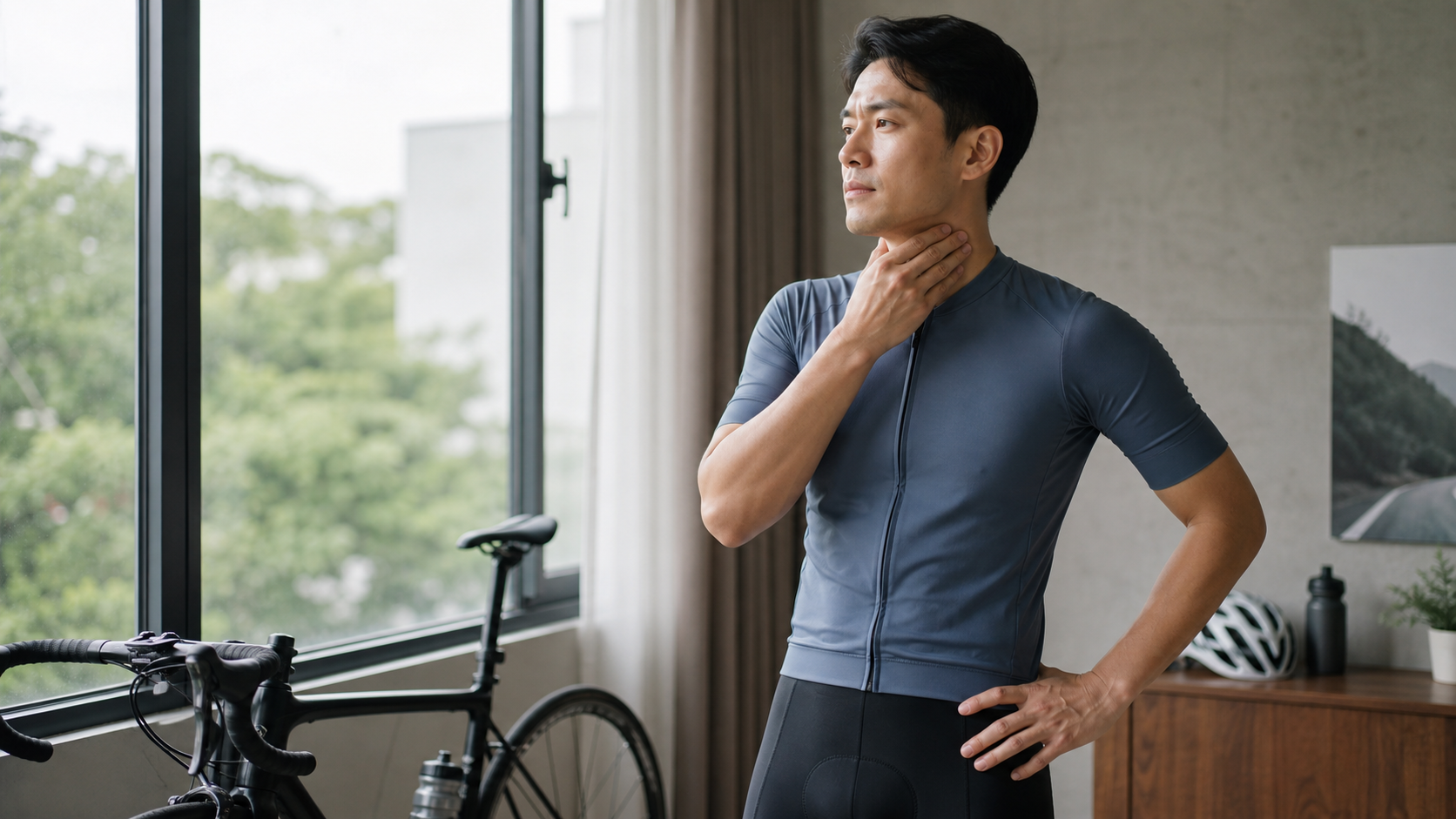
A Case I’ll Never Forget
In my fifteen years of coaching, the most common message I get in group chats isn’t “Coach, I want to break my FTP,” but rather “Coach, my throat feels weird today, can I still train?” Especially during the seasonal transitions in autumn and winter, or after Taiwan’s plum rain season when it’s muggy and temperatures swing wildly, these messages can pile up several a day.
The student who left the biggest impression on me—let’s call him A-Zhe—was an advanced amateur rider with a weekly training volume of 10 to 12 hours and clear season goals. One year, two weeks before an important climbing race, he caught a cold: stuffy nose, sore throat. He was anxious, afraid that stopping training would cause him to lose fitness, so he took matters into his own hands: despite having a fever and body aches, he forced himself to do a two-plus-hour long endurance ride along the riverside. When he finished, he told me, “Sweating it out seems to have made me feel a bit better.” Two days later, he wasn’t better—instead, it escalated into chest tightness, getting winded just climbing stairs, and a resting heart rate over ten bpm higher than usual. It took him nearly three weeks to get back to a normal training state, and he ended up withdrawing from that target race.
He later asked me a question that I still think every athlete should ponder: “Coach, if I had just rested that day, wouldn’t I have avoided dragging this out for so long?”
The answer is, most likely, yes.
What made me even more sympathetic was that A-Zhe wasn’t a lazy or ignorant athlete. Quite the opposite—he was serious and disciplined, following his schedule daily and tracking his data meticulously. It was precisely that seriousness that led him to make the worst possible choice on that sick day—because in his value system, “rest” equaled “regression,” and “completing the scheduled workout” equaled “being responsible.” This is a blind spot I’ve seen in many excellent amateur riders: They can endure the pain of training, but they can’t endure the anxiety of “not training today.” And when it comes to a cold, that anxiety is precisely the most dangerous thing.
In this article, I want to lay out the complete decision-making framework I’ve built from over a decade of coaching athletes, combined with ongoing reading of exercise physiology and sports medicine literature. The core revolves around three things: whether you can exercise with a cold, how to quickly assess using the “Neck Rule,” and how to safely return to training after illness. Whether you’re a commuter riding three times a week, a leisure rider doing weekend group rides, or an advanced cyclist with specific race goals, you’ll find an approach that works for you.
Concept 1: Exercise and Immunity Follow a “J-Curve”
Many people think “exercise always boosts immunity.” That statement is only half true.
In exercise science, there’s a classic descriptive model called the J-curve. It describes the relationship between exercise intensity and the risk of upper respiratory tract infections (URTI—what we commonly call a cold)—and it’s not linear; it’s shaped like the letter J.
- Completely sedentary people: Poorer immune regulation, higher infection risk (the left end of the curve is elevated).
- Regular moderate-intensity exercisers: Immune function gets positive stimulation, and infection risk is at its lowest (the bottom of the curve). Studies have observed that moderate-intensity exercise may reduce URTI risk by roughly 40–50%.
- Those doing chronic high-volume, high-intensity training: Risk actually rises again, potentially even higher than in sedentary people (the right end of the curve curves upward). Relevant literature indicates that prolonged strenuous exercise may increase URTI risk several-fold.
This explains a seemingly contradictory phenomenon: why do some high-performing athletes seem to catch colds every other week? Because they’re chronically sitting at the right end of the J-curve.
The “Open Window Theory”: The Briefly Opened Door After Training
Complementing the J-curve is the Open Window Theory.
It means that after a single bout of prolonged, high-intensity exercise, the body’s immune system enters a temporary “suppression period”—for example, decreased lymphocyte counts, reduced natural killer (NK) cell activity, and altered neutrophil phagocytic function. This window of lowered immunity is like a temporarily opened door; if you happen to encounter a pathogen during this time, your chances of infection rise. Depending on the measured markers, the literature describes this window as lasting roughly from three hours to seventy-two hours post-exercise.
The practical implications for us are straightforward:
- Immediately after completing an ultra-long-distance challenge or an all-out race, pay special attention to warmth, nutrition, sleep, and avoiding crowded environments—because your door is open.
- When you already have cold symptoms, adding a high-intensity session is like opening the door even wider while your immunity is already compromised. That’s exactly how A-Zhe’s story unfolded.
A note: these models are frameworks to help build intuition, not precise predictive formulas—individual variation is huge. Some people are naturally more resilient; others get sick easily with just a slight increase in load. That’s why I never tell athletes to memorize numbers, but rather to understand the underlying direction: moderate intensity is generally protective, while excessive high-intensity stacking with insufficient recovery is risky, and the period right after a hard session leaves the body especially vulnerable. Once you grasp this direction, you won’t be held hostage by a single workout plan when reading your body’s signals.
Coach’s Key Point: Regular moderate-intensity exercise is a great friend to your immune system; but “training hard while sick” and “letting loose after a big race” are the two most common ways you’ll get caught.
Concept 2: The Most Practical Assessment Tool—The “Neck Rule”
Science aside, here’s something you can use this very morning.
A simple self-assessment method that’s been around in sports medicine for a long time is the Neck Check Rule, also called the “above/below the neck rule.” Its logic is easy to remember: use your neck as the dividing line to separate your symptoms into upper and lower zones.
Symptoms “Above” the Neck (Usually OK to Exercise, but Reduce Intensity)
This zone includes: runny nose, nasal congestion, sneezing, mild throat tickle, or sore throat. If your symptoms are all above the neck, and you have no fever, light, low-intensity exercise is generally acceptable—such as walking, easy riding, or gentle stretching. The general recommendation is to keep intensity at about 50–70% of your normal level.
Symptoms “Below” the Neck (Rest When You Should)
This zone includes: chest tightness, chest congestion with phlegm, severe or persistent coughing, fever, whole-body muscle aches, extreme fatigue, or gastrointestinal issues (nausea, diarrhea). If you have any one symptom below the neck—especially fever—it’s time to put the training away and rest properly.
I’ve organized this into a comparison table you can save as a quick reference card for seasonal transitions:
| Symptom | Zone | General Recommendation |
|---|---|---|
| Runny nose, nasal congestion | Above the neck | Light exercise OK, reduce intensity to 50–70% |
| Sneezing | Above the neck | Light exercise OK, monitor for worsening |
| Mild throat tickle/sore throat | Above the neck | Low-intensity activity OK, avoid high-intensity intervals |
| Fever (elevated temperature, chills) | Below the neck | Stop training, rest and seek medical care |
| Whole-body muscle aches, extreme fatigue | Below the neck | Stop training, complete rest |
| Chest tightness, chest pressure, shortness of breath | Below the neck | Stop training, seek medical evaluation promptly |
| Severe or persistent cough, phlegm | Below the neck | Stop training |
| Nausea, vomiting, diarrhea | Below the neck | Stop training, hydrate and rest |
The Neck Rule Isn’t Infallible
I need to be honest here: the Neck Rule is a great starting point, but it’s not a precise medical diagnosis, nor does it replace a physician’s assessment. It’s meant for initial self-screening by “otherwise healthy general adults.” In several situations, I’d tell athletes to skip this rule entirely and prioritize medical professionals:
- Those with cardiovascular disease, diabetes, hypertension, asthma, or other chronic conditions.
- Symptoms that recur, persist for more than a week without improvement, or improve and then worsen.
- Any warning signs such as chest pain, palpitations, difficulty breathing, or altered consciousness.
These situations vary from person to person—handle them individually and seek medical attention early. Don’t use a table to make your own conclusions.
Concept 3: Why Is “Training Hard with a Fever” Especially Dangerous?
If you can remember only one sentence from this entire article, I hope it’s this: A fever is the absolute red line—never train.
This isn’t being overly cautious; there are clear risk-based reasons. Sports medicine literature has long focused on one issue: training during an infection (especially a viral infection) is one of the factors that increases the risk of myocarditis. Myocarditis is inflammation of the heart muscle, and it’s a serious problem for athletes because it can trigger dangerous arrhythmias under strenuous exercise and is one of the causes of exercise-related sudden death.
The mechanism can be roughly understood as: when your body is fighting a systemic viral infection (a fever itself is a manifestation of a systemic inflammatory response), adding the cardiovascular stress and inflammation of high-intensity exercise on top of that may give the virus a greater opportunity to affect the heart muscle. The literature also notes that current management principles lean toward: a period of exercise restriction during infection, followed by a full reassessment before resuming training.
There’s a practical reality Taiwanese cyclists should heed: studies have observed that regardless of severity, many athletes are unaware of the risks of training while sick, and even those who know often choose to ignore it and keep training. A-Zhe was exactly like that—it wasn’t that he didn’t know he should rest; it’s that the anxiety of “losing fitness” overrode his rationality.
I often tell my athletes: Losing two or three days of training barely dents your fitness; but the health you lose might take weeks or longer to recover. That’s a terrible trade.
I also want to speak frankly to Taiwan’s amateur cyclists: you’re not a professional athlete. You don’t have a medical team monitoring your heart data 24/7, and you don’t have a team physician deciding when you’re ready to return. Precisely because of that, you need to be more conservative. The risks a pro team can absorb are completely different from those faced by someone who works, takes care of family, and rides as a passion. When it comes to health, better to be conservative and slow than to gamble your body on an uncertain “it’s probably fine.”
Practical Method: A Step-by-Step “Sick Period Decision Flow”
Now that the concepts are clear, here’s the most important part—how to decide in the moment. I’ve written out the decision process I’ve refined over years of coaching into a top-down sequence you can follow.
Step 1: Take Your Temperature and Do a Neck Check
First thing in the morning, do two things: take your temperature and inventory your symptoms using the Neck Rule. If you have a fever or any below-the-neck symptoms, cancel today’s training outright—no hesitation.
Step 2: If All Symptoms Are Above the Neck, Do a “Trial Warm-Up”
If your symptoms are all above the neck with no fever, don’t rush to declare “training as usual today.” I have athletes do a 10–15 minute low-intensity warm-up (e.g., easy riding with heart rate in a very easy zone), then honestly ask themselves:
- Do I feel more winded, more tired, or weaker in the legs than usual?
- Is there any chest tightness, dizziness, or palpitations?
If after the warm-up you feel “okay, even a bit better,” then proceed with a reduced-intensity easy session. If you feel worse after the warm-up, stop immediately and rest. The feedback your body gives you during those ten-odd minutes of warm-up is more accurate than any theory.
Step 3: Intensity Ceiling During the Symptomatic Period
Even if you can exercise while sick, there must be a clear intensity ceiling. Here’s the general reference table I give athletes (intensity based on your usual perceived effort and heart rate zones; for reference only, needs individual adjustment):
| Status | Training Allowed? | Recommended Intensity Ceiling | Recommended Activities |
|---|---|---|---|
| All above the neck, no fever, days 1–2 | Yes, but reduced load | 50–60% of normal | Easy riding, walking, gentle stretching |
| All above the neck, symptoms improving | Yes, gradually increasing | 60–70% of normal | Easy to low-moderate aerobic |
| Any below-the-neck symptoms | No | 0 (complete rest) | Rest, hydration, sleep |
| Fever present | Absolutely not | 0 | Rest, seek medical evaluation |
| Within 24 hours after fever breaks | No | 0 | Continue resting and monitoring |
Step 4: Treat “Rest” as Training
This is a mindset issue. Many serious cyclists view rest as “wasted time,” and that’s the most important belief to correct. For your immune system to win this battle, it needs energy, protein, and sleep. By giving your body the resources to repair itself, you’re protecting your long-term training continuity. Someone who can train consistently for twelve months without interruption will always progress more than someone who trains for two weeks and then gets knocked out by a major illness.
Returning to Training: How to Safely Get Back on the Bike After Illness
Once the fever breaks and symptoms subside, the phase where most mistakes happen begins—rushing back to your original training volume. The Open Window Theory tells us that the body is still fragile right after recovery, and surging too quickly can easily lead to a relapse or complications.
I give my athletes a conservative but reliable set of progressive return-to-training principles, with the core spirit: after symptoms fully resolve, add load back day by day—slow is better than fast.
Here’s a sample generic return-to-training schedule, based on the premise of “a common cold, no fever, no chest symptoms, fully fever-free, and symptoms resolved.” If you had a fever or chest symptoms, extend the timeline and get a physician’s evaluation first:
| Day | Training Content | Intensity | Key Self-Monitoring Points |
|---|---|---|---|
| Day 1 after symptoms resolve | 30–45 min easy ride or brisk walk | Very easy (can chat comfortably) | Resting heart rate, fatigue level |
| Day 2 | 45–60 min easy aerobic | Easy | Any chest tightness, unusual breathlessness |
| Day 3 | 60 min, with a few short, light tempo efforts | Low-moderate intensity | Recovery status |
| Days 4–5 | Return to near-normal endurance volume | Moderate | Sleep and appetite |
| Days 6–7 | If all is normal, attempt resuming high-intensity intervals | Gradually back to full load | Body’s response at high intensity |
Three Numbers to Watch Most Closely During Return-to-Training
During the return phase, I have athletes record three simple metrics each morning as their body’s “dashboard”:
- Morning resting heart rate: If it’s more than about 5–10 bpm above your usual baseline, your body hasn’t fully recovered—reduce the day’s load.
- Sleep quality: If you slept poorly or not enough, don’t rush to add volume.
- Subjective fatigue: Rate your fatigue on a scale of 1 to 10; if it’s consistently elevated, take a step back.
These three metrics are low-tech, but they’re especially useful during the return-to-training phase because they honestly reflect your body’s true state—not the state you “want” it to be in.
Common Mistakes and Corrections (The Pitfalls I See Most with Athletes)
Mistake 1: “Sweating It Out Will Flush the Illness”
This is probably the most stubborn myth. A cold won’t be sweated out. Training hard with a fever only increases cardiovascular and immune burden, prolongs the illness, and can invite myocarditis risk. Correction: Fever and below-the-neck symptoms mean rest, period.
Mistake 2: “Fever Broke, So I’m Better—Back to the Full Schedule”
A broken fever is just the beginning of improvement, not the finish line. Immune and fitness recovery take time, and surging too quickly easily leads to a relapse. Correction: Follow the progressive return-to-training principles and add load back day by day.
Mistake 3: The Anxiety of “Losing Fitness” Overrides Judgment
This is a psychological pitfall. The truth is, a few days of complete rest barely dents your fitness; it’s a complication that drags on for three weeks that truly ruins your season. Correction: Prioritize “training continuity” over “weekly training volume” in your thinking.
Mistake 4: Treating Supplements as Insurance
When sick, people want to “get better fast” with handfuls of vitamins and various supplements. Many claims on the market lack reliable evidence, and excessive intake of certain ingredients can even be harmful. Correction: Get the fundamentals right—adequate sleep, sufficient protein, balanced diet, and hydration—these matter far more than any supplement. For individual supplement use, consult a physician or dietitian.
Mistake 5: Ignoring Warning Symptoms
Dismissing chest tightness, palpitations, or unusual breathlessness as “probably just not fully recovered.” These are red flags requiring prompt medical attention. Correction: If any cardiac-related warning signs appear, stop exercising immediately and seek medical care.
Taiwan-Specific Context: Putting Principles into Practice
Theory only matters if it works in Taiwanese daily life. Here are some details I specifically emphasize when coaching athletes locally.
Taiwan’s Climate
Taiwan’s autumn/winter and plum rain seasons are damp and cold with large day-night temperature swings. The temperature differences between riverside paths and mountain areas in the early morning and evening are significant—this is the peak season for colds and respiratory symptoms. During the “open window” period after a race or long-distance challenge, pay special attention to staying warm—don’t sit around in a sweat-soaked jersey after riding; have a dry, warm layer ready to change into. In summer, high-intensity training in hot, humid conditions also creates an immune window—make sure to hydrate and cool down properly.
Taiwan’s Eating-Out Environment
When sick, appetite is poor, and eating out is common, which easily leads to nutritional imbalance. Here are some practical choices: light noodle soup, congee with lean meat, steamed egg, soy milk, unsweetened yogurt, boiled eggs, and sweet potato—all are easy to find and easy to digest. The key is getting enough protein to support repair and staying hydrated, while avoiding eating only sweets or empty calories. Once your appetite returns during the return-to-training phase, gradually rebuild the carbohydrates and protein needed for training.
Taiwan’s Healthcare and NHI System
Seeing a doctor is convenient in Taiwan, and NHI accessibility is high—this is our advantage, so use it. If you have a fever, symptoms lasting more than a week, or any chest or cardiac warning signs, make an appointment and see a doctor. When you do, proactively tell the physician that you exercise regularly, describe your recent training status, and mention your plan to resume training after the infection. This information helps the doctor give you advice tailored to your situation. Cyclists with chronic conditions should especially discuss resuming exercise with their primary care physician first.
Going Deeper: The Triangle of Training Load, Sleep, and Immunity
The Neck Rule handles “should I train today,” but what truly determines how often you catch colds is something further upstream—your long-term training load, sleep, and life stress. This section is about prevention: how to keep yourself near the low point of the J-curve and reduce the need for sick-day decisions.
The “Acute-to-Chronic Ratio” Concept in Training Load
I often use a simple analogy with athletes: how much stress your body can handle depends on how much it’s “used to.” If you normally train 6 hours a week and suddenly spike to 14 hours, that sharp jump in load is exactly when the immune system is most likely to be overwhelmed and the open window is most vulnerable to pathogens. Sports science has the concept of “acute load relative to chronic load”—in plain terms: don’t let this week’s volume deviate too far from your average over the past month. Increase load progressively; roughly a 10% weekly increase is a relatively safe pace, not doubling all at once.
Many amateur cyclists’ colds aren’t random—they happen after a combination punch of “consecutive days of overtime and late nights, plus cramming in an ultra-long ride on the weekend.” That’s not bad luck; it’s predictable.
Sleep Is the Most Underrated Immune Supplement
If I had to pick the single most important recovery tool for immunity, I’d unhesitatingly choose sleep. Chronic sleep deprivation directly suppresses immune defenses, and stacking high-intensity training on top of that is a double blow. My bottom line for athletes: the higher your training volume that week, the less you can afford to skimp on sleep. Rather than squeezing in an extra hour of riding while only sleeping five hours, it’s better to train a bit less and get a full night’s sleep—it’s a better deal for both immunity and long-term progress.
Life Stress Counts as “Total Stress”
The body doesn’t distinguish whether stress comes from training, work, or family—it experiences the sum total. So when you’re in a high-pressure period with work deadlines and compressed sleep, your training plan should proactively step back rather than stubbornly pushing through on both fronts. That’s why I often say: a good training plan breathes and adapts to life; it isn’t carved in stone.
| Immune Maintenance Aspect | Recommended Approach | Common Mistake |
|---|---|---|
| Training load | Progressive, ~10% weekly increase | Impulsive spikes in weekly volume |
| Sleep | Sleep even more during high-volume weeks | Sacrificing sleep to fit in training |
| Post-race recovery | Proactively deload, stay warm and well-fueled | Letting loose, staying up late celebrating |
| Life stress | Proactively reduce training during high-stress periods | Grinding through both work and training |
| Nutrition and hydration | Balanced diet, adequate protein and water | Relying on supplements as a shortcut |
Nutrition and Hydration: What to Eat and Drink When Sick
The dietary goals during illness differ from training: training is for performance; illness is for repair and maintaining immune function. Here are the general principles I share with athletes—all values are ranges for reference, actual needs vary by individual, and supplement use should be discussed with a physician or dietitian.
Key Dietary Points During Illness
- Stay hydrated: Fever, sweating, and increased respiratory secretions all cause fluid loss. Prioritize warm water, in small amounts frequently; if appetite is poor, pair it with clear soup or congee broth.
- Adequate protein: Protein is the raw material for immune cells and tissue repair—don’t spend all day eating plain congee with pickled cucumber just because your appetite is off. Steamed egg, soy milk, lean meat, and yogurt are all easily digestible sources.
- Easily digestible carbohydrates: Sweet potato, congee, and noodles provide energy without adding gastrointestinal burden, especially when you have digestive symptoms—keep it light.
- No need to deliberately “tonify” or diet: Heavy-flavored “tonics” like sesame oil chicken or ginger duck are actually a burden during fever or GI distress; but don’t skip eating to “starve the virus” either—your body needs energy to fight.
Attitude Toward Common Supplements
My stance on vitamins and supplements has always been conservative: fundamentals (sleep, diet, hydration) always come first; supplements are a last, non-essential piece. Many claims of “boost immunity, recover fast” on the market have weak evidence, and excessive intake of certain ingredients can even be harmful. The table below summarizes common intake attitudes for educational reference only—not usage instructions:
| Item | Common Claim | Pragmatic Attitude |
|---|---|---|
| Water | Dilutes viruses, aids metabolism | Genuinely important—replenish in small amounts frequently |
| Fruits and vegetables in a balanced diet | Provide vitamins and antioxidants | Getting them from whole foods is ideal |
| Various “immune-boosting” supplements | Faster recovery, cold prevention | Evidence is mostly weak; don’t overdo it; ask a professional first |
| High-dose single vitamins | Shortens illness duration | Excess can be harmful; self-supplementing in large doses is not recommended |
Coach’s Key Point: Rather than spending money on a pile of supplements for peace of mind, put that energy into “going to bed earlier tonight.” I’ve been saying this for over a decade and haven’t changed it yet.
Frequently Asked Questions (FAQ)
Over years of coaching, the same questions come up repeatedly. Here are the most common ones.
Q1: I only have a mild throat tickle. Can I do my interval training as usual?
Not recommended. A throat tickle is above the neck, but high-intensity intervals place major stress on the body and widen the immune window. In this situation, I’d have athletes swap the day’s intervals for easy aerobic work and return to high intensity only after symptoms fully resolve and you’ve confirmed your body has recovered. Reducing intensity isn’t the same as not training—it’s training smart.
Q2: I took fever medication and my temperature is normal. Can I train?
No. A normal temperature achieved by fever medication doesn’t mean the infection is gone. Your body is still fighting at this point, and the risk of training hard isn’t any lower. The principle is: after the fever breaks, your temperature stays normal without medication, and symptoms have resolved—then begin progressive return-to-training.
Q3: Can wearing a mask while riding prevent colds?
Masks have their place in crowded, enclosed environments, but while riding (especially at high intensity), a mask affects breathing—it’s impractical and unnecessary. The more fundamental ways to prevent colds are: regular moderate-intensity exercise, adequate sleep, a balanced diet, and paying attention to the open window after big events. These benefits far outweigh agonizing over whether to wear a mask while riding.
Q4: Will doing absolutely nothing while sick cause me to lose a lot of fitness?
Almost certainly not. Research and practical experience both show that a few days to a week of complete rest has very limited impact on long-term fitness, and it’s usually regained quickly after resuming training. In contrast, complications and prolonged interruptions caused by training through illness are what truly set you back. Don’t gamble weeks of health to preserve a few days of training.
Q5: After recovering from a cold, how long until I can return to racing or high-intensity challenges?
There’s no one-size-fits-all number of days—it depends on how severe the illness was and whether you had fever or chest symptoms. The general principle is: after symptoms fully resolve, first go through a round of progressive return-to-training, confirm your body responds normally at high intensity, then schedule the race. If you had fever or chest/cardiac symptoms, get a physician’s evaluation before resuming high intensity.
Q6: I catch colds several times a year. Does that mean my immunity is especially weak?
Don’t jump to conclusions. If you’re a high-volume cyclist, recurrent colds may be related to chronically sitting at the right end of the J-curve with insufficient recovery—in that case, what needs examining is training load and sleep, not buying more supplements. But if your cold frequency is abnormal or accompanied by other symptoms, it’s still advisable to see a doctor for a full evaluation to find the real cause.
Actionable Advice for Readers at Different Levels
For Commuters and Leisure Riders
Your training doesn’t chase limits, which actually puts you in the healthiest position on the J-curve. The principle is simple: above the neck with no fever—easy commuting or walking-level riding is fine; below-the-neck symptoms or fever mean rest. Don’t feel guilty about “not riding today”—your regular exercise itself is already maintaining your immunity.
For Advanced Cyclists with Training Volume
You’re the group that needs the most vigilance, because you may be chronically at the right end of the J-curve and carry the psychological pressure of “fear of losing form.” Here are three concrete practices:
- Establish a morning monitoring habit: resting heart rate, sleep, and fatigue—record all three before and after infections, and let the data apply the brakes for you.
- Proactively deload and enhance recovery after races and long-distance events, and take the open window seriously.
- Write the “infection red line” into your training plan: fever and below-the-neck symptoms mean canceling training, and follow the progressive return principles—don’t let the completion of a single workout plan hold you hostage.
For Cyclists with Chronic Conditions
For those with diabetes, hypertension, heart disease, asthma, and other chronic conditions, risk assessment during infection needs to be individualized. Put “ask your doctor first” ahead of any self-assessment—the Neck Rule is only a reference for you, not a decision-making basis. The pace of resuming exercise, intensity, and warning signs to watch for should all be discussed with your primary care physician before proceeding.
Conclusion: Get Sick Smart, Come Back Safe
After all these years of coaching, I’m increasingly convinced of one thing: true experts aren’t those who never get sick—they’re those who know how to be sick and how to recover.
Colds are an unavoidable topic for every athlete. Instead of agonizing over “can I train today or not,” keep this framework in mind: use the Neck Rule for quick assessment, treat fever as an absolute red line, understand the logic behind the Open Window Theory and the J-curve, and follow the progressive return-to-training principles to ease back in after illness. When you can make these decisions calmly, you’ve upgraded from “grinding through with willpower” to “protecting yourself with knowledge.”
A-Zhe eventually internalized this process. The next year, he caught another cold—this time he rested for four days as advised, returned gradually, and was back to normal training in just over a week. That season turned out to be his personal best. He told me, “So rest really isn’t a waste—it’s another form of training.” I’ve shared that line with many athletes since.
Take care of your body—you have many more years of riding ahead. Getting sick isn’t failure; rushing to push through it is. Wishing you a safe seasonal transition—get sick smart, come back safe, and let’s climb together on the next sunny day.
References
- Mayo Clinic — Exercise and illness: Work out with a cold? https://www.mayoclinic.org/healthy-lifestyle/fitness/expert-answers/exercise/faq-20058494
- USA Triathlon — The Neck Rule https://www.usatriathlon.org/articles/training-tips/the-neck-rule
- Springer / Sports Medicine — Respiratory Viral Infections in Athletes https://link.springer.com/article/10.1007/s40279-022-01660-9
- MDPI Diagnostics — Return-to-Play Post-Myocarditis for Athletes https://www.mdpi.com/2075-4418/14/19/2236
- Journal of Science and Medicine in Sport — The open window of susceptibility to infection after acute exercise https://www.jsams.org/article/S1440-2440(10)00843-1/abstract
This article is educational content and does not replace individual diagnosis or treatment advice from physicians, physical therapists, or dietitians. All case scenarios are illustrative examples; intensities and values should be individually adjusted based on personal circumstances and professional advice. If you have fever, chest tightness, palpitations, difficulty breathing, or other symptoms, seek medical attention promptly.
Related Reading
- Getting Sick More Often the More You Train? A Full Analysis of Exercise and Immune Dysregulation: Overtraining’s Immunosuppression, Recovery, and Nutrition Strategies
- Immune Nutrition for Athletes: Dietary Strategies to Prevent Colds, So Your Season Doesn’t Fall Apart with One Cough
- Immunosuppression from Cycling Overtraining: A Guide to Cold Prevention and Training Load Adjustment
- The Complete Guide to Athlete Nutrition and Immunity: From Season Strategy to Table Practice
一日北高/長距離團騎 常見問題補充篇 / 組團或跟團的眉角 / 壯車友容易被瘦車友慢性拉爆 / 原來屁股痛可能是這個原因...? / 風場配速法 / 公路車 / CT Yeh
2 年前
FTL 與 SYB 車隊專訪 西進武嶺 實用攻略分享! 2小時 如何練?!你不知道的眉角!新手準備武嶺必看 EP1 | 實力派女車友 | 精華版 | 公路車 | CTYeh
4 年前
一個測試有沒有認真練車的方法😂 #公路車
10 個月前
風櫃嘴時間 預測西進武嶺時間?13000名車友統計數據分析告訴你 !
5 年前
一日北高前的西濱集訓 | 跟著11小時軍團 | 300W踩不動的大逆風 | 輪車破風差幾瓦?
6 年前
CT 喇低賽) 武嶺牽車 才是王道 西進牽車四小時內秘訣 攝手位置 如何判斷 防抽筋小秘訣
7 年前
CT暗黑廚房) 車友必備 宇宙無敵鮮蚵湯 幫助訓練恢復 天然食補 好市多 超肥鮮蚵 破PR
7 年前
#公路車 #Vo2Max #最大攝氧量 測驗 體驗 | 心肺測試
6 年前