Athlete Balance and Fall Prevention: A Practical Guide from Single-Leg Stance Assessment to Elderly Fall Prevention
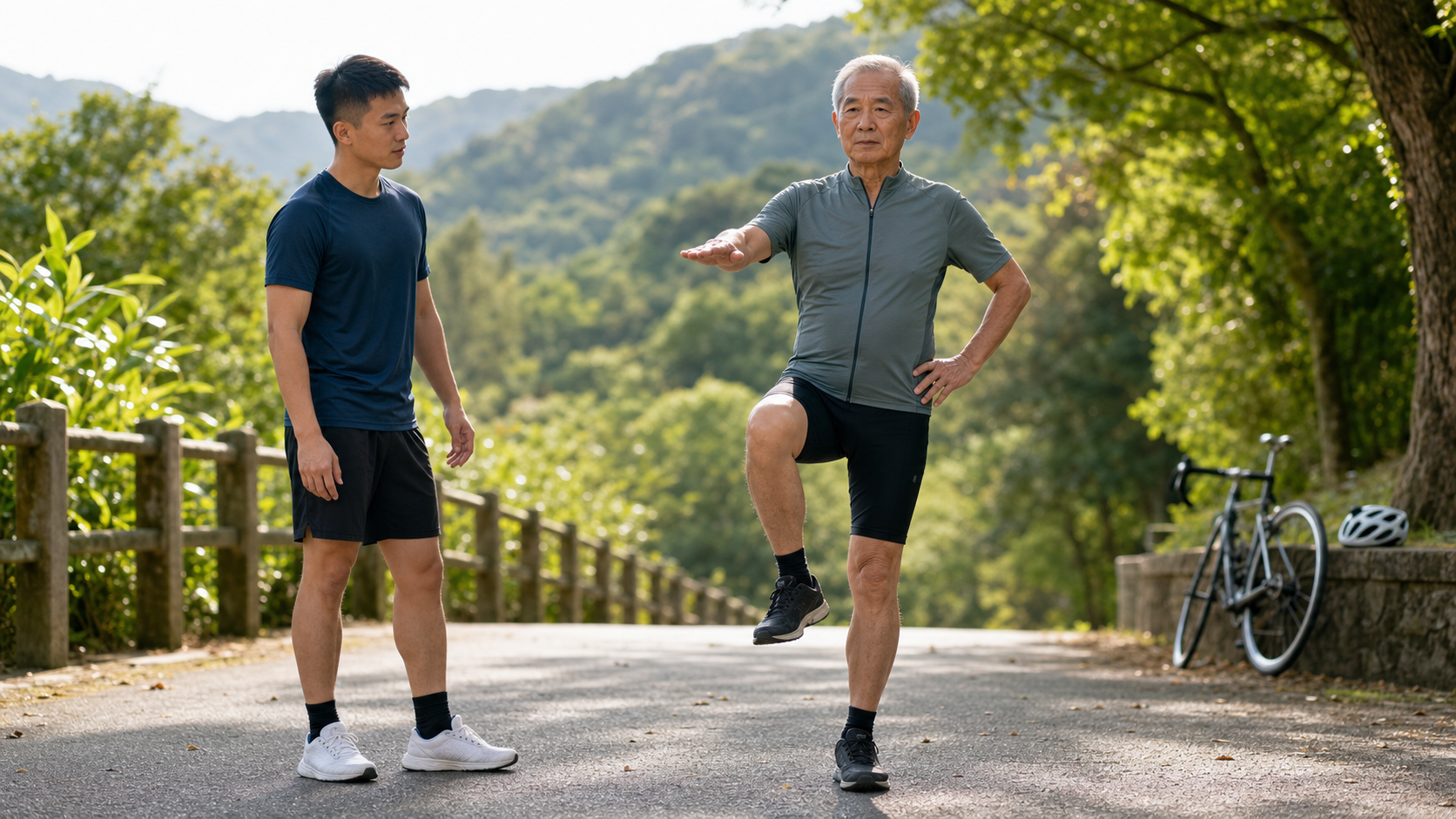
Starting with a Crash on a Yangmingshan Descent
I once coached a 68-year-old student, let’s call him Mr. Chen. After retiring, he became passionate about cycling and would ride up Yangmingshan with his cycling buddies every weekend. His fitness was so good it put younger riders to shame. One day, while descending and reaching for his water bottle with one hand, his front wheel hit a small pothole and the bike wobbled—the problem was he couldn’t “recover” in that moment. He tipped over completely, fractured his collarbone, and was sidelined for three months.
Afterward, I asked him to do a very simple test: stand on one leg with his eyes closed and see how many seconds he could last. With his eyes open, he could hold a single-leg stance for nearly 30 seconds, which looked great. But the moment he closed his eyes, he was wobbling all over the place in under 4 seconds. That’s when he understood: his strength and cardiovascular fitness were strong, but his “balance” had already quietly deteriorated.
This is almost the most common blind spot I’ve seen in 15 years of coaching. Everyone trains leg strength, cardiovascular fitness, and chases wattage, but almost no one specifically trains balance. For athletes, poor balance means a higher risk of injury, slower recovery, and limits on peak performance. For those entering middle age and beyond, poor balance directly connects to “falling”—and falls are one of the leading causes of accidental injury death among older adults in Taiwan.
In this article, I want to explain this often-overlooked ability clearly: what it actually is, how to assess it, how to train it, and provide practical methods that work whether you’re an athlete pursuing performance or a middle-aged child wanting to protect your parents.
What Is Balance, Really? Let’s Build the Right Concept First
Many people think balance is just about “how good your inner ear is,” but it’s far more than that. Balance is a complete system where the brain integrates three sets of sensory information and then directs muscles to make real-time corrections. If any part degrades, the whole system gets worse.
The Three Sensory Inputs of Balance
- Visual System: The eyes tell the brain “my position relative to the environment.” This is why closing your eyes during a single-leg stance suddenly makes it much harder—you’ve turned off your strongest input.
- Vestibular System: The semicircular canals and otoliths in the inner ear detect head rotation and acceleration. Motion sickness and vertigo are mostly related to issues here.
- Proprioception: Receptors in muscles, tendons, and joints let you “know how many degrees your ankle is bent without looking.” This is the area athletes most need to strengthen and the one most likely to degrade after injury.
The brain integrates these three signals and then makes real-time corrections through muscles. So balance training is essentially training “neuromuscular reaction speed and coordination,” not just muscle strength.
How the Body “Saves Itself”: Three Balance Strategies
When you’re about to lose your balance, your body actually has a set of self-rescue mechanisms that progress from simple to complex. Understanding this helps you design your training:
- Ankle Strategy: When the sway is very small, muscles around the ankle make fine adjustments to pull the body back to center. This is the most efficient, most commonly used first line of defense, and it requires good ankle proprioception.
- Hip Strategy: When the sway is larger, the body switches to larger hip movements to regain balance, recruiting bigger core and gluteal muscles.
- Stepping Strategy: When the first two can’t save you, the body “takes a step” to re-establish a base of support. Whether that step can be taken quickly and stably is often the dividing line between “a brief stumble and you’re fine” and “a full fall.”
This is why I included “lateral step landing stability” in Workout Plan A—the last line of defense in a real fall is that critical step, and that step must be trained. Many older adults get injured from falls precisely because their stepping reaction is too slow or the leg they step out with can’t support them.
Why Athletes Also Need Dedicated Balance Training
Some people say, “I’m not old, why should I train balance?” But for cyclists, runners, hikers, and ball sport players, balance directly affects:
- Bike handling and cornering: High-speed descents, rough terrain, and obstacle avoidance all rely on real-time balance corrections.
- Injury prevention: Many ankle and knee sprains happen because proprioceptive reactions aren’t fast enough at the moment of landing.
- Recovery efficiency: After injury (especially ankle, knee, or lower back), proprioception degrades. Without rebuilding it, you’re prone to repeated injuries.
- A buffer against aging: Balance begins to slowly decline after about age 30. If it’s not maintained in middle age, the decline accelerates rapidly after 60.
Balance is a “use it or lose it” ability—if you don’t challenge it, it degrades; if you stimulate it regularly, it improves, and it can be trained at any age.
How Balance Changes with Age
Many people think balance “suddenly gets worse one day,” but it’s actually a gradual slope. The table below is a conceptual trend I use to communicate concepts with students (not precise medical data, just to help understand the direction):
| Age Range | Balance System Change Trend | Practical Implication |
|---|---|---|
| Before 30 | All three sensory systems and muscle reactions are at their peak | Good foundation, but don’t neglect it |
| 30–50 | Proprioception and reaction speed begin to slowly decline | Middle age is the golden period to “bank balance reserves” |
| 50–65 | Muscle mass loss accelerates, vestibular function gradually declines | Requires “deliberate training” to offset decline |
| 65+ | Without training, decline accelerates noticeably | Fall prevention becomes a core health issue |
The key point of this table is simple: maintaining balance is a long-term investment where “the earlier you start, the easier it is.” I often tell students in their 40s who think they’re “still young”: the more balance reserves you bank now, the more insurance you’re buying for your 70-year-old self.
Assess First, Then Train: Tests You Can Do at Home
Before training, you must know your starting point. Here are several assessments I actually use in class—safe, no equipment needed, and suitable for older adults (just make sure there’s a wall or sturdy chair nearby to hold onto).
Single-Leg Stance Test
This is one of the most practical and well-supported static balance tests. According to international clinical reference values, maintaining a single-leg stance for more than 10 seconds is within the normal range, while less than 5 seconds indicates a significantly elevated fall risk. However, some research suggests 10 seconds isn’t an absolutely precise cutoff; more rigorous assessments recommend extending the observation period to 20 seconds or more to better capture early balance decline.
How to do it: Place hands on hips or let them hang naturally, lift one foot (not touching the other leg), and time how many seconds you can hold steady. Test both legs. Start with eyes open, then challenge yourself with eyes closed (closing your eyes dramatically increases difficulty—make sure you have something to hold onto nearby).
The table below is the reference grading I use in class (general principles, not medical diagnostic criteria, for self-tracking trends only):
| Eyes-Open Single-Leg Stance Seconds | General Interpretation | Recommendation |
|---|---|---|
| 30+ seconds | Good balance foundation | Progress to dynamic and eyes-closed training |
| 10–30 seconds | Acceptable, room for improvement | Regularly incorporate balance training |
| 5–10 seconds | Weak, needs attention | Train daily and assess other risk factors |
| Less than 5 seconds | High risk | Start with supported training; older adults should seek medical evaluation |
Tandem Stance and Tandem Walk
Stand with both feet in a straight line (heel of front foot touching toes of back foot), or walk in a straight line along a line on the floor. This tests balance on a much narrower base of support and is sensitive for detecting early decline. If you can’t walk a straight line or keep veering to the side, that’s a warning sign. This test is particularly sensitive—many people look fine in a static single-leg stance but fall apart during tandem walking, indicating that dynamic balance and gait control have already begun to decline and deserve early intervention.
Timed Up and Go Test (TUG)
This is a clinically common and very functional test:
- Sit in a chair with armrests.
- On “go,” stand up, walk 3 meters at your normal pace, turn around, walk back, and sit down.
- Time the entire process.
Generally, healthy older adults can complete this in about 10 seconds. If it takes significantly longer, overall mobility and balance function need attention. This test is useful because it integrates strength, gait, turning, and balance into one comprehensive picture.
Reminder: These self-tests are meant to “track your own trends” and “raise awareness,” not to self-diagnose medical conditions. If your results are poor, or accompanied by dizziness, veering when walking, or unexplained falls, please see a doctor or physical therapist for a formal assessment.
Practical Training: Balance Workout Plans You Can Follow
The core principle of balance training is “progressively narrowing your base of support and gradually removing sensory aids.” Simply put, the logic for increasing difficulty is:
- Narrow the base of support: Double-leg stance → feet together → tandem stance → single-leg stance.
- Remove vision: Eyes open → eyes closed.
- Unstable surfaces: Hard floor → soft mat, foam, balance pad.
- Add dynamic interference: Standing still → adding arm movements, head turns, catching balls, walking.
Below are two sample workout plans I’ve designed for “general healthy adults/athletes” and “middle-aged and older fall prevention.” Adjust them to your own level.
Workout Plan A: Advanced Balance for Athletes/Healthy Adults (2–3 times per week)
| Exercise | Sets × Time/Reps | Ways to Increase Difficulty |
|---|---|---|
| Single-leg stance (eyes open) | 3 sets × 30 seconds per leg | Progress to eyes closed or on a soft pad |
| Single-leg deadlift (bodyweight or light load) | 3 sets × 8 reps per leg | Add dumbbells, increase hip hinge range |
| Tandem walk (heel-to-toe) | 3 trips × 10 steps | Eyes closed, walking backward |
| Single-leg stance with ball toss/catch | 3 sets × 30 seconds per leg | Use a smaller ball, bounce off wall |
| Lateral step landing stability | 3 sets × 8 reps per side | Increase speed, land on one leg |
| Bosu ball/balance pad squat | 3 sets × 10 reps | Increase squat depth or close eyes |
The focus of this plan is dynamic movement and resistance to interference, because an athlete’s balance in real situations always happens “in motion.” Training purely static stances for too long has limited transfer to the playing field.
Workout Plan B: Basic Fall Prevention Plan for Middle-Aged and Older Adults (3+ times per week, can be done daily)
International fall prevention guidelines for older adults generally recommend: functional balance and strength training at least 3 days per week, combined with at least 150 minutes of moderate-intensity activity per week and resistance training at least 2 days per week. The following plan is safe and can be done holding onto support:
| Exercise | Sets × Time/Reps | Safety Reminder |
|---|---|---|
| Feet together standing while holding chair back | 3 sets × 30 seconds | Try releasing your grip once stable |
| Tandem stance holding chair back | 3 sets × 30 seconds per side | Keep feet in a straight line |
| Single-leg stance holding chair back | 3 sets × 15 seconds per leg | Reduce grip only when you can hold steady |
| Sit-to-stand (stand up and sit down) | 3 sets × 10 reps | Builds leg strength, key for fall prevention |
| Marching in place (can hold support) | 3 sets × 20 steps | Lift knees high, keep head up and chest tall |
| Alternating heel and toe raises | 3 sets × 15 reps | Trains calves and ankle stability |
The principle for older adults: it’s better to train longer while holding onto support than to stubbornly push through and fall. The way to progress is to “gradually reduce hand support,” not to let go completely from the start.
12-Week Progressive Plan: How to Increase Difficulty Step by Step
Having a list of exercises isn’t enough—many people get stuck not knowing “when to increase difficulty.” Here’s a 12-week progressive framework I commonly use to give progress a rhythm to follow (adjust flexibly based on your actual situation):
| Week | Training Focus | Goal for This Phase |
|---|---|---|
| Weeks 1–2 | Learn the movements, build the habit, holding support is fine | Do it daily, don’t push hard, record baseline seconds |
| Weeks 3–4 | Reduce hand support, extend hold times | Hold eyes-open single-leg stance longer |
| Weeks 5–6 | Try letting go, add tandem stance | Can hold steady even when briefly letting go |
| Weeks 7–8 | Add soft pad or eyes closed (with safety precautions) | Challenge removing vision or changing surface |
| Weeks 9–10 | Add dynamic elements (marching, head turns, toss/catch) | Maintain balance during “movement” |
| Weeks 11–12 | Re-test assessments, integrate into daily life | Improved seconds, turn training into a lifestyle habit |
The spirit of this framework is “review every 2 weeks, only increase difficulty when you can consistently complete the current level.” You don’t need to follow it rigidly, but it helps you avoid two extremes: one is staying at the same difficulty forever without progress, and the other is rushing ahead stubbornly and getting injured. When I worked with Mr. Chen on his rehab, I followed this exact rhythm, helping him go from “afraid to let go” to eventually holding a single-leg stance with his eyes closed.
Warm-Up Before Training and Integrating into Daily Life
Balance training doesn’t require a complex warm-up, but I ask students to first mobilize their ankles and hips (10 circles and 10 forward-backward swings each) to “wake up” the joints and proprioceptors before starting the formal exercises.
More importantly, integrate balance into daily life rather than treating it as an extra chore:
- While brushing your teeth: Stand on one leg, alternating legs for each half of brushing.
- While waiting for the bus, in line, or at a red light: Sneak in a tandem stance or calf raises.
- During TV commercials: Stand up and do a few sit-to-stands.
- While putting on shoes and socks: Try putting on one leg without holding onto anything (with something to grab nearby).
These “fragmented moments” add up to several extra minutes of training per day, at zero additional cost. The best training is the one you can sustain long-term.
The Value of Tai Chi and Group Exercise
In Taiwan, Tai Chi, external dan gong, folk dance, and gateball in parks and community activity centers are all excellent balance training. Tai Chi is particularly well-studied because it simultaneously involves weight shifting, single-leg support, slow control, and multi-directional movement. It’s very fall-prevention-friendly for older adults, and the social companionship helps with long-term adherence. I often encourage older adults who don’t like the gym: “Find an activity you’re willing to attend weekly with companions.” Consistency matters far more than how advanced the movements are.
Common Mistakes and Corrections
After coaching for so many years, these are the issues I correct most often.
Mistake 1: Only Training Strength, Not Balance
Many people think strong legs mean you won’t fall. But falls often happen in moments of “not reacting in time”—that’s a neural reaction speed issue, not purely a strength issue. Correction: Train both strength and balance; they complement each other. Squats and deadlifts build strength; single-leg stances and unstable surfaces train reaction.
Mistake 2: Not Training at All for Fear of Falling
This is the most common mindset among older adults and their families—“Grandma is old, don’t let her move around, what if she falls?” The result is that the less they move, the faster their muscles and balance decline, making them even more likely to fall. Correction: Progressive training in a safe environment (handrails, soft mats, someone present) is the real way to reduce risk. Overprotection is itself a risk factor.
Mistake 3: Staying at the Same Difficulty Forever
If you’ve been doing eyes-open single-leg stance holding a wall for three months, your body has long adapted. Without new stimuli, there’s no progress. Correction: Review every 2–4 weeks. As soon as you can complete a level consistently, add one level of difficulty (eyes closed, soft pad, added movement).
Mistake 4: Ignoring Environment and Other Risk Factors
Balance training is important, but falls are caused by multiple factors. Correction: Also check these commonly overlooked items:
- Vision: Uncorrected cataracts or presbyopia make balance worse. Get regular eye exams.
- Medications: Certain sleep aids, blood pressure medications, and anti-anxiety drugs can cause dizziness or orthostatic hypotension. If you suspect medication effects, discuss with your doctor or pharmacist—never stop medication on your own.
- Home environment: Slippery floors, electrical cords, thresholds, dim hallways, and bathrooms without grab bars are common fall hotspots for older adults in Taiwan. Adding non-slip mats and grab bars in the bathroom is the highest cost-effectiveness fall prevention investment.
- Footwear: Loose slippers and worn-out soles increase risk.
Mistake 5: Holding Your Breath and Stiffening Up
Many people unconsciously hold their breath and stiffen their whole body when they feel unbalanced, which actually makes them more unstable. Correction: Breathe naturally and keep your shoulders relaxed during training. Balance relies on “real-time micro-adjustments,” and a stiff body can’t adjust.
Taiwan-Specific Context: Climate, Eating Out, and Healthcare
Only by fitting training into real Taiwanese life can you sustain it long-term.
Humidity and the Plum Rain Season
Taiwan’s climate is humid, especially during the plum rain and typhoon seasons when tiled floors, arcades, and bathrooms become especially slippery. During this period, I ask students to incorporate single-leg stance and sit-to-stand into daily routines—single-leg stance while brushing teeth, extra sit-to-stands while watching TV. You can train indoors without going out in the rain.
Eating Out and Nutrition
The foundation of balance and strength is muscle, and people in Taiwan who eat out frequently generally don’t get enough protein. General adults need about 1.0–1.2 grams of protein per kilogram of body weight per day; middle-aged and older adults or those who exercise regularly may need more (range-based recommendation; consult a nutritionist for individual situations). When eating out, deliberately add one serving of protein per meal: braised egg, soy milk, chicken breast, mackerel, or tofu. Additionally, vitamin D and calcium are important for bone and muscle function. People in Taiwan commonly have low vitamin D, so moderate sun exposure and a balanced diet help—but whether to supplement and how much should be determined by your doctor or nutritionist based on your blood test results. Don’t self-supplement high doses.
Here I also want to highlight a hidden key to fall prevention: bone density. Balance training reduces the “probability of falling,” while sufficient bone mass reduces the “severity of fractures once you fall.” These are two sides of the same coin in fall prevention. For postmenopausal women and older men, osteoporosis deserves special attention. Adequate calcium and protein intake, regular weight-bearing exercise, and bone density checks when necessary are all worth discussing with your doctor. Many hospitals and health checkup centers in Taiwan offer bone density testing. If you have a family history of osteoporosis or have noticeably lost height, don’t ignore it.
Sleep, Dehydration, and Taiwan’s Summer Heat
Balance isn’t just about training—it’s also about your current physical state. When sleep-deprived, reaction speed and focus decline, and balance naturally worsens. In Taiwan’s humid summers, prolonged outdoor exercise without adequate hydration and electrolyte replacement can cause dizziness and orthostatic hypotension. Seeing black spots when standing up is a high-risk moment for falls. I often remind students: During summer outdoor exercise, hydrate frequently in small amounts, slow down when standing up, and if it’s too hot, move indoors or exercise in the early morning or evening. Older adults especially need to be careful—extreme heat combined with certain blood pressure medications can compound dizziness risk.
Making Good Use of Health Insurance and Medical Resources
Taiwan’s accessible healthcare is a huge advantage. If self-tests reveal significant balance decline, or if an older family member has a history of falls, you can:
- See a rehabilitation medicine, orthopedics, or neurology specialist for a formal balance and gait assessment.
- Ask a physical therapist to design a personalized home exercise prescription.
- If accompanied by dizziness or vertigo, you may need an ENT (otolaryngology) evaluation of vestibular function.
Many community hospitals and health centers also offer health promotion and fall prevention programs for older adults. These programs are often free or low-cost, have professional guidance, and let you meet peers to keep going with—they’re valuable local resources worth using rather than letting them sit idle.
Special Reminders for Cycling Enthusiasts
Since this article is in the cycling health category, I want to specifically address balance issues that cyclists often overlook. Cycling may seem like it doesn’t test balance much (after all, two wheels support you), but the real risks hide in specific moments:
- Mounting/dismounting and walking the bike across streets: You’re most likely to lose balance and tip over at low speed or when stationary, especially when clipped in and standing on one leg.
- High-speed descending and cornering: This relies on weight shifting and real-time corrections. People with degraded proprioception react half a beat too slow.
- Rough terrain and evasive maneuvers: Potholes, sudden pedestrians, or dogs all require stabilizing the bike in an extremely short time.
- Reaching for water bottles, checking bike computers, removing jackets: One hand off the bars directly tests your core stability and balance.
Mr. Chen’s crash was exactly this kind of compound situation—“one hand reaching for a water bottle when hitting a pothole.” For cyclists, balance training should focus on single-leg support strength (single-leg deadlifts, single-leg squats) and dynamic resistance to interference. These abilities transfer directly to bike handling. Additionally, core training (planks, bird dogs, dead bugs) is an important foundation for balance because stabilizing the bike relies heavily on your torso.
I usually recommend cyclists: reserve at least 15–20 minutes per week for balance and core work. Over time, you’ll find you’re more confident on descents, smoother through corners, and more stable in unexpected situations. This isn’t a flashy bonus—it’s fundamental work for staying safe and extending your athletic career.
Another Case Study: 72-Year-Old Auntie Lin’s Three-Month Transformation
Besides Mr. Chen, I want to share another very representative student. Auntie Lin is 72, had no exercise habits, and was dragged to class by her daughter. At her first assessment, her eyes-open single-leg stance was only 6 seconds on the left leg and 8 seconds on the right. Her TUG took nearly 14 seconds, and she veered to the side after just three steps of tandem walking. More problematic, she had slipped in the bathroom six months prior and had since become “increasingly afraid to move,” sitting all day in a vicious cycle.
I didn’t start her on single-leg stances—that would have scared her off. We started with the two safest exercises: “feet together standing while holding the kitchen counter” and “sit-to-stand.” Five minutes a day, with her daughter accompanying her. At the same time, I asked her daughter to install grab bars and non-slip mats in the bathroom, replace the hallway lighting with something brighter, and clear away clutter and cords on the living room floor that could trip her.
Here’s Auntie Lin’s three-month progression (a real case scenario; data illustrates the direction of improvement):
| Assessment Item | Baseline | Week 6 | Week 12 |
|---|---|---|---|
| Eyes-open single-leg stance (left) | 6 seconds | 12 seconds | 22 seconds |
| Eyes-open single-leg stance (right) | 8 seconds | 15 seconds | 25 seconds |
| Sit-to-stand in 30 seconds | 8 reps | 11 reps | 14 reps |
| Mental state | Fearful of movement, avoidant | Willing to try | Actively requesting harder exercises |
What moved me most wasn’t the seconds—it was her transformation from “afraid to fall, so I don’t move” to “because I’m steadier, I dare to move more.” She now goes to the park on her own to play gateball with neighbors and walks to the market without holding walls. This is the most precious thing about fall prevention training—it doesn’t just extend lifespan; it gives older adults back their autonomy and dignity in daily life.
Quick Fall Risk Self-Checklist
I’ve organized common risk factors into a table. You can check off each item for yourself or an older family member. The more items checked, the more urgent the need for active intervention and medical evaluation:
| Risk Factor | What to Check |
|---|---|
| Fallen in the past year | Even one fall significantly increases future risk |
| Single-leg stance under 5 seconds | Balance ability is clearly weak |
| Walking has become slower, with shorter steps | Warning sign of gait decline |
| Need to hold something to dare standing up | Insufficient lower limb strength |
| Dizziness, orthostatic hypotension | Be especially careful if you see black spots when standing up |
| Uncorrected vision | Cataracts and presbyopia directly affect balance |
| Multiple medications (especially sleep aids, blood pressure meds) | May cause dizziness; discuss with your doctor |
| Home environment has tripping hazards | Thresholds, cords, slippery surfaces, dim lighting |
This checklist isn’t meant to scare you—it’s meant to turn the vague feeling of “maybe a bit unsteady” into a concrete, actionable list. If you check several items, don’t panic. Just improve them one by one.
Action Recommendations for Different Readers
If You’re an Athlete / A Healthy Adult Who Exercises Regularly
- Start with a single-leg stance (eyes open + eyes closed) self-assessment and record your seconds as a baseline.
- Schedule Workout Plan A 2–3 times per week, focusing on dynamic movement and resistance to interference.
- After injury (especially ankle or knee), make sure to rebuild proprioception—don’t just wait for the wound to heal and jump straight back in.
- Re-test every 4 weeks and use the data to track progress.
If You’re a Middle-Aged Child Wanting to Protect Your Parents
- Find an opportunity to accompany your parents through a single-leg stance and TUG test to understand their current status (protect them throughout).
- Turn Workout Plan B into a “5–10 minutes daily” habit, doing it with them for better adherence.
- Actively improve the home environment: bathroom grab bars, non-slip mats, hallway lighting, remove thresholds and floor clutter.
- If test results are poor or there’s a fall history, take them to a rehabilitation medicine specialist for a formal assessment.
If You’re Middle-Aged or Older and Want to Get Moving on Your Own
- Start with the safe versions holding onto a chair back. Don’t push yourself, don’t hold your breath.
- Train at least 3 days per week, combined with walking or community activities (Tai Chi, folk dance—all good).
- Get enough protein, and don’t neglect eye exams and medication reviews.
- If you experience any dizziness or unsteadiness, see a doctor before continuing.
FAQ
Q: Is it too late to train balance at any age?
A: It’s never too late. Research consistently shows that even older adults can improve function and reduce fall risk with regular balance and strength training. It’s never too late to start.
Q: How many times per week do I need to train to see results?
A: International fall prevention guidelines for older adults recommend functional balance and strength training at least 3 days per week. Athletes pursuing performance can do 2–3 times per week alongside their existing training. The key is consistent regularity—one intense session per week is worse than doing a little every day.
Q: Eyes-closed single-leg stance is really hard. Does that mean something’s wrong with me?
A: Closing your eyes shuts off your strongest sensory aid, so difficulty naturally skyrockets. It’s completely normal to only last a few seconds at first. That’s exactly the room for training—just progress gradually while holding onto a wall.
Q: My elderly parent is afraid of falling and won’t train. What should I do?
A: Start with the “fully supported, absolutely safe” version to build confidence, and emphasize that “not moving leads to faster decline.” Companionship and encouragement work better than lecturing. Auntie Lin built confidence from the safest supported exercises before she was willing to progress.
Q: Do I need to buy equipment for balance training?
A: Not at all. A wall and a sturdy chair are enough to start. When you want to increase difficulty, a soft mat or balance pad is plenty. No need to spend money on fancy equipment.
Q: Could balance training actually make me more likely to fall?
A: As long as you follow the three principles—“safe environment, progressive difficulty, don’t push beyond your limits”—training reduces risk rather than increasing it. What’s truly dangerous is not training at all and letting your abilities keep declining. If your balance is already very poor or you have medical conditions, start under the guidance of a physical therapist.
Q: How long until I see results?
A: Most people feel noticeable improvement after 4–8 weeks of regular training—single-leg stance seconds increase and walking becomes steadier. But balance is an ability that “declines when you stop training,” so the key is making it a long-term habit rather than training for a while and stopping.
Q: I have diabetes/high blood pressure. Can I train balance?
A: Yes, you can, and maintaining mobility is especially important for people with chronic conditions. However, diabetes may be accompanied by peripheral neuropathy affecting proprioception, and blood pressure medications may cause orthostatic hypotension—these require individualized consideration. Please consult your primary care physician first and let professionals advise based on your specific situation. This article cannot replace individual diagnosis.
Conclusion: Stability Is an Ability You Can Train
Back to Mr. Chen from the beginning. He dutifully added single-leg stance and single-leg deadlifts to his weekly training. Three months later, his eyes-closed single-leg stance went from under 4 seconds to over 15 seconds. He said himself that descending now feels “noticeably more stable, and my first reaction to potholes is much faster.”
Balance isn’t a matter of genetic luck, nor is it a fate of inevitable decline with age. It’s an ability you can start training today, and it will improve no matter how old you are. For athletes, it’s the foundational layer of performance and safety. For those of us approaching middle age and beyond, and for our families, it’s the critical line of defense for “aging slower and living with quality.”
Find a wall today, lift one foot, and start your first 30 seconds. Once you’re stable, the road ahead can be traveled farther and longer.
If you remember only one sentence from this article, I hope it’s this: Balance isn’t a talent you’re born with or without—it’s a habit you either practice or you don’t. It requires no expensive equipment, no large blocks of time. It only requires a few minutes each day, seriously committing your weight to one foot. Those few minutes might be what keeps you steady over a pothole someday, or what lets an older family member catch their step after slipping in the bathroom. Train it up, then train it with your family—this is, in my 15 years, the most worthwhile health investment I know.
This article is educational content and cannot replace individual diagnosis and treatment advice from physicians, physical therapists, or nutritionists. If you or a family member have a history of falls, dizziness, chronic conditions, or are taking medication, please consult a healthcare professional before starting a new exercise program.
References
- World guidelines for falls prevention and management for older adults: a global initiative (Age and Ageing): https://academic.oup.com/ageing/article/51/9/afac205/6730755
- Fall Prevention: Balance and Strength Exercises for Older Adults (Johns Hopkins Medicine): https://www.hopkinsmedicine.org/health/wellness-and-prevention/fall-prevention-exercises
- Standing balance test for fall prediction in older adults: a 6-month longitudinal study (BMC Geriatrics): https://link.springer.com/article/10.1186/s12877-024-05380-9
- Single Leg Stance / One-Legged Stance Test (Shirley Ryan AbilityLab, RehabMeasures Database): https://www.sralab.org/rehabilitation-measures/single-leg-stance-or-one-legged-stance-test
Related Reading
- Balance and Coordination for Older Cyclists: Core Training Programs for Fall Prevention
- Proprioception and Motor Control: A Complete Coach’s Guide from Balance Training to Post-Injury Rebuilding
- Improving Balance in Older Adults Through Cycling: Bicycle Applications for Fall Prevention Training
- Balance Training for Runners: Progressing from Single-Leg Stance to Dynamic Balance
西進武嶺 免費訓練分析服務 Intervals | 練不夠還是練過頭?你哪一種類型選手?AI模型告訴你! | 備戰神器 | 公路車 訓練 | CT Yeh
4 年前
單車 一日北高 ( 雙城 ) 肥宅雙人瘋狂行 紀錄片 REACTO
10 年前
滑雪新手們慘摔學習全紀錄(請開字幕),滑雪好好玩 | Snowboard + Ski | 岩原 スキー場 | 滑雪APP使用 | GoPro Max
6 年前
[教學] Premiere 影片 手震 修正 教學 防抖 單眼 影像 GoPro 穩定 Video Stabilization
8 年前
單車 梅山36灣 坡度介紹 路段介紹 空拍 (相關遊記影片,請參考說明或我的頻道喔,歡迎訂閱)
6 年前
西進武嶺 自製新版AI配速表產生器 x 賽前攻略 抱佛腳! 沒有功率計也可以產生配速表嗎?有什麼其他眉角賽前要注意的呢? | 西進武嶺 / 東進武嶺 KOM 攻略 | 公路車 | CT Yeh
4 年前
摔車後補裝備: 好市多新款單車安全帽& Specialized Romin 北高整路屁股都不痛的坐墊 | 一千元居然有MIPS | CT Yeh | 公路車
4 年前
太平山單車員工旅遊 | 這樣玩CP值最高!| 公路車
5 年前