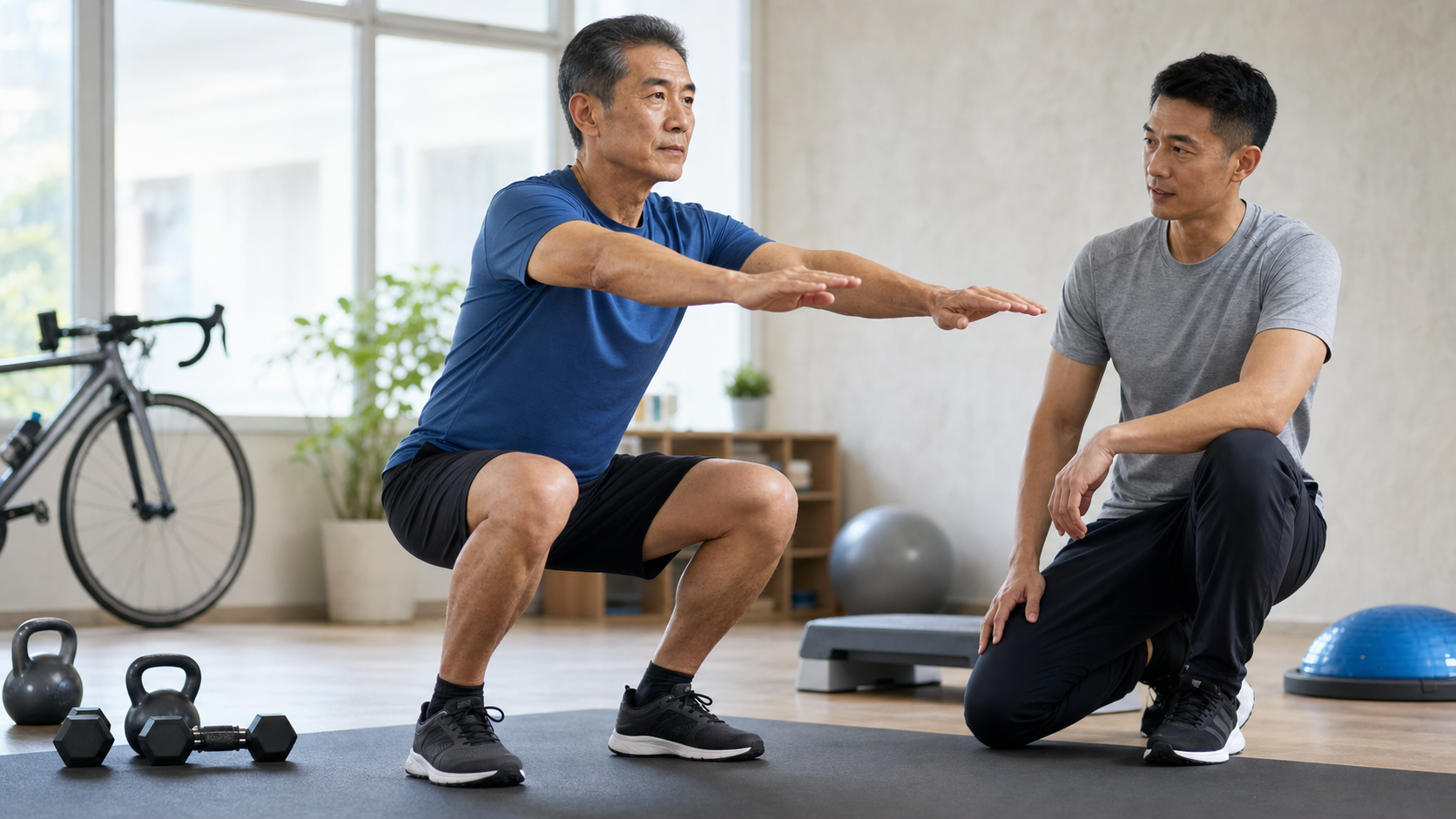
Opening: Mr. Zhang, Who Refused to Do Squats
I remember it vividly—a 58-year-old man, Mr. Zhang, came to see me a few years ago. In his younger days, he was a regular in the cycling club, having conquered Wuling and Fengguizui, brimming with confidence in his fitness. But in the two years prior, he’d started feeling “stiffness in his knees when climbing stairs” and “needing to push off with his hands to get up from the sofa.” His first words to me were: “Coach, I just want to keep riding my bike. I don’t need that weight training stuff for old people, right?”
I didn’t argue with him right away. Instead, I asked him to do just one thing: stand on one leg in front of me, close his eyes, and see how long he could hold it. He opened his eyes faster than anyone—he wobbled and stumbled in under five seconds. A man who could ride up Wuling couldn’t stand on one leg with his eyes closed for five seconds. In that moment, he was stunned too.
In my fifteen years of bringing sports science to athletes at all levels and to the general exercising population, the most common misconception I encounter is this: equating “being active” with “being fully healthy.” Mr. Zhang’s cardiorespiratory fitness was excellent, but his lower-body strength, balance, and neuromuscular control had long been quietly deteriorating. What I want to talk to you about in this article is a “blueprint for healthy aging through exercise”—not about turning you into a gym rat, but about spending your effort in the right places at the right age, so that at sixty, seventy, or eighty, you can still walk to the market on your own, squat down to tie your shoelaces, and get up from the toilet by yourself. These seemingly humble abilities are the baseline of dignity in old age.
Why “Exercise Combinations” Matter More Than “Single-Activity Exercise”
Aging Is Actually Four Lines Declining Simultaneously
Many people think aging simply means “getting weaker,” but from a sports physiology perspective, at least four systems are each deteriorating at their own pace:
- Muscle Mass and Strength (Sarcopenia): This is the most overlooked, yet the most critical piece.
- Cardiorespiratory Endurance (Aerobic Capacity): Maximal oxygen uptake declines with age.
- Balance and Neuromuscular Control: The core of fall risk, yet almost no one proactively trains it.
- Bone Mineral Density: Especially in postmenopausal women, bone loss accelerates.
The key point is this: these four lines won’t all be covered just because you do one type of exercise. Mr. Zhang, for instance, only cycled, which primarily trained his cardiorespiratory system and some lower-body aerobic endurance. But cycling is seated, non-weight-bearing, and offers little balance stimulation outside of closed-chain movements, so his strength, balance, and bone density were barely addressed. This is why the concept of “exercise combinations” is so important—healthy aging requires a complete puzzle, not a single piece.
Sarcopenia: Silently Starting as Early as Age Thirty
Let’s start with the numbers. Based on the data I’ve verified, starting around age thirty, adults lose approximately 3% to 8% of muscle mass per decade. After sixty, the rate accelerates, potentially reaching around 15% per decade. In other words, if someone goes from thirty to seventy without doing any resistance training, the cumulative muscle loss over those forty years is substantial—and it’s a “use it or lose it” situation: if you don’t use it, it goes away.
But the good news is equally clear: resistance training (weight training) is the most effective means of combating muscle loss, and it remains effective even in older populations. Studies have shown that in older adults with an average age of nearly seventy, resistance training combined with nutritional intervention can significantly reduce the prevalence of sarcopenia. I want to emphasize this again in bold: muscle can be rebuilt at any age—it’s never too late for an eighty-year-old to start, though the pace of progress and the strategy need to be adjusted.
So when Mr. Zhang said, “Weight training is for old people,” my response was: “Precisely because you’re going to become an old person, you need to start training now.”
Why “Aerobic-Only” Can’t Rebuild Muscle
I want to explain a bit more of the physiological mechanism here, because once you understand it, you’ll actually be willing to change. To maintain or even grow muscle, what’s needed is “tension stimulation beyond daily load”—meaning muscle fibers must experience resistance they don’t normally encounter, prompting the body to initiate synthesis and rebuild the muscle stronger. Aerobic exercise (especially repetitive, low-resistance activities like cycling and jogging) is excellent for the heart, lungs, blood sugar, and blood lipids, but the tension stimulus it provides to muscle is far from sufficient, especially for fast-twitch muscle fibers—which are precisely the ones that decline fastest during aging and have the greatest impact on explosive power and fall-prevention reactions.
This is why no matter how diligently Mr. Zhang cycled, his lower-body “maximal strength” and “ability to generate force quickly” kept declining. His heart was strong, but when he tripped on a bump in the road and needed to brace himself forcefully within a fraction of a second, that rapid force-output capacity had already deteriorated. Fall prevention isn’t just a balance issue—it’s a question of whether your muscles can generate force in an instant.
Bone and Nerve: Two Silent Systems
Beyond muscle, there are two other systems worth highlighting. The first is bone. Like muscle, bone is living tissue that follows “use it or lose it”—it needs weight-bearing and impact stimulation to maintain density. This is why swimming and cycling, despite being excellent exercises, offer limited benefits for bone health—they’re non-weight-bearing. To protect bone density, you need standing resistance training, brisk walking, moderate jumping, or stair climbing—movements that put load on the skeleton.
The second is the nervous system. When we’re young, our movements are fast and precise because the nervous system recruits muscles quickly and efficiently. With aging, the efficiency of this neural transmission declines—reaction time slows, coordination worsens. The good news is that balance and coordination training can directly exercise this pathway—the more you practice single-leg stands and movements requiring focused control, the less the nervous system’s command over muscles deteriorates. This is why I place balance training on equal footing with strength training.
Four Exercise Types, Each with Its Own Role
I usually use a table to explain to my clients that a complete blueprint for healthy aging through exercise should encompass four training types:
| Exercise Type | Primary Systems Addressed | Common Activities | Recommended Frequency |
|---|---|---|---|
| Aerobic Endurance | Heart, lungs, blood vessels, metabolism | Brisk walking, jogging, cycling, swimming | 150–300 minutes of moderate intensity per week |
| Resistance Training | Muscle mass, strength, bone density | Squats, deadlifts, pushes/pulls, resistance bands | 2–3 days per week, covering all major muscle groups |
| Balance and Functional Training | Neuromuscular control, fall prevention | Single-leg stands, tai chi, balance pads, stair climbing | 3+ days per week for older adults |
| Flexibility and Mobility | Joint range of motion, posture | Stretching, yoga, foam rolling | Nearly every day, especially after exercise |
This table aligns with mainstream international recommendations: general adults should accumulate at least 150–300 minutes of moderate-intensity aerobic activity per week, or 75–150 minutes of vigorous-intensity aerobic activity; additionally, they should engage in muscle-strengthening activities targeting all major muscle groups on 2 or more days per week. For older adults, international guidelines specifically emphasize incorporating “multi-component exercise programs that focus on functional balance and strength training” for 3 or more days per week, to improve functional capacity and prevent falls.
Note that I’ve deliberately given ranges for these numbers. Individual variation is huge—don’t treat “150 minutes” as a magic password. What matters is that the direction is right and you can sustain it.
How to Determine “Moderate Intensity” vs. “High Intensity”
Students most often ask me: “Coach, the guidelines say moderate-intensity cardio—so how out of breath do I need to be for it to count as moderate?” I usually give two simple, easy-to-remember methods that don’t require an expensive watch:
- Talk Test: At moderate intensity, you can talk but not sing; at high intensity, even getting out a full sentence leaves you breathless.
- Rating of Perceived Exertion: Imagine your effort on a scale of 0 to 10. Moderate intensity falls around 5 to 6, and high intensity around 7 to 8.
If you have a heart-rate monitor and want a rough reference range, you can use “approximately 220 minus your age” as a crude estimate of your maximum heart rate, then take a percentage of that. But I want to emphasize that this formula has a significant margin of error and should only be treated as a very rough reference, not a precise number. For people taking heart or blood-pressure medication, heart-rate responses can be completely different, so don’t fixate on the numbers.
| Intensity | Talk Test | Perceived Exertion (0–10) | Rough Heart-Rate Zone |
|---|---|---|---|
| Easy | Can chat and sing comfortably | 2–3 | ~50–60% of max HR |
| Moderate | Can talk, cannot sing | 5–6 | ~60–70% of max HR |
| High | Breathless while talking, sentences broken up | 7–8 | ~70–85% of max HR |
For older adults or people with chronic conditions, I always recommend starting at easy to moderate intensity. Feeling comfortable and being able to sustain the activity matters most—never rush into high intensity from the start. If you experience chest tightness, chest pain, dizziness, or unusual breathlessness during exercise, stop immediately and seek medical attention. Cardiology and family-medicine resources in Taiwan are very accessible—don’t push through it.
Foundational Concept: Healthy Aging Is Not “Not Being Sick” but “Maintaining Function”
From “Lifespan” to “Healthspan”
People in Taiwan are living longer, but many overlook a harsh gap: the difference between lifespan (how long you live) and healthspan (how long you can live independently) is often several years. That gap is usually spent bedridden, dependent on others for care, or shuttling in and out of hospitals.
I often tell my students that the ultimate goal of exercise is not “not dying” but “compressing that period of dependency.” The ideal aging curve is one where health holds up until close to the end of life and then declines rapidly—not one where disability begins creeping in during your fifties. And among the key variables that determine this curve, exercise ranks near the very top.
Three “Functional Currencies” Worth Investing In Most
If I had to pick the three abilities with the greatest leverage on quality of life in old age, I’d choose:
- Lower-body strength: Determines whether you can stand up on your own, walk, and avoid falls. Squat ability is almost a marker of independent living in later life.
- Grip strength: A microcosm of total-body strength and often used as one reference indicator of overall health. Opening jars, carrying groceries, and grabbing handrails all depend on it.
- Balance: Falls are a major threat to older adults—a single hip fracture can permanently alter the trajectory of someone’s life.
These three happen to be things you can’t fully develop by “only cycling” or “only running,” which is why I keep stressing that exercise needs to be “combined.”
Practical Approach: Priorities and Training Plans by Age
This is the core of the article. I divide life into several stages. Each stage has different physical conditions, life pressures, and risks, so the “mix” of exercise should adjust accordingly. The plans below are general guidelines—if you have chronic conditions or old injuries, be sure to consult a physician or physical therapist before executing them.
Thirties: The Golden Window for Building Your Nest Egg
People in their thirties often rely on their youth and think, “It’s still early.” Wrong. This is the peak period for muscle mass. The muscle and bone you bank now is the principal you’ll be slowly withdrawing from for decades to come. The focus at this stage is building a solid strength foundation and establishing a resistance-training habit, while also maintaining cardiovascular fitness.
People at this stage have the busiest lives—work, kids, mortgage—so the principle behind the plan I give is “lean, efficient, and sustainable.”
| Day | Content | Time |
|---|---|---|
| Monday | Full-body resistance training (squats, push, pull, core) | 40–50 min |
| Wednesday | Moderate-to-high intensity cardio (cycling/running/intervals) | 30–40 min |
| Friday | Full-body resistance training (deadlifts, overhead press, rows, lunges) | 40–50 min |
| Saturday or Sunday | Longer easy cardio (suburban cycling, hiking) | 60–90 min |
The one piece of advice I most want to give at this stage: Don’t keep postponing resistance training just because you’re “still young.” Many people in their thirties rely on good metabolism and fast recovery, thinking any movement is enough—then panic in their forties when their physique starts slipping. But by then, you’re not just making up for the current gap; you’re also paying back the principal you never saved over that decade. A training habit built in your thirties works like compound interest, paying dividends in every decade that follows.
Forties: The Turning Point Against Decline
After forty, many people start to feel “slower metabolism, a belly creeping in, worse recovery.” This isn’t in your head—muscle loss and hormonal changes start becoming noticeable. The biggest mistake at this stage is “doing only cardio to lose weight,” because that will strip away muscle along with the fat.
Core strategy for the forties: make resistance training the main course and cardio the side dish. You also need to take recovery and sleep more seriously. I once coached a 45-year-old tech executive who had been sweating on the treadmill for years yet kept getting softer and weaker. After switching to two days of strength training per week, his physique and energy were clearly different within three months—muscle came back, and his basal metabolic rate was supported again. He later told me the most unexpected gain wasn’t his physique but that “the lower-back soreness after sitting all day” had improved, because his core and back strength had been built up. This is something people in their forties often overlook: the postural problems accumulated from long hours at a desk are usually not solved by massage, but by rebuilding the strength you’re supposed to have.
Also, the forties are usually a high-pressure period of juggling family and career, and I fully understand that “finding time is really hard.” But precisely because of that, I advocate an efficiency-first approach—rather than agonizing over whether to spend an hour running, it’s more effective to commit to two 40-minute full-body resistance sessions per week, where the benefits are more concentrated. When time is limited, prioritize resistance training—it’s the one thing you can’t skimp on at this age.
Fifties: The Critical Line for Balance and Bone Density
Fifty is a watershed, especially for women who may be entering perimenopause or menopause, with accelerated bone loss. At this stage, beyond continuing resistance training, I specifically add weight-bearing and moderately impact-loaded movements (within joint tolerance) to stimulate bone, and I formally schedule balance training into the plan.
Mr. Zhang was a classic case stuck at this stage. His problem wasn’t that he didn’t exercise—it was that his exercise mix was unbalanced. The plan I helped him restructure looked roughly like this:
| Day | Content | Focus |
|---|---|---|
| Monday | Lower-body resistance (squats, split squats, calf raises) | Strength + bone density |
| Tuesday | Balance-specific work (single-leg stance, balance pad, walking a straight line with head turns) | Neuromuscular control |
| Wednesday | Cycling (his favorite—kept it) | Cardiovascular |
| Friday | Upper-body and core resistance (push/pull, farmer’s carries) | Grip strength + core |
| Saturday | Outdoor hiking with uphill and downhill sections | Cardio + functional movement |
Three months later, Mr. Zhang improved from 5 seconds to over 20 seconds on a single-leg stance with eyes closed. What he felt most, though, was “I can stand up from a low stool without using my hands anymore.” These kinds of everyday improvements are far more compelling than any physique photo.
The Sixties and Seventies: Function First, Safety Above All
Entering your sixties and seventies, your training philosophy needs to shift: no longer chasing peak performance, but prioritizing function, safety, and sustainability. Weights can be lighter, but the movements should train for real-life scenarios like “standing up, sitting down, climbing stairs, picking things up, and preventing falls.”
At this stage, I emphasize three things above all:
- Every session must include balance work, because the cost of a fall is too high.
- Resistance training cannot stop, even if it’s just using resistance bands, bodyweight, or water bottles as weights. The key is consistently stimulating the muscles.
- Know your limits and progress gradually. It’s better to do a little less than to get injured and have to stop training altogether.
| Training Focus | Senior-Friendly Approach | Frequency Recommendation |
|---|---|---|
| Strength | Repeated sit-to-stand from a chair, wall squats, resistance bands | 2–3 days per week |
| Balance | Single-leg stand holding a chair back, heel-to-toe walk | 3+ days per week |
| Aerobic | Brisk walking, stationary bike, water exercises | Accumulate to about 150 minutes per week |
| Flexibility | Gentle stretching, joint mobility work | Almost daily |
Special Reminder: If seniors have chronic conditions like high blood pressure, diabetes, or heart disease, they must get a doctor’s evaluation and personalized advice before exercising. Do not just apply online workout plans. Taiwan’s NHI system makes seeing a doctor convenient, so don’t skip this step.
How to Know If You’re Improving: Self-Assessments You Can Do at Home
Many people ask me after exercising for a while: “Coach, have I actually gotten better?” I don’t like to rely only on body weight, because weight mixes water, fat, and muscle together and doesn’t show the truth. I prefer using a few “functional indicators” to track progress. These can be done at home, tested every one to two months, and recorded to see the trend:
| Assessment | How to Do It | What It Represents |
|---|---|---|
| Sit-to-Stand Test | Count the number of times you can stand up and sit down from a chair within a time limit | Lower body strength and endurance |
| Single-Leg Stand (Eyes Closed) | Time how long you can stand steadily | Balance and neuromuscular control |
| Timed Up and Go | Measure the smoothness of getting up from a chair, walking a few steps, and returning to sit down | Overall mobility |
| Carrying Weight | Whether carrying groceries or water jugs feels easier than before | Upper body and grip strength |
| Climbing Stairs | How breathless you get after climbing a few flights | Cardiorespiratory endurance |
The focus is on the trend, not the absolute numbers. As long as these indicators slowly improve over time, it means your blueprint is working. I often ask my clients to jot the numbers down in their phone notes or on a calendar. Looking back after two or three months, that tangible feeling of “I really have gotten better” is the best motivation to maintain an exercise habit. Remember to perform these tests in a safe environment—have something to hold onto near your single-leg stand, and seniors should ideally have someone accompany them during testing.
Don’t Neglect Recovery: Sleep and Stress Are Part of Training
When talking about an exercise blueprint, many people only think about “how to train” but forget “how to recover.” Yet recovery is when the body actually gets stronger—training provides the stimulus, and recovery is the process where the body responds to that stimulus and rebuilds itself stronger. This is especially important for middle-aged and older adults, as recovery typically takes longer with age.
I usually remind my clients of three things:
- Sleep: Sleep is the most underrated recovery tool. Chronic poor sleep affects muscle protein synthesis, hormones, immunity, and mood. People in Taiwan generally sleep too little and love scrolling on their phones late into the night—this area deserves serious investment.
- Training Intervals: You don’t need to hammer the same muscle group every day; give it time to repair. This is why I schedule resistance training with rest days in between, rather than working the same body part on consecutive days.
- Stress Management: Chronic high stress keeps the body in a “catabolic” rather than “anabolic” state, diminishing the effects of exercise. Walking, stretching, deep breathing, and getting out into nature—these things that seem unrelated to training are actually helping you recover.
In other words, healthy aging isn’t about “the harder you train, the better,” but about “the balance between stimulus and recovery.” Younger people might be able to push through on raw resilience, but past middle age, whoever takes care of their recovery is the one who can keep building progress over the long haul.
The Local Taiwan Context: Putting the Blueprint into Daily Life
No matter how beautiful a blueprint is, it’s useless if it can’t be implemented. When designing programs for my clients, I always take Taiwan’s actual environment into account.
Climate: Hot and Humid—How to Train
Taiwan’s summers are hot and humid, and exercising outdoors at noon carries a high risk of heatstroke. My usual advice:
- Move aerobic exercise to early morning or evening, avoiding the peak heat hours between 10 a.m. and 4 p.m.
- Have an indoor backup plan, such as a community gym, school activity center, or resistance bands and bodyweight training at home. Switch indoors when it rains or air quality is poor.
- Hydrate proactively. In hot, humid conditions you sweat a lot; don’t wait until you’re thirsty to drink.
Venues: Make Use of Free Resources
Taiwan actually has decent exercise resources: riverside bike paths, school tracks (mostly open in the evenings), parks, hiking trails, and public sports centers are all great options. The outdoor fitness equipment in parks that seniors love, and the morning tai chi and external elixir (Wai Dan Gong) groups, are also helpful for balance and mobility—the key is not to do only these, but to add proper resistance training as well.
Nutrition for People Who Eat Out
For exercise to be effective, protein intake must keep up, especially after resistance training. Eating out in Taiwan is convenient, but meals often skew toward “lots of carbs, little protein.” Here are some practical tips I give my clients who eat out:
- Actively add a clear source of protein to each meal: marinated egg, chicken breast, tofu, unsweetened soy milk, tuna, or skinless chicken thigh.
- Convenience stores work too: tea eggs plus unsweetened soy milk plus an onigiri (rice ball) makes a decent post-workout combo.
- Seniors with small appetites or poor dentition need to pay even more attention to protein intake; if necessary, consult a dietitian to assess whether supplements are needed.
The specific grams of protein vary from person to person (body weight, kidney function, and exercise volume all play a role), so I won’t give rigid numbers here. Those with kidney disease especially must follow the individualized advice of their doctor and dietitian.
For Those with Chronic Conditions: Leverage Taiwan’s Healthcare System
Taiwan has a huge advantage: convenient access to medical care and high NHI accessibility. For people with chronic conditions, I always emphasize: exercise is not contraindicated by chronic disease—it’s often part of the treatment—but the key is that it must be “individualized.” Here are a few common scenarios (these are general principles, not prescriptions; please defer to your primary care physician for actual practice):
- High Blood Pressure: Regular aerobic exercise and moderate resistance training usually help manage blood pressure, but avoid breath-holding and straining (Valsalva maneuver), avoid sudden high-intensity sprints, and monitor your blood pressure and body response before and after exercise.
- Diabetes: Exercise helps with blood sugar control, but be aware that exercise can cause blood sugar fluctuations, especially for those on glucose-lowering medication or insulin. Exercise timing, food intake, and monitoring all need to be discussed with your medical team.
- History of Heart Disease: You must first have a cardiologist assess what level of exercise is safe for you. Progress gradually, and stop immediately and seek medical attention if you experience any discomfort during exercise.
I want to reiterate that these are not decisions I can make for you through an article. You must bring your medication list and medical history to your doctor—and, if needed, a physical therapist and dietitian—to work out a version that’s right for you. Taiwan’s medical resources are right there; use them. Don’t just grab a workout plan off the internet and go at it hard.
Common Mistakes and Corrections
After coaching clients for so many years, I’ve compiled the most common mistakes into a comparison table. Check to see if any apply to you:
| Common Mistake | Why It’s a Problem | How to Fix It |
|---|---|---|
| Only doing cardio, refusing strength training | Continuous muscle loss, declining metabolism | At least 2 days of full-body resistance training per week |
| Only training one sport (e.g., only cycling) | Balance, bone density, and upper body strength get neglected | Add resistance and balance training |
| Thinking you must sweat buckets and be sore to count | Overtraining and insufficient recovery actually harm the body | Prioritize progression and recovery; soreness isn’t the only indicator |
| Seniors “afraid to move” for fear of injury | Not moving actually accelerates disability and fall risk | Start with low-intensity, supported movements |
| Completely ignoring balance training | Fall risk remains dangerously high | Even a few minutes of single-leg standing daily helps |
| Exercising sporadically (three days fishing, two days drying nets) | Training effects can’t accumulate | Frequency trumps intensity; aim for consistency first |
The Myth I Most Want to Correct: “No Pain, No Gain”
This mindset has hurt a lot of people. Mild delayed onset muscle soreness after training is normal, but treating “being unable to move the next day” as a badge of honor usually means you’re progressing too fast. Healthy aging is about forty years of consistency, not one bout of intensity. I’d rather you train at just the right level each time and still want to train again tomorrow, than push yourself into an injury, have to rest for two weeks, and lose all your progress.
Another Dangerous Myth: “I’m Too Old for Strength Training”
As mentioned earlier, muscle can still be regained even at an advanced age. What’s truly unsuitable isn’t “strength training” itself, but rather “training recklessly without assessment or guidance.” Finding a qualified coach or physical therapist to guide you through the basics is far safer than not training at all out of fear.
Actionable Advice for Readers of Different Levels
If You Are a Complete Beginner
Don’t try to do everything at once. This week, just focus on one thing: stand on one leg for thirty seconds every day (you may hold onto something) plus a twenty-minute walk every day. Once that becomes a habit, add simple sit-to-stand repetitions next week. Healthy aging is a marathon—it doesn’t matter how stylish your starting posture is; what matters is that you can keep going.
If You Already Exercise but It’s Too One-Dimensional
You are Brother Zhang. Be honest with yourself: are your balance, upper-body strength, and bone health being taken care of? Try this test—stand on one leg with your eyes closed and see how many seconds you can last. If you can’t hold it for long, swap one or two of your weekly training sessions for resistance plus balance work. Stop spending all your time on the exercise you’re best at and most comfortable with.
If You Are a Family Member Caring for an Elderly Relative
When helping an elderly relative build an exercise habit, the key is to lower the barrier and increase companionship. Start by walking with them and doing sit-to-stand repetitions beside a chair. Turn exercise into a daily routine done with company, not a lonely task done alone. If your relative has a chronic illness or has previously fallen, take them for a medical evaluation first. Taiwan’s rehabilitation medicine and physical therapy resources are well worth utilizing.
Another Case: 72-Year-Old Auntie Lin, Who Had a Fall
Let me share another senior who left a deep impression on me. Auntie Lin is 72 years old. Two years ago, she slipped in the bathroom. Although she didn’t fracture anything, she became terrified of moving afterward. The more afraid she grew, the less she dared to walk; the more muscle she lost, the higher her risk of falling again—a vicious cycle. When her daughter brought her to see me, she needed both hands to push herself up from the sofa, leaning forward at a sharp angle.
I didn’t start her on any complex exercises. In the first month, we only did three things: sit-to-stand using a sturdy table for support, single-leg stands holding onto a chair back, and a short walk every day with a family member. The intensity was so low that some might think, “Is this even exercise?” But for Auntie Lin, this was the starting point for rebuilding her confidence and strength.
Three months later, she could stand up from a chair without using her hands; six months later, she dared to walk a full loop around her community park by herself. She told me that what made her happiest wasn’t improved stamina, but that “I’m no longer so afraid of falling.” I always use this case to remind my trainees: for older adults, the first outcome of exercise is often not getting stronger, but replacing fear with confidence. And confidence is the fuel that keeps them moving.
Auntie Lin’s example also shows that even for seniors in their seventies with a history of falls, function can still improve significantly as long as the approach is correct, progress is gradual, and there’s companionship. Never give up because you’re “too old,” and never stay completely still out of fear—the cost of not moving is far higher than the cost of moving cautiously.
FAQ
Q: I’m very busy and really have no time at all. What’s the absolute minimum I should do?
A: If you truly can’t carve out a dedicated block of time, then “fragment” your exercise. Do two to three sets of sit-to-stand every day, a few single-leg stands, take the stairs instead of the elevator, and get off the bus one stop early on your commute to walk. These small bits add up and are far better than the fantasy of “doing it all at once when I have time.” Healthy aging is about frequency and consistency, not the duration of a single session.
Q: My joints are already degenerated and painful. Can I still exercise?
A: In most cases, appropriate exercise actually helps support the muscles around the joints. But the prerequisite is choosing the right movements, avoiding angles that trigger pain, and getting evaluated by a physician or physical therapist first. Joint degeneration isn’t a reason not to move; it’s a reason to “move smarter.” Be sure to get individualized guidance—don’t just grit your teeth and push through the pain on your own.
Q: Do I have to join a gym or buy equipment?
A: No. Your own body weight, resistance bands, water bottles, stairs at home, and sturdy chairs are enough to build a complete home workout program. Equipment is a bonus, not a requirement. I’ve seen too many people get stuck in “I’ll start once I get a gym membership,” and end up delaying for years. You can start at home today.
Q: Do I need to supplement with protein powder or other supplements after exercise?
A: For most people with a balanced diet, getting enough protein from whole foods at each meal is usually sufficient—supplements aren’t necessarily needed. If your intake is inadequate due to a small appetite, poor dental health, or special conditions, consult a dietitian for an assessment. Those with kidney disease especially must not self-prescribe large amounts of protein; always follow medical advice.
Q: Is it really never too late to start at any age?
A: It’s never too late. The data cited earlier shows that even seniors with an average age of nearly 70 can significantly improve muscle and function through resistance training combined with nutritional intervention. The best time to start was twenty years ago; the second-best time is today.
Conclusion: The Blueprint Is Drawn—Now Make the First Stroke
Back to Brother Zhang. He’s now in his early sixties, still cycling, but he does strength training twice a week and balance work every day. He once told me something I’ve never forgotten: “I used to think exercise was for achieving results in my youth. Now I understand—exercise is so that I can still take care of myself when I’m old.”
That’s the entire spirit of the healthy aging exercise blueprint. It’s not glamorous; it’s even a bit boring—squats, single-leg stands, brisk walking, stretching, day after day. But it’s precisely these unremarkable accumulations that determine whether, at 70 or 80, you walk to the market yourself or sit in a wheelchair waiting for someone to push you.
These four pieces of the exercise puzzle—aerobic, strength, balance, and flexibility—can be filled in starting today, no matter how old you are. The young build their reserves, the middle-aged hold the line, and the elderly maintain function. As long as the direction is right, it’s never too late to start.
Drawing the blueprint is only the first step. What truly matters is whether, tomorrow morning, you’re willing to start with that thirty-second single-leg stand. Even if it’s just that one small step, it’s the first bit of capital you’re personally saving for your future self—the self who can live independently and with dignity.
This article is for educational purposes and cannot replace individual diagnosis and treatment advice from a physician, physical therapist, or dietitian. The exercise program described is a general guideline. If you have a chronic disease (such as hypertension, diabetes, or heart disease), bone or joint injuries, or a history of falls or fractures, please undergo a professional medical evaluation and receive individualized guidance before proceeding.
References
- WHO Guidelines on Physical Activity and Sedentary Behaviour: https://www.ncbi.nlm.nih.gov/books/NBK566046/
- World Health Organization 2020 guidelines on physical activity and sedentary behaviour (PMC): https://pmc.ncbi.nlm.nih.gov/articles/PMC7719906/
- Preserve your muscle mass — Harvard Health: https://www.health.harvard.edu/staying-healthy/preserve-your-muscle-mass
- Strength training in elderly: A useful tool against sarcopenia (PMC): https://www.ncbi.nlm.nih.gov/pmc/articles/PMC9339797/
Related Reading
- Exercise for Older Adults: A Complete Prescription for Extending Healthy Lifespan—Practical Notes from a 15-Year Coach
- Exercise Science for Older Adults: Sarcopenia, Frailty, and Exercise Prescription—A Practical Guide to Resistance Training, Balance, and Fall Prevention
- The Aging Curve of Athletic Performance: When Is the Peak, and How to Train After It
- Training Adjustments After Forty: How to Smartly Extend Your Athletic Career
西進武嶺 免費訓練分析服務 Intervals | 練不夠還是練過頭?你哪一種類型選手?AI模型告訴你! | 備戰神器 | 公路車 訓練 | CT Yeh
4 年前
一日北高/長距離團騎 常見問題補充篇 / 組團或跟團的眉角 / 壯車友容易被瘦車友慢性拉爆 / 原來屁股痛可能是這個原因...? / 風場配速法 / 公路車 / CT Yeh
2 年前
靠單車減肥35公斤 心得分享與整理
7 年前
單車AI教練!全新 ChatGPT4o 幫你分析訓練成果!排武嶺課表,分析騎車姿勢! 太神了! / 公路車 / CT Yeh / feat. 緯緯
2 年前
實景訓練台) 彰化經典百K 高強度喵團 90分鐘 跟著一起練功 2019 Indoor workout Changhua Classic 100 Taiwan
7 年前
武嶺配速表最佳使用方式 #bike
1 年前
單車 一日北高 ( 雙城 ) 肥宅雙人瘋狂行 紀錄片 REACTO
10 年前
#公路車 #Fitting 靠人工智慧APP 幫你調整單車
6 年前