Takachiho Riverhead Hardcore Steep Climb Guide: 5.43km at 9.5% Average Grade — Full Breakdown of Life-Saving Gearing and Pacing
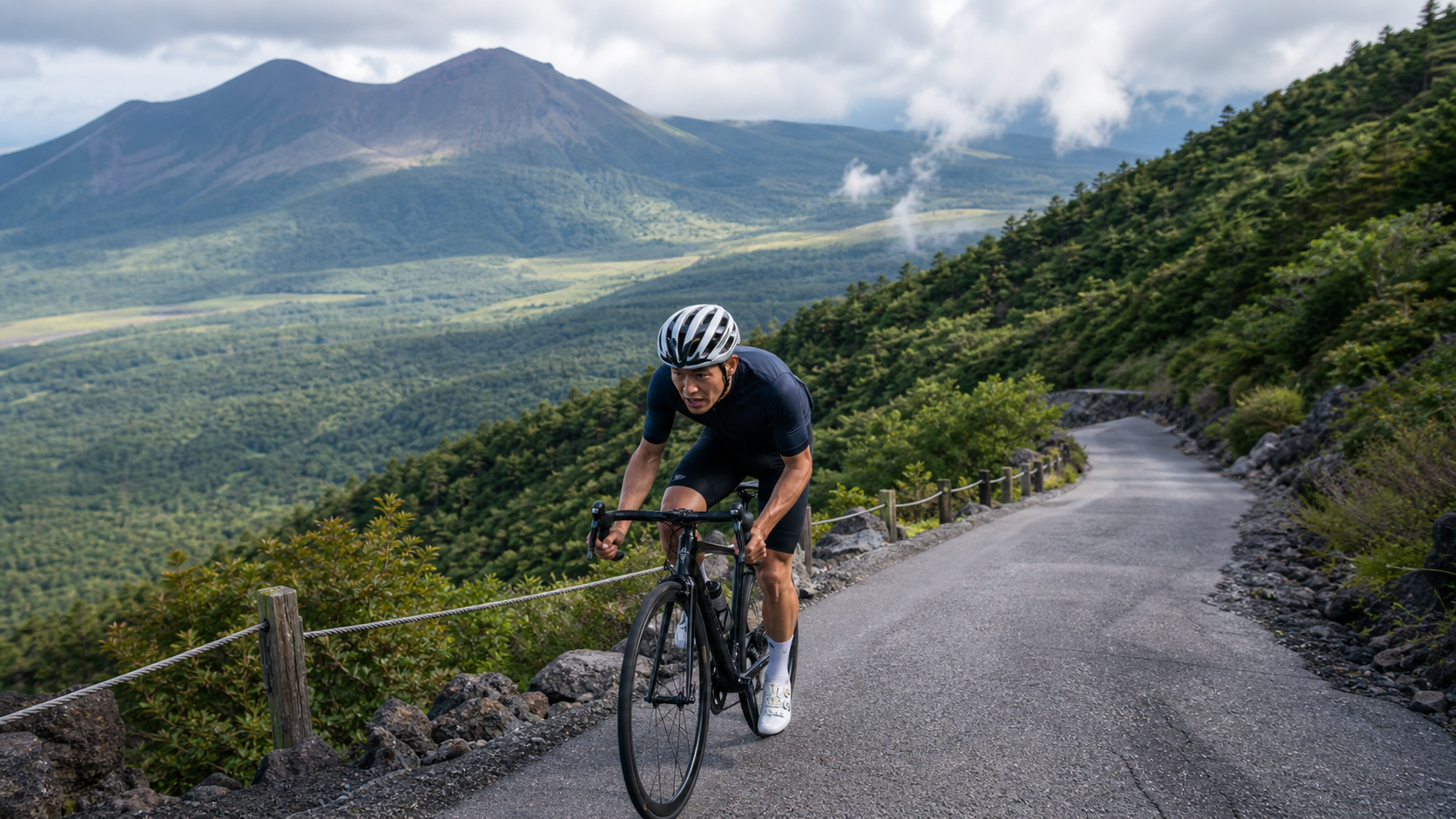
Takachiho-kawara: The Complete Guide to a Brutal 5.43 km Short Climb at 9.5% Average Gradient
If Ebino-kogen is a test of “long-distance endurance management,” then the Takachiho-kawara Hill Climb is its polar opposite — a short, violent, almost breathless brutal steep climb.
Let’s lay out the numbers first: this route is 5,430.97 meters (approximately 5.43 km) long with an average gradient of 9.5%, classified as Category 3 on Strava. It’s located in Kirishima City, Kagoshima Prefecture, Kyushu, Japan. The start is near Kirishima Shrine, designated a National Treasure of Japan, and the finish is the trailhead for climbing Mt. Takachiho-no-mine (elevation 1,574 m) — the Takachiho-kawara Visitor Center.
Regarding the elevation gain, I need to be upfront about one thing. The original data shows the elevation gain as 0, which is clearly a data gap. Therefore, this article estimates it using “distance × average gradient”: 5.43 km × 9.5% ≈ approximately 515 meters of climbing (more precisely, 5,430.97 × 0.095 ≈ 516 meters). Please note this is an estimated value, not a measured one. The actual climbing will vary due to road undulations, but it’s reliable enough for planning your pacing and gearing.
Remember this number: 9.5% is the “average” gradient. Behind that average lies the reality that there will be plenty of sections exceeding 11%, 12%, or even steeper. This road gives you no room to slack off — it pushes you from start to finish.
This article will break down this short but vicious climb from an engineer’s perspective: segment strategies, gearing (especially the life-saving gear), pacing rhythm, common mistakes, and target times for riders of different levels.
Route Overview and Real Data Analysis
Let’s first convert the core data into an easy-to-understand format:
| Metric | Value | Notes |
|---|---|---|
| Total Distance | 5.43 km | Short, but every meter is tough |
| Average Gradient | 9.5% | Brutal steep climb level |
| Estimated Elevation Gain | Approx. 515–516 m | Estimated from distance × average gradient (not measured) |
| Average Elevation Gain per km | Approx. 95 m | Nearly 1.35 times the density of Ebino-kogen |
| Finish Elevation | Takachiho-kawara (Mt. Takachiho-no-mine trailhead) | Start is near Kirishima Shrine |
| Strava Category | Category 3 | Short distance but extremely steep |
The most critical concept here is “gradient density.” Both are Category 3, but Ebino-kogen accumulates 861 meters over 12 km, while Takachiho-kawara needs to climb approximately 515 meters in just 5.43 km. Converted to elevation gain per kilometer, the former is about 71 meters, while the latter is a staggering 95 meters — a density nearly 35% higher. This means every pedal stroke has to overcome a greater gravitational component, and the instantaneous load on your muscles is far higher than on a long, gradual climb.
Another fact you must internalize: an average of 9.5% means the peak gradients will be higher. A road with a 9.5% average cannot be exactly 9.5% the entire way — there must be relatively “easier” 7–8% sections to balance out those walls of 11%, 12%, or even steeper. And it’s precisely those steep walls that will determine whether you make it up that day or are forced to dismount and walk. Therefore, your gearing must be set up to handle the peak gradient, not the average gradient. This is one of the most important reminders in this article.
From a power-to-weight ratio perspective, this kind of steep climb makes very direct demands on your “climbing-specific power-to-weight ratio.” Lighter riders with ample instantaneous power have the advantage here; heavier riders need to compensate with gearing and rhythm. This is not a road you can bluff your way through with momentum and speed — it will honestly expose your power-to-weight ratio in broad daylight.
Segment Strategy: Breaking 5.43 km into Four Sections
A short climb doesn’t mean you can just muscle through it mindlessly. Quite the opposite — the shorter and steeper the climb, the more precise your pacing control needs to be, because the margin for error is compressed. Once you blow up in the early section, you don’t even have the chance to “slowly recover over a long distance.” I’ve conceptually divided these 5.43 km into four segments.
Segment 1 (0–1.2 km): Don’t Get Carried Away by the Momentum at the Start
The start of Takachiho-kawara is near Kirishima Shrine, and the gradient doesn’t mess around from the very beginning. Many people are misled by the mindset of “it’s only 5 km anyway” and push hard from the gun, only to find their legs filled with lead before they’re even halfway.
The discipline for this segment is: it’s better to feel like you’re riding too conservatively than to hit your limit right from the start. Start at the highest “sustainable intensity” you can maintain steadily, not a short burst of explosive power. Maintain whatever cadence you can; the moment you feel the gradient dragging your cadence below 60 rpm, shift down immediately. The goal of this segment isn’t to gain time — it’s to “enter the rhythm alive.”
Segment 2 (1.2–3 km): The Head-On Battle with the Steep Walls
This is usually the most unforgiving section in terms of gradient, and it’s the core battleground that determines whether you can finish the climb. You’ll encounter those walls exceeding 11% and 12%, each one testing your gearing and your will.
The tactic is to “use your lowest available gear to maintain the highest sustainable cadence.” On gradients like this, maintaining 60–70 rpm is already quite good. If your bailout gear on the cassette is big enough (more on this later), you can shift down calmly before the steep walls and stay seated while pedaling; if your gearing isn’t sufficient, you’re forced to stand up and grind, and while standing delivers power momentarily, it’s extremely energy-draining and won’t last long. So, the quality of your gearing will be mercilessly magnified in this segment.
Segment 3 (3–4.5 km): The Battle of Willpower
Past the steepest middle section, fatigue has accumulated considerably, but the finish line is still ahead. This segment is a “battle of willpower” — the gradient may fluctuate slightly, but your legs have little margin left.
At this point, the goal is to “hold the line and not collapse.” Narrow your focus to the few dozen meters ahead, take it one corner at a time, one utility pole at a time. Keep your breathing as deep and rhythmic as possible, avoiding a runaway heart rate from gasping. Whether you can hold steady here often determines whether you finish “riding” or “walking.”
Segment 4 (4.5–5.43 km): The Final Push to the Summit
With less than a kilometer to go, the Takachiho-kawara Visitor Center is ahead. If you’ve paced well and still have something left, you can push the intensity up slightly and drive toward the finish at a slightly higher rhythm. But this road is too steep — don’t expect any glorious sprint. Finishing the last section steadily, without putting a foot down, is itself a victory.
After reaching the top, it’s also advisable not to stop dead. Spin easily for a few dozen meters to let your heart rate settle, then stop to catch your breath, refuel, and take in the view at the trailhead of this “living mountain.”
Gearing and Equipment: A Life-Saving Gear Is a Hard Requirement
This is the most non-negotiable part of the entire article. Facing a 9.5% average gradient with even steeper peaks, a life-saving gear isn’t optional — it’s a necessity.
The original data already states it plainly: a 9.5% average gradient means there are plenty of sections exceeding 11–12%, and a life-saving gear (34T or larger cassette) is essential. Please underline this sentence three times.
| Rider Level | Recommended Chainring | Recommended Cassette | Notes |
|---|---|---|---|
| Advanced/Strong Legs | 50/34 Compact | At least 11-34T | Even with strong legs, it’s wise to have a bailout gear ready |
| General Enthusiast | 50/34 Compact | 11-34T or larger | Standard versatile steep-climb setup |
| Beginner/Aiming to Finish | 46/30, 48/31 Sub-Compact | 11-36T or even larger | The bigger, the better; prioritize being able to climb seated |
Why is the life-saving gear so critical? Because on 11–12% walls, if your lowest gear isn’t light enough, you’ll be forced to grind at an extremely low cadence. This sends the torque on your knees skyrocketing — not only harming your joints, but also depleting your muscle glycogen in a very short time. Conversely, a sufficiently large cassette allows you to maintain a higher cadence and lower per-stroke force on the same gradient, shifting the load from “explosive power” to “aerobic endurance.” That’s the key to lasting the entire climb.
Other equipment priorities:
- Bike Weight: Short, steep climbs are extremely sensitive to bike weight. Shed as much weight as you can. Remove unnecessary gear and excess water before heading up.
- Brakes: What goes up must come down. A 5+ km steep climb means the descent is a long, steep section requiring constant speed control. Make sure your braking system is in good working order, and remember to brake intermittently on the way down to avoid prolonged gripping that overheats rims or rotors.
- Tire Pressure and Grip: The route is enveloped by dense forest, and the road surface may be damp with fallen leaves or moss. Grip is important — don’t inflate your tires to maximum pressure.
- Watch for Volcanic Steam Sections: Some sections have volcanic steam and a sulfur smell on the roadside. This is a hallmark of Kirishima, and a reminder that this is a “living mountain.” Stay focused when cornering and riding.
Pacing, Cadence, and Pedaling Rhythm
On gradients like this, the traditional “power cruising” mindset needs slight adjustment. On a 5.43 km short climb, you can sustain a slightly higher relative intensity than on a long climb, but the prerequisite remains “sustainable to the finish.”
- Cadence: Aim to keep your cadence above 60 rpm on the steep walls. If you’re below 60 rpm and struggling persistently, it’s a warning sign of insufficient gearing or excessive intensity.
- Seated Priority: Prioritize seated pedaling to maintain efficiency, treating standing sprints as a tactical weapon for “brief steep walls,” not the norm. Every time you stand, you’re burning your limited anaerobic reserves.
- Relax Your Upper Body: On steep climbs, many people unconsciously shrug their shoulders, death-grip the handlebars, and hold their breath — all wasted energy. Deliberately relax your shoulders and arms, focusing your power on your core and legs.
- Breathing: Use deep, rhythmic diaphragmatic breathing to deliver oxygen steadily to your muscles, avoiding the short, shallow chest breathing that steep gradients often trigger.
Common Mistakes and DNF Risks
Takachiho-kawara may be short, but it’s a place where many people end up “dismounting and walking.” Here are the most typical mistakes:
- Insufficient Gearing: This is the number one cause of DNF. If your largest cassette cog isn’t big enough, you’ll be forced to grind at a low cadence on 11–12% walls, instantly exhausting your knees and thighs, forcing you off the bike.
- Going Out Too Hard: Misled by the illusion of “it’s only 5 km,” riders hit their limit from the start and blow up in the middle section.
- Over-Reliance on Standing: Treating standing sprints as the norm burns through anaerobic capacity in no time, leaving nothing for the later stages.
- Ignoring the Descent Risk: Only preparing for the climb, without considering the test that a long, steep descent poses to brakes and handling — risking overcooling or brake fade on the way down.
- Not Checking Volcanic Conditions: Kirishima is an active volcanic zone, and road access can change at certain times. Failing to confirm beforehand can leave you stranded.
- Mental Collapse: This road is too direct; the pain comes fast and hard. Many people “give up mentally” before their “legs give out.” Lacking the psychological strategy of narrowing your focus and breaking the climb into segments is an invisible DNF cause.
Target Time References for Riders of Different Levels
The following are conceptual references — actual times are heavily influenced by fitness, weight, equipment, weather, and daily condition. Use them for self-positioning rather than as rigid standards. Individual variation on short, steep climbs is often greater than on long, gradual ones.
| Rider Level | Approximate Finish Time | Positioning |
|---|---|---|
| Competitive/Climbing Specialist | Approx. 22–28 minutes | Chasing PRs and rankings |
| Advanced Enthusiast | Approx. 28–35 minutes | Steady finish, controlled pacing |
| General Rider | Approx. 35–45 minutes | Goal is to finish without putting a foot down |
| Beginner/Endurance Type | 45 minutes or more | Ride within your limits; walking if necessary is no shame |
A practical benchmark: if you’re completely out of breath in the middle section and grinding at 50 rpm, it’s likely a double problem of “going out too hard” plus “insufficient gearing.” Next time, hold back a bit more at the start and go up one size on your cassette — your finish rate will improve dramatically. On gradients like this, smart preparation matters far more than brute force.
Pre-Ride Checklist
- [ ] Life-Saving Gear: Cassette largest cog at least 34T; go 36T or above if you want an easier finish. This is the most non-negotiable item on this road.
- [ ] Volcanic Conditions: Confirm road access around Kirishima/Takachiho-kawara and no volcanic warnings in effect.
- [ ] Brake System: The long, steep descent demands a lot from your brakes; make sure brake pads and lever feel are in good condition.
- [ ] Tire Pressure and Condition: Forest sections may be damp; slightly lower tire pressure for better grip.
- [ ] Shed Bike Weight: Remove unnecessary gear; short, steep climbs are highly sensitive to bike weight.
- [ ] Nutrition: The route is short but extremely intense; have energy and water ready, and fuel up before starting.
- [ ] Weather: Check the day’s temperature and rainfall; don’t forget a warm layer for the descent.
- [ ] Transport: Kagoshima Airport is about 25 km from the start and is bike-friendly; plan your arrival.
- [ ] Mental Preparation: Tell yourself this is a short, fierce battle. Face it with the strategy of narrowing your focus and breaking the climb into segments.
Takachiho-kawara isn’t long, but it will force out your most honest climbing ability. Bring enough gearing, hold back at the start, and steady your mind — and you can reach the trailhead of this mythical mountain with dignity, without putting a foot down. Ride steady, climb hard, and descend safe.
Advanced Concept: Why “Short Climbs” Are Actually Harder to Pace
Many people have the intuitive misconception that a shorter distance equals easier. But from the science of pacing, short, steep climbs are actually harder to pace than long, gradual ones, for three reasons.
First, the margin for error is compressed. On a 12 km long climb, even if you make a pacing mistake and go out too hard, there’s still plenty of distance in the middle and later sections to “slow down, adjust, and find your rhythm again.” But on a 5.43 km short climb, once you blow up in the early section, you have no room to adjust — the distance is too short. By the time you realize the problem, you’re often already in the steepest core section, watching yourself collapse with no recourse.
Second, the intensity zone sits closer to your limit. Because the climb is short, theoretically you can sustain a higher relative intensity than on a long climb. But this is also the trap: higher intensity means getting closer to your anaerobic threshold. Exceed that line even slightly, and lactate accumulation spirals out of control, sending you from “still holding on” to “completely spent” within minutes. That threshold line is very fine, and it requires a solid understanding of your own body to manage.
Third, the psychological rhythm is hard to establish. A long climb gives you ample time to enter a “cruising meditation” state — letting your mind go blank and your body run on autopilot. But a short, steep climb is high-intensity suffering from start to finish. The pain comes fast and hard, and you barely have time to let your mind adapt gradually. This is why many long-distance endurance riders find these short, steep walls particularly uncomfortable — their accustomed rhythm doesn’t apply.
Understanding these three points, you’ll see: the smartest strategy for Takachiho-kawara is ironically to “ride a short climb with the caution of a long one.” Hold your start back more conservatively than you think you need, bring gearing bigger than you think you need, and prepare mentally more thoroughly than you think you need. Better to reach the finish feeling “I actually had a little left” than to collapse in the middle and show yourself.
Training Advice: What to Practice to Conquer It
If you’ve set Takachiho-kawara as a goal, your training in the weeks before can be targeted. Here are a few specific directions.
One: Threshold and Above-Threshold Climbing Intervals. This road will frequently push you to or above your threshold, so you need to practice “repeatedly entering high intensity and recovering.” Find a climb with a similar gradient (Fengguizui, Xizhi Wuzhi Mountain in Taiwan, or any section with an 8%+ average gradient), and do several 3–5 minute high-intensity climbing intervals with full recovery between reps. This improves your lactate tolerance and clearance ability.
Two: Low-Cadence Strength Training. On steep walls, you’ll inevitably face moments when your cadence gets dragged down. So in training, deliberately practice “big gear, low cadence” seated climbing to strengthen your quadriceps and glutes under high torque. But progress gradually and pay attention to knee sensation — this type of training is easy to overdo and cause injury.
Three: Weight Management. As emphasized repeatedly, short, steep climbs are extremely sensitive to bike and body weight. Maintaining a lean physique, within safe and healthy limits, will directly translate to how easy you find this climb. This isn’t about extreme dieting — it’s a reminder that “climbing specialists tend to have low body fat” for good reason.
Four: Practice Seated-to-Standing Transitions. In training, practice smoothly switching between seated and standing while climbing, and feel the difference in energy expenditure. The goal is to make standing a “precisely controlled tool you can deploy and retract at will,” rather than an uncontrolled reaction forced by the gradient.
Master these, and you’ll face Takachiho-kawara with far more composure. Climbing has no shortcuts, but it does have methods — those who use the right methods always ride farther, longer, and smarter than those who just muscle through.
Comparing the Two Kirishima Climbs Side by Side
If your Kyushu trip includes both Ebino-kogen and Takachiho-kawara, understanding the “personality differences” between these two climbs will help you allocate your energy and mindset.
| Comparison Item | Ebino-kogen | Takachiho-kawara |
|---|---|---|
| Distance | 12.14 km | 5.43 km |
| Average Gradient | 4.9% | 9.5% |
| Elevation Gain | 861 m (measured) | Approx. 515 m (estimated) |
| Elevation Gain per km | Approx. 71 m | Approx. 95 m |
| Core Challenge | Long-distance endurance management | Short-distance steep wall assault |
| Gearing Focus | Cruising gear to protect cadence | Life-saving gear for steep walls |
| Pacing Philosophy | Conservative start, steady middle | Hold back throughout, avoid blowing up |
In simple terms, Ebino-kogen tests your “stamina for maintaining steady output,” while Takachiho-kawara tests your “assault capability against steep walls and gearing wisdom.” The two are complementary. If you’re challenging both on the same day, I’d suggest putting the endurance-type Ebino-kogen first while your energy is fresh, and saving the explosive Takachiho-kawara for when your body is fully warmed up but not yet completely drained — or better yet, split them across two days and face each with your best condition. That’s the way to do justice to these two distinctive volcanic climbs.
However you arrange it, remember one thing: both climbs deserve to be taken seriously and savored. One is long, one is short; one is gradual, one is steep — yet both sit on the same Kirishima land embraced by volcanoes and mythology. Ride them with the right strategy, and you’ll take away not just two Strava records, but a clearer understanding of your own climbing ability.
Supplementary Note on the “Estimated Elevation Gain”
At the end of this article, I want to return to the “approximately 515 meters of climbing” and explain it more clearly, because honesty about data is the baseline of an engineer’s voice.
In the original data, the elevation gain for this route shows as 0, which is practically impossible — a road with a 9.5% average gradient absolutely cannot have zero climbing. The reasonable conclusion is that the elevation information was omitted during data collection or recording. Faced with this situation, the most robust approach is to back-calculate using the geometric relationship of “distance × average gradient”: multiply 5,430.97 meters by 9.5% to get approximately 516 meters of vertical gain.
But it’s important to emphasize that this estimate has its assumptions — it assumes the gradient distribution along the road is relatively uniform. In reality, if there are flat or even briefly descending sections, then to maintain a 9.5% “average,” other sections must be steeper, and the total gain may vary slightly. Therefore, treat “approximately 515 meters” as a reliable planning baseline, not a meter-precise measured value. Only when you actually ride it and record with your own altimeter will you get the true number for your particular ride.
I’ve spent this space on this topic to convey a principle: when looking at route data, know where each number comes from and how reliable it is. Average gradient, total gain, Strava category — these are all tools to help you plan, but tools have their margins of error and applicable ranges. A mature rider uses these data points to aid judgment but doesn’t blindly follow a single number. Heading up the mountain with this attitude, you’ll not only ride smarter, but also have a clearer, more honest understanding of every ride you do.
This is Takachiho-kawara — a brutal steep climb that’s short on paper, ferocious in feel, and steeped in mythology. Study it thoroughly, prepare fully, and then ride it with dignity. When you stop at the trailhead of Mt. Takachiho-no-mine and look back at the steep wall you just conquered, you’ll know: these 5.43 kilometers — every meter was hard-earned, and every meter is worth being proud of.
Related Reading
- Kirishima Ebino-kogen Climb Guide: Full Data Analysis of a 12 km, 861 m Volcanic Highland Long Climb
- Haruna-san Haruhiru Guide: Full Analysis of Pacing, Gearing, and DNF on a 4.7 km, 10% Average Gradient Brutal Section
- Hakone-toge (Route 1) Guide: Segment-by-Segment Pacing and Gearing Breakdown for 15.6 km with 846 m of Climbing
- Koyasan Guide: Full Endurance Pacing, Gearing, and Nutrition Guide for a 17.4 km, 4.4% Long Climb
台北闊瀨陡坡 騎旅 / 日本單車雜誌編輯車友臨時加入!/ 髮香才是最強的 / feat. 北迴歸線小隊 / 公路車 CT Yeh
6 個月前
萬年峽谷! 30% 超激陡坡 里佳部落DAY2 還是很硬! | 公路車 | CT Yeh
3 年前
新竹羅平 x 天湖部落 大禹嶺級變態陡坡! 4K超高畫質 空拍 | 公路車
5 年前
雨戰! 西進武嶺員工旅遊 加料 各路段大數據分析 | 同事端出5公斤的公路車來挑戰!? EP1
4 年前
半日 小台灣 極限單車路線挑戰實錄
7 年前
大武山後門26%歡樂陡坡!JJSC南台灣單車行Day2 / 被颱風追著跑 / 公路車 / CT Yeh
2 年前
#公路車 #西進武嶺 配速配瓦實驗 坡度分析 四小時內攻略 建大盃 NeverStop #西進武嶺攻略
6 年前
大武山20%魔王陡坡【JJSC南台灣遊騎Day2】!屁股真的要裂開了...凡士林抹滿也沒用?神秘金教堂還有超便宜夜市
3 個月前