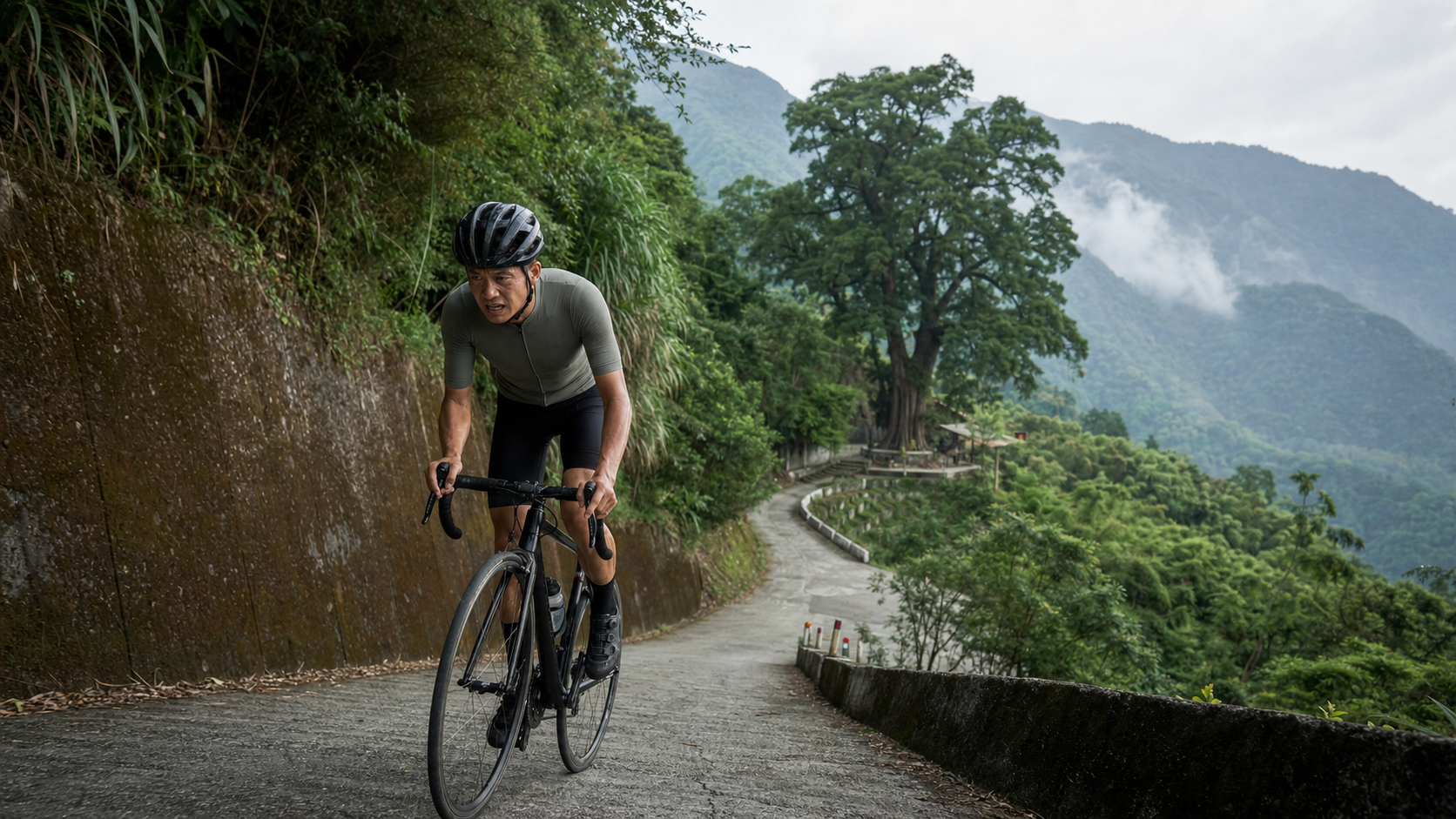
If Tatajia is a long-distance marathon won through “endurance,” then the Tou 56 Sacred Tree Route is a sprint that forces you to confront “pure steepness.”
Located in the mountains of Nantou, this route spans just 6,904.4 meters (approximately 6.9 km) yet demands 653.8 meters of climbing. Using the most honest arithmetic: 653.8 meters of climbing divided by 6,904.4 meters of distance yields an average gradient of approximately 9.5%. That’s a hardcore number. It means this isn’t a road you can “casually spin up”—it’s a secret-level steep climb that tests your leg strength, gearing, and willpower from the very first kilometer.
This article maintains an engineering-oriented, data-driven style, breaking down this short but ferocious route clearly. At the same time, I want to honestly disclose one detail about the data upfront.
1. An Honest Note on the Gradient Data
In the database’s original field, this route’s “average gradient” is listed as 4.9%. However, this figure clearly doesn’t align with two other more fundamental, more credible numbers—a distance of 6,904.4 meters and an elevation gain of 653.8 meters.
Let’s verify with the simplest physics:
Average gradient = Total elevation gain ÷ Horizontal distance = 653.8 ÷ 6904.4 ≈ 0.0947 ≈ 9.5%
In other words, if the “distance” and “elevation gain” figures are accurate (and they are typically the two most reliable baseline metrics from GPS tracks), then the true average gradient should be close to 9.5%, not the 4.9% listed in the field. This discrepancy may stem from differences in how the data source defines “distance” (e.g., whether it includes out-and-back segments, or whether it’s net climbing for a one-way trip), or from differences in how the field was calculated.
This article’s guiding principle is: use the two most credible confirmed figures (6.9 km distance, 653.8 m elevation gain) as the baseline, and derive an average gradient of approximately 9.5% accordingly. I won’t pretend 4.9% is correct, nor will I dogmatically claim 9.5% is the absolute truth—I’m simply laying the calculation out in the open for you to judge for yourself. And in terms of riding feel, a 6.9 km climb with 653 meters of elevation gain is unquestionably “hard climb” territory. There’s no doubt about that.
| Item | Data | Credibility |
|---|---|---|
| Total Distance | 6,904.4 meters (approx. 6.9 km) | High (GPS baseline metric) |
| Total Elevation Gain | 653.8 meters | High (GPS baseline metric) |
| Calculated Average Gradient | Approx. 9.5% | Derived from the two figures above |
| Original Field Gradient | 4.9% | Inconsistent with elevation gain/distance; questionable |
| Strava Category | Category 3 | Short-to-medium steep climb tier |
| Location | Nantou County | Exact township data unconfirmed |
2. What Kind of Road Is This?
“Tou 56” is the county road designation for Nantou County, while “Sacred Tree” points to a large sacred tree at the route’s endpoint or along the way. The mountainous areas of Nantou—Zhushan, Lugu, Xinyi—are renowned for sacred tree attractions, home to precious giant trees such as Taiwan red cypress and Taiwan hinoki.
The Tou 56 Sacred Tree Route is positioned as an industrial road/county road steep climb leading to a mountain sacred tree. It’s sparsely populated, a “secret-level” hard climb: no endless traffic, no bustling feed stations—just winding, shaded asphalt climbing ever upward, and at the end, that sacred tree that has witnessed the passage of countless years.
Precisely because it’s “short,” many people underestimate it. But a 9.5% average gradient means that even at just 6.9 km, every single kilometer is a hard grind, with no gentle respite to recover. This “sustained high intensity” is the route’s true difficulty.
3. Terrain Characteristics and Pacing Strategy
The pacing philosophy for a short, steep climb is fundamentally different from a long climb.
On a long route like Tatajia, the core is “budgeting your energy carefully.” On a short, steep climb like Tou 56 Sacred Tree, the core is “finding an intensity that sits right at the threshold edge while still being sustainable to the finish.”
- Intensity targeting: Overall intensity will hover near or slightly above the lactate threshold. This is acceptable—because the distance is short, you don’t need to reserve much “budget for the later stages,” but you also can’t go all-out from the start and blow up.
- Discipline at the start: Many riders, with fresh legs at the base of a steep climb, push too hard too early, only to find their heart rate maxed out and legs flooded with acid by kilometers 3–4. Deliberately hold back in the first 1–2 km, keeping intensity in the “hard but sustainable” zone.
- Cadence first: On a 9.5% grade, maintaining cadence matters more than maintaining speed. Better to go slow and keep the pedals turning continuously than to fall into the knee-killing “mashing and grinding” pattern.
Segment Recommendations (Managing in Three Phases)
Segment 1 (approx. 0–2.5 km): Establish rhythm. Don’t be tempted by fresh legs after the start. Settle in at an intensity you expect to sustain for the entire climb, keeping cadence above 70 rpm. The task here is “finding rhythm,” not “opening a gap.”
Segment 2 (approx. 2.5–5 km): Hold the threshold. This is the most mentally and physically grueling middle section. The freshness of the opening has faded, and the finish isn’t in sight yet. Focus your attention on breathing rhythm and pedal cadence. Allow yourself to recover slightly on gentler sections (if any), and grind through the steepest parts with your easiest gear.
Segment 3 (approx. 5–6.9 km): Close it out. The psychological support of seeing the finish line approaching gives you a little extra strength. If you have anything left, make a controlled push; if you’re spent, make “not putting a foot down” your only goal, grinding turn after turn until you reach the sacred tree.
4. Gearing and Equipment: Light Gearing Is Your Lifeline
On a route with a 9.5% average gradient, your gear configuration almost directly determines your completion rate and knee health.
| Rider Level | Recommended Gearing | Notes |
|---|---|---|
| Advanced / Strong legs | 34T × 30–32T | Still recommend keeping a large enough cog; don’t overreach on steep sections |
| General fitness | 34T × 32–34T | Mainstream safe setup; strongly recommended |
| Beginner / First attempt | Gravel gearing or below 1:1 | Trading gears for completion is nothing to be ashamed of |
Core principle: better to have gearing too light than too heavy. On sustained steep climbs like this, the cost of too-heavy gearing is cramping, knee injury, and premature DNF; the only “cost” of too-light gearing is a slightly slower pace—which, on a secret-level journey to see a sacred tree, isn’t a cost at all.
Equipment essentials:
- Lightweight build: For a pure climbing scenario, every gram saved on the bike is a tangible benefit. Aero deep-section wheels aren’t needed.
- Tire pressure: Set according to your weight and tire width. Industrial road surfaces may not be as smooth as main roads; a slightly more conservative pressure can improve grip and comfort.
- Repair supplies: This is a secret-level route—few people, sparse traffic, and difficult rescue access. Spare tubes, inflation tools, patch kits, and quick links must all be packed.
- Communication: Cell reception is poor in the mountains. Inform family or friends of your itinerary before departing, and carry a power bank.
5. Nutrition and Hydration
Although it’s only 6.9 km, the all-out intensity means your body’s expenditure is far from trivial. Combined with the sparse resupply options on this secret-level route, your nutrition strategy actually needs to be even more “self-sufficient.”
- Eat and hydrate well before starting: Don’t treat this as “a short ride that’ll be over quickly” and neglect fueling. Make sure carbohydrates and fluids are topped off before departure.
- Carry enough water on the bike: Sustained high intensity means heavy sweating. Carry at least one large bottle, and double it in summer. Adding electrolytes can help prevent cramping.
- Don’t gamble on supplies at the top: The endpoint of a secret-level route typically has no shops. Everything you need must be prepared at the bottom.
- Save water for the descent: Don’t drink all your water on the way up. The descent back down isn’t strenuous, but you’ll still need hydration.
6. Common Mistakes and DNF Risks
Short, steep climbs are the easiest to “underestimate.” Here are the most typical ways things go wrong:
- Underestimating the difficulty: A “it’s only 6.9 km” mindset leads to starting too fast and collapsing mid-climb. A 9.5% average gradient is no joke.
- Gearing too heavy: Mashing up a steep climb with heavy gears is the number one cause of cramping and knee injuries.
- Blowing up early: Fresh legs push hard, burning through threshold capacity, and the back half becomes a hike-a-bike.
- Insufficient supplies: Assuming a short route needs no fuel, then running out of water and food in the middle of nowhere.
- Ignoring road conditions: Industrial roads may have rockfall, gravel, moss, or slippery surfaces—especially after rain. Pay close attention to road conditions and brake control.
7. Target Times for Different Rider Levels
The following are reference one-way times (climbing to the sacred tree), heavily influenced by road conditions, form, and rest stops. They’re provided only as pacing-planning references.
| Rider Level | Reference One-Way Time | Strategy Focus |
|---|---|---|
| Racing / Advanced | 35–50 minutes | Hold the threshold, steady cadence |
| General fitness | 55–75 minutes | Hold back early, light gearing, proper hydration |
| First-time challenger | 80+ minutes | Goal is finishing without putting a foot down; take extra breathers |
8. Pre-Ride Checklist
- [ ] Gearing: Confirm you have sufficiently light climbing gears to handle the sustained 9.5% grade.
- [ ] Brakes: The climb is fine, but the steep descent on the way back is the real test for your brakes. Verify brake performance.
- [ ] Tire pressure and tires: Set according to industrial road conditions; check for cuts or damage.
- [ ] Nutrition: All water, electrolytes, and carbohydrates needed for the entire ride, prepared at the bottom.
- [ ] Repairs: Spare tubes, inflation tools, patch kits, quick links.
- [ ] Communication: Inform family/friends of your itinerary, carry a power bank, and download offline maps.
- [ ] Road status check: Before departing, check whether the industrial road has closures, construction, or rockfall.
- [ ] Weather: Avoid riding after rain when surfaces are slick. Mountain afternoons are prone to changing weather—start early whenever possible.
9. Safety Reminders for the Descent
While climbing, your focus is on the ascent—but don’t forget: the steep descent on the way back is another injury-prone segment of this route.
- Intermittent braking: A sustained 9.5% grade continues on the way down. Continuous braking will overheat rims or rotors. Use an “intermittent, front-rear balanced” braking strategy.
- Control your speed: Industrial roads have many curves and potentially poor sightlines. Better slow than sorry—leave yourself reaction distance.
- Watch the road: Rockfall, gravel, and slippery patches carry higher risk on descents. Stay focused.
10. Training Preparation for Short, Steep Climbs
Don’t assume that because this route is “only 6.9 km,” no preparation is needed. In fact, a short, sustained steep climb demands muscular strength and anaerobic endurance every bit as much as a long route demands aerobic endurance. To complete Tou 56 Sacred Tree in style, you can prepare with the following before taking on the challenge:
- Climbing intervals (VO2max workouts): Find a 5–8 minute climb and repeat it at near-threshold intensity with full recovery in between. This improves your VO2max and threshold power—exactly the capacities a short, steep climb demands.
- Threshold endurance (Sweet Spot / Threshold): Do 15–20 minute sustained efforts slightly below threshold to train your body’s ability to “stay at high intensity for extended periods,” matching this route’s near-threshold nature throughout.
- Low-cadence strength work: On a climb, use heavy gears at low cadence (50–60 rpm) for short durations to build the absolute strength needed for steep grades. But keep each session short and protect your knees.
- Weight management: Short, steep climbs are a pure “power-to-weight ratio” contest. Maintaining a reasonable body weight, within healthy limits, has a very direct impact on performance.
A practical tip: before the real challenge, find a similar climb with comparable gradient and length and “test-ride” it. Use it to calibrate your pacing and gear choices, so you don’t discover mid-challenge that your gearing isn’t light enough or your pacing is too aggressive.
11. Special Road Conditions and Riding Techniques on Industrial Roads
The Tou 56 Sacred Tree Route is an industrial road/county road, and its conditions differ fundamentally from main roads—which directly affects your riding technique and safety.
- Inconsistent surface quality: Paving on industrial roads can vary from section to section. Some stretches are smooth; others may have potholes, cracks, or patches. Look ahead, read the road early, and avoid obvious potholes and gravel.
- Moss and slickness: Sections with dense tree cover and limited sunlight are prone to moss growth, especially slippery after rain. Slow down on corners and descents to avoid losing grip and crashing.
- Rockfall and debris: Mountain industrial roads often accumulate rockfall, broken branches, and leaf litter. Conditions can deteriorate noticeably after rain or typhoons—check recent weather before heading out.
- Blind corners: Mountain roads have many curves, some with sightlines blocked by hillsides or trees. Climbing speeds are low and risk is relatively modest, but still ride on the right side and leave reaction space—especially watch for occasional industrial vehicles or scooters.
- Narrow width: Industrial roads are typically narrow with limited passing room. When encountering oncoming traffic, stay calm, pull over, and yield—never fight for position on a blind corner.
In terms of riding technique, on steep grades, occasional “standing sprints” can engage different muscle groups and temporarily relieve seated fatigue. But standing efforts consume more oxygen, so control their frequency and duration—don’t exhaust yourself from too much standing. Most of the time, stay seated with a high cadence.
12. Adding It to Your Training Menu
For riders living in Nantou or nearby areas who can visit this route regularly, Tou 56 Sacred Tree is essentially a “natural climbing trainer.”
Its distance is moderate, its gradient is steep enough, and it’s relatively quiet with little traffic—ideal for “repeated climbing training”: climb up, descend gently, climb again. This kind of repeated-climb workout is one of the most direct and effective ways to improve climbing ability.
You can design it into different training formats:
| Training Format | Execution | Training Goal |
|---|---|---|
| Threshold climb | Climb once at threshold intensity, rest fully, then repeat | Improve threshold power |
| Tempo climb | Climb at slightly lower intensity with a steady rhythm, accumulating climbing time | Build climbing muscular endurance |
| Time trial | Go all-out for a single timed run, chasing a personal best | Test progress, maintain motivation |
Treating a secret-level route as both a “scenic destination” and a “training ground” is a privilege only riders living near mountain towns enjoy. With every repetition, you’re not just getting stronger—you’re building a deeper connection with this forest.
13. Long Climbs vs. Short Steep Climbs: Two Fundamentally Different Kinds of Pain
Many riders, after conquering long mountain routes (like Tatajia), naturally assume short steep climbs are “a piece of cake.” This is a classic misconception. Long climbs and short steep climbs are two fundamentally different challenges, producing two fundamentally different kinds of pain.
| Aspect | Long Big Climb (e.g., Tatajia) | Short Steep Climb (e.g., Tou 56 Sacred Tree) |
|---|---|---|
| Primary energy system | Aerobic dominant, long duration at low-to-moderate intensity | Near-anaerobic threshold, short duration at high intensity |
| Core test | Endurance, nutrition, pacing, altitude response | Muscular strength, anaerobic endurance, gearing, suffering tolerance |
| Pacing philosophy | Budget energy, save for the later stages | Hold the threshold, but don’t blow up at the start |
| Type of pain | Prolonged, grinding fatigue accumulation | Concentrated, sharp high-intensity suffering |
| Completion time | Several hours | Usually under an hour |
Understanding this difference is critical to your pacing strategy. If you transplant the “conservative, energy-saving” instincts trained on long routes directly to a short steep climb, you may ride “too conservatively” and fail to perform. Conversely, if you bring the “go all-out” instinct from short steep climbs to a long route, you’ll squander your energy in the opening stages.
The correct mindset for a short steep climb like Tou 56 Sacred Tree is: it’s short enough that you can “ride relatively hard,” but steep enough that you can’t “spend everything at the start.” Finding that sweet spot of intensity—“hard but sustainable to the finish”—is the key to conquering it.
14. Standing or Seated? Pedaling Choices on Steep Climbs
On a sustained 9.5% grade, “should I sit and pedal, or stand and sprint?” is a practical technical question.
Seated pedaling is the foundation of climbing. It’s more efficient and economical, allowing you to sustain output at a steady cadence. On most sections—especially where the gradient is relatively “tolerable”—you should ride seated, maintaining cadence above 70 rpm.
Standing sprints are a tactical tool. Their advantages:
- They recruit different muscle groups than seated pedaling, giving fatigued muscles a temporary rotation.
- On the steepest sections where seated cadence becomes unsustainable, body weight can provide additional downward force.
- They can temporarily relieve pressure on the hips and lower back from prolonged sitting.
But the cost of standing is significantly higher oxygen consumption and a faster-spiking heart rate. Therefore, standing should be used as “intermittent relief,” not “the sustained main effort.” A practical approach: stand and sprint through the steepest short sections, then sit back down to recover on slightly gentler stretches. This “seated-primary, standing-secondary” rhythm switching helps you allocate energy more efficiently.
A common mistake: beginners on steep climbs, unable to ride seated, stand and sprint the entire way, only to see their heart rate max out and energy drain rapidly. Remember, standing is “seasoning,” not “the main course.”
15. A Practical Simulation: An Ideal Tou 56 Sacred Tree Ride
Let me tie all the theory together with a practical simulation, giving you a complete picture of this route.
Before departure: You’ve had a full breakfast at the bottom, carrying a large bottle of water with electrolytes and two energy bars. You’ve confirmed your gearing is 34T×34T, and checked brakes, tire pressure, and chain. You checked the weather—clear and stable this morning.
Segment 1 (0–2.5 km): Turning onto the entrance of Tou 56, the road climbs immediately. You deliberately suppress your fresh legs, settling into an intensity that’s “hard but still able to talk,” cadence held at 75 rpm. You remind yourself: going slow now is what lets you reach the finish later.
Segment 2 (2.5–5 km): This is the most grueling middle section. The freshness of the opening has faded, and the finish isn’t in sight. You feel your heart rate approaching threshold and acid building in your legs. You narrow your focus to breathing and pedaling, briefly standing to sprint through the steepest spots, then sitting back down to recover on gentler stretches. You tell yourself: just get through this section.
Segment 3 (5–6.9 km): You vaguely notice changes in the forest ahead and sense the finish is near. This psychological support gives you a little extra strength. You maintain a steady rhythm, turn after turn, until—that sacred tree appears before you.
At the finish: You stop, gasping for air, legs burning, heart pounding. But when you look up and see that silently standing giant tree, all the suffering becomes worth it in an instant. You take a long drink of water, stand quietly before the sacred tree, and savor this moment of tranquility and accomplishment earned through sweat.
This is an ideal Tou 56 Sacred Tree ride. Discipline at the start, endurance through the middle, correct gearing and pedaling choices—all culminating in that pure satisfaction at the finish.
16. Post-Ride Recovery
After completing a high-intensity short steep climb, don’t neglect the “recovery” phase. Good recovery not only helps you eliminate fatigue faster but also reduces injury risk and improves your performance on the next ride.
- Cool-down and stretching: After reaching the finish and resting briefly, don’t immediately collapse into stillness. Do some simple stretches, especially for the quadriceps, hamstrings, calves, and glutes, to help tight muscles relax and reduce soreness.
- Carbohydrate and protein intake: The 30–60 minutes after riding is the golden recovery window. Consume carbohydrates to replenish glycogen, paired with moderate protein to support muscle repair.
- Fluids and electrolytes: High-intensity riding depletes significant fluids and electrolytes. Keep replenishing after the ride until urine color returns to a normal pale yellow.
- Gentle descent: The descent back down isn’t strenuous, but it can serve as active recovery—maintain an easy rhythm and let blood circulation help flush metabolic waste.
- Sleep: True muscle repair and adaptation happen during sleep. Giving yourself adequate sleep after a challenge is the most underestimated yet most effective recovery tool.
Training progress doesn’t happen while you’re riding—it happens while you’re recovering. Take recovery seriously, and you’ll keep getting stronger and enjoy a longer riding career.
Conclusion: Short Doesn’t Mean Easy
The Tou 56 Sacred Tree Route, in the most compact distance, gives you the most honest gradient. 6.9 km, 653 meters of elevation gain, an estimated average gradient of about 9.5%—these numbers together form a “short but far from easy” secret-level hard climb in Nantou.
It won’t test your endurance limits the way Tatajia does, but it will use sustained steepness to force you to take every kilometer, every pedal stroke, and every gear choice seriously. When you treat pacing as strategy, gearing as your lifeline, and nutrition as discipline, you can safely reach the top—and before that sacred tree that has witnessed the ages, you’ll be gasping for breath, yet filled with accomplishment.
Short has never meant easy. And it’s precisely this “short but ferocious” purity that makes Tou 56 Sacred Tree a route worth taking seriously. Prepare your gear, dial in your gearing, face that 9.5% honestly—and then, ride toward the sacred tree.
Related Reading
- The Secret Steep Climb to the Sacred Tree: Tou 56, An Encounter with a Millennial Giant in the Deep Shade of the Forest
- Eastbound Wuling - Sacred Tree Cup Combat Guide: 19.8 km Data Decoded and Full Long-Haul Gear & Nutrition Guide
- Sanxia Lishan Shrine Combat Guide: Technical Short Climb Analysis of 6.3 km at 6.1% Average Gradient
- Alishan Highway Complete Guide: 53.57 km with Over 2,000 Meters of Climbing—Southern Taiwan’s Long-Haul Pilgrimage
台北闊瀨陡坡 騎旅 / 日本單車雜誌編輯車友臨時加入!/ 髮香才是最強的 / feat. 北迴歸線小隊 / 公路車 CT Yeh
6 個月前
半日 小台灣 極限單車路線挑戰實錄
7 年前
雨戰! 西進武嶺員工旅遊 加料 各路段大數據分析 | 同事端出5公斤的公路車來挑戰!? EP1
4 年前
2016 彰化經典百K - 74號爬坡全程
10 年前
單車 梅山36灣 坡度介紹 路段介紹 空拍 (相關遊記影片,請參考說明或我的頻道喔,歡迎訂閱)
6 年前
阿里山塔塔加 兩倍特濃版!全新隧道開通! 進喔!公路車 | CT Yeh
3 年前
爬坡ITT實境)台中 魔王 松鼠坡 首航 6:12 大肚山 大三元 科福路
8 年前
塔塔加 員工旅遊 加料 各路段大數據分析 | EP2 | 公路車 | CT Yeh
4 年前