Sun Moon Lake Circuit Practical Guide: Breaking Down the Steep-Climb Traps Behind the 2.9% Average Gradient
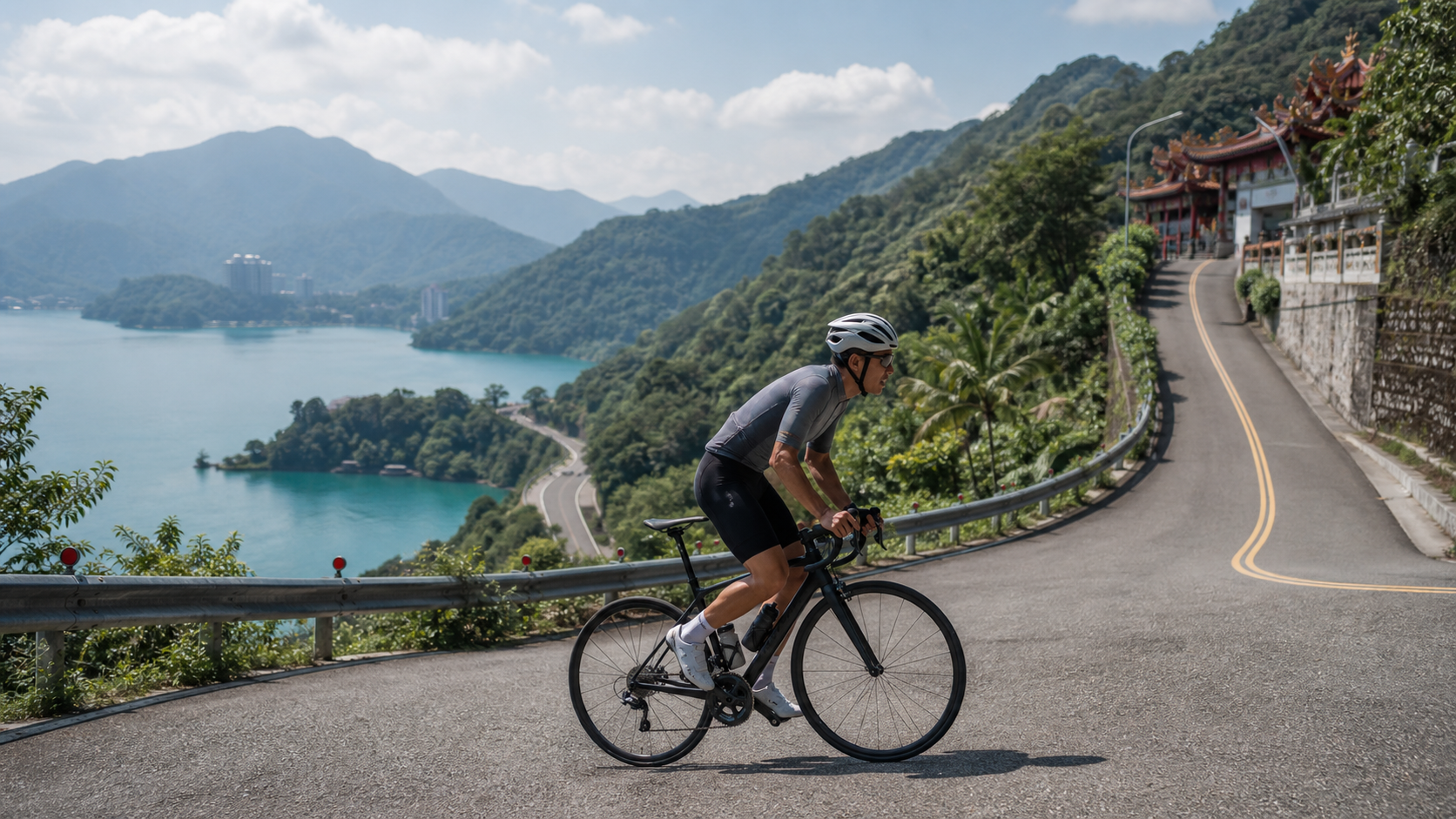
Sun Moon Lake is Taiwan’s largest natural lake, with a surface elevation of about 748 meters. The full loop around the lake spans roughly 30 to 33 kilometers. This article focuses on a core section of the lake-circuit road network of approximately 11.2 kilometers with about 501 meters of cumulative climbing and an average gradient of 2.9%. These figures look gentle, but don’t be fooled by the average gradient—that 2.9% is the result of “blending” flat lakeside roads with several short, steep climbs. In reality, you’ll encounter near-flat lakeshore stretches as well as short ramps around Xuanguang Temple and Ci’en Pagoda that instantly kick up to 8% or more.
The Sun Moon Lake bike path has long been named one of the “Top 10 Most Beautiful Bike Paths in the World” by CNN, and in 2026 it earned the “Tour de France Cycling City International Certification.” Precisely because of its fame, many people assume this is a “casual ride for beginners” tourist route—only to be brought back down to earth on several key climbs. This practical guide breaks down those 11.2 kilometers with data, telling you what gear ratio, pacing, and rhythm to use on each section.
Route Overview: First, Understand the Trap of the 2.9% Average Gradient
Let’s lay the core numbers on the table:
| Item | Figure |
|---|---|
| Section Distance | Approx. 11.2 km |
| Cumulative Climbing | Approx. 501 m |
| Average Gradient | 2.9% |
| Lake Surface Elevation | Approx. 748 m |
| Full Lake Loop | Approx. 30–33 km |
501 meters of climbing divided by 11.2 kilometers gives a theoretical average of 4.5%—so why is the stated figure 2.9%? Because Strava calculates average gradient as “net elevation gain ÷ total distance,” and the loop section contains large amounts of descending and flat road that dilute the number. This means the real climbing is concentrated in just a few stretches. You cannot use a “it’s only 2.9% anyway” mindset to distribute your effort evenly, or you’ll blow up instantly on the steep sections.
The correct mental model is to think of this route as a combination of “several gentle lakeshore stretches + three to four short steep climbs.” The flat sections are where you recover, refuel, and enjoy the scenery; the steep sections are what truly determine whether today’s ride feels comfortable.
Put another way, the difficulty of this route isn’t written in the “average gradient” column—it’s written in the “variability of gradient.” A climb that holds a steady 4% throughout has a simple pacing strategy: set a power target, set a heart rate target, and grind steadily upward. But Sun Moon Lake is a sawtooth route where “0% flats” and “8–10% short steep ramps” alternate. What really takes it out of you is the moment of “transition”: you’ve just gotten your cadence and breathing smooth on the flat, and the next corner demands an immediate downshift, added pressure, and a spike in heart rate. Whether you can make each of those “transitions” smoothly is the dividing line between an enjoyable ride and a miserable one.
Reading the Route with Power/Heart Rate
If you have a power meter or heart rate strap, you can use the following zone reference table to map your effort allocation across the route as a “rhythmic curve” rather than a flat line:
| Section Type | Target Power Zone (% FTP) | Target Heart Rate Zone (% HRmax) | Cadence |
|---|---|---|---|
| Lakeshore Flat (Warm-up/Recovery) | 55–70% | 65–72% | 85–95 rpm |
| Rolling Gentle Cruise | 70–85% | 72–80% | 80–90 rpm |
| Short Steep Climb (6–8%) | 90–105% | 80–87% | 70–80 rpm |
| Steepest Critical Point (>8%) | 110%+ (brief) | 87–92% | 60–70 rpm |
Key concept: Power can spike instantly, but heart rate responds with a delay. When you push power to 110% FTP on a steep climb, your heart rate takes 30–60 seconds to catch up; by the time you crest and ease off, your heart rate is often still elevated and slowly coming down. So the correct approach is to “start easing off before the summit,” letting your heart rate settle just as you enter the next flat section—rather than grinding through the top and only starting to gasp on the flat.
Section Guide 1: Shuǐshè / Xiàngshān Start (First 3.5 km, Warm-up)
The most common starting points are the Xiàngshān Visitor Center (a fair-faced concrete building near the Shuǐshè Tunnel on Provincial Highway 21) or Shuǐshè Pier. From Shuǐshè to the Xiàngshān Visitor Center is about 3.4 kilometers, with an official recommended riding time of about 30 minutes—that “30 minutes for 3.4 km” official time is a leisurely sightseeing pace for tourists stopping to take photos; competitive riders can complete it in 8 to 10 minutes.
This section is the gentlest lakeshore road on the entire route, with gradients mostly between 1–3%, making it an excellent warm-up zone. Recommended actions:
- Gear ratio: Use the middle chainring with a mid-to-large rear cog (e.g., 50/34 front with 15–19 teeth), spin easily, and keep heart rate at 65–70% of max.
- Pacing rhythm: Maintain a cadence of 85–90 rpm, focusing on “warming the body up” rather than sprinting. In the morning, lake moisture is heavy and the road surface may be slightly damp—leave extra margin when cornering and braking.
- Common mistake: Charging off with the group at the start, burning a third of your leg strength in the first 3 km, then having nothing left when the steep climbs arrive.
Section Guide 2: Shuǐshè Dam to Wénwǔ Temple (Mid-Section, First Wave of Rolling Hills)
Past Shuǐshè Pier heading north, you’ll pass Shuǐshè Dam and the Crescent Bay area—one of the signature lakeshore stretches from CNN’s selection. Then, heading toward Wénwǔ Temple, the first noticeable climb appears. Wénwǔ Temple sits on the high ground above the lakeshore, and in just one or two kilometers you’ll gain several dozen meters of elevation, with gradients stepping into the 6–8% range.
- Gear ratio: Shift down to the large cogs on the rear cassette (23–28 teeth) early. Better to shift early than to fumble frantically when you can no longer turn the pedals.
- Pedaling rhythm: On the steep section, keep cadence above 70 rpm and pull through smoothly with a “pedaling in circles” motion, avoiding mashing hard strokes that strain the knees.
- Heart rate management: This section allows heart rate to rise to 80–85% of max, but once over the top, immediately ease off, breathe deeply, and flush the lactate—because more climbs lie ahead.
- When to stand: The Wénwǔ Temple climb isn’t long, but the gradient changes are pronounced. Ride seated for the bulk of it, and only stand to power over the steepest ten or so meters to cross the critical point, then sit back down immediately—don’t burn through your standing strength from the start.
Advanced Riders’ Section Pacing Strategy
For advanced riders chasing a good Strava time, this wave of rolling hills is where you “make time.” The strategy: push slightly above threshold tempo on the flats (to claw back time), and on the steep climbs “don’t add, just maintain”—because the speed gain from going above threshold on a steep climb is minimal, while the cost is lactate blowout later. In other words, overtake on the flats, hold steady on the climbs is the most efficient time-trial strategy for this route.
Section Guide 3: Xuánguāng Temple / Ci’en Pagoda Steep Climb Cluster (Hardest on the Route)
If you ride counterclockwise (closer to the Ita Thao and Xuánguāng Temple side), there’s a steep climb with a big bend near the Xuánguāng Temple parking lot, followed by a long descent toward Tóushè. This area is the most demanding on the entire route, with short steep ramps that can approach 10% momentarily.
In recent years, the authorities have improved the “must-dismount” forest trail steep sections to make the route closer to “rideable all the way through,” but individual short climbs still pose a threat to beginners.
- Strategy: Alternate between “standing to power” and “sitting to spin.” On the steepest ten or so meters, stand and power for two or three strokes to cross the critical point, then immediately sit back down and resume spinning—avoid standing the whole way and draining your legs.
- Braking: Steep climbs are often followed by sharp descents and corners. On descents, brake in intervals with front and rear brakes, shift your body weight back, and be especially conservative when wet.
- DNF risk point: This is where the most people “dismount and surrender.” Rather than grinding until you blow up, drop to your easiest gear before the climb, slow down early, and “grind” your way up with maximum efficiency.
Descending and Braking Technique: The Hidden Test After Steep Climbs
Many riders focus all their attention on “how to get up,” overlooking that the descents and corners right after the steep climbs are where accidents actually happen most. The descents around Xuánguāng Temple and Ci’en Pagoda share common traits: steep gradients, consecutive corners, and road surfaces that are easily damp after morning mist. Key descending techniques are as follows:
| Scenario | Correct Approach | Common Mistake |
|---|---|---|
| Braking before a corner | Get your speed down on the straight, then “release and glide” into the corner | Braking hard mid-corner, risking loss of traction and a slide |
| Front/rear brake ratio | Front brake primary (about 7), rear brake assist (about 3), applied in intervals | Using only the rear brake or grabbing the front brake hard, causing a lock-up |
| Body position | On descents, shift hips back, lower your center of gravity, relax the elbows | Stiff, leaning forward—bounced off the bike by the first pothole |
| Wet road surface | Be fully conservative, extend braking distance, reduce cornering speed | Riding wet roads with dry-road confidence |
| Long descent heat management | Brake in intervals, avoid continuous dragging | Dragging brakes the whole way, causing rim/disc overheating and brake fade |
A practical mantra: “Brake on the straight, no braking in the corner, accelerate only on the exit.” Do all your braking on the straight before the corner, and through the corner only steer without touching the brake levers—the bike’s traction will be far more stable.
Section Guide 4: Tóushè / Return Flats (Final Stretch Recovery)
Past the main steep climb cluster, the route toward Tóushè and Lóngfèng Temple is mostly gentle descent and flat road—the final recovery stretch. Here’s what to do:
- Bring cadence back up to a 90 rpm cruising rhythm, letting your legs “flush out” accumulated fatigue in the aerobic zone.
- Refuel and rehydrate: under the lakeside sun, fluid loss is rapid. Use this flat section to drink up and finish your nutrition, preparing for the completion of the full loop.
Gear Ratio and Equipment Recommendations
Given the route’s character of “short distance, concentrated steep climbs,” equipment setup priorities are low-speed climbing capability and wet-condition handling:
| Equipment Item | Recommendation |
|---|---|
| Front chainring | Compact 50/34 or Sub-compact 48/32; beginners need not show off with a big ring |
| Rear cassette | At least 28T max cog; 30–32T recommended for average fitness |
| Tires | 28c or wider with decent grip; more reassuring on damp mornings |
| Brakes | Disc brakes are clearly superior to rim brakes in the damp lakeside area |
| Nutrition | At least one large bottle of water; bring energy gels for the full loop |
The misty moisture from the lake’s 748-meter elevation is a signature scenic feature, but that same moisture means morning road surfaces are easily damp and locally foggy. Lowering tire pressure by 5–10 psi for extra grip is a detail many overlook.
Gear Ratio Reference Table: Which Gear for Which Gradient
Mapping “gradient” directly to “which gear combination to use” saves hesitation in the moment. Using the common Compact 50/34 front chainring with an 11–34T cassette as an example, here are recommended “chainring × cog” combinations and the logic behind them:
| Gradient Range | Recommended Front Chainring | Recommended Rear Cog | Target Cadence | Notes |
|---|---|---|---|---|
| 0–2% (Flat) | 50T big ring | 14–17T | 90 rpm | Big-ring cruising, efficient speed output |
| 2–4% (Gentle up) | 50 or 34T | 17–21T | 85 rpm | Shift to small ring early; don’t grind the big ring |
| 4–6% (Noticeable climb) | 34T small ring | 21–25T | 80 rpm | Enter climbing rhythm, stabilize heart rate |
| 6–8% (Short steep) | 34T small ring | 25–30T | 72–78 rpm | Protect knees; lighter is better than heavier |
| 8%+ (Critical) | 34T small ring | 30–34T | 60–70 rpm | “Grind” through with the largest cog |
The core principle is one sentence: “Shift early—don’t wait until you can’t turn the pedals.” Shifting under heavy load (i.e., forcing a shift when you can barely pedal) is not only jerky and prone to dropping the chain, it also accelerates wear on the chainrings and chain. When you see a climb ahead, pre-shift to a lower gear while you can still pedal comfortably.
Common Mechanical Issues and Pre-Ride Checks
The lakeside area has heavy humidity and heavy morning dew, so a pre-ride mechanical check is worth an extra five minutes. Here are the most common trouble spots at Sun Moon Lake:
- Brake pads and disc/rim surfaces: Moisture temporarily reduces braking power. After starting, tap the brakes lightly to confirm feel—don’t discover “slippery, weak brakes” on the first descent.
- Tire pressure and tread: Before departure, check that tire pressure is at the planned value (5–10 psi lower on damp days), and glance at the tread for embedded gravel or cuts.
- Derailleur adjustment: Jerky shifts or skipping gears may be unnoticeable on flats, but on a steep climb they can cause a dropped or even snapped chain. Run through the full gear range before heading out to confirm smooth shifting.
- Chain lubrication: Morning dew washes out dry lube. In humid conditions, use wet lube to avoid a ride full of “squeaking” and reduced drivetrain efficiency.
- Quick release / thru-axle: Check that both wheels are properly secured—the most basic yet most commonly overlooked safety item.
Nutrition, Hydration, and Seasons
The lakeside area doesn’t have the convenience store density of a big city, but the main piers (Shuǐshè, Ita Thao, Xuánguāng) all have commercial areas for refueling. Sun Moon Lake black tea (Ruby Red Tea No. 18, Assam) is a well-known local specialty, and the Ita Thao commercial area has famous snacks. For longer rides, you can plan the piers as staged refueling points.
Seasonally, winter (including February) offers the lake area’s bald cypress scenery and mild weather, making it a popular season for the loop; summer has strong sun and frequent afternoon thunderstorms, so an early start and finishing before noon is recommended.
Nutrition Schedule: Make Eating and Drinking Part of the Plan
Using a full loop of 30–33 km, moderate exercise intensity, and a roughly 2 to 2.5-hour ride as an example, here’s a nutrition rhythm you can follow (the principle is “small amounts, frequent; don’t wait until you’re thirsty to drink or hungry to eat”):
| Time Point | Action | Content Suggestion |
|---|---|---|
| 30 min before departure | Hydrate + light food | 300–500 ml water, moderate carbs |
| Every 15–20 minutes | Hydrate | One to two sips of water, done on flats |
| Every 40–45 minutes | Carb intake | One energy gel / banana / small snack |
| 5 minutes before a steep climb | Pre-fuel | Drink and eat first; no free hands on the climb |
| Pier commercial areas | Fixed-point major refuel | Use Shuǐshè / Ita Thao as supply stops |
A practical rule of thumb: The more you sweat and the higher the temperature, the more frequent your hydration should be. In summer, the lakeside sun is strong and fluid loss is rapid—better to carry an extra bottle than to gamble that “the pier will definitely have some.”
Weather Risk Levels: When to Call It Off
| Risk Level | Weather Conditions | Recommendation |
|---|---|---|
| Green (Rideable) | Sunny to partly cloudy, no rain, gentle winds | Start normally; make the most of the morning |
| Yellow (Caution) | Heavy morning fog, damp road surface, thickening afternoon clouds | Start early, finish before noon, heighten braking awareness |
| Orange (Conservative) | Scattered showers, reduced visibility, stronger gusts | Shorten the ride, slow down on descents, be ready to turn back |
| Red (Do Not Ride) | Thunderstorms, heavy rain, poor visibility | Cancel outright; the lakeside’s thunderstorm and wet-road risk is too high |
Afternoon thunderstorms are a summer norm in the lake area. “Start early, finish before noon” isn’t conservative—it’s the most rational schedule for this route.
Target Times by Rider Level (Reference for the Core 11.2 km Section Only)
| Rider Level | Recommended Gear Strategy | Reference Completion Time |
|---|---|---|
| Tourist/Leisure | Light gears throughout, stop-and-go for photos | 60–90 minutes |
| General Fitness | Cruise on flats, drop gears and grind up climbs | 35–45 minutes |
| Advanced Enthusiast | Push aerobic on flats, stand to power on climbs | 25–32 minutes |
| Competitive | Push tempo/threshold the whole way | Around 20 minutes |
Note: The above are estimates for the core section mileage. If challenging the full 30–33 km loop, scale up both time and nutrition planning accordingly.
Training Recommendations Specific to Sun Moon Lake
If you want to ride Sun Moon Lake both comfortably and impressively, targeted training beforehand is more effective than willpower on the day. The physical demands of this route come down to two things: short-duration climbing power and recovery ability after repeated undulations. Here are several corresponding training methods:
- Short-hill intervals (VO2max): Find a climb of 1–3 minutes, go up at slightly above threshold intensity, recover on the descent, and repeat 5–8 times. Most effective for the “short and steep” climbs like Xuánguāng Temple and Wénwǔ Temple.
- Threshold cruising (FTP): Hold a steady threshold power for 15–20 minutes on a gentle climb or flat road, training your ability to cruise without fading.
- Cadence training: Deliberately use a small gear and train cadence up to 95–100 rpm, getting your body used to “using spin instead of brute force,” reducing knee strain on climbs.
- Long endurance (Z2): Schedule one 2-hour-plus aerobic long ride per week to build the foundation for “riding the full loop without fatigue.”
Even if you just want to “finish comfortably,” a few short-hill sessions in the two to three weeks before the ride can significantly reduce the odds of “blowing up and dismounting” on the steep sections.
Riding Strategies for Different Weather
The same route is almost a different difficulty level in sunny versus rainy conditions. Factoring weather variables into your tactics keeps unexpected conditions from disrupting your rhythm:
- Clear and dry: You can push pacing as planned and be a bit bolder on descents, but pay more attention to hydration and sun protection to avoid dehydration and heat exhaustion.
- Morning mist and damp: Dial overall speed down, especially on descents and corners; lower tire pressure slightly for grip; brake earlier and in intervals.
- After a passing shower: The road may look dry, but shaded areas and the inside of corners often remain slick, and leaf-strewn sections demand extra care; metal manhole covers and painted road markings have very poor grip when wet—avoid them when possible.
- Windy days: Crosswinds are noticeable on open lakeshore stretches. Keep your grip relaxed, lower your center of gravity, and leave room to be pushed by crosswinds when crossing exposed bridges.
Common Myth-Busting
Many people have ridden this route, but the stories that circulate aren’t always correct. Here are the most frequently heard myths that mislead pacing decisions:
Myth 1: “The average gradient is only 2.9%, so any flat-bar road bike can ride it easily.” As broken down earlier, 2.9% is a number diluted by flats. The short steep climbs around Xuánguāng Temple and Wénwǔ Temple actually approach 8–10%. Those who set out with an “average value” mindset are the ones most caught off guard on these sections, even ending up walking their bikes.
Myth 2: “Counterclockwise is always easier than clockwise.” Direction itself has no absolute advantage; the difference lies in “when the steep climbs appear” and “which rhythm you prefer.” Counterclockwise hits the gentler Shuǐshè lakeshore warm-up first, with steep climbs concentrated in the middle-to-late section; clockwise is the opposite, facing undulations from the start. What truly determines difficulty is your feel and nutrition rhythm that day, not simply the direction.
Myth 3: “The gradient shown on the bike computer is the actual road gradient.” GPS device gradient data is affected by barometer drift and sampling frequency. Short steep climbs are often “smoothed” into lower numbers, or conversely show momentarily distorted high values. Rather than staring at the live gradient percentage on the computer, use “leg feel + cadence” to judge whether to downshift. Data is an aid, not the sole authority.
Myth 4: “A tourist route must be crowded, so don’t go on weekends.” The loop bike path’s crowds are indeed concentrated around specific scenic spots, but as long as you avoid the sightseeing peak after 10 a.m., early morning and evening hours remain smooth and enjoyable—sometimes even quieter than certain weekday times.
Myth 5: “You need a 52T or larger big ring to be strong enough; small gears are for beginners.” The key on this route isn’t “whether you can turn a big gear,” but “whether you can maintain cadence rhythm through the short steep climbs.” Grinding 6–8% short climbs with an oversized gear noticeably increases knee strain and makes it more likely you’ll be gasping at the top and forced to slow down significantly to recover. In contrast, riders willing to drop to the small ring early and spin through the steep sections at higher cadence maintain a steadier overall rhythm and recover faster. Gear choice should match the route’s characteristics—not serve as a badge of riding level.
Advanced Riders’ PR Challenge Strategy
If you’ve ridden this route a few times and want to chase a personal record, there are several key segments worth calculating precisely. The first is Shuǐshè to Wénwǔ Temple: the terrain is gentle with a bit of undulation, ideal for holding a steady tempo intensity the whole way. No need for deliberate sprints—the key is not to have any “ease off and catch your breath” gaps. This section is the easiest place to unconsciously relax your pace because the scenery is so beautiful, and PRs are often lost in those moments.
The second key is entry and exit speed through the Xuánguāng Temple steep climb cluster. Many riders spend all their effort on the climb itself, overlooking the efficiency of the two transition points: “corner exit into the climb” and “summit into the descent.” An advanced approach is to use the last straight before the climb to build speed slightly above normal on the big ring, carrying that momentum into the early part of the climb to save the effort of re-accelerating from a near stop. At the summit, time your return to the saddle and resumption of spinning early, letting the descent’s initial speed extend the momentum generated from the climb.
The third is overall mental pacing. Because the scenery is dense on this route, it’s easy to unconsciously “coast while taking photos.” If your goal is a record, plan in advance “which points you’ll stop for photos,” and maintain a focused pedaling mindset on the rest, avoiding too many interruptions to your rhythm. In practice, simply reducing “stops” from five or six down to two or three key points can save a significant number of minutes on overall time.
Conclusion
The most captivating thing about these 11.2 kilometers at Sun Moon Lake is precisely its dual nature: “seemingly gentle, yet hiding steep climbs.” Use the right gear ratios, understand the distribution behind that 2.9% average gradient, and save your strength for the short steep climbs around Xuánguāng Temple and Wénwǔ Temple—and you can turn this CNN-recognized world-class route into a perfect record with great numbers and unblown legs. It’s one of Taiwan’s rare lakeside classics where “beginners can finish it, and advanced riders can play with pacing.” It deserves a place on every cyclist’s riding list this year.
Related Reading
- Sun Moon Lake Circuit Bike Path: Riding the 29 km International-Class Lakeside Route
- Sun Moon Lake Lakeside Bike Path Complete Guide: Taiwan’s Most Beautiful Lakeside Ride
- Sun Moon Lake Circuit Riding Notes: Four Temples, Black Tea, and Morning Mist Around One Lake
- Nantou Sun Moon Lake Loop: A Riding Guide for the 8 km Lakeshore Route
大武山後門26%歡樂陡坡!JJSC南台灣單車行Day2 / 被颱風追著跑 / 公路車 / CT Yeh
2 年前
半日 小台灣 極限單車路線挑戰實錄
7 年前
大武山20%魔王陡坡【JJSC南台灣遊騎Day2】!屁股真的要裂開了...凡士林抹滿也沒用?神秘金教堂還有超便宜夜市
3 個月前
台北闊瀨陡坡 騎旅 / 日本單車雜誌編輯車友臨時加入!/ 髮香才是最強的 / feat. 北迴歸線小隊 / 公路車 CT Yeh
6 個月前
單車 梅山36灣 坡度介紹 路段介紹 空拍 (相關遊記影片,請參考說明或我的頻道喔,歡迎訂閱)
6 年前
新竹羅平 x 天湖部落 大禹嶺級變態陡坡! 4K超高畫質 空拍 | 公路車
5 年前
日本自助單車旅,茨城絕景路線/ 新手也可以體驗 / 4K空拍絕景 / 機票省錢大法 / 單車友善旅館 / 國家級霞之浦180K自行車道 / feat. 緯緯 / CT Yeh
1 年前
虎豹潭!日本老師來台一日約騎 台灣車友熱情招待私房路線 / CT Yeh
21 天前