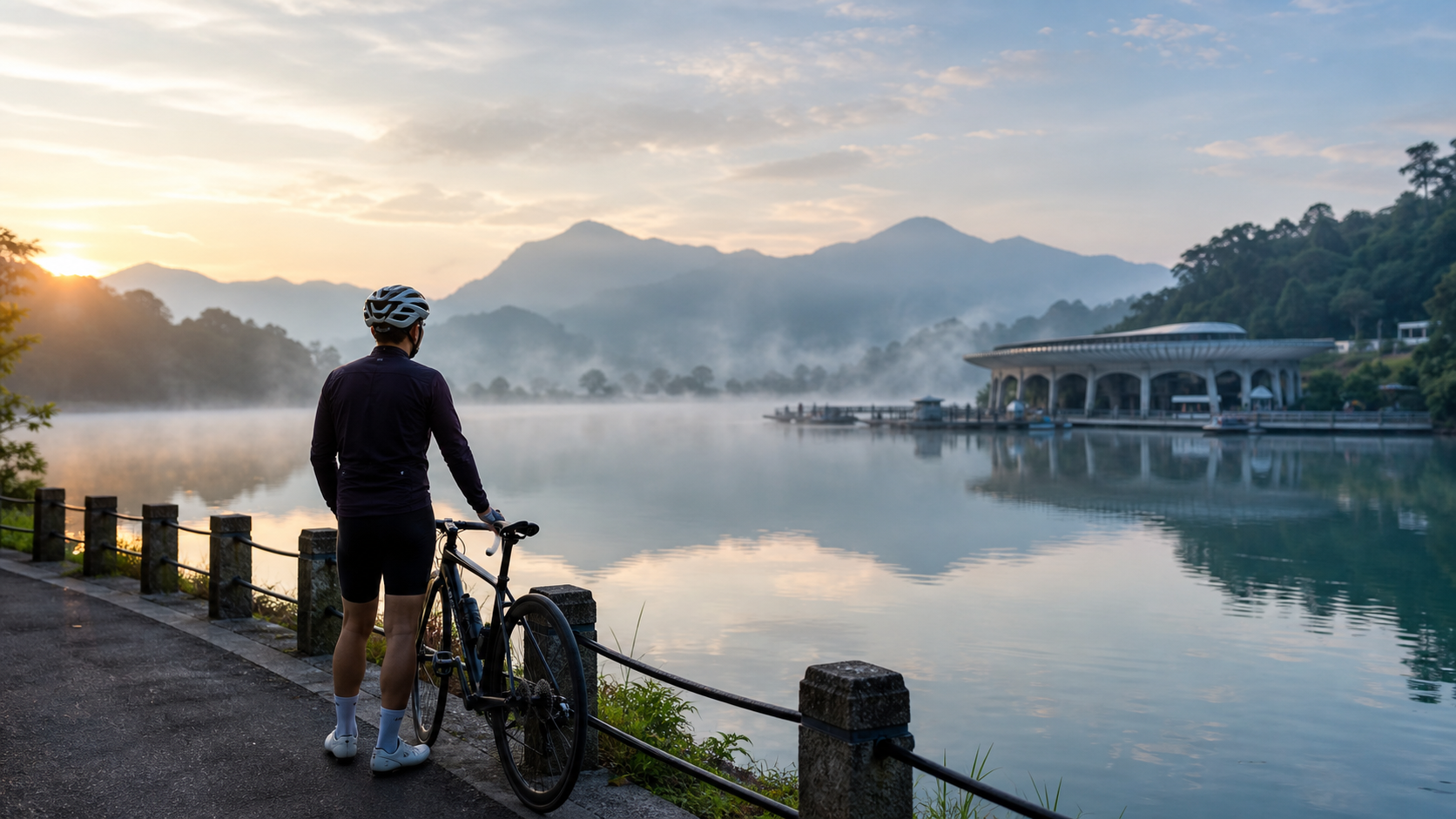
At 5:30 in the morning, before the sky is fully light, the curved exposed-concrete corridor at Xiangshan Visitor Center looks like a docked ship in the thin mist. I wheel my bike out; a layer of moisture drifts over the lake surface, and the distant mountains are still wrapped in slate gray. Sun Moon Lake, at 748 meters above sea level, greets every early-rising rider with its own particular temperature—not the salt-damp of the coast, not the biting chill of the high mountains, but a humid air nourished by the lake itself, carrying the scent of tea.
A full loop around the lake is about 30 to 33 kilometers; the core section I rode for this article is roughly 11.2 kilometers with about 501 meters of cumulative climbing. But this article isn’t about pacing, and it isn’t about gear ratios. What I want to talk about is why this lake has been selected year after year by CNN as one of the “World’s 10 Most Beautiful Bike Paths,” and why it earned the “Tour de France Cities International Certification” in 2026—when you actually put your wheels on this road, you’ll understand that those awards aren’t marketing talk, but an answer that every turn explains for you.
One Lake, Two Personalities
Sun Moon Lake’s name comes from its shape: with Lalu Island (Guanghua Island) as the dividing point, the northern half of the lake is shaped like a sun disc, and the southern half like a crescent moon—the characters “sun” and “moon” are thus etched into Taiwan’s geographic memory. It is Taiwan’s largest natural lake, and it also carries the traces of Japanese-era hydraulic engineering—the full-water-level surface we see today is the result of both a natural lake and artificial reservoir storage.
Riding on the lakeside road, you can clearly feel the lake’s “two personalities.” On the side hugging Shuishe and Xiangshan, the road is gentle and open, the lake spreading out continuously on your right—this is its warm, bright face. On the Ita Thao and Xuanguang Temple side, the road starts to roll, the tree canopy presses down, and the water appears and disappears between the trees—this is its deep, introverted face. The same lake, ridden clockwise or counterclockwise, becomes two completely different journeys.
I still remember the morning I first completed the full loop. In the first half, I kept chasing the lake light, unable to take my eyes off the water; in the second half, entering the shade of the trees, things suddenly grew quiet, and all I could hear was my own breathing and the faint rustle of tires over fallen leaves. In that moment I understood that Sun Moon Lake isn’t a “road with beautiful scenery”—it’s a road that “breathes as you move forward.” It gives you openness first, then depth, and finally, just when you think it’s about to end, it gives the lake light back to you. That rhythm is like a well-composed piece of music.
Lalu Island: The Drifting Story of an Island
Along the loop, at some angle you’ll always catch a glimpse of the small island at the lake’s center—Lalu Island. It is the sacred resting place of ancestral spirits in Thao legend, and the spiritual heart of this lake. The elders of the Thao people believe that the highest ancestral spirit dwells on the island, making it a land not to be taken lightly.
I like to pause briefly on the lakeshore where Lalu Island comes into view. It floats quietly at the center of the water—unassuming, unassertive—yet it anchors the entire lake. Looking at it, you realize you are pedaling across waters that have an “owner.” The beauty here is not ownerless scenery; it is a home guarded by a people for generations. That awareness makes you ride slower, lighter, and with more reverence.
Landmarks of Faith Along the Way: A Pilgrimage of Four Temples Around the Lake
The most captivating cultural undertone of the Sun Moon Lake loop is the “Four Great Temples” scattered along the shore—Wenwu Temple, Xuanzang Temple, Xuanguang Temple, and Longfeng Temple. They aren’t just religious sites; they serve as milestones that set the rhythm of this lakeside route.
Wenwu Temple sits high on the lakeshore, the stop with the most expansive views on the entire route. To reach it, you first have to climb a short, steep slope, but when you lean your bike against the temple front and turn to look back over the whole lake, that “view earned with your own legs” is something bus tourists will never experience. The “Sun Moon Lake” stone tablet beside the pier at Xuanguang Temple is one of the most photographed spots in all of Taiwan, and the gateway where boat passengers come ashore. Xuanzang Temple is much quieter, housing the relics of Master Xuanzang; farther up stands Ci’en Pagoda, the highest vantage point overlooking the entire lake.
I especially like stopping at Xuanguang Temple to buy a tea egg. The lake breeze blows over, and the aroma of egg mingles with the scent of black tea. In that moment, you’re not thinking about how many kilometers remain—you just want to stand there a little longer.
Longfeng Temple sits on the other side of the lakeshore between Toushe and Shuishe, with thriving incense and a solemn layout. Interestingly, the four temples each guard a different direction around the lake, like four silent sentinels gently encircling the entire body of water. When you’ve ridden past all four temples, you’ve actually completed a quiet circumambulation pilgrimage—not to ask for anything, but to give yourself, at every turn, a reason to stop, catch your breath, and look at the lake.
I often think this might be Sun Moon Lake’s most brilliant design: it disguises “rest stops” as “landmarks of faith.” You think you’re stopping to pay respects at a temple, but in truth, the lake is using its temples to arrange just the right resting rhythm for every rider who tends to push too hard.
Ci’en Pagoda: A Height That Gathers the Whole Lake Into View
Continuing up from Xuanzang Temple, you’ll reach Ci’en Pagoda—a tall tower standing on the mountaintop. Getting there requires climbing a slope and then walking a trail, but when you stand at the top, the entire Sun Moon Lake spreads out beneath you without reservation, and the shapes of the sun disc and crescent moon are especially clear from this height.
The day I first climbed Ci’en Pagoda, mountain mist happened to be half-shrouding the lake, and sunlight slanted through gaps in the clouds, cutting the water into patches of alternating light and shadow like fields of light. In that moment I suddenly understood why the ancients built pagodas and temples at the highest points—because some scenery is only worthy of those who pay the price of “climbing up.” Bus tourists can’t reach this height, and they can’t read this stillness. A bicycle and your own two feet are the only keys that bring you here, and that is the most enchanting reward of cycling.
The Thao People’s Lake, the Liveliness of Ita Thao
If the temples are Sun Moon Lake’s faith, then Ita Thao is its heartbeat. Ita Thao is the Thao settlement and pier-side commercial area—“Ita Thao” means “we are people” in the Thao language. This is the most vibrant, lived-in stretch of the entire loop—white smoke from grilled mushrooms and mushroom-cabbage buns rises from the stalls, and Sun Moon Lake black tea shop signs stand side by side.
Sun Moon Lake black tea is this land’s proudest specialty. Ruby Black (TTES No. 18) carries a distinctive cinnamon and mint finish, while Assam is rich and full-bodied—both thanks to the elevation and humid climate here. When you’re tired from riding, find a small shop in Ita Thao, sit down, order a pot of Ruby Black, and watch the cable cars slowly climb toward Formosan Aboriginal Culture Village from the pier—in that moment, you’ll feel that the destination of this ride isn’t actually the finish line, but this cup of tea.
(The cable car and Formosan Aboriginal Culture Village are right next to each other on the Ita Thao side, making a popular combined side trip; however, for riding details, I recommend checking the day’s operating information before you set out.)
I particularly remember one time, queuing at a small stall in Ita Thao for grilled mushrooms, when the couple ahead of me were an older pair who had ridden over from central Taiwan. The old gentleman chatted with the stall owner in Taiwanese, saying they came to circle the lake every spring, “My legs get weaker every year, but I’m more reluctant to leave this road every year.” The owner smiled and gave them an extra skewer. That image has stayed with me—the liveliness of Ita Thao isn’t just the aroma of food; it’s that warmth of people passing something to one another, almost without thinking. It turns a ride into a memory with a human touch.
The Thao are one of the smaller indigenous peoples of Taiwan, having lived beside this lake for generations. Their pestle music, their songs, their dependence on these waters—all of it is hidden in the white smoke that rises over Ita Thao every day. When you rest here, you’re not just eating a snack; you’re tasting a people’s way of living by the lakeshore. Slow down, listen a little longer, and you’ll discover that the deepest scenery of this lake is, in fact, its people.
Sun Moon Lake Black Tea: The Moist Origins of a Leaf
If there’s one flavor to remember Sun Moon Lake by, it has to be black tea. The Ruby Black (TTES No. 18) grown here carries a distinctive cinnamon and mint finish—a point of pride from Taiwan’s own breeding program—while the Assam is rich and full-bodied, chosen as early as the Japanese era for this region’s elevation, humidity, and sunlight, making it a golden production area for black tea.
I like to treat “drinking a pot of black tea” as the ceremonial finish of a lake loop. After completing the circuit, legs still faintly warm, I find a small shop by the shore, sit down, and watch the steam rise slowly from the teacup, merging with the lake mist outside the window. In that moment you understand that the moist richness of this leaf is, in truth, the taste of this lake—the same moisture, the same mountain fog, first nurtured the tea, then nurtured the scenery, and finally nurtured every traveler willing to slow down.
Memories of Water Level: The Nine Frogs Stack and the Lake’s Breathing
Beside the Shuiwutou Trail stands the famous “Nine Frogs Stack”—nine bronze frogs piled one atop another. It isn’t just an art installation; it’s Sun Moon Lake’s “water level gauge”: during the high-water season, the lowest frogs are submerged, and during the dry season, all nine frogs are exposed. When you see how many frogs are above water, you can read the depth of the lake’s “breath” at that moment.
This is one of the details I find most moving about Sun Moon Lake. It reminds you that this seemingly constant body of water actually rises and falls with the seasons and rainfall, like a living being. Take a second look as you ride past, and you’ll gain a little more respect for the resource that is water.
A Lake for All Seasons, Scenery for All Seasons
Sun Moon Lake is one of the few routes “worth riding in every season.” In winter (including around the Lunar New Year), the bald cypress along the shore turns a warm rust red, and the climate is mild and dry—the golden season for circling the lake. In spring, mountain cherries and fresh greenery interweave. In summer, the lake surface at dawn is often spread with a layer of milky morning mist, and at sunrise the whole lake seems to light up, though afternoon thunderstorms are common, so you need to start early. Autumn brings crisp, clear air and the best visibility of the year.
My strongest recommendation is a summer morning. Before the heat arrives and before the tourists wake, ride alone around the lake as the mist rises slowly from the water—the entire lakeside road feels like it belongs only to you. That quiet is the reward this road gives to early risers.
Winter’s bald cypress is another kind of scene. When those rows of dawn redwoods turn a warm rust red and reflect in the perfectly still lake, the whole shore looks as if someone tipped over a box of warm-colored paint. The air that season is dry and clear, visibility is crisp, and the mountain ridgelines stack layer upon layer to the horizon—the best time of year to press the shutter, and also the best time to drop your speed to its slowest. I once stopped in the bald cypress grove on a winter morning, watching sunlight creep inch by inch across the red leaves, until the riders behind me thought something was wrong—the truth was, I simply couldn’t bear to leave.
Spring belongs to the mountain cherries. Pink blossoms bloom sporadically along the lakeside road, set against the fresh green just emerging, and the whole route looks like it’s put on light makeup. That’s the season of “starting over”—legs that have been dormant all winter are just right for finding their pedaling rhythm again in weather like this. The seasons rotate along this road, and every time you come, you meet a slightly different Sun Moon Lake.
What This Road Means to a Rider
What makes Sun Moon Lake a world-class bike path in CNN’s eyes has never been its gradient or difficulty—the average grade of its core section is only 2.9%. What it relies on is “the distance between people and the lake.” This road hugs the water’s edge almost the entire way, letting you take in a lake’s seasons, faith, peoples, and tea fragrance inch by inch, in the slowest and most intimate way possible.
For many Taiwanese cyclists, Sun Moon Lake is “where cycling began.” Someone completed their first-ever ride over 30 kilometers here; someone else brought their children to learn to converse with the lake on the gentle bike path between Shuishe and Xiangshan. Its threshold is low enough for beginners to dare; its scenery is good enough for veterans to return again and again; its culture is deep enough that every trip offers something new.
I myself learned to “make peace with climbs” here. The first time I rode Sun Moon Lake, I nearly had to dismount on the short slope before Wenwu Temple, gasping as if I might cough out a lung, my mind filled with nothing but “why isn’t it here yet.” Years later, on that same slope, I learned to take a deep breath before the climb, shift to an easier gear, and move my eyes from the bike computer to the lake—the slope is still the same slope, but my state of mind has completely changed. This road hasn’t changed; it’s the road that changed me. I think that’s why so many people are willing to return here again and again: Sun Moon Lake is like a mirror, and every lap reflects back a self that has improved just a little more.
A Lake, a Metaphor for Life
The 2.9% average gradient of Sun Moon Lake is actually a fine metaphor for life. If you only look at the “average,” you’d think everything is smooth; only when you actually ride it do you discover that beneath the smoothness lie a few steep climbs you simply have to endure. Life is the same—averaged out, the days seem manageable, but everyone knows in their heart that there are always a few slopes you have to grit your teeth through, drop to your lowest gear, and grind up inch by inch. What Sun Moon Lake taught me isn’t how to avoid steep climbs, but how to shift gears before the climb arrives, how to steady my breathing during it, and how to relax and recover after cresting the top. The lake doesn’t explain these truths in words—it uses an entire road and lets you ride them out yourself.
Side Trip Suggestions: Turning Sun Moon Lake Into a Mini Journey
- Xiangshan Visitor Center: The exposed-concrete architecture is a sight in itself, ideal as a starting and finishing point.
- Ita Thao Commercial Area: Thao cuisine and Sun Moon Lake black tea—the top choice for resupply and rest in the middle of the loop.
- Wenwu Temple & Ci’en Pagoda: For panoramic lake views, park your bike and walk up—worth it.
- Formosan Aboriginal Culture Village + Cable Car: If you have a full day, add the cable car and the culture village to your itinerary (check operating hours first).
- Black Tea Culture: Before you leave, bring home a pack of Ruby Black or Assam so the aroma of this ride lingers.
One Day’s Ride, a Whole Lake’s Story
If you’re willing to treat Sun Moon Lake as a slow journey rather than just a ride, here’s how I’d arrange a full day. Set out from Xiangshan before dawn; while the morning mist still lingers and the tourists are still asleep, take in the quietest half of the lake first. By the time the sun rises, you’ll have reached the shore where Lalu Island comes into view, and you can watch the first light ignite the water. Then rest at the heights of Wenwu Temple, looking back over the entire lake gilded by the morning sun, and continue on to Ita Thao, arriving at the liveliest hour to dive into the market and make a hot snack and a pot of Ruby Black your brunch.
In the afternoon, slow your pace completely, detour to the Shuiwutou Trail to see how many of the nine frogs are exposed today, and read the lake’s current water level and mood. If you still have energy, add the cable car and the culture village to your plan, and see from above the same waters you just measured with your legs. Toward evening, the light on the lake shifts to a gentle golden orange—the best time of day to sit by the shore, do nothing, and simply watch. By the end of the day, what you’ve collected isn’t just mileage, but the complete expression of a lake from dawn to dusk.
Staying Overnight by the Lake: Letting the Story Stay One More Night
If time allows, I strongly recommend spending a night by the lakeshore. Sun Moon Lake at night is another face entirely—the day’s clamor recedes, the lake surface goes still as a dark mirror, the distant mountain silhouettes are reduced to outlines, and occasionally you hear the low hum of a night boat. At this hour, the lake tucks away all the liveliness of the day, keeping it only for those willing to stay.
The next morning, you’ll wake earlier than any tourist, and push open the window to a lake still sleeping. That illusion of “the whole lake belongs only to me” is a reward that day-trippers can never trade for. Many veteran riders keep returning to Sun Moon Lake not just for the road, but for this intimacy of “spending a night with the lake.” When you wake by the shore, wheel your bike out, and press down on the pedal first, you’ll feel less like you’re visiting this lake and more like you’ve temporarily become part of its life.
The Birth of a Bike Path: Giving the Lake Back to Feet and Wheels
Riding on the dedicated lakeside bike path now feels like a given, but this “separated pedestrian and cycling” network was hard-won. The area around Sun Moon Lake was originally served by Provincial Highway 21 and Provincial Highway 63A, with heavy traffic and tour buses flowing through, forcing cyclists and pedestrians to share the road with cars and motorcycles. Only through the phased construction of independent, dedicated bike paths were riders able to escape the traffic and ride along the water’s edge and through the shade without constantly watching for vehicles behind them.
This planning philosophy of “giving the most beautiful lakeside views to the slowest mode of transport” is actually the common logic behind many world-class scenic bike paths—the best scenery, after all, shouldn’t be reserved for the fastest vehicles. It’s precisely because of such a dedicated path that Sun Moon Lake can maintain its function as a scenic highway while also giving cyclists a nearly undisturbed, water-hugging riding experience. Every time I ride on the dedicated path and watch the traffic roar past on the road beside me, I’m grateful I chose this slower way.
People I’ve Met by the Lake
Over the years of riding Sun Moon Lake, what I remember most isn’t the scenery—it’s the people I’ve met along the way. Once, on the long corridor at Xiangshan Visitor Center, I met an older gentleman riding an old mountain bike with a canvas bag hanging from the rear rack. He said he’d ridden over from Nantou City; in his youth he’d worked in the nearby forest districts, and after retirement he comes back to circle the lake several times a month. “Before, I crossed mountains and ridges to make a living; now I come back to ride in memory of those days.” He said it lightly, but I could feel the weight of it.
Another time, on the steps of Wenwu Temple, I met a group of middle school students struggling to push rented tandem bikes up the final steep slope. The teacher leading them smiled and said this was a fixed part of their graduation trip—“to let them know that some scenery can’t be bought with money; you have to earn it with a little sweat.” Watching those kids laugh and shove their bikes to the top of the slope, I suddenly remembered my own bedraggled elation the first time I completed the loop—that sense of achievement from reaching a high place by your own strength for the first time is probably the most similar gift this road leaves for every generation.
These fleeting encounters have made Sun Moon Lake, for me, far more than a scenic route—it’s a lake filled with the stories of strangers. Every lap, I feel like I’m stamping those stories once more.
I also once met a young woman traveling alone at Xiangshan Visitor Center. She said she’d flown in from elsewhere specifically to complete a “thirtieth birthday gift” to herself—circling Sun Moon Lake by bicycle. She wasn’t a practiced rider; her face was flushed red as she walked her bike up the short slope at Wenwu Temple, but when she reached the finish, she smiled brighter than anyone. She told me that riding this loop had helped her sort out a lot of things. “I realized I can finish something completely on my own.” I’ve remembered those words ever since. Sun Moon Lake is probably that kind of lake—it lets everyone take away something different after riding it. Some take away scenery, some take away a memory, and some take away a little bit of rediscovering themselves.
Conclusion
These 11.2 kilometers of Sun Moon Lake are short enough to ride in a single morning, yet long enough to hold all the stories of a lake. When you park your bike before the stone tablet at Xuanguang Temple pier and the lake breeze carries the scent of black tea to your nose, you’ll suddenly understand—the world’s most beautiful bike path has never been measured by distance, but by how close it brings you to a body of water, a group of people, and a stretch of history. This is Sun Moon Lake: a road written in lake light, faith, peoples, and tea fragrance, waiting for everyone willing to slow down to read it, inch by inch.
Related Reading
- The Complete Guide to the Sun Moon Lake Cycling Path: Taiwan’s Most Beautiful Lakeside Ride
- Sun Moon Lake Cycling Path: Named by CNN as One of the World’s Most Beautiful Bike Paths
- Nantou Sun Moon Lake Loop: A Riding Guide to the 8km Lakeshore Route
- Sun Moon Lake Cycling Path: A 29km International-Class Lakeside Route, Ridden for Real
半日 小台灣 極限單車路線挑戰實錄
7 年前
鯉魚潭水庫 歡笑單車騎旅,季節限定大景 | 大湖/鯉魚潭水庫/龍騰斷橋/薑麻園 | 公路車 | CT Yeh
3 年前
虎豹潭!日本老師來台一日約騎 台灣車友熱情招待私房路線 / CT Yeh
21 天前
大武山後門26%歡樂陡坡!JJSC南台灣單車行Day2 / 被颱風追著跑 / 公路車 / CT Yeh
2 年前
觀霧 變好騎了! | 北高車友爆笑大會師 | 公路車 | 單車旅遊 Taiwan Cycling Route GuanWu
6 年前
密境!雙灣自行車道 / 環法日月潭 x YAKIMA 百人大約騎 / 公路車 / CT Yeh
11 個月前
嘉義大埔、阿婆灣挑戰賽,美到以為在日本!ft. 環騎5 Cool 西拉雅188 / 公路車 / CT Yeh
7 個月前
西拉雅五庫單車挑戰 / 曾文水庫 & 南168 二寮 / 500元報名費居然這麼超值/ 公路車 / CT Yeh
10 個月前