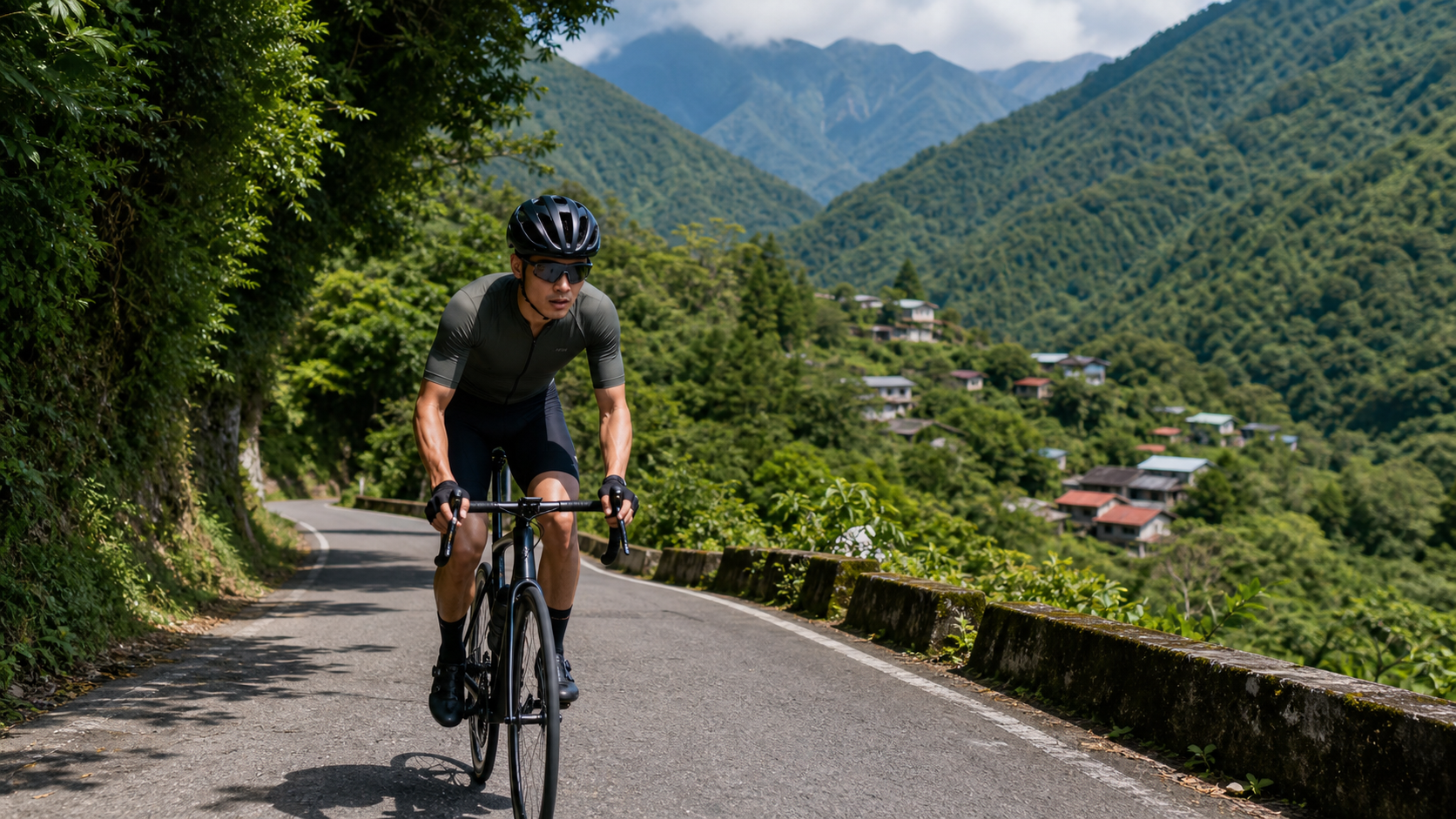
Tannan (Tannan Village) is a little-known tribal climbing route hidden in the mountains of Nantou. It spans approximately 5.2 km with about 466 meters of elevation gain and an average gradient of 6.3%, and is classified as Category 3 on Strava. Administratively, Tannan Village belongs to Xinyi Township in Nantou County (not Shuili Township, as many assume). It sits on the mid-slope of a tributary of the middle Zhuoshui River, at an elevation of about 800 meters, and is named for its location “south” of Sun Moon Lake.
Let’s first clear up a common misconception: because the route is often approached from Shuili or Sun Moon Lake, many assume Tannan belongs to Shuili Township. However, since Tannan Village was split from Dili Village in 1963, it has been part of Xinyi Township. This geographic positioning also defines the route’s character—a quiet, low-traffic, short steep climb steeped in Bunun culture. This article breaks down how to ride these 5.2 km from a data-driven perspective.
Route Overview: A Short, Concentrated Climb
| Item | Data |
|---|---|
| Distance | Approx. 5.2 km |
| Total Elevation Gain | Approx. 466 m |
| Average Gradient | 6.3% |
| Strava Category | Category 3 |
| Village Elevation | Approx. 800 m |
Climbing 466 meters over 5.2 km at an average of 6.3%—this is a route that is “short but not easy.” Its strength is the short distance, which gives you more room for error in pacing than a long climb; its weakness is the concentrated gradient, with little flat ground to recover. Once your rhythm falls apart, even 5 km can leave you struggling badly.
Compared to the same tier of climbs like Wujie (7.8%, 9.5 km), Tannan is slightly gentler and shorter, making it relatively suitable as an “advanced entry-level” climb. But don’t take 6.3% lightly—it’s still a serious climb that demands proper gear shifting and cadence management.
Understanding This Climb Through “Elevation Density”
Engineers don’t just look at average gradient when evaluating a route; they also consider “elevation density”—how much vertical gain each kilometer consumes. Tannan’s 466 meters of gain spread over 5.2 km works out to roughly 90 meters of vertical gain per kilometer. On the spectrum of Taiwan climbs, this falls into the “medium-high density” range: steeper than most riverside paths and industrial roads, but not at the level of Beiyi or Tataka, which demand sustained output over long periods. Its character is “high density, low total volume”—in other words, the intensity is significant, but the time you suffer is limited. That’s exactly why it works as a threshold training ground: short enough that you dare to go all out, steep enough that going all out actually pays off.
If you divide the 5.2 km into ten equal segments of 520 meters each, you’ll find the elevation gain isn’t evenly distributed but concentrated in the mid-slope switchback sections. Understanding this lets you plan your energy in advance: don’t play all your cards in the first kilometer—save the fuel for those truly demanding consecutive steep sections in the middle.
Segment Strategy 1: The Approach and Start
Coming in from the Shuili/Sun Moon Lake south side onto the village access road, the opening stretch is where you confirm your gearing and warm up your legs. Since the total distance is only 5.2 km, the room for warming up is less than on longer routes, so it’s best to spin a few hundred meters on flat ground before hitting the climb.
- Gearing: Shift to the mid-to-large rear cog as soon as you enter the climb, maintaining a comfortable spin above 80 rpm.
- Heart Rate: Keep it at 72–75% of max HR at the start. Don’t charge ahead just because “it’s only 5 km”—blowing up on a short climb still ends in a DNF.
- Key Point: Pacing on a short route is “steady all the way,” not “push early, survive late.”
The core task of the opening stretch is really just one thing: smoothly transition your body’s energy systems from “rest” to “aerobic cruise.” Moving from a resting state to stable aerobic energy production typically requires 5 to 10 minutes of progressive load. If you spike your heart rate above 85% the moment you enter the climb, the phosphagen and glycolytic systems are forced into action too early, lactic acid accumulates prematurely, and you’re effectively borrowing energy from the later stages. This “early overdraft” is the worst mistake on a short route, because you don’t have enough flat ground to recover. The ideal start curve lets your heart rate climb linearly into the cruising zone like a ramp, not jump straight to the redline like a staircase.
Segment Strategy 2: The Consecutive Mid-Slope Steep Sections (Core Segment)
Entering the core segment that switchbacks along the mid-slope of the Zhuoshui River tributary, the 6.3% average manifests as a series of continuous steep pitches. There aren’t many breathers here, and this is where the ride is won or lost.
- Gearing: Stay on the large rear cog (28–30 teeth), keeping cadence at 65–70 rpm, using a “smooth grind” instead of “hard stomping.”
- Pedaling Rhythm: The temptation on a short climb is “I’m almost there, let’s surge”—but that’s exactly what causes the blow-up. Keep your heart rate stable in the climbing cruise zone (78–82% of max HR) to maintain aerobic metabolism.
- Common Mistake: Because the route is short, many riders refuse to shift to an easier gear and grind a heavy one, putting excessive strain on the knees and dropping cadence below 50 rpm, which makes things harder. Shift down when you need to.
Power and Heart Rate Zone Reference Table (Core Segment Targets)
If you have a power meter, managing the core segment by zones is far more stable than going by feel. The following is based on FTP (Functional Threshold Power) percentage, with recommended operations for this climb:
| Zone | %FTP | %Max HR | Cadence | When to Use |
|---|---|---|---|---|
| Zone 2 Aerobic | 60–75% | 70–78% | 80–85 rpm | Start warm-up, recovery on gentler sections |
| Zone 3 Tempo | 76–90% | 78–83% | 70–78 rpm | Main cruising for core segment |
| Zone 4 Threshold | 91–105% | 83–88% | 65–72 rpm | Short pushes on steep pitches |
| Zone 5 and Above | >105% | >88% | As needed | Reserve for the final sprint only; don’t use early |
In practice, the sweet spot on this climb is spending most of your time in Zone 3 tempo, briefly touching Zone 4 on the steep pitches, and avoiding prolonged time in Zone 5 altogether. The myth of short routes is “since it’s short, push threshold the whole way,” but once you enter Zone 5 early, glycogen depletes rapidly and lactate clearance can’t keep up—you’ll often hit the wall at kilometers 3 or 4.
The Mechanical Relationship Between Cadence and Knee Load
Why do we keep emphasizing “shift down when you need to”? Because the force on your knee joint during pedaling is proportional to the torque you must output with each stroke. At the same power output, the lower the cadence, the greater the pedal force required per stroke, and the greater the shear stress on the front of the knee (patellar tendon). Bringing cadence from 55 rpm back up to 70 rpm can theoretically significantly reduce peak pedal force per stroke, and over the long term, greatly lowers the risk of knee pain and overuse injuries. Low gear with high cadence isn’t “the choice of the weak”—it’s an engineering decision to protect your joints and extend your riding career.
Segment Strategy 3: Arriving at the Village and Finishing
The end of the climb is Tannan Village. The gradient may ease slightly in the final stretch—use this time to steady your breathing and bring your heart rate down as you approach the village. Remember to slow down, because this is a living community, not a timed finish line.
Descending and Braking Technique (Return Trip)
Getting to the top is only half the mission; getting safely back down is what completes the ride. The Tannan access road may not have perfectly smooth pavement, has many mountain curves, and may have falling rocks and slippery sections. On the descent, stick to these principles:
- Front/Rear Brake Distribution: On long descents, use “pulsing” instead of “holding” to avoid overheating and fading one side of the pads and rotors. The front brake provides the primary stopping power while the rear stabilizes the bike—roughly a 70/30 front-to-rear ratio, but be more conservative when wet.
- Brake Before the Corner, Accelerate Out: All braking should be completed before entering the corner. Stay steady through the turn without sudden braking to avoid losing front-wheel traction.
- Look Ahead: Keep your eyes on the corner exit rather than the front wheel, and your body will naturally guide the bike along the proper line.
- Disc Brake Cooling: On continuous descents, periodically find a safe spot to let the braking system cool down, preventing brake fluid from vapor locking due to high temperatures and losing braking power.
Altitude Physiological Effects (A Relative Perspective)
Tan’nan Village sits at an elevation of about 800 meters. While not considered high altitude, there is a slight difference compared to sea level. For every roughly 1,000 meters of elevation gain, the partial pressure of oxygen in the air drops by about 10–12%, which discounts aerobic output. The loss at 800 meters is limited, and most riders won’t noticeably feel hypoxia. However, if you normally train at sea level and are sensitive to numbers, you might notice slightly lower power at the same heart rate and slightly slower recovery. The real concern is when you link Tan’nan with higher-altitude routes (such as the higher reaches of Wujie or the Hehuan Mountain range)—that’s when the “altitude surcharge” goes from invisible to critical.
Gear Ratio and Equipment Recommendations
| Equipment Item | Recommendation |
|---|---|
| Crankset | Compact 50/34 or Sub-compact 48/32 |
| Rear Cassette | Largest cog 28–30T; 30T or above recommended for average riders |
| Tires | 28c or wider; village access roads may not have smooth pavement |
| Brakes | Disc brakes preferred for better control on the descent |
| Supplies | At least one large water bottle; resupply options in the mountains are limited |
Because the route is short, many people overlook supplies—but mountain sunshine and climbing burn through them just as fast. One large water bottle is the bare minimum. If you plan to link surrounding routes (such as toward Shuili or Checheng), add more.
Gear Ratio Quick Reference Table
Different chainring and cassette combinations give you vastly different “easiest gear ratios.” Whether a climb feels light depends on the ratio of the smallest front chainring divided by the largest rear cog—the smaller the ratio, the lighter the gear. Here’s a comparison of common combinations:
| Chainring × Cassette | Easiest Gear Ratio | Suitable For |
|---|---|---|
| 50/34 × 11-28T | 1.21 | Strong riders accustomed to the big ring |
| 50/34 × 11-32T | 1.06 | Average recreational riders |
| 48/32 × 11-34T | 0.94 | Advanced beginners, knee preservation |
| 46/30 (Gravel) × 10-36T | 0.83 | Heavy loads, slow grinding, first-time climbers |
On this 6.3% climb, most riders will find it more comfortable with an easiest gear ratio of 1.06 or lower. If you’re currently on 50/34 with an 11-28T (1.21) and find it very hard, swapping to an 11-32T cassette often delivers more immediate results than hard training.
Resupply Schedule (Including Route Linking)
| Time Point | Action |
|---|---|
| 30 minutes before departure | Consume easily digestible carbs, drink about 300–500ml of water |
| Start to 2nd kilometer | Take small sips of water every 10 minutes |
| Steep core section | Take an energy hit (gel or food) before hitting the wall |
| Arrival at village | Drink plenty of water, replenish salt and electrolytes, take photos and rest |
| Before descending for route linking | Take another energy hit to ensure fuel for the return and surrounding rides |
Supplies, Hydration, and Linking Surrounding Routes
Tan’nan itself is a quiet village; resupply is mainly about experiencing local tribal cuisine (such as meals tied to hunting culture). It’s best to decide on specific options once you’re there. The real fun is linking Tan’nan with nearby attractions into a half-day route:
- Checheng: The terminus of the Jiji Line railway and a former timber industry hub, featuring a wood industry exhibition hall—a popular stopover.
- Jiji Branch Line: You can transfer to the TRA at Checheng, extending toward Jiji, Longquan, or Ershui.
- Shuili Snake Kiln: Built in 1927, it’s the oldest surviving wood-fired snake kiln in Taiwan, suitable for visiting before or after the ride.
- Shuili Creek Bike Path: A gentle riverside route of about 4 kilometers, great for a cool-down or family rides.
Seasons and Weather
Tan’nan is a Bunun tribal mountain village at about 800 meters elevation, with a relatively cool climate. Mountain roads are prone to dampness in the early morning and after rain, and visibility can be affected by fog—brake and corner conservatively when riding. Summer afternoons often bring thunderstorms in the mountains; it’s advisable to start early, complete the climb and descend before noon, avoiding afternoon convection and rockfall risks.
Weather Risk Levels (Pre-Ride Self-Assessment)
Before riding in the mountains, use a simple red-yellow-green three-tier system to decide “whether to go and how to ride”:
| Risk Level | Conditions | Recommendation |
|---|---|---|
| Green (Rideable) | Sunny or partly cloudy, dry roads, good visibility | Proceed as planned, still carry basic rain gear |
| Yellow (Caution) | Isolated brief showers, dense morning fog, slightly damp roads | Slow down on descents, turn on lights, shorten the route |
| Red (Do Not Ride) | Persistent rain, thunderstorm warnings, typhoon periphery, rockfall alerts | Reschedule outright; there’s no luck in mountain safety |
Mountain weather changes quickly—“green at the start, yellow up on the mountain” is the norm, so always prepare gear for the worst case: a packable wind/rain jacket, front and rear lights, and the judgment to abort the ride at any time. A ride that gets you home safely is a successful ride.
Training Advice: What to Treat Tan’nan As
A route like Tan’nan—“short, steep, high density”—is an excellent threshold interval training ground. You can structure your training cycle like this:
- Base Phase: Grind the entire route at Zone 3 pace, focusing on smooth pedaling efficiency and cadence, building aerobic foundation.
- Build Phase: Treat the core section as one long interval, pushing Zone 4 threshold power for the whole segment. After recovering on the descent, go up again for 2–3 sets.
- Peak Phase: Insert several “short, steep out-of-the-saddle surges” within the core section, simulating the rhythm changes of attacks and wheel-sucking in a race.
Since a single ascent takes only 15–40 minutes, Tan’nan fits well into weekday “short, high-efficiency” training without burning an entire weekend like a long climb.
Common Mechanical Issues and Pre-Ride Checks
Short routes are the most prone to neglected pre-ride checks—the “it’s only 5 kilometers” mindset often leads people to skip inspections and run into trouble on the mountain. Before departure, be sure to confirm:
- Derailleur adjustment: The worst thing on a climb is being unable to shift into the largest cog or dropping the chain. Before leaving, actually shift into the easiest gear to confirm it engages smoothly.
- Brake pad thickness: Overly thin disc brake pads severely compromise descending braking; there’s no second chance on mountain descents.
- Tire pressure and condition: Mountain gravel is plentiful; set tire pressure appropriately for your weight and tire width, and check for cracks and embedded debris.
- Chain lubrication: A dry chain on a climb eats your power and increases shifting errors; apply weather-appropriate chain lube before departure.
- Quick-release/through-axle tightness: Confirm both wheels are properly secured—this is the most basic yet most critical oversight.
Target Times for Different Rider Levels (5.2 km Core Section Reference)
| Rider Level | Gear Strategy | Reference Completion Time |
|---|---|---|
| Finish the challenge | Grind in low gears throughout, mix riding and walking | 40+ minutes |
| Average recreational | Steady climbing heart rate, shift down on steep points | 28–35 minutes |
| Advanced enthusiast | Cruise at threshold, surge out of the saddle on short steep sections | 20–26 minutes |
| Intensity-focused | Push threshold for the entire segment | 15–20 minutes |
Data-Driven Self-Check: Did You Ride Well Today?
After getting home, don’t just look at total time. Use a few engineering metrics to review the ride, and you’ll improve next time:
- Pacing coefficient of variation: Calculate the standard deviation of speed or power per kilometer on the core section. The smaller the value, the more even your pacing and the more mature your energy distribution. On a short climb like Tan’nan, the ideal is “the second half doesn’t drop much compared to the first.”
- Cardiac drift: Under constant power, if your heart rate rises noticeably in the latter half compared to the first, it may indicate insufficient hydration, elevated body temperature, or an inadequate aerobic base.
- Cadence stability: Check whether your cadence ever dropped below 55 rpm on the steep points. If so, your gearing is too heavy for this climb, and you should switch to a lighter cassette or crankset next time.
- Normalized power vs. average power: The larger the gap between the two, the more you tend to “surge and coast”; a small gap represents efficient, even output.
Write these numbers down, compare them three months later, and you’ll clearly see your evolution on the same climb. That’s the most fascinating part of data-driven training—it makes progress visible.
Common Myth-Busting: A Short Climb Isn’t Necessarily Easy
Short-distance climbs are fertile ground for misconceptions, and these myths are often the real reason riders end up struggling more than expected on Tannan.
- Myth 1: “It’s only 5.2 km, no warm-up needed.” The opposite is true—the shorter the route, the greater the proportion of damage caused by an inadequate warm-up. On a long climb, even if you haven’t warmed up in the early section, you have distance ahead to gradually adjust. But Tannan is only 5.2 km in total; if your heart rate spikes into the anaerobic zone within the first kilometer, you’re essentially paying a third of your entire ride as a “warm-up deficit” toll. The correct approach is to spin on flat ground for 5–10 minutes before starting, gradually bringing your heart rate into the cruising zone before entering the climb.
- Myth 2: “Since it’s a short climb, go all-out from the start.” The 6.3% average gradient may seem gentle, but the sustained steep sections in the core segment are enough to push an unprepared rider’s heart rate near maximum within 3–4 minutes. The cost of blowing up on a short climb isn’t just being slower—it’s losing all speed in the latter half, or even being forced to dismount and walk, which ends up being far slower than maintaining a steady pace.
- Myth 3: “Almost there, no need to worry about cadence.” We’ve discussed the mechanical relationship between cadence and knee strain earlier—this isn’t just theoretical fuss. Many riders, thinking “I’m almost there, just push through,” grind the final few hundred meters in a heavy gear at low cadence, and wake up the next day with pain in the front of their knees—a sign of acute overload, not “normal muscle soreness.”
- Myth 4: “Short climbs don’t need training; just go ride it.” The core segment of Tannan is intense enough to rival a formal threshold interval session. Riders without a base aerobic capacity who attempt it recklessly risk stalling mid-climb due to glycogen depletion. Even though the route is short, accumulating several weeks of regular riding beforehand is still essential homework.
The Week Before: Tapering and Mental Preparation
If you’ve scheduled Tannan into a periodized goal—such as testing your threshold power or as a checkpoint before tackling longer climbs—your preparation in the week leading up to it will directly affect your performance on the day.
- Taper training volume: In the 3–5 days before the event or challenge, reduce your usual training volume to 70–80%. Intensity can be maintained, but total duration should decrease, allowing your body to clear fatigue and replenish muscle glycogen.
- Prioritize sleep: Climbing performance is particularly sensitive to sleep debt. Getting full sleep on the two nights before is more effective than trying to go to bed early just the night before.
- Mental rehearsal: Spend a few minutes “pre-riding” the route in your mind—steady breathing on the opening section, holding cadence through the core segment, and slowing down to yield to the village at the finish. Mentally walking through it once beforehand makes your pacing control more composed during the actual ride. Especially for those consecutive steep points in the core segment, knowing the psychological anchor of “almost there, just hold on a bit longer” can effectively delay the rise of subjective fatigue.
- Final check on the day: Before departing, re-confirm tire pressure, shifting, and bottle cage latches. These trivial details are most easily overlooked when your mind is relaxed, yet they are the last line of defense for safety in the mountains.
The value of a short-distance route lies precisely in its ability to be repeatedly used to test whether your preparation is solid—Tannan tolerates no luck, but it honestly condenses your training results, equipment management, and mental state into these 5.2 km and gives them back to you.
Road Conditions and Navigation Reminders
The road connecting Tannan is a mountain tribal road. Compared to popular tourist routes, signage density is lower and the road width is relatively narrower. When planning this ride, several practical details are worth noting:
- Offline maps: Mobile network signals are unstable in some mountain sections. It’s recommended to download offline maps on your phone before departing, or at least screenshot key turning points, to avoid getting lost when the signal drops.
- Yielding etiquette: Most of the road is single-lane, two-way. When encountering oncoming traffic or agricultural vehicles from behind, proactively pull over and yield. Especially at corners with poor visibility, it’s better to slow down and confirm before proceeding.
- Surface observation: Mountain roads occasionally have fallen leaves, gravel, or mud after rain, especially at corners and in shaded sections. Always visually confirm the road condition before entering a turn; don’t fully trust your memory of the route.
- Riding companions: Unless you’re an experienced solo rider familiar with mountain roads, it’s recommended to ride with at least one other person—for mutual support, and for assistance in case of mechanical failure or exhaustion.
- Buffer time for the return: Mountain daylight conditions change quickly, especially with afternoon fog or overcast skies. It’s advisable to plan a more generous return time than expected to avoid descending in the dark.
These seemingly trivial reminders are precisely the details most easily overlooked on short, off-the-beaten-path routes—yet they are the most practical and safety-critical. Tannan has no steady stream of riding groups or aid stations to back you up. Preparing every aspect thoroughly is the proper riding attitude for this route.
Safety and Tribal Etiquette
Tannan is a settlement primarily of the Bunun people’s Takitudu (Ka) community. The village is home to Tannan Elementary School, rebuilt based on the concept of traditional Bunun slate houses, as well as tribal murals created in collaboration with international art groups. When you ride in, you are entering someone’s home. Please slow down, yield to residents and children, and respect local culture and daily rhythms. Respect for this land is the most essential piece of gear to bring on this hidden route.
Conclusion
These 5.2 km of Tannan are short enough to be easily overlooked on an itinerary, yet they hold the quietest and most culturally rich climbing experience in Nantou’s mountains. The 6.3% gradient isn’t long, but it demands that you “pace yourself properly even on a short distance.” It has little traffic, is serene, and carries no race prestige—yet it allows you, at the summit of the climb, to encounter a Bunun tribe that guards its own stories with slate houses and hundred-pacer snake murals. String it together with Checheng and the Snake Kiln into a half-day excursion, and you’ll discover—the best routes are often the most unremarkable ones on the map.
Related Reading
- Tannan: A Slate-House Elementary School and the Legend of Shooting the Sun, a Hidden Bunun Tribe
- Xianshan–Shitan Side Climb Complete Guide: 5.89 km, 475 m Elevation Gain, 8.1% Average Gradient Hard Battle in Miaoli
- Guoxing Demon Slope Guide: Complete Analysis of the 8.1% Tough Climb in Taiwan’s Coffee Hometown
- Luye Songlin Practical Guide: How to Ride the Short but Explosive 3.8 km Climb with Steepest Sections Exceeding 20%
台北闊瀨陡坡 騎旅 / 日本單車雜誌編輯車友臨時加入!/ 髮香才是最強的 / feat. 北迴歸線小隊 / 公路車 CT Yeh
6 個月前
半日 小台灣 極限單車路線挑戰實錄
7 年前
一定要騎一次!阿里山最深處:里佳部落!單車旅行 | 2800m爬升 | 深度部落體驗:嗨翻晚會、螢火蟲、銀河 | feat. JJSC & 廢物伙伴 | 公路車 CT Yeh
9 個月前
藤枝二集團 單車行 Day1 | 南部小武嶺 | 爬坡爬到罵罵叫 | JJSC | 公路車 | CT Yeh
3 年前
爬坡ITT實境)台中 魔王 松鼠坡 首航 6:12 大肚山 大三元 科福路
8 年前
萬年峽谷! 30% 超激陡坡 里佳部落DAY2 還是很硬! | 公路車 | CT Yeh
3 年前
那瑪夏x茶山 阿里山系深山單車行 Day2 累積爬升6000M | 🥶超陡連續下坡 整路看隊友刷 | 爬升一座西進武嶺 | JJSC | 公路車 | CT Yeh
3 年前
新竹羅平 x 天湖部落 大禹嶺級變態陡坡! 4K超高畫質 空拍 | 公路車
5 年前