Dakeng Zhongzheng Campground Climb Practical Guide: 5.8 km of Gentle-to-Steep Terrain, Taichung's Entry-Level Training Stone
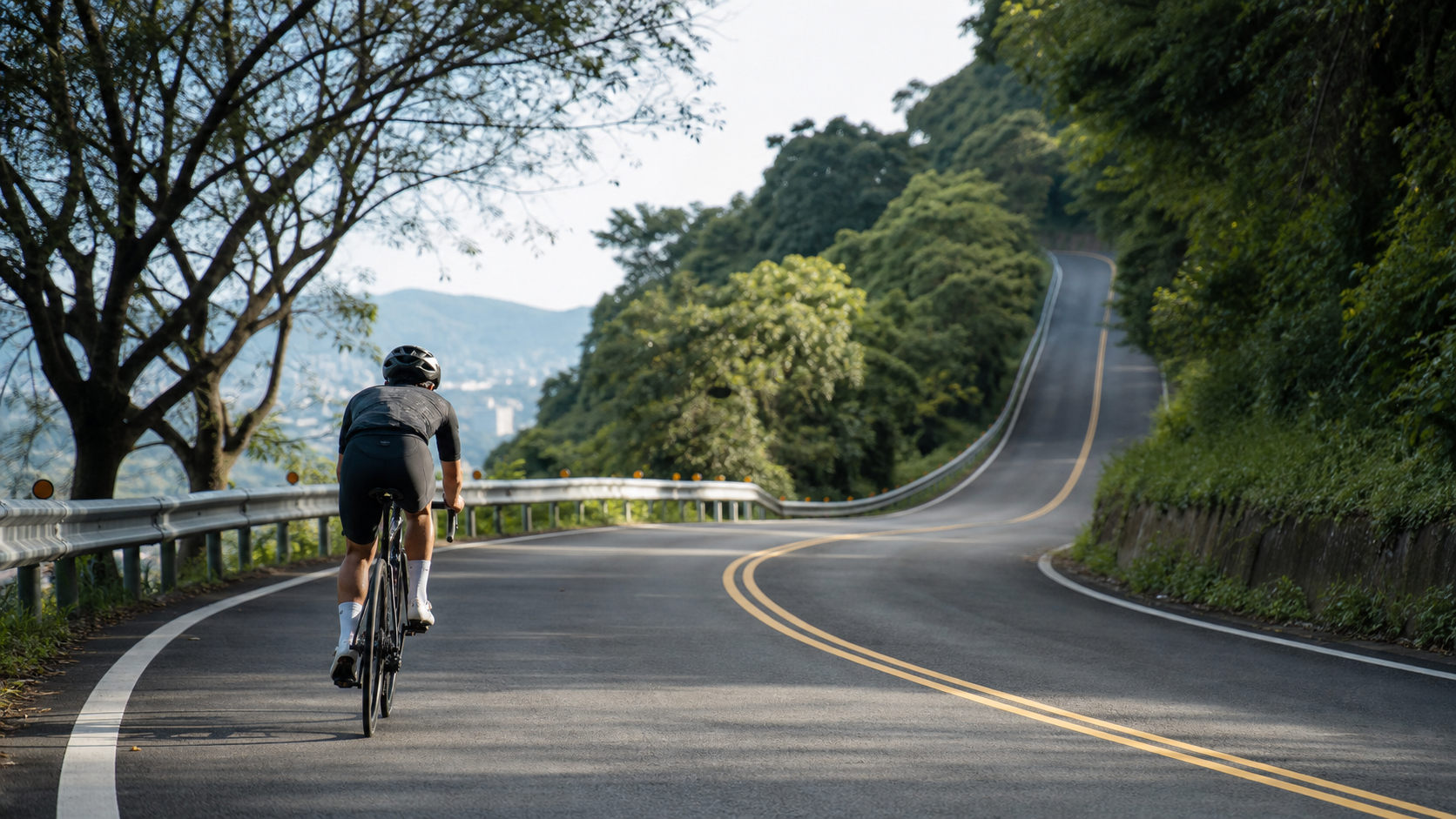
For local Taichung riders, the Dakeng Zhongzheng Campground route is practically the first lesson in “getting hooked.” Located in the Dakeng Scenic Area, often dubbed “Taichung’s Yangmingshan,” the route spans 5.84 km with an average gradient of 4.3%. The endpoint, Zhongzheng Campground, sits at the trailhead of the Dakeng No. 4 Trail at roughly 465 meters above sea level, making it the largest public campground in Dakeng. For those who’ve just stepped onto a road bike and want to progress from flat city roads to mountain training, the length isn’t intimidating and the gradient remains manageable—yet it’s “gentle with steep punches,” enough to force you to understand your pedaling rhythm and heart rate ceiling. This article takes an engineer’s perspective, breaking down the route segment by segment from start to finish so you can hit the road with data in hand.
Route Overview and Data Analysis
Let’s put the core numbers on the table first:
| Item | Data |
|---|---|
| Total Route Length | Approx. 5.84 km |
| Average Gradient | 4.3% |
| Starting Area | Beitun District, Taichung City, around Taiyuan Road turning into Beikeng Lane |
| Endpoint | Dakeng Zhongzheng Campground (No. 4 Trail entrance, approx. 465m elevation) |
| Route Category | Short climbing training route |
| Suggested Round Trip | Can complete one loop within 2 hours |
The 4.3% average looks gentle, but “average” is the most deceptive word. The gradient distribution on this route is far from uniform: the early section along Taiyuan Road and Beikeng Lane starts with gentle 3% grades, giving you the illusion that “this is way too easy.” But as you push deeper into the widened section of Beikeng Lane, the gradient quietly ramps up, throwing in several 10%+ short steep pitches. In other words, the real challenge is hidden in the back half—this is the key thing to watch out for when planning your pacing.
Compared to other classic segments in the Dakeng area, Qingshui Lane runs about 5 km with roughly 248 meters of elevation gain and a 4.8% average gradient, but after Qingshui Bridge the grade spikes to 13%, plus a 400-meter stretch averaging 10%. The Zhongzheng Campground route shares a similar personality with Qingshui Lane—both are “gentle early, steep late”—but the overall intensity is slightly lower and the road is more comfortable, making it an ideal stepping stone before advancing to Qingshui Lane or Zhuoshui Lane.
Segment-by-Segment Guide
Segment 1: City Warm-Up to the Foothills (0–1.5 km, 2–3% gradient)
Ride straight from Taiyuan Road in Beitun, then connect onto Beikeng Lane heading toward the campground. This stretch still carries a city feel, with residences and scattered shops on both sides, and gradients mostly falling between 2% and 3%. The key here isn’t speed—it’s waking your body up. Keep your heart rate at 65% to 70% of max, use a light gear with high cadence (85–95 rpm) to gradually awaken your legs, and establish your rhythm before lactate starts building. Many riders charge hard the moment they reach the foothills, only to find their legs already gone when the steep sections arrive in the back half—this is the most common pacing mistake.
Segment 2: Beikeng Lane Gentle Climb (1.5–3.5 km, 4–5% gradient)
Past the fork at the foothills, take the left toward Zhongzheng Campground (the right leads to the harder route toward Sifang Taizi Temple), and the road begins to narrow into a typical mountain road. This section holds a steady 4% to 5% gradient—the most “linear” part of the entire route and your golden zone for building cruising power. Aim to lock your power or heart rate at roughly 10% below your lactate threshold (heart rate around 78–82% of max), shift to the middle of your cassette, and maintain 75–85 rpm. The road here is relatively wide with decent pavement, making it the best classroom for practicing “steady output”—the kind of stability that long climbs like Daxueshan demand, and Zhongzheng Campground is its miniature version.
Segment 3: Steep Pitch Cluster in the Widened Section (3.5–5 km, 8–12% gradient)
This is the watershed of the entire route. In the widened area of Beikeng Lane, several 10%+ steep pitches emerge, yanking the gradient from a comfortable 5% up to double digits. If you were greedy with your pacing earlier, this is where you pay the debt. Before entering a steep pitch, be sure to shift down to your easiest one or two gears in advance (don’t wait until you’re on the slope with the chain under full load—hard shifting then risks dropping or snapping the chain). Shift your body weight slightly forward to press the front wheel, relax your upper body, and get through it with “seated riding as the primary approach, with brief standing sprints only when necessary.” Keep standing sprints short and purposeful—use them only for the steepest 20–30 meters, then immediately return to the saddle and resume your cadence. Don’t make standing sprints a habit, or your heart rate will spike through the roof.
Segment 4: Final Stretch to the Campground (5–5.84 km)
After surviving the steep pitch cluster, the gradient eases again as you approach Zhongzheng Campground. This final stretch of under 1 km is your “recovery zone” and the test of your pacing skills—if you still have energy to accelerate here, you paced the front half just right; if you can barely hold on, slow down a bit more next time. Upon reaching the campground (approx. 465m elevation), stop for a sip of water and take in the Dakeng forest—it’s an excellent turnaround or resupply point.
Gear Ratio and Equipment Recommendations
Given the route’s 4.3% average gradient with 10–12% steep pitches in the back half, here’s the recommended equipment setup:
- Chainrings/Cassette: If you’re a beginner or a heavier rider, a compact crank (50/34T) paired with an 11–32T or 11–34T cassette is strongly recommended. On those 12% pitches, 34×32 or 34×34 gives you comfortable cadence room, so you won’t be forced into a grinding “crawling pace” that wrecks your knees.
- Wheelset: A mid-to-low profile (30–40mm) aluminum or carbon wheelset for general training is sufficient. This kind of short climb doesn’t demand extreme lightness—stability and durability matter more.
- Tire Pressure: The descent has corners, so don’t inflate too high. For 700x25C tires, try 5.5–6.5 bar front and 6–7 bar rear (adjust by body weight) to balance grip and rolling efficiency.
- Brakes: On the descent back, always check brake feel. Descending puts a real test on both rim and disc brakes—prolonged braking causes heat fade, so remember to “feather” rather than “death-grip.”
Nutrition and Hydration
This is a route that’s “short but not to be underestimated.” A single round trip can be completed within 2 hours, but Taichung’s basin heat in summer will make you lose fluid faster than you’d imagine.
- Before Departure: Fill your bottles in the city first—at least one large bottle (750ml). There’s parking and supply shops near the Dakeng trailhead, and food and drink stalls along the trail, but don’t pin all your resupply hopes on “there’ll definitely be something on the road.”
- Energy Intake: This route is short, so one energy bar or a banana usually suffices. If you plan to use it as repeated interval training (e.g., 3–4 laps up and down), then fuel at a pace of 30–60 grams of carbs per hour.
- On the Return: Refill water at the campground, and take a few more sips before descending back to the city, so you don’t forget to hydrate on the descent when you’re not exerting effort.
Weather and Seasons
The Dakeng area of Taichung is rideable year-round, but each season has its quirks:
- Spring/Autumn (Mar–May, Oct–Nov): The most comfortable seasons—cool temperatures and good visibility make this the golden window for setting PRs (personal records).
- Summer (Jun–Sep): Taichung’s basin is muggy and hot; set off before 6 AM to avoid the sun exposure after 10 AM. Afternoon thunderstorms are common, and descending in the rain on mountain roads is extremely slippery and dangerous—if you see cumulus clouds stacking up fast, call it a day early.
- Winter (Dec–Feb): Taichung winters are relatively dry and cool, making it a surprisingly good riding season, but the mountains are chilly in the early morning and wind chill is pronounced on descents—bring a windbreaker.
Common Mistakes and DNF Risks
Even though this is an entry-level route, people still “die” or get injured here. Common causes:
- Pacing too fast in the front half: Fooled by the 2–3% gentle grades, riders charge all the way to the foothills, only to have their legs give out on the steep pitches in the back half. This is the number one killer.
- Shifting too late: Waiting until you’re on the steep pitch with the pedals too heavy to turn before shifting—shifting under full load risks dropping or even snapping the chain. Always shift “early, while you still have strength.”
- Overdoing standing sprints: Treating standing sprints as the norm sends your heart rate to the ceiling instantly, and you won’t make it halfway before you have to stop. Standing sprints are a tool, not the main engine.
- Losing control on the descent: What goes up must come down. The return descent has corners, and if your brakes overheat and fade or you enter a corner too fast, the crash risk is far higher than on the climb. The descent is where this route’s real danger lies.
Target Times for Riders of Different Levels (Single Climb Segment)
| Rider Level | Reference Finish Time | Corresponding Intensity |
|---|---|---|
| Beginner (new to climbing) | 30–40 minutes | Finishing is a victory; keep heart rate controlled throughout, no blow-ups |
| Intermediate (6+ months of regular training) | 22–30 minutes | Steady cruising, no dismounting on the later steep sections |
| Competitive (race experience) | 16–22 minutes | Near-threshold output, chasing a PR |
These times are rough ranges; actual performance is affected by body weight, daily condition, and wind direction. What you should really track is your own heart rate curve and power data—riding the same road faster with a lower heart rate is the hard proof of progress.
Pedaling Technique: Different Force Application on Gentle vs. Steep Climbs
On the same Zhongzheng Camping Area, the pedaling technique required on the gentle sections differs completely from the steep sections—a detail many beginners overlook.
On the front 3–5% gentle slopes, the ideal pedaling is “pedaling in circles”—not just pushing down on the pedal, but maintaining continuous power transfer throughout the entire pedal stroke: pushing down, scraping back (like wiping mud off the bottom of your shoe), lifting up, and pushing forward. This smooth, circular application of force keeps power output more stable and saves muscle energy. Gentle slopes are the best place to practice circular pedaling because the pace isn’t rushed and you have the spare capacity to feel every point of force application.
When you reach the 10–12% steep sections in the latter part, pedaling in circles becomes difficult, and the focus shifts to “center of gravity and core.” Your upper body should be relaxed but your core engaged, avoiding wasteful side-to-side swaying. When seated, shift your hips slightly back and lean your torso forward and low, so your body weight presses more effectively onto the pedals; if you switch to standing, let the bike sway side to side while your body stays relatively stable, using your weight to “stomp” rather than muscling the pedals. These details are best refined on a safe, repeatable short climb like Zhongzheng Camping Area.
The Dakeng Route Network Extending from Zhongzheng Camping Area
Once you’ve mastered Zhongzheng Camping Area, it can become your base for exploring the entire Dakeng route network. The Dakeng area is actually dotted with climbs of varying difficulty:
- Qingshui Lane: Approximately 5 km long, ~248 m of elevation gain, average gradient 4.8%. After Qingshui Bridge, the gradient spikes to 13%, and there’s a 400 m section averaging 10%. One step harder than Zhongzheng Camping Area, making it an excellent next-level goal.
- Zhuoshui Lane: Only about 250 m from Qingshui Lane, with the same endpoint leading to Dakeng No. 2 Hiking Trail. More difficult, suited for riders looking to move up another level.
- Sifang Taizi Temple: Another tough climb branching right from the Zhongzheng Camping Area junction.
- Zhongxingling: Straight up from Section 2, Dongshan Road, about 5.5 km at an average 5.5% gradient. It’s the gateway to Xinshe, Guguan, and Dasanyuan.
An ideal progression path is: first get solid on Zhongzheng Camping Area, then take on Qingshui Lane and Zhuoshui Lane, and finally work toward Zhongxingling and Dasanyuan. Dakeng is like a natural “graded climbing training system,” and Zhongzheng Camping Area is the most welcoming entry level of that system.
Recovery and Cool-Down: Don’t Skip the Final Mile After Riding
Many riders pack up and head home immediately after finishing, skipping the “cool-down” step—which actually slows down your progress and recovery.
- Cool-down ride: After reaching the camping area and descending back to flat ground, don’t stop immediately. Ride for another 10 minutes in an easy gear at low intensity to let your heart rate come down smoothly and help flush out lactate.
- Stretching: After the ride, do static stretches for the quadriceps, hamstrings, calves, and hip flexors to reduce next-day tightness and soreness.
- Refueling: Within 30 minutes after the ride, consume carbohydrates and protein to replenish glycogen and support muscle repair.
- Logging: Write down the day’s data and how you felt, as a reference for your next adjustment.
Take care of this “final mile” and every training session’s benefits will be amplified, allowing you to get back into your next workout sooner.
Common Q&A: Practical Questions About Zhongzheng Camping Area
Q: How long until a beginner can ride the whole way without dismounting?
If you have basic riding habits and switch to a compact crankset with a large cassette, it typically takes three to five practice sessions before you can ride the entire climb without putting a foot down. The key is gearing and pacing on the later steep sections—don’t burn all your energy on the front part. It’s fine to dismount and walk at first; treat it as a gradual process, improving a little each time.
Q: How many times a week should I train?
Treating Zhongzheng Camping Area as your training ground, one to two climbing sessions per week is sufficient, with flat-road aerobic rides and rest filling the rest of the week. Climbing training is high-intensity and requires adequate recovery; training it daily only accumulates fatigue and prevents progress.
Q: What if I’m afraid of crashing on the descent?
The fear of descending mostly comes from “losing speed control” and “not knowing the road.” The solution: ride it several times at a slower speed to memorize the position and gradient of every corner, building muscle memory; brake early before entering a corner (don’t brake mid-corner); look toward the corner exit; keep your body relaxed and your center of gravity low. Once you’re familiar with it, the fear of descending turns into fun.
Q: Is it normal to be very sore the day after riding?
Delayed onset muscle soreness (DOMS) after early climbing training is normal—it means your muscles have been stimulated and are adapting. Do your cool-down stretching, get enough protein, and ensure proper sleep, and the soreness will diminish as your body adapts. However, if it’s joint pain (especially in the knees) rather than muscle soreness, check whether your gearing is too heavy or your saddle height is incorrect.
Put Zhongzheng Camping Area in Your Training Log
Riders who truly want to improve all have a habit of logging. Zhongzheng Camping Area—short, controllable, and repeatable—is the most suitable segment for logging and long-term tracking. It’s recommended to record the following each time:
- Date and weather: Temperature and wind direction affect performance; recording them allows for fair comparisons.
- Finish time: The time for the full climb is the most intuitive metric.
- Average and maximum heart rate: Reflects your intensity and cardiovascular load.
- Average power / normalized power (if you have a power meter): The most objective output metric.
- Average cadence: Check whether your pedaling rhythm is stable.
- Subjective feeling: How your legs felt that day, where you struggled, and whether your pacing had any mistakes.
Accumulate this data over time and you’ll see a clear improvement curve. More importantly, through comparison, you can identify your weaknesses—is it insufficient aerobic capacity? Poor pacing discipline? Poor technique on the later steep sections? Once you find the weakness, you can address it specifically and make your training more efficient. Turn every ride up Zhongzheng Camping Area into a training session with data, reflection, and progress, and you’ll discover that this short climb can take you a long way.
Advanced Perspective: Turning Data into Training Decisions
Many riders buy power meters and heart rate straps but only “look at the numbers” without turning them into decisions—which is a real shame. Zhongzheng Camping Area, as a repeatable short climb, is the perfect venue for practicing “data-driven decision-making.”
For example, when you notice that over several consecutive rides, your heart rate on the later steep sections always spikes out of control and takes a long time to come down, that data is telling you: your aerobic base or lactate tolerance is insufficient. The decision is—over the next few weeks, add low-intensity, long-duration aerobic mileage combined with threshold sustained training to build up your foundation, then come back and test again.
Or, if your power curve always shows “surge at the front, collapse at the back,” that data is telling you: your pacing discipline is poor. The decision is—deliberately hold back power on the front section, practice “riding with restraint,” and flatten out your power across the whole segment.
Or, if you find that with the same finish time, your heart rate is progressively lower each time, that good news is telling you: your fitness is improving and your body’s efficiency is rising. The decision is—you can try raising your target intensity and chase a faster time.
Data isn’t meant to be looked at; it’s meant to drive decisions. Treat Zhongzheng Camping Area as your data-decision practice ground. After every ride, ask yourself: “What are these numbers telling me? What should I adjust next?” Once you develop this habit of “data-driven training,” your progress will be several times faster than those who just grind blindly. This scientific training mindset is the core competency every modern rider should possess.
For Everyone Who Has Just Fallen in Love with Climbing
If you’re standing at the door of cycling, hesitating whether to step into the world of climbing, let me tell you—don’t be afraid. Every rider who now moves effortlessly through the mountains was once on a short climb like Zhongzheng Campground, gasping for air, legs giving out, doubting whether they had what it takes. Climbing is never an innate gift; it’s the accumulation of gritting your teeth and pushing through, again and again.
What makes this road precious is that it gives you a safe, friendly stage where you can try over and over. You can fail here, you can put a foot down, you can take your time figuring things out, and it will never mock you. It simply waits there quietly, waiting for you to ride a little more steadily, a little faster, a little more composed each time. This kind of acceptance is the gentleness every beginner needs most.
So don’t set your sights only on the distant, magnificent peaks like Wuling or Daxueshan. Real growth lies in the unremarkable short climb beneath your feet, in every earnest pedal stroke, every post-ride review, every small improvement. Ride Zhongzheng Campground well, ride it thoroughly, ride it until you develop a bond with it, and you will unknowingly grow into a rider you once looked up to. And when that day comes, you’ll be grateful to the version of yourself that didn’t give up, that was willing to try again and again on this gentle short climb. This is what makes climbing so moving—it doesn’t just make you stronger; it introduces you to the version of yourself that never gives up.
Conclusion
The 5.84 km route at Dakeng Zhongzheng Campground with an average gradient of 4.3% is the best “diagnostic tool” for Taichung riders. It’s short enough that it won’t exhaust you, yet it hides steep sections above 10% in the latter half that force you to confront the truth about pacing and gear selection. Ride it until you know it well and ride it steadily, and you’ll have the confidence to move on to Qingshui Lane, Zhuoshui Lane, Zhongxingling, and even the real challenges like Dasanyuan or Daxueshan. Next time you head out, bring your cycling computer, control your heart rate, shift gears early, and conquer it with data.
Training Plan: Treat Zhongzheng Campground as Your Climbing Laboratory
The greatest value of this 5.84 km short climb isn’t “conquering it once,” but “using it repeatedly.” Because it’s short enough and recovery is quick, it’s perfectly suited for structured climbing workouts:
Workout A: Threshold Sustained (Ideal for Building Cruising Fitness)
Ride the entire climb in one go at an intensity where “you can speak short sentences but not hold a conversation” (around the lower edge of threshold), descend to recover for 10 minutes, and repeat 2–3 times. The key is “each rep’s time should not differ by more than 30 seconds”—consistency matters more than absolute speed.
Workout B: Steep-Section Intervals (Ideal for Improving Anaerobic Capacity and Lactate Tolerance)
Use the widened sections in the latter half with gradients above 10%: accelerate before entering the steep pitch, maintain high output for 30–60 seconds on the climb, then recover after cresting it. Repeatedly stimulating the latter steep sections will significantly improve your ability to handle the pressure when facing real mountains like Chikanding or Baimaoshan.
Workout C: Low-Cadence Strength (Ideal for the Winter Base Phase)
Deliberately use a gear one step heavier than usual and keep your cadence at 55–65 rpm for the entire climb, simulating heavy-gear loading to strengthen leg muscles. Remember: low-cadence strength training places significant stress on the knees, so don’t do too many reps each session, and always warm up thoroughly first.
Self-Diagnosis with Heart Rate and Power
After finishing Zhongzheng Campground, don’t rush off—spend five minutes reviewing the data:
- Does your heart rate spike out of control in the latter half? If your heart rate maxes out on the latter steep sections and takes a long time to come down, it means your pacing in the early section was too ambitious, or your overall aerobic base is insufficient—time to do more long-distance aerobic work.
- Is your power output too high early and dropping too much later? An ideal climbing power curve should be relatively steady. If your early power is far higher than your latter power, it means you’re “spending your money too fast”—your pacing discipline needs work.
- Is your speed improving at the same heart rate? This is the most honest indicator of progress. Record your “average heart rate vs. completion time” each ride—when you can ride faster at a lower heart rate, it means your fitness is genuinely improving.
Common Equipment Questions
Q: Do beginners need to switch to a compact crankset?
If you’re on a standard crankset (53/39T) with an 11–28T cassette, climbing the 12% sections in the latter half will be very tough. If your budget is limited, swapping to a larger cassette (11–32T or 11–34T) is the lowest-cost, most direct solution. Consider a compact crankset only if you have the budget.
Q: Do I need clipless pedals and shoes?
Clipless pedals can improve pedaling efficiency and save energy on steep climbs, but for pure beginners, it’s perfectly fine to build up your technique and fitness on flat pedals first. Upgrade to clipless once you start chasing performance.
Q: Disc brakes or rim brakes?
The descent on this route isn’t long, and both can handle it. But if you often ride in the rain or on long descents, the consistent braking power of disc brakes is certainly more reassuring.
Turning a Short Climb into Long-Term Progress
Many people look down on short climbs like Zhongzheng Campground, thinking they’re “not worthy.” But those who truly understand training know: progress often comes from repeatedly refining a section of road that is “controllable and repeatable.” You can only ride Wuling or Daxueshan a few times a year, but you can come to Zhongzheng Campground every week. Treat it as your climbing laboratory—adjust your pacing, gearing, and cadence each time, record the data, compare your progress, and you’ll unknowingly become a stronger rider who knows yourself better.
Related Reading
- Riding into Taichung’s Backyard: The Forests, Fireflies, and a Cup of Coffee at Dakeng Zhongzheng Campground
- Taichung Dakeng Mountain Riding: Beginner-Friendly Climbing Training Venue Recommendations
- Taichung Dakeng Trail Area Routes: Cross-Training Routes for Hill Riding and Hiking
- Taichung Dakeng Route Group: Cycling Climbing Challenges from Trail 1 to Trail 10
爬坡ITT實境)台中 魔王 松鼠坡 首航 6:12 大肚山 大三元 科福路
8 年前
半日 小台灣 極限單車路線挑戰實錄
7 年前
台北闊瀨陡坡 騎旅 / 日本單車雜誌編輯車友臨時加入!/ 髮香才是最強的 / feat. 北迴歸線小隊 / 公路車 CT Yeh
6 個月前
藤枝二集團 單車行 Day1 | 南部小武嶺 | 爬坡爬到罵罵叫 | JJSC | 公路車 | CT Yeh
3 年前
台中大雪山 膏王領騎 震到都沒畫面了 公路車
5 年前
2019 夏季KOM 5小 完賽心得 準備攻略 東進武嶺 夏季登山王之路 Taiwan KOM Challenge
7 年前
大禹嶺 到 武嶺牌樓 全程前後實況錄影 | 北進武嶺 | 東進武嶺 | KOM | 訓練台 | 坡度分析 | Taiwan KOM Last 10 km HARD | 公路車
6 年前
#公路車 #西進武嶺 配速配瓦實驗 坡度分析 四小時內攻略 建大盃 NeverStop #西進武嶺攻略
6 年前