The Central Cross-Island Highway Hub Above the Sea of Clouds: Riding to Lishan, a Mountain Highway Poem Through the Lanyang River and Dajia River
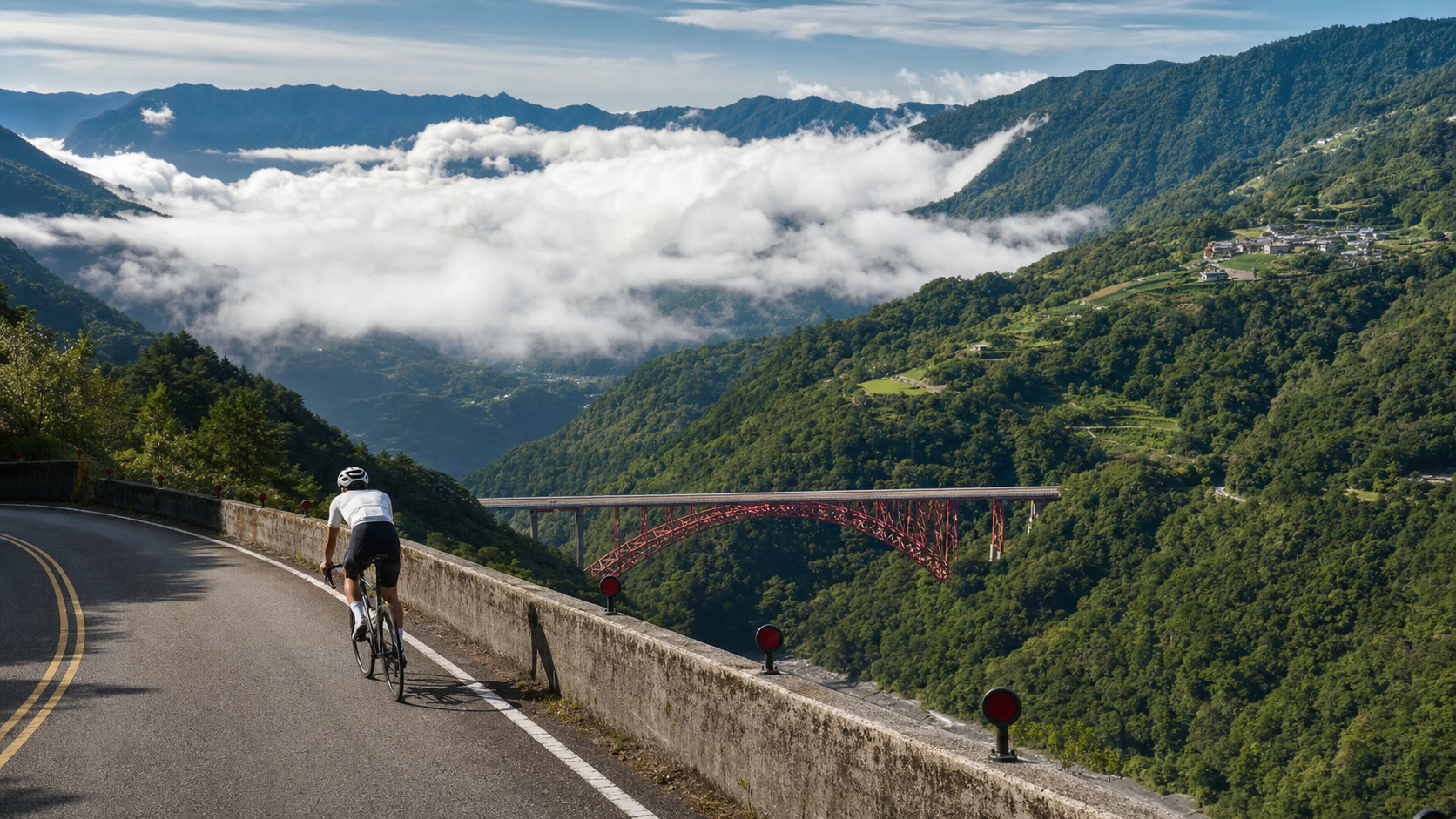
Among Taiwan’s roads, Provincial Highway 7A has a unique romance. It starts from Cilan in Datong Township, Yilan, pushes deep into the mountains along the Lanyang River, crosses the watershed at Siyuan Pass, then winds along the Dajia River, finally connecting to Provincial Highway 8 at Lishan—the hub of the Central Cross-Island Highway. The 8.6-kilometer stretch from Qingquan Bridge to Lishan, climbing about 394 meters at an average gradient of 4.5%, is the climax of this high-mountain highway poem. In this article, I want to take you on a slower pace, to see the streams, villages, and sea of clouds along the way, as well as the indescribable emotion of approaching Lishan.
Qingquan Bridge: A Red Gateway
Qingquan Bridge is the starting point of this journey, and it feels like a gateway. With its red steel structure, it spans the river valley, located at approximately Kilometer 65 of Provincial Highway 7A, and it also marks the entrance to an abandoned old forestry road.
Standing on Qingquan Bridge and looking down, the stream rushes through the valley floor. About 500 meters downstream from Qingquan Bridge, there is a beautiful stretch of meander terrain—the water flows toward you, then immediately turns away, making a nearly 180-degree bend in its course. This kind of meander is evidence of the stream sculpting the landscape over countless years—a masterpiece of nature’s craftsmanship. The red of Qingquan Bridge stands out vividly against the green of the forest and the blue of the stream, like a bright seal stamped onto this high-mountain journey.
Once you cross Qingquan Bridge, you have officially begun the final stretch of the approach to Lishan.
The Lanyang River and Dajia River: A Journey Across the Watershed
The most compelling geographic story of Provincial Highway 7A is that it “straddles two rivers.” This highway departs from the broad riverbed of the Lanyang River, pushing deep into the mountains along its course; after crossing the watershed at Siyuan Pass, it winds down along the Dajia River, then climbs back up toward Lishan.
A watershed is a poetic geographic concept. On the same mountain range, rain that falls on one side gathers into the Lanyang River and flows toward the Pacific Ocean in Yilan; rain that falls on the other side gathers into the Dajia River and flows toward the Taiwan Strait in Taichung. And you, riding your bike, are crossing this invisible boundary with your own legs—stepping from the embrace of one river system into the domain of another. This experience of “measuring geography with your body” is a romance unique to high-mountain cycling.
On the stretch from Qingquan Bridge to Lishan, you are traveling through the upper reaches of the Dajia River system. The valley is deep, flanked by peaks often exceeding 3,000 meters, with the stream glinting in the valley floor below. This is a rare high-mountain river-valley highway scenery in Taiwan—open, magnificent, and carrying a power that cleanses the spirit.
Huanshan Village: An Atayal Settlement Hidden in the Valley
If your journey covers the area around Lishan and heads toward Wuling, you will pass through Huanshan Village. This is a small Atayal settlement, located between Lishan and Wuling Farm, embraced by peaks over 3,000 meters—a rare “valley village.”
The tranquility of Huanshan Village will make you unconsciously slow down. Scattered houses, terraced orchards, and the continuous high mountains in the distance form a scene completely different from the city. The Atayal people here have lived among these high mountains for generations, growing high-mountain fruits and vegetables while guarding their ancestral land. As you ride through, you will feel an atmosphere where time slows—as if life here has always moved at this unhurried pace.
(To cross the Nanhu River, the road in this area makes a noticeable descent and then climb, dropping from about 1,700 meters to 1,500 meters before climbing back up. When riding through, don’t just focus on the effort—look up and take in the surrounding mountain scenery; it is the best reward for this undulating stretch.)
Lishan: A Settlement Above the Clouds
Finally, Lishan arrives.
Lishan sits at an elevation of nearly 2,000 meters and is the hub of the Central Cross-Island Highway—where Provincial Highway 8 and Provincial Highway 7A meet. It rests above the sea of clouds, surrounded by high peaks, and is a high-mountain settlement full of stories. Lishan is famous for its high-mountain fruits—peaches, apples, pears, and cabbage. This cold, high-altitude land produces Taiwan’s finest temperate fruits. In spring, the fruit trees of Lishan bloom, painting the hillsides in shades of pink and white; in autumn, the branches bend heavy with fruit in a season of harvest.
Standing at Lishan, watching the highways converge below your feet and the sea of clouds churning in the distance, you feel a profound sense of emotion. You think of the entire journey along Provincial Highway 7A—setting out from Cilan, pushing along the Lanyang River, crossing the watershed at Siyuan Pass, then following the Dajia River to this point. With your legs, you have strung together the story of an entire high-mountain highway. This feeling of “arriving at the hub” is not just geographic—it is psychological. You have pedaled a long and magnificent road into your own life.
What This Stretch Means to Riders
The stretch from Qingquan Bridge to Lishan is not a road for chasing personal records. It is too beautiful, too high in elevation, and carries too many stories to be rushed. It deserves you to slow down and take it in with your heart.
It is the essence of high-mountain cycling—the grandeur of river valleys, the tranquility of villages, the ethereal sea of clouds, and the achievement of reaching the hub. What it teaches you is not how to ride faster, but how, in the thin air, to learn humility, to learn appreciation, and to learn to coexist with this magnificent landscape. For many riders, Lishan is a necessary passage for the Central Cross-Island loop, climbing Wuling, or traversing Siyuan; but even as a standalone climb, this stretch forms a complete high-mountain highway poem of its own.
Side Trips and Reminders
- Accommodation and supplies at Lishan: Lishan is a settlement with lodging, dining, and shops, making it a suitable stopover for multi-day high-mountain trips. Tasting the seasonal high-mountain fruits is an unmissable pleasure when visiting Lishan.
- High-altitude safety: This is a high-mountain route near 2,000 meters. Take warmth, supplies, and altitude sickness seriously. The weather can change in an instant—be sure to check the latest forecasts and Central Cross-Island Highway conditions (landslides and traffic controls occasionally occur along the route).
- Respect the villages: When passing through indigenous villages such as Huanshan, slow down and respect the local way of life and culture.
- Revere the mountains: Take your trash with you, protect this pristine high-mountain land, and leave its grandeur for every rider who comes after.
Provincial Highway 7A: A Central Cross-Island Branch Line Full of Stories
To truly understand the stretch from Qingquan Bridge to Lishan, you must first know the highway it belongs to—Provincial Highway 7A. Also known as the “Central Cross-Island Highway Yilan Branch,” it begins at Baitao Bridge in Cilan, Datong Township, Yilan, and ends at Lishan in Heping District, Taichung, spanning approximately 74 kilometers. It departs from the broad riverbed of the Lanyang River, pushes deep into the mountains along the valley, crosses the watershed at Siyuan Pass, then winds along the Dajia River to Lishan, where it connects to Provincial Highway 8.
Every section of Provincial Highway 7A is written with stories. It connects two worlds—Yilan and Taichung—linking landmarks with resonant names such as Cilan, Siyuan Pass, Wuling, Huanshan, and Lishan. For cycling travelers, being able to ride Provincial Highway 7A is itself a romance—every kilometer you pedal is overlaid with the history of the Central Cross-Island Highway’s development, the breathing of the forests, and the footprints of generations of people who have lived here.
The Meander: A Love Letter Written by the Stream to the Land
Qingquan Bridge, with its red steel structure, is located at approximately Kilometer 65 of Provincial Highway 7A and also marks the entrance to an abandoned old forestry road. But its most captivating geographic feature lies about 500 meters downstream—where there is a beautiful “meander.”
A meander is a winding river channel carved out over countless years by the stream’s repeated erosion and deposition within the valley. Downstream from Qingquan Bridge, the water flows toward you, then immediately turns away, making a nearly 180-degree bend—like an elegant arc drawn across the land. It is a love letter written by the stream to the earth over tens of millions of years.
Standing on Qingquan Bridge and looking down at this meander, you feel the unhurried yet immensely powerful force of nature. The human-built highway crosses the valley here, but the stream had been carving this landscape day and night for countless ages long before the road ever existed. This contrast in timescales humbles you.
Huanshan Village: A High-Mountain Home Where Time Slows
If your journey extends to the area around Lishan and heads toward Wuling, you will pass through Huanshan Village—an Atayal settlement located between Lishan and Wuling Farm, embraced by peaks over 3,000 meters, a rare “valley village.”
The tranquility of Huanshan Village will make you unconsciously slow down. Scattered houses, terraced orchards, and the continuous high mountains in the distance form a scene completely different from the city. The Atayal people here have lived among these high mountains for generations, growing high-mountain fruits and vegetables while guarding their ancestral land. Their days seem to have always moved at this unhurried pace—living with the mountains, in sync with the seasons.
Riding through Huanshan, you feel an atmosphere where time slows. In an era that demands speed in everything, a settlement that still lives according to nature’s rhythm is itself a reminder: slowness is also a form of wisdom. (When passing through the village, slow down, respect the local way of life and culture, and avoid loud noise or photographing residents without permission.)
The Romance of the Watershed: A Journey Across Two Rivers
The most poetic geographical story of Provincial Highway 7A is that it “straddles two rivers.” This road departs from the Lanyang River, crosses the watershed at Siyuan Pass, and then follows the Dajia River instead.
A watershed is a concept full of poetry. On the same mountain, rain falling on one side flows into the Lanyang River and rushes toward the Pacific Ocean in Yilan; rain falling on the other side flows into the Dajia River and heads toward the Taiwan Strait in Taichung. And you, on your bike, are precisely the one crossing this invisible boundary with your own legs—stepping from the embrace of one river system into the territory of another.
On the section from Qingquan Bridge to Lishan, you ride through the upper reaches of the Dajia River system. The valley is deep, flanked by peaks that routinely exceed 3,000 meters. This is a rare high-mountain river-valley road scene in Taiwan—open, magnificent, carrying a power that cleanses the soul. Measuring this watershed by bicycle is a romance unique to high-altitude riding.
Lishan: The Fruit Town Above the Sea of Clouds
Finally, Lishan arrives. At an elevation of nearly 2,000 meters, Lishan is the hub of the Cross-Island Highway, perched above the sea of clouds and embraced by towering peaks on all sides. It is famous for its high-mountain fruits—peaches, apples, pears, and cabbage. This cold, high-altitude land nurtures Taiwan’s finest temperate-zone produce.
In spring, the fruit trees of Lishan bloom, painting the entire hillside in shades of pink and white, like a fairyland; in autumn, it is the season of heavy fruit and harvest. Standing in Lishan, tasting a seasonal peach or apple, that high-mountain sweetness is the bond between this land and the cyclist. Watching the roads converge below your feet and the sea of clouds churn in the distance, you feel a profound emotion—you have strung together the story of an entire high-mountain highway with your legs.
Memories of the Cross-Island Highway: A Road Carved with Lives
Riding toward Lishan, it is hard not to think of the history behind this Cross-Island Highway. Provincial Highway 8, the Central Cross-Island Highway, was Taiwan’s first road traversing the island from east to west. It begins in Dongshi, Taichung, in the west and ends in Taroko, Hualien, in the east, stretching nearly 188 kilometers.
The carving of this road is a history written in sweat and lives. Back then, thousands of veterans and engineering workers, in an era without modern machinery, chiseled this road inch by inch through the rugged Central Mountain Range with their bare hands and simple tools. Countless people paid with their lives during construction. The Cross-Island Highway is not merely a transportation route; it is a monument built with lives.
When you ride on this road, every kilometer you pedal is overlaid with this history of pioneering. Those sections carved along sheer cliffs, those bridges spanning deep gorges—all were bought with the lives of those who came before. The weight of this history adds a layer of solemnity and gratitude to the journey of conquering Lishan. Riding the Cross-Island Highway, you ride not just scenery, but a piece of Taiwan’s collective memory.
Lishan’s Spring and Autumn: Two Faces of the Fruit Town
Lishan is renowned for its high-mountain fruits, and in spring and autumn, it reveals two completely different yet equally captivating faces.
Lishan in spring is the season of flowers. The fruit trees burst into bloom—the pink of peaches, the white of apples, the elegance of pears—painting the entire hillside into a soft, beautiful picture. Walking among the seas of blossoms, a faint floral fragrance lingers in the air, with misty clouds swirling around the distant peaks, like a fairyland. Spring in Lishan is romantic and full of hope.
Lishan in autumn is the season of fruit. After a summer of nurturing, the trees are laden with plump produce—red apples, peaches, and high-mountain pears. This is the season of harvest; orchard farmers busily gather their crops, and the air carries the sweet aroma of ripened fruit. Autumn in Lishan is abundant and deeply satisfying.
In both spring and autumn, Lishan’s high-mountain fruits are worth stopping for. A seasonal peach or apple, with that sweetness nurtured by this cold, high-altitude land, is the most beautiful bond between this fruit town and the cyclist.
The Rhythm of Life in High-Mountain Settlements
High-mountain settlements like Lishan and Huanshan have a rhythm of life completely different from that of the city.
Here, time seems to slow down. In the early morning, orchard farmers head up to work; in the afternoon, clouds and mist roll over the valley; in the evening, scattered lights flicker to life in the settlement. Days flow with the seasons and the farming calendar—unhurried, in sync with nature. The people here have lived among the high mountains for generations, growing fruit, guarding the land, living a simple and grounded life.
Riding through these settlements, you feel the tranquility of that life. In an era that demands speed in everything, a place that still lives by nature’s rhythm is itself a reminder—slowness is also a wisdom of living; coexisting with nature is also a rare kind of happiness.
With Gratitude and Awe
After riding the high-mountain road poem from Qingquan Bridge to Lishan, the deepest feelings in my heart are “gratitude” and “awe.”
Gratitude to those before us who carved the Cross-Island Highway with their lives, allowing us to measure this magnificent landscape by bicycle; gratitude to these high mountains for nurturing such pure streams, such premium fruits, such moving scenery. Awe at the vastness of nature—the meandering rivers carved over millions of years, the peaks that routinely exceed 3,000 meters, the high-mountain weather that changes in an instant.
Carrying this gratitude and awe, please treat this landscape with care: take your trash with you, respect the tribes and settlements along the way, and follow the regulations of the mountain areas. Let the grandeur and purity of these high mountains be preserved for every traveler who comes after. This is the heart every cyclist who sets foot on these high mountains should carry.
The Sea of Clouds: Lishan’s Most Luxurious Scenery
If there is one most luxurious sight in Lishan, it must be the sea of clouds.
At nearly 2,000 meters in elevation, surrounded by high peaks, Lishan’s unique terrain and climate frequently give rise to magnificent seas of clouds in the early morning or afternoon. When you stand in Lishan, watching the clouds surge like waves below your feet and distant peaks floating above the clouds like islands, the awe makes you forget the fatigue of the climb.
The sea of clouds is fluid and ever-changing. Sometimes it thunders like a stampede of horses, sometimes it is a serene white ocean; when sunlight breaks through, it scatters golden light across the clouds; when the wind rises, it floods over the valleys like tides. This kind of unpredictable beauty is beyond any man-made spectacle.
And the most moving thing about the sea of clouds is that it “cannot be sought, only encountered.” It requires just the right temperature, humidity, and wind direction to form—you cannot book it, you cannot force it. Precisely because of this, when you are fortunate enough to encounter a magnificent sea of clouds in Lishan, the surprise and emotion run especially deep. It is like a random yet precious gift from these high mountains to the travelers willing to ride up.
The Hub of the Cross-Island Highway: All Roads Lead to Lishan
What makes Lishan special is that it is the “hub” of the Cross-Island Highway—multiple major high-mountain roads converge here.
To the east, Provincial Highway 8 leads to Dayuling and Taroko, the main artery of the Cross-Island Highway; to the west, Provincial Highway 8 connects to Guguan and Dongshi, returning to the Taichung Basin; to the north, Provincial Highway 7A passes through Siyuan Pass toward Yilan, with a turnoff along the way to Wuling Farm; and Provincial Highway 14A, branching off at Dayuling, leads to Hehuanshan and Wuling—the highest point on Taiwan’s road network.
This hub status of “all roads lead to Lishan” makes it the heart of Taiwan’s high-mountain cycling network. Whether you are circling the Cross-Island Highway, climbing Wuling, taking the Siyuan route, or visiting Wuling Farm, Lishan is an unavoidable waypoint and crossroads. Standing in Lishan, watching these roads stretching out in all directions below your feet, you feel the grandeur of “standing at the mountain’s hub”—this is the starting point and meeting place of countless high-mountain dreams.
The Sweet Bond of the High-Mountain Fruit Town
When you come to Lishan, you must taste the sweetness of this high-mountain fruit town.
Lishan is famous across Taiwan for its high-mountain fruits—peaches, apples, pears, and cabbage. This cold, high-altitude land at nearly 2,000 meters, with its large diurnal temperature swings, abundant sunshine, and pure air, produces fruits that are especially sweet and crisp. In spring, the fruit trees bloom, painting the hillsides pink and white; in summer and autumn, the trees are heavy with harvest.
After cycling your way up to Lishan, buy a seasonal peach or apple in the settlement and sit down to savor it slowly. That sweetness nurtured by the high-mountain soil is especially refreshing after you have sweated and climbed. This is not just a piece of fruit—it is a sweet bond between these high mountains and the cyclist: you measured the height of this land with your legs, and it rewards your effort with its sweetest produce.
This “sweetness earned through sweat” is the most unforgettable taste of the Lishan journey. It gives the hardship of conquering Lishan the gentlest, sweetest conclusion. And in the days that follow, whenever you think of Lishan, your palate will recall that high-mountain fruit sweetness, along with the memory of riding above the sea of clouds.
Arrival vs. the Journey: Which Matters More?
This high-mountain highway poem of a ride toward Lishan made me rethink the question of whether “arrival” or “the journey” matters more. When I first started cycling, I always kept my eyes fixed firmly on the finish line—I only thought about getting to Lishan as quickly as possible, and only cared about whether I’d completed the goal. The scenery, the feelings, and the stories along the way were all treated as a “necessary evil” on the path to the destination, hurriedly passed by.
It wasn’t until one time, when I deliberately slowed down, that I truly “saw” the journey for the first time—the meandering river carved by millennia of water beneath Qingquan Bridge, the terraced orchards of Huanshan Village, the grandeur of the Dajia River Gorge, and the ever-shifting sea of clouds along the way. These beauties hidden within the journey moved me far more and left a deeper impression than the mere result of “arriving at Lishan.”
That’s when I understood: the meaning of life often lies not in the destination, but in the journey that leads there. We’re always in a hurry to arrive—at success, at happiness, at some goal we think will satisfy us. But when we finally do arrive, we often discover that what truly enriches our lives is actually the scenery and stories along the way that we overlooked. This road to Lishan taught me: don’t just rush ahead, and don’t treat the journey merely as a means to an arrival. Slow down and savor every bit of beauty along the way—because in the end, what lingers in your memory is never the destination itself, but the scenery you saw, the people you met, and everything you experienced along the road.
Conclusion
From Qingquan Bridge to Lishan—an 8.6-kilometer high-mountain highway poem. It departs from a red bridge, crosses the meandering love letter the stream wrote to the land, follows the Dajia River Gorge, passes through the tranquility of Huanshan Village, climbs over the romance of the watershed divide, and finally knocks on the gate of the Central Cross-Island Highway’s hub above the sea of clouds—Lishan, fragrant with fruit. Here you’ll find Taiwan’s most magnificent high-mountain river gorge, its finest temperate fruits, and its most moving geographic stories. It doesn’t urge you to hurry; it only invites you to slow down and measure the vastness of these mountains and rivers with your own legs. If you ever get the chance to ride this stretch, don’t rush—stop, look at the meanders beneath Qingquan Bridge, the terraced fields of Huanshan, and the sea of clouds at Lishan, and let this high-mountain highway poem sing its full verse through your life. And please remember: take your trash with you, respect the tribes and the mountains, and leave this magnificence for every traveler who comes after.
Related Reading
- Qingquan Bridge to Lishan Practical Guide: 8.6 km to the Central Cross-Island Highway Hub, Climbing to Lishan at 2,000 Meters
- The Mountain Route from Guguan, Taichung to Lishan: A Cycling Version of the Central Cross-Island Highway
- Lileng Creek Deep in Guguan: A Forest Road Journey into the Atayal Tribe and the Memory of the Dajia River
- Central Cross-Island Highway Cycling Tour: The Magnificent Crossing from Taroko to Lishan
嘉義大埔、阿婆灣挑戰賽,美到以為在日本!ft. 環騎5 Cool 西拉雅188 / 公路車 / CT Yeh
7 個月前
一定要騎一次!阿里山最深處:里佳部落!單車旅行 | 2800m爬升 | 深度部落體驗:嗨翻晚會、螢火蟲、銀河 | feat. JJSC & 廢物伙伴 | 公路車 CT Yeh
9 個月前
大武山20%魔王陡坡【JJSC南台灣遊騎Day2】!屁股真的要裂開了...凡士林抹滿也沒用?神秘金教堂還有超便宜夜市
3 個月前
台北闊瀨陡坡 騎旅 / 日本單車雜誌編輯車友臨時加入!/ 髮香才是最強的 / feat. 北迴歸線小隊 / 公路車 CT Yeh
6 個月前
台北大雁西飛 約騎挑戰 feat. Doris | 公路車 | CT Yeh
3 年前
爬坡ITT實境)台中 魔王 松鼠坡 首航 6:12 大肚山 大三元 科福路
8 年前
新竹白蘭部落! 爬陡坡還能講笑話...? 廢物伙伴の約騎 | 公路車 | CT Yeh
4 年前
#北橫 + #北進武嶺 最硬的員工旅遊 EP1 | #公路車 #拉拉山 | 明池 | 武嶺 | 武陵農場 | 雲海 | Taiwan Cycling Route Wulin
6 年前