The Sound of Water in Lilen Village and Baileng Ice Pops: A Cycling Memory in the Embrace of the Dajia River
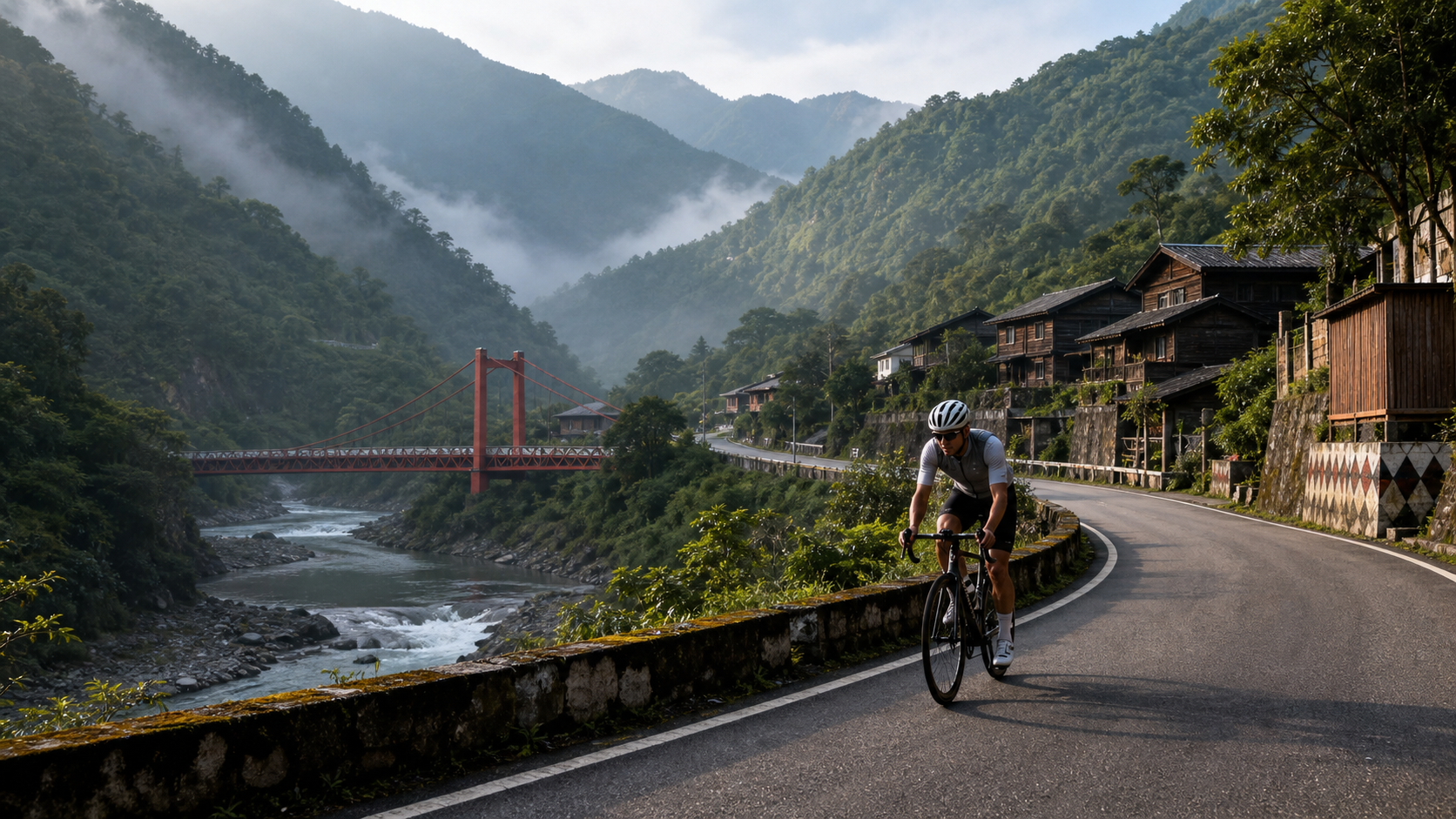
Some roads never make it onto the cover of a travel guide, yet they hold a tender place in the memories of cyclists. Lilen is exactly such a road.
It lies hidden in the embrace of the Dajia River on the western section of Provincial Highway 8 (the Central Cross-Island Highway), marked coolly on Strava as 7.98 kilometers, 562 meters of climbing, with an average gradient of 7%. But anyone who has actually ridden it knows that this road demands not a power meter, but your eyes and your breath—you’ll be pulled to a stop by the sound of the Dajia River at a bend, slow down before the tribe’s red bridge, and find yourself unable to resist stopping for a photo in front of the hinoki wooden houses in Songhe. This article isn’t about pacing; it’s about what this road gives to those who ride it.
A Road in the Embrace of the Dajia River
Lilen Village is located in Bo’ai Borough, Heping District, Taichung City, at approximately kilometer 26 of the Central Cross-Island Highway, about 10 kilometers short of the hot spring resort of Guguan. The first thing you’ll see is a striking bright-red Lilen Bridge, beneath which the Dajia River meets Lilen Creek. With mountains at its back and the river in front, the air here always carries a hint of coolness because of the valley—even in the height of summer, riding here feels as if the river water has lowered the temperature.
On this stretch of Provincial Highway 8, one side is the Dajia River’s riverbed—a gentle stream in ordinary times, a torrent during the rainy season—while the other side is Mount Basianshan, rising over a thousand meters. The old cross-island highway that once connected Yilan and Hualien was carved inch by inch, hugging the riverbed and the cliff face. When you pedal upstream along the river, you are in fact retracing a road etched out with blood and sweat by those who came before. That depth is something no indoor trainer can ever give you.
Two Atayal Tribes: Lilen and Songhe
Heading toward Guguan along Provincial Highway 8, you’ll pass through two Atayal tribal villages in sequence: Lilen and Songhe. These two villages are the warmest part of this road.
Lilen Village sits with its back to the mountain and facing the river, blessed with a comfortable climate. In recent years, hot springs were discovered along Lilen Creek, adding a touch of resort atmosphere to this small village. The village has shops and homestays, and Atayal totems and motifs adorn the streets, making it immediately clear that you’ve arrived somewhere special.
Songhe Village has an even more interesting story. It was formerly called “Gulas” or “Jiulaoqi”; after the Retrocession, because egrets often foraged on the Dajia River’s riverbed, it was renamed “Songhe”—pine and crane, a place name that paints a picture. What makes Songhe most precious is that it still preserves century-old hinoki wooden houses and the historical traces of the Jiulaoqi Station of the Basianshan Forest Railway. After passing Songhe Village, you enter the bounds of Basianshan National Forest Recreation Area, with only about 4 kilometers left to Guguan.
Stopping in front of Songhe’s old hinoki houses, you’ll forget you came here to train. The grain of the wood, the Atayal handicrafts, the clothes hung out to dry in front of tribal homes—these everyday details are the true scenery of this road.
First Person: A Cool Summer Morning in Lilen
At six in the morning, I set off from Dongshi, heading toward Guguan along Provincial Highway 8. The sun hasn’t fully climbed over the mountain ridge yet, and the air in the valley is that kind of transparent, moisture-laden clarity. The early stretch rolls up and down, with the Dajia River appearing and disappearing on the right, its sound like an invisible riding companion accompanying you the whole way.
Entering the Lilen section, the gradient starts to show its temper. It doesn’t bear down on you relentlessly like Wuling does; instead, it’s a short steep pitch, then a breather, then another push—as if the road were conversing with you: “Give it some effort—okay, rest—now again.” You’re forced to read every bend and every climb rather than staring down at your computer. The moment you look up, the ridgeline of Mount Basianshan flickers in and out of the morning mist, and you suddenly understand why veteran riders keep coming back here again and again.
When I reach Lilen Bridge, I stop as I always do. The red bridge stands out vividly against the green valley, and beneath it, two streams converge, their sound louder than before. Right nearby happens to be a stall selling Baileng ice pops. I buy one and sit by the bridge to eat it, the chill sliding down my throat into a body warmed by the climb—this moment is worth more than any KOM.
The Taste Along the Way: Baileng Ice Pops and Tribal Snacks
If this road had to be given a single taste memory, it would undoubtedly be the Baileng ice pop. It’s the unspoken supply stop for veteran riders on Provincial Highway 8—one old-fashioned ice pop is the most honest comfort in the mountain heat. When you’re tired and hot, stop to cool off, then press on—that’s the ritual of this road.
Beyond that, both Lilen and Songhe villages have shops and snack stands, and the tribes have developed a rich indigenous leisure industry. Some shops sell five-leaf pine drinks and Atayal-style meals, letting you taste a bit of local flavor while you resupply. Ride a little farther toward Guguan, reach the hot spring area, strip off your gear, and soak in the mildly alkaline carbonated hot springs, letting your tense muscles relax in the warm water—this is the most healing way to extend the Lilen section into a one-day mini getaway.
What This Road Means to Riders
For many Taichung cyclists, the Lilen section is the “outpost” on the way to Guguan and deeper into the Central Cross-Island Highway. It’s not a destination, but it’s the stretch used to calibrate body and mind before every mountain expedition.
What it teaches you is the humility of “reading the road.” Behind that 7% average gradient lies a rhythm of sudden steepness and sudden ease; you must let go of your obsession with numbers and learn to feel the breathing of this river-valley highway with your body. When you stop competing with the gradient and instead follow its rhythm, you’ll find that cycling becomes something pure—just you, the bike, and the sound of the Dajia River.
Seasonal Scenery
- Spring: Fresh greenery sprouts on both banks of the valley, the river runs clear, and it’s the most comfortable riding season.
- Summer: The valley can be muggy, but the morning coolness pairs perfectly with a Baileng ice pop; just be sure to avoid afternoon thunderstorms.
- Autumn: Clear and crisp, the season with the best visibility, when the ridgeline of Mount Basianshan is sharply defined.
- Winter: Mornings are cold, but the lure of the hot springs is strongest—perfect for a leisurely “ride plus soak” itinerary.
Suggested Side Trips
Treat the Lilen section as the middle leg of a day trip, arranged like this:
- Morning: Set off from Dongshi, ride slowly along Provincial Highway 8 toward Guguan, passing through Lilen and Songhe, stopping here and there along the way.
- Noon: Have lunch in Songhe Village or Guguan, and take a look at the hinoki wooden houses and the Jiulaoqi Station ruins.
- Afternoon: Relax in the Guguan hot springs, and take a stroll through Basianshan National Forest Recreation Area.
- Evening: On the way back, descend along the Dajia River, letting the sunset seal the day into your memory.
Lilen doesn’t make a fuss, yet it draws people back again and again. It reminds us that cycling isn’t just about results and mileage—it’s also about finding, in the embrace of the Dajia River, that self willing to stop and listen to the water. Next time you’re on your way to Guguan, don’t rush—stop at Lilen Bridge, buy a Baileng ice pop, and you’ll understand.
The Story of the Central Cross-Island Highway: A Road Carved with Blood and Sweat
To truly understand Lilen, you have to talk about the story of Provincial Highway 8—the Central Cross-Island Highway. This road, cutting through Taiwan’s Central Mountain Range, is one of the most formidable engineering feats in Taiwan’s highway history. Back then, to connect the east and the west, road builders had to carve out a path inch by inch between sheer cliffs and rushing gorges. Countless sweat and even lives were left on this road.
The western section of Provincial Highway 8, where Lilen sits, is part of this legendary road. When you ride here, with the thunderous Dajia River on your right and the towering cliff of Mount Basianshan on your left, you’ll suddenly realize—every inch of asphalt beneath your wheels is layered over a weighty history. This feeling of “riding alongside history” is something no indoor trainer or flat road can give you. And it’s precisely this depth that adds an indescribable weight to the Lilen section, beyond mere exercise. The Dajia River itself is also a river with stories. It originates between the Snow Mountain Range and the Central Mountain Range, rushing down to carve a deep valley, nurturing the tribes and settlements along its banks. The river’s water sustains the Taichung plain and forms hidden gems like Guguan and Lilen, nestled between mountains and water, in its upper reaches. Riding in Lilen, you are in fact following the arm of this mother river, drawing ever closer to its source.
The Wisdom of the Atayal: Living with the Mountain
The two Atayal tribal villages of Lilen and Songhe are the warmest presence on this road. The Atayal are one of the most widely distributed indigenous groups in Taiwan, having lived in the mountainous regions of the north-central area for generations. Their understanding of the forest runs far deeper than any textbook.
In Atayal tradition, the mountain is not something to be conquered, but a partner to coexist with. Their hunting, farming, and gathering all follow the wisdom of living in harmony with nature—taking what is needed, without greed. This philosophy of coexisting with the mountain echoes, in a way, what cyclists aspire to. When we ride the steep slopes of Lilen, learning not to fight the gradient but to follow the road’s rhythm upward, we are, in a sense, learning the Atayal wisdom of going with nature. The hinoki wooden houses in the villages are concrete testimony to the Atayal’s relationship with the forest. Built from Taiwan’s precious hinoki, these houses have stood through a century of wind and rain, still radiating the warm, distinctive scent of the wood. Stopping before the old houses in Songhe, you’ll be moved by the tranquility that time has settled there—no urban clamor, only mountain breezes, birdsong, and the warmth of wood in the sunlight.
Lilen Through the Day: Different Charms at Dawn and Dusk
The Lilen section takes on completely different faces at different times of day. The Lilen of early morning is the most enchanting—the sun hasn’t fully climbed over the ridgeline of Mount Basianshan, a thin mist hangs over the valley, and the air is transparent and crisp. The sound of the Dajia River is especially clear in the stillness, as if the whole world has shrunk to just you, the bike, and this ceaselessly flowing river. This is the best time to ride—cool, quiet, and before the afternoon thunderstorms have had a chance to brew.
The Lilen of the afternoon carries a touch more languor. Sunlight floods the valley, the village shops begin to bustle, and tourists occasionally pause at the Baileng ice pop stall. This Lilen belongs to travelers; you can slow down, stop and go, letting yourself melt into the rhythm of tribal life. But beware—the Central Cross-Island mountain area often gets foggy and the weather turns in the afternoon, so if you plan to head deeper toward Guguan, it’s best to finish before noon. The Lilen of early evening is a time of winding down. The setting sun dyes the valley gold, and the ridgeline of Mount Basianshan gradually blurs into the twilight. If you choose to descend back at this hour, gliding down along the Dajia River toward the plains, the cool breeze on your face, the day’s fatigue seems to fall away with the speed of the descent. This is Lilen’s gentlest farewell.
Mount Basianshan: The Silent Guardian
Riding in Lilen, look up to your left—that towering mountain is Mount Basianshan. Rising over two thousand meters, it is one of Taiwan’s eight great mountains and the silent guardian of this road. During the Japanese colonial era, Basianshan was one of Taiwan’s three major logging grounds, rich in hinoki resources. To transport the precious timber, a forest railway was laid through the mountains, and Jiulaoqi Station (now Songhe) stands as a witness to that railway history.
Today, Basianshan has been incorporated into a national forest recreation area, and the former logging grounds have become verdant forest trails. When you ride through Lilen and Songhe, you are in fact traveling along the tracks of this logging history. Those century-old hinoki houses and railway relics are traces of a forest that once flourished and has since returned to stillness. Once you understand this history, you’ll see Basianshan not merely as a mountain, but as a history of Taiwan’s forestry written on its ridgeline. The relationship between cyclists and Mount Basianshan is subtle. It stands far off, unassuming and quiet, yet it accompanies every rider who passes through Lilen. On clear days, its ridgeline is as sharp as a knife-cut; in fog, it hides in the clouds, revealing only a hazy outline. Whether you ride fast or slow, with the wind or against it, it is always there, like a silent elder, watching generation after generation of cyclists pass beneath it.
The Philosophy of an Ice Pop
Finally, let me end this article with a Baileng ice pop. It may sound a little silly, but on this road of Lilen, that ice pop actually holds the most unadorned philosophy of a cyclist.
It reminds us: after hardship, don’t forget to reward yourself. Climbing is hard, sweat is salty, but if you just stop, buy a cold ice pop, and sit by the bridge, that hardship turns into sweetness. Life is the same—we often bury our heads in hard work and forget to give ourselves small treats along the way. The Baileng ice pop of Lilen is exactly such a gentle reminder: enjoying the process matters more than chasing the outcome. It also reminds us that the best happiness is often the simplest. You don’t need expensive gear or stunning results; just an old-fashioned ice pop, a rushing river, and a silent mountain are enough to make a sweat-soaked rider feel utterly happy. This simple joy is the most precious gift of the Lilen road, and the thing we most easily forget in a complicated world.
Why Lilen Is Worth Returning To Again and Again
Some might ask: Lilen is just a 7.98-kilometer climb, without Wuling’s altitude or fame—why is it worth returning to again and again? The answer, perhaps, lies in the phrase “doesn’t make a fuss.” Wuling is a grand ceremony, requiring full preparation and ample time, a major event you do only a few times a year. Lilen, by contrast, is an everyday road you can return to anytime—on any morning, you can set off lightly loaded, ride this familiar road along the Dajia River, greet the Baileng ice pop vendor, stop at Lilen Bridge to listen to the water, and then head home content.
This “intimacy of the everyday” is what makes Lilen most precious. It’s not a peak to be conquered, but a friend to spend time with. Every time you return, you discover something new—a seasonal wildflower, a new crop planted by a tribal household, a particular angle of light falling across the valley. These subtle changes are visible only to those willing to slow down and return again and again. In the end, cycling isn’t about being faster, farther, or higher; it’s about finding a way of being with yourself, with the land, and with time. Lilen is exactly such a road that teaches you how to be. It teaches you to slow down, to feel, to cherish. And these are precisely the things we most easily lose—and most need—in our busy lives. Next time you tire of chasing numbers and results, ride a trip toward Guguan. Stop at Lilen Bridge, buy a Baileng ice pop, and let the sound of two streams converging wash away the noise in your heart, little by little. In that moment, you’ll understand—the best part of cycling has never been about where you arrive, but about meeting, along the way, that long-missed, quiet self. Lilen, in the embrace of the Dajia River, quietly waits for you to come back.
The People You Meet in Lilen
The most beautiful part of cycling is often not the scenery, but the people. In Lilen, you’ll meet all kinds of people. There’s the tribal grandmother pushing a vegetable cart who nods and smiles at you; the vendor at the Baileng ice pop stand who chats with you about “why you’re riding so early today”; the fellow cyclist who stops at Lilen Bridge to catch their breath, exchanging a knowing glance with you. These fleeting moments of warmth are the unique human touch of the Lilen road.
I particularly remember one time, buying water at a small village grocery store, when the owner’s wife saw me drenched in sweat and pressed an extra tangerine from her own trees into my hand, saying, “Riding in the mountains is hard work—have something to replenish your energy.” The sweet-and-sour taste of that tangerine is still unforgettable. This kind of unexpected kindness makes Lilen not just a climb, but a journey full of human warmth. This is also why cycling brings you closer to a place than driving or taking a tour bus—by moving at the slowest speed, you give yourself the chance to form genuine connections with the land and the people here.
From Lilen, Gazing Deeper into the Central Cross-Island Highway
Although Lilen itself is just a 7.98-kilometer stretch, its location makes it a gateway to a wider world. Past Lilen and Songhe, Guguan lies ahead, and beyond Guguan, the Central Cross-Island Highway pushes deep into the heart of the Central Mountain Range. For many cyclists, Lilen is a test—testing your fitness, testing your condition on the day, testing whether you’re ready to take on roads farther and higher.
Standing on Lilen Bridge, gazing upstream along the Dajia River, you feel a sense of being summoned. That river, that road, stretches to the very edge of your sight, as if saying: “There’s more scenery waiting for you, deeper in.” This sense of the unfinished is one of the reasons Lilen lingers in the mind. It’s not an end, but a starting point full of possibility. And so, every ride up Lilen feels like warming up for some greater dream. Perhaps it’s riding the entire Central Cross-Island Highway one day, perhaps it’s taking on Wuling, perhaps it’s simply getting to know this forest more deeply. Whatever that dream is, Lilen is the best first step—it gently tells you that the mountain is there, the road is there, and whenever you’re willing, you can set off. And perhaps this is the most captivating thing about cycling: every road is the beginning of the next; every arrival holds the seed of the next departure. Lilen is exactly such a seed, quietly buried in the heart of every cyclist who passes through, waiting for the day it sprouts into a longer journey.
Conclusion: Finding Yourself in the Sound of Water
The Lilen section is a road you could ride for a lifetime. It won’t give you KOM glory, won’t let you show off to your riding buddies, but with every ride, it quietly gives you something more important—the sound of the Dajia River, the warmth of the tribal people, the watchful presence of Mount Basianshan, and that self willing to stop and truly feel.
In the end, you’ll discover that what cycling pursues isn’t faster, farther, or higher, but this way of being with yourself, with the land, and with time. Lilen is exactly such a road that teaches you how to be. It’s like a silent old friend, always waiting for you in the embrace of the Dajia River. Next time you’re on your way to Guguan, don’t rush—stop at Lilen Bridge, buy a Baileng ice pop, sit by the bridge, and listen to the sound of two streams converging. You’ll understand why some roads are worth returning to, again and again.
Following the River, and Following Your Own Rhythm
What the Lilen road ultimately teaches is a wisdom of going with the flow. The Dajia River rushes down from the high mountains, never colliding head-on with the rocks—it goes around them, turns at the bends, yet always keeps moving toward the sea. Riding in Lilen, we too should learn to be like the river—not fighting the gradient, adjusting our rhythm to the road’s undulations, putting in effort on the steep pitches and easing off on the gentle stretches. This yielding is not compromise; it’s a more refined way of moving forward.
This is why so many veteran riders are willing to return to Lilen again and again. What they come back for isn’t just the 7.98 kilometers of climbing, but the rhythm of being in harmony with themselves, rediscovered in the sound of the river. In the city, we’re always pushed forward, driven by speed, by performance, by others’ expectations. But in Lilen, you can set all of that aside, following only the sound of the Dajia River and your own breath, stroke by stroke. In that moment, you are no longer that anxious, chasing self, but returned to the simplest, most at-ease state. Lilen, with its water, its mountains, its tribes, gently reminds everyone who passes through: slow down a little, go with the flow a little, and you’ll go farther and live better. This, perhaps, is the deepest gift hidden beneath the numbers of this unassuming valley road.
Related Reading
- Lilen Creek Deep in Guguan: A Forest-Road Journey into the Atayal Tribe and the Memory of the Dajia River
- Lilen Section Practical Guide: Pacing and Gear Ratios for the 7% River-Valley Climb on Provincial Highway 8
- Taichung Dajia River Basin Routes: Complete Guide to Natural Scenic Valley Riding
- Lilen Creek Forest Road Practical Guide: A 4.57-km, 378-m Climb at 8.3% Average Gradient—a Hard Battle in the Deep Mountains of Guguan
一定要騎一次!阿里山最深處:里佳部落!單車旅行 | 2800m爬升 | 深度部落體驗:嗨翻晚會、螢火蟲、銀河 | feat. JJSC & 廢物伙伴 | 公路車 CT Yeh
10 個月前
嘉義大埔、阿婆灣挑戰賽,美到以為在日本!ft. 環騎5 Cool 西拉雅188 / 公路車 / CT Yeh
7 個月前
台北闊瀨陡坡 騎旅 / 日本單車雜誌編輯車友臨時加入!/ 髮香才是最強的 / feat. 北迴歸線小隊 / 公路車 CT Yeh
6 個月前
里佳部落 阿里山單車深度旅遊! | 竹山/草嶺/來吉/奮起湖 | 無敵銀河絕景 全新路線探索! 驚險狀況百出! | 4K沉浸式畫質 | 公路車 | CT Yeh
3 年前
秘境雪場 日本 八甲田 冰樹探險與滑雪體驗 ft. Q老師 & 運動生活
7 年前
水金九不厭五分 10度寒流冷到不願停!feat. 卡卡 / 公路車 / CT Yeh
6 個月前
藤枝二集團 單車行 Day1 | 南部小武嶺 | 爬坡爬到罵罵叫 | JJSC | 公路車 | CT Yeh
3 年前
新竹羅平 x 天湖部落 大禹嶺級變態陡坡! 4K超高畫質 空拍 | 公路車
5 年前