Westward Wuling Complete Ride Guide: A Four-Segment Pacing Map for 53 km and 2,889 m of Climbing
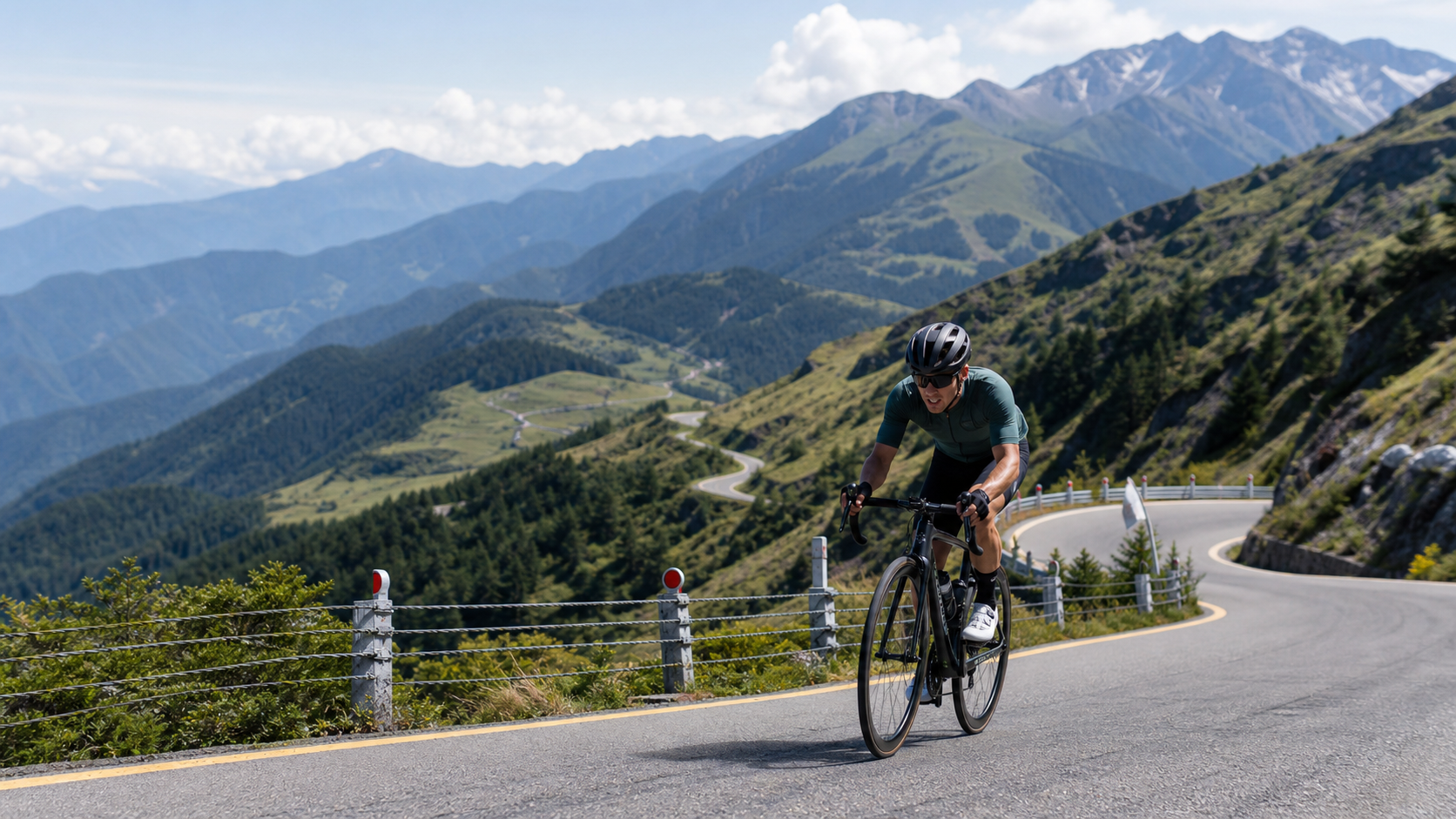
In the climbing bible of Taiwanese cyclists, Wuling is always the thickest chapter. And the “West Route to Wuling” is the most classic and most popular first path to the highest point on Taiwan’s roads.
Let’s put the real numbers on the table: the West Route to Wuling is approximately 53.02 km long, with a total elevation gain of 2,889.6 meters and an average gradient of 7.2%. On Strava, it is rated as the highest Category 5 (HC / Hors Catégorie). The start is in Puli, Nantou, and the finish is Wuling at 3,275 meters above sea level—the rooftop of Taiwan reachable by road. This is not just a road; it is an expedition that demands an engineering approach to break down.
This article takes a data-driven perspective, dividing these 53 kilometers into executable segment strategies to turn “finishing the ride” from luck into a plan.
Route Overview: A 53 km Battle Against Altitude
| Item | Data |
|---|---|
| Total Distance | 53,020 meters (approx. 53.02 km) |
| Total Elevation Gain | 2,889.6 meters |
| Average Gradient | 7.2% |
| Strava Rating | Category 5 (HC) |
| Start | Puli, Nantou (near the Geographic Center Monument, approx. 450m elevation) |
| Finish | Wuling (3,275m elevation) |
| Main Route | Provincial Highway 14 → Renzhiguan → Provincial Highway 14A → Wushe → Cingjing → Cuifeng → Yuanfeng → Kunyang → Wuling |
The reason the West Route to Wuling is listed as the “first-choice for first-time challengers” is that compared to other directions (such as the East Route or North Route), it is shorter, has less total elevation gain, and offers more supply points along the way. But don’t be mistaken—“relatively easier” does not mean “easy.” Nearly 2,900 meters of climbing and the final push above 3,000 meters of altitude are physical realities that no one can power through on willpower alone.
Segment Strategy 1: Puli to Wushe (0 – 24 km) — Don’t Be Fooled by the Gentle Slope
The early section departs from Puli, passing through Renzhiguan and entering Provincial Highway 14A. The first 16 km average only about 2% gradient, so gentle it almost feels flat. This is the most dangerous psychological trap on the entire route.
- Core tactic: The mission for these 16 km is just one word—restraint. Keep power at 65%–70% of FTP and heart rate at the lower edge of the aerobic zone.
- Common mistake: Because the slope is gentle and the body feels strong, many riders cruise at high speed in the big ring or even get into pace-line battles. As a result, they burn through the glycogen they truly need after Cingjing—this is the number one cause of DNF on the West Route to Wuling.
- Pacing analogy: Treat the first 24 km as “warm-up plus savings.” Every bit of energy you save here will be paid back to you with interest after Kunyang.
From Renzhiguan to Wushe, the gradient gradually increases—this is the transition zone where the body switches from flat-road mode to climbing mode.
Segment Strategy 2: Wushe to Cingjing (24 – 36 km) — The First Real Wall
From Wushe to Cingjing Farm is about 12 km, with nearly 800 meters of elevation gain. The average gradient steepens sharply, and the road profile is full of sudden short steep pitches. This is the first “real climb” of the entire route.
- Gear ratio advice: From here on, have your survival gear ratio of 34×32 or 34×34 ready. When you hit 10%+ steep sections, shift down decisively and use cadence (70–80 rpm) to maintain rhythm.
- Pacing strategy: Keep power at 75%–80% of FTP. Better to go slow than to push your heart rate into the red zone here. Cingjing has many guesthouses and shops—it’s an important supply point and psychological anchor.
- Key reminder: Cingjing is already at nearly 1,700–2,000m elevation, and some people begin to feel mild altitude effects. This is the first signal your body gives you—make a conscious effort to breathe deeply from here on.
Segment Strategy 3: Cingjing to Cuifeng and Yuanfeng (36 – 45 km) — The High-Altitude Threshold
Past Cingjing is where the real challenge of the West Route to Wuling begins. As the gradient persists and altitude breaks through 2,000 meters, altitude effects become increasingly noticeable: you give it everything you have, yet you feel like you can’t get enough air and your output won’t go up. This is a physiological phenomenon, not a lack of effort on your part.
- Pacing principle: Lower your expectations for “power.” Above 2,500 meters, your usable VO₂ max drops significantly. Maintaining a steady, sustainable rhythm matters far more than chasing numbers.
- Breathing rhythm: Use deep, slow diaphragmatic breathing, synced with your pedaling cadence (for example, inhale for two pedal strokes, exhale for two).
- Mindset management: Between Cuifeng and Yuanfeng, there will be the psychological letdown of “false summits”—you see a corner and think it’s the top, only to find more climbing after the turn. Focus on the next 500 meters, not on how far you still have to go.
Segment Strategy 4: Kunyang to Wuling (45 – 53 km) — The Final Rooftop
Kunyang (approx. 3,070m elevation) to Wuling is the final push and the section with the thinnest air. The short steep pitch just before Wuling is, in many riders’ memories, the longest few hundred meters of their lives.
- Pacing: Save a little reserve for this section throughout the ride. If you’ve paced correctly up front, you can simply grind up in your lowest gear with a steady cadence.
- Standing climbs: Standing at high altitude consumes a huge amount of oxygen. Unless absolutely necessary, stay seated.
- Finishing: When you see the Wuling archway, that’s not just the finish line—it’s the highest point on Taiwan’s roads. Hold your breathing steady and ride smoothly through the final corner.
Gear Ratio and Equipment Recommendations
| Rider Level | Recommended Chainring | Recommended Cassette | Notes |
|---|---|---|---|
| First-time challenger | 50/34T compact crank | 11-34T (or lighter) | A survival gear ratio is the key to finishing—don’t be stubborn |
| Advanced | 50/34T | 11-32T | For those with a training foundation |
| Competitive | 52/36T | 11-30T | For those with high-altitude experience and strong power |
Other essentials:
- Warmth: The temperature difference between the summit and Puli can exceed 15–20°C. A windbreaker, full-finger gloves, and leg warmers are life-saving gear, not optional extras. Hypothermia on the descent is a common high-mountain accident.
- Tires: 25c–28c, with slightly lower pressure for better grip.
- Lighting and reflectors: If you might start before dawn or in poor weather, lights are a must.
Nutrition and Hydration Strategy
The West Route to Wuling has relatively friendly supply points, but planning is still required:
- Puli: Eat a full meal before departure and carry enough energy gels and electrolytes.
- Wushe / Cingjing: The last dense supply area—be sure to refill water, stock up on food, and use the restroom here. Supplies are scarce after Cingjing.
- Kunyang: The last chance to catch your breath before nearing the summit.
- Principle: Replenish carbohydrates every 45–60 minutes. Appetite decreases at high altitude, so force yourself to eat small amounts frequently.
Weather and Seasons
- Best season: Late spring to early autumn (April–October), when the climate is relatively stable.
- Afternoon thunderstorms: Mountain weather often changes in the afternoon, so start early in the morning and aim to reach the summit before noon.
- Winter: Icy roads and closures are possible; not recommended for those without experience. Always check real-time road conditions and weather forecasts before departure.
- High-altitude cold: Even in summer, temperatures at the Wuling summit can be in the single digits.
Common Mistakes and DNF Risks
- Going too fast on the early gentle slopes: The biggest killer on the West Route to Wuling. Saving energy in the first 16 km is a prerequisite for finishing.
- Gear ratio not light enough: Going up the mountain with a gear ratio that’s too big leads to a double collapse of knees and glycogen.
- Ignoring altitude sickness: Forcing power above 2,500m will blow you up directly.
- Insufficient warmth: Hypothermia on the descent is the real reason riders get taken down by ambulance.
- Erratic fueling: Poor appetite at high altitude without forcing yourself to eat leaves you with no fuel for the later stages.
Target Times for Riders of Different Levels
| Rider Level | Reference Finish Time |
|---|---|
| Competitive Racer | 3 – 3.5 hours |
| Advanced Rider | 4 – 5 hours |
| General Rider | 5 – 6.5 hours |
| First-Time Challenger (Goal: Just Finish) | 6.5 – 7+ hours |
“Ride slow, and you can conquer Wuling in seven hours too” — this saying, passed among riders, captures the true essence of the West Approach to Wuling: it doesn’t reward recklessness, only discipline. Break the 53 kilometers into four segments — hold back in the first, stay steady in the middle, accept your limits at high altitude, and grit your teeth at the end. When you stand beneath the Wuling archway at 3,275 meters, you’ll understand that every pacing decision in this long march was worth it.
Note: The 2025 96 Cycling League Wuling stage was shortened to end at Cuifeng due to weather conditions, so it doesn’t serve as a valid reference for completing the full classic West Approach. The data and strategies in this article are based on the standard full West Approach to Wuling route.
High-Altitude Physiology: Why Wuling Can’t Be Conquered by Leg Power Alone
The most fundamental difference between the West Approach to Wuling and other climbs is altitude. When you ride past 2,500 meters and approach 3,000 meters, you’re no longer facing just gradient — you’re facing thin air. Understanding the physiology behind this is the key to completing Wuling.
The higher the altitude, the lower the partial pressure of oxygen in the air. At the summit of Wuling (3,275m), atmospheric pressure is only about 68% of sea level, meaning every breath you take delivers about one-third less oxygen than at lower elevations. Oxygen is the fuel muscles use to produce energy. With less oxygen, your maximal oxygen uptake (VO2max) drops significantly — research shows that for every 1,000 meters of elevation gain, VO2max decreases by roughly 6%–10%. By the time you reach the summit of Wuling, your aerobic capacity may be only 70–80% of what it is at sea level. This brings a harsh reality: on the high-altitude sections of Wuling, even if you give it everything you have, the power you can output is far below what you could produce at lower elevations. This isn’t a lack of effort — your body is bound by the laws of physics. Therefore, the right mindset is to let go of your obsession with power numbers and instead aim to “maintain a sustainable, controlled rhythm.” Many people fall apart after Kunyang precisely because they don’t understand this — they insist on maintaining their sea-level output, and the result is a heart rate pegged to the max, breathing out of control, and lactate levels through the roof.
Recognizing and Responding to Altitude Sickness
Beyond reduced power output, high altitude can also trigger altitude sickness (acute mountain sickness). Mild symptoms include headache, nausea, dizziness, loss of appetite, and unusual fatigue. These symptoms are more likely to appear when climbing too quickly, when dehydrated, or when pushing too hard.
Response strategies:
- Slow down: Don’t push hard on high-altitude sections. Give your body time to adapt.
- Deep breathing: Use diaphragmatic deep breathing to actively increase ventilation.
- Hydrate: High altitude is dry, and you lose water quickly through respiration. Dehydration worsens altitude sickness, so keep hydrating continuously.
- Watch for severe symptoms: If you experience severe headache, confusion, unsteady gait, or serious breathing difficulty, these could be precursors to high-altitude cerebral edema or pulmonary edema. You must immediately stop ascending, descend as quickly as possible, and seek medical attention. This is a life-threatening warning sign — never push through it.
Training Plan for Completing the West Approach to Wuling
The West Approach to Wuling isn’t something you can complete on impulse — it requires systematic preparation. Here’s a reference training framework for amateur riders (8–12 weeks before the challenge):
Phase 1: Aerobic Base (4 weeks) — 2–3 long-distance aerobic rides per week (Zone 2), gradually extending each ride to 3–4 hours. Goal: build your aerobic engine and the endurance foundation for long hours in the saddle.
Phase 2: Climbing Specialization (3–4 weeks) — Schedule 1–2 climbing sessions per week. Find a continuous climb of 30 minutes or more and practice sustained output. Add sweet-spot and threshold intervals to raise your FTP.
Phase 3: Simulation and Acclimatization (2–3 weeks) — Do 3–4 hour long rides with substantial elevation gain to simulate Wuling’s physical demands. If possible, ride at mid-to-high altitude beforehand to let your body acclimatize in advance.
Phase 4: Taper (1 week before the event) — Reduce training volume while maintaining intensity, allowing your body to fully recover and arrive at the mountain in peak condition.
Gear Details: Staying Warm Is Life-Saving, Not Optional
The West Approach to Wuling spans from Puli (around 25–30°C) to the summit (possibly only 5–10°C, or even lower) — an enormous temperature difference. And the descent after summiting is when the risk of hypothermia is highest — you’ve just climbed at full effort, drenched in sweat, and the moment you transition to a high-speed descent, cold wind blasts through your soaked jersey and your core temperature plummets rapidly.
Early symptoms of hypothermia include shivering, slowed reactions, and stiff fingers (which affects braking). In severe cases, confusion can set in. In a high-altitude, high-speed descent scenario, this is extremely dangerous. Therefore:
- Windbreaker is essential: Put on a windproof jacket before summiting. Even if you feel hot while climbing, stop and put it on before descending.
- Full-finger gloves: Keep your fingers nimble for braking while staying warm.
- Leg warmers / knee warmers: Protect your knee joints and avoid injury from riding in cold conditions.
- Spare dry clothing: If conditions allow, change into a dry base layer before descending after summiting.
Remember: On Wuling, cold-weather gear isn’t for comfort — it’s for getting home alive. This isn’t an exaggeration; every year, riders are taken down the mountain by ambulance due to hypothermia. That’s a real lesson.
Debunking Common Myths
Myth 1: “The West Approach is the easiest — anyone can ride up it casually.” The West Approach is more forgiving than other directions, but “relatively” doesn’t mean “easy.” Nearly 2,900 meters of elevation gain and the high-altitude challenge still demand thorough preparation. Underestimating it is how DNFs begin.
Myth 2: “I can push hard on the early gentle sections to bank time.” Quite the opposite. Pushing too hard early on will burn through the glycogen you need after Cingjing — this is the most classic failure mode on the West Approach to Wuling. Going slow in the early sections is what allows you to go fast later.
Myth 3: “A heavier gear ratio is more impressive.” On Wuling, whether your gearing is light enough directly determines whether you make it up. Forcing a gear that’s too heavy will wreck both your knees and your glycogen stores. A bailout gear isn’t embarrassing — a DNF is.
Myth 4: “Only people with poor fitness get altitude sickness.” Altitude sickness has no absolute correlation with fitness level — even the strongest riders can be affected. It depends on individual physiology, rate of ascent, hydration status, and more. Always respect high altitude; don’t assume you’re the exception.
Segment-by-Segment Elevation and Mental Anchors
| Landmark | Approx. Elevation | Distance from Start | Mental Cue |
|---|---|---|---|
| Puli (Start) | 450m | 0km | Hold back, don’t sprint |
| Renzhiguan | 800m | ~14km | Enter climbing mode |
| Wushe | 1,150m | ~22km | Resupply and prepare |
| Cingjing | 1,750m | ~36km | Last major resupply, take deep breaths |
| Cuifeng | 2,300m | ~42km | High altitude begins |
| Yuanfeng | 2,750m | ~46km | Let go of power obsession |
| Kunyang | 3,070m | ~50km | Final breather |
| Wuling | 3,275m | 53km | The rooftop — steady your breathing and finish |
Print this table in your mind, and you’ll have clear mental anchors on the mountain. When you know that “after Cingjing there are still 17 kilometers and 1,500 meters of climbing,” you can rationally allocate your remaining energy instead of letting the endless road break your will.
Conclusion: Discipline Is the Only Shortcut to Wuling
There are no shortcuts on the West Approach to Wuling — and if there had to be one, it would be discipline. The discipline to hold back and not sprint in the early sections, the discipline to maintain a steady pace in the middle, the discipline to let go of power obsession at high altitude, the discipline to keep fueling and hydrating throughout, the discipline to put on warm clothing before summiting. When you execute each of these disciplines one by one, the 53 kilometers and 2,889 meters of climbing transform from a gamble on luck into a plan that can be executed and completed. And when you finally stand beneath the Wuling archway at 3,275 meters, looking back at the sea of clouds churning below, you’ll understand: what this long march truly forges isn’t just your legs — it’s the composure, discipline, and wisdom you summon when facing difficulty. That is the most precious reward the West Approach to Wuling gives to every rider who completes it.
Stage-by-Stage Aid Station Checklist and Practical Advice
Aid station planning for the West Approach to Wuling directly determines whether you finish successfully. Here is a practical checklist:
- Before departing from Puli: Eat a carbohydrate-focused meal (such as rice balls, noodles, or toast), and carry enough energy gels, energy bars, and water for the entire ride. Puli’s city center has convenience stores and breakfast shops, making it the most complete resupply point.
- Wushe: There are shops and restaurants here, making it a key aid station for the early section. Be sure to check your water supply, top up on carbohydrates, and use the restroom here.
- Cingjing: The Cingjing Farm area has a dense concentration of homestays and shops, and is the last dense resupply zone before supplies become scarce after Cingjing. It is strongly recommended to fully resupply here—fill your water bottles and eat enough food. After Cingjing, aid stations drop off dramatically.
- Kunyang: The last breather point before the summit. If you are carrying supplies, this is where you can make your final energy replenishment.
One key reminder: high altitude suppresses appetite, and many people cannot eat once they pass 2,500 meters. But at this point, your body desperately needs fuel. The solution is to “force yourself to eat small amounts frequently”—tear energy gels into small portions and sip them, or choose easily consumable foods. Do not skip eating entirely just because you have no appetite, or you will completely run out of energy on the final stretch.
Safety Rules for the Descent
Reaching the summit is only half the accomplishment; a safe descent is what completes the West Approach to Wuling. The descent from Wuling back to Puli is a long downhill of nearly 53 kilometers with a drop of nearly 2,900 meters, and the risks should not be underestimated:
- Dress warmly: Before descending, be sure to stop and put on a windbreaker and full-finger gloves. The wind chill effect at high-speed descent is extremely strong, and a soaked body can lose heat rapidly.
- Control your speed: Mountain descents have many curves and limited visibility—do not get greedy for speed. Use intermittent braking to control your speed and slow down well before entering corners.
- Protect your brakes: Continuous dragging on a long descent will overheat rims or rotors, and rim brakes in particular risk blowouts. Use “intermittent pulsing” to let the braking system cool down.
- Watch road conditions: Be alert for falling rocks, gravel, wet surfaces, and oncoming traffic. Mountain roads are narrow—never cross the center line on corners.
- Keep your fingers warm: Cold temperatures will stiffen your fingers and affect braking control. This is an overlooked but extremely dangerous detail, and full-finger gloves are essential.
West, East, and North Approaches: Comparing the Three Routes to Wuling
There are multiple directions to summit Wuling. Understanding their differences helps you choose the right route:
| Direction | Starting Point | Characteristics | Suitable For |
|---|---|---|---|
| West Approach | Puli | Shorter distance, less climbing, more aid stations | First choice for first-time challengers |
| East Approach | Dayuling / Hualien direction | Long distance, massive climbing, considered the hardest | Experienced challengers |
| North Approach | Hehuan Mountain direction | Each has its own difficulty | Advanced riders |
The West Approach is the “first-choice for beginners” precisely because it is relatively friendly in all three aspects: distance, climbing, and aid stations. But as mentioned earlier, “relatively friendly” does not mean “easy”—nearly 2,900 meters of climbing and the challenge of high altitude are a serious test for anyone. Riding the West Approach well and thoroughly is the best foundation for tackling the other directions in the future.
The Mental Battle: How to Get Through the “False Summits”
On the latter section of the West Approach to Wuling, what torments you most is not your body but your mind. Between Cuifeng and Yuanfeng, “false summits” keep appearing—you see a curve ahead, think you have reached the top, and only after rounding it do you realize there is more climbing. This repeated psychological letdown is the invisible killer that breaks your will.
The way to fight false summits is to “shrink your goals.” Do not think about “how much farther to Wuling”—that is too distant and too discouraging. Instead, focus on “the next 500 meters,” “the next curve,” “one hundred more pedal strokes.” Break the enormous challenge into small, achievable goals, and your will will not be crushed by the endless slopes.
Another technique is “self-talk.” In the most painful moments, give yourself positive affirmations: “I have prepared thoroughly,” “I can do this,” “This pain is temporary.” Psychological research shows that positive self-talk significantly improves endurance performance. The West Approach to Wuling ultimately tests your mind—when your legs want to give up, it is your mind that carries you, pedal stroke by pedal stroke, upward.
Conclusion: After You Finish, You Will Be Different
The West Approach to Wuling is a forging of body and mind. When you ride those 53 kilometers and stand on the rooftop at 3,275 meters, what you take away is not just a summit photo, but a new understanding of yourself.
You will learn that your limits are farther than you imagined; that with discipline and patience, even the hardest slopes can be climbed step by step. This realization will extend to every corner of your life—when facing difficulties at work or low points in life, you will remember the version of yourself still pedaling upward in the thin air of Kunyang, and tell yourself: “I rode up Wuling—what is this small difficulty compared to that?” This is the true value of the West Approach to Wuling. It is not just a road; it is a transformation that allows you to grow into a new person.
Preparation Checklist for the Night Before the Summit
Half of the success of the West Approach to Wuling is decided the night before departure. Here is a practical checklist to minimize variables.
Equipment: inspect your bike (brakes, shifting, tire pressure, chain lubrication), confirm your gearing is light enough, pack a windbreaker and full-finger gloves, prepare enough energy gels and electrolytes, and fully charge your cycling computer and lights. Diet: make dinner carbohydrate-focused, avoid greasy food and overeating, hydrate well but do not drink too much before bed to avoid nighttime bathroom trips disrupting sleep. Routine: go to bed early, set your alarm, and plan your departure time (be sure to allow yourself to summit before noon to avoid afternoon weather changes).
Mental preparation: run through the elevation profile and mental anchor points of each stage in your mind, set a reasonable target time (for your first attempt, aim for completion rather than chasing speed), and remind yourself that “you must hold back in the early stages.” When you have completed all this preparation, you can set off at dawn the next day with composure rather than anxiety. The West Approach to Wuling rewards those who prepare—every bit of preparation you do before departure becomes the confidence to finish once you are on the mountain.
Related Reading
- The Art of Pacing in Climbing Races: Perfect Strategy for the Wuling Cup and East Approach Wuling
- Full 52.2km Segment Pacing Strategy for Wuling: A Rhythm Map from Puli to the Rooftop
- 2026 Wuling Climb Race Complete Guide: Route Analysis, Pacing Strategy, and Record Breakdown
- Wuling Climb Guide: Challenge Strategy and Aid Planning for Taiwan’s Highest Highway
#公路車 #西進武嶺 配速配瓦實驗 坡度分析 四小時內攻略 建大盃 NeverStop #西進武嶺攻略
6 年前
西進武嶺各路段 前8000名 大數據分析 配速攻略/功率/心律/推力比/維持率/踏頻/踏瓦比/牽車率 大公開 | 建大盃 NeverStop 可參考 | 公路車 | CT Yeh
5 年前
#北橫 + #北進武嶺 最硬的員工旅遊 EP1 | #公路車 #拉拉山 | 明池 | 武嶺 | 武陵農場 | 雲海 | Taiwan Cycling Route Wulin
6 年前
風櫃嘴時間 預測西進武嶺時間?13000名車友統計數據分析告訴你 !
5 年前
西進武嶺 世界紀錄挑戰!破2:30 ?!一群人推著一個夢上山 直播精華版 / ft. 張翰允 & 台視主播魏于恬 & KPLUS / #cycling 公路車 CT Yeh
2 個月前
大禹嶺 到 武嶺牌樓 全程前後實況錄影 | 北進武嶺 | 東進武嶺 | KOM | 訓練台 | 坡度分析 | Taiwan KOM Last 10 km HARD | 公路車
6 年前
西進武嶺 8000名單車友數據分析 PART1 | 從新手到高手數量/瓦數/推力比/FTP推力比/功率計使用率 大解析 | 公路車 | CTYeh
5 年前
Never Stop 西進武嶺 前後雙機 完整全程錄影 訓練台 實境
8 年前